Baku’s Olympic Stadium is hosting the Europa League final between Arsenal and Chelsea Wednesday 29 May 2019 and is also the venue for four games in next year’s European Championship. I will certinaly watch the match but will keep in mind Amnesty International’s warning that we should not let Azerbaijan hide human rights abuses behind football. Sports washing is a phenomenon that deserves more attention, see e.g.:
The decision to stage the Europa League final in Baku has drawn criticism from fans and human rights groups. Photograph: Robert Prezioso/Getty Images
Paul MacInnes writes in the Guardian of 22 May 2019 reporting that Amnesty International has increased the pressure on European football’s governing body, UEFA, by saying Azerbaijan must not be allowed to “sportswash its appalling human rights record” by staging high-profile football matches…
“We must ensure that Azerbaijan isn’t allowed to sportswash its appalling human rights record as a result of the football fanfare,” Amnesty International’s UK director, Kate Allen, said. “Azerbaijan is in the grip of a sinister human rights crackdown, with journalists, bloggers and human rights defenders being ruthlessly targeted. Unfair trials and smear campaigns remain commonplace.
“LGBTI people have been arrested, and even people fleeing the country have been harassed and pressured to return. Fans, players and backroom staff can help prevent Azerbaijan’s likely attempt to sportswash its image by informing themselves about the human rights situation behind the glitzy facade of Wednesday’s match….All too often, governments are using high-profile sporting competitions to distract attention from repressive policies and human rights violations, to instead project an image of openness. This couldn’t be further from the truth with the current administration, and the Arsenal-Chelsea clash is just the latest reminder of this.”
The ink on an EU report (March 15) concluding that human rights in Azerbaijan remain in need of improvement, is hardly dry and there is a surprise announcement that Azerbaijan’s strongman-resident has ordered the release of more than 400 people, including opposition politicians and pro-democracy youth activists who were listed as political prisoners by international human rights groups. True, the EU report comes ahead of the upcoming EU-Azerbaijan Cooperation Council, scheduled to take place on 4 April in Brussels, but there must be other reasons.
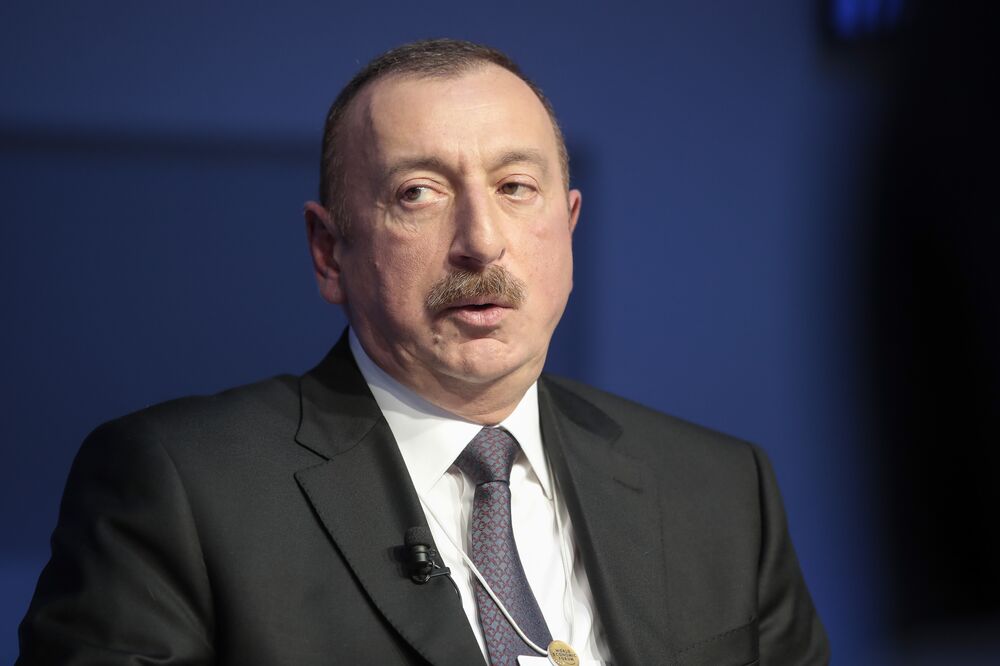
Ilham AliyevPhotographer: Jason Alden/Bloomberg
Fuad Qahramanli and Gozal Bayramli, deputy leaders of the opposition Popular Front of Azerbaijan Party, are among the pardoned, according to a statement on the presidential website. Pro-opposition youth activists Ilkin Rustamzada, Qiyas Ibrahimov and Bayram Mammadov will also be released. The pardoned are to be freed within 24 hours. At least 43 human rights defenders, journalists, political and religious activists remained wrongfully imprisoned in Azerbaijan last year, according to Human Rights Watch. Whether all of these are freed is not yet clear.
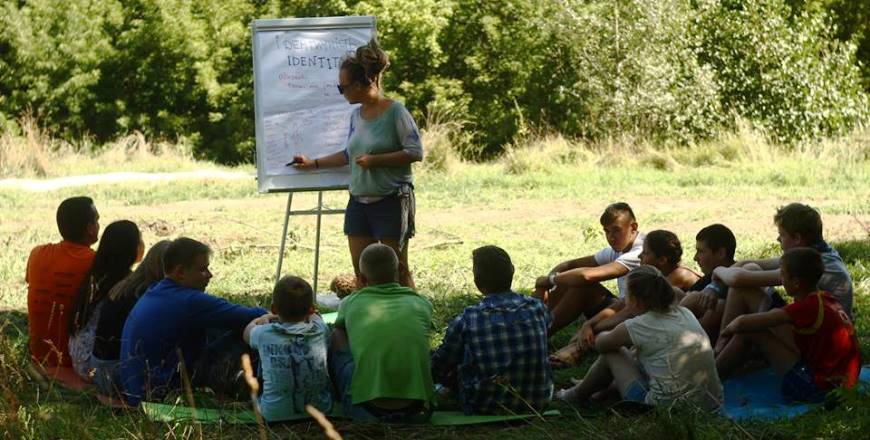
For those who think that human rights education work is done only in developing countries, here some information from the Council of Europe. The 2019 call for COMPASS National and Regional Training Courses in Human Rights Education for young people generated 45 projects proposals submitted by youth NGOs from 24 Council of Europe member states. The 2019 programme of Compass courses includes activities in Azerbaijan, Greece, Ireland, Italy, Lithuania, the Republic of Moldova and Serbia (see list below). Proposals from Norway, Slovenia and Portugal are on a reserve list pending further availability of funds.
Om 29 June 2018 Front Line Defenders reported on the case of disbarment of human rights lawyer Irada Javadova in Azerbaijan. It shows how seemingly ‘neutral’ procedures within the Bar Association are used to silence human rights defenders.
Irada Javadova <https://www.frontlinedefenders.org/en/profile/irada-javadova>is a human rights lawyer who was involved in many resonant cases, including working on numerous violations of citizens’ property rights and violations against political activists and human rights defenders. She is the former head of NGO “Human Rights Education”. The procedure was initiated upon the complaint of an anonymous citizen, who stated that Irada Javadova wrote a letter to the Interior Ministry about her illegal detention in the Directorate for Combating Organized Crime and reported the incident to the press, without the citizen’s consent. According to reports, the citizen stated that Irada Javadova spread false information, defamed her, and requested that the Bar Association take action against the human rights defender. On 11 June 2018, the Presidium of the Bar Association announced the termination of her authority.
Irada Javadova denied the allegations, stating that she had an agreement with her client and that she had legitimately defended her and acted within the law. She had submitted the agreement with the complainant to the Bar Association, but her colleagues expressed doubts about the authenticity of the client’s signature. She was disbarred on 11 June 2018. On 12 June, she met with the chairman of the Presidium of the Bar Association and presented additional evidence, but she was told that there will be an appeal to Baku Administrative Economic Court No. 1, where she will have the opportunity to defend her rights. Irada Javadova believes that the disciplinary commission was biased and erroneous. On 14 June 2018, human rights lawyer Irada Javadova appealed the Presidium of the Bar Association’s decision to disbar her.
PS In 2018, Irada Javadova was the only member of Presidium of the Bar Association to vote against the disbarment of human rights lawyer Yalchin Imanov. It is believed that she lost her place in the Presidium following her defence of Yalchin Imanov.
Federica Mogherini and Elmar Mammadyarov in Brussels on 9 February 2018. [Council]
On 9 February the European Union and Azerbaijan held their 15th annual Cooperation Council after a three year gap. {The previous Cooperation Council took place in November 2013, but relations between Baku and Brussels hit a low in 2015, following European Parliament resolutions that were highly critical of the human rights situation and the prosecution of human rights defenders in Azerbaijan. In November 2016 the EU Foreign Ministers 2016 adopted a mandate to negotiate a new agreement with Baku, which would replace the 1996 partnership and cooperation agreement.}
Human Rights Watch and other NGOs demanded that the “Top EU Diplomat Should Deliver Tough Message to Azerbaijan” and place human tights at the top of the agenda with Azerbaijan Foreign Minister:
And yet the EU acts like it’s business as usual. This week the European Investment Bank (EIB) approved a €1.5 billion loan for the construction of the Trans Adriatic Pipeline (TAP), of which Azerbaijan’s state-owned company SOCAR is a 20 percent partner. TAP is part of the Southern Gas Corridor, which would bring Caspian Sea natural gas to Europe. That decision could pave the way for EIB support to another section of the Southern Gas Corridor that would connect TAP through to Azerbaijan’s shores. The EIB didn’t seem to mind that Azerbaijan’s anti-corruption activists and those monitoring Azerbaijan’s extractive industries have been among those persecuted.
The EIB is the EU’s bank, so the EIB’s decision should have been made in compliance with the EU’s stated foreign policy principles on promoting democracy and human rights. In reality the EU’s concerns about Azerbaijan’s crackdown have no consequences when gas is up for discussion.
Mogherini also has yet to show Azerbaijan that its relentless crackdown against critics and dismissal of the European Court’s ruling on Mammadov could lead to serious political consequences. Brussels continues to negotiate a new political and economic partnership with Baku, without first insisting that Baku take at least some steps to stop the crackdown, for example by freeing Mammadov. The partnership might indeed lead to more engagement and dialogue, but that doesn’t give much hope for activists unjustly behind bars or forced into exile.
Azerbaijan just announced a snap presidential election in April, a surprise move likely to lead to a further clampdown on critics. It’s urgent that Mogherini tell Mammadyarov that Azerbaijan’s failure to release those unjustly imprisoned and end restrictions on civil society jeopardizes any new partnership deal, as well as the EU’s support for a pipeline that is already tainted by repression.
After the meeting Radio Free Europe reported that the European Union is urging Azerbaijan to implement reforms in the fields of elections, freedom of assembly, and the media ahead of the country’s presidential election in April. EU foreign-policy chief Federica Mogherini said that “the European Union has always stressed, as we did it again, that the full implementation of international obligations and commitments by Azerbaijan is vital to us.” Sources in Brussels told RFE/RL that EU officials raised a number of individual human rights cases, including that of opposition politician Ilqar Mammadov, who has been in prison in Azerbaijan since 2014.
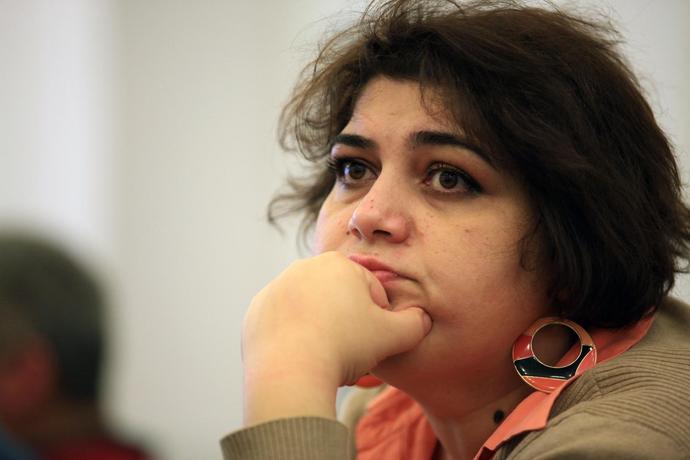
The Right Livelihood Foundation stated on Friday 24 November that its 2017 prize winner from Azerbaijan, Khadija Ismayilova, would not be able to attend the 1 December award ceremony in Stockholm because of a travel ban linked to a suspended sentence she is serving. Khadija Ismayilova says that she is under the travel ban “because I criticize the government when it steals the people’s money.” Lawyers Colin Gonsalves from India and Yetnebersh Nigussie of Ethiopia share the cash award of 3 million kronor ($374,000) with Ismayilova. [https://humanrightsdefenders.blog/2017/10/04/2017-right-livelihood-laureates-announcement-in-video/]
Ismayilova, Azerbaijan’s top investigative journalist, was convicted of tax evasion in 2015 in what was largely viewed as a payback for her work. She was released from prison six months later after a higher court commuted her 7 ½-year sentence and converted it into a suspended one. She is not legally allowed to travel outside the country while she is still serving the sentence. Ismayilova petitioned the court several times after her release to be allowed to travel outside the country but all of her requests have been denied.
This year’s Right Livelihood Awards recipients have fought for greater inclusion for those with disabilities, defended human and health rights, as well as sought to expose governmental corruption.
The Right Livelihood Award Foundation announced the three recipients of its 2017 prize on Tuesday 26 September in Stockholm: Ethiopian lawyer Yetnebersh Nigussie, Azerbaijani investigative reporter Khadija Ismayilova and Indian attorney Colin Gonsalves were honored for their work “offering visionary and exemplary solutions to the root causes of global problems.” US attorney Robert Bilott received an honorary mention.
The four awardees were selected from a pool of 102 nominations from 51 different countries. An award ceremony will take place on December 1.
Niguissie, Ismayilova and Gonsalves will share a prize of 3 million Swedish kronor (around €314,000).
Michel Forst (right), the UN special rapporteur on the situation of human rights defenders (right), addressing reporters in Baku on 22 September 2016.
Michel Forst, the UN’s special rapporteur on the situation of human rights defenders, said on 22 September 2016 that Azerbaijani authorities have applied crippling pressure to journalists and rights activists critical of the government, and made it virtually impossible for nongovernmental organizations to operate. “Civil society has been paralyzed as a result of such intense pressure,” Forst saidas he wrapped up a nine-day visit to the South Caucasus nation to assess the situation. Observing that most of the recommendations by the international and regional human rights mechanisms have yet to be implemented by the Government of Azerbaijan, Mr Forst strongly called for establishing a mechanism that would result in a plan of action to implement those outstanding recommendations. He urged the Government to “to build bridges with civil society organizations, and to establish a regular and meaningful dialogue with human rights defenders, ensuring broad and inclusive participation. I believe such dialogue and partnership is ultimately in the interest of the Azerbaijani State”. [for the full end of mission statement see: http://www.ohchr.org/EN/NewsEvents/Pages/DisplayNews.aspx?NewsID=20544&LangID=E
“Human rights defenders have been accused by public officials to be a fifth column of the Western governments, or foreign agents, which has led to misperception in the population of the truly valuable role played by civil society,” Forst added.
He was served immediately by Azerbaijani MP and editor-in-chief of the New Azerbaijan newspaper, Hikmat Babaoghlu, who told APA that “the Western imperialism has launched an attack on Azerbaijan with its entire network, which includes radical opposition groups, numerous local and international “civil society instructions” and “human rights defenders”. All these are taking place before the eyes of the Azerbaijani people, who are well aware of what is happening. Therefore, the destructive plan of imperialist centers will never succeed in Azerbaijan” The main goal of the upcoming referendum is to better ensure the national security and the transition of development to a qualitatively new stage, he added. (Even more scathing is a piece written by Elmira Tariverdiyeva, the head of Trend Agency’s Russian news service – see link below.)
Forst’s report indeed comes just days ahead of a referendum (26 September) on changes to Azerbaijan’s constitution that critics say will tighten Aliyev’s grip on power, which he has held since 2003. The proposed amendments to the Constitution would further strengthen the already powerful president, including a longer presidential term, the authority to declare early presidential elections at will and dissolve parliament. The amendments will also lead to violations of the right to freedom of association. While in practice, public assemblies have already been prohibited in central Baku, the proposed amendments will grant the government even more power to interfere with the freedom of assembly in violation of international standards. The Council of Europe experts said on September 20 that the proposed changes would severely upset the balance of power and give “unprecedented” control to the president. (The head of the legal department in Aliyev’s administration called that assessment “hasty” and “politically driven.”)
On Wednesday 25 May 2016 Azerbaijan finally released investigative journalist Khadijah Ismayilova[https://thoolen.wordpress.com/2015/12/18/azerbaijan-khadija-ismayilova-remains-in-jail-but-council-of-europe-takes-exceptional-step/] after a number of other human rights defenders were released bit by bit over the last months. Ismayilova was serving a seven-and-a-half year sentence on charges which included embezzlement, illegal business activities and tax evasion. The Supreme Court has now amended her imprisonment to 3 1/2 years of suspended sentence and released her from prison. She vowed to continue to fight to clear her name. “I will continue to fight until complete acquittal,” Ismayilova told reporters after her release. “I will also continue to work as a journalist.” The British-Lebanese lawyer Amal Clooney is representing Khadija Ismayilova at the European Court of Human Rights.
As an independent reporter and journalist of the Azerbaijani radio Azadliq (“Radio Freedom”) she has shown great courage (see: https://thoolen.wordpress.com/2014/12/11/khadija-ismayilova-azerbaijan-is-not-deterred/), and received several international prizes, such as the 2015 Alison Des Forges Award for Extraordinary Activism (HRW), the 2015 Freedom to Write Award, the 2012 Fritt Ord/Zeit Press Prize, and the 2012 Courage of Journalism Award by the Washington-based International Women’s Media Foundation.
Although there are still human rights defenders and journalists in prison, Azerbaijan provides a fine example of how awards and the combined international pressure from a variety of sources (States, NGOs and international organizations) can have an impact: