Archive for the 'UN' Category

New High Commissioner for Human Rights, Zeid Ra’ad Al Hussein, opens Human Rights Council

September 8, 2014

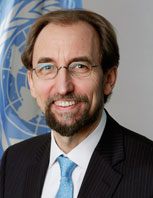
UN HCHR Al HusseinOn 8 September 2014 the new UN High Commissioner for Human Rights, Zeid Ra’ad Al Hussein, addressed for the first time the Human Rights Council, and many will have been listening for clues about where he stands on key issues, how ‘activist’ he is likely to be etc. As the speech was rather long and covered a huge variety of issues, it is not easy to draw any conclusions yet. The fist half addressed issues of war and violence and in particular the humanitarian crises of today.

The role of the individual is beautifully worded: “courage is the first human virtue, revered the world over, the very virtue we value the most as human beings. The courageous individual is not he or she who wields great political power or points a gun at those who do not – that is not courage.  The courageous individual is he or she who has nothing to wield but common sense, reason and the law, and is prepared to forfeit future, family, friends and even life in defence of others, or to end injustice.  In its most magnificent form, the courageous individual undertakes this exertion, without ever threatening or taking the life of someone else, and certainly not someone defenceless.”..”the Takfiris [IS] who recently murdered James Foley and hundreds of other defenceless victims in Iraq and Syria – do they believe they are acting courageously? “…

Navi Pillay was one of the greatest senior officials the UN has ever had, and one of the most able, formidable High Commissioners for Human Rights. That she could annoy many Governments – and she did – was clear; but she believed deeply and movingly in the centrality of victims, and of those who are discriminated against. They needed her vocal chords, her lungs and her pen, and she made everyone listen. I pledge to continue along the same path: to be as firm, yet always fair; critical of states when necessary, and full of praise when they deserve it.”

“A ministerial-level meeting will be held in New York on 25 September, on the need for a code of conduct to be adopted by the permanent members of the UN Security Council regarding use of veto, in situations where atrocities are ongoing and where those facts are well founded.  This is not a call to have the UN Charter rewritten, but a call for the permanent members to exercise a moratorium in very specific circumstances involving atrocity crimes.  I applaud the Government of France for taking the lead over this, and thank it for inviting me to participate on the 25th.  When the veto is exercised for the sole purpose of blocking action by the Security Council, with no alternative course of action offered, and when people are suffering so grievously ­– that is also a form of cruelty.”

After briefly describing his priorities:

  1. halt the increasingly conjoined conflicts in Iraq and Syria. In particular, dedicated efforts are urgently needed to protect religious and ethnic groups, children – who are at risk of forcible recruitment and sexual violence – and women, who have been the targets of severe restrictions.
  2. ensure accountability and stop impunity
  3. to take a step back and look at how and why these crises erupted,

the UN High Commissioner touched on a number of current situations and mentioned the importance of the different mechanisms and bodies. Finally he came to the civil society with the following words:

But the work done by OHCHR, by the Special Procedures, by Treaty Bodies, this Council itself, and indeed, by Member States, could never be achieved without the greater efforts of civil society actors. We need their continuing support and contributions to realise progress. I encourage the Council to strengthen its constructive engagement with civil society actors, and to ensure that their voices can be raised safely and without reprisals.  Freedoms of expression, association and peaceful assembly are rights that enable people to share ideas, form new thinking, and join together with others to claim their rights. It is through the exercise of these public freedoms that we make informed, considered and intelligent decisions about our development. To restrict them undermines progress. We must acknowledge the value of civic contribution, build the capacity of marginalised voices, ensure a place at the table for civil society actors, and safeguard their activities – including the activities of those who cooperate with this Council, its Special Procedures and Commissions of Inquiry. I take this opportunity to echo the Secretary-General’s condemnation of acts of reprisal against individuals by reason of their engagement with the United Nations.”

At the end of this speech, he paid significant attention to the issue of migration:  “The treatment of non-nationals must observe the minimum standards set by international law. Human rights are not reserved for citizens only, or for people with visas. They are the inalienable rights of every individual, regardless of his or her location and migration status. A tendency to promote law enforcement and security paradigms at the expense of human rights frameworks dehumanises irregular migrants, enabling a climate of violence against them and further depriving them of the full protection of the law.”

See full text at: Media Centre.

THF and ISHR produce new video on reprisals against human rights defenders

August 28, 2014

In this new video produced by ISHR and True Heroes Films [THF] you hear about 4 cases (from Russia, China, Sri Lanka and DRC) of reprisals against human rights defenders who have bravely engaged at the UN. It would seem that the political costs of silencing and intimidating HRDs is not high enough for certain States to desist from this terrible practice. [for more posts on reprisals: https://thoolen.wordpress.com/tag/reprisals/]

ISHR-logo-colour-highTHF_LOGO


UN special rapporteurs join calls on Azerbaijan

August 20, 2014

Yesterday,19 August 2014, three United Nations human rights experts [The Special Rapporteur on the situation of human rights defenders, Michel Forst, the Special Rapporteur on the rights to freedom of peaceful assembly and of association, Maina Kiai, and the Special Rapporteur on the promotion and protection of the right to freedom or opinion and expression, David Kaye] alsoy condemned the growing tendency to prosecute prominent human rights defenders in Azerbaijan, and urged the Government “to show leadership and reverse the trend of repression, criminalization and prosecution of human rights work in the country.” Yesterday I referred to the UN expert group on business and human rights (currently in the country, see: https://thoolen.wordpress.com/2014/08/18/un-expert-group-on-business-and-human-rights-on-timely-visit-to-azerbaijan/) and reports of several major NGOs (see my post of yesterday: https://thoolen.wordpress.com/2014/08/18/azerbaijan-a-hot-summer-in-summary/)

The UN experts highlighted the specific cases of Leyla Yunus, director of the Azerbaijani Institute of Peace and Democracy; Arif Yunus, head of Conflict Studies in the Institute of Peace and Democracy; Rasul Jafarov, coordinator of Art of Democracy and head of Human Rights Club; and Intigam Aliyev, chair of Legal Education Society. “Azerbaijan’s recent membership of the UN Committee on Non-Governmental Organizations does not square well with the authorities’ actions directed at stifling freedoms on the ground,” the UN rights experts noted.

UN experts call on the Government of Azerbaijan | Scoop News.

UN expert group on business and human rights on timely visit to Azerbaijan

August 18, 2014

In relation to my post this morning about the hot summer in Azerbaijan [https://thoolen.wordpress.com/2014/08/18/azerbaijan-a-hot-summer-in-summary/] it is relevant to note that the UN expert group on business and human rights is visiting this country for the first time. The information provided by the different NGOs clearly points to a huge problem in preventing and protecting against business-related human rights abuses.


The United Nations group of independent experts undertakes its first official visit to Azerbaijan from 18 to 27 August 2014 to examine the impact of business activities on human rights in the country. [The UN Guiding Principles on Business and Human Rights, unanimously endorsed by the UN Human Rights Council in 2011, offer clarity and guidance for authorities and companies to prevent and address adverse impacts of business activities on human rights. They re-affirm States’ existing obligations to protect against human rights abuse by third parties, including businesses. They also clarify the corporate responsibility to respect human rights, and the need to ensure that victims have access to effective remedy.]

They group will hold a press conference to share with the media preliminary observations from their visit at 13h30 on Wednesday 27 August 2014 at UN House, UN 50th Anniversary Street 3, Baku. The official report is to be presented to the Human Rights Council in June 2015.

(The Working Group on the issue of human rights and transnational corporations and other business enterprises was established by the UN Human Rights Council in June 2011. The five members are Mr. Michael Addo (Ghana), Ms. Alexandra Guáqueta (Colombia), Ms. Margaret Jungk (USA), Mr. Puvan Selvanathan (Malaysia) and Mr. Pavel Sulyandziga (Russian Federation). The Working Group is independent from any government or organization. Its members serve in their personal capacities. They are not UN staff members and do not receive a salary for their work.)

See: http://www.ohchr.org/EN/Issues/Business/Pages/WGHRandtransnationalcorporationsandotherbusiness.aspx


New UN High Commissioner should be the “Human Rights Defender-in-Chief”

August 11, 2014

(re-issued for technical reasons)

My reference last week to an interview with the new Special Rapporteur on Human Rights Defenders [https://thoolen.wordpress.com/2014/08/05/michel-forst-new-special-rapporteur-on-human-rights-defenders-gives-indication-of-his-priorities/] seemed well appreciated judging from the number of views. Therefore I now refer you to a piece by the Director of the ISHR, Phil Lynch, of 16 July, who addresses the incoming UN High Commissioner for Human Rights, Zeid Ra’ad Zeid al-Hussein as the “human rights defender-in-chief “, saying that he has a particular responsibility to protect human rights defenders, especially so when they face intimidation and reprisals for their efforts to seek accountability at the UN for human rights violations. Read the rest of this entry »

New UN High Commissioner for Human Rights should be the “human rights defender-in-chief”

August 11, 2014

My reference last week to an interview with the new Special Rapporteur on Human Rights Defenders [https://thoolen.wordpress.com/2014/08/05/michel-forst-new-special-rapporteur-on-human-rights-defenders-gives-indication-of-his-priorities/] seemed well appreciated judging from the number of views. Therefore I now refer you to a piece by the Director of the ISHR, Phil Lynch, of 16 July, who addresses the incoming UN High Commissioner for Human Rights, Zeid Ra’ad Zeid al-Hussein as the “human rights defender-in-chief “, saying that he has a particular responsibility to protect human rights defenders, especially so when they face intimidation and reprisals for their efforts to seek accountability at the UN for human rights violations. Read the rest of this entry »

Michel Forst, New Special Rapporteur on Human Rights Defenders, gives indication of his priorities

August 5, 2014

After a long holiday break there is probably no better way to start again covering developments relevant to human rights defenders than by referring to the views of the new Special Rapporteur on Human Rights Defenders, Michel Forst, who shared his vision with the International Service on Human Rights on 16 July 2014. Michel Forst – appointed in June 2014 – is an experienced human rights lawyer. He was Secretary-General of France’s national human rights commission, and was a Board member of several international human rights NGOs.  In an interview with ISHR, he sets out his vision and priorities in the post of Special Rapporteur on HRDs. Read the rest of this entry »

Some States have the courage to set out their commitments as members of the Human Rights Council

July 17, 2014

ISHR-logo-colour-high

and

Amnesty-Internationa


have successfully co-hosted for the third time an event where candidate countries for the UN Human Rights Council have voluntarily shown up to set out their views and commitments in case they would be elected. ‘We are delighted to see more and more States prepared to participate in what is becoming an annual event, said Eleanor Openshaw of the ISHR. We would encourage all State candidates to see this as an opportunity to speak about their vision and commitments as members of the Council and, through their participation, to demonstrate the kind of transparency and accountability that should be expected of all Council members.  Ahead of elections to the UN Human Rights Council in November by the GA, seven candidate States have subjected themselves to public questioning, at the event hosted at UN Headquarters by the 2 NGOs and the missions of Tunisia and Uruguay.

Albania, Bolivia, Botswana, Costa Rica, Latvia, The Netherlands and Portugal elaborated on their pledges and were questioned on how they would work as members of the Council to challenge human rights violations and uphold the credibility of the Council. It is a pity that the other 10 candidates did not (yet) have the courage to join.

The protection of human rights defenders featured prominently in the discussion, with the Netherlands Human Rights Ambassador, Lionel Veer, describing human rights defenders as agents of change and calling for stronger recognition and protection of their work under both national and international law.  Building on this, all speakers affirmed their State’s commitment to the protection of defenders, with Albania and Bolivia committing to support and strengthen civil society engagement with the UN and Costa Rica pledging to support the right of peaceful protest. Botswana was explicit about its commitment to prevent and ensure accountability for reprisals and to work for the endorsement of Human Rights Council Resolution 24/24, adoption of which by the General Assembly would provide for the appointment of a high-level UN focal point to combat reprisals. We welcome the statements and commitments made by States to protect the work of human rights defenders and support robust civil society engagement with the UN, said Ms Openshaw. This is a recognition of the crucial role played by defenders in holding States to account for their human rights obligations at both the national and international levels.

A webcast of the event is available here: http://webtv.un.org/watch/human-rights-council-elections-a-discussion-of…-aspirations-and-vision-for-membership/3676385473001/.

via States set out their vision and commitments as members of the Human Rights Council | ISHR.

More on UN Process Toward Contentious Treaty on Business and Human Rights

July 11, 2014

The virtual ink on my post this morning is hardly dry when I see a case reported by Front Line on anti-mining protesters in Malaysia who were released on conditions that infringe their right to freedom of expression, while Mintpress of 10 July published a more detailed piece by Carey Biron on the intricacies of the new UN proposal to negotiate a legally binding treaty to prevent human rights abuses by transnational corporations.

On 8 July 2014, six human rights defenders were released on condition a social media ban, as well as monthly reporting to the police station. Six members of the Malaysian environmentalist movement Himpunan Hijau (“Green Assembly”) were detained on charges of illegal assembly and rioting, following their participation in a protest on 22 June 2014 calling for the closure of Australian mining company, Lynas Corporation. The Lynas Advanced Materials Plant – a rare earth processing plant being set up in Kuantan – will potentially impose tonnes of toxic waste on the local community. On 22 June 2014, around 1000 activists and local residents gathered to protest Lynas Corporation’s activities at Jalan Bandaran in Gebeng. At around 4:30pm, while the demonstrators were sitting peacefully, the police moved in and reportedly started beating and arresting the protesters. Allegedly, the human rights defenders did not disperse when Kuantan police issued a directive to do so. ..The lawyer for the human rights defenders rejected the conditions, arguing that this injunction was an unconstitutional infringement of his clients’ right to freedom of expression. Furthermore, the judge in Kuantan ordered an injunction (a ‘gag order’) against the six human rights defenders not to discuss their case on social media, and they must also report to the police station once per month.

The article in Mintpress entitled “Without the US and EU on board, what might become of a UN proposal to negotiate a legally binding treaty to prevent human rights abuses by transnational corporations? is so relevant that I include the full text below:


In a landmark decision at the end of June, the United Nations Human Rights Council voted to allow negotiations to begin toward a binding international treaty around transnational companies and their human rights obligations.

The move marked a key success for activists worldwide who have been working for decades to jumpstart such a process. Yet while the development is being lauded by many groups, others are cautioning that the treaty idea remains unworkably broad and could even divert attention from a nascent international mechanism already working toward similar goals.

That mechanism, known as the Guiding Principles on Business and Human Rights, was unanimously adopted only in 2011. Formal conformance to these principles has thus far seen only stuttering, initial success. And while the same session of the Human Rights Council approved a popular second resolution to now strengthen implementation of the Guiding Principles process, some worry the new treaty push will divert energy.

Indeed, this was the rationale offered by the U.S. delegation to the council, explaining why the United States voted against the start of treaty negotiations. The U.S. now says it will not take part in the intergovernmental working group that will initiate discussions around a binding agreement. It is also urging other countries to boycott the process.

“We have not given states adequate time and space to implement the Guiding Principles … this resolution is a threat to the Guiding Principles themselves,” Stephen Townley, the U.S. representative to the U.N. Human Rights Council, said on June 26.

“The proposed Intergovernmental Working Group will create a competing initiative, which will undermine efforts to implement the Guiding Principles. The focus will turn to the new instrument, and companies, states and others are unlikely to invest significant time and money in implementing the Guiding Principles if they see divisive discussions here in Geneva.”

The European Union also voted against the treaty process in June, and had initially suggested that it, too, would not take part in the intergovernmental negotiations process. Sources tell MintPress News, however, that the EU could now be rethinking this position.

Home-state skepticism

The treaty push has come primarily from countries in the Global South, spearheaded particularly by Ecuador and backed by South Africa, Bolivia, Cuba and Venezuela. Ecuador floated the initial resolution in September, and others voting for the measure in June included China, India and Russia.

Perhaps reflecting this division, Townley warned in his speech that the treaty process would “unduly polarize these issues.” Certainly, any treaty on transnational corporate rights obligations would be largely meaningless if neither the U.S., nor the EU, takes part, given that the vast majority of the world’s major corporations are based in these countries.

“The development of a treaty on business and human rights is an important opportunity to strengthen corporate respect for human rights, the protection of human rights defenders working on issues of corporate accountability, and access to justice for victims of corporate human rights violations,” Phil Lynch, director of International Service for Human Rights, a Geneva-based advocacy group, told MintPress in an email.

“If a treaty is to be effective in fulfilling these purposes, however, it needs to be developed in close consultation with all relevant States, including those that headquarter many transnational corporations such as the US and EU States, together with other stakeholders such as human rights defenders and affected communities.”

Influential voices in the global business community, which have vociferously pushed against binding rights commitments for decades, have expressed broad concern over the idea of a treaty.

“While the business community continues to be fully engaged to effectively implement voluntary commitments for respecting human rights, no initiative or standard with regard to business and human rights can replace the primary role of the state and national laws in this area,” Viviane Schiavi, a senior policy manager with the International Chamber of Commerce, a prominent lobby group, said in astatement.

The chamber expressed its “deep concern” over the new treaty process. Like others, it is warning that the new aims will divert attention away from the Guiding Principles.

The U.S. delegation, meanwhile, has already laid down an important marker in this argument. Immediately following last month’s vote, Townley, the U.S. representative, noted that any treaty “would only be binding on the states that became party to it.”

Excuse for inaction

Among supporters of the new treaty process, response to the concerns and stances of the U.S. and EU has been highly critical. While nearly all such groups continue to support the Guiding Principles, their concern has always revolved around the voluntary nature of these principles. A binding treaty, on the other hand, would likely include enforcement mechanisms for recalcitrant corporations and governments alike.

“The U.S. position is misguided. The real threat to the U.N. Guiding Principles comes from the reluctance of governments to give effect to them,” Peter Frankental, director of the economic relations program at Amnesty International U.K., a watchdog group, told MintPress.

“Our main concern with the U.S. delegation’s stance on the Human Rights Council resolution is that it offers governments an excuse for inaction.”

Gauging progress on the Guiding Principles is complex, and it is undeniable that the global environment today around the idea of corporate rights obligations has seen a sea change from just a decade ago. Companies around the world have moved to conform their corporate policies with a variety of related concerns, though much more remains to be done.

At the same time, analysts have told MintPress that only around eight governments worldwide have come out with national action plans on how they will implement the Guiding Principles, as urged by the Human Rights Council in June. Despite its strong support for the Guiding Principles, the U.S. also has yet to release such a plan. (Last week, Danish and U.S. groups released a comprehensive report offering a roadmap for countries aiming to put together such a plan.)

“It has been clear from the outset that the U.N. Guiding Principles alone would not be enough,” Frankental said. “They must be complemented by effective regulatory measures, including with extra-territorial effect, to address the continuing human rights protection gaps relating to the adverse impacts of business.”

Parallel processes

Advocates say that these two processes can now proceed alongside one another — implementing the voluntary Guiding Principles while simultaneously pursuing a binding treaty, which would likely take a decade or more to complete.

“There is no reason why countries and businesses should not continue working on implementing the [Guiding Principles]. It has taken civil society, governments and companies years to agree on a set of criteria that businesses need to uphold when operating at an international level,” Anne van Schaik, accountable finance campaigner at Friends of the Earth Europe, a watchdog group, told MintPress.

“They should continue to work on this, but now there is a parallel process that ensures that if companies do not abide by international human rights obligations … they can be hold responsible.”

Global civil society groups are also preparing parallel pressure campaigns. Van Schaik says her office will begin pushing governments to step up their drafting of national action plans on implementation of the Guiding Principles, while simultaneously trying to convince countries that voted against the recent treaty resolution to honor it.

“We think this threat is another example of how the Western countries are trying to bully NGOs and other countries in order to weaken support for the Ecuador resolution,” she said.

“We have built in very short time a coalition that consists of more than 610 organizations … That shows there is huge support for this idea, and that people, organizations as well as 95 countries are fed up with transnational corporations’ cowboy style [of] producing where and how they want to. Enough is enough, and that was shown in Geneva last month.”

Overly ambitious?

Even among some of the most forceful proponents of stronger accountability around corporate rights abuses, however, there remains significant concern about the current scope and potential impact of the treaty process.

As it stands today, for instance, the language of the Ecuador resolution appears to focus solely on multinational corporations, leaving national companies accountable solely to domestic legislation and regulation.

As John Ruggie, the Harvard professor who led the drafting of the Guiding Principles as a U.N. rapporteur, wrote in a nuanced analysis published Tuesday, this would hold foreign companies involved in last year’s Rana Plaza disaster in Bangladesh solely responsible for the catastrophe. The treaty would place no liability on the garment factory’s local owners for the fire and building collapse, which killed more than 1,100 workers.

Ruggie, who remains a widely admired figure, also expressed concern that the treaty’s scope, as currently envisioned, is unworkably broad, warning that “neither the international political or legal order is capable of achieving [such an agreement] in practice.” Speaking also of a “resurgent polarization” seen over the past year around the issue, Ruggie warns that proponents on both sides are becoming increasingly, and unhelpfully, dogmatic.

Ultimately, observers say the ideas behind the Guiding Principles are now increasingly entrenched across the globe. But implementation remains up in the air, and it is here that the treaty’s impact is uncertain.

“What is at issue today is not whether we will have a treaty or not. What matters today are the effects of a treaty process on the politics of the corporate accountability movement and the effects of a treaty process on the likelihood of regulation by governments,” Mark Taylor, a senior researcher at the Fafo Institute for Applied International Studies, a Norwegian think tank, told MintPress.

“The challenge for activists — no matter where they sit with respect to a treaty — is to identify an advocacy strategy that can pressure states to deliver actual protection and accountability. Making sure any treaty process is narrowly focused, for example, on judicial remedies, would be a step in the right direction.”

The U.N. Human Rights Council’s new intergovernmental working group on a treaty around business and human rights is expected to begin talks next year.

Contentious Start For UN Process Toward Business And Human Rights Treaty.

https://thoolen.wordpress.com/2014/07/11/news-un-human-rights-council-agrees-to-start-negotiating-about-a-binding-treaty-against-human-rights-abuses-by-corporations/
NEWS: UN Human Rights Council agrees to start negotiating about a binding treaty against human rights abuses by corporations

July 11, 2014

The NGO Aliran reports “Victory!” in describing today’s decision (11 July 2014) by the UN Human Rights Council UNHRC to start elaborating an international, legally binding instrument to regulate the activities of Transnational Corporations [TNCs] with respect to human rights. The resolution passed with twenty states in favor, fourteen mostly European states against and thirteen abstaining at the twenty-sixth session of the UN Human Rights Council. More than eighty nations and 500 organisations supported the  resolution, which could bring about a legally binding treaty on businesses and human rights. Read the rest of this entry »