Archive for the 'UN' Category

The ADHOC FIVE in Cambodia continue to linger in shameful pre-trial detention for more than a year!

April 29, 2017

From left to right: Ny Chakrya, Yi Soksan, Ny Sokha, Lim Mony and Nay Vanda.

From left to right: Ny Chakrya, Yi Soksan, Ny Sokha, Lim Mony and Nay Vanda. RFA

On 27 April 2017, the Phnom Penh Municipal Court extended the pre-trial detention of senior ADHOC staff and human rights defenders, Lim Mony, Ny Sokha, Nay Vanda, Yi Soksan and Ny Chakrya by an additional six months, purportedly to further investigate their case. The five human rights defenders have already spent a year in pre-trial detention!  The Cambodian Human Rights and Development Association (ADHOC) [https://www.frontlinedefenders.org/en/profile/adhoc]  is a human rights organisation founded in December 1991 by a group of former political prisoners aiming to address the absence of basic rights and freedoms in Cambodia. The organisation assists human rights victims and disseminates information on human rights, law and democracy to the Cambodian public.

On April 26, 2017, the detainees, listed as “FreeThe5KH” (Free the Khmer Five), were named as a finalist for the Martin Ennals Award for Human Rights Defenders [https://humanrightsdefenders.blog/2017/04/26/breaking-news-three-human-rights-defenders-selected-as-finalists-for-the-2017-martin-ennals-award/].

Many NGOs and the UN (including an opinion by the UN Working Group on Arbitrary Detention last November) have called on he Cambodian government to immediately release five the human rights defenders and urge all to participate in the #FreeThe5KH campaign at https://freethe5kh.net/. “Cambodia’s donors should publicly call for the release and dropping of bogus charges against the ‘ADHOC Five,’ which were instigated by Prime Minister Hun Sen to intimidate and suppress human rights work,” said Brad Adams, Asia director of HRW. “These human rights defenders are in jail as part of a campaign to destroy the opposition and scare Cambodian human rights workers into silence.”

Radio Free Asia reported on 28 April that the children of two of the human rights defenders said that their families faced serious hardship during the year their parents have spent in prison and expressed hope they might be freed.

Sources:

OHCHR BRIEFING NOTES – Arkansas executions, Cambodia | Scoop News

http://www.rfa.org/english/news/cambodia/children-04282017171322.html

https://www.hrw.org/news/2017/04/26/cambodia-use-anniversary-freethe5kh

Breaking news: three Human Rights Defenders selected as Finalists for the 2017 Martin Ennals Award.

https://www.ifex.org/cambodia/2017/04/28/free-khmer-five/

Bahrain shows again how important it is to contribute to the Secretary-General’s reprisals report

April 28, 2017

NGOs and human rights defenders have until the end of May to submit cases of reprisals to the UN Secretary-General’s report, covering the period June 2016 to May 2017. The Call for submissions to the Secretary General’s annual report on cooperation with the United Nations, its mechanisms and representatives in the field of human rights – more frequently referred to as the ‘reprisals report’ – will be made public soon. Please send your submission to reprisals@ohchr.org.  For some of my earlier posts on reprisals see: https://humanrightsdefenders.blog/tag/reprisals/

The report consists of a compilation of cases of intimidation and reprisals due to cooperation with the United Nations organisations and its specialised agencies in the field of human rights, including cases in relation to the Human Rights Council, its Universal Periodic Review and Special Procedures; Human Rights Treaty Bodies; the Office of the High Commissioner for Human Rights, its field presences and Human Rights Advisers; United Nations Country Teams; human rights components of peacekeeping missions and other parts of the Secretariat or specialized agencies working in the field of human rights.

When submitting cases please ensure consent has been obtained from the alleged victim or his/her family and this is clearly indicated in your email; meaning 1) the victim or his/her family has been informed and has understood the possible security risks, and 2) the victim or his/her family has agreed to have his/her case included in the reprisals report;   Mention is made of whether or not the alleged act of reprisal has been referred to in any official UN publication (UN report, press release, public statement, video of UN conference etc.) and, if so, the reference to this publication, including document symbol number where relevant, is provided.  The report also contains a section on follow-up. Hence information in follow-up to cases included in the 2014 (A/HRC/27/38), 2015 (A/HRC/30/29) and 2016 (A/HRC/33/19) reports is also welcome. This information could for instance concern continued acts of reprisal or indicate measures that have been taken by the relevant State to investigate or prevent future reprisals from occurring. Please note that also for follow-up information the three requirements mentioned above must be adhered to.

Bahrain shows again how important this exercise is: According to Front Line Defenders there is a clear pattern of preventing HRDs to attend to the human rights sessions: From 24 to 25 April 2017, twenty-two human rights defenders in Bahrain were interrogated by the Bahraini authorities. All defenders received police summonses on 21 April 2017 to appear before the office of the General Prosecutor. Most of the human rights defenders who were summoned for interrogation received confirmation that the Public Prosecutor has issued travel bans against them. The interrogations, which lasted on average 3 to 7 minutes, were in relation to allegations that the human rights defenders had attended an illegal gathering in Diraz village sometime between 2016 and 2017. Ebtisam Al-Saegh and Hussain Radhi were among the twenty-two human rights defenders who were summoned, interrogated and later received confirmation that they were subject to a travel ban. In a separate case on 20 April 2017, Sharaf Al-Mousawi was prevented from traveling to attend a meeting on development in Lebanon. The  interrogations precede the upcoming Universal Periodic Review (UPR) session which will take place in Geneva, Switzerland, on 1 May 2017. 

 Ebtisam Al-Saegh   is a Bahraini human rights defender who works for the organisation Salam for Human Rights and Democracy. Hussain Radhi   is a human rights defender who works for the Bahrain Center for Human Rights (BCHR) and Sharaf Al-Mousawi   is President of the Bahrain Transparency Society, a non-governmental organisation  promoting transparency and the elimination of corruption in Bahrain. The organisation is also a partner organisation of Transparency International.

 On 25 April 2017, the Public Prosecution interrogated Hussain Radhi after he received a summons on 21 April 2017 by the Bahraini security forces. He was interrogated for three or four minutes and accused of participating in an illegal gathering; allegations which he denies. While returning from a trip on 20 April 2017, Hussain Radhi  was informed upon his arrival at the airport in Bahrain that on 14 April 2017, a travel ban had been issued against him by the Public Prosecution. 

 Twenty-one other human rights defenders faced the same situation between 21 and 25 April 2017. On 24 April, Ebtisam Al-Saegh was also interrogated for three minutes after waiting for a couple of hours at the office of the Public Prosecutor. A Police force made up of six vehicles came to her home on 21 April and delivered a summons for interrogation at the Public Prosecutor’s office. The human rights defender then inquired with  the Bahraini Immigration and Visas Office about her ability to travel and was informed that she faced a travel ban by order of the Public Prosecutor. Among the other human rights defenders who were  interrogated, and informed that they are banned from travel, are Abdulnabi Al-Ekri , Mohammad Al-Tajer , Enas Oun , Rula Al-Safar , Jalila Al-Salman , Zainab Al-Khamis , and Ahmed Al-Saffar . All 22 human rights defenders were accused of participating in illegal gatherings between October 2016 and January 2017 in the village of Diraz. All denied the charges and several noted that it would be impossible for them to even enter Diraz as it is blocked by checkpoints manned by security forces. The human rights defenders seem to believe that the summonses and interrogations were used to justify the travel bans  ahead of the upcoming UPR session in Geneva, Switzerland, in an attempt to deter their legitimate and peaceful work to protect and promote human rights in Bahrain and participate in international human rights mechanisms as is their right. 

In November 2016 <https://www.frontlinedefenders.org/en/case/ebtisam-al-saegh-summoned-interrogation&gt; , several human rights defenders, including Ebtisam Al-Saegh and Hussain Al-Radhi, were interrogated and prevented from traveling ahead of that month’s Human Rights Council session.

See also: http://www.omct.org/human-rights-defenders/urgent-interventions/bahrain/2017/04/d24314/ which contains a Joint appeal (of 25 April 2017) signed by 60 organisations around the world to release human rights defenders Nabeel Rajab and Abdulhadi Al-Khawaja who both require adequate medical care.

Source: Call for contributions to Secretary-General’s reprisals report | ISHR

Sunny Maldives: Murder of human rights defender and blogger Yameen Rasheed tip of the iceberg

April 25, 2017

The Maldives normally create images in our mind of luxury holidays. This is a false image [see also: https://humanrightsdefenders.blog/tag/maldives/]. On Sunday, 23 April 2017, a prominent blogger and social media activist, Yameen Rasheed, was found in the stairwell of his residence in the country’s capital Malé with multiple stab wounds to his head, neck and body. Mr. Rasheed died of his injuries. The UN, Front Line and others expressed deep alarmed by Mr. Rasheed’s killing and urge the authorities to ensure that the investigation into the murder is prompt, thorough and that the perpetrators are brought to justice. Mr. Rasheed had in December reported to the Maldives Police Service that he was receiving targeted death threats following the publication of his photo along with those of others on an anonymous Facebook page, but he complained that he had to follow up for three days just to get a confirmation that his complaint had been registered. Mr. Rasheed’s killing comes in the context of what appears to be an upsurge in arrests and prosecutions of the political opposition.

Yameen Rasheed [see his profile: https://www.frontlinedefenders.org/en/profile/yameen-rasheed]  was a prominent human rights defender and social media activist in Maldives. Through his blog The Daily Panic, he was an outspoken critic of government corruption and was vocal against impunity for crimes against journalists and attacks of freedom of expression  committed by radical Islamist groups. Yameen Rasheed was a close friend of Ahmed Rilwan Abdulla, another well known Maldivian journalist, blogger and human rights advocate, who was abducted and disappeared in 2014. Since 2014, Yameen Rasheed had been working to obtain justice for Rilwan, and was recently coordinating with Rilwan’s family to file a case against the Maldives police on the investigation of Rilwan’s death. In 2015, he was arrested along with 200 other activists and imprisoned for three weeks after taking part in a pro-democracy rally in the capital.

Maldives has a troubling history of attacks targeting human rights defenders, journalists and bloggers. On 5 June 2012, blogger, LGBT activist and journalist Ismail Khilath Rasheed, also known as Hilath, was stabbed by radical Islamists. On 8 August 2014, prominent HRD Ahmed Rilwan went missing and has not been heard of since then. On 4 September 2015, human rights lawyer Mahfooz Saeed [https://www.frontlinedefenders.org/en/case/case-history-mahfooz-saeed] was brutally attacked by two unidentified men, see: https://humanrightsdefenders.blog/2015/09/07/mahfooz-saeed-lawyer-of-maldives-ex-president-stabbed/. 

It would seem therefore that the groundbreaking legal proceedings (October 2016), which the ISHR has brought to the UN Human Rights Committee have a lot of merit. It was requested to rule that the Maldives violated international law by restricting human rights defenders from submitting information to the UN.

In what is the first case filed with the UN on behalf of former members of a national human rights institution, ISHR has asked the UN Human Rights Committee to authoritatively rule that there is a legal right to submit information, evidence and reports to the UN and that restrictions on this right, or reprisals for exercising this right, amount to serious breaches of international law. The case could have wide-ranging implications, as a number of countries seek to criminalise or prosecute people to prevent them from exposing human rights violations at the UN.

Assisted by ISHR, Ahmed Tholal and Jeehan Mahmood, former Commissioners of the Human Rights Commission of the Maldives (HRCM), have filed a communication with the UN’s Human Rights Committee to highlight the Maldives’ failure to ensure their right to share information freely with the UN without reprisal. The HRCM was prosecuted in 2015 by the Supreme Court in the Maldives following a submission made by the HRCM on human rights in the Maldives to the UN’s Universal Periodic Review….The Court ruled that the HRCM’s report was unlawful, biased and undermined judicial independence, and ordered the HRCM to follow a set of guidelines designed to restrict the HRCM’s work and its ability to communicate with the UN.

Ahmed Tholal and Jeehan Mahmood said they were seeking a ruling from the Committee because they want the HRCM’s right to freely communicate with international human rights mechanisms to be firmly preserved in law and practice. ‘If the HRCM is not able to communicate freely with the UN, its ability to carry out its mandate is severely undermined. This case isn’t just about the HRCM of 2010. Rather it’s about the far reaching implications such reprisals will have on the independence and integrity of NHRI’s everywhere,’ they said.

‘The decision of the Supreme Court to restrict the activities and independence of the Commission is incompatible with the right of safe and unhindered communication with UN bodies, and the prohibition against reprisals for exercising that right. Such a decision by an arm of government is a clear breach of international law,’ Ms Sinclair of ISHR said. Background to the case can be found here.

A copy of the Communication can be found here.

Source: OHCHR Press Briefing Notes – South Sudan, Maldives | Scoop News

https://www.ishr.ch/news/reprisals-groundbreaking-legal-proceedings-filed-against-maldives

US pushes for ‘historic’ human rights debate at Security Council but achieves little

April 20, 2017

Nikki Haley, the US ambassador to the UN, with Liu Jieyi, China’s ambassador, before the April 18 Security Council meeting. Rick Bajornas/UN Photo

The United States led on Tuesday 18 April what it (and not many others) dubbed a ‘historicU.N. Security Council meeting on the link between rights abuses and conflict, but it had to drop a push for the broad issue of human rights to become a fixed item of the Security Council’s agenda when it appeared that at least six members would oppose it [Russia, China, Egypt, Ethiopia, Kazakhstan and Bolivia were against the move and Senegal’s support was uncertain]. The United States, council president for April, did not risk the measure being put to a rare procedural vote, which requires nine in favour, and vetoes cannot be used. The opposing council members say rights discussion should be confined to the Geneva-based Human Rights Council – which Washington accuses of being anti-Israel and has threatened to quit – and the 193-member U.N. General Assembly third committee. Here is some of the analysis:

Read the rest of this entry »

HRCnet seeks Geneva based coordinator

April 11, 2017
The Human Rights Council Network (HRCnet) is seeking a Coordinator based at the International Service of Human Rights in Geneva. For details on the post see below:
HRCnet is a 10-year old coalition of national, regional and international NGOs engaging with the UN Human Rights Council. Its current members are:
in Africa: African Centre for Democracy and Human Rights Studies (The Gambia), DefendDefenders (East and Horn of African Human Rights Defenders Network) (Uganda), Southern African Human Rights Defenders Network (Zimbabwe), West African Human Rights Defenders Network (Togo),
in Asia: Asian Legal Resource Centre (Hong Kong, China), Asian Forum for Human Rights and Development (FORUM ASIA) (Thailand), Commonwealth Human Rights Initiative (India),
in Latin America: Centro de Estudios Legales y Sociales (CELS) (Argentina), Conectas Direitos Humanos (Brazil),
in the Middle East and North Africa: Cairo Institute for Human Rights Studies (Egypt), Egyptian Initiative for Personal Rights (Egypt),
and the following  International NGOs: Human Rights Watch (USA), International Service for Human Rights (Switzerland), Open Society Foundations (USA).

Read the rest of this entry »

UN archive on North Korean human rights violations to be established in Geneva

April 8, 2017
The 34th regular session of the United Nations Human Rights Council in Geneva, 2017

An archive of information and evidence on human rights abuses by the North Korean regime is to be established in Geneva. Quoting a report by the UN Office of Programme Planning, Budget and Accounts (OPPBA), VOA explained that the independent archive, to be created in accordance with a North Korean human resolution adopted by the 34th UN Human Rights Council (UNHRC), will be established in physically distant Geneva for the security and total confidentiality of sensitive information.The OPPBA was also quoted as saying a legal officer with at least seven years of experience would be needed to integrate and preserve information and evidence in connection with the archive’s establishment at the Office of the UN High Commissioner for Human Rights (OHCHR) in Geneva, along with another information management officer with at least five years of experience to conduct practical affairs. It also said its UN human rights office in Seoul would require three staffers: one international criminal system expert, one expert in South Korean criminal law, and one expert in interpreting for South Korean law. On 24 March 2017, the UNHRC adopted a North Korean resolution by non-voting agreement that recommends the international community’s cooperation in investigating responsibility in connection with the findings of a Commission of Inquiry (COI) report on crimes against humanity by the North Korean regime.The resolution suggested specific procedures and methods over the next two years for assigning responsibility for North Korea’s human rights abuses, including boosting the capabilities of the North Korean human rights office and OHCHR, establishing the archive, and appointing legal experts to collect and preserve information and evidence needed for procedures in investigating responsibility.

see also https://humanrightsdefenders.blog/2014/02/20/north-korea-the-un-report-in-images/

Source: UN archive on N. Korean human rights abuses to be established in Geneva : North Korea : News : The Hankyoreh

34th Session of UN Human Rights Council ended: the summing up by civil society

March 28, 2017

On 24 March 2017 a group of important NGOs that are active at the UN Human Rights Council made a joint statement at the end of the 34th session. These are: International Service for Human Rights, Asian Forum for Human Rights and Development (FORUM ASIA), Global Centre for the Responsibility to Protect, Human Rights House Foundation, CIVICUS, International Lesbian, Gay, Bisexual, Trans and Intersex Association (ILGA), Amnesty International, and Human Rights Watch. They:

….. welcome the renewal of key Special Procedures mandates, and in particular that of the Special Rapporteur on human rights defenders. At a time when defenders are under an unprecedented attack and killings of defenders are on the rise, the united stance of the Human Rights Council is key. While we welcome the restoring of consensus to this key resolution, we deeply regret the fracturing of the same on the right to food resolution, particularly given the increasing interrelationship of food insecurity, conflict and human rights violations.

At the outset of this session, High Commissioner Zeid has described 2017 as a pivotal year for the Council, and has diagnosed an attack on the entire rights-based system. To be a credible part of this system, and rise to the world’s challenges, the Council must – while appropriately engaging the concerned States – respond firmly to human rights violations and victims’ demands for accountability Some actions at this session have struck this balance in part; others – such as the decision hastily ending the mandate on Haiti – have not. The Council still fails to bring needed attention to a range of violations in countries such as Azerbaijan, Bahrain, China, Egypt, Philippines, Turkey and others.

The urgent dispatch of a Fact-Finding Mission [FFM] on Myanmar is a welcome step. We now look to you, President, to consult, including with civil society, on the appointment of the FFM’s members. But we regret the dissociation of Myanmar from the resolution, and call on Myanmar to fully cooperate with the FFM. We look to all States, including in particular those with investment, trade and business relationships with Myanmar, to fully facilitate the work of the FFM. We commend the Council for recognising the fundamental relationship between violations of human rights and the commission of mass atrocities, including by advancing accountability for such crimes in the DPRK, South Sudan, Sri Lanka and Syria.

Finally, Mr President, we are again concerned about allegations of intimidation and reprisals against defenders from Myanmar, Bahrain and Sri Lanka, including during the current session. In line with your legal obligation, we urge you to take these cases seriously, follow-up thoroughly on the allegations, and ensure that all those who engage with the body you preside over can do so safely.

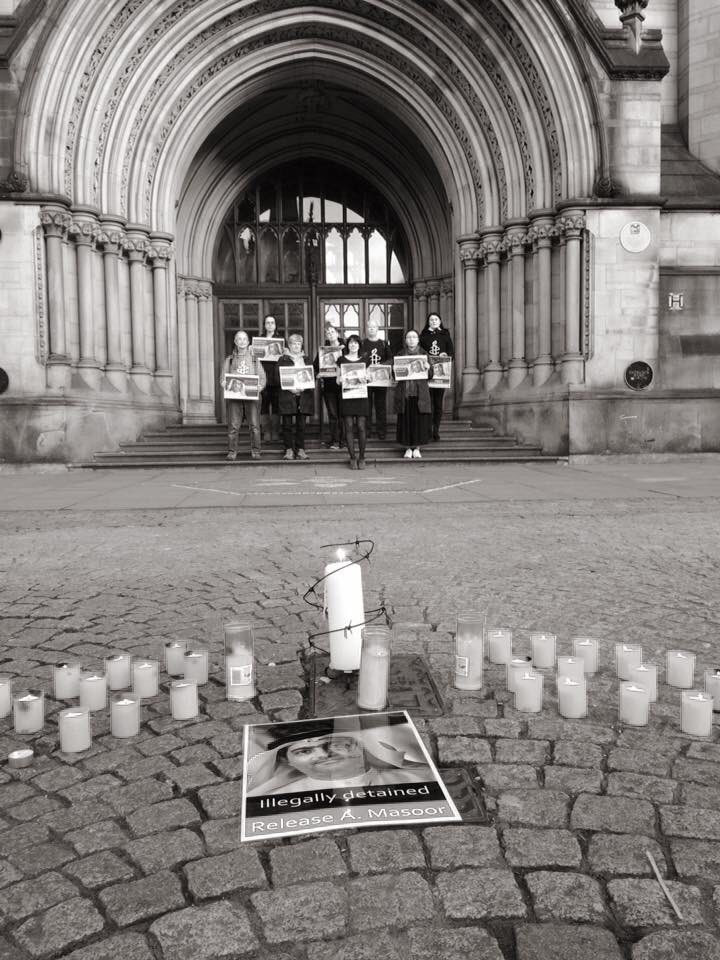
Ahmed Mansoor under arrest – Emirates under pressure

March 28, 2017

The importance of Ahmed Mansoor – MEA Laureate 2015 – as human rights defender and as the most important source of information on human rights in the Emirates (UAE) has been demonstrated by the international response to his sudden arrest [https://humanrightsdefenders.blog/2017/03/21/ahmed-mansoor-mea-laureate-2015-arrested-in-middle-of-the-night-raid-in-emirates/ ]. In addition to many newspaper and social media, there have been two important statements this morning:

The UN Special Procedures have called for Ahmed Mansoor’s release:  http://www.ohchr.org/EN/NewsEvents/Pages/DisplayNews.aspx?NewsID=21449&LangID=E,

And so has the Chair of the Subcommittee on Human Rights of the EU Parliament  http://www.europarl.europa.eu/news/en/news-room/20170328IPR68805/droi-chair-calls-on-uae-to-unconditionally-release-ahmed-mansoor 

In view of the link between Manchester and UAE airlines (Emirates and Ethiad) it is specially interesting to note that AI Manchester has joined the campaign to free Ahmed Mansoor:

Human Rights Council extends mandate on human rights defenders – after considerable wrangling

March 24, 2017

On Thursday 23 March 2017 the UN Human Rights Council adopted a resolution in which it extended, for a period of three years, the mandate of the Special Rapporteurs on human rights defenders. [https://humanrightsdefenders.blog/2017/02/22/un-special-rapporteur-on-human-rights-defenders-wraps-up-his-first-mandate/]

The press statement by the UN (see below) explains that there was quite a bit of wrangling on wording, but in the end the draft resolution (A/HRC/34/L.5) on the mandate of the Special Rapporteur on the situation of human rights defenders, Michael Forst, was adopted without a vote as orally revised, in the same terms as provided for by the Human Rights Council in its resolution 16/5. It urges again all States to cooperate with and assist the Special Rapporteur in the performance of his tasks, to provide all information and to respond to the communications transmitted to them by the Special Rapporteur without undue delay; and calls upon States to give serious consideration to responding favourably to the requests of the Special Rapporteur to visit their countries.

(here the detailed report on the failed efforts – mainly by Russia and China – to weaken the text:) Read the rest of this entry »

Louise Arbour of Canada appointed Special Representative for International Migration

March 13, 2017

On 9 March 2017 the UN Secretary-General, António Guterres, announced the appointment of Louise Arbour of Canada as his Special Representative for International Migration. The Special Representative will lead the follow-up to the 19 September 2016 High-level Summit on Addressing Large Movements of Refugees and Migrants.  Ms. Arbour will work with Member States, in partnership with other stakeholders, as they develop a first-ever global compact on safe, orderly and regular migration.  She will lead United Nations advocacy efforts on international migration, provide policy advice and coordinate the engagement of United Nations entities on migration issues, particularly in implementing the migration-related components of the New York Declaration.  She previously served as United Nations High Commissioner for Human Rights and as Chief Prosecutor of the International Criminal Tribunals for the Former Yugoslavia and Rwanda.  She is a former justice of the Supreme Court of Canada and of the Court of Appeal for Ontario.  From 2009 to 2014, Ms. Arbour was President and CEO of the International Crisis Group.

Louise Arbour Walk of Fame 20150608

Louise Arbour smiles after having her star unveiled on Canada’s Walk of Fame in Toronto on 8 June, 2015. THE CANADIAN PRESS/Darren Calabrese (Canadian Press).

Talking about refugees, please note that the Sergio Vieira de Mello Lecture by Angelina Jolie on 15 March [https://humanrightsdefenders.blog/2017/02/27/angelina-jolie-gives-2017-sergio-vieira-de-mello-lecture-on-15-march-2017/] is ‘sold out’, but it will be streamed live on UN TV and UNHCR’s Facebook.

Sources:

Secretary-General Appoints Louise Arbour of Canada Special Representative for International Migration | Meetings Coverage and Press Releases

http://www.cbc.ca/radio/thehouse/first-ottawa-visit-by-trump-cabinet-member-focuses-on-security-border-1.4015295