The Lawyers for Lawyers Award aims to honour lawyers who have made significant contributions to the protection of the rule of law and human rights in challenging environments. Through the bi-annual Award, Lawyers for Lawyers generates public recognition for the work and outstanding achievements of lawyers at risk. See for the award and its laureates: https://www.trueheroesfilms.org/thedigest/awards/B40861B3-0BE3-4CAF-A417-BC4F976E9CB0
On Wednesday 24 February 2021 Megan Thornberry writes about a report by the University of York and others concluding that human rights defenders have been at increased risk during pandemic, and calls for UK government to provide better protection.
There is a dearth of serious and quantitative research into how human rights defenders experience diplomatic support and interest in their work. So, this report – published by Amnesty International UK and the Center for Applied Human Rights, in collaboration with the Law Society of England and Wales, Peace Brigades International UK, Bond and other NGOs – is most welcome.
Research by the University’s Centre for Applied Human Rights (CAHR) and Amnesty International UK shows that during the COVID-19 pandemic, 94 per cent of human rights defenders interviewed reported face threats, death threats, abuse, and harassment.
It is reported that only 6 per cent of these activists, including lawyers, journalists, women’s rights defenders, and LGBTQ+ activists, received support from the UK government.
Researchers interviewed 82 human rights defenders from seven countries about their experiences with UK government support:
40% had contacted the UK government embassy as part of their work in the last two years, where as 70% had contacted other embassies
75% could not recall a time in which their resident country’s UK embassy had spoken out in support of specific at-risk human rights defenders
31% had been in contacted by their UK embassy seeking to further its knowledge about the struggles for human rights
The report highlights the increased threats to LGBTQ+ rights during the pandemic, as poor job security has driven many to return to unsafe and unaccepting hometowns in order to live with family. Particularly in countries such as Russia and the Philippines, this has placed LGBTQ+ activists at a higher risk of abuse. LGBTQ+ activists have also reported an increase in discrimination towards LGBTQ+ groups due to their being blamed for the pandemic.
Dr Piergiuseppe Parisi, a research associate at the Human Rights Defender Hub at CAHR and direct contributor to the report, said: “Human rights defenders are active agents of positive change. The UK should make sure that they are recognised as such, that they have the means to carry on with their crucial work and that they have access to rapid response protection mechanisms when they are in danger.”
Kate Allen, Director of Amnesty International UK, said: “The UK government has pledged to stand up for human rights defenders around the world. We now need to see words turned into action. The UK’s voice has power. It’s time to use it and to be a world leader.”
On 24 February 2021 a new Amnesty International investigation has identified a campaign of spyware attacks targeting Vietnamese human rights defenders (HRDs) from February 2018 to November 2020. Amnesty International’s Security Lab attributes these attacks to an attack group known as Ocean Lotus. The group has been active since at least 2014, targeting the private sector and HRDs. The spyware attacks investigated and identified by the Security Lab are the latest evidence of a crackdown on freedom of expression in Viet Nam and against Vietnamese activists outside the country.
Viet Nam’s history of Online Repression: Human rights are increasingly under attack both offline and online in Viet Nam. Over the past 15 years, repression linked to online activity has intensified, leading to a wave of harassment, intimidation, physical assault, and prosecution. Amnesty International has documented multiple cases of the arrest and prosecution of HRDs in Viet Nam in retaliation for their online expression since 2006. That year, former prisoner of conscience Truong Quoc Huy was arrested at an internet café in Ho Chi Minh City. Many activists and bloggers have been convicted for “conducting propaganda against the state.” Human rights blogger Nguyen Ngoc Nhu Quynh (Mother Mushroom) was sentenced to 10 years in prison in June 2017 on such charges. Activists and bloggers also face frequent physical assaults by officials or government-connected thugs. [see: https://www.trueheroesfilms.org/thedigest/laureates/70F07728-1E21-4D33-F0BE-460D5A188B9D] Police place activists under house arrest or briefly detain them to prevent them from participating in public events. The government also uses travel bans to prevent activists and HRDs from going abroad and engaging with the international community. In December 2020, Amnesty International published “Let Us Breathe”, a report documenting the widespread criminalization, online harassment and physical attacks faced by activists and bloggers and the rising numbers of individuals detained for peacefully expressing themselves online. [see: https://humanrightsdefenders.blog/2020/12/01/facebook-and-youtube-are-allowing-themselves-to-become-tools-of-the-vietnamese-authorities-censorship-and-harassment/ ]
What is Ocean Lotus?
The cyber-security industry, comprised of individual and company-based researchers, routinely researches and publishes information about attack groups targeting companies and governments. The industry often gives informal names to groups they continuously track based on each group’s unique tactics and tools. Ocean Lotus (also commonly called APT32 or APT-C-00) is one of these groups. The first known Ocean Lotus attack happened in 2014. It targeted US-based NGO Electronic Frontier Foundation (EFF), the Associated Press international news organization and two Vietnamese activists. This group was named Ocean Lotus in a report from the Chinese company Qihoo 360 in May 2015. In 2017, the American cyber-security company FireEye published a report linking the 2014 EFF and other attacks to this same Ocean Lotus. Over the years, Ocean Lotus has developed a sophisticated spyware toolkit comprised of several variants of Mac OS spyware, Android spyware and Windows spyware. They also strategically compromise websites in order to identify visitors and conduct further targeting. More recently, Ocean Lotus was found creating fake media websites based on content automatically gathered online. A significant part of the group’s activities is the targeting of HRDs and civil society. In 2017, the cyber-security company Volexity revealed that over 100 websites were compromised, including many belonging to human rights organizations from Viet Nam, in an attack campaign that they attributed to Ocean Lotus. Numerous other spyware attacks linked to Ocean Lotus against human rights organizations have also been reported, such as the targeting of the Cambodian human rights organization, LICADHO, in 2018. The cyber-security company FireEye describes Ocean Lotus’ operations as “aligned with Vietnamese state interests” based on the list of targeted companies and civil society groups they identified. In December 2020, Facebook published a threat report linking Ocean Lotus’ activities with a Vietnamese company named CyberOne Group. Although Amnesty International was unable to independently verify any direct connection between Ocean Lotus and Cyber One or with the Vietnamese authorities, the attacks described in this investigation confirm a pattern of targeting Vietnamese individuals and organizations.
Attacks against HRDs.
The investigation conducted by Amnesty International’s Security Lab revealed that two HRDs and a non-profit human rights organization from Viet Nam have been targeted by a coordinated spyware campaign. This spyware allows to fully monitor a compromised system, including reading and writing files, or launching other malicious programs. Bui Thanh Hieu is a blogger and pro-democracy activist who goes by the name “Nguoi Buon Gio” (The Wind Trader). He writes about social and economic justice and human rights. He is also critical of the Vietnamese government’s policies and actions regarding its relations with China, including the dispute over sovereignty in the South China Sea. Due to his writing and activism, the licence for an Internet Café he owned in Ha Noi has been revoked and he has been repeatedly subjected to reprisals. He was arrested along with activists Pham Doan Trang [see https://www.trueheroesfilms.org/thedigest/laureates/fe8bf320-1d78-11e8-aacf-35c4dd34b7ba] and Nguyen Ngoc Nhu Quynh in 2009 and was kept in police custody for 10 days for“abusing democratic freedoms to infringe upon the interests of the State.” In January 2013, Bui Thanh Hieu reported on the trial of 14 dissidents in Viet Nam and was arrested and released a few days later. He has since left Viet Nam and has lived in exile in Germany since 2013. Vietnamese Overseas Initiative for Conscience Empowerment (VOICE) is a non-profit organization supporting Vietnamese refugees and promoting human rights in Viet Nam. It was established in 1997 in the Filipino capital of Manila as a legal aid office, before formally registering in the United States in 2007. The organization continues to operate out of Manila and has helped 3,000 Vietnamese refugees resettle in third countries. Since 2011, VOICE has operated an internship programme to equip Vietnamese people with knowledge, skills, and tools to become effective activists. The organization has faced reprisals from Vietnamese authorities several times. Staff at VOICE told Amnesty International that employees and interns have been harassed, banned from travelling, and have had their passports confiscated when they have returned to Viet Nam. Furthermore, state-owned media has run an unsubstantiated smear campaign against VOICE, claiming that the organization is a terrorist group. A blogger residing in Viet Nam has also been confirmed as an Ocean Lotus target by the Security Lab, but due to security concerns their name has been omitted. They are known to have spoken out publicly about the Dong Tam incident on 9 January 2020, when approximately 3,000 security officers from Ha Noi raided Dong Tam village and killed the 84-year-old village leader Le Dinh Kinh. Three police officers were also killed. The Dong Tam incident sparked a national outcry in Viet Nam. Activists and bloggers were at the forefront of the public debate online, prompting a nationwide crackdown on on-line expression by the government. VOICE and the two bloggers all received emails containing spyware between February 2018 and November 2020. These emails pretended to share an important document. They either contained spyware as an attachment or as a link. Once downloaded and launched on the victim’s computer, the spyware would then open a decoy document in line with what the email pretended to share to trick the victim in believing the file was benign. Screenshot of the email sent to VOICE in April 2020The spyware identified by the Security Lab were either for Mac OS or Windows systems. The Windows spyware was a variant of a malware family called Kerrdown and used exclusively by the Ocean Lotus group. Kerrdown is a downloader that installs additional spyware from a server on the victim’s system and opens a decoy document. In this case, it downloaded Cobalt Strike, a commercial spyware toolkit developed by the American company Strategy Cyber and routinely used to lawfully audit the security of organizations through simulated attacks. It allows an attacker full access to the compromised system including executing scripts, taking screenshots or logging keystrokes. Unlicensed versions of Cobalt Strikes have been increasingly used by attack groups, including Ocean Lotus, over the past three years.Example of Windows Spyware Infection Chain from one of the emails received The Mac OS Spyware was a variant of a malware family for Mac OS developed and used exclusively by Ocean Lotus, analysed by Trend Micro in April 2018 and November 2020. It allows the perpetrator to access system information, download, upload or execute files and execute commands.
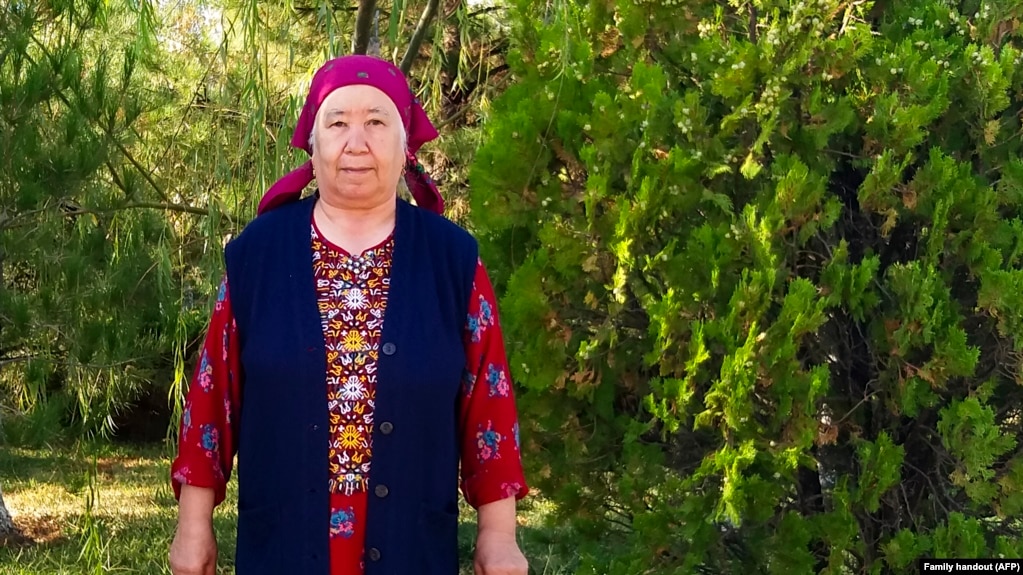
On 19 February 2021 RFE/RL reported that 71-year-old Turkmen journalist Soltan Achilova has issued a rare rebuke of the Central Asian nation’s authoritarian President Gurbanguly Berdymukhammedov, criticizing him and his government in a video posted on YouTube for failing to provide proper heating and water supply to Ashgabat residents during winter.
In the video statement that appeared on YouTube late on February 18, Achilova, who has previously worked as a reporter for RFE/RL’s Turkmen Service, said she will no longer call Berdymukhammedov “respected” because “millions of Turkmen had stopped respecting you long ago.”
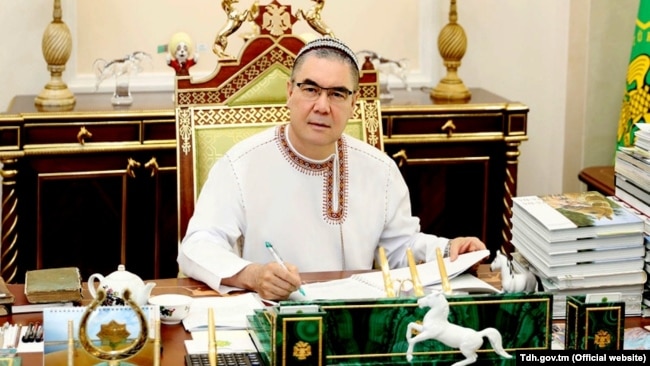
Turkmen President Gurbanguly Berdymukhammedov (file photo)
Such an act of public dissent is a rare occurrence in Turkmenistan, where Berdymukhammedov has run the former Soviet republic with an iron fist since 2006, becoming the center of an elaborate personality cult
Achilova also criticized Berdymukhammedov and his government for what she called a “failure to provide” ordinary people with decent food at acceptable prices, adding that “miserable pensions and salaries in the country” do not provide people with the means to shop for regular items at local markets. Achilova added that the heating system in her apartment had been switched off several times in recent days, which she called an intentional warning over her journalistic activities.
“Our fellow Turkmen citizens working in foreign countries have staged several protests recently demanding your resignation. We join those protests and demand your resignation as well because you are incapable of carrying out your duties. We are suffering and you do not even care about it. All you are capable of is ruining our homes and causing our people to suffer,” Achilova said.
Based in Ashgabat, Achilova is currently a contributor to the Vienna-based independent news website Khronika Turkmenistana (Chronicles of Turkmenistan), which focuses on news and developments in Turkmenistan. Turkmen authorities, who don’t tolerate an independent press, have targeted Achilova in the past for her work as a journalist. SEE ALSO: RFE/RL Correspondent Roughed Up — Again — In Turkmenistan
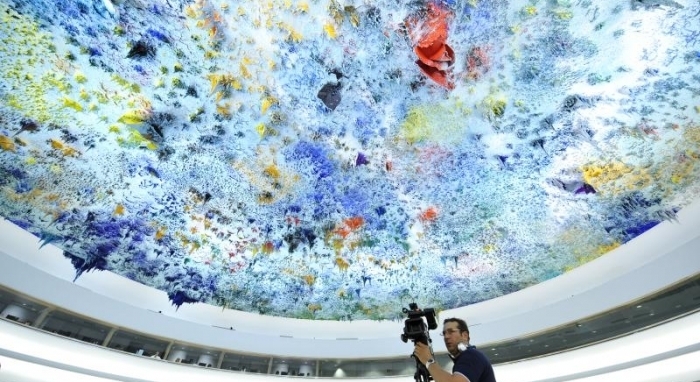
Although I have decided to focus this blog mostly on human rights defenders and their awards, I will make an exception for the regular sessions of the UN Human Rights Council of which the46th session has started on 22 February and which will last until to 23 March 2021. This post is based on the as always excellent general overview published by the International Service for Human rights: “HRC46 | Key issues on agenda of March 2021 session”. Here’s an overview of some of the key issues on the agenda which affect HRDs directly:
Modalities for NGOs this year: According to the Bureau minutes of 4 February 2021: “Concerning the participation of NGOs in the 46th session, the President clarified that under the proposed extraordinary modalities, NGOs in consultative status with the ECOSOC would be invited to submit pre-recorded video statements for a maximum of three general debates in addition to the interactive dialogues, panel discussions and UPR adoptions as they had been able to do during the 45th session. In addition, “the Bureau agreed that events organised virtually by NGOs in consultative status with the ECOSOC could be listed on the HRC Extranet for information purposes.”
Human Rights implications of COVID-19
The pandemic – and States’ response to it – has presented various new challenges and threats for those defending human rights. The pandemic has exposed and deepened existing discrimination, violence and other violations. Governments have used COVID as a pretext for further restricting fundamental rights, including through the enactment of legislation, and specific groups of defenders – including WHRDs and LGBTI rights defenders – have lost their livelihoods, access to health services have reduced and they have been excluded from participating in pandemic responses. Action to address the pandemic must be comprehensive and systemic, it must apply a feminist, human rights-based, and intersectional lens, centred on non-discrimination, participation and empowerment of vulnerable communities. Last March ISHR joined a coalition of 187 organisations to draw the Council’s attention to the situation of LGBTI persons and defenders in the context of the pandemic.
Reports of cases of intimidation and reprisals against those cooperating or seeking to cooperate with the UN not only continue, but grow. Intimidation and reprisals violate the rights of the individuals concerned, they constitute violations of international human rights law and undermine the UN human rights system. See also: https://humanrightsdefenders.blog/tag/reprisals/
The UN has taken action towards addressing this critical issue including:
Establishing a dedicated dialogue under item 5 to take place every September;
Affirmation by the Council of the particular responsibilities of its Members, President and Vice-Presidents to investigate and promote accountability for reprisals and intimidation; and
Appointment of the UN Assistant Secretary General on Human Rights as the Senior Official on addressing reprisals.
ISHR remains deeply concerned about reprisals against civil society actors who try to engage with UN mechanisms, and consistent in its calls for all States and the Council to do more to address the situation.
During its 42nd session, the Council adopted a resolution which listed key trends such as the patterns of reprisals, increasing self-censorship, the use of national security arguments and counter-terrorism strategies by States as justification for blocking access to the UN. The resolution also acknowledged the specific risks to individuals in vulnerable situations or belonging to marginalised groups, and called on the UN to implement gender-responsive policies to end reprisals. The Council called on States to combat impunity and to report back to it on how they are preventing reprisals, both online and offline.
Item 5 of the Human Rights Council’s agenda provides a key opportunity for States to raise concerns about reprisals, and for governments involved in existing cases to provide an update to the Council on any investigation or action taken toward accountability to be carried out.
During the organisational meeting held on 8 February, the President of the Council stressed the importance of ensuring the safety of those participating in the Council’s work, and the obligation of States to prevent intimidation or reprisals.
In line with previous calls, ISHR expects the President of the Human Rights Council to publicly identify and denounce specific instances of reprisals by issuing formal statements, conducting press-briefings, corresponding directly with the State concerned, publicly releasing such correspondence with States involved, and insist on undertakings from the State concerned to investigate, hold the perpetrators accountable and report back to the Council on action taken.
Other thematic reports
At this 46th session, the Council will discuss a range of economic, social and cultural rights in depth through dedicated debates with mandate holders, and consider the annual report of the Secretary-General on the question of the realization in all countries of economic, social and cultural rights. The debates with mandate holders include:
The Special Rapporteur in the field of cultural rights, annual report on COVID-19, culture and culture rights and country visit to Tuvalu
The Special Rapporteur on the right to adequate housing, annual report on twenty years on the right to adequate housing: taking stock – moving ahead and country visit to New Zealand
The Council will discuss a range of civil and political rights through dedicated debates with the mandate holders, including:
The Special Rapporteur on freedom of religion or belief, annual report on combating anti-Muslim hatred
The Special Rapporteur on the right to privacy, annual report on artificial intelligence and privacy, and children’s privacy, and country visit reports to the United Kingdom, France, Germany, United States of America, Argentina, and Republic of Korea.
In addition, the Council will hold dedicated debates on the rights of specific groups including:
In addition, the Council will hold dedicated debates on interrelation of human rights and human rights thematic issues including:
The Special Rapporteur on human rights and the environment, annual report on human rights and the global water crisis: water pollution, water scarcity and water-related disasters
The Special Rapporteur on the promotion and protection of human rights while countering terrorism, annual report on human rights impact of counter-terrorism and countering (violent) extremism policies and practices on the rights of women, girls and the family
Country-specific developments
China
A pile of evidence continues to mount, including the assessment from the UN Committee on the Elimination of Racial Discrimination, about policies of the Chinese government targeting ethnic and religious minorities, including Uyghurs, Tibetans and Mongolians. The rule of law is being further eroded in Hong Kong, as deeply-respected principles of due process and pluralistic democracy are disappearing at an alarming rate. Human rights defenders and ordinary citizens confront ongoing crackdowns on civic freedoms, pervasive censorship and lightning-fast recourse to administrative sanction, enforced disappearance and trumped-up national security charges to silence critics. – In the face of this, inaction has become indefensible.
The UN Special Procedures issued a sweeping statement in June 2020, calling for the international community to take ‘decisive action’ on the human rights situation in the country. At the March session, ISHR urges States to convey at the highest level the incompatibility of China’s actions domestically with its obligations as a new Council member, and to continue to press for transparency, actionable reporting and monitoring of the situation. Statements throughout the Council are key moments to show solidarity with individual defenders – by name – , their families, and communities struggling to survive. And finally, States should take every opportunity to support efforts by China that meaningfully seek to advance human rights – while resolutely refuting, at all stages of the process, initiatives that seek to distort principles of human rights and universality; upend the Council’s impressive work to hold States up to scrutiny; and weaken the effectiveness and impact of the Council for victims of violations and human rights defenders. Furthermore, other Council members should step up their commitments to the body’s mandate and purpose, and reject efforts by China and its partners and proxies. See also: https://humanrightsdefenders.blog/tag/china/
Egypt
The Egyptian authorities continue to systematically carry out patterns of reprisals against human rights defenders for their legitimate work, including for engagement with UN Special Procedures. These have included arbitrary arrests and detention, enforced disappearance, torture, unlawful surveillance, threats and summons for questioning by security agencies. The government’s refusal to address key concerns raised by States in its response to the UPR in March 2020 demonstrated its lack of political will to address its deep challenges and to engage constructively with the Council. ISHR reiterates its call on the Council to establish a monitoring and reporting mechanism on the human rights situation in Egypt. See also: https://humanrightsdefenders.blog/tag/egypt/
Saudi Arabia
In 2020, the Council continued its scrutiny over the human rights situation in Saudi Arabia. Yet, the Saudi government has failed the litmus test to immediately and unconditionally release the women’s rights activists and human rights defenders, instead they continued to prosecute and harshly sentence them for their peaceful activism. On 10 February 2021, it was reported that WHRDs Loujain Al-Hathloul, and Nouf Abdulaziz have been released conditionally from prison after spending over two and a half years in detention solely for advocating for women’s rights, including the right to drive and the dismantling of the male guardianship system. ALQST reported that WHRDs Nassima al-Sadah and Samar Badawi remain in detention and that “in a worrying development, the Public Prosecution has appealed the initial sentence issued on 25 November 2020 by the Criminal Court against al-Sadah of five years and eight months in prison, half of it suspended, seemingly with the aim of securing an even harsher sentence”. See: https://www.trueheroesfilms.org/thedigest/laureates/1a6d84c0-b494-11ea-b00d-9db077762c6c
The government’s refusal to address this key concern raised in the three joint statements demonstrates its lack of political will to genuinely improve the human rights situation and to engage constructively with the Council. ISHR reiterates its call on the Council to establish a monitoring and reporting mechanism on the human rights situation in Saudi Arabia.
Nicaragua
On 24 February, the Council will hold an interactive dialogue on the High Commissioner’s report on Nicaragua. Despite the renewal of Resolution 43/2, the human rights situation in Nicaragua has steadily deteriorated over the last months. Civil society space has sharply shrank, due to new restrictive laws on foreign agents and counter-terrorism, while attacks against journalists and human rights defenders -the last remaining independent human rights observers – continue. The lack of an independent judiciary or NHRI further deprives victims of the possibility to seek justice and redress. Whilst the repression deepens, State inaction in the face of the Covid-19 pandemic and the passage of hurricanes have also exacerbated the ongoing humanitarian crisis and the deprivation of economic, social, and cultural rights. In light of upcoming elections in Nicaragua, ISHR urges the Council to renew and strengthen its resolution on the human rights situation in Nicaragua, laying down a clear benchmark of key steps the State should take to demonstrate its willingness to cooperate in good faith, while clearly signaling the intention to move towards international investigation and accountability should such cooperation steps not be met within the year. States should also increase support to targeted defenders and CSOs by raising in their statements the cases of student Kevin Solís, Aníbal Toruño and Radio Darío journalists, trans activist Celia Cruz, as well as the CENIDH and seven other CSOs subject to cancellation of their legal status.
Venezuela
Venezuela will come under the spotlight several times with oral updates from OHCHR on the situation of human rights in the country (25 February, 11 March) and an update from the international fact-finding mission on Venezuela (10 March). OHCHR is mandated to report on the implementation of the recommendations made to Venezuela, including in reports (here and here) presented last June. The fact-finding mission has started work on its renewed and strengthened 2-year mandate, despite delays in the disbursement of funds and is due to outline its plans to the Council. Intensifying threats and attacks on civil society in Venezuela since November 2020, provide a bleak context to these discussions. States should engage actively in dialogue on Venezuela, urging that recommendations be implemented – including facilitating visits from Special Rapporteurs; that the fact-finding mission be granted access to the country and that civil society be promoted and safeguarded in its essential work.
Burundi
On 2 February 2021, the Supreme Court of Burundi announced its decision allegedly adopted on 23 June 2020 to sentence 12 defenders to life in prison. The date of the adoption of this decision was announced after the Court decided to defer it further to 30 June 2020 and again after that. The Court never assigned or informed the 12 concerned of the proceedings. This case was investigated and judged in the absence of all those concerned and the sentence only made public seven months after the alleged proceedings took place. Among the victims of this arbitrary procedure are renown lawyers such as Me Armel Niyongere, Vital Nshimirimana and Dieudonné Bashirahishize, who are being targeted for their engagement in the defense of victims of the 2015 repression in Burundi and for filing complaints for victims to the International Criminal Court (ICC) in The Hague. A group of civil society organisations denounced the dysfunctioning and lack of independence of judicial proceedings in the country. After confirming the 32 years sentence of defender Germain Rukuki, Burundi continues its crackdown against civil society. In addition to ensuring the continued work of the Commission of Inquiry on Burundi, members of the Council need to call on Burundi to uphold its international obligations and stop reprisals against defenders for engaging with any international mechanisms. See also: https://humanrightsdefenders.blog/2019/03/29/ngo-statement-condemns-new-irregularities-in-the-case-of-germain-rukuki-burundi/ The Council will hold an interactive dialogue with the Commission of Inquiry on Burundi on 10 March.
The High Commissioner will provide an oral update to the Council on 25 February. The Council will consider updates, reports on and is expected to consider resolutions addressing a range of country situations, in some instances involving the renewal of the relevant expert mandates. These include:
Oral update and interactive dialogue with the Special Rapporteur on Eritrea
Interactive Dialogue on the High Commissioner’s report on Sri Lanka
Enhanced Interactive Dialogue on the High Commissioner’s report on Belarus
Oral update and interactive dialogue with the Group of Eminent International and Regional Experts on Yemen
Interactive Dialogue on the High Commissioner’s report on ensuring accountability and justice in the Occupied Palestinian Territory, including East Jerusalem
Interactive Dialogue with the Special Rapporteur on the situation of human rights in the Islamic Republic of Iran
Interactive Dialogue with the Special Rapporteur on the situation of human rights in the Democratic People’s Republic of Korea
Interactive Dialogue with the Commission on Human Rights in South Sudan
Interactive Dialogue with the Commission of Inquiry on the Syrian Arab Republic
Interactive Dialogue with the Special Rapporteur on the situation of human rights in Myanmar
Interactive Dialogue with the High Commissioner on the situation of human rights in Ukraine
Oral updates and enhanced interactive dialogue with the High Commissioner on the situation of human rights in the Democratic Republic of the Congo, and the team of international experts on the situation in Kasai
High-level Interactive Dialogue with the Independent Expert on the situation of human rights in the Central African Republic
Interactive Dialogue with the Independent Expert on the situation of human rights in Mali
Council programme, appointments and resolutions
During the organisational meeting for the 46th session held on 8 February, the President of the Human Rights Council presented the programme of work. It includes seven panel discussions. States also announced at least 28 proposed resolutions. Read here the reports presented this session.
Appointment of mandate holders
The President of the Human Rights Council proposed candidates for the following mandates:
Expert Mechanism on the Rights of Indigenous Peoples (member from Africa)
Expert Mechanism on the Rights of Indigenous Peoples (member from North America)
Special Rapporteur on extrajudicial, summary or arbitrary executions
Special Rapporteur on the situation of human rights in Cambodia
Working Group of Experts on People of African Descent (member from African States)
Working Group on Arbitrary Detention (member from Asia-Pacific States).
Resolutions to be presented to the Council’s 46th session
At the organisational meeting on 8 February the following resolutions were announced (States leading the resolution in brackets):
Promotion of the enjoyment of the cultural rights of everyone and respect for cultural diversity (Cuba)
Human rights and the environment, mandate renewal (Costa Rica, Maldives, Morocco, Slovenia, Switzerland)
Prevention of torture and other cruel, inhuman or degrading treatment or punishment (Denmark)
Question of the realization in all countries of economic, social and cultural rights (Portugal)
Guarantee of the right to the health through equitable and universal access to vaccines in response to pandemics and other health emergencies (Ecuador)
Negative impacts of unilateral coercive measures (Azerbaijan on behalf of the Non-Aligned Movement-NAM)
Human rights, democracy and the rule of law (Morocco, Norway, Peru, Romania, Republic of Korea, Tunisia)
Freedom of religion or belief (EU)
Situation of human rights in the Democratic People’s Republic of Korea, mandate renewal (EU)
Situation of human rights in Myanmar, mandate renewal (EU)
Combating intolerance based on religion or belief (OIC)
Ensuring accountability and justice for all violations of international law in the Occupied Palestinian Territory, including East Jerusalem (OIC)
Right of the Palestinian people to self-determination (OIC)
Human rights situation in the Occupied Palestinian Territory, including East Jerusalem (OIC)
Israeli settlements in the Occupied Palestinian Territory, including East Jerusalem, and in the occupied Syrian Golan (OIC)
Technical assistance and capacity-building for Mali in the field of human rights (African Group)
Persons with albinism (African Group)
Impact of non-repatriation of funds of illicit origin to countries of origin (African Group)
The situation of human rights in Iran, mandate renewal (Moldova, United Kingdom of Great Britain and Northern Ireland, Iceland)
The right to privacy in the digital age, mandate renewal (Austria, Brazil, Germany, Liechtenstein, Mexico)
The human rights situation in the Syrian Arab Republic, mandate renewal (France, Germany, Italy, Jordan, Kuwait, Morocco, Netherlands, Qatar, Turkey, United Kingdom of Great Britain and Northern Ireland)
Promoting reconciliation, accountability and human rights in Sri Lanka (Canada, Germany, Montenegro, North Macedonia, United Kingdom of Great Britain and Northern Ireland)
Situation of human rights in South Sudan, mandate renewal (Albania, Norway, UK)
Adoption of Universal Periodic Review (UPR) reports
During this session, the Council will adopt the UPR working group reports on Belarus, Liberia, Malawi, Panama, Mongolia, Maldives, Andorra, Honduras, Bulgaria, the Marshall Islands, the United States of America, Croatia, Libya and Jamaica. ISHR supports human rights defenders in their interaction with the UPR. It publishes and submits briefing papers regarding the situation facing human rights defenders in some States under review and advocate for the UPR to be used as a mechanism to support and protect human rights defenders on the ground.
Panel discussions
During each Council session, panel discussions are held to provide member States and NGOs with opportunities to hear from subject-matter experts and raise questions. Panel discussions scheduled for this upcoming session:
Annual high-level panel discussion on human rights mainstreaming. Theme: The state of play in the fight against racism and discrimination 20 years after the adoption of the Durban Declaration and Plan of Action and the exacerbating effects the COVID-19 pandemic has had on these efforts
Biennial high-level panel discussion on the question of the death penalty. Theme: Human rights violations related to the use of the death penalty, in particular with respect to whether the use of the death penalty has a deterrent effect on crime rate
Meeting on the role of poverty alleviation in promoting and protecting human rights
Annual full-day meeting on the rights of the child [two accessible panels]. Theme: Rights of the child and the Sustainable Development Goals
Annual interactive debate on the rights of persons with disabilities [accessible panel]. Theme: Participation in sport under article 30 of the Convention on the Rights of Persons with Disabilities
Debate on the midterm review of the International Decade for People of African Descent. (Commemoration of the International Day for the Elimination of Racial Discrimination)
To stay up-to-date: Follow @ISHRglobal and #HRC46 on Twitter, and look out for the Human Rights Council Monitor. During the session, follow the live-updated programme of work on Sched.
On 15 January 2021 The International Service for Human Rights (ISHR) published a long interview with Alicia Wallace, a human rights defender from the Bahamas. Here it is in full:
“I remember to be hopeful, not because it feels good or because I am waiting for something to happen on its own, but because I believe in my own power and the magic we create when queer people, Black people, women come together to channel our rage, righteous and raw, into sustained action.”
The year is 2050. What does the world look like – in particular for women, Black people, LGBTI people?
We are making strides toward equality and we are centered in all decision-making processes. We are protected and respected. It is a norm for us to be in positions of leadership. Diversity is expected. We are as safe at night as anyone is during the day. We have access to education, healthcare, food, and housing. All of our needs are met. Redistribution of wealth is in progress. Our survival is not dependent on or propping up the capitalist system. We are defining justice for ourselves. We recognise ourselves as the source of our own healing.
How did your work help achieve the vision you just described?
My work provoked conversation. It made information, from academic theory to changemaking methodologies, accessible to everyone. I created spaces where people have been comfortable to question, critique, challenge, learn, share, and create. I developed tools for all of us to be able to think outside of the reality we used to know. We knew we were not bound to it because I put significant emphasis on imagination and future-making. I found a way to fight the injustice we faced and facilitate collaborative visioning, imagining, and creating. We channeled our rage, weaponised hope (inspired by the work of artist Angelika Wallace-Whitfield), and we came together to co-create the futures. I helped to create tools and systems to enable that practice.
Was there a defining moment in your life that motivated you to defend human rights?
I am a queer Black woman. I have student loan debt. I am unwaged. I am a survivor of violence. My life is a collection of moments that make it necessary for me to defend and promote human rights if I am to survive and leave the world better than I met it. Perhaps what prompts me to action is recognition of another important fact—I have privilege. I have had experiences I may never speak of, and I know that my circumstances could be a lot worse. It is important for me to use what I have to help us all get what we ought to have had a long time ago. For me, the defining moment happens over and over again, when I feel rage threatens to control my body, and I remember to be hopeful, not because it feels good or because I am waiting for something to happen on its own, but because I believe in my own power and the magic we create when queer people, Black people, women come together to turn channel our rage, righteous and raw, into sustained action.
Do you face any threats and attacks because of your work?
I’ve been experiencing rape and death threats for the past six years. Most of it has been online. The most troubling threats come following participation in direct action or agitation from people in positions of influence. In 2018, when I participated in the 71st session of the Committee on the Elimination of Discrimination against Women (CEDAW) in Geneva, a radio personality made dangerous statements about me on the air. The same person incited the first threats of violence against me in 2014, so I knew I needed to take it seriously. I made a report to the CEDAW focal point on reprisals, but the outcome was not favorable. A government representative called me to suggest I report the incident to the police, but did not offer support in doing so and could not cite an offense, according to Bahamian law, that I would be reporting. It was a ridiculous suggestion that gave me no help. The government, of course, reported its “action” to the UN, even claiming that I said I no longer felt unsafe. I told the focal point that this was untrue and that, at the very least, the government should have been instructed to publicly state its support for human rights defenders, enact hate speech and hate crime legislation, and direct the radio personality to cease and desist all reference to me and any other human rights defenders. It would have cost the UN nothing to support me and other human rights defenders by making these recommendations to the government. Instead, I am left to fend for myself in a place where I continue to live and work without protection, legal or otherwise.
On this see what was stated by Andrew Gilmour in December 2019: “The Bahamas responded to the allegations of intimidation and reprisals against woman human rights defender Alicia Wallace after she engaged with the Committee on Elimination of all forms of Discrimination against Women (CEDAW). She and her colleagues were subjected to hate speech by a well-known radio personality, the effect of which was to create an unsafe environment for Ms. Wallace and other women human rights defenders. The Bahamas affirmed its commitment to protect human rights defenders and ensure that they can engage freely with the UN. The delegation told the Council that authorities proactively provided assistance to Ms. Wallace to guarantee her safety.”[from: https://humanrightsdefenders.blog/2019/09/23/andrew-gilmours-2019-report-on-reprisals-it-gets-worse-but-response-remains-mostly-rhetoric/]
What could be done for you to be able to work safely and effectively?
Institutions and people in positions of power need to rebuke violence, harassment, and threats of violence. The State needs to enact legislation against hate crimes and hate speech. It needs to publicly state its support of human rights defenders, make it clear that the relationship between itself and advocates is complementary, not adversarial, and assert that it will protect us. The United Nations and other bodies in control of international mechanisms and reporting processes need to take responsibility for the safety and security of the human rights defenders it depends on to monitor and evaluate State action. These organisations need to raise the bar, calling States to higher standards. They have to make it clear to States and the general public that the safety and security of human rights defenders are a matter of priority before we are detained, disappeared, or murdered.
How has the Covid-19 pandemic affected your work?
It has, as predicted, increased the volume of work. People, especially vulnerable people, are suffering. The pandemic has created crisis after crisis, from domestic violence and unpaid care work to unemployment and disruption of education. In anticipation of the effects of COVID-19 and State actions in response to it, Feminist Alliance for Rights (FAR)—where I am a steering committee member—produced guidelines for feminist policymaking during this time. This is one of the most critical pieces of work I have contributed to this year. In addition, I have been engaged in rapid response, working on policy recommendations to end gender-based violence, and continuing the regular programming of Equality Bahamas. It has been a busy year, but one of learning and where I have been able to see and strengthen my own agility. Human rights defenders have to be able to anticipate, prepare, respond, pivot, assess, and revise at all times, and especially during the crisis. The work has intensified and been taxing, but I believe that we have learned more this year than we have in years gone by, people are more aware of inequalities, and in addition to getting more people on our team, we can get institutions to make substantive change.
You are the producer of a monthly newsletter called The Culture RUSH. How does fusing pop culture with social justice help achieve your vision?
I want people to understand the movement for justice and equality. I want to see a broader understanding of feminism, women’s rights, LGBTQ+ people’s rights, and the importance of centering vulnerable people in decision-making processes, programmes, and activities. We need more people on our team. That requires two main actions: communicating in clear, accessible ways, and meeting them where they are in order to deliver the message. Academic text, feminist theory, and the language of institutions and advocacy are not as appealing or accessible as pop culture. People know what’s going on in Cardi B’s marriage, Megan Thee Stallion’s friend group, and the lives of real housewives. If WAP gets us talking about women’s pleasure, let’s talk about women in rap, lyrics, and music videos. In The Culture RUSH, I make connections between pop culture and social justice. In January 2021, I am starting Scorch, a paid subscription newsletter breaking feminist theory and academic text down into digestible bites (similar to Blinkist). I’m excited about making human rights and social justice accessible and interesting to wider audiences. When people are interested, they’re more likely to get invested, and when they’re invested, we can convince them to take action with us. People power is how we win.
Thank you, Alicia!
Alicia A. Wallace is a queer Black feminist, gender expert, and research consultant. She is the Director of Equality Bahamas which promotes women’s and LGBTQ+ rights as human rights through public education, community programming, and advocacy. Her work has included a two-year educational campaign ahead of a national referendum on gender and citizenship, the design and coordination of Women’s Wednesdays—a month event series bringing women together to share knowledge and ideas—and management of a disaster relief donation and distribution center. Alicia is also a steering committee member of Feminist Alliance for Rights (FAR). She has a weekly column on social and political issues in the Bahamian daily newspaper The Tribune and has published academic papers.
Photo credits in order of appearance: Blair J. Meadows, Equality and Justice Alliance, Equality Bahamas
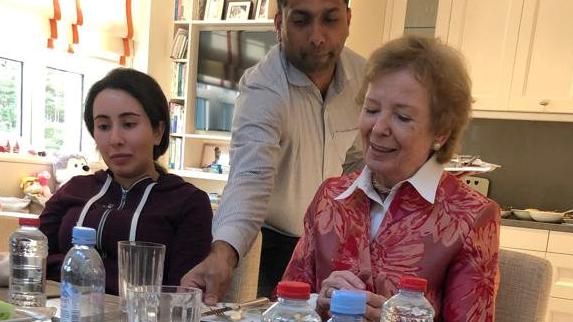
There’s a saying in show business that you can spend 20 years becoming an overnight star. In politics, the same is true in reverse, as the sad case of Mary Robinson and Princess Latifa of Dubai shows. Mary Robinson as former UN High Commissioner for Human Rights and a widely-honored human rights defender [with 9 awards to her name, see: https://www.trueheroesfilms.org/thedigest/laureates/4E44A265-DF1A-45E2-8C6A-3294577EA211] was a much admired personality. For that reason I was reluctant to highlight her role in the sad case back in December 2018, although many human rights NGOs (including AI and HRW) did criticise her.
The former UN human rights Commissioner has been criticised for describing the daughter of Dubai’s ruler as “troubled” after she was reportedly forcibly returned to the kingdom after fleeing months earlier. Mary Robinson met with Sheikha Latifa on 15 December and photos released showed the two women smiling together in what appears to be a home. Ms Robinson, the former president of Ireland, told BBC’s Radio 4 the princess was a “vulnerable” woman with a “serious medical situation” for which she was receiving psychiatric care.
Immediately the highly publicised and bizarre meeting in December was panned by rights groups for being stage-managed by the Emirati ruling family (Ms Robinson is a personal friend of Sheikha Haya, a wife of the Dubai ruler.) Defending her comments, Ms Robinson released a statement saying: “I am dismayed at some of the media comments on my visit and I would like to say I undertook the visit and made an assessment, not a judgement, based on personal witness, in good faith and to the best of my ability.”
Toby Cadman, a barrister instructed by Detained in Dubai to act on behalf of the princess, told Review: “I am extremely disappointed that she would lend herself to what has been interpreted as a whitewash. “We have requested an independent assessment of [Princess Latifa’s] state of mind and her physical well-being. It’s up to the United Nations to be satisfied that she is not being detained against her will.” Then in January 2019 Mrs Robinson stated that she contacted Michelle Bachelet, UN high commissioner for human rights. On 18/02/2019 Former Irish president Mary Robinson said she has no regrets over getting involved in the case of a Dubai princess who had tried to flee the UAE.
Exactly one year on from Latifa’s dramatic capture at sea, rights groups told The Independent they were deeply concerned about her welfare and still had no knowledge of what happened to her between her March 2018 capture and December when she reappeared in Dubai. Pleas to the UAE for an independent delegation to be granted access to the royal to assess her, have gone unanswered. “Human Rights Watch is still calling for her to be able to travel to a third country where we and other monitors can be assured she is able to speak freely and independently without fear of retaliation,” Hiba Zayadin of HRW told The Independent. “Ms Robinson is not equipped to make an evaluation of Latifa, who was in the presence of people who allegedly forcibly disappeared her,” she added.
Amnesty International put out a similar call. “There has been no reply from the UAE, which has never responded to anything regarding domestic human-rights abuses that Amnesty International has attempted to raise with them,” said Amnesty’s Devin Kenney.
Now, 16 February 2021, after new footage was shared by BBC Panorama, in which the 35-year-old daughter of the ruler of Dubai has confirmed that commandos drugged her as she tried to flee by boat and flew her back to detention and accused her father, Sheikh Mohammed bin Rashid Al Maktoum, of holding her “hostage”, Mrs Robinson has stated that she feels “horribly tricked” by the family of Princess Latifa Al Maktoum, and has joined in calls for immediate international action in order to establish Princess Latifa’s current condition and whereabouts
Robinson is rightly revered for her life’s work, and that work is not invalidated by her unacceptable interference in the case of Princess Latifa. But her reputation has been tarnished by this.
’I have been prosecuted many times and jailed for my thoughts. I’m still here. I’m not going anywhere’ – Eren Keskin tweeted after she was sentenced.
Amnesty International has condemned the sentencing of four Turkish human rights defenders on “terrorism-related” in a case involving Özgür Gündem – a daily newspaper that was closed down in 2016. Eren Keskin, a prominent human rights defender and lawyer in Turkey – was sentenced to six years in jail for supposed “membership of an armed terrorist organisation”. See: https://www.trueheroesfilms.org/thedigest/laureates/BFDBB222-0FE0-32BF-ADD6-4D342A315C22
Zana Kaya, the newspaper’s editor-in-chief was sentenced to one year and 13 months in prison for “making propaganda for a terrorist organisation.” Özgür Gündem’s former publisher, Kemal Sancılı and the newspaper’s managing editor İnan Kızılkaya have been sentenced to six years and three months in prison for “being a member of an armed terrorist organisation” – the same sentence as Eren Keskin’s.
All four remain at liberty pending their appeals. This case is latest where anti-terrorism laws used to criminalise legitimate and peaceful activity in Turkey. Milena Buyum, Turkey Campaigner at Amnesty International said: “Today a human rights lawyer who has spoken out against injustice for more than three decades, has become the victim of injustice herself.
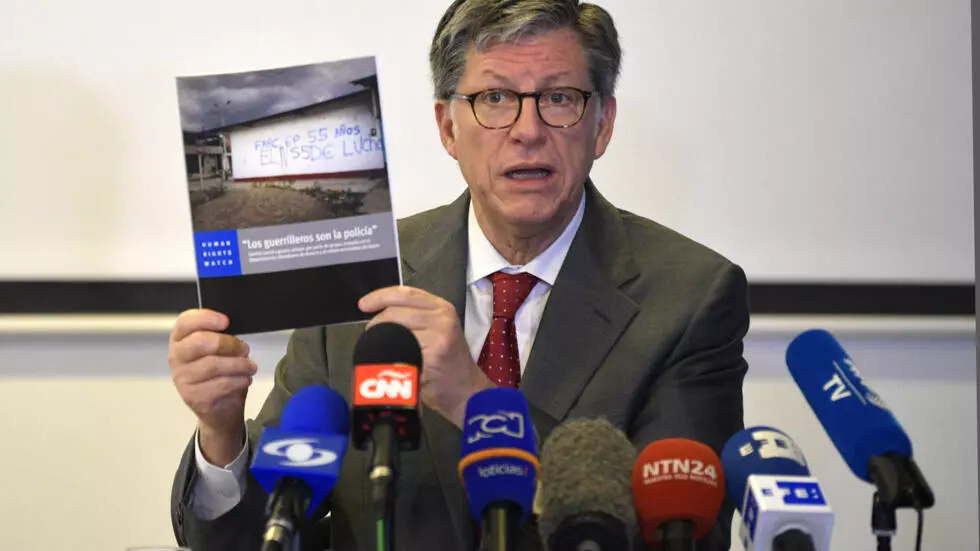
Jose Miguel Vivanco, HRW director for the Americas, accuses the Colombian government of failing to act on the murders of rights activists Raul ARBOLEDA AFP
Human Rights Watch on Wednesday 10 Febuary 2021 hit out at Colombia’s government over the rising number of human rights defenders and activists being murdered in the South American country.
Since the 2016 peace accord that ended half a century of fighting between government forces and the Revolutionary Armed Forces of Colombia (FARC), an increasing number of civil society leaders have been killed each year. But “the government has acted slowly and weakly in the implementation of policies to prevent these murders,” HRW said in a statement.
Despite Colombia suffering the largest number of such murders on the continent, “the government’s response has been more focussed on making speeches and announcements than adopting measures that will have an impact in the territories” affected by the violence, said Jose Miguel Vivanco, HRW director for the Americas.
Behind the wave of violence targeting advocates are National Liberation Army Marxist rebels, dissident FARC guerrillas and right-wing paramilitaries, as well as armed drug-trafficking groups. They are fighting each other over access to lucrative cocaine and illegal mining markets.
HRW says most victims were murdered as reprisals for opposing drug-trafficking in their territories, allegedly collaborating with the army or supporting the replacement of illegal coca plantations with legal ones. The digest of Human Rights Laureates lists 50 HRDs in Colombia. See: https://www.trueheroesfilms.org/thedigest
On 11 February 2021 Human Rights Watch stated that The Democratic Republic of Congo government should reopen its investigation into the 2010 double murder of the leading human rights defender Floribert Chebeya and his driver, Fidèle Bazana, following new revelations about the case. Amid allegations reported by international media outlets that the murders were carried out on the orders of the police chief at that time, Gen. John Numbi, Human Rights Watch called for a credible, impartial, and independent inquiry.
On February 8, 2021, in radio interviews with Radio France Internationale (RFI) and Deutsche Welle, two Congolese police officers in exile admitted to taking part in the murders of Chebeya and Bazana on the premises of police headquarters on June 1, 2010 and provided a detailed account of the murder. At a meeting in April 2019, President Felix Tshisekedi personally told Chebeya’s wife and human rights groups that he was committed to conducting an impartial investigation into the murder.
“President Tshisekedi should put his words about investigating the Chebeya murder into action,” said Thomas Fessy, senior Congo researcher at Human Rights Watch. “The latest revelations show the need for a new inquiry and present the best chance to see that justice is done.”
On June 1, 2010, Chebeya received a telephone call asking him to attend a meeting at General Numbi’s office. The next day, the police said that Chebeya had been found dead in his car in the Mont Ngafula area of Kinshasa, the capital. The body of his driver, Bazana, is still missing.
Speaking to RFI and Deutsche Welle from an undisclosed location abroad, the former police drivers Hergil Ilunga and Alain Kayeye revealed details about the plan to kill Chebeya and how it was carried out. They alleged that police officers asphyxiated Chebeya and Bazana, one after the other, in different police vehicles at the police headquarters.
They admitted to taking part in the murders and covering them up on the orders of Col. Daniel Mukalay, then the police intelligence chief, and Christian Ngoy, then the commander of the feared Simba battalion. The two former drivers said that both senior officers were acting upon Numbi’s instructions.
Ilunga and Kayeye said they would be ready to face justice if their safety were guaranteed. They claimed to have fled Congo in late 2020 for fear of their lives as Numbi was allegedly looking to kill them.
Chebeya was among Congo’s most vocal human rights defenders, regularly exposing abuses by the country’s security services and successive governments over many years. He was threatened and intimidated repeatedly by Congolese authorities because of his work. He received the now defunct Reebok award: https://www.trueheroesfilms.org/thedigest/laureates/BA601D45-292F-61CB-530A-17FE52D5F974
Following a widely criticized trial by a military court – with a first verdict in June 2011 and an appeal decision in September 2015 – four police officers were found guilty of murdering Chebeya and Bazana. Ngoy, along with Paul Mwilambwe and Jacques Mugabo, were tried in absentia and sentenced to death. Mukalay, the highest-ranking officer on trial, was sentenced to 15 years in prison and is currently serving his sentence at Kinshasa’s central prison. The military court also found the Congolese government at fault and ordered it to pay damages to the families of both victims.
When the trial began in November 2010, Numbi, then police inspector general, was presented to the court as a witness even though he was widely suspected to be behind the murders. In 2014, one of the fugitives, Mwilambwe, resurfaced in Senegal, where he accused Numbi of orchestrating the murders. Senegalese authorities opened an investigation and Mwilambwe was indicted in January 2015. But the proceedings stalled, and the investigation is ongoing in Senegal. Mwilambwe, a presumed key witness, has since moved to Belgium and has also said he was ready to stand trial. [https://humanrightsdefenders.blog/2015/01/13/indictment-in-senegal-a-breakthrough-in-the-congolese-chebeya-bazana-case/]
On September 3, 2020, Ngoy was arrested in Lubumbashi and immediately transferred to Ndolo military prison in Kinshasa for possession of illegal weapons. Following his arrest, Congolese human rights organizations said that the authorities should reopen the Chebeya case.
Following these new revelations, over 100 Congolese human rights groups called for the immediate arrest of Gen. Numbi and the reopening of Chebeya’s case. Ambassadors in Congo from the EU, Belgium, and the US have also all publicly backed reopening the inquiry. The United Nations Joint Human Rights Office said it was “available to assist the judiciary in shedding light on the despicable murder of Chebeya and Bazana.”
“The Chebeya and Bazana families have yet to learn the full truth and obtain justice for the gruesome killings of their loved ones,” Fessy said. “With these new revelations, the Congolese government needs to act. The judiciary should provide safe conditions to hear those who have come forward while General Numbi and other senior officials implicated in the murders should be fully and fairly investigated.”




 Hans Thoolen on Human Rights Defenders and their awards