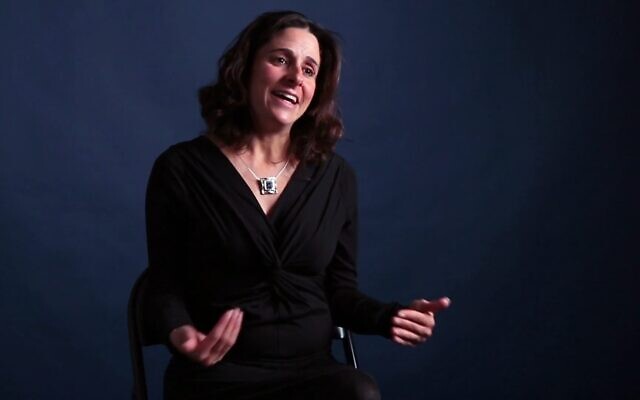
“I’m thrilled, honored, humbled and grateful to announce that next month, I will begin my appointment as @hrw’s new Program Director, supervising our research and investigations as we reorient ourselves to strengthen the broader human rights ecosystem and meet today’s challenges,” Bashi tweeted on Friday.
In the past, Bashi, a lawyer by training, co-founded and directed Gisha, an organization that pushes for freedom of movement for Palestinians in Gaza. From 2015 to 2018 she served as the director of Israel-Palestine for HRW, and returned to the organization last year as a special adviser.
In recent years, Bashi, a US native, has been open about her relationship with a Palestinian man originally from Gaza, and the struggles they have faced to live in the same place. They lived together for a few years in the United States as well as in South Africa, and have based their lives in Ramallah, she said, since they are unable to live together in Israel.
The reaction was quick in coming. On 2 May Just the News stated: “A powerful nongovernmental organization with a massive budget and an alleged ideological bias against Israel will continue targeting the Jewish state after it completes a major leadership change now underway, according to experts and lawmakers who spoke to Just the News.” “Unfortunately, the extremely biased attitude toward Israel which Kenneth Roth represented in Human Rights Watch will, most probably, be cemented with the appointment of Sari Bashi,” said Sarah Stern, president of the Endowment for Middle East Truth, a think tank. “Throughout her career, Ms. Bashi has constantly demonstrated her lack of objectivity and overwhelming animus towards the state of Israel.”
Steven Donziger, the human rights lawyer who took on Chevron, spent nearly a thousand days in jail or on house arrest. Amnesty says it was corporate retaliation.
This article originally appeared on 26 April at Common Dreams:
Human rights lawyer Steven Donziger walked free Monday after 993 days of detention stemming from his decades-long legal fight with Chevron, which deployed its vast resources in a campaign to destroy Donziger after he won a $9.5 billion settlement against the fossil fuel giant over its pollution of the Amazon rainforest.
“It’s over. Just left with release papers in hand,” Donziger wrote on Twitter. “Completely unjust that I spent even one day in this Kafkaesque situation. Not looking back. Onward.”
“We are relieved that Steven Donziger will finally recover his freedom after almost 1,000 days of arbitrary detention, which included 45 days in prison and over 900 days under house arrest,” Daniel Joloy, senior policy advisor at Amnesty International, said in a statement Monday. “He should have never been detained for even one day, as it has been clear the whole process against him has been in retaliation for his human rights work that exposed corporate wrongdoings.”
“Corporations must not be allowed to continue abusing the U.S. justice system to silence and intimidate human rights defenders or anyone else exposing their wrongdoing,” Joloy added.
…In 2014, a federal judge with ties to Chevron ruled that Donziger was guilty of a “pattern of racketeering activity,” a charge he has denied. U.S. District Judge Lewis Kaplan’s decision was based on testimony from a witness who later admitted to lying.
Andrew Rettman writing in the EUObserver of 27 April 2022
Independent media should have less to fear in future from malicious lawsuits, after the EU Commission put forward a new law to shield them.
Billionaires, big corporations, and autocrats have, in recent years, resorted ever more frequently to so-called strategic lawsuits against public participation (SLAPPs) in order to try to gag adversaries.
But if EU states and MEPs back the commission’s proposed anti-SLAPP directive, then judges will soon get a fresh mandate to throw out bogus cases — and compensate their victims.
“With these measures we are helping to protect those who take risks and speak up when the public interest is at stake,” EU values commissioner Věra Jourová said in Brussels.
“We promised to defend better journalists and human rights defenders,” she said. “The new law does that,” Jourová said.
The directive lists criteria which individual judges can, using their discretion on a case-by-case basis, use to decide whether litigation is genuine or abusive.
These include seeking disproportionately huge financial damages or launching multiple cases at the same time, for instance.
The anti-SLAPP law applies to non-EU or “third” countries, giving European judges leeway to annul vexatious judgments against EU nationals if they are doled out in London, for example.
It is delimited to civil cases “with cross-border implication”. This is because EU competences do not cover national and criminal media laws in member states under the terms of Europe’s treaties. It means a Polish journalist or LGBTI rights activist, for example, who is sued by a Polish entity would normally not be covered.
But the “cross-border” element has been drafted by Jourová’s lawyers in a canny way so that if their case arguably had relevance beyond their national borders then the EU law would kick in.
EUobserver has faced three lawsuits in the past three years that were designated as SLAPPs by leading pro-free media NGOs.
The first saw a Luxembourg-based firm sue us in Belgium about an article on disinformation in Malta — an archetypal example of a “cross-border” lawsuit falling under the directive.
The second saw a Belgian firm sue EUobserver in Belgium, but as the story covered VIP-jet leasing security for EU and Nato heads of state from all over Europe this would also be covered under the cross-border clause.
The final one, which is ongoing, involves a Belarusian firm suing EUobserver in Belgium over an article about alleged money-laundering in Cyprus, but this would also likely fall under both the “third-country” and “cross-border” provisions, NGO experts told this website Wednesday in a flash analysis.
The commission “did the best it could do”, given its jurisdiction, Julie Majerczak, from the Paris-based NGO Reporters Without Borders, said. “It’s not perfect, but it’s a big step forward — two years ago we were nowhere on this,” she added…
There were at least 438 SLAPP cases in 24 member states in 2021 targeting 978 people or entities, the commission noted. Journalists in Bulgaria, Croatia, Poland, and Slovenia were being routinely targeted, Reporters Without Borders said. Journalists in Italy and environmental activists in France and Spain were also notable victims, it added.
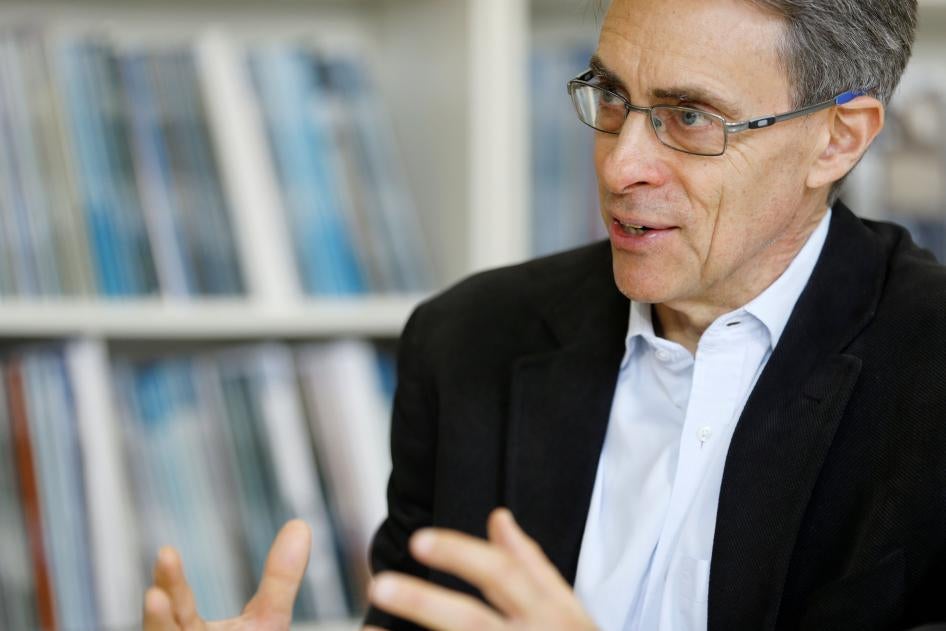
Human Rights Watch Executive Director Kenneth Roth has announced that he plans to step down at the end of August 2022, Human Rights Watch said on 26 April. Roth has led the organization since 1993, transforming it from a small group of regional “watch committees” to a major international human rights organization with global influence.
“I had the great privilege to spend nearly 30 years building an organization that has become a leading force in defending the rights of people around the world,” Roth said. “I leave Human Rights Watch with confidence that a highly talented and dedicated staff will carry on that defence with great energy, creativity, and effectiveness.”
Under Roth’s leadership, Human Rights Watch grew from a staff of about 60 with a $7 million budget, to 552 covering more than 100 countries and a nearly $100 million budget.
Roth began his human rights career as a volunteer, working on nights and weekends while serving as an attorney and a federal prosecutor. He joined Human Rights Watch in 1987 as deputy director. At the time, the organization consisted of Helsinki Watch, formed in 1978 to support dissident movements in Eastern Europe; Americas Watch, founded in 1981; and Asia Watch, formed in 1985. Shortly after Roth joined, the organization created Middle East Watch and Africa Watch. Early in his tenure, Roth moved the organization toward a single identity as Human Rights Watch…
Roth recognized the need for real time documentation of atrocities to generate immediate pressure to end them. That led to the creation of a group of specially trained researchers who could provide a surge capacity to the organization’s regular country researchers.
Roth also embraced new possibilities to bring perpetrators to justice. As Human Rights Watch researchers meticulously documented abuses, the organization pressed the United Nations Security Council, then in a more cooperative moment, to create international war crimes tribunals for the former Yugoslavia and Rwanda. Human Rights Watch research was used to build some of the cases, and staff testified at both UN tribunals. Human Rights Watch also played a prominent role in establishing the International Criminal Court, fending off pressure from the US government seeking to ensure immunity for its own forces.
“Ken’s fearless passion for justice, his courage and compassion towards the victims of human rights violations and atrocity crimes was not just professional responsibility but a personal conviction to him,” said Fatou Bensouda, former chief prosecutor of the International Criminal Court. “He has indeed been a great inspiration to me and my colleagues.”
Today, amid the horrific abuse taking place in Ukraine, an infrastructure is in place to hold perpetrators accountable.
Roth also created special teams to address the needs of certain marginalized people, including women, children, lesbian, gay, bisexual and transgender (LGBT) people, refugees, people with disabilities, and older people. He also oversaw the development of specialized programs on poverty and inequality, climate change, technology, and corporate social responsibility. In addition, he initiated a program to address human rights in the United States.
Roth changed the way that Human Rights Watch directed its advocacy. The organization began focusing mainly on US foreign policy. Roth globalized the organization’s advocacy, establishing offices in Brussels, London, Paris, Berlin, Stockholm, Tokyo, Sao Paolo, Johannesburg, and Sydney. He also spearheaded the organization’s work with the United Nations, with dedicated advocates in New York and Geneva.
After the 9/11 attacks, Human Rights Watch documented and exposed the use of “black sites” where US officials interrogated and tortured terrorism suspects. Under Roth, Human Rights Watch pressed the US government to investigate and prosecute those responsible for issuing the orders. Eventually the US Senate issued the Torture Report confirming Human Rights Watch’s findings and denouncing the Central Intelligence Agency’s use of torture.
“Ken Roth turned Human Rights Watch into a juggernaut for justice,” said Anthony Romero, executive director of the American Civil Liberties Union. “He has inspired a generation of human rights defenders to fight for a better world. During the so-called ‘war on terror,’ Ken went to Guantanamo and brought to bear his acumen and stature in exposing the farce of the military commission process. No organization and no leader have had a greater impact in human rights on a global scale.”
Human Rights Watch’s communication strategy evolved dramatically under Roth. The organization began by writing reports. Over time, it also began producing shorter and quicker reports and built a strong multimedia capacity, so that videos, photos, and graphics now routinely accompany the organization’s publications and sometimes are the publication itself. The organization also embraced social media. The organization has amassed nearly 14 million followers on the major social media platforms. Roth himself has more than half a million Twitter followers.
In his nearly 30 years at the helm of Human Rights Watch, Roth traveled the world, pressing government officials of all stripes to pay greater respect to human rights. He met with more than two dozen heads of state and government along with countless ministers and made investigative or advocacy trips to more than 50 countries. Whenever he could, he also met with communities affected by human rights violations. During his early years with the organization, he conducted fact-finding investigations himself, including in Haiti, Cuba, Israel-Palestine, Kuwait after the Iraqi invasion, and Serbia after the US bombing. In recent years, he has been especially concerned with addressing atrocities during the Syrian war as well as Chinese government repression in Xinjiang.
Roth inevitably earned many enemies. Despite being Jewish (and having a father who fled Nazi Germany as a 12-year-old boy), he has been attacked for the organization’s criticism of Israeli government abuses. The Rwandan government was particularly vitriolic in its criticism of Roth after Human Rights Watch, which had issued a definitive account of the genocide, also reported on atrocities and repression under President Paul Kagame.
The Chinese government imposed “sanctions” on him and expelled him from Hong Kong when he traveled there to release the annual World Report in January 2020, which spotlighted Beijing’s threat to the global human rights system. Roth responded to these and many other criticisms by noting that the organization employs the same fact-finding methodology and applies the same human rights principles in every country where it works.
Roth has written extensively on a range of human rights issues. In addition to writing the introduction to the World Report since 1990, he has published more than 300 articles including in the New York Times, The Washington Post, The Guardian, The New York Review of Books, Foreign Policy, and Foreign Affairs. I quoted him often in this blog: see e.g. : https://humanrightsdefenders.blog/tag/kenneth-roth/
Roth plans to write a book drawing on his personal experiences about the most effective strategies for defending human rights. “I am leaving Human Rights Watch but I am not leaving the human rights cause,” Roth said.
Human Rights Watch will conduct an open search for Roth’s successor. Tirana Hassan, chief programs officer, will serve as interim executive director.
HURIDOCS has been working with urgency to meet the needs of our Ukrainian partners to enable effective, comprehensive and safe documentation of human rights violations. The HURIDOCS Team on 19 April 2022 tells how:
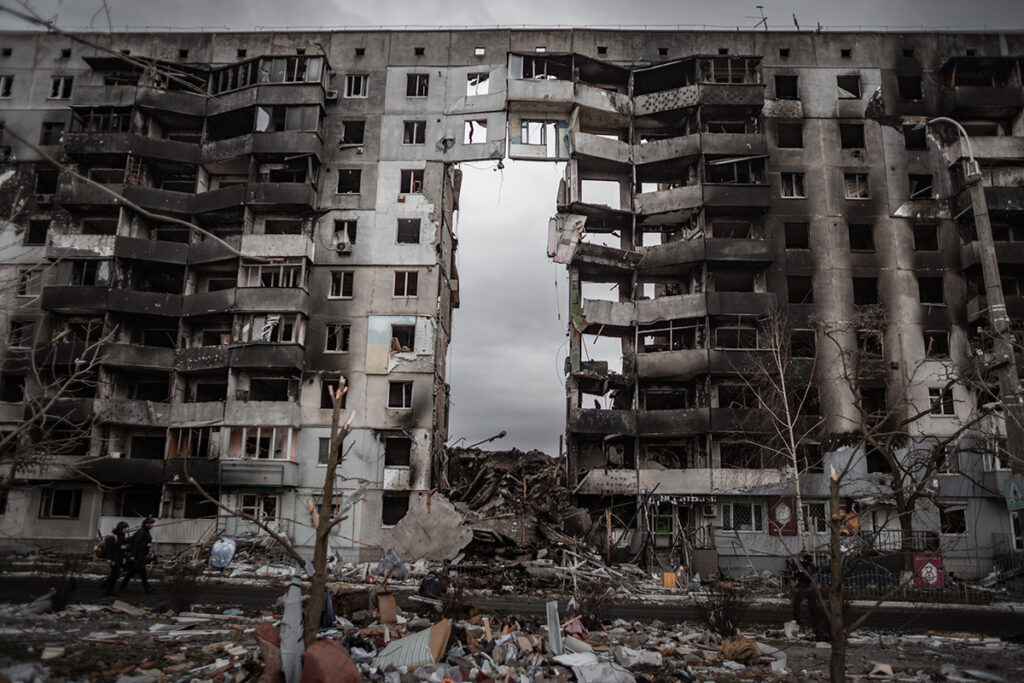
A maternity ward and children’s hospital are hit by an airstrike. Schools and apartment blocks are shelled. A psychiatric facility is attacked. Residential areas are targeted by cluster bombs. Critical infrastructure is struck by missiles. Mass civilian graves are discovered.
These horrendous attacks on civilians in Ukraine, some of them on healthcare facilities, are labelled by the United Nations as ‘acts of unconscionable cruelty’. Russia’s invasion of Ukraine, which started on 24 February 2022, is unfolding as a series of atrocities committed against civilians.
Indiscriminate attacks using missiles, heavy artillery shells, rockets and airstrikes on civilians and non-combatants are in contravention of international humanitarian law and may amount to war crimes. Apart from attacks on civilians, Russia is reported to be shelling agreed-upon humanitarian corridors from conflict zones and therefore halting mass evacuations.
Borodyanka, a Ukrainian commuter town near Kyiv, was among the first places to be hit by Russian airstrikes.
Kyiv Declaration calls for support to groups actively documenting violations
Leaders of more than 100 Ukrainian civil society organisations have published the Kyiv Declaration, which defines the invasion as “a war against the fundamental principles of democracy”. The #KyivDeclaration asks for solidarity and immediate action, and outlines six urgent appeals to the international community. The organisations are collectively calling for the creation of safe zones in Ukraine, military aid, sanctions against Russia, humanitarian aid, freezing assets and revoking visas of prominent Russian families, and providing equipment to track war crimes. This includes technology and support to groups who are actively documenting the events in Ukraine, as well as human rights groups and lawyers who will be supporting accountability efforts in the long run.
An appeal from 100 Ukrainian civil society leaders
HURIDOCS has been working with urgency to meet the needs of our Ukrainian partners to enable effective, comprehensive and safe documentation of human rights violations.
“When Russia started its full-scale invasion in February this year, we revived the work of EuromaidanSOS. We are faced with a large number of war crimes that need to be documented. Among these are indiscriminate attacks on civilians and civilian objects, deliberate killings, torture, cruel and inhumane treatment, enforced disappearances and other crimes listed in the Rome Statute. Such acts are not justified by any circumstances of the war. Russia is simply using war crimes as a way of waging war.
Our volunteers from EuromaidanSOS are based in different parts of the country, and some of them work directly in hot spots, where they face constant connectivity issues. This is why usable technical solutions are indispensable. As this work is undertaken in the context of war, it is important to have qualified technology support. We are very grateful to the organisations, such as HURIDOCS, providing it in this difficult time for us.”– Oleksandra Matviychuk, Head of the Center for Civil Liberties and Board Member of HURIDOCS
Documenting violations is vital for accountability
Four days into the Russian invasion, the International Criminal Court (ICC) Prosecutor opened an investigation into war crimes being committed in Ukraine. In conjunction with the investigation, the ICC launched a contact portal and anyone with relevant information is urged to come forward and share the details with the ICC. The United Nations Human Rights Council expressed that it is gravely concerned about the escalating human rights and humanitarian crisis and passed a resolution to establish a Commission of Inquiry. The Commission will first and foremost collect evidence of violations and those responsible, and subsequently submit reports to the Human Rights Council and General Assembly. The Federal Prosecutor’s Office in Germany has launched an investigation by collecting evidence of suspected crimes on civilians and critical infrastructure. Germany’s probe is based on the principle of universal jurisdiction, which allows countries to prosecute crimes against international law outside of its borders.
The United Nations High Commissioner for Human Rights released a statement where she expressed horror by the images of civilian bodies on the streets and in improvised graves in the town of Bucha. She stated that reports of egregious crimes raise serious questions about possible war crimes and grave breaches of international and humanitarian law. She urged that “it is vital that all efforts are made to ensure there are independent and effective investigations into what happened in Bucha to ensure truth, justice and accountability, as well as reparations and remedy for victims and their families”.
In addition to these and other measures already underway to investigate possible war crimes and breaches of international and humanitarian law, some of the most authoritative civil society organisations in Ukraine have established a global initiative to seek justice and hold perpetrators accountable. The ‘Breaking the Vicious Circle of Russia’s Impunity for Its War Crimes’ initiative was jointly established by the Ukrainian Helsinki Human Rights Union, the Kharkiv Human Rights Protection Group and the Center for Civil Liberties, and is also known as the ‘Tribunal for Putin’.
The Tribunal for Putin aims to document events which can be classified as genocide, crimes against humanity and war crimes under the Rome Statute of the International Criminal Court. The Tribunal for Putin will also collect evidence and facts on the crimes committed and will work with existing international mechanisms of the United Nations, Council of Europe, OSCE, EU and the International Criminal Court. The initiative has called for support from various actors such as international organisations, networks, government agencies, public associations, volunteer initiatives and groups who all share the common goal of restoring peace in Ukraine and ensuring that justice will prevail.
Civil society plays a crucial role in seeking justice
In this context, it is clear that the systematic documentation of human rights violations, irrespective of who is committing the transgression, is critical to achieving justice and accountability. Documentation should not only be undertaken to assist future justice and accountability mechanisms but also to support the process of reckoning and healing.
Civil society plays a key role in efforts to document and monitor violations, and to build and strengthen cases for accountability. Civil society actors are usually the first to respond to crises, have the deepest community reach and can mobilise the people who are living through these experiences. Documenting human rights violations as they happen is imperative in the process of restoring justice. To effectively and safely assist the community there is a need for strong digital tools to gather, process, preserve, manage, protect and analyse the rapidly growing bodies of potential evidence, including large amounts of storage-intensive video. In addition, deterrence against the worst violations can also be established through credible documentation strategies.
HURIDOCS is a longtime supporter of civil society organisations and human rights defenders who use human rights documentation strategies and tools as a means to strengthen accountability and advocate for justice. We are already supporting a number of groups working on documenting human rights violations in Ukraine and HURIDOCS invites other initiatives who need support with their documentation efforts to contact us. We value diverse approaches to documenting violations, as it may strengthen accountability measures and aid in articulating narratives during the process of memorialisation.
Support for documenting violations in Ukraine
With the increased need for support to document violations in Ukraine to strengthen accountability, the Alfred Landecker Foundation has partnered with HURIDOCS to increase our capacity to support civil society-led initiatives where our expertise can be helpful. HURIDOCS is grateful to the Foundation for the support, as it comes at a time when documenting threats to peace, justice and democracy is critical. The support from the Alfred Landecker Foundation will be used to assist groups who are already participating in documentation efforts, and to aid other initiatives related to documenting violations in Ukraine.
HURIDOCS is currently supporting our partners in the following ways:
Training and consultation on information collection, protection and management techniques and associated tools, such as Uwazi;
Setting up digital information repositories to securely store sensitive data;
Refinement and integration of existing technology solutions to document, protect and analyse evidence of human rights violations; and
Hardening and scaling infrastructure to preserve and protect large amounts of information.
There is a significant and growing need to support organisations with their efforts to gather, process, preserve, manage, protect and analyse information on abuses. Reliable documentation of violations is essential for the restoration of justice in the pursuit of upholding democracy and human rights.
“Xheni Karaj, from Albania, and Frank Mugisha, from Uganda, are two of the world’s most courageous LGBTI+ activists and human rights defenders. Despite working in environments where homophobia is widespread, they continue fighting with impressive resilience, for every individual’s right to have their own sexual orientation and gender identity. They have both been instrumental in building LGBTI+ movements in their countries and inspire LGBTI+ activists all over the Balkan region and the African continent,” the Civil Rights Defenders Board of Directors writes in the motivation for the award.
The right to one’s own sexuality and gender identity is a human right, but violence and discrimination against people from the LGBTI+ community is still a problem globally. Xheni Karaj, founder and Executive Director of Aleanca LGBT in Albania and Frank Mugisha, Executive Director of Sexual Minorities Uganda (SMUG) are working for LGBTI+ and human rights in countries where violence, discrimination, and homophobia is widespread. Due to the situation in both Uganda and Albania, many LGBTI+ people keep their sexual identity hidden out of fear for the consequences they might face if coming out in public. Through education, advocacy, and building a community for LGBTI+ persons, Frank Mugisha and Xheni Karaj are contributing to improving the lives of thousands. Their commitment to LGBTI+ rights has played a huge part in the progress for human rights in their regions.
“I am excited and happy about the award. This prize shows that LGBTI+ rights are part of universal human rights. For us, it is a recognition that we are involved in advancing human rights work,” says Frank Mugisha.
“The award made us all feel very happy and appreciated and motivates us to continue with the good work we are doing. To get this acknowledgment also helps me realise that we are making a revolution in Albania. From being invisible, we have showed people that we exist. That we are proud of ourselves, and we should have the right to be free and tell our stories,” says Xheni Karaj.
On 14 April 2022, ProtectDefenders.eu published its 2021 annual report:
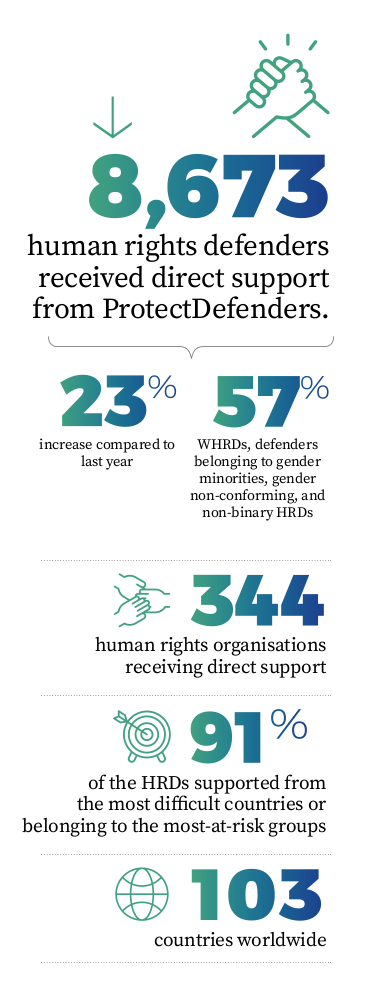
Throughout 2021, the EU human rights defenders mechanism, ProtectDefenders.eu, has delivered life-saving support and multi-faceted assistance to nearly 8,700 of the most at-risk human rights defenders and grassroots human rights organisations around the world – 23% more than in 2020. The EU HRD mechanism’s strategic, flexible, and efficient support has mitigated the ravages suffered by the human rights defence community last year, amid the pervasive impacts of the COVID-19 pandemic and the most critical global and geopolitical environment for human rights defence work reported since the creation of ProtectDefenders.eu in 2015.
Despite this extremely adverse situation, ProtectDefenders.eu has continued to mobilise protective support to individuals at risk, and to provide comprehensive assistance to organisations and movements confronting security threats. The support of ProtectDefenders.eu has helped human rights defenders and grassroots human rights groups to strengthen their resilience and protection globally, particularly in the most difficult contexts, making a significant contribution to their ability to continue their work.
Last year, the activities of the EU HRD mechanism have been impacted by an unprecedented increase in requests for urgent materially protective support from defenders and communities: ProtectDefenders.eu has had to respond to, among other severe crises, the dismantling and repression of civil society in Belarus, the consequences of the coup d’état in Myanmar on civil society and HRDs, and the collapse of Afghanistan as the Taliban took over its government. Thus, significant efforts were made to reach these most difficult countries and the most at-risk groups of defenders, who have absorbed an unprecedented level of the support delivered by the EU HRD mechanism. See also; https://humanrightsdefenders.blog/2019/05/28/the-eu-human-rights-defenders-mechanism-a-short-overview/
In a quickly evolving context, creative and flexible solutions and adaptations have been implemented, and this year the consolidation of the ProtectDefenders.eu consortium has given rise to new spaces to explore the privileged positioning of the EU HRD mechanism in the international community in support of defenders. This is illustrated by the launch of the first HRD resettlement stream by the government of Canada in partnership with ProtectDefenders.eu, the articulation of a comprehensive response in Afghanistan through new programmes in partnership with the EU, and the steps taken towards a more comprehensive and collective approach to advocacy on issues of common interest.
ProtectDefenders.eu has continued to provide a comprehensive, holistic and effective emergency protection for HRDs at the greatest risk, including 24/7 support, and to invest in the resilience and capacity of human rights organisations to continue their work in adverse environments – notably through lifeline and core-funding grant-making to local actors, including communities defending rights. ProtectDefenders.eu has also ensured that international temporary relocation capacities remain operational and accessible for HRDs and members of their families, and has taken a significant step in strengthening regional relocation structures through the Shelter Initiatives program. Furthermore, and despite the prevailing limitations created by the pandemic, capacity-building activities have continued to provide access to knowledge about reinforced protection strategies for the community of defenders. Similarly, ProtectDefenders.eu has strengthened its support to individual HRDs and NGOs through its reactive and protective advocacy work to HRDs at risk through urgent interventions, reports, and related proactive steps, mobilising the international community in an effort that has led to multiple success stories throughout the world.
This coordinated implementation, coupled with a holistic and complementary approach between partners, actions, strategies, and programmes, continues to step up the practical support available to HRDs at risk and local human rights NGOs in a timely and comprehensive manner; the vast majority of HRDs accessing ProtectDefenders.eu’s support have reported enhanced security and protection, and highly positive outcomes. Although the extreme situation in 2021 has pushed the mandate and resources of the EU HRD mechanism to the limit, ProtectDefenders.eu has managed to maintain and generate a consistently noticeable and positive impact on the HRD community at highest risk.
The 2021 ProtectDefenders.eu Annual Report is introduced by Victoria Fyodorova, a woman human rights defender from Belarus, Jamila Afghani, a WHRD from Afghanistan, Josep Borrell, Representative of the Union for Foreign Affairs and Security Policy/Vice-President of the European Commission, Jutta Urpilainen, Commissioner for International Partnerships, and Maria Arena, Chair of the European Parliament’s subcommittee on Human Rights.
On 19 April 2022 the EU published its 2021 report on Human Rights and Democracy in the World.l
INTRODUCTION: In 2021, in a context characterised by a prevailing global pandemic and a sustained trend of rising authoritarianism, the EU stepped up its work to uphold human rights, democracy and the rule of law across the world and strengthened its tools.
This annual report on human rights and democracy monitors the implementation of the EU Action Plan by presenting the progress achieved to date.
One landmark achievement is the EU Global Human Rights Sanctions Regime (EUGHRSR). In 2021, the EU adopted restrictive measures targeting persons and entities from China, the Democratic People’s Republic of Korea (DPRK), Libya, South Sudan, Eritrea and Russia, involved in serious human rights violations and abuses. The EU imposed sanctions in the case of Alexei Navalny’s arbitrary arrest and detention, as well as sanctions against the Wagner group and its members. In December, the Council adopted a decision prolonging for one year the existing sanctions.
Throughout the year, the EU took the lead in UN human rights fora on initiatives aimed at addressing human rights violations and abuses in Afghanistan, Belarus, Burundi, DPRK, Ethiopia, Eritrea and Myanmar. The first EU strategic dialogue with the Office of the UN High Commissioner for Human Rights (OHCHR) in October 2021 was an opportunity to share updates on global human rights issues, to discuss priorities and to build a stronger partnership for more effective multilateralism and rules-based international cooperation. As a staunch advocate of multilateralism, the EU also remains vigilant in the defence and advancement of universal human rights and the integrity and functionality of the global human rights system.
Pursuing its political priority towards achieving gender equality and women’s empowerment, the EU reinforced its ambition through the implementation of the EU Action Plan on Gender Equality and Women’s Empowerment in the EU External Action 2021-2025 (GAP III). The EU remained committed to preventing and combatting all forms of gender-based violence and engaged as an Action Coalition leader in the Generation Equality Forum, as well as in the Call to Action on Protection from Gender-Based Violence in Emergencies.
In 2021, the International Year for the Elimination of Child Labour, the EU Strategy on the Rights of the Child5 was also adopted. It was developed with contributions from over 10,000 children and proposed new actions to support children and contribute to the protection and promotion of their rights.
In 2021, the EU further expanded its concrete support to civil society organisations and human rights defenders, especially environmental, land and indigenous peoples’ rights defenders, women human rights defenders and labour rights defenders, who remained under severe pressure around the world. The 23rd EU-NGO Human Rights Forum organised on 7-8 December 2021 focused on ‘Rebuilding better: a human-rights based recovery from the pandemic’. The EU Human Rights Defenders Mechanism ProtectDefenders.eu (EUR 35 million for 2015-2022) has supported nearly 53,000 human rights defenders at risk and their families since its launch in 2015. [see: https://humanrightsdefenders.blog/2022/02/28/eu-by-far-biggest-funder-of-human-rights-defenders/]
In a global context of democratic backsliding, supporting democratic electoral processes remained a cornerstone of EU engagement worldwide. Despite the restrictions linked to the pandemic and political and security circumstances, in the second half of 2021 the EU successfully deployed Election Observation Missions to Zambia, Kosovo, Iraq, Venezuela, Honduras, and The Gambia.
The Martin Ennals Award Laureates 2022 are leading architects of the human rights movement. Get inspired by their courage and unique contributions at the Award Ceremony on 2 June 2022
The authorities in Thailand should urgently investigate an incident intended to intimidate a prominent human rights defender, Human Rights Watch said on 13 April, 2022.
On April 12, 2022, at about 6 a.m., an unidentified assailant threw a pair of 9-inch-long scissors at the house of Angkhana Neelapaijit in Bangkok, making a hole in her front door. Security camera footage showed what appeared to be a woman wearing a face mask and a dark t-shirt with the Thai numeral 9 standing in front of the house, throwing the scissors, and then running away. Angkhana, 66, is a former commissioner of the National Human Rights Commission of Thailand and a newly appointed member of the United Nations Working Group on Enforced or Involuntary Disappearances. See: https://www.trueheroesfilms.org/thedigest/laureates/0D5DED3E-F79F-4AB4-8261-F6A19486F062
“Violent acts intended to intimidate a well-known figure like Angkhana not only pose a threat to her and her family, but send a spine-chilling message to the entire Thai human rights community,” said Elaine Pearson, acting Asia director at Human Rights Watch. “The Thai government should respond immediately by undertaking a serious investigation to ensure that everyone responsible for this incident is held accountable.”
Angkhana told Human Rights Watch that she and her family felt vulnerable after the Justice Ministry canceled her protection under the government’s witness protection program on April 1. The authorities claimed the service was no longer needed because Angkhana’s life would no longer be in danger after the Department of Special Investigation ended its investigation of the enforced disappearance of her husband, the prominent human rights lawyer Somchai Neelapaijit. [See also: https://humanrightsdefenders.blog/2021/03/17/where-is-somchai-a-brave-wifes-17-year-quest-for-the-truth/]
“The Thai government should not ignore this disturbing incident, which appears to be a response to Angkhana’s effective human rights advocacy,” Pearson said. “Foreign governments and the United Nations should press the Thai government to urgently act to protect Angkhana and other human rights defenders in the country.”


 Hans Thoolen on Human Rights Defenders and their awards