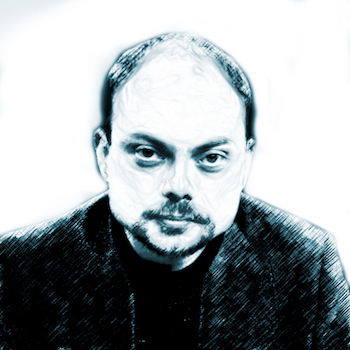
Vladimir Kara-Murza, the Russian democracy activist, historian, twice-poisoned critic of Vladimir Putin’s regime, and a senior advisor to Human Rights First, was reportedly arrested near his Moscow residence on 11 April 2022. Kara-Murza’s arrest came just days after his return to Russia and shortly after CNN broadcasted an interview with him. He is the winner of 3 human rights awards, see: https://www.trueheroesfilms.org/thedigest/laureates/34e43b60-3236-11ea-b4d5-37ffeeddd006
“We are deeply concerned for our friend Vladimir Kara-Murza’s personal safety, and we call on Russian authorities to release him immediately,” said Michael Breen, President and CEO of Human Rights First. “Putin and his regime have shown themselves to be willing to break any law, domestic or international, to suppress political opposition at home and subjugate neighboring countries like Ukraine. We call on all of democracy’s allies to oppose criminal behavior like this to protect human rights in Russia, Ukraine, and around the world.”
Having been targeted for assassination twice before, Kara-Murza knew his return to Russia put him in danger. In his recent CNN interview, Kara-Murza said, “The biggest gift we could give…to the Kremlin would be just to give up and run…that’s all they want from us.”
On 8 April 2022, the Russian government closed the offices of Amnesty International and Human Rights Watch and several other NGOs such as Carnegie Endowment for International Peace, Friedrich Naumann Foundation for Freedom, Friedrich Ebert Foundation. This decision has been taken “in connection with the discovered violations of the Russian legislation.”
On 11 March, Russia’s media regulator had already blocked access to Amnesty International’s Russian-language website.
“Human Rights Watch has been working on and in Russia since the Soviet era, and we will continue to do so,” said Kenneth Roth, executive director of Human Rights Watch. “This new iron curtain will not stop our ongoing efforts to defend the rights of all Russians and to protect civilians in Ukraine.”
Reacting to the news, Agnès Callamard, Secretary General of Amnesty International, said: “Amnesty’s closing down in Russia is only the latest in a long list of organizations that have been punished for defending human rights and speaking the truth to the Russian authorities. In a country where scores of activists and dissidents have been imprisoned, killed or exiled, where independent media has been smeared, blocked or forced to self-censor, and where civil society organizations have been outlawed or liquidated, you must be doing something right if the Kremlin tries to shut you up.“
TechCrunch of 5 April 2022 reports that Investigators say they have found evidence that a Jordanian journalist and human rights defender’s iPhone was hacked with the Pegasus spyware just weeks after Apple sued the spyware’s maker NSO Group to stop it from targeting Apple’s customers.
Award-winning journalist Suhair Jaradat’s phone was hacked with the notorious spyware as recently as December 5, 2021, according to an analysis of her phone by Front Line Defenders and Citizen Lab that was shared with TechCrunch ahead of its publication. Jaradat was sent a WhatsApp message from someone impersonating a popular anti-government critic with links to the Pegasus spyware, compromising her phone. According to the forensic analysis, Jaradat’s iPhone was hacked several times in the preceding months and as far back as February 2021.
Apple had filed a lawsuit against Israeli spyware maker NSO Group in November 2021, seeking a court-issued injunction aimed at banning NSO from using Apple’s products and services to develop and deploy hacks against its customers. See also: https://humanrightsdefenders.blog/2021/07/21/nsos-pegasus-spyware-now-really-in-the-firing-line/…But so far the case has gotten off to a slow start after the first judge assigned to the case recused herself, with no decision on the case likely to be made any time before June.
Jaradat is one of several Jordanians, including human rights defenders, lawyers and fellow journalists whose phones were compromised likely by agencies of the Jordanian government, according to Front Line Defenders and Citizen Lab’s findings out Tuesday.
Among the others targeted include Malik Abu Orabi, a human rights lawyer whose work has included defending the teachers’ union, which in 2019 led the longest public sector strike in the country’s history. Abu Orabi’s phone was targeted as early as August 2019 until June 2021. Also, the phone of Ahmed Al-Neimat, a human rights defender and anti-corruption activist, was targeted by the ForcedEntry exploit in February 2021. The researchers said the hacking of Al-Neimat’s phone is believed to be the earliest suspected use of ForcedEntry.
Another Jordanian journalist and human rights defender’s phone was targeted, according to the researchers, but who asked for her identity not to be disclosed.
—
Meanwhile, on 5 April 2022, AFP reported that Palestinian lawyer Salah Hamouri, who is in Israeli detention, filed a complaint in France Tuesday against surveillance firm NSO Group for having “illegally infiltrated” his mobile phone with the spyware Pegasus.
Hamouri, who also holds French citizenship, is serving a four-month term of administrative detention ordered by an Israeli military court in March on the claim he is a “threat to security”.
On Tuesday, the International Federation for Human Rights (FIDH), the Human Rights League (LDH) and Hamouri filed a complaint with the Paris prosecutor. It accused NSO of “having illegally infiltrated the telephone of rights defender Salah Hamouri,” they said in a statement sent to the AFP bureau in Jerusalem.
“Obviously, this is an operation that is part of a largely political framework given the harassment Hamouri has been subjected to for years and the attacks on human rights defenders in Israel,” attorney Patrick Baudouin, honorary president of the FIDH, told AFP.
On 30 March 2022, Statewatch along with 13 other human rights organisations condemned the deportation from Spain to Algeria of Mohamed Benhalima, a human rights activist who faces a serious risk of torture and other ill-treatment in the North African state.
The organisations strongly condemn the deportation by Spain of Algerian activist Mohamed Benhalima, in the evening of 24 March 2022, despite the risks of torture and serious human rights violations he faces in Algeria, and therefore in blatant violation of Spain’s international obligations on non-refoulement. The authorities had been made aware, through civil society and legal appeals, that Mr Benhalima faces a high risk of torture, arbitrary detention and unfair trial in Algeria, where such violations are increasingly common against prisoners of opinion and peaceful activists.
Mohamed Benhalima is an Algerian citizen and a former Army corporal turned whistleblower, who exposed corruption among Algeria’s high-ranking military officials in 2019. He left Algeria after receiving information that his name was on a list of wanted military officials at risk of detention by the Algerian army for their participation in the Hirak, a mass pro-democracy protest movement.
He sought asylum in Spain on 18 February 2020 and again on 18 March 2022; Spain refused him asylum both times. On 14 March 2022, authorities opened an administrative file of expulsion for infringement of Art. 54.1.a. of Immigration Law 4/2000, alleging that Mr. Benhalima took part in “activities contrary to public security or which may be harmful for Spanish relationships with foreign states”.
Spanish authorities justified the opening of an expulsion file based on Mr. Benhalima’s alleged association with political opposition group Rachad, which was listed as a terrorist group by Algeria on 6 February 2022. Spanish authorities claimed that Rachad’s objective was to infiltrate radical youth into Algerian society to protest against the Algerian government, and concluded that the activist was a member of a terrorist group.
Authorities did not provide any proof of violent action or speech or any other action taken by the activist that would fall under a definition of terrorism in accordance with the definition proposed by the UN Special Rapporteur on the protection of human rights while countering terrorism. Authorities also do not appear to have considered a context in which Algerian authorities have been increasingly levelling bogus terrorism and state security charges against peaceful activists, human rights defenders and journalists since April 2021. On 27 December 2021, UN Special Procedures warned that the definition of terrorism in the Algerian Penal Code was too imprecise and undermined fundamental rights. They stated that the procedure for registration on the national terrorist list did not comply with international human rights standards and expressed concern that it could give rise to abuse.
On 24 March around 7pm, Mr. Benhalima’s lawyers were notified of the resolution of expulsion and promptly filed a request for an interim suspensive measure at the National Court of Spain, which was rejected; however, it was revealed later that the activist was already on his way to Algeria at the time.
On 21 March 2022, the UN High Commissioner for Refugees (UNHCR) submitted a non-public report to the Spanish government stating that Mr. Benhalima’s asylum request should be studied thoroughly in a regular procedure and not rejected expediently, arguing that the fear of torture was credible and that Algeria’s criminalisation of peaceful opposition was internationally recognised.
On 27 March, Benhalima appeared in a video broadcasted on Ennahar TV, in which he “confesses” to the crimes of conspiracy against the state, and states that he was not treated badly in custody. However, the undersigned organisations call into question the reliability of such statements which might be the result of duress. In addition, Benhalima had himself released a video from the retention centre in Valencia, before his deportation to Algeria, in which he warns that such videos would not be genuine and would show that he “was subjected to severe torture at the hands of intelligence services.”
In January and March 2021, in Algeria, Mohamed Benhalima was sentenced in absentia to a total of 20 years in prison for charges including “participation in a terrorist group” (Article 87bis 3 of the Penal Code) and “publishing fake news undermining national unity” (Art.196 bis) among other charges. The overly broad formulation of both articles has been used by Algeria repeatedly to criminalise fundamental freedoms. In one of the verdicts, issued on 9 March 2021, the judge sentenced Benhalima to 10 years in prison for his online publications, including videos exposing corruption in the army, a form of peaceful expression, which is protected under the right to freedom of expression.
Spanish authorities additionally motivated the expulsion based on Mr. Benhalima’s close relationship with Mohamed Abdellah, another Algerian whistleblower and former member of the military, who also sought refuge in Spain in April 2019 and was forcibly returned on 21 August 2021 using Art. 54.1.a. of Law 4/2000, in similar circumstances and for the same motives.
Mohamed Abdellah, currently detained in the military prison of Blida, stated in court on 2 January 2022 that he had been subjected to various forms of torture and ill-treatment upon his return to Algeria, including prolonged solitary confinement in a cell with no light and physical abuse, according to a witness who attended the hearing. He was also deprived of access to a lawyer.
Despite the strong similarities between both cases providing a compelling precedent about the actual risk of torture and ill treatment of activists and whistleblowers, notably former members of the military, in Algeria, the Spanish government showed its determination to forcibly return someone where their physical and psychological integrity was not guaranteed. In doing so, Spain flouted critical international law obligations under which nobody should be returned to a country where they would be in danger of suffering torture or other cruel, inhuman or degrading treatment.
Signatures
MENA Rights Group
Justitia Center for legal protection of human rights in Algeria
European Union leaders should announce specific policy responses to the Chinese government’s atrocity crimes, Human Rights Watch said today, 30 March 2022. A virtual summit between the EU and China is scheduled for April 1, 2022.
The summit takes place at a time of heightened tensions between the EU and the Chinese government, which retaliated against Lithuania for its relations with Taiwan, baselessly sanctioned EU bodies and European research institutions, and has not condemned Russian war crimes in Ukraine. The Chinese government’s disregard for international human rights norms mirrors its domestic track record of grave abuses without accountability.
“The EU’s foreign policy chief has pointed with alarm to the Chinese government’s ‘revisionist campaign’ against universal human rights and institutions,” said Sophie Richardson, China director at Human Rights Watch. “Brussels should revise its approach to match the magnitude of that threat.”
While the EU has taken important steps in reaction to these developments, including some targeted sanctions and strong condemnations of Beijing’s abuses at the United Nations, these efforts lack the consequences to bring significant change. The rights groups urged Michel and von der Leyen to use their time with the Chinese leaders to announce further steps to counter Beijing’s abuses, and cautioned them against calling for yet another round of the bilateral human rights dialogue, which after 37 rounds has proven unable to secure concrete progress.
Stronger, better coordinated action is also supported by the European Parliament, which has remained a staunch critic of the Chinese government’s crackdown and has repeatedly denounced its abuses. Beijing responded by sanctioning several members of the European Parliament. In response, the European Parliament froze consideration of a bilateral trade deal and called for a new, and more assertive, EU strategy on China, including further targeted sanctions and closer coordination with like-minded partners. [see: https://humanrightsdefenders.blog/2021/05/21/china-eu-investment-deal-off-the-rail/]
“Presidents Michel and von der Leyen should go beyond words of condemnation at the summit if they want to deter Chinese government violations now and in the future,” said Claudio Francavilla, EU advocate at Human Rights Watch. “Bolder steps are needed to counter Beijing’s crimes against humanity and anti-rights agenda, and EU leaders should announce their determination to pursue them.”
The human rights organisation looks back on 2021, “a year of dashed hopes“. According to Amnesty International, the digital sphere is increasingly becoming a space for activism — and repression.
Despite promises and pledges to the contrary, at almost every turn, leaders and corporations opted for a non-transformative path, choosing to entrench rather than overturn the systemic inequalities behind the pandemic. Yet, people the world over have made it abundantly clear that a more just world, grounded in human rights, is what they want
Agnès Callamard SG AI
Here is how Deutsche Welle summarized it:
Every year, Amnesty International looks at developments around the world and compiles an analysis of the most important global trends in human and civil rights. In its latest annual report, Amnesty Middle East and North Africa research and advocacy director Philip Luth says: “2021 was a year of really quite significant promises. … The reality was completely otherwise.”
There had been hope that the world might emerge from the pandemic equitably, Luther told DW, but richer countries in particular have prevented the widespread manufacture and distribution of vaccines. The annual report cites the facts: Fewer than 8% of the 1.2 billion people in Africa were fully vaccinated at the end of 2021 — the lowest rate in the world and far from the WHO’s 40% vaccination target…..The study also found that many governments have used the pandemic to suppress opposition and civil society. “It’s across regions and that’s one of the reasons we highlighted it in our global analysis,” Luther said. “Some governments very specifically used the smoke screen of the pandemic to restrict freedom of expression.” Examples of countries where protests have been broken up and human rights defenders are at risk include Cambodia, Russia, China and others.
According to Amnesty and other international organizations, the pandemic is also having an effect on civil society. “There are various strategies that are making it increasingly difficult for civil society to operate in different regions of the world,” Silke Pfeiffer, head of the department for human rights and peace at the Christian-affiliated aid organization Brot für die Welt (Bread for the World), told DW. “This is quite specifically directed at individual activists, who are discriminated against, threatened, persecuted and in some cases murdered.” In many countries, Pfeiffer said, governments cultivate a hostile environment. “It becomes increasingly difficult for civil society organizations to work,” she said. “That goes as far as the closure of NGOs; we see that again and again.” To cite just one example: In late March, Nicaraguan President Daniel Ortega had 25 nongovernmental organizations closed. One of them is the Nicaraguan partner organization to Brot für die Welt.
Governments and NGOs are increasingly doing their work online. Luther describes the development as a “double-edged sword.” Authorities clandestinely use technology in ways that have a negative impact on people’s human rights, he said: “Governments in many cases were also then trying to shut down and disrupt tools that enable civil society to better communicate with each other and spread information.”
Amnesty International’s annual report cites multiple examples of this: the internet shutdown from August 4, 2019, to February 5, 2021, in the India-controlled regions of Jammu and Kashmir; the use of facial recognition technology at protests in Moscow; and the use of Israel’s Pegasus spyware against journalists, opposition figures and human rights activists. Pfeiffer said the internet was an important way for civil society to organize and mobilize. But she added that, around the world, “governments and other actors have completely upgraded digitally and are now also taking very strong action against freedom on the internet — through censorship, by shutting down internet services, through mass surveillance.”
Across the world, Amnesty noted, people took to the streets to fight for their rights and the rights of others in 2021 — in Russia, India, Colombia, Sudan, Lebanon and at least 75 other countries. in the words of AI Secretary General: “The palpable and persistent resistance offered by people’s movements the world over is a beacon of hope. Uncowed and undaunted, theirs is a clarion call for a more equal world. If governments won’t build back better – if they seemingly are intent on building back broken – then we are left with little option. We must fight their every attempt to muzzle our voices and we must stand up to their every betrayal. It is why, in the coming weeks, we are launching a global campaign of solidarity with people’s movements, a campaign demanding respect for the right to protest. We must build and harness global solidarity, even if our leaders won’t.”
She also said:
Global trends to stifle independent and critical voices gathered steam in 2021 as governments deployed a widening gamut of tools and tactics. Human rights defenders, NGOs, media outlets and opposition leaders were the targets of unlawful detention, torture and enforced disappearance, many under the smokescreen of the pandemic.
At least 67 countries introduced new laws in 2021 to restrict freedom of expression, association or assembly. In the USA, at least 36 states introduced more than 80 pieces of draft legislation limiting freedom of assembly, whilst the UK government proposed the Police, Crime, Sentencing and Courts Bill, which would drastically curtail the right to freedom of peaceful assembly, including by expanding police powers.
Global trends to stifle independent and critical voices gathered steam in 2021 as governments deployed a widening gamut of tools and tactics. Human rights defenders, NGOs, media outlets and opposition leaders were the targets of unlawful detention, torture and enforced disappearance, many under the smokescreen of the pandemic.
At least 67 countries introduced new laws in 2021 to restrict freedom of expression, association or assembly. In the USA, at least 36 states introduced more than 80 pieces of draft legislation limiting freedom of assembly, whilst the UK government proposed the Police, Crime, Sentencing and Courts Bill, which would drastically curtail the right to freedom of peaceful assembly, including by expanding police powers.
The English Premier League should immediately adopt and implement human rights policies that would prohibit governments implicated in grave human rights abuses from securing stakes in Premier League clubs to whitewash their reputations, Human Rights Watch said 0n 23 March 2022. The ban should be extended to state entities that they control, abusive state leaders, and individuals funding or otherwise assisting in serious abuses. See also: https://humanrightsdefenders.blog/2020/08/07/human-rights-compliance-test-for-football-clubs/
On March 14, 2022, mediareported that a consortium led by a Saudi media group closely connected to the Saudi government had expressed interest in purchasing Chelsea Football Club. This reinforces the urgent need for the Premier League to adopt policies to protect clubs and their supporters, before any sale takes place, from being implicated in efforts to whitewash rights abuses. The Premier League’s approval of the sale of Newcastle United to a business consortium led by the Saudi Arabia’s Public Investment Fund (PIF), a government-controlled entity implicated in serious human rights abuses, was conducted in an opaque manner and without any human rights policy in place. The Premier League should reconsider the approval of the Newcastle United sale. [see also: https://humanrightsdefenders.blog/2020/01/30/newcastles-takeover-bid-from-saudi-arabia-welcomed-by-many-fans-but-it-remains-sportswashing/]
“Allowing Newcastle United to be sold to a business consortium led by Saudi Arabia’s sovereign wealth fund, an institution chaired by a state leader linked to human rights abuses, has exposed the farcical inadequacies of the Premier League’s Owners and Directors Test,” said Yasmine Ahmed, UK advocacy director at Human Rights Watch. “As another consortium with Saudi government links eyes acquiring Chelsea, the Premier League should move fast to protect the league and its clubs from being a fast-track option for dictators and kleptocrats to whitewash their reputations.”
Human Rights Watch wrote to the Premier League CEO, Richard Masters, on March 15, to express concerns over the Newcastle United decision and to raise further concerns about the involvement of Saudi Arabia’s Public Investment Fund in facilitating human rights abuses.
The October 7, 2021 Premier League statement announcing the sale said that the league had “received legally binding assurances that the Kingdom of Saudi Arabia will not control Newcastle United Football Club.” The league did not disclose what these assurances were, nor explain how they would be legally binding. Instead, the Premier League appears to have acquiesced to the notion that the Public Investment Fund is separate from the Saudi state, even though its chairman is the de facto Saudi ruler, Crown Prince Mohammed bin Salman, its board members are nearly all currently serving ministers and other high-level officials, and it is a sovereign wealth fund that reports to the government’s Council of Economic and Development Affairs…
Human Rights Watch has significant concerns around the role of the investment fund itself in facilitating human rights abuses. Human Rights Watch wrote to the fund’s governor, Yasir al-Rumayyan, who, according to a LinkedIn page attributed to al-Rumayyan and various media reports, was managing director of the fund between 2015 and 2019, on December 21, 2021, and again on March 15 requesting his response to allegations of serious human rights violations associated with the fund. He has not responded. Al-Rumayyan is also Newcastle United’s new nonexecutive chairman.
Human Rights Watch has reviewed internal Saudi government documents submitted to a Canadian court as part of an ongoing legal claim filed by a group of Saudi companies against a former intelligence official. The documents showed that in 2017, one of Mohammed bin Salman’s advisers ordered al-Rumayyan, then the fund’s “supervisor,” to transfer 20 companies into the fund as part of an anti-corruption campaign. There is a risk that these companies were “transferred” from their owners without due process.
..
The Premier League has a responsibility to respect human rights throughout all its operations. The UN Guiding Principles on Business and Human Rights sets out these responsibilities, including the expectation that businesses will adopt specific policies and conduct due diligence to identify any risks of contributing to human rights harm. Such harm may include conferring reputational benefits that help cover up human rights abuses. The Premier League’s handbook does not include human rights under its “owners and directors test,” even though ownership of prominent football clubs by state entities or individuals close to state leaders is on the rise throughout Europe. This gap has allowed Saudi Arabia to employ its “sportswashing” strategy in the Premier League.
On March 3, the Premier League said it was considering adding a human rights component to its owners’ and directors’ test as it reviews its governance and regulations, and Masters told the Financial Times that this had come under “a lot of scrutiny” and league officials were looking to see if “we need to be more transparent and whether those decisions should be approved by an independent body.” The Premier League should also investigate the allegations of involvement of the fund’s and al-Rumayyan’s involvement in abuses, including Khashoggi’s murder, and publish its findings.
Potential purchase of Chelsea FC by Saudi-led consortium The Saudi-led consortium that has reportedly made a £2.7bn bid to purchase Chelsea is being spearheaded by the Saudi Research and Media Group (SRMG), one of the largest publishing companies in Middle East, headed by a prominent Saudi media executive, Mohammed al Khereiji. The company owns more than 30 media outlets including Asharq Al-Awsat, Asharq News, and Arab News – media outlets with an apparently pro-Saudi government bias – and has its headquarters in Saudi Arabia where there are almost no independent media. Al- Khereiji is the only name mentioned in any reports regarding the Chelsea bid, and it is unclear who else is involved in the consortium.
In 2020, Al-Khereiji who holds several high-level positions, was appointed board chairman of MBC Media Solutions, a commercial advertising and sales unit created in partnership between MBC Group, a media conglomerate owned by the Saudi government, and Engineer Holding Group (EGH), the media company’s parent company which al-Khereiji also heads.
Given how closely connected the media company is to Saudi state-controlled entities, how little independence the Saudi-based media outlets under its control have, and how much influence it wields – it claims it has a combined monthly reach of 165 million people – it contributes heavily to promoting the image of the Saudi government.
“The Saudi government has gone all-out in the past years to bury its human rights abuses under public spectacles and sporting events,” Ahmed said. “Until there is real accountability for these abuses by the Saudi leadership, those silently benefiting from the kingdom’s largess risk being an accomplice in whitewashing their crimes.”
On Thursday 24 March 2022, from 1:30pm – 2:30pm (CET)will take place the panel “Fighting for equality: Working together to combat violence and discrimination on the basis of sexual orientation and gender identity“
Over the last two decades, UN human rights bodies and mechanisms have been at the forefront of promoting equality and fair treatment of lesbian, gay, bisexual, trans, gender-diverse and intersex (LGBTI) people.
These contributions have led to considerable progress regarding decriminalisation of same-sex consensual acts and diverse gender identities, enactment of progressive laws and the promotion of international standards on the rights of LGBTI persons.
While these advances have been, and continue to be, integral in the promotion and protection of equal rights for LGBTI persons, the stories of those relentlessly fighting for that progress often remain untold. Indeed, everywhere around the world human rights defenders working on issues of sexual orientation and gender identity and expression (SOGIE) play a central role in the fight for equality for LGBTI persons.
This side event aims to shed light on the success stories of human rights defenders working to combat violence and discrimination based on SOGIE, bringing together defenders as well as two UN mandate holders that focus on human rights defenders and on SOGIE. The panel will reflect on opportunities and risks for LGBTI human rights defenders, nation-level developments towards equality for LGBTI persons, progress of the current UN standards on these issues, and what can be done to address challenges. SPEAKERS:
Victor Madrigal-Borloz, Independent Expert on violence and discrimination on the basis of sexual orientation and gender identity
Mary Lawlor, Special Rapporteur on the situation of human rights defenders
Other speakers will be confirmed soon
Welcoming and closing remarks by the Permanent Mission of the Netherlands and the Permanent Mission of Mexico
MODERATOR: Julia Ehrt, ILGA World’s Executive Director
You are welcome to join this discussion, which will be held in English with simultaneous interpretation in Spanish. Click here to register to the event.
Zinaida Muradova, Head of Rapid Response at Civil Rights Defenders
Defending human rights has become increasingly dangerous in many parts of the world. Many of those who do, face numerous risks and threats on a daily basis. When a threat towards a human rights defender escalates, Civil Rights Defenders’ Emergency Fund provides rapid assistance to strengthen the defender’s security as quickly as possible.
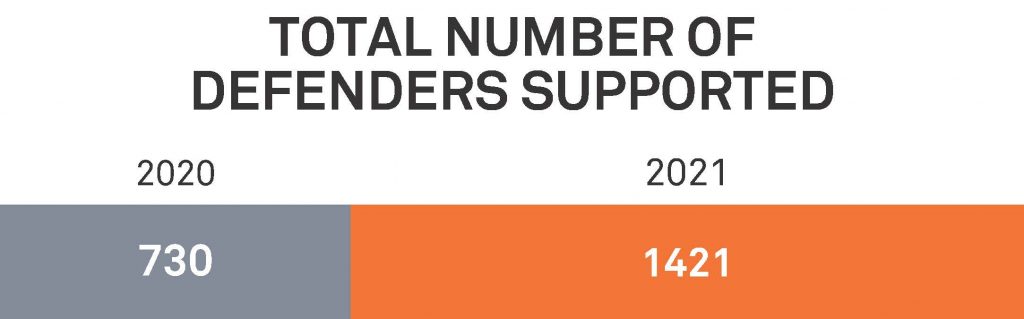
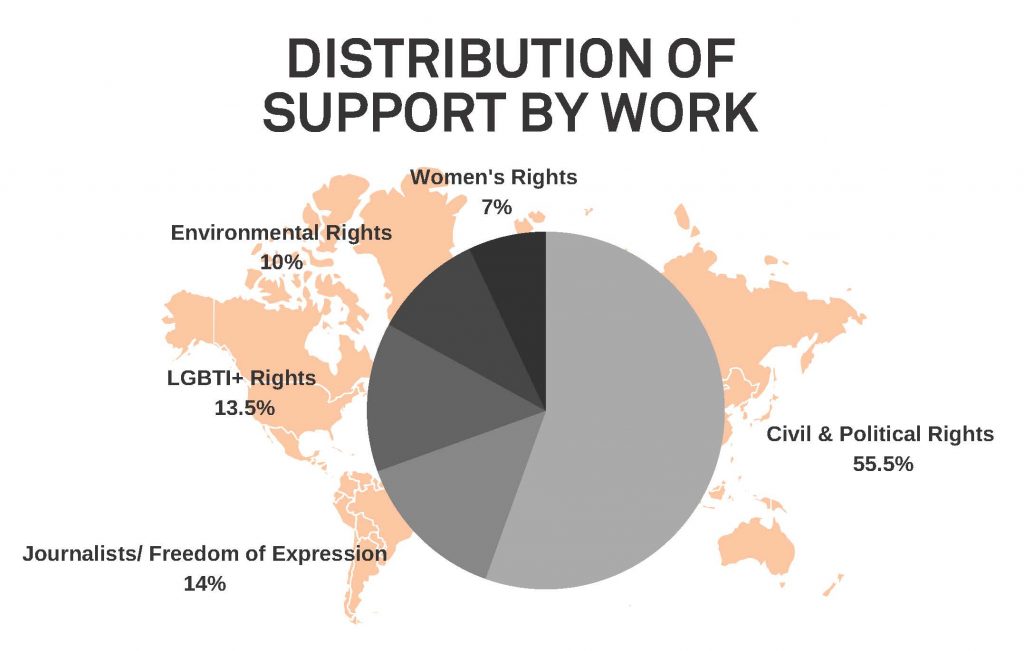
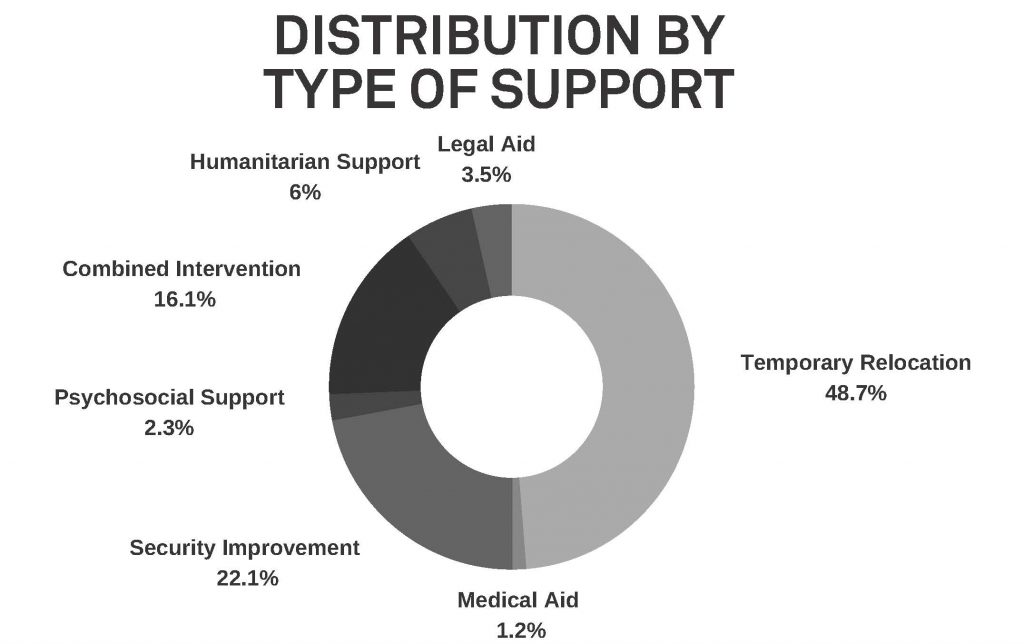
On 7 March 2022 it provided a breakdown of its use. The fund can, for example, provide legal aid or temporarily relocate people who suffer persecution, as well as provide preemptive efforts such as security trainings and digital security solutions. In 2021, the fund supported a total of 1421 human rights defenders in 30 countries.
Emergency support doubled in 2021
In 2021, Civil Rights Defender’ Emergency Fund has received and processed the largest number of applications since the inception of the fund in 2012. We have supported a total of 1.421 Human Rights Defenders (HRD:s) and/or members of their families at risk through a total of 171 grants in 30 countries. The number of applications and granted support have thus both doubled compared to 2020.
The world is becoming an increasingly dangerous place for human rights defenders, which is a significant explaining factor behind this increase. The CRD Emergency Fund has seen and reacted to the global backsliding of democracy and a number of emerging conflicts in 2021. The aftermath of the war between Armenia and Azerbaijan, the military coup in Burma, the spring protests in Colombia, the witch-hunt on civil society in Belarus, the civil war in Ethiopia and the Taliban’s takeover in Afghanistan are only a few of the conflicts that have deteriorated the security situation for human rights defenders in 2021. Many human rights defenders cannot continue their work for human rights and democracy without the support of the outside world.
Although the number of applications has doubled, so has the number of Emergency Fund applications granted. This increase is much thanks to the additional resources that Civil Rights Defenders has been able to put into processing fund applications.
“We are humbled to have been able to support so many human rights defenders in 2021. The need for emergency support is greater than ever, with the war in Ukraine the number of applicants is likely to keep increasing in the immediate future”, says Zinaida Muradova.
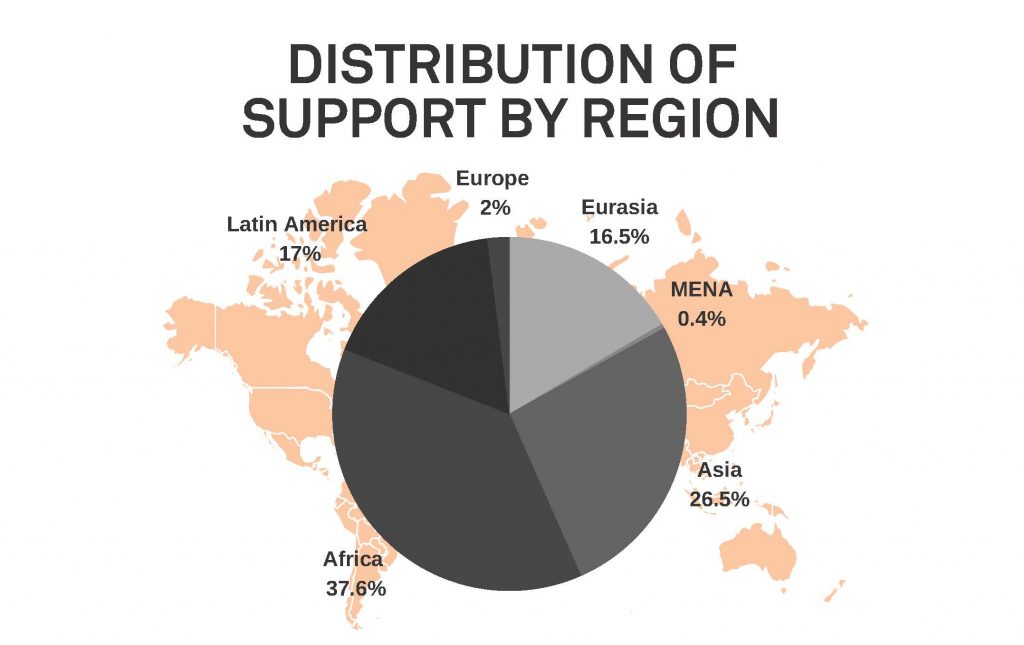
Emergency support to Burma and Asia has significantly increased in 2021, although the majority of human rights defenders who received emergency support continued to be from Africa. Additionally, the Emergency Fund continued to expand its global reach in five more regions – Eurasia, Europe, Africa, Latin America and MENA. In total, support was provided to human rights defenders in 30 countries during the course of 2021.
Further advancing gender sensitivity
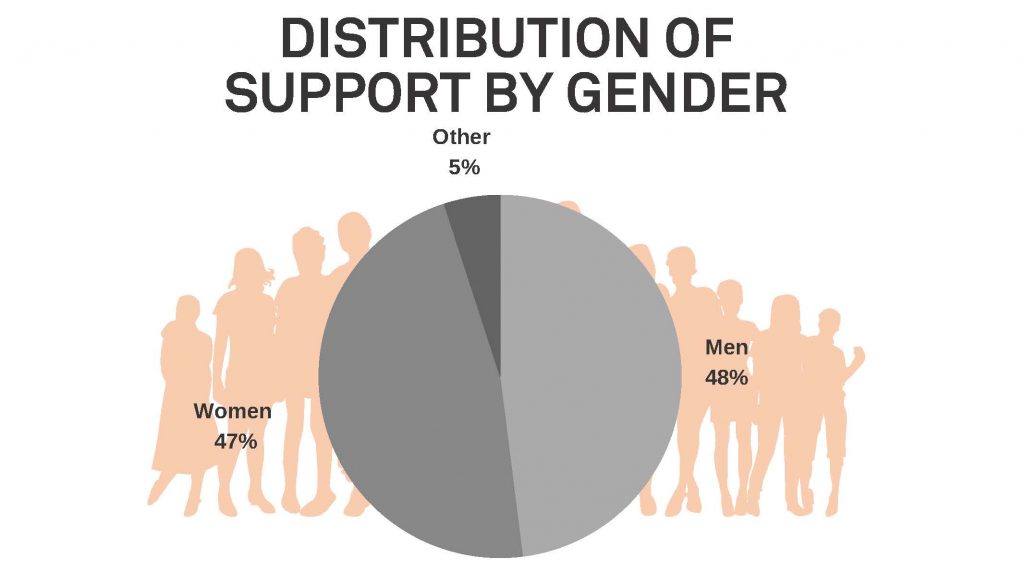
The Emergency Fund continued to build on gender work started in 2019 to ensure a good gender balance and representation amongst the beneficiaries of support. We have been working to increase the accessibility of the mechanism for the most vulnerable groups. We see an improvement in gender balance, for example the percentage of non-conforming people supported doubled compared to 2020.
An increasing demand for legal aid and psychological support
Despite the Covid 19 pandemic and continued strict restrictions on travel around the world, temporary relocations, where human rights defenders can reside safely for a short period, remained by far the most requested type of support in 2021. The majority of relocations were related to the major crises in countries mentioned above. Requests for preventive security measures to improve home, office or digital security, such as installing security cameras or digital security software, remained to be in high demand as well. Many HRD:s needed so called combined interventions, meaning a combination of several of the above mentioned support types.
In 2021 The Emergency Fund has seen a noteworthy increase in requests for humanitarian and psychological support. Many HRDs also request legal aid due to an increasing trend of arbitrary arrests and charges.
“Democracy and human rights cannot be achieved without human rights defenders. Through the Emergency Fund we ensure that they feel safe enough to continue their work which ultimately helps ensure that the fight for democracy can continue worldwide”, says Zinaida Muradova.
On 14 March 2022 a group of UN human rights experts today called on Bangladesh to immediately cease reprisals against human rights defenders and relatives of forcibly disappeared persons for their activism and co-operation with international human rights bodies and UN mechanisms.
In the period between December 2021 and February 2022, the homes of at least 10 relatives of forcibly disappeared individuals were reported to have been raided late at night.
“During the raids, relatives were intimidated, threatened and forced to either sign blank sheets of paper or pre-written statements indicating that their family member was not forcibly disappeared and that they had deliberately misled the police. This is unacceptable,” the experts observed.
The experts noted with concern the increasingly challenging situation relatives, human rights defenders and civil society are facing in Bangladesh. Repeated accusations by senior Government officials against some civil society organizations of providing “false information” to the UN mechanisms risk undermining the civil society’s key role.
“Bangladesh must ensure that relatives and human rights defenders are able to carry out their legitimate work in a safe and enabling environment without fear of threats, intimidation or reprisals of any kind,” the experts stressed. They expressed their concern that the reported reprisals may have a chilling effect and deter others from reporting on issues of public interest, including human rights, and from cooperating with the UN, its representatives and mechanisms.
Since 2009, the RAB has reportedly been involved in the perpetration of the majority of cases of enforced disappearance in the country, as noted in several reports by the UN Working Group on Enforced or Involuntary Disappearances.**
“Bangladeshi authorities are obliged under international law to promptly launch ex officio, independent, impartial and thorough investigations into these serious allegations, complemented by a thorough and comprehensive search for disappeared persons. At the same time, the RAB and other security agencies should not be shielded from scrutiny and criminal responsibility.”
The experts also reiterated their request to the Government of Bangladesh to take effective steps to protect and uphold the rights of victims and their families to truth, justice, reparation, and guarantees of non-recurrence.
On 17 March HRW stated that the Bangladesh government should meaningfully respond to United Nations concerns regarding grave allegations of torture, enforced disappearance, and extrajudicial killings in the country.

 Hans Thoolen on Human Rights Defenders and their awards