Archive for the 'organisations' Category

Human Rights Watch World Report 2022: work to be done

January 18, 2022

Autocratic leaders faced significant backlash in 2021, but democracy will flourish in the contest with autocracy only if democratic leaders do a better job of addressing global problems, Kenneth Roth, executive director at Human Rights Watch, said today in releasing the Human Rights Watch World Report 2022.

From Cuba to Hong Kong, people took to the streets demanding democracy when unaccountable rulers, as they so often do, prioritized their own interests over those of their citizens, Roth said. However, many democratic leaders have been too mired in short-term preoccupations and scoring political points to address serious problems such as climate change, the Covid-19 pandemic, poverty and inequality, racial injustice, or the threats from modern technology.

In country after country, large numbers of people have taken to the streets, even at the risk of being arrested or shot, which shows the appeal of democracy remains strong,” Roth said. “But elected leaders need to do a better job of addressing major challenges to show that democratic government delivers on its promised dividends.

The Human Rights Watch World Report 2022, its 32nd edition, describes the human rights situation in nearly all of the approximately 100 countries where Human Rights Watch works.

World Report 2022, Human Rights Watch’s 32nd annual review of human rights practices and trends around the globe, reviews developments in more than 100 countries. READ IT HERE

In his introductory essay, Roth challenges the common view that autocracy is ascendent and democracy is on the decline. Many autocrats claim to serve their people better than democratically elected leaders, but they usually deliver mainly for themselves and then try to manipulate electoral systems so citizens cannot deliver a negative verdict. Autocrats typically try to divert attention with racist, sexist, xenophobic, or homophobic appeals, he said.

Covid-19 spotlighted this self-serving tendency, with many autocratic leaders downplaying the pandemic, turning their backs on scientific evidence, spreading false information, and failing to take basic measures to protect the health and lives of the public.

In an important and growing development that must worry some autocrats, a broad range of opposition political parties has begun to gloss over their policy differences to build alliances that prioritize their common interest in getting corrupt politicians or repressive leaders voted out of office, Roth said. 

In the Czech Republic, an unlikely coalition defeated Prime Minister Andrej Babiš. In Israel, an even unlikelier coalition ended the longtime rule of Prime Minister Benjamin Netanyahu. Similar broad alliances of opposition parties have formed for forthcoming elections against Viktor Orban in Hungary and Recep Tayyip Erdoğan in Turkey. A comparable tendency within the US Democratic Party contributed to the selection of Joe Biden to contest the 2020 election against Donald Trump.

Moreover, as autocrats can no longer rely on subtly manipulated elections to preserve power, a growing number, from Nicaragua to Russia, are resorting to overt electoral charades that guarantee their desired result but confer none of the legitimacy sought from holding an election. This growing repression is a sign of weakness, not strength, Roth said.

However, to persuade people to abandon the self-serving rule of autocrats, democracies need to do better in addressing societal ills, Roth said.

For example, the climate crisis poses a dire threat to humankind, yet democratic leaders are only nibbling at the problem, he said, seemingly incapable of overcoming national perspectives and vested interests to take the major steps needed to avert catastrophic consequences. The World Report 2022 includes assessments of the climate policies of the world’s top 10 greenhouse gas emitters, as well as more than a dozen other countries where there have been significant policy developments related to the climate crisis.

The Covid-19 pandemic also exposed weaknesses of democratic leaders. Democracies met the pandemic by developing highly effective mRNA vaccines with remarkable speed but have failed to ensure that the people of lower-income countries share this lifesaving invention. Some democratic governments took steps to mitigate the economic consequences of Covid-19 lockdowns, but have yet to tackle the broader and persistent problem of widespread poverty and inequality or to build adequate systems of social protection for the next inevitable economic disruption, he said.

Democracies regularly debate the threats posed by technology, he said. These include the dissemination of disinformation and hate speech by social media platforms, the large-scale invasion of privacy as an economic model, the intrusiveness of new surveillance tools, and the biases of artificial intelligence. But democratic leaders have taken only baby steps to address them.

Democracies fare no better when acting outside their borders. They frequently descend to the compromises of realpolitik, bolstering autocratic “friends” to curtail migration, fight terrorism, or protect supposed “stability” rather than defending democratic principles.

In contrast to Trump’s embrace of friendly autocrats when he was US president, Biden promised a foreign policy that would be guided by human rights. But the US has continued to provide arms to Egypt, Saudi Arabia, the United Arab Emirates, and Israel despite their persistent repression. In the face of an autocratic trend in Central America, Biden mainly prioritized efforts to curtail migration rather than autocracy.

Other Western leaders displayed similar weakness in their defense of democracy. Former German Chancellor Angela Merkel’s government helped to orchestrate global condemnation of the Chinese government’s crimes against humanity in Xinjiang. But while holding the European Union presidency, Germany helped to promote an EU investment deal with China despite Beijing’s use of ethnic Uyghur forced labor.

The government of French President Emmanuel Macron helped to coordinate broad condemnation of Beijing’s conduct in Xinjiang but was blind to the abysmal situation in Egypt.

If democracies are to prevail, their leaders must do more than spotlight the inevitable shortcomings of autocratic rule, Roth said. They must do a better job of meeting national and global challenges of making sure that democracy in fact delivers.

“Promoting democracy means standing up for democratic institutions such as independent courts, free media, robust parliaments, and vibrant civil societies even when that brings unwelcome scrutiny or challenges to executive policies,” Roth said. “And it demands elevating public discourse rather than stoking our worst sentiments, acting on democratic principles rather than merely voicing them, and unifying us before looming threats rather than dividing us in the quest for another do-nothing term in office.”

https://www.hrw.org/news/2022/01/13/future-autocrats-darker-it-seems

https://www.rferl.org/a/human-rights-watch-autocracy-democracy-rights/31652052.html
Ground breaking conviction of Syrian torturer in Germany

January 17, 2022
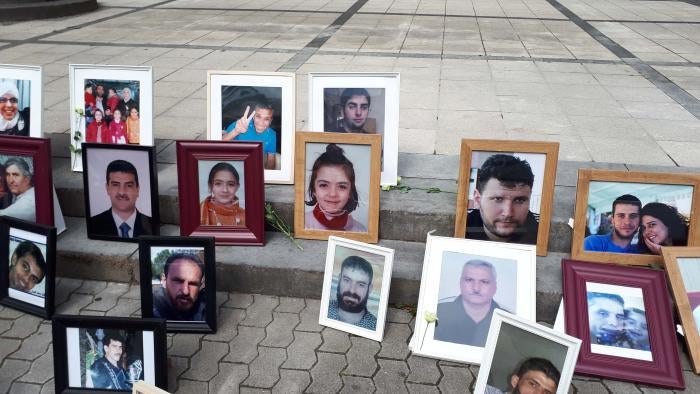
Group of framed portraits
Photos of Syrians who have been detained or disappeared set up by Families for Freedom, as part of a protest in front of the court in Koblenz, July 2, 2020. © 2020 Alexander Suttor

The conviction of a former Syrian intelligence officer for crimes against humanity by a German court is a ground-breaking step toward justice for serious crimes in Syria, Human Rights Watch said today. The judgment is a meaningful moment for civilians who survived torture and sexual abuse in Syria’s prisons.  

On January 13, 2022, a German court delivered its judgment in the trial of Anwar R., a former member of Syria’s General Intelligence Directorate, one of the country’s four main intelligence agencies commonly referred to collectively as the mukhabarat. Anwar R. is the most senior former Syrian government official to be convicted for serious crimes in Syria.  

German prosecutors accused Anwar R. of overseeing the torture of detainees in his capacity as head of the investigations section at the General Intelligence Directorate’s al-Khatib detention facility in Damascus, also known as “Branch 251.” 

The judges found Anwar R. guilty of committing crimes against humanity and sentenced him to life in prison. Following the verdict in the case, Anwar R. has one week to appeal.  

More than 10 years after the violations were committed in Syria, the German court’s verdict is a long-awaited beacon of hope that justice can and will in the end prevail,” said Balkees Jarrah, associate international justice director at Human Rights Watch. “Other countries should follow Germany’s lead, and actively bolster efforts to prosecute serious crimes in Syria.”  

Human Rights Watch issued a question and answer document and a feature article on the trial and how it is situated in the larger context of the Syrian conflict on January 6, 2022. The trial against Anwar R. and Eyad A., who was found guilty of aiding and abetting crimes against humanity in February, began in April 2020 and was the first anywhere in the world for state-sponsored torture in Syria. Eyad A.’s appeal against his conviction remains pending. 

Syrian survivors, lawyers, and activists have been central to making this trial a reality, not only pressing for justice but laying the groundwork that makes justice possible, Human Rights Watch said.  

More than 80 witnesses testified, including former detainees, former Syrian government employees, German police investigators, and experts in Syrian affairs. The testimony included well-documented accounts of torture and sexual abuse in Branch 251, descriptions of mass graves, and details of Syria’s government policy to violently crack down on peaceful protesters in 2011. Several of the witnesses were able to identify Anwar R. in the courtroom.  

One of the major challenges of this trial was witness protection. Several witnesses living in Germany and other European countries cancelled their appearance in court out of fear for their lives and safety, or that of their families. Several witnesses, some who were also victims, testified that they feared a risk to themselves and their families given their role in the trial. German authorities should ensure that witnesses and victims are sufficiently informed about their rights to protective measures, including to appear anonymously before the court. 

Tens-of-thousands of people have been detained or disappeared in Syria since 2011, the vast majority by government forces using an extensive network of detention facilities throughout the country. The Syrian government continues to detain and forcibly disappear thousands of people. 

Many of those detained have died from torture and horrific detention conditions. Comprehensive justice for these and other unchecked atrocities in Syria has been elusive. Syria is not a member of the International Criminal Court. And in 2014, Russia and China blocked efforts at the United Nations Security Council to give the court a mandate over serious crimes in Syria. 

The trial of Anwar R. and Eyad A. is possible because Germany’s laws recognize universal jurisdiction over certain of the most serious crimes under international law. That allows for the investigation and prosecution of these crimes no matter where they were committed and regardless of the nationality of the suspects or victims. Universal jurisdiction remains one of the few viable pathways to justice for crimes committed in Syria.  

Germany has several elements in place to allow for the successful investigation and prosecution of grave crimes in Syria. It has above all a comprehensive legal framework, well-functioning specialized war crimes units, and previous experience with prosecuting such crimes. Countries with universal jurisdiction laws should establish specialized war crimes units within law enforcement and prosecution services, and ensure that such units are adequately resourced and staffed. 

Germany’s trial against Anwar R. is a message to the Syrian authorities that no one is beyond the reach of justice,” Jarrah said. “The Koblenz case has shown that with other avenues blocked, national courts can play a critical role in combating impunity.” 

The first such reaction came immediately, see: https://www.ncr-iran.org/en/news/human-rights/after-german-conviction-of-syrian-official-focus-may-turn-to-swedish-trial-of-iranian/

https://www.hrw.org/news/2022/01/13/germany-conviction-state-torture-syria

https://www.fidh.org/en/region/north-africa-middle-east/syria/syria-landmark-ruling-offers-hope-to-regime-s-victims

https://www.ecchr.eu/en/case/first-criminal-trial-worldwide-on-torture-in-syria-before-a-german-court/

Front Line Defenders looking for Head of Protection

January 17, 2022

Front Line Defenders is looking for a Head of Protection.

The Head of Protection (HoP) is a critical senior leadership role in the organisation, managing a large global team and directing crucial organisations trategy on HRD protection in countries and regions. The HoP has overall responsibility for the management, sustainability, cohesion and well-being of the Protection Team. Together with Protection Team Managers, they provide and support the strategy and direction of timely and appropriate responses to human rights defenders at risk globally, ensuring holistic and effective protection support.

The HoP holds a strategic overview of the trends, challenges and responses for HRD protection, and shapes our organizational position through ensuring this is reflected in strategy, communication and representation, and our various holistic protection responses. The Head of Protection is also part of the organisation management team, directly supporting the Directors in the strategy, planning, management and evaluation of the all aspects of the organisation.

Deadline: 17th January 2022

Download the full advert here.

Follow the Announcement of the Martin Ennals Laureates 2022 on 19 January

January 17, 2022
Webinar banner

The 2022 Martin Ennals Award Laureate Announcement will be live-streamed at a press conference, announcing the 2022 Laureates on Wednesday 19 January at 11am CET. More on this awards and it laureates, see: https://www.trueheroesfilms.org/thedigest/awards/043F9D13-640A-412C-90E8-99952CA56DCE

Media requests can be shared at media@martinennalsaward.org. To register, follow link below:

https://us02web.zoom.us/webinar/register/WN_C–uTIoFQAumucPTbGOeeQ

You can follow the livestreaming on the MEF website for general audience: https://youtu.be/UgvIli5X-T8

Iranian dissident Poet Baktash Abtin dies of Covid in arbitrary detention

January 10, 2022

On 8 January 2022 the Iranian poet Baktash Abtin died in Tehran after contracting COVID-19 in Evin Prison. Abtin, who died after being put into an induced coma while hospitalized, is the second known political prisoner to die in Iran in the first week of 2022. On January 1, Kian Adelpour died after going on hunger strike to protest being imprisoned without a fair trial.

This is a preventable tragedy and more prisoners’ deaths are inevitable because there is no accountability in the Iranian government,” said Hadi Ghaemi, executive director of the Center for Human Rights in Iran (CHRI). “Abtin was imprisoned in Iran because the government wanted to muzzle him with a jail cell; the state killed him.” Abtin had been serving a five-year prison sentence on the charge of “assembly and collusion against national security.

A group of main NGOs had addressed a joint letter to Ayatollah Ali Hosseini Khamenei on 7 January repeating their call that Abtin be given access to the best possible medical care as he battles for his life. In addition, we urge that: he and all those unjustly detained for their writing or expression be immediately and unconditionally released; that authorities refrain from summoning political prisoners to serve their sentences while the conditions inside Evin and other Iranian prisons remain unsafe; and that any who do contract COVID-19 or other serious illnesses while in jail be granted speedy access to all needed medical care or a medical parole on humanitarian grounds.

While offering condolences to Abtin’s family and friends, the Iranian Writers Association (IWA) where Abtin, 48, was a board member, released a statement on January 8 on the “injustice that was committed against Abtin”: “Baktash Abtin is alive because the spirit of freedom-seeking and the fight against tyranny and injustice is alive,” said the statement.

Fellow IWA board member Reza Khandan Mahabadi was also sentenced to five years in prison and Keyvan Bajan to three years and six months. An international chorus has condemned the IWA writers’ imprisonment, with dozens of high-profile writers and artistic figures including Nobel laureates calling for the writers’ acquittal.

At least 11 writers are known to be either currently imprisoned or living with an unserved prison sentence hanging over their heads in Iran as they await an appeal or to be summoned to jail, according to a list compiled by CHRI.

In an interview with CHRI in May 2019 after his trial, Abtin forcefully said the charge of “assembly and collusion against national security” was for statements published by the IWA, articles in the organization’s internal newsletter, and holding memorial ceremonies for IWA members Mohammad Mokhtari and Mohammad Jafar Pouyandeh, who were murdered in 1998 as part of a concerted state policy to eliminate political and cultural dissidents inside and outside of Iran.

“Nowhere in the world is it necessary to get a permit to gather around someone’s grave,” Abtin told CHRI. “But that’s what we’ve been charged with.”

https://www.hrw.org/news/2022/01/07/joint-ngo-letter-khamenei-baktash-abtins-condition

Russia’s Supreme Court orders closure emblematic Memorial

December 29, 2021

As feared in November (see blog post below) Russia’s Supreme Court on Tuesday 28 December 2021 ordered the closure of Memorial International, one of the country’s most respected human rights organizations, wiping out three decades of work to expose the abuses and atrocities of the Stalinist era. Memorial is the winner of at least 7 international human rights awards: https://www.trueheroesfilms.org/thedigest/laureates/BD12D9CE-37AA-7A35-9A32-F37A0EA8C407

The court ruled that Memorial International had fallen afoul of Russia’s “foreign agent” law. But the group said the real reason for the shutdown was that authorities did not approve of its work.

The ruling is the latest blow to Russia’s hollowed-out civil society organizations, which have gradually fallen victim to Putin’s authoritarian regime.

Videos posted on social media showed Memorial supporters shouting, “Shame, shame!” in the court’s hallways and at the entrance to the building shortly after the ruling. Seven people were detained outside the courthouse following the proceedings, according to independent monitoring group OVD-Info. The organization said three of them are believed to be instigators whose sole aim was to cause havoc, not support Memorial.

Memorial International’s lawyer, Tatiana Glushkova, confirmed the ruling to CNN and said the group would appeal the decision. “The real reason for Memorial’s closure is that the prosecutor’s office doesn’t like Memorial’s work rehabilitating the victims of Soviet terror,” Glushkova told CNN.

The Prosecutor General’s Office of Russia requested Memorial International be liquidated in November. The group was accused of repeatedly breaking the law for failing to mark all its publications with a compulsory “foreign agent” warning. The Justice Ministry had designated the group a foreign agent in 2016, using a law targeting organizations receiving international funding.

Memorial’s representatives argued there were no legal grounds for the group’s closure, and critics say the Russian government targeted Memorial for political reasons.

Oleg Orlov, a member of Memorial International’s board, said the court’s decision was “purely ideological” and “a demonstrative, blatant, illegal decision.”

“Allegedly, we do not assess the Soviet Union and Soviet history the right way. But this is our assessment, we have the right to do it,” Orlov told CNN.

Memorial was founded in the late 1980s to document political repressions carried out under the Soviet Union, building a database of victims of the Great Terror and gulag camps. The Memorial Human Rights Centre, a sister organisation that campaigns for the rights of political prisoners and other causes, is also facing liquidation for “justifying terrorism and extremism”. One of the group’s co-founders was Nobel Peace Prize winner Andrei Sakharov, who went on to be the first honorary chairman of the Memorial Society.

https://www.theguardian.com/world/2021/dec/28/russian-court-memorial-human-rights-group-closure

https://www.swissinfo.ch/eng/-erasing-history—russia-closes-top-rights-group–capping-year-of-crackdowns/47222634

On 22 March 2022: https://www.rferl.org/a/memorial-appeal-denied/31765088.html

To Counter Domestic Extremism, Human Rights First Launches Pyrra

December 26, 2021

New enterprise uses machine learning to detect extremism across online platforms

On 7 December 2021, Human Rights First announced a new enterprise, originally conceived in its Innovation Lab as Extremist Explorer, that will help to track online extremism as the threats of domestic terrorism continue to grow.

Human Rights First originally developed Extremist Explorer to monitor and challenge violent domestic actors who threaten all our human rights. To generate the level of investment needed to quickly scale up this tool, the organization launched it as a venture-backed enterprise called Pyrra Technologies.

“There is an extremist epidemic online that leads to radical violence,” said Human Rights First CEO Michael Breen. “In the 21st century, the misuse of technology by extremists is one of the greatest threats to human rights. We set up our Innovation Lab to discover, develop, and deploy new technology to both protect and promote human rights.  Pyrra is the first tool the lab has launched.”

Pyrra’s custom AI sweeps sites to detect potentially dangerous content, extremist language, violent threats, and harmful disinformation across social media sites, chatrooms, and forums.

 “We’re in the early innings of threats and disinformation emerging from a proliferating number of smaller social media platforms with neither the resources nor the will to remove violative content,Welton Chang, founding CEO of Pyrra and former CTO at Human Rights First, said at the launch announcement.  “Pyrra takes the machine learning suite we started building at Human Rights First, greatly expands on its capabilities and combines it with a sophisticated user interface and workflow to make the work of detecting violent threats and hate speech more efficient and effective.”

The Anti-Defamation League’s Center on Extremism has been an early user of the technology. 
“To have a real impact, it’s not enough to react after an event happens, it’s not enough to know how extremists operate in online spaces, we must be able to see what’s next, to get ahead of extremism,” said Oren Segal, Vice President, Center on Extremism at the ADL. “That’s why it’s been so exciting for me and my team to see how this tool has evolved over time.  We’ve seen the insights, and how they can lead to real-world impact in the fight against hate.”   

 “It really is about protecting communities and our inclusive democracy,” said Heidi Beirich, PhD, Chief Strategy Officer and Co-Founder, Global Project Against Hate and Extremism.  “The amount of information has exploded, now we’re talking about massive networks and whole ecosystems – and the threats that are embedded in those places. The Holy Grail for people who work against extremism is to have an AI system that’s intuitive, easy to work with, that can help researchers track movements that are hiding out in the dark reaches of the internet. And that’s what Pyrra does.”

Moving forward, Human Rights First will continue to partner with Pyrra to monitor extremism while building more tools to confront human rights abuses. 

Kristofer Goldsmith, Advisor on Veterans Affairs and Extremism, Human Rights First and the CEO of Sparverius, researches extremism. “We have to spend days and days and days of our lives in the worst places on the internet to get extremists’ context.  But we’re at a point now where we cannot monitor all of these platforms at once. The AI powering Pyrra can,” he said.

Pyrra’s users, including human rights defenders, journalists, and pro-democracy organizations can benefit from using the tool as well as additional tools to monitor extremism that are coming from Human Rights First’s Innovation Lab.

“This is a great step for the Innovation Lab,” said Goldsmith. “We’ve got many other projects like Pyrra that we hope to be launching that we expect to have real-world impact in stopping real-world violent extremism.”   

https://www.humanrightsfirst.org/press-release/counter-domestic-extremism-human-rights-first-launches-pyrra

Egypt: Activist Patrick Zaki released following international pressure

December 22, 2021

While the recent harsh sentencing of 3 human rights defenders in Egypt made headlines [see: https://humanrightsdefenders.blog/2021/12/21/alaa-abdel-fattah-and-two-others-receive-heavy-prison-sentences-in-egypt/], and the Government decried foreign intervention, it may be interesting to note that not long ago the release of another human rights defender was attributed to international pressure and campaigning.

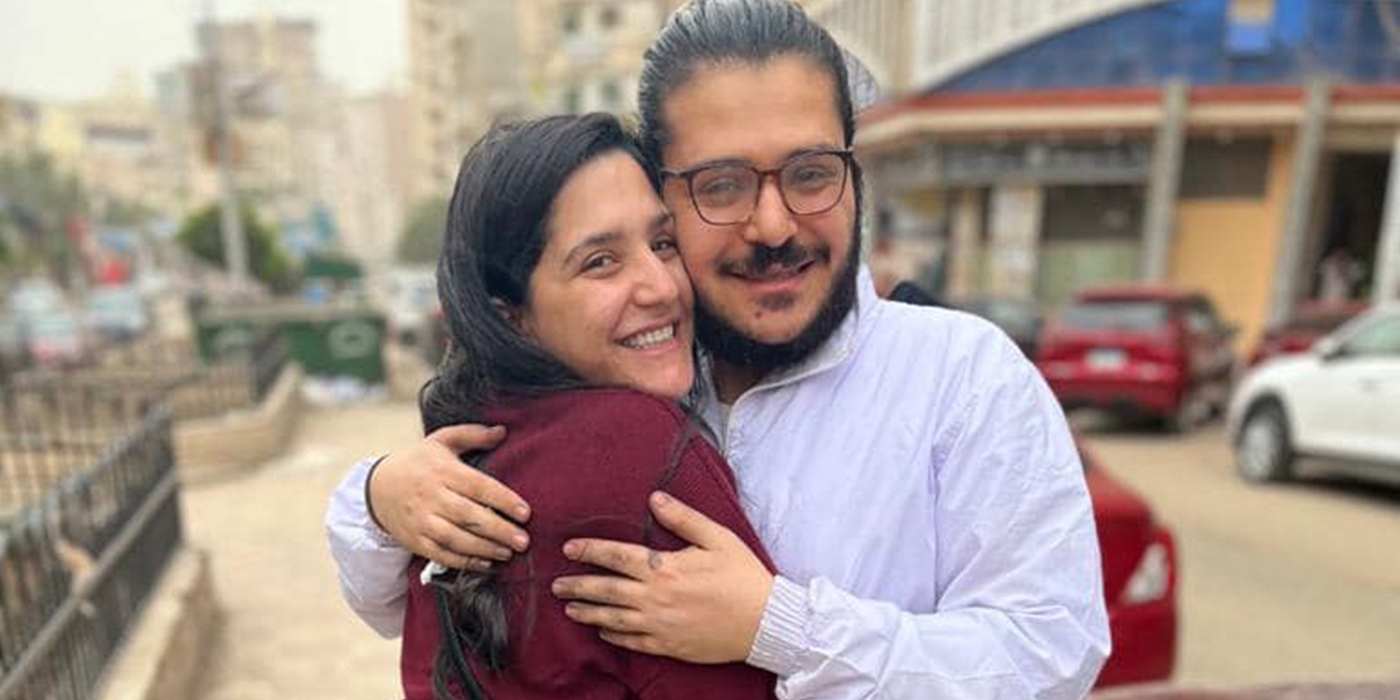
Patrick Zaki after his release on Wednesday 8 December 2021 (Screengrab/EIPR) By Areeb Ullah

Human rights activist Patrick Zaki was freed on Wednesday 8 December 2021, a day after Egypt’s Emergency State Security Misdemeanour Court ordered his provisional release. 

Zaki, a 28-year-old researcher at the Egyptian Initiative for Personal Rights (EIPR), had been studying at Italy’s Bologna University when he was taken into custody upon his return to Cairo in February 2020. Despite his release, he still faces a range of charges, including “calling for protests without permission”, “spreading false news” and “inciting violence and terrorism”. His trial will resume on 1 February 2022.

Tuesday’s hearing was the second time Zaki’s trial has been adjourned since the first session, on 14 September 2020. Human Rights Watch (HRW) told Middle East Eye that Zaki was subjected to physical torture in the days after his arrest.

Commenting on the court’s ruling for his release, Amr Magdi, Egypt researcher for HRW, described it as “rare happy news” for Patrick and his family. “Its a win with a bitter taste,” Magdi told MEE on Tuesday, pointing out that Zaki is technically still on trial as he has not been acquitted.

Zaki had been an outspoken campaigner for the truth about the 2016 murder of Italian student Giulio Regeni in Egypt. Zaki’s arrest sparked a solidarity campaign in Italy, with politicians and activists urging Egyptian authorities to release him.  Italian human rights campaigners have expressed concerns that Zaki could be at risk of torture and ill-treatment in Egypt’s notorious prisons, drawing parallels with the torture of Regeni.  Regeni’s family has also expressed solidarity with the detained activist.

In April, the Italian senate voted to approve a proposal by two lawmakers urging the government to grant Zaki Italian citizenship. Meanwhile, more than 50 Italian cities have announced the granting of “honorary citizenship” to Zaki. This was done, EIPR said, in order to show their appreciation for him as a human rights defender and to demand his immediate release in a campaign called 100 Cities with Patrick, launched by a group of human rights activists in Italy.

https://www.middleeasteye.net/news/egypt-patrick-zaki-released-italy-solidarity-regeni

https://www.middleeastmonitor.com/20220105-egypt-releases-3-prominent-political-prisoners-what-about-the-65000-others/

CALL FOR NOMINATIONS – Front Line Defenders 2022 Award for human rights defenders

December 22, 2021

Front Line Defenders is currently accepting nominations for the 2022 Front Line Defenders Award for Human Rights Defenders at Risk

award banner

The annual Front Line Defenders Award was established in 2005. For more on this award and its laureates, see: https://www.trueheroesfilms.org/thedigest/awards/2E90A0F4-6DFE-497B-8C08-56F4E831B47D

In 2021, Front Line Defenders took the decision to name all 5 regional winners as Global Laureates. For each region of the world (Africa; Americas; Asia-Pacific; Europe & Central Asia; and Middle East & North Africa) there will be one winner selected and Front Line Defenders will recognize all five as the 2022 Front Line Defenders Award Laureates.

The nomination process is open for anyone to submit a nomination of a human rights defender, collective, organisation or community working on any human rights issue and facing significant risk due to their work or operating in an environment that itself is characterised as insecure. Winners will receive:

  • a modest financial prize;
  • a security grant to improve their security measures;
  • collaboration with Front Line Defenders for media work in recognition of the Award;
  • advocacy by Front Line Defenders related to the Award and the work of the winners;
  • an event co-organized by the HRD, local partners and Front Line Defenders to give visibility to the Award in the winners’ countries (as determined and guided by the winners);
  • the Global Laureates will attend a ceremony in Dublin at a date to be determined;
  • ongoing security consultation with Front Line Defenders

If you would like to nominate a HRD for the 2022 Front Line Defenders Award for Human Rights Defenders at Risk, please follow this link to the secure online nomination form 2022 Front Line Defenders Award – Nomination Form

Please submit nominations via the online form. If there are any problems using the form, or if you have any questions, please contact: campaigns@frontlinedefenders.org

Last year’s winners of the Front Line Defenders Award, see: https://humanrightsdefenders.blog/2021/12/14/front-line-defenders-award-for-human-rights-defenders-2021%EF%BF%BC/

https://www.frontlinedefenders.org/en/call-nominations-2022-front-line-defenders-award-human-rights-defenders-risk

Harassment of Adilur Rahman Khan and other Human Rights Defenders in Bangladesh

December 21, 2021

On 14 December 2021 a Statement Bangladesh: Stop Harassment of Human Rights Defenders” was published by Forum Asia, FIDH and other NGOs: “Bangladesh authorities must end the harassment of Adilur Rahman Khan and ASM Nasiruddin Elan, respectively Secretary and Director of the human rights group Odhikar, who have been targeted through the misuse of the criminal justice system”, eleven rights groups said.

On December 15, 2021, the Cyber Tribunal of Dhaka will continue the examination of prosecution witnesses in the case brought against Adilur Rahman Khan, also a member of OMCT General Assembly and FIDH Secretary-General, and ASM Nasiruddin Elan, for charges brought against them in Case No. 1 of 2013 under the notorious Section 57 of the Information and Communication Technology (ICT) Act, 2006 (amended in 2009), in relation to a fact-finding report issued by Odhikar on the killing of at least 61 people by security forces and law-enforcement agencies in May 2013. Khan and Elan face up to ten years in prison. See also; https://www.trueheroesfilms.org/thedigest/laureates/88F17E2F-F919-580F-2FDA-59B8E24ACBF6

The government should stop using vague laws to silence human rights defenders and start holding perpetrators of abuses to account, ” said Kerry Kennedy, President of Robert F. Kennedy Human Rights. “Odhikar’s findings not only should have led to investigations and reforms, but also should have been welcomed by the government as an opportunity to strengthen their commitment to upholding human rights.

Following Odhikar’s 2013 report, Khan and Elan were arbitrarily detained for respectively 62 and 25 days until they were both released on bail. On February 14, 2021, the Appellate Division of the Supreme Court of Bangladesh rejected Odhikar’s appeal to quash the case on its legal merits. On September 12, 2021, the Cyber Tribunal of Dhaka resumed the trial in the case against the two while their review petition is still pending hearing before the Appellate Division of the Supreme Court, contravening the right to a fair trial. On October 5, November 9, and November 24, 2021, the Cyber Tribunal of Dhaka started to examine prosecution witnesses in the case.

We express our deepest concern over the ongoing harassment of Adilur Rahman Khan and ASM Nasiruddin Elan, which is manifestly a form of reprisals against Odhikar for their legitimate human rights work, including for cooperating with UN human rights mechanisms in documenting enforced disappearances, extra-judicial executions and torture in Bangladesh.

It is further a matter of great concern that since 2013, attacks, unlawful surveillance, smear campaigns and harassment against Odhikar and its staff and management have been incessant. Odhikar is also facing serious difficulties to conduct its work due to violations of the right to freedom of association, since its registration has not been renewed by the NGO Affairs Bureau of the Government of Bangladesh and is still pending since 2015. Moreover, all of its bank accounts have been frozen and the organization has been forbidden from receiving funding from foreign or international sources, impacting its operations considerably.

The trial against Khan and Elan resumes in a context where human rights in Bangladesh are under attack from all sides. Human rights violations committed by security forces, including enforced disappearances, extrajudicial executions, and torture remain pervasive throughout the country, with absolute impunity. Authorities regularly crackdown on human rights defenders and journalists who speak out against these violations, including through the use of the Digital Security Act – 2018, the Special Powers Act – 1974, and other draconian laws. See also: https://humanrightsdefenders.blog/2014/12/02/adilur-rahman-khan-speaks-out-against-torture/

Cases such as these question the Bangladeshi government’s commitment to protecting human rights. The international community, including the United Nations and the diplomatic corps in Bangladesh, should monitor the case against Adilur Rahman Khan and ASM Nasiruddin Elan and take a clear stand to ensure that the government of Bangladesh respects the rights of the two defenders to a fair and public trial and, more generally, guarantees the right to defend human rights and puts an end to all acts of harassment against all human rights defenders in Bangladesh.

Our organisations call on the authorities of Bangladesh to immediately and unconditionally drop all charges against Adilur Rahman Khan and ASM Nasiruddin Elan, and to ensure in all circumstances that human rights defenders in Bangladesh are able to carry out their legitimate activities without any hindrance and fear of reprisals.

This trial is in reality an indictment of the authorities and a crucial test case for the country’s judiciary to be closely watched by the international community,” said Gerald Staberock, OMCT Secretary General, speaking on behalf of the Observatory. “The true culprits are those responsible for extra-judicial killings not those who report on it. Prosecuting human rights activists will not stifle dissent but will isolate Bangladesh from the international community.

The NGOs:

Amnesty International

Anti-Death Penalty Asia Network (ADPAN),

Asian Human Rights Commission (AHRC),

Asian Network for Free Elections

Capital Punishment Justice Project (CPJP)

CIVICUS: World Alliance for Citizen Participation,

Eleos Justice, Monash University, Associate Professor

FIDH, within the framework of the Observatory for the Protection of Human Rights Defenders, i

FORUM-ASIA

Robert F. Kennedy Human Rights

World Organisation Against Torture (OMCT), within the framework of the Observatory for the Protection of Human Rights Defenders

https://www.fidh.org/en/region/asia/bangladesh/bangladesh-government-must-act-to-address-rule-of-law-crisis