Posts Tagged ‘death in prison’

Indigenous leader Brooklyn Rivera one of many to die in Nicaraguan custody

June 4, 2026

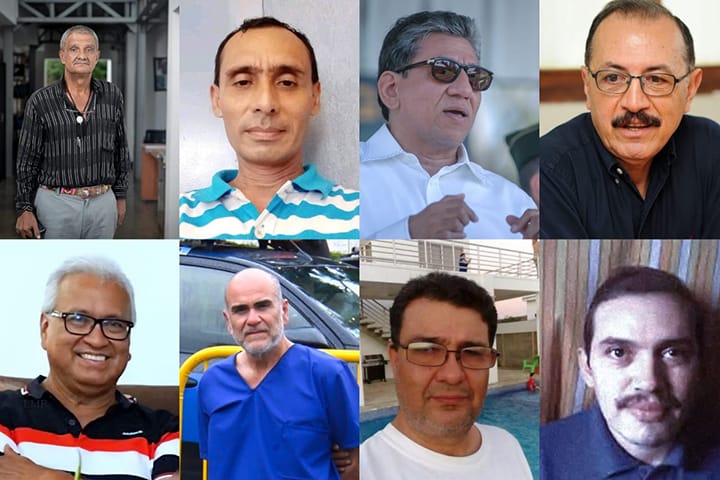
Collage: La Prensa

On 3 June 2026 UN experts expressed dismay at the death in custody of Indigenous Miskitu leader and lawmaker Brooklyn Rivera, and the allegations of enforced disappearance of seven members of his family who had come to claim his remains.

It is outrageous that repeated warnings and calls for protection have gone unheeded. We consider it an act of cruelty that the Nicaraguan Government is reportedly not allowing Brooklyn Rivera’s family to make decisions about funeral rites and the burial of his remains,” the experts said. [see also: https://humanrightsdefenders.blog/2026/03/14/where-is-nicaraguan-indigenous-leader-brooklyn-rivera/]

On 2 June 2026 La Prensa listed 8 victims. [https://www.laprensani.com/2026/06/02/english/3710346-these-are-the-eight-political-prisoners-who-died-in-the-custody-of-the-ortega-murillo-dictatorship]

They called for a prompt, effective, thorough, independent, impartial and transparent investigation into the circumstances of Rivera’s death in line with international standards, in particular the Minnesota Protocol, and for those responsible to be held accountable.

UN human rights mechanisms have followed this case since 2023 and have repeatedly raised concerns for Brooklyn Rivera’s life, physical integrity, health, and well-being. On 22 August 2025, the human rights experts wrote to the Government of Nicaragua about Rivera’s alleged arbitrary detention and enforced disappearance. They also requested proof of life from Nicaraguan authorities, following rumours of his death in custody. There was no response.

“The reported serious violations committed against Brooklyn Rivera and his family must stop. The Nicaraguan Government must reveal the fate and whereabouts of the seven missing family members and release them immediately,” the experts said.

They urged authorities to immediately respect the rights of Rivera’s family, including granting them access to all relevant information and records, ensuring their participation in decisions regarding his remains, and allowing funeral rites to be carried out in accordance with the family’s wishes and Miskito traditions.

The case of Brooklyn Rivera comes against the backdrop of a grave and sustained deterioration of the human rights situation in Nicaragua. On 1 May 2026, Human Rights Council’s experts warned of a pattern of enforced disappearances, incommunicado detention and detention conditions that could amount to torture or other cruel treatment. In March 2026, the report of a Group of Experts on Nicaragua described repression and persecution by authorities as systematic, amounting to, prima facie, crimes against humanity.

“Rivera’s case cannot be separated from the broader and deeply troubling human rights context in Nicaragua, including the repression of dissent, attacks on civic space, and the persecution of Indigenous leaders, human rights defenders and those perceived as opponents,” the experts said.

The arrest and subsequent enforced disappearance of Rivera occurred after his return from participation in the United Nations Permanent Forum on Indigenous Issues in 2023, the experts noted.

https://www.ohchr.org/en/press-releases/2026/06/nicaragua-un-experts-demand-truth-and-accountability-after-indigenous-leader

Iranian dissident Poet Baktash Abtin dies of Covid in arbitrary detention

January 10, 2022

On 8 January 2022 the Iranian poet Baktash Abtin died in Tehran after contracting COVID-19 in Evin Prison. Abtin, who died after being put into an induced coma while hospitalized, is the second known political prisoner to die in Iran in the first week of 2022. On January 1, Kian Adelpour died after going on hunger strike to protest being imprisoned without a fair trial.

This is a preventable tragedy and more prisoners’ deaths are inevitable because there is no accountability in the Iranian government,” said Hadi Ghaemi, executive director of the Center for Human Rights in Iran (CHRI). “Abtin was imprisoned in Iran because the government wanted to muzzle him with a jail cell; the state killed him.” Abtin had been serving a five-year prison sentence on the charge of “assembly and collusion against national security.

A group of main NGOs had addressed a joint letter to Ayatollah Ali Hosseini Khamenei on 7 January repeating their call that Abtin be given access to the best possible medical care as he battles for his life. In addition, we urge that: he and all those unjustly detained for their writing or expression be immediately and unconditionally released; that authorities refrain from summoning political prisoners to serve their sentences while the conditions inside Evin and other Iranian prisons remain unsafe; and that any who do contract COVID-19 or other serious illnesses while in jail be granted speedy access to all needed medical care or a medical parole on humanitarian grounds.

While offering condolences to Abtin’s family and friends, the Iranian Writers Association (IWA) where Abtin, 48, was a board member, released a statement on January 8 on the “injustice that was committed against Abtin”: “Baktash Abtin is alive because the spirit of freedom-seeking and the fight against tyranny and injustice is alive,” said the statement.

Fellow IWA board member Reza Khandan Mahabadi was also sentenced to five years in prison and Keyvan Bajan to three years and six months. An international chorus has condemned the IWA writers’ imprisonment, with dozens of high-profile writers and artistic figures including Nobel laureates calling for the writers’ acquittal.

At least 11 writers are known to be either currently imprisoned or living with an unserved prison sentence hanging over their heads in Iran as they await an appeal or to be summoned to jail, according to a list compiled by CHRI.

In an interview with CHRI in May 2019 after his trial, Abtin forcefully said the charge of “assembly and collusion against national security” was for statements published by the IWA, articles in the organization’s internal newsletter, and holding memorial ceremonies for IWA members Mohammad Mokhtari and Mohammad Jafar Pouyandeh, who were murdered in 1998 as part of a concerted state policy to eliminate political and cultural dissidents inside and outside of Iran.

“Nowhere in the world is it necessary to get a permit to gather around someone’s grave,” Abtin told CHRI. “But that’s what we’ve been charged with.”

https://www.hrw.org/news/2022/01/07/joint-ngo-letter-khamenei-baktash-abtins-condition