The Front Line Defenders Award is intended for HRDs for whom visibility can contribute to their security and who have not already had a lot of international recognition for their human rights work.
DEADLINE FOR SUBMISSIONS IS: 23rd January 2026
Selection Criteria:
the nature of human rights defender’s work
the impact of human rights defender’s work in advancing the rights of others
the level of risk or negative consequences associated with human rights defender’s work
the continued commitment to advancing human rights, despite high level risks
the potential impact of receiving the Award on the human rights defender and their work
On 12 September, 2025 the seven rights groups described Khalid’s prolonged imprisonment as a “violation of his rights” and an instance of “selective persecution”, asserting that he was arrested on “politically motivated and spurious charges” on 13 September 2020.
Alongside Amnesty International, the signatories include: CIVICUS, FORUM-ASIA, Front Line Defenders. International Commission of Jurists, International Federation for Human Rights (FIDH) and World Organisation Against Torture (OMCT).
The statement expressed deep concern over the invocation of the anti-terror law UAPA (Unlawful Activities Prevention Act) and the repeated denial of bail to Khalid.
“These repeated bail denials combined with persistent delays, and the continued absence of trial proceedings, amount to a violation of his right to a fair trial, including speedy trial, guaranteed under the International Covenant on Civil and Political Rights (ICCPR), to which India is a state party, as well as under the Constitution of India,” the statement read.
The groups further highlighted the unequal application of bail standards, particularly in cases related to the 2020 Delhi riots and anti-CAA protests, saying:
“We are further concerned about the discriminatory application of bail standards in cases arising from the violence surrounding the CAA protests and more broadly in cases involving the UAPA. While similarly situated accused have been granted bail, Khalid continues to be denied relief. Such unequal treatment violates the principle of equality before the law and sets a deeply troubling precedent.”
The rights organizations also drew attention to the role of the Delhi Police and political leaders during the 2020 Delhi riots, where Khalid and other Muslim activists were implicated.
“Independent investigations, including by Amnesty International India, Human Rights Watch and Delhi Minorities Commission, have documented the role of the Delhi Police in human rights violations during the CAA protests and the ensuing violence,” the statement said. “Police officers were recorded engaging in beatings, torture and other ill-treatment, and arbitrary arrests, and in some cases standing by as mobs attacked protesters.”
The statement noted that Indian courts have repeatedly criticized the police investigations, describing them as: “Very poor,” “callous,” and “fraught with multiple flaws,” with documented instances of fabricated cases and manipulated records.
It further condemned the role of senior political leaders, who were seen delivering inflammatory hate speeches, branding protesters as “traitors” or “anti-nationals”, and openly inciting violence.
“Despite the existence of video and documentary evidence, no meaningful accountability measures have been taken against implicated political figures or police officials,” the statement added.
The rights groups emphasized that Khalid’s prolonged detention is not an isolated incident, but part of a larger pattern of repression against those exercising their constitutional rights to freedom of expression and association.
“Other students and human rights activists, including Gulfisha Fatima, Sharjeel Imam, Khalid Saifi, Shifa-ur-Rehman and Meeran Haider, also remain in detention for their peaceful opposition to the CAA, while police officials and political leaders responsible for incitement or complicity in violence continue to enjoy impunity,” the groups noted. “This selective prosecution erodes public trust in the justice system, entrenches impunity for state actors, and criminalises free expression.”
The seven international organizations demand:
The immediate and unconditional release of Umar Khalid
The equal application of bail standards
An end to the discriminatory treatment of human rights defenders
Accountability for police officers and political leaders implicated in incitement and violence
On 5 August 2025, human rights defender Enes Hocaoğulları was detained at the Ankara Esenboğa Airport, on his return to Türkiye due to an arrest warrant issued by an Istanbul court, in connection with ongoing investigations into a speech he made at the 48th session of the Congress of Local and Regional Authorities of the Council of Europe on 27 March 2025.
Enes Hocaoğulları is a youth and LGBTI+ rights defender based in Ankara, Türkiye. Since 2022, he works as the International Advocacy and Fundraising Coordinator at ÜniKuir Association, an LGBTI+ rights organisation in Türkiye. His focus is on diplomatic engagement, monitoring youth rights, reporting and advocacy. His climate activism during his high school years eventually evolved into a fight for human rights and democracy. In February 2025, he was selected as the youth delegate from Türkiye for the Congress of Local and Regional Authorities of the Council of Europe.
On 5 August 2025, human rights defender Enes Hocaoğulları was detained at the Ankara Esenboğa Airport, on his return to Türkiye due to an arrest warrant issued by an Istanbul court, in connection with ongoing investigations into a speech he made at the 48th session of the Congress of Local and Regional Authorities of the Council of Europe on 27 March 2025.
The judgeship ruled for the pre-trial detention of Enes Hocaoğulları, justifying the decision by stating that there is strong suspicion that the human rights defender might flee. This is despite the fact that he returned to Türkiye aware of the risk of arrest upon arrival. Following the pre-trial arrest decision, he was transferred to Sincan Prison in Ankara.
In February 2025, Enes Hocaoğulları was selected as the youth delegate of Türkiye for the Congress of Local and Regional Authorities of the Council of Europe. On 24-27 March 2025, the human rights defender attended the 48th session of the Congress, where he delivered several speeches, including on 27 March 2025, when he gave a speech detailing police violence imposed on protesters in Türkiye, including attacks with tear gas, rubber bullets and water cannons, and the strip search of detained students. He called on the international community to act against the human rights violations in Türkiye.
The speech, which was recorded and posted online, went viral on social media. This led to a smear and hate campaign against the youth and LGBTI+ rights defender, accusing him of being a traitor, foreign agent and a queer who wants to “spread LGBTI+ ideology”. Additionally, investigations were initiated by Ankara and Istanbul Chief Public Prosecutors’ Office under articles 216 (inciting public to hatred and hostility) and 217/A (defamation law) of the Turkish Penal Code respectively, which were later consolidated under Ankara prosecutor’s office. An additional investigation was initiated by the Kırşehir Prosecutor’s Office under article 301 of the Turkish Penal Code (insulting the Turkish nation, the Republic of Turkey, or the institutions and organs of the state).
Front Line Defenders believes that the human rights defender was solely arrested for his peaceful human rights work and for exercising his right to free expression to explain the human rights violations that he has personally witnessed. It is particularly worrying that he was targeted for a speech that he made at the Council of Europe, which Türkiye is a member of.
In an update on its website on 6 August 2025, Front Line Defenders in raising alarm over the worsening conditions of detention for prominent Belarusian human rights defender Nasta Loika, currently held in Homel Correctional Facility No. 4. On August 1, independent Belarusian media reported that Loika had been transferred to a secure housing unit under harsher detention conditions — a common punitive tactic used by the Belarusian authorities against political prisoners. [see also; https://humanrightsdefenders.blog/2023/11/07/the-sad-story-of-nasta-loika-human-rights-defender-behind-bars-in-belarus/]
As described in the statement, these stricter conditions mean confinement in a tiny 4-square-meter cell without privacy or proper sanitation:
Loika’s ongoing persecution is part of a broader crackdown on civil society in Belarus. A lawyer and educator, she has long been involved in documenting state abuses, challenging Belarus’s vague and punitive “anti-extremist” legislation, and advocating for migrants and stateless persons. Her organization, Human Constanta, was forcibly dissolved by the state in 2021 as part of an orchestrated campaign against human rights groups. It now operates in exile.
Nasta Loika has been imprisoned since June 2023, when the Minsk City Court sentenced her to seven years in prison, accusing her of “incitement to social enmity.” In a further act of repression, she was later added to the KGB’s list of individuals “involved in terrorist activities.” Her supporters have also been targeted: in May 2025, the Instagram page @let_nasta_go, which calls for her release, was declared “extremist.”
In early July 2025, a pro-government Telegram channel claimed Aliaksandr Lukashenka had pardoned Loika, publishing a photo of a handwritten pardon request. While her colleagues acknowledged the handwriting resembled hers, they could not confirm whether the letter was written freely or under coercion. Later, another Telegram channel associated with the Belarusian police dismissed the report as a hoax.
“Front Line Defenders is deeply appalled by the continued persecution of Nasta Loika,” the organization said in its statement. “The organisation condemns the use of strict conditions of detention as part of the reprisals against her for peaceful and legitimate human rights work. Front Line Defenders expresses grave concern about the inhumane conditions of detention the woman human rights defender is enduring and reiterates its call to the Belarus authorities to quash Nasta Loika’s conviction and facilitate her immediate release.”
On 29 May the Committee to Protect Journalists and fourteen other organisations have urged Pakistan to immediately halt deportation of Afghan journalists and other vulnerable Afghan migrants. The fifteen advocacy groups expressed deep concern over Pakistan’s ongoing deportation plan, first announced on 3 October 2023, which targets undocumented Afghan nationals. The joint statement highlights the heightened risks faced by Afghan journalists, writers, artists, human rights defenders, and others who fled Taliban persecution and are now at risk of being forcibly returned.
Among the signatories are prominent international organisations such as PEN Germany, CPJ, Unlimited Free Press, Front Line Defenders, International Cities of Refuge Network (ICORN), Nai – Supporting Open Media in Afghanistan, and Reporters Without Borders (RSF).
The organisations also called on the international community to provide safe resettlement opportunities for these individuals, recognising the dangers they face if returned to Taliban-controlled Afghanistan. Pakistan’s deportation policy has faced sharp criticism from local and international bodies, including the Pakistan Human Rights Commission, the United Nations High Commissioner for Refugees (UNHCR), and the International Organisation for Migration (IOM). These entities have urged Pakistan to uphold its international obligations and provide protection to those fleeing conflict and persecution.
Despite repeated calls for restraint, the Pakistani government has accelerated forced returns in recent months. In April alone, more than 300,000 Afghans were deported, drawing further condemnation from human rights organisations.
——
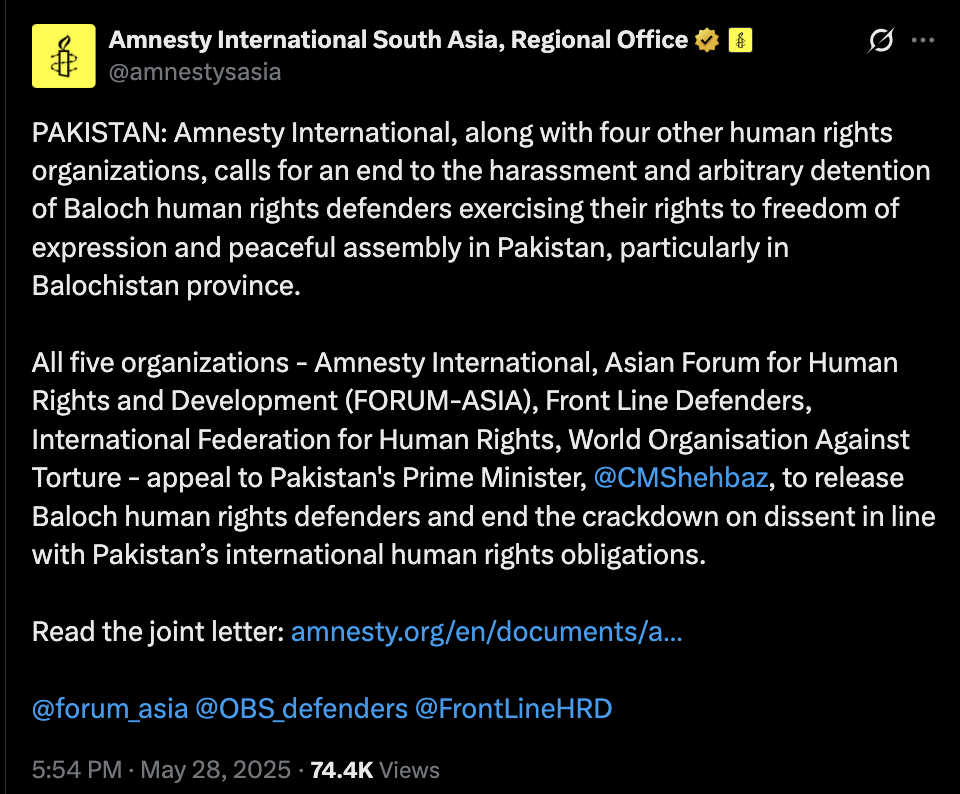
On 28 May Amnesty International along with four other human rights organizations wrote to the Pakistani prime minister, calling for an end to the “harassment and arbitrary detention” of Baloch human rights defenders (HRDs) exercising their rights to freedom of expression and peaceful assembly, particularly in Balochistan province.
The letter comes in the wake of Dr. Mahrang Baloch, one of the leading campaigners for the Baloch minority and the leader of the Baloch Yakjehti Committee (BYC), and a number of other activists, being arrested in March on charges of terrorism, sedition and murder. ..
The five organizations — Amnesty International, Asian Forum for Human Rights and Development (FORUM-ASIA), Front Line Defenders, International Federation for Human Rights, World Organization Against Torture — appeal to Pakistan’s Prime Minister to release Baloch human rights defenders and end the crackdown on dissent in line with Pakistan’s international human rights obligations;
A dozen UN experts called on Pakistan in March to immediately release Baloch rights defenders, including Dr. Baloch, and to end the repression of their peaceful protests. UN special rapporteur for human rights defenders Mary Lawlor said she was “disturbed by reports of further mistreatment in prison.”
Balochistan is the site of a long-running separatist movement, with insurgent groups accusing the state of unfairly exploiting Balochistan’s rich gas and mineral resources. The federal and provincial governments deny this, saying they are spending billions of rupees on the uplift of the province’s people.
Laureates from each of the major global regions (or their representatives) traveled to Ireland to accept the Award, including:
Africa: Luc Agblakou of Hirondelle Club International (Benin)
Americas: The Movement for Human Rights, Peace and Global Justice (MONDHA) (Dominican Republic / Haiti)
Asia and the Pacific: Arnon Nampa of Thai Lawyers for Human Rights (Thailand)
Europe and Central Asia: Sharifa Madrakhimova (Uzbekistan)
Middle East and North Africa: Mhamed Hali (Western Sahara)
“In a world that has become harsher for human rights defenders, these five courageous individuals and organisations face tremendous risks while carrying out their peaceful work to uphold the rights of their communities,” said Alan Glasgow, Executive Director of Front Line Defenders.
“These laureates are rays of light in some very dark situations of repression, discrimination and detention. Their steadfast commitment to human rights provides the solutions we need to brink humanity back from the brink, and to create a better, more just world. Governments must begin to see human rights defenders, not as a threat to their grasp on power, but as positive changemakers who can improve societies and defend the human rights of their citizens.”
This year’s laureates were selected from among hundreds of candidates put forward in a secure, public nomination process carried out between November 2024 and January 2025. In addition to a cash prize aimed at bolstering their protection, the winners receive support from Front Line Defenders on digital and physical security, advocacy, visibility, wellbeing and more.
The 2025 Front Line Defenders Award winners are:
Africa
Luc Agblakou is a human rights educator and defender for LGBTIQ+ rights in Benin. He is the Founding President of Hirondelle Club International, the first LGBTIQ+ organisation promoting integration in the country. His work has led to the inclusion of LGBTIQ+ people in the strategic plan to combat HIV/AIDS in Benin as well as court rulings promoting the protection of the LGBTIQ+ community.
Americas
The Movement for Human Rights, Peace and Global Justice (MONDHA), representing the Dominican Republic and Haiti, is a non-governmental organisation (NGO) founded in 2005 with the aim of improving the living conditions of vulnerable communities, with a particular focus on women and young people in these communities. MONDHA’s work is particularly strong in support of people of Haitian descent. To achieve this goal, they implement human development programmes related to community health, legal aid, human rights and education for communities and people of Haitian descent.
Asia and the Pacific
Arnon Nampa is a human rights lawyer who volunteers with Thai Lawyers for Human Rights. TLHR was established in 2014 to provide legal assistance to alleged violators of lèse-majesté (insulting the monarchy) and HRDs targeted by the authorities following the military coup of 22 May 2014. Arnon Nampa has defended numerous individuals accused of lèse-majesté under Article 112 of the Criminal Code, including the cases of several jailed HRDs.
Mhamed Hali from Western Sahara is a dedicated human rights defender and a member of the Sahrawi Association of Victims of Grave Human Rights Violations committed by the Moroccan State (ASVDH). He holds a doctorate in international humanitarian law, and currently serves as the Secretary General of the Association for the Protection of Sahrawi Prisoners in Moroccan Prisons (LPPS).
Resilience of Human Rights Defenders a Source of Hope Amid Global Rollback on Rights – At least 324 defenders killed in 32 countries for their peaceful work in 2024
On 6 May 2025 Front Line Defenders Global Analysis 2024/25 was published giving a detailed panorama of the violations against HRDs at risk in 105 countries in all regions. Despite an increasingly hostile world with expanded threats to their work, human rights defenders (HRDs) everywhere demonstrated a remarkable level of resilience and determination as they resisted a global rollback on human rights, Front Line Defenders said as it launched its flagship report.
The report also reveals statistics gathered and verified by the HRD Memorial – which Front Line Defenders coordinates – documenting the killings of at least 324 HRDs in 32 countries in 2024. HRDs working on land rights, citizen’s rights and Indigenous peoples’ rights each made up almost a fifth of the total, and the countries with the highest number of killings documented were Colombia (157), Mexico (32), Guatemala (29), Palestine (22) and Brazil (15). (See pp. 6-13 for complete data.)
“Year on year, hundreds of human rights defenders pay the ultimate price when they are killed for their work, having a devastating impact on their families and communities. It is a grim reflection of the immense danger faced by those who work peacefully to defend human rights,” said Alan Glasgow, Executive Director of Front Line Defenders.“Other threats and risks are manifold. Front Line Defenders’ analysis shows that women’s rights defenders globally and HRDs working in situations of conflict were among those most targeted for their work. It is a remarkable sign of these defenders’ courage that they continue their struggle despite such immense danger. They are the best among us, who fervently believe a better world is worth fighting for.”
Arbitrary arrest/detention was the most commonly reported violation against HRDs around the world, followed by threats/other harassment, legal action, death threats and surveillance. Women HRDs reported slightly higher levels of threats/other harassment compared to their male counterparts, while trans and non gender-conforming HRDs reported this as the most common violation they faced overall.
Criminalisation of HRDs remained rife with 107 charges filed in 75 cases. The most commonly cited charges were linked to defamation (23.4%); national security (19.6%); other criminal charges (12.1%); public order offences (11.2%); and terrorism-related charges (11.2%). In every region, governments and non-state actors turned to the judicial system to disrupt, stymie, stigmatise, bankrupt and imprison HRDs, regardless of the human rights they were defending. Counter-terrorism legislation and “Foreign Agent” laws were among those weaponised for use against HRDs.
According to Front Line Defenders data, defenders working on women’s rights were among the most targeted globally in 2024, ranking in the top three for all regions except one. This trend played out in numerous ways, with women human rights defenders (WHRDs) subjected to smear campaigns, criminalisation, arbitrary arrest and detention, as well as targeted with threats – including threats of sexual and gender-based violence.
WHRDs played key roles in protest movements seeking more just societies – for example in Bangladesh – faced stark discrimination in countries like Afghanistan and Iran, and shouldered heavy burdens in conflict and crisis situations, ranging from Gaza to Colombia, DRC, Myanmar, Sudan and Ukraine.
Dr. Mahrang Baloch, an outspoken WHRD from Pakistan’s Balochistan region, faced ongoing risks throughout the year, including travel bans, smear campaigns and arbitrary detention. At the time of publication she remains jailed in Quetta after being arbitrarily arrested for leading a peaceful protest. In a foreword provided to Front Line Defenders, she described why HRDs persist in their struggle:
“We must continue to resist. Because human rights defenders are the ones standing on the frontlines, risking everything so that others may find their missing loved ones, so that everyone can go to school, so that the silenced can speak, so that women raped in refugee camps can find justice, so that those fighting alone in their homes, their villages, their cities can know they are not alone. We must stand with them, and we must stand together. Not for a nation. Not for a religion. Not for a race. But for humanity. Because if we do not, who will?”
On 23 April 2025 Front Line Defenders expressed its serious concern for Syrian woman human right defender Hiba Ezzideen Al-Hajji, as well as her family and the ‘Equity and Empowerment’ organisation, who are being targeted by a defamation campaign on Facebook which seeks to incite violence against them. The online campaign, initiated both by individuals known to support the new government and unknown users, has targeted Hiba Ezzideen Al-Hajii for a Facebook post she made on 20 April 2025, in which she advocated against forced marriages. This bombardment of defamatory messages has included calls for violence, including death threats, constituting a clear case of harassment.
Hiba Ezzideen Al-Hajji is a Syrian feminist and woman human rights defender. She is the CEO of the Equity and Empowerment organisation and the Chairperson of the Board of Directors in Shan network for peace building. Equity and Empowerment is a women-led organisation which works on gender equality, focusing on digital security, economic and political empowerment. [see also: https://humanrightsdefenders.blog/2023/08/10/syrian-woman-human-rights-defender-hiba-ezzideen-al-hajji-threatened/]
Since 20 April 2025, Hiba Ezzideen Al-Hajii’s Facebook account, through which she posted about women’s rights, has been used to start a defamation campaign and incite violence against her, as well as her family and the Equity and Empowerment organisation, both based in Idlib, Syria. The online campaign has led to Hiba Ezzideen Al-Hajii receiving numerous death threats on the social media platform, both through private messages and through a flood of posts on her own account, as well as on Equity and Empowerment’s page. The online mob, formed by unknown users, have urged followers to post defamatory content against her online and called for physical violence, inciting people to burn down the center of Equity and Empowerment in Idlib, with the objective of killing Hiba Ezzideen Al-Hajii and harming her family. They have distorted the meaning of an old video, in which she stated that it is unnecessary to use the veil in the centers of Equity and Empowerment where there are only women, to falsely accuse her of insulting the Hijab and Islam. The online mob have also attempted to distort her Facebook post in which she urged authorities to investigate cases of women’s abduction, in order to allow for accountability.
Several public figures have taken advantage of this defamation campaign in order to falsely accuse the woman rights defender of being an agent to Assad security branches, despite her clear stands against the Assad regime and extensive record of human rights activism against it. Subsequently, on 22 April, the police in Idlib closed down the center of Equity and Empowerment. Furthermore, the governor of Idlib announced via Facebook that he has requested the public prosecutor to file a lawsuit against Hiba Ezzideen Al-Hajii for insulting the hijab. The woman human rights defender has expressed a profound concern for her personal safety and well-being. She has reported fearing for her life, as well as the lives of her family and team at Equity and Empowerment.
Front Line Defenders condemns the defamation and online campaign seeking to incite violence, as well as subsequent acts of intimidation against woman human rights defender Hiba Ezzideen Al-Hajii, her family and her organisation Equity and Empowerment. Front Line Defenders believes that the defamation campaign and online harassment is directly related to Hiba Ezzideen Al-Hajji’s work in the defence of human rights, particularly her work towards the promotion of women’s rights in Syria.
Front Line Defenders also expresses concern with the recurrent use of Facebook as a tool to incite violence against woman human rights defenders in Syria. The organisation urges Meta to immediately take down all Facebook posts against woman human rights defender Hiba Ezzideen Al-Hajii and her organisation Equity and Empowerment, suspend any groups, pages and profiles used to defame her or organise attacks and incite violence against her and her organisation, while also storing data that is relevant for future investigations and accountability. Meta must fulfill their responsibility to protect human rights, in accordance with international human rights standards. They must take the necessary steps to guarantee the safety of human rights defenders online, ensuring their platforms do not contribute to violent and dangerous campaigns, or allow users to incite targeted violence against defenders, particularly woman human rights defenders, which puts their lives at serious risk. Front Line Defenders stands ready to assist Meta with identifying the defamatory and violent content in question and the accounts on which they are hosted or shared.
Dr. Sabiha Baloch is a woman human rights defender and member of the Baloch Yakjehti Committee (BYC), a network focused on advocating for the human rights and interests of the Baloch people in Pakistan. Dr. Sabiha Baloch has faced reprisals due to her work, including attacks against her family. Notably, her work as a woman human rights defender has led to the abduction of her brother and relative, who were subsequently released after several months in detention. Dr. Sabiha Baloch has been an integral part of peaceful campaigns against extra judicial killings, enforced disappearances and arbitrary arrests in Balochistan. She was part of the Baloch Long March and the Baloch National Gathering in 2024, which faced severe State reprisals, including violence and arrests. Since March 2025, following the arrest of several leading human rights defenders and members of the BYC, Dr. Sabiha Baloch has continued to document and highlight violations, and demand the release of detained colleagues and protesters.
On 5 April 2025, Pakistani authorities arrested the father of Baloch woman human rights defender Beebow Baloch. He is currently detained at the Hudda District Prison in Balochistan under Section 3 of the Maintenance of Public Order Act (MPO). The woman human rights defender Beebow Baloch has also been held at the same prison under the MPO since her arrest on 22 March 2025.
On 7 April 2025, Pakistani authorities arrested woman human rights defender Gulzadi Baloch in Quetta, Balochistan, with disturbing reports of excessive violence being used during the arrest. For several hours following her arrest, there was no information about her fate or whereabouts, causing serious concerns for her physical and mental safety. She is presently held at the Hudda district prison under the regressive Maintenance of Public Order (MPO) Act, which severely restricts access to bail.
The NGO Frontline demands that Baloch human rights defenders in Pakistan are protected from reprisals, and end their ongoing persecution and punishment in the State, including for exercising their right to free expression and peaceful dissent, under the guise of national security.
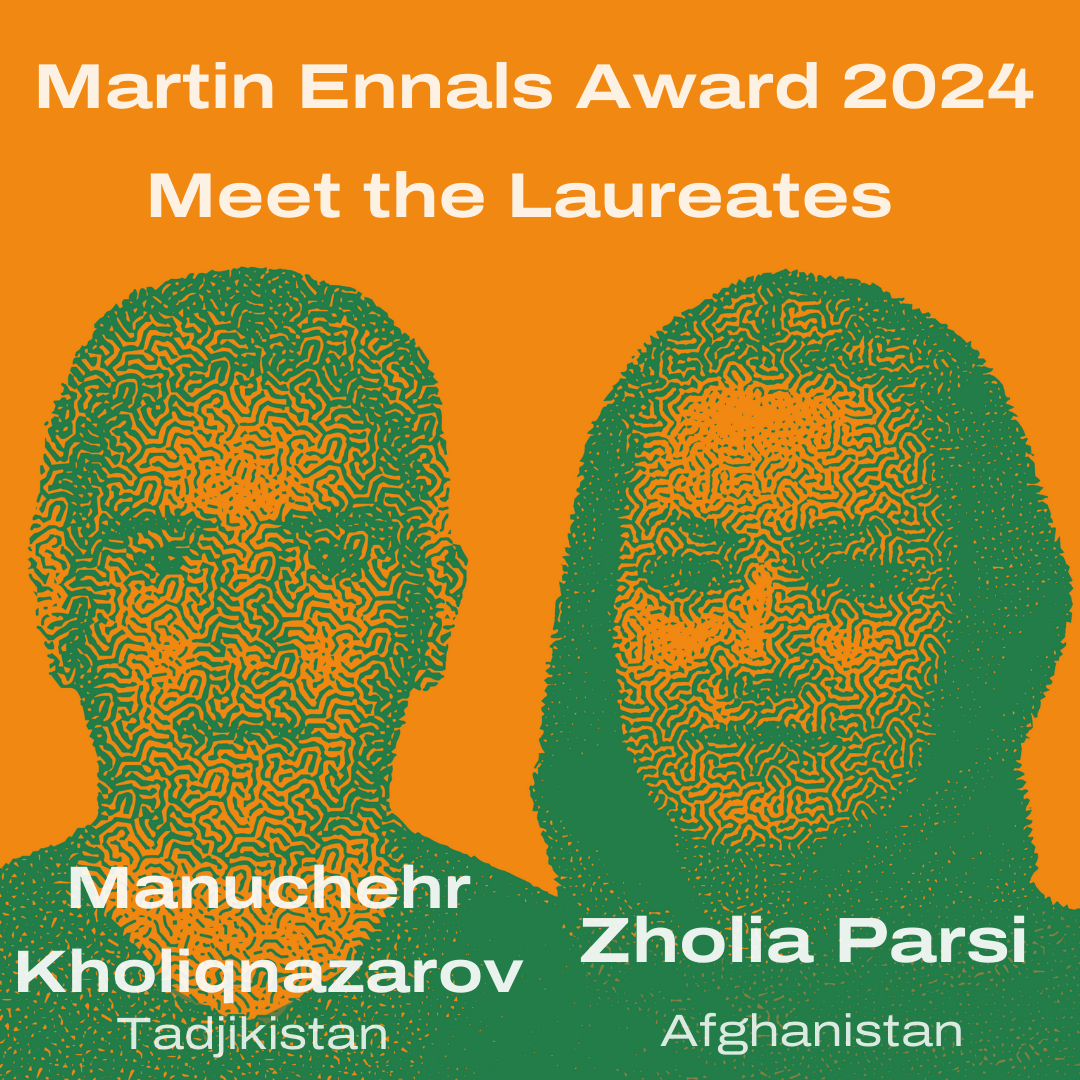
Two outstanding human rights defenders who have made it their life mission to protect human rights in Afghanistan and in Tajikistan will receive the Martin Ennals Award 2024 on November 21th, 2024, in Geneva, Switzerland, on the occasion of the 30th anniversary of the Martin Ennals Award.
The Jury of ten of the world’s leading human rights NGOs – Amnesty International, Human Rights Watch, FIDH, HURIDOCS, Bread for the World, Human Rights First, World Organisation Against Torture, International Commission of Jurists (ICJ), International Service for Human Rights (ISHR), and Front Line Defenders – has selected, after much deliberation, the two human rights defenders whom it strongly believes deserve to be recognized and honored in 2024, on the 30th anniversary of the Martin Ennals Award. [see also: https://www.trueheroesfilms.org/thedigest/awards/043F9D13-640A-412C-90E8-99952CA56DCE]
The two 2024 Laureates, Zholia Parsi (Afghanistan) and Manuchehr Kholiqnazarov (Tadjikistan) have shown exceptional courage and determination to bring human rights at the forefront despite evolving in deeply repressive environments.
“We are very proud to honor these two exceptional Laureates. They have paid too big a price for justice and equality to be respected in Afghanistan and Tajikistan and the international community must support their efforts instead of battling geostrategic interests in the region“. – Hans Thoolen, Chair of the Martin Ennals Award Jury
The two Laureates 2024:
Zholia Parsi: is a teacher from Kabul, Afghanistan. Having lost her career and seeing her daughters deprived of their education with Taliban takeover in August 2021, she founded the Spontaneous Movement of Afghan Women (SMAW) to protest the return of policies and practices against women rights and fundamental freedoms. She displayed remarkable leadership and resilience in organizing numerous public protests despite the risks involved. The grassroots movement that is the SMAW quickly grew momentum in Kabul and other provinces, now counting 180 members and having mobilized communities to resist the Taliban’s policies and practices. She was arrested in the street by armed Taliban in September 2023, and detained along with her son. She was released after three months of torture and ill-treatment under their custody, which further strengthened her resolve to resist Taliban oppression and repression.
Manuchehr Kholiqnazarov: is a Pamiri human rights lawyer from the Gorno-Badakhshan Autonomous Oblast (GBAO), Tajikistan. He is serving a 16 year-long prison sentence after what is widely considered an unfair trial in retaliation for his human rights work. As Director of the Lawyers’ Association of Pamir (LAP), he led strategic advocacy efforts in the GBAO, a region marked by its ethnic minority and historical tensions with the central government, including by lobbying for the incorporation of international human rights standards into domestic law and practice, and by providing legal support to residents of the GBAO. Through the human rights initiatives Commission 44 and Group 6, he played a key role in investigating the death of youth leader Gulbiddin Ziyobekov in November 2021, and the violent repression of subsequent mass protest in the regional capital Khorog. The investigation resulted in critical evidence of an unlawful killing, possibly an extrajudicial execution of the young man, and the unlawful use of force of security forces against protesters, resulting in two deaths, seventeen injured and hundreds detained. He was arrested on 28 May 2022 together with two other members of Commission 44 amid a widespread crackdown on local informal leadership and residents of the GBAO.
The Martin Ennals Award (MEA): 30 years alongside human rights defenders
The Martin Ennals Award (MEA) was given for the first time in 1994 to recognize, promote and protect human rights defenders at risk or from under-reported contexts. Over the years, the MEA has offered defenders a platform to issues that are of global concern and the means to steer the movement for human rights and larger freedoms. The MEA culminates every year in a public ceremony in Geneva, co-hosted with the City of Geneva (Ville de Genève). The 2024 MEA Ceremony will take place on November 21th, 2024 at the Salle communale de Plainpalais. The Ceremony, which is also livestreamed, draws many local and international human rights supporters to an inspiring event which celebrates the achievements and commitment of exceptional human rights defenders. “Geneva has a long tradition of hosting international diplomacy and promoting human rights and fundamental freedoms. The City of Geneva is proud to co-host the Martin Ennals Award and shed light, on this 30th anniversary, on the impressive resilience of two human rights defenders and the hope they bring for peace and equality” concludes Alfonso Gomez, Administrative Counselor of the City of Geneva.








 Hans Thoolen on Human Rights Defenders and their awards