This International Day of Education, Amnesty International has launched Rights Arcade, a free human rights game app which aims to educate the next generation of human rights defenders about rights such as freedom of expression and freedom of peaceful assembly.
Rights Arcade is designed to strengthen the human rights movement through action-oriented education. The games will boost players’ knowledge about human rights and encourage people to take action on human rights issues.
One of Rights Arcade’s key features is a self-paced approach that allows players to learn, reflect and take action at their own pace while navigating through the game’s stories.
“This game has been designed to empower and encourage people everywhere, but especially younger audiences, to learn about human rights in an engaging manner,” said Agnès Callamard, Amnesty International’s Secretary General.
“Young people are pivotal in setting the human rights agenda, today and for the future. Reaching them in the spaces they inhabit, or with which they engage regularly, is key to enabling new generations of activists and empowering them to fight for, and protect, human rights – now and in the future.”
The game’s stories, which are fictionalized experiences inspired by real world events, are driven by a player’s choices.
The player gets to play the role and navigate the experiences of the three central characters, making decisions based on their own understanding of human rights and unpacking how human rights concepts apply in daily life.
People around the world will be able to access a collection of three games currently available in four languages: English, Simplified Chinese, Thai and Korean.
Rights Arcade can be downloaded on iOS and Android devices, ensuring its accessibility in regions with poor internet connectivity.
Rights Arcade will be regularly updated to accommodate learning in more languages, and with new game offerings in the months and years to come.
AI has launched the world’s biggest letter writing campaign to help 10 human rights defenders around the world facing.
Millions of letters, emails and texts will be sent to support people who have been jailed, attacked or disappeared
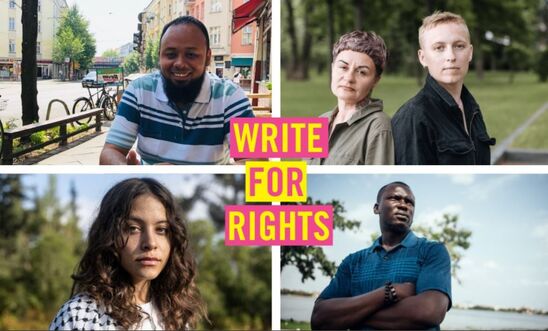
Amnesty International has launched its flagship annual letter-writing campaign, Write for Rights to support 10 activists from around the world who have been attacked, jailed, harassed or disappeared for standing up for their rights.
This year, Write for Rights – which is funded by players of the People’s Postcode Lottery – will be supporting ten individuals, including:
Imoleayo Adeyeun Michael from Nigeria, who faces years behind bars for joining the #EndSARS protests against the notorious Special Anti-Robbery Squad last year;
Janna Jihad, a 15-year-old journalist from Palestine, who faces harassment and death threats for reporting on the racist brutality her community experiences;
Mohamed Baker, an Egyptian human rights lawyer denied a trial and put behind bars for his work supporting people who have been imprisoned unjustly; and
Ciham Ali Ahmed, a US-Eritrean national, who was arrested nine years ago at the Sudanese border when she was trying to flee Eritrea aged 15 and has not been seen since.
Sacha Deshmukh, CEO of Amnesty UK, said:
“These individuals have been thrown behind bars, attacked, harassed or disappeared just for standing up for their rights. By coming together, people around the world have the power to raise their profile and increase their chances of protection or release.
“Sending a letter or email might seem like a small act, but when sent in their thousands they can have a huge impact. People in power are forced to listen.
Amnesty International’s Write for Rights campaign: Write for Rights goes back to the very roots of Amnesty International, which was founded in 1961, with Amnesty’s early campaigners writing letters of support to those affected by human rights abuses, as well as letters of concern to governments around the world.
More than 360,000 actions were taken for Algerian journalist Khaled Drareni, who was imprisoned for his reporting on the Hirak protest movement. He was provisionally released in February 2021.
Over 300,000 messages were sent to and on behalf of Paing Phyo Min, a satirical poet and student leader jailed for criticising the military in Myanmar. He was freed early in April 2021.
More than 777,000 actions were taken for Saudi women’s rights campaigner Nassima al-Sada. As a result, a G20 summit hosted by Saudi Arabia was overshadowed by international calls to free Nassima and other women human rights defenders. Nassima has since been conditionally released.
Amnesty has collaborated with 11 artists, creatives and campaigners to illustrate the four basic freedoms on social mediaFour basic freedoms outlined in 1948 Universal Declaration of Human Rights have been reimagined as Freedom to Explore, Be, Imagine and Rebel
‘We [want to] inspire a new generation to know their rights – and claim them’– Sacha Deshmukh
Amnesty International UK has collaborated with 11 artists to help a new generation of human rights defenders to better understand the four fundamental freedoms that every person has a right to.
Outlined in 1948, the Universal Declaration of Human Rights was based on four basic freedoms – freedom of speech, freedom to worship, freedom from want and freedom from fear.
But many young people today are unaware of the human rights they are entitled to, despite living at a moment in history when many of these basic freedoms are at risk of being taken away.
Now Amnesty has reimagined these four tenets for a modern audience, redefining the broad categories as the:
Freedom to Explore
Freedom to Be
Freedom to Imagine
Freedom to Rebel
Over the coming weeks, artists, creatives and campaigners will be sharing their interpretations of what these freedoms mean to them on Instagram.
Sacha Deshmukh, CEO of Amnesty International UK, said:
“From the pandemic to the climate crisis to conflicts unfolding across the planet – we live in a world of unprecedented uncertainty. But there is hope.
“Sixty years after Amnesty International was founded, we are collaborating with 11 fantastic artists, creatives and campaigners to reimagine the four basic freedoms – inspiring a new generation to know their rights and claim them.
“Knowledge is power and at a time when many basic human rights are under threat, these artists are vital beacons of hope for their followers – and the wider world.”
11 artists who want to change the world for the better
Basma Khalifa(she/her @basmakhalifa) is a Sudanese multi-disciplinary creative and hosts the ‘Unpretty Podcast’ which discusses perceptions of beauty through the lens of people of colour. Basma has worked with BBC1, BBC3, Facebook, Apple and Vice.
Das Penman (they/she@das.penman) Das started their Instagram page during lockdown as a means of creative expression but it has since grown into a safe space for discussions about politics, mental health and everything in between. Das combines a passion for drawing with current affairs to create the “Daisy Mail”, a round-up of news stories to help followers stay informed.
Jacob V Joyce (they/them@jacobvjoyce) is a non-binary artist with a focus on queer and decolonial narratives. Joyce’s work ranges from afro-futurist world building workshops to mural painting, comic books, performance art and punk music.
Joy Yamusangie(they/them @joyyamusangie) specialises in illustration, experimenting with a range of processes to produce mixed media pieces. Joy explores themes of memory, intimacy, race and culture from a personal perspective.
Bee Illustrates (they/them@beeillustrates) is a queer illustrator who uses their art to educate, empower and inform people on a range of topics including mental health, LGBTQ+ and anti-racism.
Radam Ridwan(they/them @radamridwan) is a queer non-binary multi-disciplinary artist of Indonesian heritage. Radam’s work centres on QTIPOC empowerment and has been published internationally with features in VICE, Vogue Italia, gal-dem and Gay Times.
Tahmina Begum(she/her @tahminaxbegum) is a journalist and has featured in HuffPostUK, Women’s Health, I-D, Dazed, Refinery29, Glamour, The Independent, Metro, The i and gal-dem. She covers a wide scope of topics centring around the lives of Muslim women and women of colour.
Jaz O’Hara(she/her @theworldwidetribe) is a motivational speaker, podcaster and the founder of The Worldwide Tribe, an organisation supporting refugees and asylum seekers globally.
Anshika Khullar(they/them @aorists) also known as Aorists is an award-winning Indian, non-binary transgender artist with an interest in intersectional feminist narratives. In addition to their editorial and literary projects, Anshika has appeared as a guest speaker and created video content for the Tate.
Antony Amourdoux(he/him @antony_amourdoux) was a Great British Bake Off 2018 contestant and remains a passionate baker. Antony was born in Pondicherry, India, where he learned to bake with his father. He supports a number of causes including LGBTQ rights.
Jess (she/her@thechroniciconic) campaigns about the unseen injustices around disability, mental health and neurodiversity by sharing both her lived experience and the voices of others. Jess’ goal is to destigmatise and normalise conversations on these subjects.
The Cambodian government should immediately drop baseless conspiracy and “insulting the king” charges against four environmental activists affiliated with the Mother Nature Cambodia environmental group and release the three in pretrial detention, Human Rights Watch said today.
On June 16, 2021, the police arrested Sun Ratha, 26, Ly Chandaravuth, 22, and Seth Chhivlimeng, 25, in Phnom Penh, and Yim Leanghy, 32, in Kandal province, apparently for their documentation that raw sewage has entered the Tonle Sap River near the Royal Palace. On June 20, the court charged Ratha and Leanghy with “conspiracy” and lese majeste (“insulting the king”) under articles 453 and 437 bis of Cambodia’s penal code, and Chandaravuth with “conspiracy.” If convicted, they face between 5 and 10 years in prison, and fines of up to 10 million riels (US$2,500). The authorities also charged in absentia aSpanish national, Alejandro Gonzalez-Davidson, the founder of Mother Nature Cambodia, who had been deported in 2015. Chhivlimeng was released without charge.
“The Cambodian government has stepped up its campaign to silence activists peacefully advocating to protect the environment,” said Phil Robertson, deputy Asia director. “Foreign governments, the United Nations country team, and international donors should call on the Cambodian authorities to drop their absurd charges against the environmental activists and publicly condemn any further clampdown on peaceful activism.”
An Interior Ministry spokesperson alleged that the authorities had proof that “rebellious” Mother Nature Cambodia had used foreign funding to try to topple the government, but did not make any evidence public.
This case followed earlier harassment of five Mother Nature Cambodia activists. On May 5, the Phnom Penh court convicted three environmental activists – Long Kunthea, 22, Phuon Keoraksmey, 19, and Thun Ratha, 29 – of “incitement to commit a felony or disturb social order,” articles 494 and 495 of Cambodia’s penal code. The judge sentenced them to between 18 and 20 months in prison as well as a fine of 4 million riels ($1,000) for their peaceful activism protesting the authorities’ filling-in Phnom Penh’s Boeung Tamok lake.
Amid the Covid-19 pandemic, the Cambodian authorities have stepped up their crackdown on youth and environmental activists engaged in peaceful activism and protest. The government has often used draconian new laws to arrest and prosecute activists in an apparent attempt to silence their voices and shut down their activism.
In March 2020 and early 2021, the authorities arrested environmental activists affiliated with the Prey Lang Community Network along with a prominent environmentalist and lawyer, Ouch Leng, to stop their efforts to document illegal logging and deforestation within the Prey Lang forest.
Human Rights Watch has documented cases of nearly 70 current political prisoners, including members of the political opposition, youth and environmental activists, trade union leaders, and journalists who are awaiting trial or are serving prison sentences. Many other activists have fled Cambodia to seek refuge abroad.
“Cambodia’s highly politicized courts mean that the environmental activists charged have no chance of getting a fair trial,” Robertson said. “Only international pressure on the Cambodian government holds out the possibility of saving these activists from unjust prison sentences.”
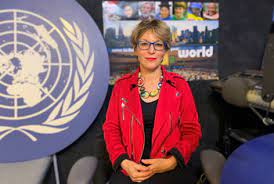
On 29 March 2021 Amnesty International announced the appointment of Dr. Agnès Callamard, a leading international human rights expert, as its new Secretary General, effective immediately.
As Secretary General, Dr. Callamard will be the Chief Executive of Amnesty’s International Secretariat and the principal spokesperson of the global Amnesty movement, which has some 10 million supporters, and offices in more than 70 countries.
“At a time when human rights are under unprecedented threat around the world, Dr. Callamard will lead, excite and rally the entire Amnesty movement to meet these challenges head-on,” said Sarah Beamish, Chair of the International Board, in announcing the appointment. “The combination of her intellectual acuity, her deep global human rights experience, and her courageous voice makes her highly qualified to front our movement. We are delighted she has accepted this challenge to take us boldly into our next phase.”
“Where governments and corporations seek to silence those who speak out against their abuses, to obfuscate the truth, and to undermine or reject human rights norms, the rigorous investigations and uncompromising campaigns of Amnesty International are more vital than ever.” Agnès Callamard
“I am honoured to take up the post of Secretary General and work alongside Amnesty’s supporters around the world so that together we defend and demand respect for all human rights for all,” Dr Callamard said.
Dr. Callamard, a French national, has built a highly distinguished career in the international human rights and humanitarian sectors, working across NGOs, academia, and the United Nations. Alongside her role as a United Nations independent human rights expert, she held the role of Director of the Global Freedom of Expression Project at Columbia University. Previously, she has been the Executive Director of the Freedom of Expression organization ARTICLE 19 and was the founder and Executive Director of HAP International (the Humanitarian Accountability Partnership).
Dr. Callamard worked with Amnesty International from 1995-2001, including as Chef de Cabinet for then-Secretary General Pierre Sané. She has led human rights investigations in more than 30 countries and published extensively on human rights, women’s rights, freedom of expression, refugee movements, and the methodology of human rights investigations.
The Court of Appeal held on Friday 29 January 2021 that a group of activists who broke into Stansted Airport in an act of protest should “never have been prosecuted” for an “extremely serious” terror-related offence under s.1(2)(b) of the Aviation and Maritime Security Act 1990 (“AMSA”).
It overturned the Stansted 15’s convictions.
Lord Burnett said the protestors should not have been prosecuted for the extremely serious offence … because their conduct did not satisfy the various elements of the offence. “There was, in truth, no case to answer.”
This case has been controversial, drawing attention both nationally and internationally. Following the initial convictions, a joint letter was sent to the Government by UN experts, including the Working Group on Arbitrary Detention, the Special Rapporteur in the promotion and protection of the right to freedom of opinion and expression, the Special Rapporteur on human rights defenders, and the Special Rapporteur on the promotion and protection of human rights and fundamental freedoms when countering terrorism. The UN experts urged the UK government not to use security and terrorism-related legislation to prosecute peaceful protesters.
The failure of the ground relating to necessity, duress and s.3 CLA are unlikely to surprise those with experience of defending protestors in direct action cases. Nevertheless, it is notable that the actions of the appellants did prevent the deportation of five persons on the flight who have consequently been able to establish their legal right to remain in the UK, including three on human rights grounds. One of those has been granted asylum as a victim of human trafficking. In total, of the 60 persons due to be on the deportation flight, eleven reportedly remain in the country.
Amongst the human rights group who have celebrated the ruling are Amnesty UK, who welcomed “a good day for justice” and Liberty, who hailed “a major victory for protest rights” and deprecated the now-quashed convictions, calling them “part of a sustained attack on the right to protest.”
The UN Human Rights Council (UNHRC) must take urgent steps to address the worsening human rights situation in Sri Lanka, said Amnesty International, on 27 January 2021 following the release of a damning UN report on the country’s efforts to ensure accountability for crimes committed during the civil conflict.
In February 2020, the Sri Lankan government announced that it would no longer cooperate with the UNHRCs landmark resolution 30/1, which promotes reconciliation, accountability, and human rights in the country, and would instead pursue its own reconciliation and accountability process. This report lays bare Sri Lanka’s abject record on delivering justice and accountability and the decaying effect this has had on human rights in the country David Griffiths, Director of the Office of the Secretary General at Amnesty International
“This report lays bare Sri Lanka’s abject record on delivering justice and accountability and the decaying effect this has had on human rights in the country. The seriousness of these findings highlights the urgent need for the UN Human Rights Council to step up its efforts in Sri Lanka,” said David Griffiths.
“For more than a decade, domestic processes have manifestly failed thousands of victims and their families. Given the government’s decision to walk away from resolution 30/1, and regression on the limited progress that had been made, the Human Rights Council must send a clear message that accountability will be pursued with or without the cooperation of the government.”
Amnesty International is calling on the UN Human Rights Council to implement the report’s key recommendations to put in place more stringent oversight on Sri Lanka, including more robust monitoring and reporting on the human rights situation, and the collection and preservation of evidence for future prosecutions.
“UN member states should learn from past experience, and this time heed the early warning indicators identified by the UN’s top human rights official.” said David Griffiths
The OHCHR report, published on 27 January 2021, is available to download here:. The Human Rights Council will meet for its 46th session from 22 February to 23 March, during which Canada, Germany, Montenegro, North Macedonia and the UK – the current core group of states leading on Sri Lanka – are expected to present a resolution in follow-up to the OHCHR report.
Amnesty International published an assessment of the situation in Sri Lanka, setting out clear expectations for HRC action, earlier this month. The High Commissioner’s report supports the call for more robust monitoring and reporting on the situation, as well as the collection and preservation of evidence for future prosecutions.
The human rights organization Amnesty International published a scathing report on 25 January 2021 decrying the inhumane conditions in Egyptian prisons. The report comes a decade after the Arab Spring uprising.
The report detailed the experiences of 67 individuals in detention, 10 of whom died in custody and two who died shortly after being released. It was carried out primarily between February 2020 and November 2020 and focused on 16 prisons. It found that:
Prisoners were kept in squalid conditions and received unhealthy food;
There was no proper access to health care, which may have resulted in death;
Overcrowding, poor ventilation and limited access to water and toilets led inevitably to outbreaks of coronavirus.
The report also found that some prisoners were deliberately denied access to health care due to their political affiliations. Activists, politicians and human rights defenders were denied basic treatments available to other inmates. There was also evidence of prison authorities “targeting prisoners critical of the government and denying them adequate food or family visits,” Markus Beeko, Secretary General of Amnesty International in Germany, asserted. According to UN estimates, there are 114,000 people incarcerated in the north African country.
On 22 January 2021 Mary Lawlor also deplored the arrest and prolonged pre-trial detention of human rights defenders and bloggers, and their accusation of being members of a terrorist organisation, continuing Egypt’s practice to intimidate and criminalise human rights defenders, journalists and their families.
“I am extremely concerned by the seemingly unrelenting efforts of the Egyptian authorities to silence dissent and shrink civic space in the country, despite repeated calls from UN mechanisms and the international community,” said Mary Lawlor, UN Special Rapporteur on the situation of human rights defenders.
The Special Rapporteur said she was disturbed by the detention since 2018 of human rights defender and blogger Mohamed Ibrahim Radwan, also known as ‘Mohamed Oxygen’, on charges of “membership of a terrorist organisation” and “misuse of social media” in retaliation for his posts and videos reporting on human rights issues. He was granted conditional release by the Cairo Criminal Court in November last year but was attached to a new case on charges of joining a terrorist organisation and kept in detention. He remains in pre-trial detention in Al-Aqrab Prison, south of Cairo.
Lawlor said that human rights defenders such as researcher and post-graduate student Patrick Zaki, who was arrested in February last year, have endured repeated renewals of detention without trial. “Pre-trial detention should only be used as the exception to the rule, rather than the default approach,” said Lawlor.
“Not only are these human rights defenders, journalists and other civil society actors unduly targeted for their legitimate and peaceful defence of human rights and fundamental freedoms, they are wrongfully accused of belonging to terrorist organisations and portrayed as a national security threat under vague legal provisions,” the Special Rapporteur said. “This is an issue which I and a number of UN experts have previously communicated our concern about to the Egyptian authorities.”
Ten years after the Tahrir square protests in Cairo, Egypt’s human rights record is disastrous. On the occasion of the anniversary of the 2011 revolution, several international campaigns are calling for the release of imprisoned activists writes Sofian Philip Naceur in Qantara.de Violent, authoritarian and extremely paranoid: since his bloody takeover in 2013, Egypt’s President Abdul Fattah al-Sisi has restored a regime whose brutality far outstrips even the reign of long-term ruler Hosni Mubarak. Hopes for real political and social change after the mass uprising that forced Mubarak out of office after 30 years in power have faded away, leaving a disillusionment that is omnipresent.
Egyptian opposition figures are using the current media attention around the tenth anniversary of the “25 January Revolution” to highlight the fate of those currently in prison for their political engagement. Some have been sentenced to heavy jail terms, while others are subjected to pre-trial detention lasting years by the Egyptian security forces and the country’s judiciary. European opposition politicians are also participating in corresponding campaigns.
Eight politicians from Germany’s left-wing party – Die Linke – have signed a solidarity statement calling for the immediate release of all political detainees, which explicitly highlights the fate of six detained leftist activists, journalists and trade unionists. Although the campaign specifically highlights six individual cases, it expresses solidarity not only with Egyptian leftists, but with all those “who are resisting Sisi’s dictatorship”. In addition to journalist Hishem Fouad, who advocated for striking workers and independent trade unions long before 2011, the German politicians are also calling for the release of novelist Ayman Abdel Moati, lawyer and trade union activist Haitham Mohamadeen and trade unionist Khalil Rizk. All four are detained on flimsy, terrorism-related charges.
On Wednesday morning 6 January 2021 an Israeli military court convicted Palestinian Human Rights Defender Issa Amro for peacefully protesting and civil disobedience. The Israeli military judge announced the verdict in a hearing attended by representatives of British, European, EU and Canadian consulates. Amnesty International issued a statement calling to drop all the “politically motivated” charges.
“Today Israel announced that Palestinians are not allowed to peacefully protest the Israeli occupation without a permit from the occupier,” Amro stated. “This conviction is the military system against the Palestinian nonviolent resistance. It aims to suppress my voice and end all activism against the Israeli occupation.” Amro’s Israeli lawyer Gaby Lasky added that “The military court is just an organ of occupation. The [indictment for nonviolent protest] is an example of how the courts are used in order to deter the important voices of human rights defenders.”
Amro is a founder of the Youth Against Settlements group in Hebron, which organises non-violent activism against the illegal Israeli settlements in Hebron and the discriminatory restrictions placed on Palestinians by the Israeli authorities in the city. Amro first appeared in an Israeli military court in 2016 on 18 charges, ranging from “insulting a soldier” to “participating in a march without a permit”. Some of the charges dated back to 2010.
The indictment, first presented in 2016, included 18 charges related to Amro’s community organizing deemed “baseless,” “politically motivated” or “physically impossible” by Amnesty. The military judge convicted Amro on six counts: three counts of “participating in a rally without a permit,” two counts of “obstructing a soldier,” and one count of “assault.” These surround Amro’s participation in the peaceful “Open Shuhada Street” demonstration in 2016; Amro’s participation in the nonviolent “I Have a Dream” demonstration from 2013 in which participants wore masks of Obama and Martin Luther King; one count of obstruction relates to a nonviolent sit-in protest in 2012 calling to re-open the old Hebron municipality building; one count of “assault” by “shoving someone” related to a previously-closed case from 2010, an incident for which the indictment had included an obstruction charge (acquitted) for Amro yelling “I am being assaulted” in the Israeli police station prior to Amro being carried out to an ambulance on a stretcher.
In 2019, UN Special Rapporteurs called for Amro’s protection and expressed “concern” over the charges. In 2017[see: https://humanrightsdefenders.blog/2019/04/11/un-rapporteurs-intervene-again-for-palestinian-human-rights-defender-issa-amro/]; thirty-five U.S. House Representatives and four Senators including Bernie Sanders sent letters highlighting that some charges were not internationally recognizable offenses and that Amnesty would consider Amro a “prisoner of conscience” if convicted. Issa Amro is the co-founder and former coordinator of the Hebron-based Youth Against Settlements initiative. In 2010, he was declared “Human Rights Defender of the year in Palestine” by the UN OHCHR and he is formally recognized by the European Union. He won the One World Media Award in 2009 for his involvement in B’Tselem’s camera distribution project. He was a guest of the U.S. State Department in 2011 and has spoken at the UN Human Rights Council on numerous occasions. The sentencing is scheduled for 8 February.
Saleh Higazi, Amnesty International’s Middle East and North Africa Deputy Director, said: “The Israeli authorities must end their campaign of persecution against Palestinian activist Issa Amro, who is a prominent voice against Israel’s regime of discrimination and systematic human rights violations against Palestinians in the Occupied Palestinian Territories, particularly in Hebron.”
Thai authorities on 1 January 2021 made their 38th arrest of a pro-democracy activist in recent weeks under the country’s tough lèse majesté law as authorities crack down on the country’s unprecedented protest movement. That law, Section 112 of the Thai criminal code, forbids defamation of the king and provides for three to 15 years’ imprisonment for violations.The law had been dormant since King Maha Vajiralongkorn succeeded his father, King Bhumibol Adulyadej, who died in 2016. The Thai government, though, is now using it to try to stamp out continuing protests calling for the government to resign, a new constitution and reform of the monarchy
Thailand’s authorities must stop targeting pro-democracy protesters with draconian legal action and instead enter into dialogue, according to the UN’s special rapporteur for freedom of assembly, who warned the country risks sliding into violence. Clément Voule said he had written to the Thai government to express alarm at the use of the fierce lese-majesty law against dozens of protesters, including students as young as 16.
“It is legitimate for people to start discussing where their country is going and what kind of future they want,” Voule said of the protests. “Stopping people from raising their legitimate concerns is not acceptable.”
So far, 37 people face charges of insulting the monarchy for alleged offences ranging from wearing traditional dress deemed to be a parody of the royals to giving speeches arguing that the power and wealth of the king should be curbed.
Anti-government protesters flash a three-finger salute – a gesture used adopted by protesters from the Hunger Games films – as they gather in support of people detained under the lese-majesty law at a police station in Bangkok. Photograph: Narong Sangnak/EPA
Prominent protest leaders face an unusually high number of charges. This includes the student activists Parit Chiwarak, also known as Penguin, (12 charges) and Panusaya Sithijirawattanakul (six charges) and the human rights lawyer Anon Nampa (eight charges), who have given speeches calling for the power of the royals to be curbed.
The pro-democracy protest fundraiser Inthira Charoenpura speaks from a stage outside Bang Khen police station in Bangkok. Photograph: Gemunu Amarasinghe/AP
Protesters – who have faced various other charges over recent months, including sedition – declined to participate in a government reconciliation panel in November, rejecting it as an attempt to buy time. The recent cases come after months of demonstrations in which protesters have made unusually frank and public calls for reform to the monarchy.
Benja Apan, 21, one of 13 people facing charges over a demonstration outside the German embassy in Bangkok, said legal action was unlikely to deter protesters from coming out in the new year. “I actually think it will bring more people out, because it is not fair,” she said.
The human rights group Amnesty International has launched a campaign calling on PM Prayut Chan-o-cha to drop charges pressed on a number of activists for their role in the pro-democracy movement and to repeal, or at least amend, Thailand’s draconian lèse majesté law. According to the campaign, at least 220 people, including minors, face criminal charges for relating to their actions in the pro-democracy movement. Activists are calling on government and monarchy reform, raising issues considered taboo and unprecedented in Thai society. Thailand must amend or repeal the repressive laws it is using to suppress peaceful assembly and the expression of critical and dissenting opinions.
Amnesty International is calling on people to take action and send a letter to the prime minister, calling on the Thai government to change their approach when handing the ongoing protests to protect human rights. Sample letter by AI’s campaign calls on Prayut to:
Immediately and unconditionally drop all criminal proceedings against protesters and others charged solely for exercising their rights to freedom of peaceful assembly and expression
Cease all other measures, including harassment, aimed at dissuading public participation in peaceful gatherings or silencing voices critical of the government and social issues
Amend or repeal legislation in order to ensure it conforms with Thailand’s international human rights obligations on freedom of peaceful assembly and expression, and to train state officials to carry out their duties confirming to Thailand’s obligation to respect, protect and fulfil the peaceful exercise of the rights to freedom of peaceful assembly and expression.
On Saturday 19 December 2020 Maya Taylor in The Thaiger had already reported that the United Nations High Commission for Human Rights has expressed shock and dismay at Thailand’s use of its strict lèse majesté law against a 16 year old pro-democracy activist. The UN High Commissioner for Human Rights’ spokesperson Ravina Shamdasani has called on Thailand to refrain from using the law against those exercising their right to freedom of speech, as she expressed alarm that a minor was being charged under the law. “It is extremely disappointing that after a period of 2 years without any cases, we are suddenly witnessing a large number of cases, and – shockingly – now also against a minor. We also remain concerned that other serious criminal charges are being filed against protesters engaged in peaceful protests in recent months, including charges of sedition and offences under the Computer Crime Act. Again, such charges have been filed against a minor, among others.”
“The UN Human Rights Committee has found that detention of individuals solely for exercising the right to freedom of expression or other human rights constitutes arbitrary arrest or detention. We also urge the government to amend the lèse majesté law and bring it into line with Article 19 of the ICCPR on the right to freedom of expression.”
Thailand’s Foreign Ministry spokesman has played down the UN High Commissioner for Human Rights’ criticisms over the kingdom’s enforcement of the Lese Majeste law.