Posts Tagged ‘Lese-majesty’

Thailand: New FIDH report details more than a decade of lèse-majesté abuse

September 4, 2026

A new report published on 2 September 2026 by the International Federation for Human Rights (FIDH) and its member organisation Thai Lawyers for Human Rights (TLHR) sheds light on the severe human rights impacts of the enforcement of Article 112 of Thailand’s Criminal Code (lèse-majesté) since the country’s latest military coup in May 2014.

The report, titled “The unsayable – Q&A on Thailand’s lèse-majesté”, answers 15 frequently asked questions about Article 112 and its implications for human rights, civic space, the media, and democratic development in Thailand.

The evidence of the serious human rights violation linked to the enforcement of Article 112 is overwhelming and causes great damage to Thailand’s international standing. Reform of Article 112 is long overdue and efforts by Thai civil society to peacefully campaign for such changes should be commended and protected,” said FIDH Vice-President Teppei Ono.

Statistics about lèse-majesté reflect the severity and scope of the human rights violations linked to the enforcement of Article 112. Between May 2014 and July 2026, at least 461 individuals were prosecuted under Article 112, with at least 199 receiving prison sentences. The 10 longest prison sentences imposed under Article 112 averaged approximately 30 years and six months, with the longest sentence reaching 50 years. At least 21 children were prosecuted under Article 112, with the youngest one aged 14.

As of July 2026, 29 individuals remained detained under Article 112. Of these, 12 were detained pending trial or appeal, while the judgments for the remaining 17 had become final. Among those behind bars is prominent pro-democracy activist and human rights lawyer Arnon Nampa, who has accumulated a prison term of over 31 years stemming from 11 lèse-majesté convictions for his speeches and online posts that called for monarchy reform. Three additional lèse-majesté cases remain pending.

At the international level, all the relevant key United Nations (UN) human rights mechanisms have consistently expressed their concerns over various aspects of the enforcement of Article 112 and declared it incompatible with Thailand’s human rights obligations under international law…

FIDH and TLHR call on states to use Thailand’s fourth UPR to raise their concerns over the ongoing abuse of Article 112 and make recommendations to the Thai government to bring this provision into line with international law. FIDH and TLHR also urge Thai authorities to establish a moratorium on new lèse-majesté prosecutions and to immediately release all those who are being deprived of their liberty under Article 112.
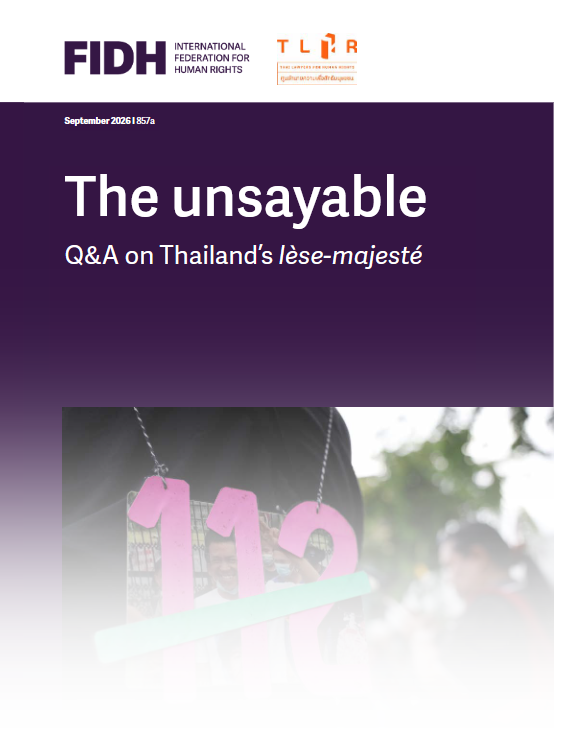
The unsayable – Q&A on Thailand’s lese majeste

Continued harassment of Mother Nature defenders in Cambodia

June 22, 2021

The Cambodian government should immediately drop baseless conspiracy and “insulting the king” charges against four environmental activists affiliated with the Mother Nature Cambodia environmental group and release the three in pretrial detention, Human Rights Watch said today.

On June 16, 2021, the police arrested Sun Ratha, 26, Ly Chandaravuth, 22, and Seth Chhivlimeng, 25, in Phnom Penh, and Yim Leanghy, 32, in Kandal province, apparently for their documentation that raw sewage has entered the Tonle Sap River near the Royal Palace. On June 20, the court charged Ratha and Leanghy with “conspiracy” and lese majeste (“insulting the king”) under articles 453 and 437 bis of Cambodia’s penal code, and Chandaravuth with “conspiracy.” If convicted, they face between 5 and 10 years in prison, and fines of up to 10 million riels (US$2,500). The authorities also charged in absentia aSpanish national, Alejandro Gonzalez-Davidson, the founder of Mother Nature Cambodia, who had been deported in 2015. Chhivlimeng was released without charge.

The Cambodian government has stepped up its campaign to silence activists peacefully advocating to protect the environment,” said Phil Robertson, deputy Asia director. “Foreign governments, the United Nations country team, and international donors should call on the Cambodian authorities to drop their absurd charges against the environmental activists and publicly condemn any further clampdown on peaceful activism.”

An Interior Ministry spokesperson alleged that the authorities had proof that “rebellious” Mother Nature Cambodia had used foreign funding to try to topple the government, but did not make any evidence public.

This case followed earlier harassment of five Mother Nature Cambodia activists. On May 5, the Phnom Penh court convicted three environmental activists – Long Kunthea, 22, Phuon Keoraksmey, 19, and Thun Ratha, 29 – of “incitement to commit a felony or disturb social order,” articles 494 and 495 of Cambodia’s penal code. The judge sentenced them to between 18 and 20 months in prison as well as a fine of 4 million riels ($1,000) for their peaceful activism protesting the authorities’ filling-in Phnom Penh’s Boeung Tamok lake.

All three activists had been arrested in September 2020 and spent almost eight months in pretrial detention. Gonzalez-Davidson and Chea Kunthin, another activist, were also convicted in absentia and sentenced to between 18 and 20 months in prison. [see: https://humanrightsdefenders.blog/2020/09/09/cambodia-arbitrary-arrest-of-mother-nature-activists/]

Amid the Covid-19 pandemic, the Cambodian authorities have stepped up their crackdown on youth and environmental activists engaged in peaceful activism and protest. The government has often used draconian new laws to arrest and prosecute activists in an apparent attempt to silence their voices and shut down their activism.

In March 2020 and early 2021, the authorities arrested environmental activists affiliated with the Prey Lang Community Network along with a prominent environmentalist and lawyer, Ouch Leng, to stop their efforts to document illegal logging and deforestation within the Prey Lang forest.

Human Rights Watch has documented cases of nearly 70 current political prisoners, including members of the political opposition, youth and environmental activists, trade union leaders, and journalists who are awaiting trial or are serving prison sentences. Many other activists have fled Cambodia to seek refuge abroad.

Because of the higher risks of getting Covid-19 in prison, Human Rights Watch has repeatedly appealed to the Cambodian authorities to conditionally release pretrial detainees not held for violent offenses. The Office of the UN High Commissioner for Human Rights and civil society groups have often criticized the government’s routine use of pretrial detention.

“Cambodia’s highly politicized courts mean that the environmental activists charged have no chance of getting a fair trial,” Robertson said. “Only international pressure on the Cambodian government holds out the possibility of saving these activists from unjust prison sentences.”

https://www.hrw.org/news/2021/06/23/cambodia-free-environmental-activists

https://www.jurist.org/news/2021/06/cambodia-court-charges-environmental-activists-with-conspiracy-insulting-king/

https://www.fidh.org/en/issues/human-rights-defenders/cambodia-arbitrary-detention-and-judicial-harassment-of-mother-nature

https://www.amnesty.org/en/latest/news/2021/06/cambodia-assault-on-environmental-defenders-escalates-as-four-more-charged-imprisonment/ 

Human rights defender in Thailand severely punished for using freedom of expression

January 24, 2013

This press release by the Asian Human Rights Commission gives ample detail on the (ab)use of ‘lesé’ majesté‘ articles in the Thai system. It explains that even being associated with someone who offends the King is enough to trigger prosecution and incur extremely heavy penalties.

THAILAND: Verdict in case of human rights defender is a serious threat to freedom of expression — Asian Human Rights Commission.