Archive for the 'human rights' Category
April 25, 2018
The key notion is expressed in the following quotes:
“.those who care about human rights need to take seriously the forces that lead so many people to vote in majoritarian strongmen in the first place.”
and
“The truth is that the growth of international human rights politics has accompanied the very economic phenomena that have led to the rise of radical populism and nationalism today. In short, human rights activism made itself at home in a plutocratic world.”
Where I most disagree with the author is that there is lot more going on in the human rights movement than the defense of civil and political rights or playing along with elites. Either he does not know it or ignores it on purpose. The thousands of human rights defenders working in their own countries are fully aware of the realities on the ground and are often prioritizing social, economic, cultural and community rights [just a cursory sample of blog posts on environmental activists will show this: https://humanrightsdefenders.blog/tag/environmental-activists/]. International and regional NGOs mostly help and protect them! Also, the author seems to underestimate the potential attraction of the human rights cause in civil society (especially victims and young people), whose mobilization is still patchy. If the human rights movement can overcome its fragmentation and use media better this potential could turn tides. Say I!.
Here the piece in full/ judge for yourselves:
The human rights movement, like the world it monitors, is in crisis: After decades of gains, nearly every country seems to be backsliding. Viktor Orban in Hungary, Rodrigo Duterte in the Philippines and other populist leaders routinely express contempt for human rights and their defenders. But from the biggest watchdogs to monitors at the United Nations, the human rights movement, like the rest of the global elite, seems to be drawing the wrong lessons from its difficulties.
Advocates have doubled down on old strategies without reckoning that their attempts to name and shame can do more to stoke anger than to change behavior. Above all, they have ignored how the grievances of newly mobilized majorities have to be addressed if there is to be an opening for better treatment of vulnerable minorities.
“The central lesson of the past year is that despite considerable headwinds, a vigorous defense of human rights can succeed,” Kenneth Roth, the longtime head of Human Rights Watch, contended recently, adding that many still “can be convinced to reject the scapegoating of unpopular minorities and leaders’ efforts to undermine basic democratic checks and balances.”
That seems unlikely. Of course, activism can awaken people to the problems with supporting abusive governments. But if lectures about moral obligations made an enormous difference, the world would already look much better. Instead, those who care about human rights need to take seriously the forces that lead so many people to vote in majoritarian strongmen in the first place.
The truth is that the growth of international human rights politics has accompanied the very economic phenomena that have led to the rise of radical populism and nationalism today. In short, human rights activism made itself at home in a plutocratic world.
It didn’t have to be this way. The Universal Declaration of Human Rights, which was promulgated in 1948 amid the consolidation of welfare states in Europe and North America and which formed the basis of the human rights agenda, was supposed to enshrine social protections. But in the 1970s, when activists in the United States and Western Europe began to take up the cause of “human rights” for the victims of brutal regimes, they forgot about that social citizenship. The signature group of that era, Amnesty International, focused narrowly on imprisonment and torture; similarly, Human Rights Watch rejected advocating economic and social rights.
This approach began to change after the Cold War, especially when it came to nongovernmental advocacy in post-colonial countries. But even then, human rights advocacy did not reassert the goal of economic fairness. Even as more activists have come to understand that political and civil freedom will struggle to survive in an unfair economic system, the focus has often been on subsistence.
In the 1990s, after the Cold War ended, both human rights and pro-market policies reached the apogee of their prestige. In Eastern Europe, human rights activists concentrated on ousting old elites and supporting basic liberal principles even as state assets were sold off to oligarchs and inequality exploded. In Latin America, the movement focused on putting former despots behind bars. But a neoliberal program that had arisen under the Chilean dictator Augusto Pinochet swept the continent along with democracy, while the human rights movement did not learn enough of a new interest in distributional fairness to keep inequality from spiking.
Now the world is reaping what the period of swelling inequality that began in the 1970s through the 1990s sowed.
There have been recent signs of reorientation. The Ford Foundation, which in the 1970s provided much of the funding that made global human rights activism possible, announced in 2015 that it would start focusing on economic fairness. George Soros, a generous funder of human rights causes, has recently observed that inequality matters, too.
Some have insisted that the movement can simply take on, without much alteration of its traditional idealism and tactics, the challenge of inequality that it ignored for so long. This is doubtful.
At the most, activists distance themselves from free-market fundamentalism only by making clear how much inequality undermines human rights themselves. Minimum entitlements, like decent housing and health care, require someone to pay. Without insisting on more than donations from the rich, the traditional companionship of human rights movements with neoliberal policies will give rise to the allegation that the two are in cahoots. No one wants the human rights movement to be remembered as a casualty of a justifiable revolt against the rich.
If the movement itself should not squander the chance to reconsider how it is going to survive, the same is even truer of its audience — policymakers, politicians and the rest of the elite. They must keep human rights in perspective: Human rights depend on majority support if they are to be taken seriously. A failure to back a broader politics of fairness is doubly risky. It leaves rights groups standing for principles they cannot see through. And it leaves majorities open to persuasion by troubling forces.
It has been tempting for four decades to believe that human rights are the primary bulwark against barbarism. But an even more ambitious agenda is to provide the necessary alternative to the rising evils of our time.
Posted in books, human rights | 3 Comments »
Tags: Civil society, equality, How the Human Rights Movement Failed, human rights movement, media, New York Times, NGOs, populism, Samuel Moyn, social economic and cultural rights
April 20, 2018
As part of the global Celebration of World Press Freedom Day, the winner of the “UNESCO/Guillermo Cano World Press Freedom Prize” will be announced on 3 May 2018. for last year’s award: https://humanrightsdefenders.blog/2017/05/04/eritrean-born-journalist-dawit-isaak-awarded-2017-unescos-guillermo-cano-world-press-freedom-prize/
For more on this award and some 20 other international awards protecting freedom of speech and the media see: http://trueheroesfilms.org/thedigest/awards/unesco-guillermo-cano-world-press-freedom-prize.
The jury on Monday 23 April awarded the honor to Mahmoud Abu Zeid, known as Shawkan, who has been in jail since he was arrested in Cairo in August 2013 for covering a demonstration at Rabaa Al-Adawiya Square. Egypt’s Foreign Ministry strongly warned UNESCO against the move Sunday, saying that Shawkan faces terror-related charges. The U.N. Working Group on Arbitrary Detentions says Shawkan’s arrest is arbitrary and his continued detention infringes his human rights.
http://www.tampabay.com/jailed-egyptian-photographer-wins-unesco-press-freedom-prize-ap_worlda917dda4d8b3494b885425c516bbc1ce
https://www.ghanaweb.com/GhanaHomePage/NewsArchive/The-UNESCO-Guillermo-Cano-World-Press-Freedom-prize-643081
Posted in awards, human rights | Leave a Comment »
Tags: censorship, digest of human rights awards, Egypt, freedom of information, human rights awards, journalists, Mahmoud Abu Zeid, Media and Human Rights, photographer, Shawkan, UNESCO/Guillermo Cano World Press Freedom Prize, World Press Freedom Day (3 May)
April 17, 2018
The climate of fear and repression in the Philippines is nicely demonstrated by the arrest (followed by a quick release order) of a 71-old year Australian nun Patricia Fox.
Metro Manila (CNN Philippines) — The Bureau of Immigration (BI) has ordered the release of Australian nun Patricia Fox after a day in detention.
Officers of the Bureau of Immigration (BI) arrested Sister Patricia Fox, Philippine superior of the international Catholic congregation Sisters of Our Lady of Sion, at her convent in Quezon City on April 16. Although the prosecutor in charge, “found no probable cause” for her arrest and ordered the nun’s “release for further investigation,” immigration officials insisted on the nun’s detention. They said Sister Fox failed to surrender her passport to the bureau. The nun said her documents were with a travel agency. Sister Fox was being detained at the bureau’s intelligence division. Immigration officials have accused the nun, who has worked in rural communities for 27 years, of being an “undesirable alien” for joining protest rallies and visiting political prisoners.
In a statement Tuesday afternoon, the BI said Commissioner Jaime Morente approved Fox’s release “after it was established that the Australian nun holds a valid missionary visa and, thus she is a properly documented alien.”
The Catholic Bishops Conference of the Philippines (CBCP) said Fox recently joined the International Fact-Finding and Solidarity Mission in Mindanao. In 2013, she was also detained for joining protests in Hacienda Luisita but was released without charges. ..Various groups staged a protest Tuesday, condemning Fox’s arrest and calling for her immediate release. They said her arrest was part of the government’s crackdown against critics and human rights defenders.
See also: https://humanrightsdefenders.blog/2018/03/17/meet-some-of-the-women-human-rights-defenders-on-dutertes-list-of-500/
http://cnnphilippines.com/news/2018/04/17/Immigration-bureau-Australian-nun-Patricia-Fox-release.html
https://www.ucanews.com/news/philippine-authorities-arrest-71-year-old-australian-nun/82076
Posted in human rights, Human Rights Defenders | Leave a Comment »
Tags: Australia, Catholic Bishops Conference of the Philippines (CBCP), detention, freedom of demonstration, immigration control, Mindanao, nun, Patricia Fox, Philippines, women human rights defenders
April 17, 2018
Since the adoption of the Declaration on Human Rights Defenders (1998), UN bodies have developed approaches to promoting the work of defenders and ensuring their protection. However, this response has been insufficiently robust or coordinated, says the
International Service for Human Rights (ISHR), one of the world’s foremost observers of the UN human rights system, in a piece published on 16 April 2018. Twenty years on, the situation for defenders in many countries around the world remains grave. [For earlier posts re the 20th anniversary of the HRD Declaration see:
https://humanrightsdefenders.blog/tag/20th-anniversary-un-declaration-on-hrds/]
UN country missions and human rights mechanisms have developed some good practice in regard to the protection of human rights defenders (HRDs) but there is still much to be done to ensure a coherent, coordinated and courageous response. ISHR submitted findings on some aspects of the UN’s work on HRDs, to the Office of the UN High Commissioner on Human Rights (OHCHR) following its call for input. At country level, ISHR – along with partners Colombian Commission of Jurists and Ligue Tunisienne for Human Rights – found positive practice by OHCHR in encouraging the State to implement the Declaration.
‘In Colombia OHCHR has contributed to a collective understanding of who defenders are and what institutional changes may be needed to counter attacks against them,’ said ISHR’s Eleanor Openshaw. ‘While in Tunisia OHCHR has developed a database to systematise the process of follow up on UN recommendations.’ In other contexts, guidelines to steer bodies and representatives in country are often vague, with no mention of the Declaration as a key UN standard.
‘UN Resident Coordinators need to have an understanding of the Declaration on HRDs so they can ensure the protection of defenders is effectively integrated into their work,’ said Openshaw. ‘There is a gap between developments in key human rights mechanisms and country responses.’
Whilst there have been some positive developments connecting different parts of the UN system – for example the new UN Environment focus on environmental defenders, developed with the Special Rapporteur on HRDs – there is a lack of an informed or coordinated response in others. This points to the need for comprehensive UN-wide policies on the protection of defenders.
‘Ensuring coherence and effectiveness throughout the UN system in regard to the protection of defenders requires a strong steer from the very top – the UN Secretary General,’ said ISHR’s Tess McEvoy. ‘We hope Mr Guterres will commit this year – the 20th anniversary of the Declaration– to providing such leadership.’ The Special Rapporteur on Human Rights Defenders, Michel Forst has spoken of attacks against defenders ‘multiplying everywhere’.
Openshaw also stated: ‘The dangers for defenders are known. The UN system has good practice to build on – and it must – to fulfil its role in encouraging and demanding States realise their obligations to defenders.’
Contacts: Eleanor Openshaw e.openshawATishr.ch; Theresa McEvoy t.mcevoyATishr.ch
http://www.ishr.ch/news/promising-patchy-un-work-human-rights-defenders
Posted in books, human rights, Human Rights Council, Human Rights Defenders, ISHR, OHCHR, UN | 1 Comment »
Tags: 20th anniversary UN Declaration on HRDs, Colombia, Eleanor Openshaw, Human Rights Defenders, ISHR, protection mechanisms, study, Tunisia, UN, UN Human Rights Committee, UN system
April 13, 2018
Viatcheslav
Moshe Kantor launched in early March 2018 a new award – the
European Medal of Tolerance – aimed at fighting extremism and promoting peace in Europe. The European Jewish leader announced the prize at the
European Council on Tolerance and Reconciliation (ECTR) round-table event at the Salon Bellevue in Monaco.The €1 million prize also referred to as the “
Kantor Prize for Secure Tolerance” is awarded by ECTR’s panel of academic advisers to those who achieve exceptional research that advance the idea of “secure tolerance.” Candidates for the award need to present original and creative research on the ways the practice of tolerance can address the challenges of a globalized world and societies that exhibit rich diversity. The award is intended to foster progressive thinking that will be helpful for Europeans as they deal with security and human rights threats.
Moshe Kantor Launches €1 MN Prize to Combat Extremism | Newsmax.com
Posted in awards, human rights | Leave a Comment »
Tags: digest, Europe, European Council on Tolerance and Reconciliation (ECTR), extremists, human rights awards, intolerance, launch, Moshe Kantor, Prince Albert II (Monaco), research
April 10, 2018
The nomination form, and the full list of past awardees of the Baldwin Medal is available on the award webpage of Human Rights First. Deadline is 10 May 2018
Nominations can be made by an individual or an organization. Nominees will be judged based on the following criteria:
- The nominee’s work is unique or particularly distinctive;
- The nominee’s work has been effective in advancing human rights in a country other than the United States;
- The nominee faces risk or insecurity as a result of their work; and
- The nominee would benefit significantly from receiving the Baldwin Award, in the form of enhanced protection, or in any other way.
For further information about the award or the nomination process, please contact Zahava Moerdler at Moerdlerz@humanrightsfirst.org or (212)-845-5272.
https://www.humanrightsfirst.org/press-release/human-rights-first-calls-nominations-29th-annual-roger-n-baldwin-medal-liberty-award
Posted in awards, HRF, human rights, Human Rights Defenders | Leave a Comment »
Tags: awards, call for nominations, digest of human rights awards, human rights award, Human Rights First, Roger Baldwin Medal, USA
April 3, 2018
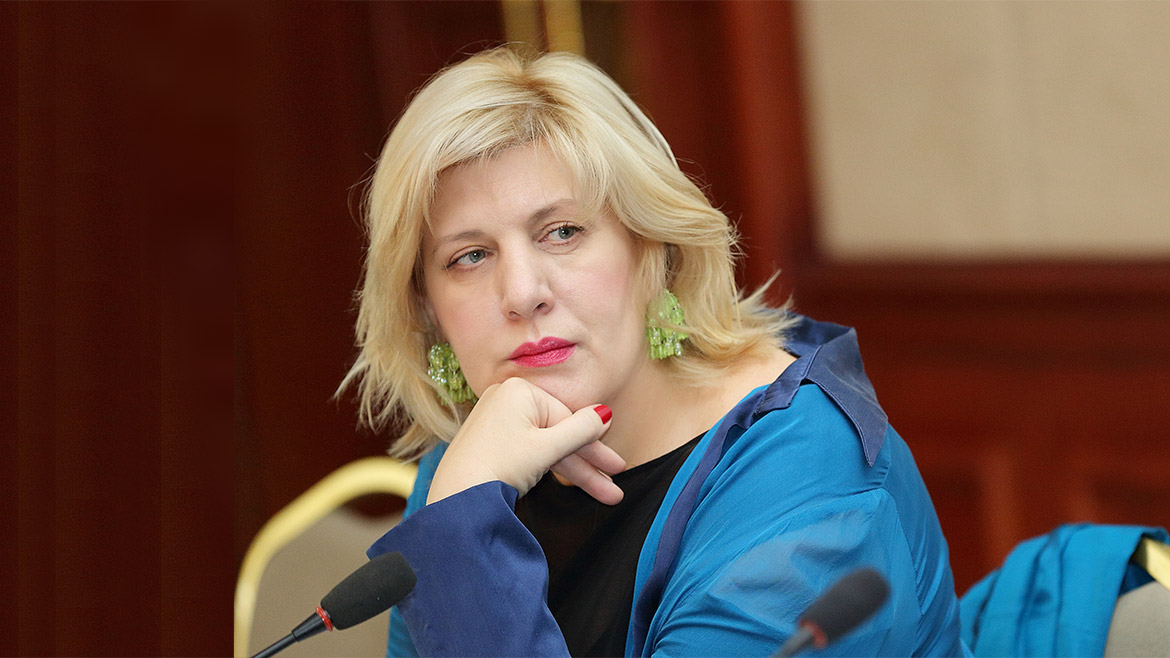
On 3 April, 2018, Dunja Mijatović has taken up the post of Council of Europe Commissioner for Human Rights.
She was elected last January [https://humanrightsdefenders.blog/2018/01/25/dunja-mijatovic-new-council-of-europe-commissioner-for-human-rights/] as the first woman to hold this post, succeeding Nils Muižnieks (2012-2018).
“I intend to keep the legacy of the previous Commissioners’ work and maintain the ability of this institution to react rapidly and effectively to protect people’s human rights. My view is that human rights are indeed universal and that no country is beyond scrutiny.
In terms of priorities, my vision is simple. In a word, it is: implementation. Norms, resolutions, treaties are there to guide us. Yes, we do need political will to make sure they are realised. But this is not a matter only for governments. We must engage our societies at large in their implementation and involve everyone in a dialogue on human rights. It is paramount that we achieve a recommitment to and a reaffirmation of human rights for all, and bring back trust in their importance for the well-being of each and every person.
I look forward to cooperating with governments, national authorities, international organisations, human rights defenders, journalists, NGOs, and human rights structures.”
https://www.coe.int/en/web/commissioner
Posted in human rights | 1 Comment »
Tags: appointment, Bosnia and Herzegovina, Council of Europe, Dunja Mijatović, Office of the Commissioner for Human Rights of the Council of Europe
April 3, 2018
An Egyptian lawyer, Samir Sabry, has requested the Attorney General to bring human right defender Asmaa Mahfouz to court. The reason? Winning the Sakharov Prize in 2011! If Egypt Today had reported it a day earlier (on 1 April), I would have credited it as a good April 1st spoof, but unfortunately it is not. In his complaint, Sabry called for the Attorney General to transfer Mahfouz to a Criminal Court trial and ban her from travelling outside the country. He stated that the prize, worth €50,000 was given to her suddenly, and he did not know why. He asked whether it is funding, a reward, or for certain service, and what the reason is for this award. The complaint from Sabry also claimed that this is a Jewish award [SIC} and questions the award’s links to Zionism. According to Sabry, the answer is that Mahfouz received the prize money, and accepted the award, in return for betraying Egypt.
Asmaa Mahfouz was one of the founding members of the April 6 Youth Movement, which sparked nation-wide demonstrations in April 2008 and was indeed awarded the Sakharov prize in 2011 (sharing it with four other Arab figures).
The prize in question is the Sakharov Prize for Freedom of Thought [http://trueheroesfilms.org/thedigest/awards/sakharov-prize-for-freedom-of-thought], which is of course is not granted by Israeli but by the European Parliament!
However, the issue of foreign funding is a major one in the Egyptian context as demonstrated by the case of two Egyptian woman human rights defenders in the ‘NGO foreign-funding case” (as ISHR reminds us on 29 March 2018): harassed and targeted Egyptian woman defenders Azza Soliman and Mozn Hassan [https://humanrightsdefenders.blog/2017/02/02/right-livelihood-has-to-go-to-egypt-to-hand-mozn-hassan-her-2016-award/] face life imprisonment if their cases are brought to trial simply for conducting legitimate human rights work.
Read the rest of this entry »
Posted in CIHRS, human rights, Human Rights Defenders, ISHR | 2 Comments »
Tags: Asmaa Mahfouz, Azza Soliman, Cairo Institute for Human Rights Studies, digest of human rights awards, Egypt, foreign funding, human rights award, human rights awards, ISHR, Israel, Mozn Hassan, NGO foreign-funding case, Sakharov Prize for Freedom of Thought, Samir Sabry, travel ban, woman human rights defenders
April 1, 2018
The funding of the office of the high commissioner for human rights in Geneva has also been cut. The current high commissioner, Zeid Ra’ad Hussein, has announced that he will be stepping down this year and not seeking another term in the post, explaining to his staff that the lack of global support for protecting human rights made his job untenable. [https://humanrightsdefenders.blog/2017/12/22/bound-to-happen-but-still-high-commissioner-zeid-announces-he-will-not-seek-second-term/]
Last week, Zeid was due to address the UN security council on plight of civilians in Syria but before he began, Russia called a procedural vote to stop him speaking on the grounds that the council was not the proper forum for discussing human rights. “The fifth committee has become a battleground for human rights,” Louis Charbonneau, the UN director for Human Rights Watch, was quoted in the Guardian. “Russia and China and others have launched a war on things that have human rights in their name.”
“China has real political momentum at the UN now,” Richard Gowan, a UN expert at the European Council for Foreign Relations, said. “It is now the second biggest contributor the UN budget after the US, and is increasingly confident in its efforts to roll back UN human rights activities. It is also pushing its own agenda – with an emphasis on ‘harmony’ rather than individual rights in UN forums. And a lot of countries like what they hear.”
A western diplomat at the UN conceded that human rights were losing ground at the UN, in part because China had become a more assertive voice, prepared to lead lobbying campaigns, and because Beijing is increasingly leveraging its vast and growing investments in the developing world to win votes for its agenda at the UN.
https://www.theguardian.com/world/2018/mar/27/china-and-russia-accused-of-waging-war-on-human-rights-at-un
https://www.amnesty.org/en/latest/news/2018/03/a-new-low-for-the-un-security-council-as-russia-takes-syrian-human-rights-off-the-table/
Posted in Amnesty international, HRW, human rights, Human Rights Council, OHCHR, UN | Leave a Comment »
Tags: AI, ‘win-win’ resolution, budget, China, funding, HRW, international human rights mechanisms, Julian Borger, Russia, the Guardian, UN, UN High Commissioner for Human Rights Zeid, UN Human Rights Council
March 29, 2018
 The Frank Jennings Fellowship was set up to give an opportunity for dedicated and talented individuals to gain experience working for the protection of human rights defenders in an international NGO and at the Office of the UN High Commissioner for Human Rights. It is named after Front Line Defenders’ former Head of Research who died after a long illness in 2005. Frank made a huge contribution to the development of human rights activism in Ireland and candidates who have some experience of human rights work in Ireland will be given priority.
The Frank Jennings Fellow spends 3 months at Front Line Defenders where they will be trained in relation to Human Rights Defenders; the UN Declaration on Human Rights Defenders; the Mandate of the UN Special Rapporteur; the procedures and methodology of the mandate; the role of Front Line Defenders and other national and international organisations in the support and protection of Human Rights Defenders. The Fellow will then move to Geneva for a period 6 months before returning to Front Line Defenders for a further 3 months.
The Fellow will be able to draft well and have good analytical skills. They will have some knowledge of the UN system and international and human rights law. They must be able to work in both English and Spanish (required!). They will be able to work on own initiative and as a member of a team. They will have good oral and written communication skills and be computer literate. They will be flexible and co-operative. Previous work experience with organisations working in the field of Human Rights would be desirable.
Basic Terms of reference – Front Line Defenders Dublin
- Provide support to Front Line Defenders’ Protection Coordinators including dealing with routine queries and correspondence with human rights defenders;
- Cooperate closely with the Regional Fellows and Protection Coordinators in drafting urgent appeals on behalf of human rights defenders at risk around the world
- Input HRD-related information on the Front Line Defenders database;
- Undertake clerical tasks such as faxing, photocopying, word processing, sending press releases, data entry, collating, emailing
- Support follow-up on cases taken up by Front Line Defenders or other specific projects relating to Human Rights Defenders as requested;
- Draft as requested, minutes, briefings, reports, appeals;
Basic Terms of Reference – Geneva SR
- Gather information on the situation of human rights defenders around the world (with a particular focus on themes of concern identified by the SR);
- In coordination with other thematic mechanisms and with geographic desk officers, and under the supervision of the HRD assistant to the SR, draft urgent appeals and communications to Governments concerning human rights violations against human rights defenders;
- Support follow-up of cases;
- Analyse replies received from Governments and prepare summaries for inclusion in the annual Human Rights Council (HRC) report;
- Assist in the drafting of annual reports to the HRC and the General Assembly;
- Assist in the preparation of background materials for official missions by the Special Rapporteur;
- Assist in liasing with non-governmental organizations for the smooth implementation of the mandate, as needed.
Honorarium: €1200 per month Dublin and €1400 per month Geneva.
The next Frank Jennings Fellowship will start on 1 April 2018.
Applications comprising a cover letter and CV should be sent to Ed O’Donovan, Head of Protection, at recruit@frontlinedefenders.org by 30 November 2017.
Important: please indicate the FULL title of the position you are applying for in the subject heading of email: ‘Frank Jennings Internship’ or the application may be missed.
https://www.frontlinedefenders.org/en/frank-jennings-fellowship-dublin-and-geneva
Posted in Front Line, human rights, Human Rights Defenders | 1 Comment »
Tags: call for applications, Dublin, fellowship, Frank Jennings Fellowship, Front Line (NGO), Geneva, internship, job opportunity, vacancy, youth


 Hans Thoolen on Human Rights Defenders and their awards