Archive for the 'human rights' Category

Olympic Committee tries its hands on human rights, ..cautiously

December 3, 2018

The IOC has set up an advisory committee on human rights chaired by Zeid Ra’ad al-Hussein, the former U.N. high commissioner for human rights. One can only hope that he will fare better than his UN predecessor’s short tenure in FIFA’s Governance Committee and that the IOC’s human right panel will do a better job than its FIFA counterpart [see my post of today: https://humanrightsdefenders.blog/2018/12/03/fifas-second-report-on-human-rights-misses-sustainable-approach/]. The IOC advisory committee was in the pipeline since March 2017 [https://humanrightsdefenders.blog/2017/03/14/olympic-games-in-future-bound-by-human-rights-standards/].

IOC President Thomas Bach said Saturday 2 December 2018 at meetings in Tokyo that “human rights standards” will be included in Olympic host-city contracts, beginning with the 2024 Games in Paris. “Promoting humanistic values in sport has been a core feature of the IOC since its beginning” and “Our mission, to put sport at the service of humanity, goes hand in hand with human rights, which is part of our DNA” But his answers re the Bejing Winter Olympics in 2022 fell short of this lofty language: Bach was asked if the committee would look at human rights in China, where hundreds of thousands of Muslims in western China are being held in interment camps. He said the IOC would not question China because it “has not the mandate nor the authority to solve the human rights problems” that are clearly “political issues. Bach suggested the committee would focus on issues like the rights of transgender athletes. “We should concentrate on what we can really achieve and what we can really do” .

https://humanrightsdefenders.blog/2018/06/27/new-global-center-for-sport-and-human-rights-created-to-address-abuses/

FIFA’s second report on human rights misses sustainable approach

December 3, 2018

FIFA’s Human Rights Advisory Board, an independent panel with a mandate to look into how FIFA tackles its human rights issues, published its second report in November 2018. (How independence is to be understood in the context of FIFA is perhaps shown by what happened to its Governance Committee: former UN High Commissioner for Human Rights Navi Pillay and others resigned in May 2017 from FIFA’s governance committee (which is not the human rights committee) saying that their independence was undercut and holding out no hope for internal reform [see: https://www.theguardian.com/football/2017/dec/21/our-sin-take-task-fifa-seriously and https://humanrightsdefenders.blog/2017/02/02/fifa-governance-committee-starts-dealing-with-a-human-rights-policy/])

The report covered the period from October 2017 to September 2018, and while it highlights progress it also shows soccer’s governing body still has a lot of work to do. The advisory board only began its work in March 2017, and described human rights as “still in the relatively early stages of being embedded in FIFA’s culture,” acknowledging that past decisions and contracts make it hard to deal with human rights issues. That can be seen by the large number of recommendations involving the Russia 2018 World Cup and the Qatar 2022 World Cup.

Of the advisory board’s six recommendations for Qatar 2022, FIFA still has work to do in two areas: using its leverage to try and improve the ‘kafala’ labor system so that it is more in line with workers’ rights, and encouraging companies linked to World Cup-related employment to do more to meet international human rights standards. The focus on World cups misses out on the same issues at the Club World Cup which takes place in the UAE in December 2018.

The human rights advisory board’s existence appears in some respects to be a reaction to the criticism FIFA received over the decision to award Qatar the right to host the 2022 World Cup, but the World Cup is far bigger than just the stadiums, and ..FIFA’s narrow focus on stadium workers means it misses the chance to create a long-term positive World Cup legacy in regards to human rights.

The report highlighted that FIFA “needs to invest in a sustainable approach” to human rights rather than just provide superficial fixes. Improvements that are made when issues are in the spotlight are often fluid and can be rolled back once the world’s attention swings to another issue.

One issue that the advisory board brought up, and which will be addressed in more detail in the next report, is how women in Iran have been banned from attending men’s soccer matches.

See also: https://humanrightsdefenders.blog/2018/06/27/new-global-center-for-sport-and-human-rights-created-to-address-abuses/

More short films on each article of the UDHR

November 27, 2018

Further to my post on the series of short films – one for each article in the 70-year old Universal Declaration of human rights [https://humanrightsdefenders.blog/2018/11/15/each-article-in-the-universal-declaration-on-human-rights-has-its-human-story/], there now more out to watch: see e.ghttps://www.facebook.com/unitednationshumanrights/videos/380180556054710/.

70th anniversary of the Universal Declaration of Human Rights: the UN plans

November 26, 2018

Series of events to shine a light on the UDHR across the world. I already referred to the series of short films – one for each article in the 70-year old Universal Declaration of human rights [https://humanrightsdefenders.blog/2018/11/15/each-article-in-the-universal-declaration-on-human-rights-has-its-human-story/].

But there is more going on: The UDHR, based on the powerful premise that we are all “born free and equal in dignity and rights,” has spread further and been translated into more languages than any other text ever. The aim of the celebratory events sponsored by the UN Human Rights Office is “to shine a light on the many ways in which universal human rights contribute to the daily lives of people everywhere.” Signature events will be held in 14 cities, spanning seven time zones, with each spotlighting a human rights theme relevant to that location:

Africa

  • Dakar (Nov 30) – Our right to accountability when rights are violated
  • Pretoria (Dec 7) – Young people standing up for rights
  • Marrakesh (Dec 10) – The human rights of migrants

Asia-Pacific

  • Suva (Nov 16) – Our right to live on a healthy planet
  • Bangkok (Nov 28) – The rights of people on the move

Europe

  • Manchester (Nov 12) – Our right to live in harmony
  • Paris (Dec 4) – The city where the UDHR was adopted in 1948
  • Geneva (Dec 13) – Upholding rights for a future we all want

Latin America

  • Mexico City (Dec 6) – Our right to defend human rights
  • Panama City (Dec 10) – Children as defenders of rights
  • Santiago (Dec 10) – Women’s rights are human rights

Middle East

  • Doha (Dec 9) – Our right to peace

North America

  • Los Angeles (Dec 10) – Human rights in the city
  • New York (Dec 18) – UN Human Rights Award ceremony

In addition to the 14 signature events, each of which will be accompanied by a social media campaign featuring prominent global and local public figures standing up for human rights, numerous other celebrations are being organized by Governments, NGOs, academic institutions, and many others all over the world.

I urge everyone to join in celebrating the 70th anniversary of the Universal Declaration.  Join us at the public events if you can, or organize one yourself.  Any way that you can take part actively – shining your light on rights – will make a difference, even if it is simply by participating on social media,” said UN High Commissioner for Human Rights Michelle Bachelet.By doing so, we can show just how precious the UDHR is to people all over the world, and the universal nature of the values it contains.  It was an inspiration, a sensation, in 1948, and it is still an astonishing and inspiring document today.

The preservation of the human rights set out in the Declaration is vital to each and every one us – woman, man and child. Human rights are essential for the protection and dignity of our loved ones, our families and friends, our neighbours and our communities – for all of us, whether living in the smallest village or in the greatest of cities.  Violations of anyone’s rights potentially undermine the rights of all of us. So I urge everyone to use the UDHR’s 70th anniversary to reflect on what rights mean, and think of ways we can actively stand up for the rights of not just ourselves, but of everyone else.”

In addition to the events taking place over the next month, on 9 November the UN Human Rights Office will start publishing a series of short articles on each of the 30 Articles of the Universal Declaration. These will be published – one article a day – on www.ohchr.org and issued to media across the world.

For more information on the events listed in this advisory, please contact Rajat Khosla at rkhosla@ohchr.org / +41 22 917 3311

Twitter: @UNHumanRights and Facebook: unitednationshumanrights

https://www.ohchr.org/EN/NewsEvents/Pages/DisplayNews.aspx?NewsID=23832&LangID=E

Meet Eva Lewis, the sole human rights defender from the USA at the HRD Summit in Paris

November 16, 2018

A young activist, Eva Lewis, who grew up on the south side of Chicago recently traveled to Paris to participate ...

Eva Lewis, founder of the I Project. Photo Credit: Provided by Eva Lewis

Katherine Newman in the Chicago Citizen proudly profiles the young woman from Chicago Eva Lewis who – as only HRD from the USA almost represented “the United States At Human Rights Defenders World Summit” [https://humanrightsdefenders.blog/2018/07/24/announcement-of-the-human-rights-defenders-world-summit-in-paris-october-2018/].

A young activist, Eva Lewis, who grew up on the south side of Chicago recently traveled to Paris to participate in the Human Rights Defenders World Summit 2018. Lewis spoke on the Americas panel, alongside activists from Latin America, and discussed youth-led movements in the United States as well as the state of black and brown people in the country. “What the Summit aims to do is bring together representatives from each country to talk about the state of human rights defenders and to brainstorm ways that we can elevate our fight for human rights and create a direct action plan that can be implemented to protect human rights defenders internationally,” said Lewis.

Lewis was one representative in a diverse group of 150 human rights defenders from around the world that came to Paris for the three-day Summit.  “I was on the Americas panel and I was the only US representative and also the youngest delegate at the Summit and I was the only English speaker on my panel. Everyone on the panel talked about their own fight for human rights and how it pertains to their country and the people that they were there to represent,” said Lewis.

“I set my self up to fulfill a specific agenda which was to bring human rights of black and brown folks in the U.S. to an international platform because we don’t talk about human rights violations against black and brown people in the US as a human rights issue. This was the first time anyone had that conversation at the Summit and I was happy to be able to be the one to present that conversation.”

Nineteen-year-old Lewis is an award-winning student, activist, and artist. She is also known for founding the I Project, a non-profit organization aiming to create equitable communities in Chicago.

I really liked hearing about how people structure their organizations so what I think I gained the most from the Summit is good information about how to make the infrastructure of my own organization more sustainable. The I Project is relatively new and we’ve only had a fiscal sponsorship for about a year and we are not sustainable at all and I’m comfortable admitting that because the journey is important and part of the process,” said Lewis.

http://thechicagocitizen.com/news/2018/nov/14/young-chicagoan-represents-united-states-human-rig/

New human rights ranking for businesses shows dismal progress for most firms

November 13, 2018

“Reprehensible” says UN about Mexican killing of human rights defender

November 7, 2018

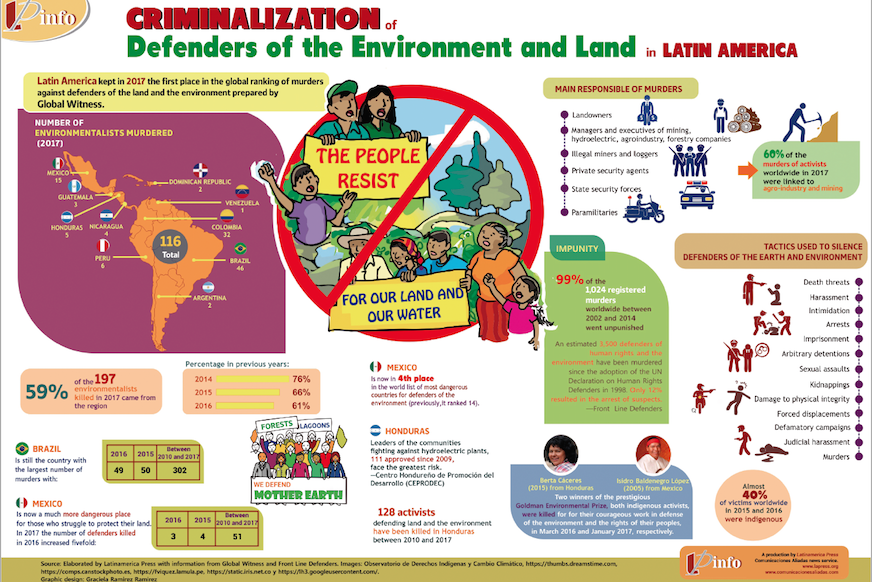
On 6 November 2018, four UN Special  Rapporteurs have strongly condemned the killing of Julián Carrillo, an indigenous rights defender from the state of Chihuahua, Mexico, who had worked tirelessly for over two decades to defend his community against the exploitation of Rarámuri ancestral lands.

On 23 October 23 2018, Julián Carrillo told a friend by phone that he believed he was being watched and said he would go into the forest in an attempt to hide. On the evening of 25 October, his body was found. He had multiple bullet wounds. “We urge the Mexican authorities to identify the perpetrators of this reprehensible crime and to bring them to justice in accordance with the law,” the experts said.

The experts also urged the Government to address the underlying causes of such violence. “The killing of Julián Carrillo highlights the serious situation in the Sierra Tarahumara where the lack of recognition of indigenous land rights is a root cause of the recurring violence against and displacements of indigenous communities.”… [The UN experts are: Mr. Michel Forst, Special Rapporteur on the situation of human rights defenders; Ms. Victoria Tauli Corpuz, Special Rapporteur on the rights of indigenous peoples;  Ms. Agnès Callamard, Special Rapporteur on extrajudicial, summary or arbitrary executions; and Ms. Cecilia Jimenez-Damary, Special Rapporteur on the Human Rights of Internally Displaced Persons.]

Julián Carrillo’s murder is one of a spate of killings of human rights defenders in the country. According to official OHCHR figures, 21 human rights defenders have been killed so far this year, nine of them from indigenous communities. Four members of Julián Carrillo’s family – his son, son-in-law and two nephews – have been killed since February 2016.

This follows soon after the assassination on Wednesday 23 October of journalist Gabriel Soriano Kuri.  Soriano had been covering Governor Héctor Astudillo Flores’ third annual report for the Radio y Televisión de Guerrero (RTG) broadcaster that evening. After the event, held in Acapulco, he was driving a company vehicle when he was attacked and killed by armed civilians. Following the murder, Astudillo offered his condolences to Soriano’s family via Twitter. But it didn’t go down very well. Soriano’s daughter replied with a blunt message: “My dad was assassinated doing his job. Covering your report to the state! Do your job and fix the situation the state is in. It’s not right,” she wrote. Her discontent was echoed in at least three demonstrations where journalists demanded that authorities solve the assassination of their colleague. A state journalists’ association reported that three members of the profession have been slain during Astudillo’s three years in office.

https://www.frontlinedefenders.org/es/profile/noel-castillo-aguilar

https://www.amnesty.org/en/latest/news/2018/10/mexico-asesinato-de-lider-raramuri-demuestra-falta-de-proteccion-estatal/

https://mexiconewsdaily.com/news/demonstrations-follow-journalists-assassination/

19 missing human rights defenders in Egypt !!

November 6, 2018

Fears grow for 19 missing human rights defenders in Egypt. Hoda was one of 19 activists – eight women and 11 men – swept up Thursday 1 November as the regime escalates pressure on human rights NGOs. Four days later the location and fate of these activists is still unknown. One of the organisations hit hard by this crackdown is the ECFR, which documents enforced disappearances and the expanding use of the death penalty.

A number of prominent members of the group have been targeted before. In September, Executive Director of ECFR, Ezzat Ghoneim, was forcibly disappeared despite being released from Tora prison after serving a six-month prison sentence there. In October Egyptian authorities issued an arrest warrant for Ghoneim for failing to adhere to the terms of his release despite the fact that his family say he is still being held in secret detention.

Along with Ghoneim the group’s co-founder Azzouz Mahgoub was also forcibly disappeared in March. Last Thursday the ECFR announced the suspension of its work citing the current climate in Egypt as “incompatible with human rights work”. “The human rights situation in Egypt, especially with regard to the rights of detainees and human rights defenders, has been the worst in Egypt’s history in the past five years” ECFR said in a statement.

“Furthermore, the Egyptian authorities have committed the most serious violations beyond all humanitarian norms including the storming of women’s homes, their detention and the arrest of their families over the past three months alone.”

see also: https://humanrightsdefenders.blog/2018/04/03/egypt-the-foreign-funding-accusation-against-human-rights-defenders-goes-in-overdrive/

https://www.middleeastmonitor.com/20181105-fears-grow-for-19-missing-human-rights-activists-in-egypt/

Interview with pro bono director, Michelle Movahed, in Newark

November 5, 2018

Since joining McCarter & English as pro bono director two years ago, Michelle Movahed has helped bring about increases in firmwide pro bono hours (by 3,000 hours annually) and in pro bono-to-billable hours ratio (even as billables increased, according to the firm). The program also has taken up a broader range of cases under Movahed, including immigration detainee asylum matters. And she recently saw through the firm’s creation of a pro bono fellowship to benefit the city of Newark, which includes a full-time attorney position. David Gialanella interviewed her on November 2018 for the New Jersey Law Journal:

What’s your single best piece of advice for handling a crisis?

Focus on what you can control, take ownership of all of it, and move forward.

Name a mentor or someone you admire, and why.

I deeply admire my clients. I’ve been very lucky to work for human rights defenders, for individuals who have stepped up to right a wrong, and, most recently, for asylum-seekers who have made harrowing journeys to escape truly horrendous trauma.

Best advice you ever got…

I’ve never been as nervous as I was the night before my first big oral argument, on our motion for a TRO to keep the doors open at the last comprehensive reproductive health clinic in Mississippi. By around 10 p.m., everyone I worked with was telling me to go to sleep and stop preparing so I’d be well-rested. I just didn’t feel like it was time yet, but I also knew I didn’t know enough to make that judgment call. So I asked for help: I wrote to the judge I’d clerked for, whose opinion I value more than almost anyone, to ask for words of wisdom. The advice he gave me was incredible, and I must have read his email a hundred times over the next 12 hours until I went in to the courthouse. He reminded me that I couldn’t lie to myself about how nervous I was, how high the stakes were, and how hard my case was. So, he said, “don’t f— it up.” If I could have that embroidered on a pillow, I would. I stayed up late, prepared until I knew I had done everything I could to avoid f-ing up, and was completely on my game at the argument. (We got the TRO, and the clinic stayed open.)

What has the #MeToo movement meant to the legal profession?

The hashtag is new, but the issues aren’t. #MeToo, #BlackLivesMatter, and #TimesUp are reminders that lawyers have a responsibility to use our privilege to challenge oppression wherever it appears. Our professional obligations include the duty to speak up when we know another lawyer has violated the rules of professional conduct; but our ability to promote justice is much broader, and we should use it.

In 50 words or less, what does the legal profession need to do to improve opportunities for women lawyers?

Every lawyer should seek out opportunities to teach, mentor, and otherwise make space for lawyers with less privilege: not only women, but also lawyers of color, who are LGBTQIA, who have disabilities, who are from other traditionally marginalized groups, and who are at the intersections of those identities.

Anders Pettersson: Civil Rights Defenders’ ‘new’ director

November 5, 2018

Already on 9 March 2018 Robert Hårdh was succeeded as Executive Director of the Stockholm-based NGO Civil Rights Defenders [see e.g.: https://humanrightsdefenders.blog/tag/civil-rights-defenders/] by Anders Pettersson. An oversight on my part that I am glad to correct. Anders has had a variety of international jobs of which the latest was head of Ecpat Sweden.


https://novare.se/anders-l-pettersson-ny-chef-civil-rights-defender/