The first Sunday in December is Lawyers’ Day in Belarus. It iscelebrated against the backdrop of the fact that at least 18 lawyers, human rights activists, and legal professionals remain in prison. Since 2020, according to the Right to Defence project, 146 lawyers have had their licenses revoked, and dozens have been charged with administrative and criminal offences. Among those currently imprisoned for political reasons are Aliaksei Barodka, Vital Brahinets, Aliaksandr Danilevich, Maksim Znak, Anastasia Lazarenka, Siarhei Khlystou, and Yuliya Yurhilevich.
On November 29, the Homyel Regional Court convicted 41-year-old preacher Aliaksei Yahiela, charged with “assisting extremist activity” under two parts of Article 361-4 of the Criminal Code. Yahiela, who has a medical background but also worked as an evangelical preacher and healthy-lifestyle activist, had attracted attention, even from state media, for his anti-smoking initiative. Initially, it was unknown what sentence Aliaksei would receive.
However, it later emerged that he had been sentenced to imprisonment and is currently being held at Homiel’s Pretrial Detention Center No. 3.
Marharyta Yasevich, 29, a BSU history graduate from Lida, was convicted of “assisting extremist activity” under Parts 1 and 2 of Article 361-4 of the Criminal Code. Yasevich, who, after graduating, ran a business in Smolensk and lived in Samakhvalavichy for the last few years, was sentenced, according to preliminary information, to imprisonment under house arrest.
The undersigned organisations recall that Ales Bialiatski, and Uladzimir Labkovich were arbitrarily detained on 14 July 2021, prosecuted, and sentenced to 10 and 7 years in prison respectively on 3 March 2023 in retaliation for their legitimate and peaceful human rights activities. Their imprisonment constituted a grave violation of Belarus’ international human rights obligations, including the rights to freedom of expression, association, and fair trial.
While their release brings long-overdue relief to them, their families, their colleagues and the human rights community around the world, we stress that this step remains insufficient as long as hundreds of human rights defenders, journalists, lawyers, activists, and political opponents remain arbitrarily detained in Belarus on politically motivated charges solely for exercising their fundamental freedoms, and repressions against Belarusian dissidents continue unabated. In particular, Valiantsin Stefanovic, former Vice President of FIDH arrested along Ales Bialiatski and Uladzimir Labkovic in July 2021, women human rights defender and Viasna member Marfa Rabkova, detained since September 2020, and founder of Human Constanta woman human rights defender Nasta Loika, arbitrarily detained since September 2022, were not among the released political prisoners. Alongside them, numerous human rights journalists, lawyers, and trade union activists remain arbitrarily detained, including Andrzej Poczobut, Katsiaryna Andreyeva, Ihar Ilyash, Danil Palianski, Pavel Dabravolski, Andrei Aliaksandrau, and many others.
The undersigned organisations call on the Belarusian authorities to immediately and unconditionally release all political prisoners and all those arbitrarily detained, to put an end to judicial harassment and reprisals against civil society, and to repeal repressive legislation used to criminalise peaceful dissent and freedom of expression. The authorities must also ensure full rehabilitation, including the quashing of convictions and restoration of civil and political rights, for all those unlawfully detained for years.
The undersigned organisations further urge the international community to continue to closely monitor the situation in Belarus and to take all available legal, political, and diplomatic measures to ensure accountability for the grave human rights violations and international crimes, including by referring the situation to the International Criminal Court.
Signatories:
International Federation for Human Rights (FIDH), in the framework of the Observatory for the Protection of Human Rights Defenders
World Organisation Against Torture (OMCT), in the framework of the Observatory for the Protection of Human Rights Defenders
Human Rights Center Viasna
Human Rights Center, Georgia
ILI Foundation, Kazakhstan
Civil Society Institute, Armeniaia
Public Association “Dignity”, Kazakhstan
Promo-LEX Association, Moldova
Norwegian Helsinki Committee, Norway
Östgruppen (Swedish Initiative for Democracy and Human Rights)
Austausch e.V., Germany
Belarusian Helsinki Committee (BHC)
Hungarian Helsinki Committee, Hungary
Human Rights Center of Azerbaijan, Azerbaijan
aditus foundation, Malta
LIBERECO – Partnership for Human Rights, Germany/Switzerland
Redress
The International Bar Association’s Human Rights Institute (IBAHRI)
ARTICLE 19
People In Need
aditus foundation
Front Line Defenders
Bir Duino-Kyrgyzstan
European Platform for Democratic Elections (EPDE)
International Society for Fair Elections and Democracy (ISFED)
On 15 December 2025 Emma Woollacott, in Forbes, referred to a new study that shows that 7 in 10 women human rights defenders, activists and journalists have experienced online violence in the course of their work. Produced through the UN Women’s ACT to End Violence against Women program and supported by the European Commission, “Tipping point: The chilling escalation of violence against women in the public sphere” draws on a global survey of women from 119 countries.
Along with online threats and harassment, more than 4 in 10 have experienced offline harm linked to online abuse — more than twice as many as in 2020, the researchers found. This can range from verbal harassment right up to physical assault, stalking and swatting.
“These figures confirm that digital violence is not virtual — it’s real violence with real-world consequences,” said Sarah Hendricks, director of policy, programme and intergovernmental division at UN Women.
“Women who speak up for our human rights, report the news or lead social movements are being targeted with abuse designed to shame, silence and push them out of public debate. Increasingly, those attacks do not stop at the screen — they end at women’s front doors. We cannot allow online spaces to become platforms for intimidation that silence women and undermine democracy.”
And AI is only making things worse, with almost 1 in 4 women human rights defenders, activists and journalists having experienced AI-assisted online violence, such as deepfake imagery and manipulated content. This is most often the case for writers and public communicators who focus on human rights issues, such as social media content creators and influencers, for whom the figure reaches 30%.
“Gender-based online violence is not a new phenomenon, but its scale certainly is,” said report co-author Lea Hellmueller, associate professor in journalism at City St George’s and associate dean for research in the School of Communication and Creativity.
“AI tools enable the production of cheaper and faster abusive content, which is detrimental to women in public life — and beyond,” Hellmueller added.
Tech firms are partly responsible, the researchers said, with the report calling for better tools to identify, monitor, report and fend off AI-assisted online violence. The researchers also want to see more legal and regulatory mechanisms to force tech firms to prevent their technologies being deployed against women in the public sphere.
“Our next steps include publishing data from the survey about the opportunities for, and barriers to, law enforcement and legal redress for survivors of online violence,” said Julie Posetti, chair of the Centre for Journalism and Democracy at City St George’s, University of London, one of the authors of the report. “We will also focus on creative efforts to counter gender-based online violence and policy recommendations to help hold the Big Tech facilitators of this dangerous phenomenon accountable.”
In 2025 the International Federation for Human Rights (FIDH) welcomed 14 new organisations, on the occasion of its 42nd Congress, which took place in Bogotá at the end of October. The federation now has 194 members in 120 countries. Of varied origins, cultures, organisations, issues and sizes, yet united by a common struggle: the universal defence of human rights. These 14 memberships demonstrate the vitality of the human rights movement across the world, the relevance of the growth of an international federation dedicated to this universalist cause, and the need to bring together the strengths of civil society worldwide in the face of the challenges it is faced with. Local struggles, global problems, the organisations of FIDH find within the federation a space of solidarity where they can exchange ideas and collectively develop solutions to the shrinking civic space observed throughout the world.
“With these new arrivals, our federation is growing and becoming stronger, particularly on the Asian continent“, says Alexis Deswaef, President of FIDH, elected at the same congress in Bogotá.
Cressida Kuala lives in a small gold mining town in the Highlands Region of Porgera District in the Enga Province of Papua New Guinea. In 2011, Cressida founded the Porgera Red Wara (River) Women’s Association, and she started speaking out about issues such as environmental degradation, chemical waste, pollution, expropriation of land, and the impact on the local community.
On 4 December 2025, 24 human rights defenders, including Seán Binder and Athanasios (Nassos) Karakitsos, will appear before the Mytilene Court of Appeals, on the island of Lesvos. This comes seven years (!!) after their initial arrests. The human rights defenders are facing felony charges of ‘membership of a criminal organisation’, ‘facilitation of the entry of third country nationals into the country’, and ‘money laundering’. The charges stem from work carried out by the defenders in Greece between 2016 and 2018, where they assisted people on the move whose lives were at risk while trying to reach safety to the island of Lesvos. If convicted, they face up to 20 years of imprisonment.
Seán Binder and Athanasios (Nassos) Karakitsos are migrant rights defenders who worked with Emergency Response Center International (ERCI) between 2016 and 2018. The humanitarian work carried out by ERCI was extensive, and included helping more than 1000 people reach safety, organising workshops and swimming classes for migrant children in the Kara Tepe camp, and providing residents in the Moria camp with medical assistance. ERCI was registered as a non-governmental organisation and regularly cooperated with Greek authorities, including with the Greek Coast Guard on rescue operations. The organisation was dissolved after the criminalisation of its members and volunteers.
In September 2023, the Supreme Court upheld the Court of Appeals’ decision, delivered on 13 January 2023, to dismiss four misdemeanour charges of ‘forgery’, ‘espionage’, ‘possession of unlicensed radio’ and ‘infringement of state secrets’ faced by Seán Binder and seven other non-Greek speaking defenders. This was due to procedural flaws, including key documents, such as the indictments, having not been translated for the accused. In January 2024, the remaining sixteen human rights defenders, including Athanasios (Nassos) Karakitsos, were acquitted of the same charges. [https://humanrightsdefenders.blog/2021/11/17/greeces-mistaken-deterrence-migrants-and-aid-workers-facing-heavy-prison-sentences/]
On 21 August 2018, Lesvos Police arrested Seán Binder after he attended the police station voluntarily, having learned that another human rights defender had been arrested earlier that day. In the following days, they also arrested Athanasios (Nassos) Karakitsos, the field director of ERCI at the time. The human rights defenders were kept in pre-trial detention for more than one hundred days, accused of ‘people smuggling’, ‘money laundering’, ‘espionage’, and ‘membership of a criminal organisation.’ In December 2018, the human rights defenders were conditionally released on bail.
The upcoming trial is the second court case since 2018 initiated against the 24 human rights defenders based on their work, aiding, assisting and saving the lives of migrants and refugees, who were trapped in the Aegean Sea between Türkiye and Greece.
Front Line Defenders calls on the authorities in Greece to:
Immediately and unconditionally drop all charges against Seán Binder and Athanasios (Nassos) Karakitsos, and the other 22 human rights defenders who are also on trial;
Cease the criminalisation of human rights defenders who peacefully defend the rights of the migrants and refugees, including the humanitarian assistance to save the lives of people stranded at the marine and land borders;
Guarantee in all circumstances that all human rights defenders in Greece are able to carry
out their legitimate human rights activities without fear of reprisals and free of all restrictions, including judicial harassment.
In the aftermath of conflict, dictatorship, or mass human rights violations, societies face the challenge of addressing past atrocities while rebuilding for the future. Transitional justice refers to a set of legal and social mechanisms designed to achieve justice, accountability, and reconciliation in such contexts. These processes include truth commissions, criminal prosecutions, reparations for victims, and institutional reforms aimed at preventing future abuses. Rooted in the principles of human rights and international law, transitional justice seeks to balance the need for justice and survivor healing with the complexities of political and social stability.
Across the world, many charities and non-governmental organisations (NGOs) play a crucial role in supporting transitional justice efforts. Whether by documenting human rights abuses, advocating for victims, or facilitating truth and reconciliation initiatives, these organisations help societies navigate the difficult journey toward justice and peace. This article by Barbara Listek explores some of the key NGOs working in the field, highlighting their impact in post-conflict and post-authoritarian contexts.
The International Center for Transitional Justice (ICTJ) supports societies recovering from mass human rights violations by helping them confront the past and build more just and inclusive futures. Working alongside victims, local communities, and institutions, ICTJ provides expertise on truth commissions, reparations, criminal accountability, and institutional reform. Whether advising on the creation of truth-seeking bodies or supporting prosecutions of those responsible for serious crimes, the organisation’s work is rooted in the belief that acknowledging harm and delivering justice are essential for healing and long-term peace.
Since its founding, ICTJ has played a key role in transitional justice processes across the globe, including in Colombia, Tunisia, and The Gambia. Its approach is deeply grounded in the lived experiences of survivors, ensuring that justice efforts are not only technically sound but also meaningful to those most affected. By focusing on systemic change and survivor-centred solutions, ICTJ works to prevent the recurrence of violence and strengthen democratic institutions in countries emerging from repression and conflict.
Redress is a London-based organisation founded by British businessman Keith Carmichael after he was unlawfully detained and tortured in Saudi Arabia. Frustrated by the lack of legal support and accountability available to survivors like himself, Carmichael launched REDRESS to fill a critical gap in access to justice. His personal experience became the driving force behind the charity’s mission: to secure justice and reparation for victims of torture and other grave human rights violations.
Now more than 30 years old, REDRESS continues to lead efforts globally to end impunity for torture. The organisation provides legal representation to survivors, supports strategic litigation before national and international courts, and advocates for stronger laws and policies that prevent torture and ensure reparations. By working directly with survivors, while also influencing governments and international institutions, REDRESS helps ensure that survivors’ voices are heard and that justice becomes a meaningful reality, central to any process of healing and transitional justice.
The Center for Justice and Accountability (CJA) is an organisation founded in 1998 on the principle, first used during the Nuremberg trials after World War II, that certain crimes are so egregious that they represent offences against all humankind. These crimes include genocide, crimes against humanity, extrajudicial killing and torture, and as CJA argues, they should never go unanswered.
CJA’s approach is survivor-led and collaborative. The organisation works closely with local partners and in-country prosecutors to build cases that centre the voices and experiences of those most affected. Alongside this, CJA advocates for stronger laws and policies that make it harder for abusers to escape justice and hold everyone accountable to the human rights standards.
The African Transitional Justice Legacy Fund (ATJLF) is an organisation launched in 2019 to support African-led responses to past atrocities, rooted in the belief that sustainable peace and justice must be shaped by those directly affected. Backed by the MacArthur Foundation and WellSpring Philanthropic Fund, the ATJLF emerged alongside the African Union’s Transitional Justice Policy, helping translate its goals into practical, community-driven action. Managed initially by the Ghana-based Institute for Democratic Governance, the Fund has since become a nine-year institutionalised effort supporting civil society across West Africa.
By empowering survivor-led groups and grassroots initiatives, the ATJLF has helped amplify voices often excluded from transitional justice processes. Since its inception, over $2.5 million has been distributed to 46 organisations working in countries including Guinea, Liberia, and The Gambia. As it enters its legacy phase (2024–2026), the Fund is scaling its efforts beyond West Africa and focusing on deeper, long-term partnerships to ensure the impact of its work endures well beyond its closure.
Impunity Watch is an international non-profit organisation working with victims of violence to deliver redress for grave human rights violations and to promote justice and peace. The organisation approaches transitional justice work through a victim-centred approach, taking into account the long-standing criticism of transitional justice not being sufficiently victim-centred. It is also their aim to overcome systemic impunity and its root causes in order to achieve transformative justice (here we could link the article I wrote on transformative justice, but it is not published yet).
For more information about the organisation, we recommend visiting their website for an abundant collection of resources and information, such as the charity’s 2023-2027 Strategic Plan, information about the complex work Impunity Watch does, as well as their multimedia resources section.
The Global Survivors Fund (GSF) is an international charity organisation based in Switzerland, that has it as its mission to enhance the access to reparations for survivors of conflict-related sexual violence around the globe. It was founded in 2019 by Dr Denis Mukwege and Nadia Murad – 2018 Nobel Peace Prize laureates.
The organisation’s work is centred around three core pillars: acting to provide interim reparative measures in situations where States or other parties are unable or unwilling to meet their responsibilities; advocating for the legally responsible parties (duty-bearers) and the international community to develop reparation programmes; and guiding States and civil society by providing expertise and technical support for designing reparation programmes.
To learn more about the organisation’s transformative work, donate or find information about positions openings, visit their website.
Founded in 2014, the Global Initiative for Justice, Truth and Reconciliation (GIJTR) is a consortium of nine global organisations dedicated to addressing the transitional justice needs of societies emerging from conflict or periods of authoritarian rule. The initiative collaborates with communities worldwide to amplify survivors’ voices and inspire collective action in confronting human rights violations. By addressing past traumas, GIJTR aims to pave the way for a more just and peaceful future.
Over the past decade, GIJTR has engaged with communities in over 70 countries, collaborating with more than 800 local civil society organisations and supporting over 500 grassroots projects. Its initiatives include documenting human rights abuses, providing technical assistance to civil society activists, and promoting reparative justice efforts. Notably, the organisation has worked alongside survivors of conflict-related sexual violence in contexts such as Bangladesh, Colombia, and Guinea, supporting them in advocating for their rights and developing community-based programs aimed at meeting survivors’ needs.
The International Coalition of Sites of Conscience is the only global network of historic sites, museums, and memory initiatives that connects past struggles to today’s human rights movements. With over 350 members in 65 countries, its mission is to ensure that the sites preserve the memory of past injustices while fostering dialogue and learning that prevent future violations.
Their slogan being “Remembering is a Form of Resistance,” the Coalition works with local communities, governments, and international partners to ensure that these sites serve as platforms for reconciliation, education, and activism. It convenes impactful projects and initiatives as well as training events that bring together site professionals, historians, and activists to develop best practices for memory‑based reconciliation and community empowerment
If you are interested in how museums can contribute to upholding human rights, or would like to visit one of such sites, we recommend checking out our article on “20 Human Rights Museums Around The World” to discover inspiring spaces that might be worth visiting (perhaps on your next trip!).
The Post-Conflict Research Center (PCRC) is a Sarajevo-based, women-led research centre and NGO, dedicated to advancing transitional justice and promoting peace in post-conflict societies. Founded in 2011 in Bosnia and Herzegovina, PCRC works on issues related to justice, accountability, reconciliation, and human rights. Its efforts include conducting research, providing education, and supporting projects aimed at improving social cohesion and fostering sustainable peace. PCRC is also involved in advocacy and works with local and international organisations to develop and implement policies that address the needs of survivors of conflict and promote justice for atrocities.
PCRC’s signature programmes include Balkan Diskurs, an online platform empowering young journalists to report on regional issues, and Ordinary Heroes, a multimedia project showcasing stories of rescue and courage to promote tolerance and reconciliation. Its work has earned international recognition, including the 2014–15 Intercultural Innovation Award from the UN Alliance of Civilizations and the BMW Group, and praise from the Council of Europe for its exemplary peace education model.
Are you inspired by PCRC’s blend of research and action? Learn what it takes to follow in their footsteps by reading our guide on “How to Become a Human Rights Researcher.”
Rights for Peace is a London-based international organisation that seeks to address the root causes of violence and promote peace through human rights advocacy and transitional justice. Focusing on countries in transition from conflict or repression, Rights for Peace engages with local communities to ensure that victims of violence are heard and that justice mechanisms are effective. It works to strengthen the rule of law, promote accountability, and support processes of social healing through legal reforms and community-led initiatives. By fostering a culture of peace and justice, the organisation aims to prevent the recurrence of violence and contribute to long-term stability.
Currently active in Sudan and South Sudan, Rights for Peace collaborates with local partners to strengthen rule‑of‑law institutions and ensure that victims’ voices shape accountability processes. Its casework includes monitoring identity‑based violations and developing strategic litigation to hold perpetrators accountable, reflecting the organisation’s commitment to survivor‑centred justice.
The issuance of Interpol red notices against two Salvadoran human rights defenders currently in exile in Spain constitutes a grave misuse of the law enforcement mechanism, UN experts warned on 19 November 2025
“This move amounts to an act of transnational repression, as it extends the harassment of human rights defenders beyond borders, targeting them in a country where they are seeking safety,” the experts said.
Ivania Cruz and Rudy Joya have applied for asylum in Spain, fleeing legal harassment in El Salvador stemming from their legitimate human rights work. Both human rights defenders work for the non-governmental organisation UNIDEHC, which has been targeted by the Salvadoran authorities since February 2025 for its support to the La Floresta community, who have been facing attempts of forced eviction since 2024.
“The charges brought against Ivania Cruz and Rudy Joya in El Salvador and related arrest warrants issued by the authorities appear to be without basis and in direct connection with their legitimate human rights work for UNIDEHC to support communities under threat and denounce the actions of the Government under the state of emergency declared in 2022,” the experts said.
In May 2025, the court presiding over their case in El Salvador ordered the Interpol National Central Bureau to submit a request for the issuance of a red notice to the Interpol General Secretariat. Interpol confirmed the issuance in July 2025.
The experts pointed to Articles 2 and 3 of the Constitution of Interpol, which state that the organisation is “strictly forbidden” from undertaking “any intervention or activities of a political nature”, and that the organisation’s activities will be conducted “in the spirit of the Universal Declaration on Human Rights.”
In September 2025, Rudy Joya was summoned by police under the pretext of his asylum application in Spain. Upon presenting himself to the authorities, he was detained and presented before a Spanish specialised court. Ivania Cruz was also summoned and appeared before the same court, which ordered that both defenders sign-in at a local court every 15 days, not leave the country, surrender their passports and report any change of address.
“We call on Interpol to immediately revoke the red notices and judicial sanctions against Ivania Cruz and Rudy Joya, and on Spain to refuse to accede to the red notice and to ensure their safety by rejecting their forcible return to El Salvador,” the experts said.
The experts are in contact with Interpol and the governments of Spain and El Salvador on these concerns.
Ganna Yudkivska (Chair-Rapporteur), Matthew Gillett (Vice-Chair on Communications), Miriam Estrada Castillo (Vice-Chair on Follow-Up), Mumba Malila, and Ethan Hee-Seok Shin,Working Group on Arbitrary Detent
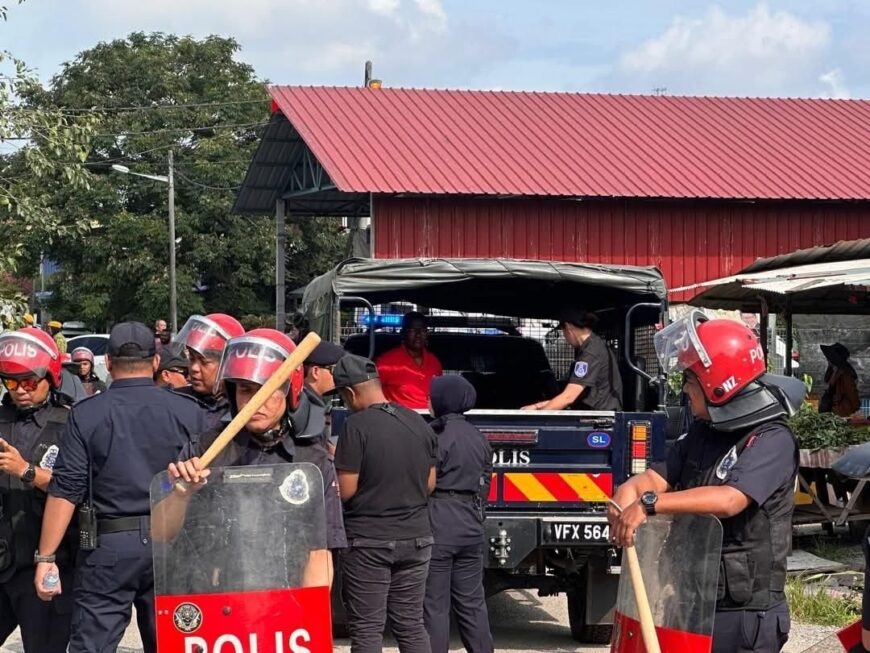
On 14 November 2025, ARTICLE 19 and the Centre for Independent Journalism (CIJ) expressed alarm about the arrests of and use of force against human rights defenders and residents who attempted to prevent the demolition of houses in Kampung Jalan Papan, which began on 11 November in the Malaysian state of Selangor. We call on the authorities to immediately release human rights defenders and end investigations into their activities.
On 14 November, two human rights defenders and seven local residents were arrested under Section 186 of Malaysia’s Penal Code for allegedly obstructing public servants from discharging their duties – a clause that carries a penalty of up to two years’ imprisonment and/or a maximum fine of RM10,000 (approximately USD 2,410). The two activists are Yee Shan from Parti Sosialis Malaysia (PSM) and Jernell Tan from the human rights organisation SUARAM. The seven local residents are Than Bee Hooi, Than Kim Kim, Lim Wee Chun, Ser Li Fang, Lim Eng Hui, Teoh Ah Guat, and Ng Ban Ping.
This follows previous arrests earlier in the week. On 13 November, 10 people were arrested, also under Section 186 of the Penal Code: PSM Secretary-General Sivaranjani Manickam, PSM National Treasurer Soh Sook Hwa, PSM activist Aein Aneera Anuar, PSM activist Ramasamy Karupan, PSM activist Tan Ka Wei, PSM activist Hridhay Praveen, activist Wong Kueng Hui from the non-governmental organisation Mandiri, local resident Tang Bing Ai, and activist Fakrurrazzi Khairur Rijal from the advocacy group Himpunan Advokasi Rakyat Malaysia. They were detained at the Pandamaran and Pelabuhan Klang police stations and later released on 14 November .
On 12 November, Deputy Chairperson of PSM Arutchelvan Subramaniam, also known as Arul, activist M. Mythreyar, and M. Logesvaran, a representative for the residents affected by the demolition, were arrested under Section 186 of the Penal Code. They were remanded one day before release on 13 November under police bail.
‘This is a blatant attack against human rights defenders who dare speak out on behalf of local communities living in a climate where forced evictions and development pressures are being used to displace long-time residents. The arbitrary arrests of the activists highlight the risks faced by human rights defenders advocating housing rights. These actions seem intended to intimidate others and discourage efforts to stop forced evictions,’ said Nalini Elumalai, Senior Malaysia Programme Officer at ARTICLE 19. ‘Using such forms of intimidation to silence human rights defenders and the residents not only threatens their safety but also undermines the ability of communities to assert their right to adequate housing and partake in meaningful decisions that affect their lives.’
This case stems from a 1995 agreement between the Selangor government and private limited company TPPT, under which affected families were to be given homes after the state government transferred 95 acres of land to the company. More than 30 years on, the residents have yet to receive their promised homes. Residents, known as Kampung Papan settlers, have lived in the area for decades, since 1939 – before Malaysia’s independence from the British in 1957. Despite a court ruling allowing the eviction, the Selangor government has said that demolition work should only be limited to vacant houses and business premises. Despite this promise, demolition work began on 10 November and as of 13 November, at least 15 occupied houses had been demolished. Residents of 44 out of 83 homes have obtained an interim injunction against the demolition.
The authorities’ actions violate the United Nation’s Declaration on Human Rights Defenders and other related resolutions, including General Assembly resolution 70/161 on human rights defenders in the context of the Declaration on the Right and Responsibility of Individuals, Groups and Organs of Society to Promote and Protect Universally Recognized Human Rights and Fundamental Freedoms. Among other things, the resolution urged States to ensure the rights and safety of human rights defenders in exercising their rights to freedom of expression, peaceful assembly, and association.
On 14 November 2025, Al Jazeera (Mariamne Everett) and other media reported that international NGOs, such as Human Rights Watch and Amnesty International, have decried a sharp decline in civil liberties and a pervading “injustice” in Tunisia since President Kais Saied came to power in 2019, as authorities escalate their crackdown on the opposition, activists and foreign nongovernmental organisations.
“Tunisian authorities have increasingly escalated their crackdown on human rights defenders and independent non-governmental organizations (NGOs) through arbitrary arrests, detention, asset freezes, bank restrictions and court-ordered suspensions, all under the pretext of fighting ‘suspicious’ foreign funding and shielding ‘national interests’,” Amnesty International said in a statement on Friday.
Tunisia’s crackdown on civil society has reached an unprecedented level, according to Amnesty, as six NGO workers and human rights defenders from the Tunisian Council for Refugees are “being criminally prosecuted on charges solely related to their legitimate work supporting refugees and asylum seekers”. The trial’s opening session, initially scheduled for October 16, has been adjourned to November 24.
Within the past four months, Tunisia has temporarily suspended the activities of at least 14 Tunisian and international NGOs, said Amnesty, including the Tunisian Association of Democratic Women and the World Organisation against Torture.
Human Rights Watch said in a statement on Friday that Tunis’s Court of Appeal will hear on November 17 the appeal of more than 30 people “unjustly sentenced to heavy prison terms in a politically motivated ‘Conspiracy Case’” mass trial in April.
“Four of those detained are on hunger strike, including one who, according to his lawyers, was subjected to physical violence in prison on November 11.”
The defendants were charged with plotting to destabilise the country under various articles of Tunisia’s Penal Code and the 2015 Counterterrorism Law. Human Rights Watch, which reviewed the judicial documents, said the charges are unfounded and lack credible evidence. The NGO has called on the court to immediately overturn the convictions and ensure the release of all those detained.
The 37 people detained include opponents of Saied, lawyers, activists and researchers. Their prison terms range from four to 66 years for “conspiracy against state security” and terrorism offences. Jawhar Ben Mbarek – cofounder of Tunisia’s main opposition alliance, the National Salvation Front – began a hunger strike on October 29 to protest his arbitrary detention. Ben Mbarek was sentenced to 18 years behind bars on charges of “conspiracy against state security” and “belonging to a terrorist group”.





 Hans Thoolen on Human Rights Defenders and their awards