The Martin Ennals Award for Human Rights Defenders (MEA) will announce its three Finalists for 2017 on Wednesday 26 April at 11:00 Geneva time. If you want to find out while on the go see: Social media @martinennals
#Ennals 2017 https://www.facebook.com/MartinEnnals/
This 5 minute video of the ProtectDefenders.eu 2016 Annual Beneficiaries’ Meeting, held in Brussels on the 29 November 2016 is now available on Your Tube. The motto was “Defending Human Rights is not a crime – #DefendersNotCriminals”.
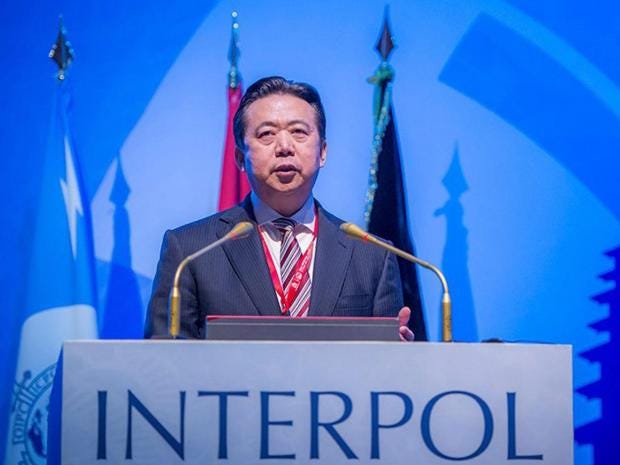
‘Old’ but underreported news is that Meng Hongwei – a top Chinese police official – has been elected president of Interpol, which worries some human rights NGOs. The Independent had an article on 10 November 2016.
Chinese President Xi Jinping has waged a four-year campaign against corruption, which includes a push to return former officials and other suspects who fled abroad. China filed a list of 100 of its most-wanted suspects with Interpol in April 2014, about one third of which have since been repatriated. The country’s police and judicial systems have been routinely criticised for abuses, including eliciting confessions under torture and the disappearance and detention without charges of political dissidents and their family members. Many Western nations have been reluctant to sign extradition treaties with China or return suspects wanted for non-violent crimes.
Given those circumstances, Mr Meng’s election is an “alarming prospect“, said Maya Wang, Hong Kong-based researcher at Human Rights Watch. “While we think it’s important to fight corruption, the campaign has been politicised and undermines judicial independence,” Ms Wang added. Mr Meng’s election “will probably embolden and encourage abuses in the system,” she said, citing recent reports of close Chinese ally Russia’s use of Interpol to attack President Vladimir Putin’s political opponents.
“This is extraordinarily worrying given China’s longstanding practice of trying to use Interpol to arrest dissidents and refugees abroad,” Nicholas Bequelin, east Asia director at Amnesty International wrote on Twitter.
Recently, 5 April 2017, Wei Jingsheng, a well-known human rights defender in exile, said while visiting Lyon (the HQ of Interpol) that the election of Meng Hongwei as chief of the global police organisation could give Beijing new leverage over its critics. “The Chinese government’s message to all political opponents like me or party officials who have fled the country is: ‘Wherever you are, the international police work with us and we will find you’,” “That’s frightening,” he said, adding that Meng “is still vice-minister of public security in China. He has led the secret police.”
While Interpol’s charter officially bars it from undertaking “any intervention or activities of a political, military, religious or racial character,” critics say some governments, primarily Russia and Iran, have abused the system to harass and detain opponents of their regime.
On 4 April 2017 the European Court of Human Rights rendered a judgment1 in the case of Milisavljević v. Serbia (application no. 50123/06) in which it unanimously held that there had been a violation of Article 10 (freedom of expression) of the European Convention on Human Rights. What makes the case particularly interesting is that it concerns Natasa Kandic a well-known human rights defender who has won several awards including the Martin Ennals Award for Human Rights Defenders (MEA) in 1999. [see also : https://humanrightsdefenders.blog/2013/04/07/serbian-natasa-kandic-receives-first-civil-rights-defender-of-the-year-awar/] Nothing is simple when it comes to human rights……
A journalist, Ms Milisavljević, had published in September 2003 an article in Politika about Kandic in which this journalist quoted another journalist who said that Kandic had been called a witch and a prostitute. Natasha Kandic sued for libel and the Serbian courts held that by failing to put one particular sentence – “Ms Kandić [had] been called a witch and a prostitute” – in quotation marks the journalist had tacitly endorsed the words as her own.
The European Court found that it was evident, even without the quotation marks, that that sentence, written by another journalist and previously published in a different magazine, had not been Ms Milisavljević’s personal opinion of Ms Kandić, but that she had merely been transmitting how Ms Kandić was perceived by others. Moreover, the domestic courts, limiting their reasoning to the lack of quotation marks, had completely failed to balance Ms Kandić’s right to reputation against Ms Milisavljević’s freedom of expression and duty, as a journalist, to impart information of general interest.
CASE OF MILISAVLJEVIĆ v. SERBIA – Application no. 50123/06)
The Human Rights Council Network (HRCnet) is seeking a Coordinator based at the International Service of Human Rights in Geneva. For details on the post see below:
HRCnetis a 10-year old coalition of national, regional and international NGOs engaging with the UN Human Rights Council. Its current members are:
in Africa: African Centre for Democracy and Human Rights Studies (The Gambia), DefendDefenders (East and Horn of African Human Rights Defenders Network) (Uganda), Southern African Human Rights Defenders Network (Zimbabwe), West African Human Rights Defenders Network (Togo),
in Asia: Asian Legal Resource Centre (Hong Kong, China), Asian Forum for Human Rights and Development (FORUM ASIA) (Thailand), Commonwealth Human Rights Initiative (India),
in Latin America: Centro de Estudios Legales y Sociales (CELS) (Argentina), Conectas Direitos Humanos (Brazil),
in the Middle East and North Africa: Cairo Institute for Human Rights Studies (Egypt), Egyptian Initiative for Personal Rights (Egypt),
and the following International NGOs: Human Rights Watch (USA), International Service for Human Rights (Switzerland), Open Society Foundations (USA).
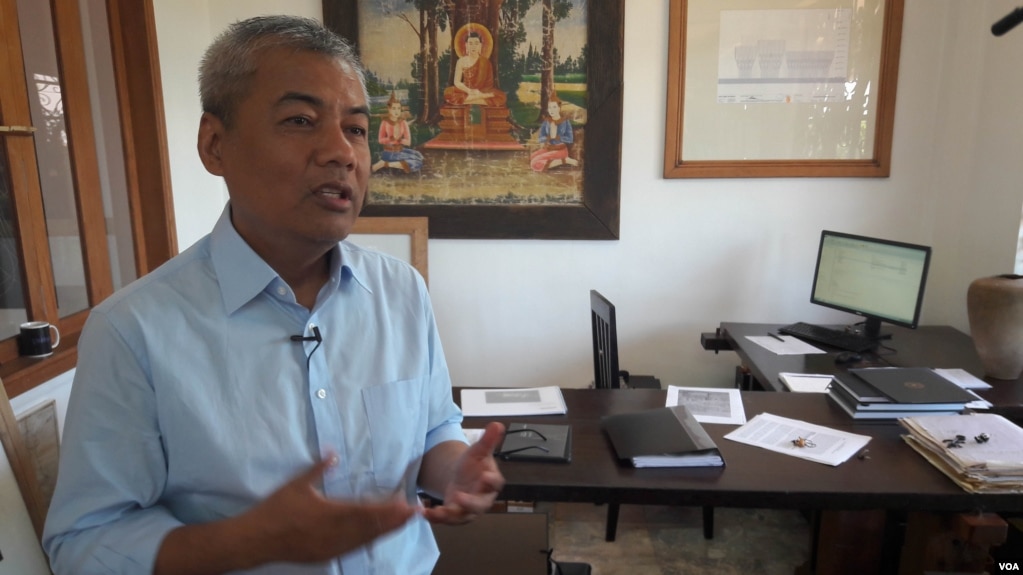
Chhang Youk, director of DC-Cam, talks to VOA Khmer about national reconciliation at his office in Phnom Penh, Cambodia, August 08th, 2016. (Neou Vannarin/VOA Khmer)
Chhang was a survivor of the Khmer Rouge regime. He fled to the United States as a refugee, but memories of the suffering he endured brought him back to his homeland in the early 1990s. He founded DC-Cam and has led the organization since 1995, creating a national genocide education program. Nushin Sarkarati, a senior attorney at CJA, said that without Chhang’s dedication there would be little justice for the victims and survivors.
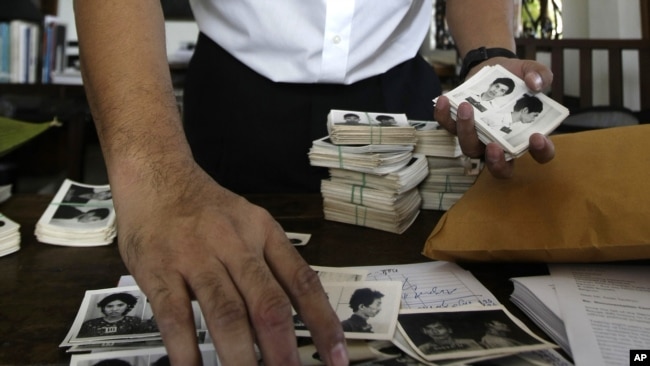
In this photo taken on Aug. 20, 2012, Director of Documentation Center of Cambodia, Youk Chhang arranges photos, a part of about a thousand of newly-discovered photo collection of detainees at the former Khmer Rouge main prison S-21, in his office in Phnom Penh, Cambodia.
Beth Van Schaack, a Stanford law professor who advises DC-Cam, said the group’s orientation towards victims made Chhang a natural choice for the award. “What CJA really admires about DC-Cam is it also has a very victim centered approach, working-hard to help Cambodian victims, experience justice before the ECCC [Extraordinary Chambers in the Courts of Cambodia] and DC-Cam has become in many ways a model for other documentation centers around the world that are collecting information that can be submitted to justice processes where human rights are concerned,” she said.
Nate Thayer, a journalist who has reported on Cambodia for some three decades, said without Chhang’s work, the Khmer Rouge perpetrators would have gotten away with their crimes. “Youk Chhang was a one-man army fighting for justice for those who suffered in Cambodia and his personal passion and devotion bringing those who responsible for mass murder to justice, to face the music, to answer for their crime.”
Peter Maguire, a law professor and an author of “Facing Death in Cambodia,” called Chhang a “Cambodian national treasure” whose efforts bring more truth and reconciliation to the Cambodian people than the combined efforts of the United Nations and ECCC.
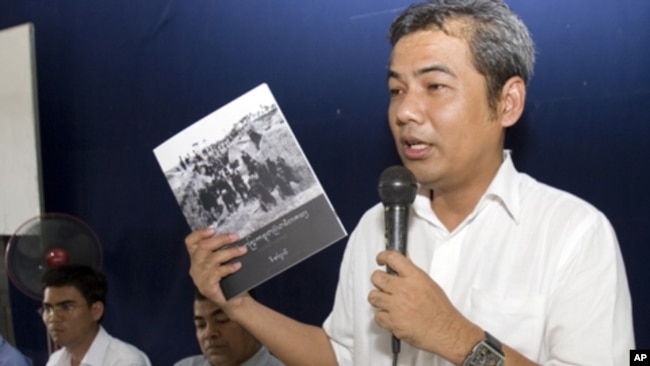
Youk Chhang, a leading Cambodian genocide researcher, shows a copy of the Cambodian version of a Khmer Rouge history textbook to teachers in Takeo province, July 3, 2012.
Neth Pheaktra, ECCC spokesman, told VOA Khmer that DC-Cam deserved the award as it had uncovered valuable evidence that could be used at the court. “The work that DC-Cam has done helps the ECCC save time in finding evidence by ourselves, and it shows us the way, brings us information as well as some historical documents we needed for the trials.”
Chhang is currently working on developing the Sleuk Rith Institute, a permanent hub for genocide studies in Asia based in Phnom Penh.
On 4 April 2017 Nils Muižnieks, the Council of Europe’s Human Rights Commissioner, wrote about “The Shrinking Space for Human Rights Organisations“. The new EU ‘alert site I referred to yesterday [see: https://humanrightsdefenders.blog/2017/04/03/protectdefenders-eu-launches-new-alert-website-but-no-single-stop-yet/] showed in 2016 some 86 reported violations in the European (and Central Asian) region, mostly detention and judicial harassment. Also the recent CIVICUS findings of the narrowing space for civil society points in this direction. An example could be Hungary as illustrated by reports of Human Rights Watch (2016), Human Rights First (2017) and Amnesty International (2016/17); the issue of academic freedom is not directly related but part of the restrictive trend [see links below].
On 30 March ProtectDefenders.eu, the European Union Human Rights Defenders mechanism implemented by international civil society, launched its Index of attacks and threats against Human Rights Defenders, featuring a monitoring of alerts concerning violations perpetrated against individuals promoting Human Rights around the globe. The Index of attacks and threats against Human Rights Defenders is available on: ProtectDefenders.eu website.
It could be a most useful tool as quite a few key information providers coöperate (but not AI, HRW?). However, to be really useful as a single stop for this kind of information it is paramount that the site is as complete as possible (otherwise one would still have to go back to the websites of the individual organizations cooperating in the project). This is apparently not yet the case (or maybe definitions still differ from NGO to NGO). Front Linee.g. in its 2017 report (covering 2016) states that 281 HRDs were killed around the world [https://hrdmemorial.org/front-line-defenders-017-annual-report-highlights-killing-of-281-hrds-in-2016/], while a search on the new site shows only 39 killed in 2016 [https://protectdefenders.eu/en/stats.php?yearFilter=2016®ionFilter=&countryFilter=#mf]. That is 242 killings missing (without checking the annual reports of other cooperating partners) ! This issue is important as the announcement claims that the site wants to become “a source of reliable and updated information that should allow the identification of worrying trends and encourage the coordination of adequate responses by decision-makers and authorities to counter the violations faced by defenders”. Read the rest of this entry »
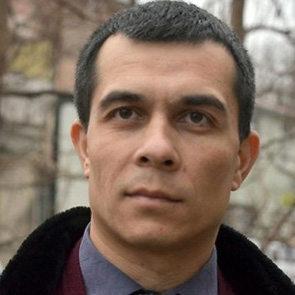
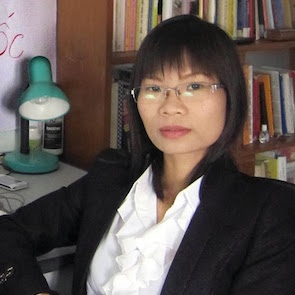
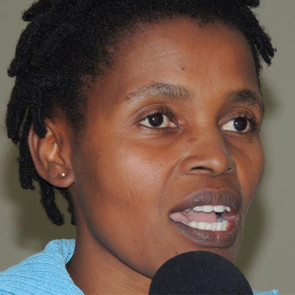
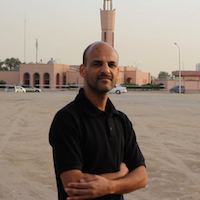
The Jury has selected human rights defenders from Ukraine, Nicaragua, Vietnam, South Africa and Kuwait as finalists for the 2017 Front Line Defenders Award for Human Rights Defenders at Risk:
Emil Kurbedinov, Crimea/Ukraine
Emil Kurbedinov is a Crimean Tatar and human rights lawyer. Since the occupation of Crimea by the Russian Federation, Emil has been defending the persecuted Crimean Tatar minority, civil society activists and journalists. He also provides emergency response and documentation of rights violations during raids and searches of activists’ homes. In January 2017, masked representatives from Crimea’s Centre for Counteracting Extremism detained Emil and took him to a local directorate of the Russian Federal Security Service (FSB) for interrogation. A district court found him guilty of “propagandizing for extremist organisations” and sentenced him to ten days in detention.
Pham Thanh Nghien, Vietnam
Vietnamese blogger Pham Thanh Nghien spent four years in prison for her work publicising violations against and defending the rights of relatives of fishermen killed by Chinese patrols. Following her release, she was kept under house arrest, during which time she spearheaded numerous human rights campaigns and co-founded the renowned Vietnamese Bloggers’ Network. Nghien has had her home raided, been blocked from attending medical appointments, had a padlock placed on her door from the outside, and been refused a marriage certificate. Nghien has also survived numerous physical assaults aimed at stopping her powerful, peaceful work uncovering and publicising human rights violations in Vietnam.
Nonhle Mbuthuma, South Africa
Nonhle Mbuthuma has persisted in her struggle for land and environmental rights in South Africa’s Eastern Cape despite assassination attempts, ongoing death threats and the murder of her colleague. She is a founder and current member of the Executive Committee of the Amadiba Crisis Committee, formed to unite community members in five villages of the Amadiba Tribal Authority region opposing destructive mining projects. In July 2016, Nonhle and other activists successfully forced the biggest shareholder in a titanium mining project to withdraw, but threats to activists continue as the community now fears the project will continue with funding from local “front” companies.
Abdulhakim Al Fadhli, Kuwait
Abdulhakim Al Fadhli is currently imprisoned for his peaceful activism on behalf of Kuwait‘s stateless Bedoon and other minority communities in Kuwait. The term Bedoon, meaning “without” in Arabic, refers to the community of stateless persons, native to Kuwait, who are prohibited from obtaining any official state documents including, but not limited to, birth, death and marriage certificates. Abdulhakim is currently serving a one-year prison sentence and faces deportation upon release. Throughout his imprisonment, he has protested and staged hunger strikes against the inhumane and unsanitary conditions in the Anbar 4 prison facility, where he has also been subjected to solitary confinement. [see also https://humanrightsdefenders.blog/2014/02/27/car-chase-in-kuwait-bedoun-human-rights-defender-the-target/]
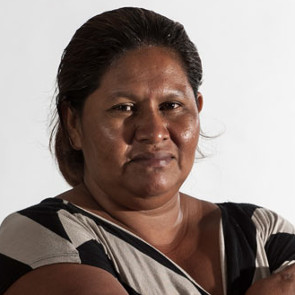
Francisca Ramírez Torres, Nicaragua
Human rights defender Francisca Ramírez Torres‘ children were attacked in attempt to stop her powerful work advocating against a destructive inter-oceanic canal in Nicaragua. Francisca is the coordinator of the Council for the Defence of Land, Lake and Sovereignty, which educates communities on their rights, campaigns for the repeal of laws allowing land-grabbing. The proposed canal would displace thousands of small farmers and indigenous peoples, without respecting their right to free, prior and informed consent. Francisca has been detained, harassed, and had her home and family attacked for her peaceful resistance to this destructive canal project.
The annual Front Line Defenders Award seeks to focus international attention on the human rights defender’s work, thus contributing to the recipient’s personal security, and a cash prize of €15,000 is awarded to the Award recipient and his/her organisation in an effort to support the continuation of this important work.

 Hans Thoolen on Human Rights Defenders and their awards