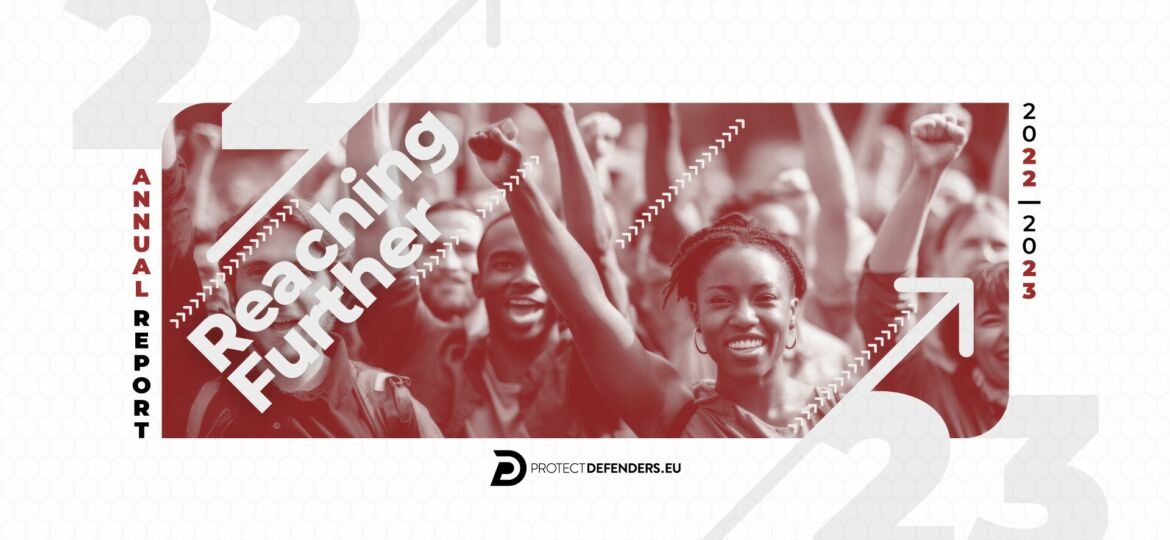
On 25 April 2024, ProtectDefenders.eu, the European Union (EU) Human Rights Defenders Mechanism, presented its comprehensive annual report entitled “REACHING FURTHER,” covering the period November 2022 – October 2023. This report illustrates the support provided and efforts made by ProtectDefenders.eu to support human rights defenders (HRDs) around the world, and especially to reach those who are the most at risk.
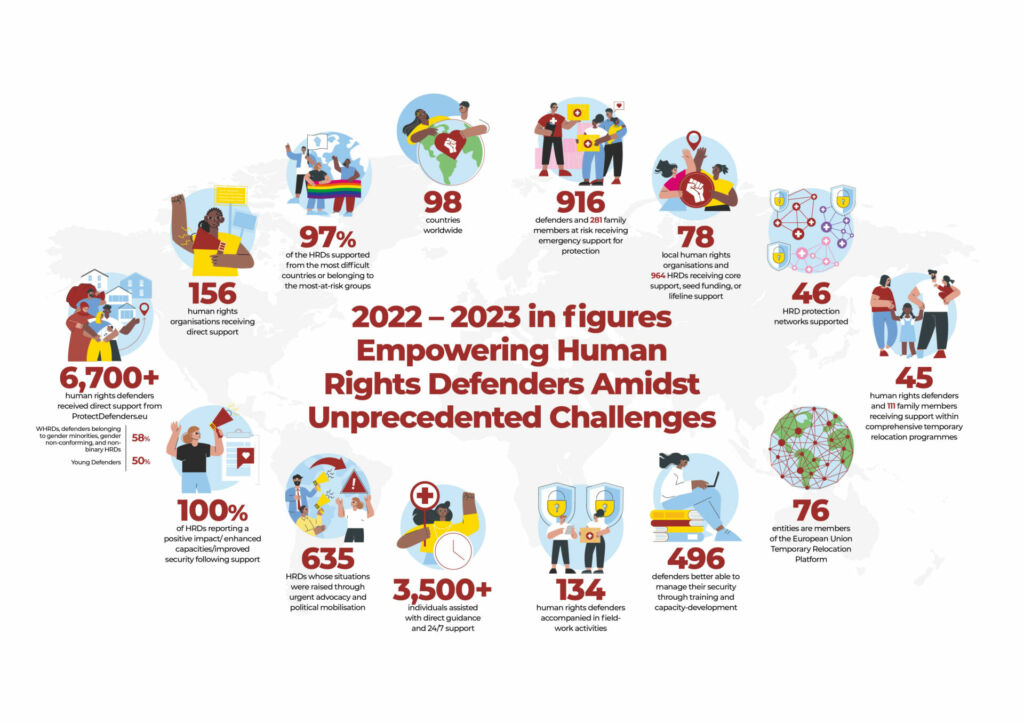
In November 2022, ProtectDefenders.eu entered the third phase of its implementation, marking a milestone in its commitment to safeguarding human rights defenders worldwide. Throughout the first year of this new phase, the renewed and consolidated EU HRD Mechanism has provided direct protection, support, and empowerment to over 6,700 at-risk HRDs, with a particular focus on those facing the highest risks. Notably, 50% of beneficiaries were young defenders, and 58% identified as women human rights defenders (WHRDs), trans-male, trans-female, genderqueer, or gender non-conforming individuals.
Despite facing extraordinary challenges amidst protracted crises globally, ProtectDefenders.eu has demonstrated remarkable effectiveness, efficiency, and adaptability in addressing the pressing needs of HRDs. The mechanism has extended support not only to individual defenders but also to their families, communities, and organizations. This comprehensive support, including financial aid, technical assistance, and guidance, has been delivered through collaboration among consortium partners, showcasing flexibility, creativity, and responsiveness in the face of evolving challenges.
ProtectDefenders.eu has actively responded to increased requests for protection support amid protracted crises in various regions, including Belarus, Myanmar, Afghanistan, Nicaragua, Sudan, Tanzania, and beyond. Emergency protection measures have been consistently provided, alongside investments in the capacity and resilience of human rights organisations and communities. The international temporary relocation system supported by ProtectDefenders.eu, including through the Shelter Initiatives program, further exemplifies the mechanism’s commitment to HRD safety.
Through reactive and preventative advocacy efforts, ProtectDefenders.eu has achieved multiple successes globally, pioneering a collective advocacy approach on shared concerns such as international funding for HRDs and EU visas. The enhanced coordination among consortium partners has facilitated continuous improvements and innovation, addressing challenges faced by HRDs and organizations at risk more effectively.
Moreover, significant progress has been made in enhancing outreach efforts to new groups, including young defenders and those with disabilities. Increased collaboration with local actors, context-specific support, and prioritized coordination have extended the impact of ProtectDefenders.eu widely, with 93% of supported organizations not affiliated with consortium partners.
Looking ahead, ProtectDefenders.eu will remain particularly committed to fulfilling its protection mandate by addressing comprehensively the unique vulnerabilities and barriers faced by HRDs with disabilities. The EU HRD mechanism will actively engage in finding innovative solutions to ensure their protection, inclusion, and access to resources.
Powerful governments cast humanity into an era devoid of effective international rule of law, with civilians in conflicts paying the highest price
Rapidly changing artificial intelligence is left to create fertile ground for racism, discrimination and division in landmark year for public elections
Standing against these abuses, people the world over mobilized in unprecedented numbers, demanding human rights protection and respect for our common humanity
The world is reaping a harvest of terrifying consequences from escalating conflict and the near breakdown of international law, said Amnesty International as it launched its annual The State of the World’s Human Rights report, delivering an assessment of human rights in 155 countries.
Amnesty International also warned that the breakdown of the rule of law is likely to accelerate with rapid advancement in artificial intelligence (AI) which, coupled with the dominance of Big Tech, risks a “supercharging” of human rights violations if regulation continues to lag behind advances.
“Amnesty International’s report paints a dismal picture of alarming human rights repression and prolific international rule-breaking, all in the midst of deepening global inequality, superpowers vying for supremacy and an escalating climate crisis,” said Amnesty International’s Secretary General, Agnès Callamard.
“Israel’s flagrant disregard for international law is compounded by the failures of its allies to stop the indescribable civilian bloodshed meted out in Gaza. Many of those allies were the very architects of that post-World War Two system of law. Alongside Russia’s ongoing aggression against Ukraine, the growing number of armed conflicts, and massive human rights violations witnessed, for example, in Sudan, Ethiopia and Myanmar – the global rule-based order is at risk of decimation.”
Lawlessness, discrimination and impunity in conflicts and elsewhere have been enabled by unchecked use of new and familiar technologies which are now routinely weaponized by military, political and corporate actors. Big Tech’s platforms have stoked conflict. Spyware and mass surveillance tools are used to encroach on fundamental rights and freedoms, while governments are deploying automated tools targeting the most marginalized groups in society.
“In an increasingly precarious world, unregulated proliferation and deployment of technologies such as generative AI, facial recognition and spyware are poised to be a pernicious foe – scaling up and supercharging violations of international law and human rights to exceptional levels,” said Agnès Callamard.
“During a landmark year of elections and in the face of the increasingly powerful anti-regulation lobby driven and financed by Big Tech actors, these rogue and unregulated technological advances pose an enormous threat to us all. They can be weaponized to discriminate, disinform and divide.”
Amnesty International’s report paints a dismal picture of alarming human rights repression and prolific international rule-breaking, all in the midst of deepening global inequality, superpowers vying for supremacy and an escalating climate crisis. Amnesty International’s Secretary General, Agnès Callamard
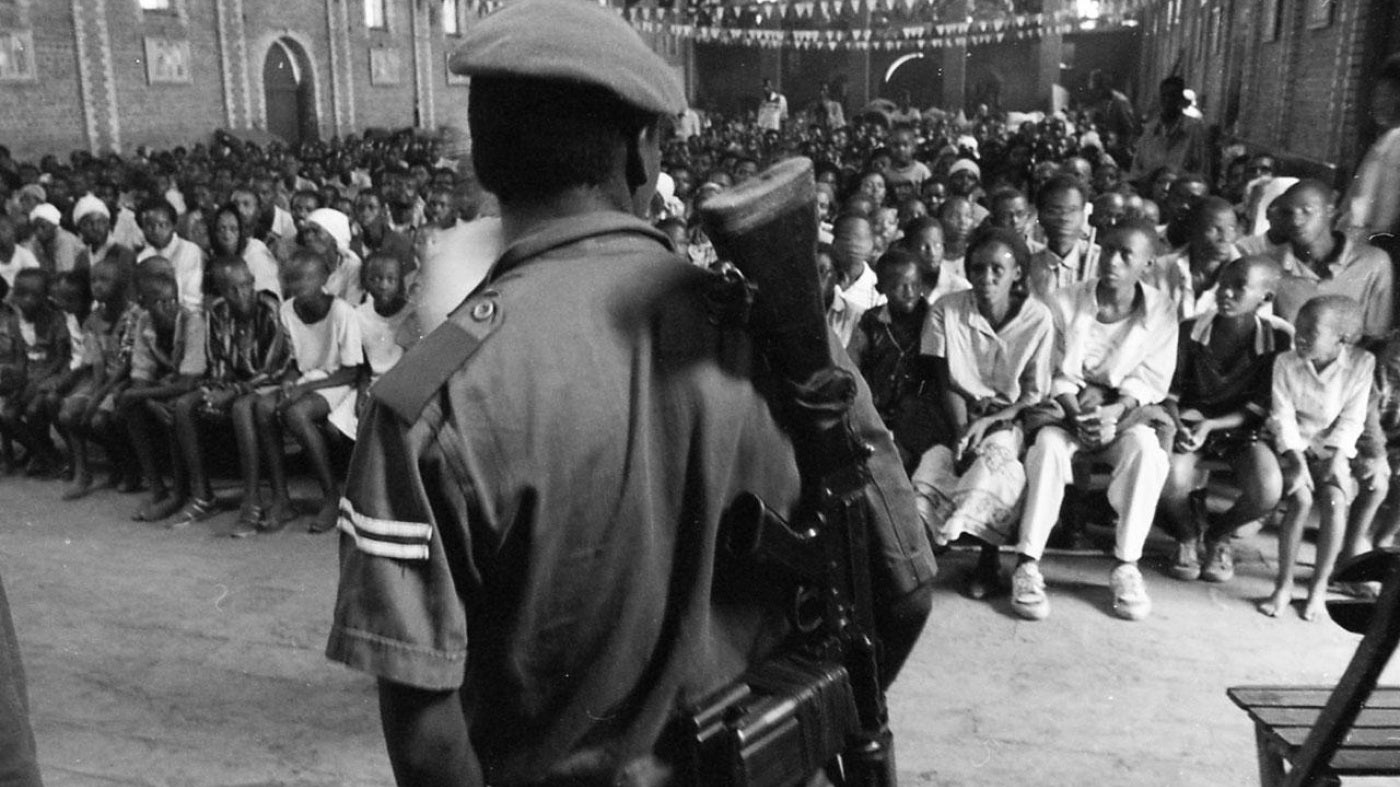
On 2 April, 2024 Human Rights Watch made part of its Rwanda Archives public in digital form.
Human Rights Watch has been documenting and exposing human rights violations in Rwanda since the early 1990s. Its senior adviser in the Africa division, Alison Des Forges, one of the world’s foremost experts on Rwanda, dedicated her career to the struggle for human rights in the Great Lakes region of Africa, and to Rwanda in particular. In the period leading up to the 1994 genocide, she worked tirelessly to alert world powers to the impending crisis in Rwanda. Few would listen. By the time the genocidal forces had unleashed their sinister program and the world had awakened to the full horror that was unfolding in Rwanda, it was too late. The killings in Rwanda increased as a civil war in Burundi waged on. The violence in Burundi, also based on ethnic divisions between Hutu and Tutsi ethnic groups, lasted from 1993 until 2005.
Des Forges’s efforts did not stop when the genocide ended. She continued to painstakingly gather information on the killings, rapes, and other horrific crimes, which she compiled into what has become one of the main reference books on the Rwandan genocide: “Leave None to Tell the Story: Genocide in Rwanda”, a 500-page account of the genocide published jointly by Human Rights Watch and the International Federation of Human Rights (FIDH) in 1999.
Des Forges testified as an expert witness in 11 trials at the United Nations International Criminal Tribunal for Rwanda (ICTR) in Arusha, Tanzania, as well as in domestic court proceedings involving Rwandan genocide suspects in several countries.
Des Forges campaigned vigorously for justice for the genocide until her tragic death in a plane crash in the US on February 12, 2009. She also documented human rights abuses by the new government of Rwanda after the genocide and advocated for accountability for all abuses, past and present.
Thirty years after the genocide, Human Rights Watch has begun the process of digitizing and making available some of Des Forges’s archives. The documents summarized below are some of those that remained in Human Rights Watch possession after Des Forges’s death and help shed light on efforts by Des Forges and others to warn about, and then attempt to stop, the genocide. These are just a selection of the many documents in the archives; others will not be published at this time for a variety of reasons. The private exchanges, letters, statements, and reports below do not purport to be a comprehensive account of the work of Human Rights Watch and others at the time, as it is likely documents are missing from the archive.
Michelle Langrand for Geneva Solutions of 20 March 2024 has an exclusive report on the liquidity crunch and its effect on the UN human rights branch. Here her report in full:
UN secretary general António Guterres and UN human rights high commissioner Volker Türk at the opening of the Human Rights Council 55th session in Geneva, 26 February 2024. (UN Photo/Elma Okic)
As the United Nations faces its worst liquidity crisis in recent history, experts, staff and observers worry about the ramifications on human rights work. Correspondence seen by Geneva Solutions reveals concerns at the highest levels of the UN human rights branch in Geneva as they are forced to scale back their operations.
A patchwork of cost-saving measures taken over the winter holidays at the Palais des Nations in Geneva, from keeping the heat down and closing the premises for two weeks, revealed how serious the UN’s cash troubles were after states failed to fully pay their bills in 2023. The new year didn’t brighten prospects either. In January, UN secretary general Antonio Guterres in New York announced that “aggressive cash conservation measures” would be taken across the organisation to avoid running out of cash by August as year-end arrears reached a record $859 million.
It couldn’t have come at a worse time for a cash-strapped UN Office of the High Commissioner for Human Rights (OHCHR) as worsening human rights crises worldwide add to its workload. The Geneva-based office acts as a secretariat for dozens of independent experts, investigative bodies and human rights committees that rely for the most part on the UN’s regular budget and few voluntary contributions from states. Between vacancies and travel restrictions, both insiders and outsiders worry that planned cuts could severely impair the UN’s crucial human rights work.
Understaffed and overwhelmed
On 12 February, just as the UN’s Geneva headquarters prepared for one of its busiest months hosting the Human Rights Council’s first session of the year, bad news came from New York. Countries had only paid one-third of the UN’s $3.59bn regular budget for 2024, and instructions from the higher-ups were that the hiring freeze imposed in July 2023 would be extended throughout 2024 across UN operations. The organisation said that $350 million would need to be shaved off through spending restrictions on travel, conference services and others.
Human rights bodies, where vacancies had been piling up in the last months, would have to continue to run with reduced staff. In a letter from 23 December, UN high commissioner for human rights Volker Türk had already warned Council president Omar Zniber that 63 posts in over 10 investigative mandates were waiting to be filled while recruitments had been placed on hold. Currently, there are active investigations on serious human rights abuses in Ukraine, Iran, Syria, South Sudan and Nicaragua among others.
“While no compromise has been made in terms of methodology, some of the investigative bodies have had to narrow the scope of both their investigations and their upcoming reports,” the letter reads.
The fact-finding mission on Sudan was one of the bodies immediately affected. Created in October to collect evidence on atrocities committed during the last year of bloody conflict in which thousands of civilians have been killed and millions displaced, the probe body has struggled to begin work. The independent experts composing it, who aren’t paid, have been appointed since December, but as of late February, the Human Rights Office hadn’t been able to hire a support team due to insufficient cash flow, according to a Human Rights Council spokesperson. The experts, who have been mandated for one year, are due to present their findings in September, with observers wondering whether the western-led proposal will garner the political backing it needs to be renewed.
That isn’t the only initiative struggling to get off the ground. “We have met with some new mandates, and we realised that they barely have a team, if any, to support them,” said one NGO member who collaborates with the human rights mechanisms and asked to remain anonymous. Observers say most investigative bodies, even older ones, are impacted at some level.
Kaoru Okoizumi, deputy head of the Independent Investigative Mechanism on Myanmar (IIMM) – the largest human rights probe team – said six out of 57 staff positions funded through the UN’s regular budget were vacant, significantly affecting their work. The IIMM, which also relies on a trust fund made up of voluntary donations and doesn’t depend on the OHCHR’s budget, is coping better than most.
Expert committees that oversee states’ compliance with international human rights law, such as on children’s rights and on torture, are also stretched thin. One staffer said they were required to take on more work than normally expected, for example, having to conduct research and compile information about several countries at the same time for one session. “It’s just too much!” they said, adding that their team was short of more than 10 people.
Another worker from the OHCHR’s special procedures branch, who said was covering for several vacant spots, conceded that the quality of work is affected in such conditions. “Of course, you won’t work as well after pulling all-nighters,” they said. Türk’s letter to Zniber acknowledges that the secretariat was having trouble supporting some 60 special procedures, which are UN-backed independent experts or groups of experts assigned to report to the council on a specific theme or country.
While the problem of understaffing isn’t new, and many also point to cumbersome months-long recruitment processes that are often incompatible with brief mandates, the situation has worsened. To compensate for the hiring freeze, the UN has also increasingly resorted to temporary contracts that last for a few months and can be exceptionally renewed for up to two years. The two workers, who have living on contract to contract for more than a year, said that there is fear that temporary staff may be among the first to go, along with consultants. “In the food chain of contracts, we’re at the bottom,” one of them said.
A slim year for the Human Rights Council
The UN’s human rights branch, which receives as little as four per cent of the UN’s total budget – around $142 million – just enough to cover one third of its activities, has been scrambling to cut back on spending. On Friday, in another letter seen by Geneva Solutions, Türk informed Zniber that his office would be forced to axe certain activities this year.
OHCHR spokesperson Marta Hurtado confirmed the information to Geneva Solutions by writing: “The office has developed an internal contingency plan, which provides for adjustment pending the complete availability of regular budget resources become available.”
Among the measures it proposes is postponing some activities to 2025 altogether while as many consultations and meetings as possible would be moved online without interpretation, according to Hurtado, since the UN in New York hasn’t authorised it for virtual meetings. For those that will be held in person, resources to fly in experts and civil society will also be reduced.
The UN’s recent decision that it would no longer provide online services for meetings has drawn outcry from rights campaigners who argue it curtails the possibility of civil society groups and states with little resources to participate. While the move has been attributed to matters of rules, observers can’t help but wonder if it isn’t, in the end, about the money. Echoing the concerns in the letter, Türks described the impact of these measures on participation from experts and other stakeholders as “deeply regrettable”.
Another issue raised by the UN rights chief is the difficulty that his office has been facing in providing technical assistance to national authorities. He gave the example of the Marshall Islands, which requested help in 2022 to assess the human rights impact of US nuclear testing in its territory in the 1940s and 50s. A source said that although a first visit finally took place this year, work has been delayed.
Marc Limon, director of the human rights think tank Universal Rights Group, remarked that work by the Council to help states improve their rights record through capacity-building support was unfortunately “almost inexistent” and regretted that resources couldn’t be spared for what he calls the “hard end of human rights diplomacy”. “While UN investigations must be protected, there is little threat to key commissions of inquiry due to the huge budgets allocated to them in the first place,” he said. Most probe bodies have between 17 to 27 staff while special procedures usually have one or two assistants.
The Moroccan ambassador forwarded Türk’s letter to fellow states on Monday and said a draft decision regarding the measures would be tabled for the council to consider at the end of the session at the beginning of April.
Human rights credibility at stake
One that has raised eyebrows but isn’t explicitly mentioned by the UN rights chief is limiting country visits by UN experts to one visit instead of two. Hurtado acknowledged that special procedures and other expert mechanisms, including probe bodies, would see their country visits “reduced” while not commenting on the number of authorised visits.
One UN expert, speaking under the condition of anonymity, voiced concern over the restriction. “Country visits are extremely important because they give us a real intimate understanding of a place and the state gets direct feedback on what they’re doing well and what they can do to improve, while also energising civil society,” they said, point out that experts were already barely able to conduct visits during the Covid-19 pandemic.
Limon commented that while it was a wise choice to cut back on some of the “superfluous” debates and activities, reducing special rapporteur trips to countries to one per year, an idea that he said has been floated around before, showed the office “had its priorities wrong”.
Travel restrictions could also have significant implications for criminal cases. Okoizumi said her Myanmar team only had 65 per cent of its usual travel budget, which is key for the Geneva-based group to reach victims and witnesses. “We do our witness interviews in person because we think it’s important in a criminal investigation to make sure that interviews are being conducted in a way that preserves the integrity of the testimony,” she said.
The body, set up in 2018 by the Human Rights Council, is currently working to support a case brought by The Gambia against Myanmar for violating the Genocide Convention at the International Court of Justice, as well as investigations on crimes against the Rohingya at the International Criminal Court and Argentina.
“These are very concrete proceedings and our ability to support them will be impacted by the number of interviews that we’re able to conduct or the analysis that we’re able to produce and share with these jurisdictions,” Okoizumi said, noting that the ICJ case is particularly time-sensitive as both parties were expected to make submissions this year.
The international lawyer said this has meant shifting resources to meet shorter-term deadlines at the risk of putting aside other objectives. “The whole point of having an investigative mechanism is to make sure that we can collect the evidence very soon after a crime happens, even if there isn’t an investigation or prosecution until many years or even decades later. So, shifting our resources in that way, overall will have a negative impact,” she explained.
Top experts within the human rights branch have also rang alarm bells about the wider repercussions of the funding crisis. In a letter seen by Geneva Solutions addressed to the president of the General Assembly, Dennis Francis, dated 23 February, 10 chairs of human rights committees warned that the liquidity crisis “severely threatens the credibility and efficiency of the United Nations human rights system”.
The experts said the treaty bodies were “being denied even the minimum staff and operational resources required to deliver their critical mandates to advance human rights” at a time of “such a severe existential crisis of multilateralism and of non compliance with international law”.
Referring to some of the measures being considered, the signatories also argue that suspending sessions “for the first time in their over six decades of history for financial reasons, together with visits to prevent torture and other human rights violations” would lead to “concrete and irreversible” harm.
“When the collective security system has failed to honour the ‘never again’ pledge of 1945, the least to do is to strengthen human rights monitoring mechanisms, so that human rights violations are documented, even when justice seems extremely challenging to serve. We note with deep regret that the opposite is being done,” the custodians of human rights law wrote.
Democracy and rule of law continued to weaken across Europe in 2023, and restrictions on the right to peaceful protest have increased significantly. That is what is shown by a new report on rule and law and human rights produced by 37 European human rights organisations. Older democracies, for example Sweden and Italy, also show signs of the gradual erosion of rule of law.
The Liberties Rule of Law Report 2024 is the most extensive independent report submitted to the EU. A group of civil liberties groups dedicated to strengthening freedoms and rights reviewed 19 EU countries and their adherence to rule of law and human rights in 2023. The report provides this information to the EU Commission, which annually assesses how EU member states uphold their commitments to rule of law.
According to this year’s report, the rule of law in the EU continued to deteriorate in 2023, as governments further weakened legal and democratic checks and balances. Balazs Denes, Executive Director of the Civil Liberties Union for Europe (Liberties), comments:
“Liberties Rule of Law Report 2024 shows that intentional harm or neglect to fix breaches to the rule of law by governments, if left unaddressed, can evolve into systemic issues over time. The growing far right, building on these abuses, will very quickly dismantle European democracy if the European Commission does not use the tools at its disposal, including infringement proceedings or conditional freezing of EU funds, in a much more assertive way. There is no need to wait until a captive state like Hungary’s emerges with an irremovable anti-democratic regime”.
In 2023, many of us worry that society is becoming more divided and less equal, and we have strong opinions about the choices government makes on our behalf, such as how to treat migrants and refugees, tackle climate crisis, or respond to global conflicts. As elected representatives, we rely on politicians to use the power and resources of their office to address our concerns.
The strength of democracy is determined not by the outcome of governments’ decisions, but the democratic environment in which decisions are made. Liberties’ fifth annual rule of law report evaluates whether governments respect the rule of law structures, such as independent media, free courts, and citizen rights groups, that hold them accountable. The most in-depth ‘shadow reporting’ exercise by an independent civil liberties network covering 19 Member States, our report identifies Europe-wide trends and provides the EU with recommendations to reverse democracy’s downward trajectory.
There was a strong uptick in restrictions on peaceful protest increased in 2023 (Bulgaria, the Czech Republic, Estonia, Germany, Hungary and Sweden), often selectively applied to pro-Palestine and climate protests. The use of surveillance technology at protests persisted (Belgium, France, and the Netherlands) and civil society organisations and human rights defenders were still subject to attacks in almost all countries observed.
Governments continued to pass laws in an accelerated fashion (Bulgaria, Greece and Sweden, Slovakia), largely bypassing input put from citizens groups and resulting in poorer quality legislation. When public consultations with civil society did take place, our members reported that they were symbolic in nature (Bulgaria, Hungary, Ireland or Croatia) or faced deadlines too short to be meaningful (Germany, Slovakia and Slovenia).
Recommendations to the EU
Once authoritarian tendencies become entrenched, they are extremely difficult to reverse. The EU has a range of tools at its disposal and should use them more readily before rule of law violations take root. If violations are blatant and deliberate, infringement proceedings should be initiated without discussion, interim measures requested, and systemic infringement proceedings should follow multiple rule of law violations. Civil society should be given more support in its role fostering rule of law dialogue. The Commission’s annual report should include targeted and specific recommendations for Member States to address rule of law shortcomings, linked to enforcement measures, and we recommend evaluating civic space as a standalone topic and broadening the scope of human rights violations.
This is the fifth annual report on the state of the rule of law, democracy and fundamental rights across the EU.
On 22 February 2024, Human Rights Watch came with a study on governments reaching outside their borders to silence or deter dissent by committing human rights abuses against their own nationals or former nationals. Governments have targeted human rights defenders, journalists, civil society activists, and political opponents, among others, deemed to be a security threat. Many are asylum seekers or recognized refugees in their place of exile. These governmental actions beyond borders leave individuals unable to find genuine safety for themselves and their families. This is transnational repression.
Transnational repression looks different depending on the context. Recent cases include a Rwandan refugee who was killed in Uganda following threats from the Rwandan government; a Cambodian refugee in Thailand only to be extradited to Cambodia and summarily detained; and a Belarusian activist who was abducted while aboard a commercial airline flight. Transnational repression may mean that a person’s family members who remain at home become targets of collective punishment, such as the Tajik activist whose family in Tajikistan, including his 10-year-old daughter, was detained, interrogated, and threatened.
Transnational repression is not new, but it is a phenomenon that has often been downplayed or ignored and warrants a call to action from a global, rights-centered perspective. Human Rights Watch’s general reporting includes over 100 cases of transnational repression. This report includes more than 75 of these cases from the past 15 years, committed by over two dozen governments across four regions. While the term “transnational repression” has at times become shorthand for naming authoritarian governments as perpetrators of rights violations, democratic administrations have assisted in cases of transnational repression.
Methods of transnational repression include killings, unlawful removals (expulsions, extraditions, and deportations), abductions and enforced disappearances, targeting of relatives, abuse of consular services, and so-called digital transnational repression, which includes the use of technology to surveil or harass people. These tactics often facilitate further human rights violations, such as torture and ill-treatment.
This report also highlights cases of governments misusing the International Criminal Police Organization (Interpol)—an intergovernmental organization with 195 member countries—to target critics abroad.
Victims of transnational repression have included government critics, actual or perceived dissidents, human rights defenders, civil society activists, journalists, and opposition party members and others. Governments have targeted individuals because of their identity, such as ethnicity, religion, or gender. Back home, families and friends of targeted people may also become victims, as governments detain, harass, or harm them as retribution or collective punishment. Transnational repression can have far-reaching consequences, including a chilling effect on the rights to freedom of expression, association, and assembly among those who have been targeted or fear they could be next.
This report is not an exhaustive examination of cases of transnational repression. Instead, it outlines cases that Human Rights Watch has documented in the course of researching global human rights issues that point to key methods and trends of transnational repression.
Human Rights Watch hopes that by drawing attention to cases of transnational repression, international organizations and concerned governments will pursue actions to provide greater safety and security for those at risk. Governments responsible for transnational repression should be on notice that their efforts to silence critics, threaten human rights defenders, and target people based on their identity are no less problematic abroad than they are at home. This report provides governments seeking to tackle transnational repression with concrete recommendations, while raising caution against laws and policies that could restrict other human rights.
Human Rights Watch calls on governments committing transnational repression to respect international human rights standards both within and beyond their territory. Governments combatting transnational repression should recognize such abuses as a threat to human rights generally and act to protect those at risk within their jurisdiction or control.
According to the Business and Human Rights Resource Center (BHRRC), since January 2015, there have been nearly 5,000 attacks on human rights defenders working on business and human rights issues. Defenders and UN experts have long worked to hold businesses accountable for meeting their responsibilities to defend civic freedoms and protect human rights defenders. Part of this work has included articulating what these responsibilities are and practical steps to meet them.
Inspired by and building from the United Nations Guiding Principles on Business and Human Rights, the BHRRC and ISHR 2018 report, ‘Shared Space Under Pressure: Business Support for Civic Freedoms and Human Rights Defenders, Guidance for Companies,’ lays out the normative framework that clarifies the corporate responsibility to act and to do no harm against HRDs. The UN Working Group on Business and Human Rights reaffirmed this in their 2021 Guidance on ensuring respect for human rights defenders. This guidance develops the implications of the Guiding Principles for engaging with and safeguarding the rights of human rights defenders– providing both States and businesses with a set of recommendations to follow.
Over the last few years, there has been an increasing articulation of the responsibility of businesses to respect and promote civic freedoms and the rights of Human Rights Defenders. Some recent examples of these efforts include the 2023 Unilever human rights policy and implementation guide and the BHRRC Human Rights Defender Policy Tracker.
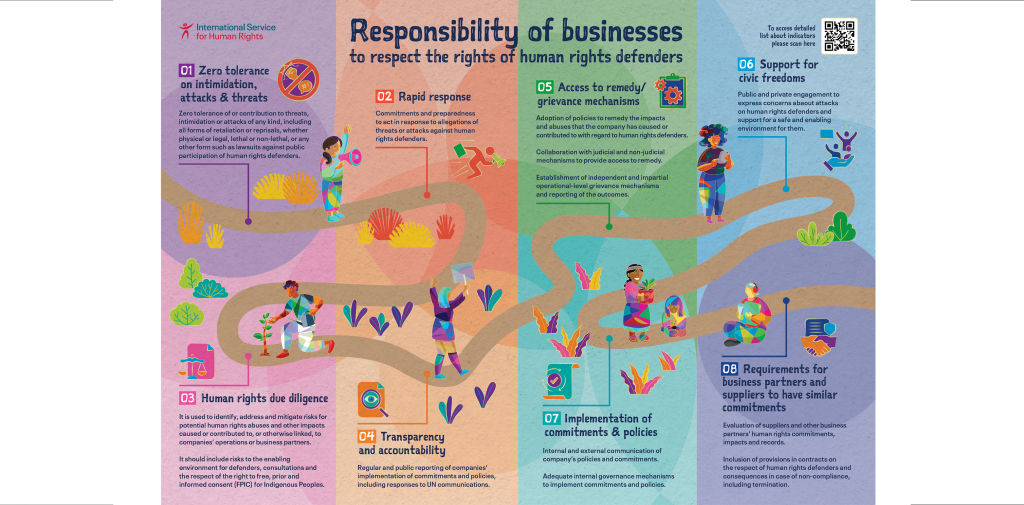
In this same spirit, ISHR is launching a set of Indicators on Business and Human Rights that cover the following areas:
Zero tolerance on intimidation, attacks and threats against HRDs
Human rights due diligence
Transparency and accountability
Access to remedy/grievance mechanisms
Support for civic freedoms
Requirements for business partners and suppliers to have similar commitments
The indicators come in list and poster form. ISHR has also produced a ‘snapshot’ of the UN Working Group’s Guidance on ensuring respect for human rights defenders, in the form of an explainer, available in multiple languages.
We created a wonderful “Responsibility of businesses” roadmap poster for you. It shows the important steps to take on the journey to a responsible business, respecting the rights of human rights defenders amongst all people. You can download it in poster size print quality in the download section and print it yourself to go on your office wall, to remind everyone about the little steps and big responsibility to take everyday.
On 3 March 2024 Gary Price from the University of Minnesota Libraries reports that the University of Minnesota now has one of the largest human rights archives at a public university, and it’s already helping researchers, educators, and human rights advocates across the globe.
“With everything that’s happening in the world, if we can highlight aspects of the history of human rights, maybe that provides us an opportunity to learn what not to do in the future,” said Kris Kiesling, director of the U of M’s Archives and Special Collections (ASC).
Unlike other collections in ASC, the Minnesota Human Rights Archive (MHRA) is an umbrella archive composed of new human rights materials donated to the Libraries, as well as existing materials housed in other collections.
From the Givens Collection of African American Literature to the Immigration History Research Center Archives, there’s a trove of materials about civil rights, LGBTQ rights, child labor, domestic violence, public health, and more. ASC archivists and curators are already investigating how their materials relate to human rights, and how their collections are positioned under the MHRA umbrella.
Planning for MHRA began around eight years ago when Barbara Frey — the former director of the U of M Human Rights Program and a founder and previous director of the advocates for human rights — began contacting The Advocates, CVT, and other organizations across the state.
Kiesling — alongside University Archivist Erik Moore and Social Welfare History Archivist Linnea Anderson — met with Frey, Weissbrodt, and Meyer Weinshel, former collections and outreach lead for UMN’s Center for Holocaust and Genocide Studies, to build the MHRA.
The team transferred some materials from HRC in 2016, and later on, Patrick Finnegan, former assistant director of HRC and administrative associate for The Advocates, surveyed and listed Weissbrodt’s personal papers and research materials.
Pooling new and existing materials under the human rights umbrella not only helps researchers by condensing the initial hunt-and-gather phase of their projects, but it also helps potential donors. It’s easier for them to articulate their goals for their material, Moore explained, and it’s easier to connect their work to the broad framework of human rights, than a more granular collection like the University Archives.
UN Report Unveils Strategies to Shield Child, Youth Human Rights Defenders
Emmanuel Abara Benson, on 6 March 2024, unveils in BNN a new UN report which highlights the challenges faced by young activists, advocating for global support and legal frameworks to safeguard their rights and efforts:
Amnesty International heralds a new UN report as a significant advancement for young activists worldwide, set to be introduced by UN Special Rapporteur Mary Lawlor during the 55th Session of the Human Rights Council on 12 March 2024. The document, titled “We are not just the future”: challenges faced by child and youth human rights defenders”, highlights the unique challenges faced by young activists, including oppression, age-based discrimination, and barriers to resources and legal aid.
The report by Mary Lawlor sheds light on the considerable obstacles child and youth defenders encounter, such as intimidation, threats, and attacks, both in physical and digital realms. Amnesty International’s Sara Vida Coumans emphasizes the overdue recognition of the distinct experiences and adversities young defenders face compared to their adult counterparts. The report also addresses the issue of “gatekeeping” by adult-led groups, which hampers the ability of young activists to access necessary resources and participate in decision-making processes.
Amnesty International has documented numerous instances of abuses against young human rights defenders. Examples include Fatima Movlamli from Azerbaijan and Mahmoud Hussein from Egypt, who faced intimidation and arbitrary detention, respectively, due to their activism. Moreover, the report mentions the plight of child climate defender Leonela Moncayo in Ecuador, who was intimidated with an explosive device outside her home, highlighting the risks young activists face. The organization calls for governments worldwide to heed the Special Rapporteur’s recommendations, particularly in providing legal aid and support for young defenders. See also: https://humanrightsdefenders.blog/2023/11/13/hrw-submission-to-special-rapporteur-focuses-on-child-and-youth-human-rights-defenders/
The document not only brings to the forefront the specific challenges faced by child and young human rights defenders but also underscores the importance of global support and legal frameworks to safeguard these individuals. By spotlighting the adverse impact of social media, the right to peaceful assembly, and the effects of climate change on young people, the report advocates for a more inclusive and supportive environment for young activists. Governments are urged to adopt the recommendations, recognizing the vital role of young defenders in advocating for human rights and democratic reforms.
This groundbreaking report marks a pivotal moment in the recognition and support of child and young human rights defenders. By highlighting the unique challenges they face and offering targeted strategies for protection, the UN and Amnesty International are paving the way for a more inclusive and equitable future for young activists. The global community’s response to these recommendations will be instrumental in ensuring that young voices are not only heard, but also protected in their brave efforts to defend human rights.
On 16 February, 2024 Sandra Epal Ratjen & Nicolas Agostini in Global Rights reported on a UN consultation on law enforcement’s role in peaceful protests which brought together practitioners and human rights defenders.
Over two days in Geneva, the UN special rapporteur on freedoms of peaceful assembly and association, Clément Voule, the UN Human Rights Office (OHCHR), and the UN Office on Drugs and Crime (UNODC) convened a consultation on the facilitation of peaceful protests by law enforcement. The event followed several regional workshops, organized in accordance with Human Rights Council resolution 50/21, which requested that the special rapporteur develop “technical and practical tools . . . to assist law enforcement officials in promoting and protecting human rights in the context of peaceful protests.” There was nothing unusual in this format—or in the event’s title. But despite its attractive feel (at least for human rights geeks), it ran the risk of turning into yet another academic discussion replete with theorizing but offering little in the way of practical solutions.
It turned out to be one of the most refreshing, engaging, and action-oriented human rights dialogues we’ve attended.
It’s about the makeup
What made the event rather unusual was its makeup. In addition to civil society members (public assembly, law enforcement, torture, and rule of law specialists attended), the consultation brought together practitioners from all over the world. By “practitioners,” we mean not just police watchdogs (oversight bodies and disciplinary authorities) but police officers and commanders, all on active duty.
While some activists would draw back with a wince, those human rights defenders and organizations who were present engaged with an open mind, as did law enforcement personnel. Participants weren’t going to talk amongst themselves or only preach to the converted. They were going to try to bring about an actionable outcome. After all, their aim was to devise how law enforcement can facilitate peaceful assemblies and protect rights in such contexts.
Peer pressure was minimal. On all sides, there was nothing to “prove”: no need to adopt an intransigent position, no need to show you’re smart, no need to cajole anyone—there were only incentives to share expertise and experience.
Sure, there were precedents. Recent workshops brought together practitioners and outlined best practices. For instance, the “Istanbul Process” meeting on promoting religious tolerance held in Singapore was practitioner-centric. Since then, however, the Istanbul Process has collapsed as the Organization of Islamic Cooperation (OIC) revived the “defamation of religions” agenda.
Without naïveté but considering the “real-world” nature of the outputs of this process, we’re confident that the work done under the auspices of Clément Voule, OHCHR, and UNODC will, to some extent, enhance human rights compliance in police practice and benefit both peaceful protesters and law enforcement officials. Notably, the outcome documents are less technical than most human rights documents.
It’s also about the substance
The consultation was also innovative because of its hands-on approach. In addition to the main working document, a “Model Protocol” for the law enforcement facilitation of peaceful protests, the project led by Clément Voule and his team, OHCHR, and UNODC will produce a “Handbook” and a “Checklist” for law enforcement professionals. The latter two will be practical documents guiding police practice.
The magnitude and diversity of experiences in the room meant that discussions were light-years away from sterile sloganeering or divisive debates—the kind we see on social media. On civil society’s side, no one advocated “defunding the police.” On the police side, no one advocated for qualified immunity. All participants created a fertile ground for dialogue on how to ensure human rights-compliant, competent, and respected law enforcement that is able to facilitate, not hinder, public assemblies.
Civil society participants recognized the need for well-funded, well-trained police. We kept in mind (and were reminded of) the realities of the job—what the average law enforcement officer faces daily. The challenges include understaffing, lack of adequate training, and, quite simply, fear (facing a crowd, even peaceful, will never feel like sitting on your sofa sipping a Whiskey Sour). Law enforcement participants, for their part, recognized the need for accountable police behavior and to confront discrimination and abuses of power. They kept in mind (and were reminded) that to be respectful is a sine qua non to be respected.
Also reviewed were “prior to protest,” “during protest,” and “after protest” issues, plus the situation of specific groups and accountability for violations. One section addressed police well-being, which is essential to human rights compliance, as strained police officers are much more likely to engage in misconduct. We didn’t shy away from addressing sensitive issues—police brutality, accountability, or budgeting.
It wasn’t an echo chamber, but participants agreed on key points. Among others: the role of police vs. the role of prosecution; the need for effective communication between protesters and police, de-escalation, and adequate training for police officers; or the fact that a clear distinction must always be made between peaceful and non-peaceful elements of an assembly.
It was a far cry from the way these conversations unfold online, and once again, one can see the toxicity of social media. Instead of fostering healthy discussions (differences aren’t that wide between most people), social media algorithms artificially promote simplistic views, entrench positions, and elevate the most divisive topics. This process distracts those seeking solutions from problem-solving. No one benefits from this situation—certainly not rights-holders.
Don’t forget political will
Assuredly, the outcomes of this consultation will go unheeded in many countries, where protests are rare or police have total impunity. Elsewhere, not much will happen without political will.
But the beauty of this consultation is that political will to facilitate assemblies won’t need to come from the highest level. Once publicly available, the outcome documents—particularly the Handbook and Checklist, with their guidelines on communication, de-escalation, and risk assessment regarding protests—will be available for law enforcement agencies and officers at all levels to use. The ideal scenario, of course, will be governments publicly committing to using the outcome documents.
The final documents will stem from a dialogue that brought together people with hands-on experience who tried to build bridges and maximize their chances of having an impact on the ground. This model should inform future human rights dialogues.
The Protocol, Handbook, and Checklist will be presented at the next session of the UN Human Rights Council, February 26–April 5, 2024. Clément Voule will make his last appearance as special rapporteur. For his successor—and for all people of goodwill who want to see peaceful protests proceed without hindrance, as well as rights-compliant law enforcement, joint work will be needed to popularize, operationalize, and implement the documents.



/bnn/media/media_files/7d7279a6fe08cbdd641cda8431af6038216be3c9c100f79beacc07763c194f26.jpg)
 Hans Thoolen on Human Rights Defenders and their awards