Author Archive

SHIFT’s new Chair is former High Commissioner Zeid Ra’ad Al Hussein

May 20, 2022

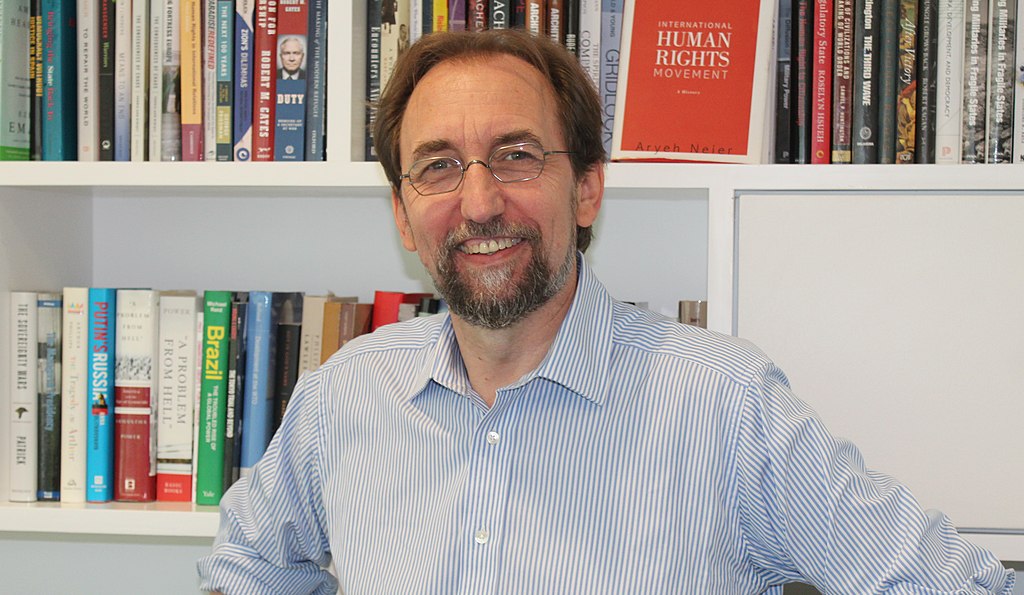
Shift, the centre of expertise on the UN Guiding Principles on Business and Human Rights, announced the appointment of HRH Prince Zeid Ra’ad Al Hussein as the new Chair of its Board of Trustees. He served as the United Nations High Commissioner for Human Rights from 2014-2018, as well as Jordan’s Permanent Representative to the UN, and as the first president of the International Criminal Court (ICC), among other leadership roles.

He is currently the CEO and President of the International Peace Institute and the Perry World House Professor of Practice of Law and Human Rights at the University of Pennsylvania Carey Law School. He is also a member of The Elders, an independent group of global leaders working together for peace, justice and human rights, first established by Nelson Mandela in 2007. He has been recognized globally and received 5 human rights awards, see: https://www.trueheroesfilms.org/thedigest/laureates/8ec8e85a-66ba-404c-b82e-720ebf044549]  

Prince Zeid succeeds Shift’s late founding Chair, Professor John Ruggie, author of the UN Guiding Principles on Business and Human Rights. [See also: https://humanrightsdefenders.blog/2021/09/28/in-memoriam-john-ruggie-father-of-business-and-human-rights/]

On taking up the role of Shift’s Chair, Prince Zeid said:  

The unanimous endorsement of the Guiding Principles in 2011 represented a watershed moment in changing the understanding of companies’ responsibility for the negative impacts that business activities can have on people. For a decade now, Shift has worked relentlessly to embed the ethos of the UNGPs in the way business gets done, with the focus where it must always be – on delivering better outcomes for the most vulnerable workers and communities. I am delighted to take up the role of Chair of Shift’s Trustees at a time when we see so much growth in the appetite and need for the organization’s work and leadership, not least as regulators, legislators, investors and financiers become more attuned to their own roles in incentivizing rights-respecting business practices, including as an essential component of a Just Transition to carbon neutral economies. I look forward to working with the Board and the management team to seize these growing opportunities to deliver on the promise of the UN Guiding Principles.”

For the past three years, Shift has worked closely with Prince Zeid in strategic partnerships to advise global sports bodies––including the International Olympic Committee and the Féderation Internationale de l’Automobile ––on their responsibility to respect human rights under the UN Guiding Principles.

Taliban dissolves ‘unnecessary’ Human Rights Commision

May 20, 2022

Patrick Slater, from the Vermont Law School, reports in Jurist.org of 18 May 2022 that the Taliban authorities in Afghanistan announced that the country’s Human Rights Commission will be dissolved, calling it “unnecessary.”

The Afghan Independent Human Rights Commission (AIHRC) was the national human rights institution of Afghanistan, dedicated to the promotion, protection, and monitoring of human rights and the investigation of human rights abuses.

The Kabul-based Commission was established on the basis of a decree of the Chairman of the Interim Administration on June 6, 2002, pursuant to the Bonn Agreement (5 December 2001); United Nations General Assembly resolution 48/134 of 1993 endorsing the Paris Principles on national human rights institutions, and article 58 of the Constitution of Islamic Republic of Afghanistan.

The much-honoured Sima Samar was the Chairperson of the Afghan Independent Human Rights Commission [see: https://www.trueheroesfilms.org/thedigest/laureates/4AEEBC97-C788-49F5-8DE1-33F7855D2192] and as of 2019, its chairperson was Shaharzad Akbar [see: https://www.trueheroesfilms.org/thedigest/laureates/46068051-7f6e-403a-9663-8286238d7d2e]

Following the Taliban capture of the country in 2021, the AIHRC has been unable to carry out its work, due to confiscation of he human rights commission’s “buildings, vehicles and computers”

Along with the Commission, four other departments were dissolved. The Taliban faces a $500 million budget deficit, and the dissolution of these agencies was deemed necessary to avert a financial disaster. In addition to the Human Rights Commission, key agencies such as the National Security Council and the High Council for National Reconciliation have been dissolved.

For other posts on Afghan human rights defenders, see: https://humanrightsdefenders.blog/tag/afghanistan/

https://www.jurist.org/news/2022/05/taliban-authorities-dissolve-afghanistan-human-rights-agency/

Polish Border NGO Granica receives 2022 Zabel award

May 20, 2022

Human Rights First announced that it will present Grupa Granica with the William D. Zabel Human Rights Award 2022 in recognition of its commitment to human rights at the Poland-Belarus border.

For more about this award and its laureates, see: https://www.trueheroesfilms.org/thedigest/awards/984CA015-FE02-4992-8AED-4EB1AEC7D0EE

Grupa Granica are front-line human rights defenders working at a flashpoint for human rights and freedom of migration,” said Michael Breen, president and CEO of Human Rights First. “We hope that Human Rights First’s presentation of the William D. Zabel Award provides additional recognition to the importance of their work and helps to stem this humanitarian and geopolitical crisis.

Formed in 2021 in response to the humanitarian crisis at the Polish-Belarusian border, Grupa Granica is an informal network of Polish NGOs, activists, and inhabitants of the border region that provides humanitarian, medical, and legal aid to migrants stranded in the forests there.  They monitor the situation on the ground, provide assistance to people searching for missing family members, document human rights violations and educate Polish society on the situation at the border.

Our network was formed in August last year in response to the humanitarian crisis at the Polish-Belarusian border. It consists of local inhabitants, activists, NGO staff, doctors, lawyers, interpreters, psychologists, public figures and many others working hand in hand to save the lives of migrants stranded at the border,” says Marta Górczyńska of Grupa Granica.  “This prestigious award sends a clear message to the public that despite the recent attempts by the Polish authorities, providing humanitarian aid and defending human rights must never be criminalized. We hope it will also make it more difficult for the international community to turn a blind eye to the violations at the border.”

The 2022 award will be officially presented to Grupa Granica on June 8. 

For last year’s, see: https://humanrightsdefenders.blog/2021/05/27/william-zabel-human-rights-award-2021-to-philippines-ngo-karapatan/

https://www.humanrightsfirst.org/press-release/human-rights-first-present-poland-s-grupa-granica-2022-william-d-zabel-human-rights

Turkey’s unsuitable candidate for the UN Human Rights Committee

May 18, 2022

Abdullah Bozkurt in the Nordic Monitor of 18 May 2022 points out that Turkey is nominating an unsuitable candidate for membership on the UN Human Rights Committee.

Turkey nominates human rights abuser to UN Human Rights Committee

Turkish President Recep Tayyip Erdoğan has nominated a person with a poor human rights record for membership on the UN Human Rights Committee. According to UN documents Hacı Ali Açıkgül, head of the human rights department at Turkey’s Justice Ministry since 2015, was officially nominated to become one of nine new members of the Human Rights Committee.

Açıkgül, a loyalist and partisan official in the Erdoğan regime, hushed up cases of torture and abuse in Turkey’s detention and prison facilities where many people, including journalists, human rights defenders and activists, were subjected to harsh treatment.

The widespread and systematic practice of torture and abuse is approved by the Erdoğan government as part of an intimidation campaign to silence critical and independent voices in Turkey. Complaints of rights abuse fell on deaf ears, while officials who were involved in ill-treatment and torture were granted impunity.

He issued opinions to challenge complaints filed by victims with the Constitutional Court on violation of fundamental human rights and secretly and illegally coordinated with judges and prosecutors to ensure the continuous imprisonment of government critics. He defended the Erdoğan government in cases brought to the European Court of Human Rights.

Açıkgül used his position in the department not only to bury torture and abuse allegations and complaints, but also helped whitewash them when queried by organizations such as the Council of Europe.

International NGO opens office in Taiwan

May 17, 2022

On 16 May 2022 Safeguard Defenders announced the opening of its first Asian office in Taiwan’s capital, Taipei.

With our focus on the decline in human rights in China and other authoritarian states in the region, Taiwan was an obvious choice because of its open society and geographic proximity. Only recently emerging from its own authoritarian past, this progressive democracy has now become a popular base for civil society and media, particularly as Hong Kong’s human rights situation rapidly deteriorates under Beijing’s control.”

The story behind Safeguard Defenders goes back to 2009, the year when a small NGO called China Action was founded in Beijing by human rights activists Peter Dahlin from Sweden and Michael Caster from the U.S. and a small group of Chinese rights lawyers and other human rights defenders (HRD). ,,China Action was shuttered in 2016 after Chinese authorities targeted it in a major crackdown and when many of its staff and partners were detained, disappeared or imprisoned, including Peter. The foundation for Safeguard Defenders was laid in 2016, and was publicly launched in 2017. The organisation has inherited the mission of China Action, but with an expanded scope to support the survival and effectiveness of civil society and HRDs in some of Asia’s most hostile environments, including China.

Safeguard Defenders has been researching developing rule of law issues including arbitrary detention, the black jail systems of RSDL and Liuzhi, forced confessions, transnational repression including global harassment and kidnappings, and the CCP’s secret police institution, the National Supervisory Commission. See e,g, : https://humanrightsdefenders.blog/2022/01/18/china-goes-after-dissidents-abroad/

Coming in the next few months, Safeguard Defenders will have several key and ground-breaking reports on China on issues including the practice of sending political prisoners to psychiatric hospitals, the latest violations of human rights in the name of Covid, and how Beijing has weaponized exit bans. It will also be launching a brand new website. Follow on Twitter. 

China’s reaction will not be nice…

https://safeguarddefenders.com/en/blog/safeguard-defenders-opens-taiwan-office

https://focustaiwan.tw/politics/202205170025

Better “business and human rights” starts with better understanding

May 17, 2022

Andrés Zaragoza in Open Global Rights of 16 May 2022 hits the nail by arguing that “If we want to constructively engage companies, business associations or investors on human rights issues, we must recognize who our interlocutor is.

..Building trust and a common narrative to engage in a constructive conversation is extremely difficult. Some would argue that a trusting relationship between civil society and private companies is not only impossible but also not desirable; that good faith is nowhere to be found in business sectors where human rights abuses can and do take place.

It has already been 10 years since the adoption of the UN Guiding Principles on Business and Human Rights…..The enactment of legislation at the regional and national levels requiring companies to carry out human rights due diligence, such as the newly proposed EU Directive on Corporate Sustainability Due Diligence, as well as negotiations on a binding international treaty on business and human rights, creates a window of opportunity for NGOs to be creative, ambitious, and innovative in testing new advocacy strategies to change corporate conduct and advance human rights.

Despite an understandably dogged legacy of mistrust between civil society and corporations, there is a momentum for human rights organizations to engage productively with businesses, responsible investors, and other private actors that hold increasing market power, leverage, and are subject to new human rights legislation. As we write, global corporations are becoming increasingly relevant actors in international conflicts. In other words, businesses could become powerful allies in advancing human rights’ agendas with governments or in regards to public opinion.  

It’s no mystery that businesses and civil society speak different languages and engage from radically distinct perspectives when referring to human rights issues.

It is true that corporate activism is on the rise, with some companies supporting important causes and campaigns such as LGBTQ+ rights, anti-racism, equality, and non-discrimination. However, companies are not founded for promoting and protecting human rights, even if we may wish it otherwise. Instead, corporations see human rights issues through the lens of their productive and business models. This does not mean that workers or companies do not care about human rights. They do care, especially in certain sectors and business cultures. 

As civil society, we need to identify and understand how to best engage our strategic targets and audiences. If we want to constructively engage companies, business associations or investors on human rights issues, we must recognize who our interlocutor is. Businesses’ core activity is the starting point to analyse any human rights issue: their business, people, customers, and supply chain

Businesses tend to focus on risk identification and mitigation. There is growing recognition that human rights defenders can play a vital role in sounding the alarm on problems within an organization’s operations or supply chain. Generally, ‘UN speak’ does not work with businesses. Civil society should avoid jargon when engaging with business circles. Business representatives seek examples and clarity on which human rights issues are of concern and how they are relevant to their operations. See also: https://humanrightsdefenders.blog/2019/01/21/davos-businesses-need-strong-human-rights-defenders/

Civil society should not automatically feel good about the fact that a company has a person with “human rights” written in their title. Unfortunately, this often means that a position was created for compliance or reputational management purposes, to deal discreetly with human rights issues, or engage (read: manage) civil society relations. By contrast, companies that take human rights seriously embed the topic across functions and departments, working towards including human rights within the company’s ethos. 

To achieve change, civil society should make every effort to better understand the complexity of a particular company, its economic sector, activity, internal governance, corporate values, and culture. Each company has its own systems and structure, progressing through their human rights journey differently. 

On a micro level, the individual background, connections, and motivations of the human rights personnel within the company have great bearing on how issues are pushed through a company. At the systemic level, NGOs must understand the functioning of international business, economics, investment and trade.  

Lessons learnt and scars taken 

..Civil society should understand and use the market. As companies need to comply with human rights and sustainability regulations, NGOs and defenders can become key in risk assessment or due diligence processes, influencing directly the behavior of companies. We need to know the “enemy” and know ourselves. As civil society, we should build our technical capacity to understand and leverage international business, economics, investment and trade. We will not change business dynamics if we do not understand them.

See also: https://humanrightsdefenders.blog/2022/02/18/business-network-on-civic-freedoms-and-human-rights-defenders-launches-new-website/

https://www.openglobalrights.org/what-it-takes-to-bridge-the-divide-between-the-business-sector-and-human-rights/

Sad symbolic number reached in Mexico: 100,000 disappeared.

May 17, 2022

The 100,000 officially registered disappearances in Mexico illustrate a long-standing pattern of impunity in the country, indicating the tragedy continues daily, UN human rights experts warned.

The Committee on Enforced Disappearances (CED) and the Working Group on Enforced or Involuntary Disappearances (WGEID) on 17 May 2022 expressed grave concern about the growing numbers registered by Mexico’s National Register of Disappeared Persons

There are now over 100,000 people in Mexico’s national register of the “disappeared.” The UN says organized crime is among the leading causes of missing people in the country. Human rights organizations and relatives of the missing have called on the government to step up investigations and conduct searches more effectively

In the last two years the numbers have spiked from about 73,000 people to more than 100,000 — mostly men.

Mexico has seen spiralling violence since the war on drugs began in 2006, with over 350,000 people having died since then. Last year, the country of more than 129 million people saw 94 murders a day on average.

It’s incredible that disappearances are still on the rise,” Virginia Garay, whose son went missing in 2018 in the state of Nayarit, told news agency Reuters. “The government is not doing enough to find them,” said Garay, who works in a group called Warriors Searching for Our Treasures that seeks to locate missing loved ones.

Civil society groups that help try and locate missing people stress that many families do not report disappearances because of distrust in the authorities. The actual figure of missing people is therefore believed to be much higher than the official data.

Organized crime has become a central perpetrator of disappearance in Mexico, with varying degrees of participation, acquiescence or omission by public servants,” a report by the UN Committee on Enforced Disappearances, released last month, said.

“State parties are directly responsible for enforced disappearances committed by public officials, but may also be accountable for disappearances committed by criminal organizations,” the report added.

The missing people include human rights defenders, some of whom went missing because of their own involvement in the fight against disappearances.

According to the UN committee, over 30 journalists have also disappeared in Mexico between 2003 and 2021. See also: https://humanrightsdefenders.blog/2022/01/31/more-killings-of-journalists-in-mexico-in-2022/

https://www.ohchr.org/en/statements/2022/05/mexico-dark-landmark-100000-disappearances-reflects-pattern-impunity-un-experts

https://www.dw.com/en/mexicos-number-of-disappeared-people-rises-above-100000/a-61820055

Call for applications: funding from USAID for human rights

May 16, 2022

The United States Agency for International Development (USAID), Bureau for Development, Democracy, and Innovation, Democracy, Human Rights, and Governance (DDI/DRG) Center is inviting applications for the Justice, Rights, and Security (JRS) Annual Program Statement (APS). Deadline: 11 May 2023

The purpose of the JRS APS is to empower USAID and its Missions to seek solutions to JRS-related challenges, to engage new and underutilized partners, to solve problems not adequately addressed by other USAID investments, and to offer USAID Missions and USAID/Washington Offices a mechanism through which such work can be innovatively accomplished with dedicated support and expertise from USAID Washington DRG Center’s JRS team.

Objectives
  • Promote Justice, including the following objectives:
    • To ensure the independent, efficient, and open administration of justice.
    • To enhance the quality and accessibility of justice.
    • To guarantee impartial application of the law and due process.
    • To improve justice seeker experiences and outcomes.
    • To strengthen effective checks and balances and accountable institutions as foundations of democratic governance.
  • Protect Rights, including the following objectives:
    • To improve enabling environments for the protection and advancement of human rights.
    • To facilitate, develop, and implement effective remedies to address human rights violations and abuses to ensure non-recurrence.
    • To promote equal and equitable enjoyment of human rights by all.
    • To empower people to know, use, and shape the law in their daily lives to protect and advance human rights.
    • To facilitate the work of all types of human rights defenders and activists.
  • Promote Security, including the following objectives:
    • To constrain the arbitrary exercise of power and tempering the use of force by civilian law enforcement.
    • To strengthen the accountability, professionalism, capacity, and integrity of police and other civilian law enforcement actors.
    • To safeguard all members of society from crime and violence, including gender-based violence, so they may live safely and recognize their full potential.
Both U.S. and Non-U.S. Non-Profit Organizations NGOs) are eligible to apply for this APS

Ronaldo vs Messi in sports washing: 1 – 0

May 16, 2022
Lionel Messi. Editorial credit: Asatur Yesayants / Shutterstock.com

In January 2021 I happily reported that Ronaldo rejected an offer of reportedly €6m per year to feature in commercial campaigns and visit the country. I added that Lionel Messi also received an offer from Saudi Arabia, but like his great rival didn’t accept.

According to 5Pillars (RMS) this turned out to be premature. The Argentina and Paris Saint Germain football superstar Lionel Messi was unveiled as the new tourism ambassador for Saudi Arabia. Messi visited Jeddah’s historic area on Tuesday to showcase the country’s ambitions to boost its tourism industry. Messi landed in the Kingdom on 9 May, Monday night and was welcomed by Tourism Minister Ahmed Al-Khateeb.

I am happy to welcome Lionel,” said Al Khateeb. “We are delighted to have him explore the treasure of the Red Sea, the Jeddah station and our ancient history. This is not his first visit to the Kingdom and it will not be his last.” He was then hosted and accompanied by Princess Haifa Al-Saud, assistant minister of tourism….

The player himself posted an image of himself in Saudi Arabia on Instagram. “Discovering the Red Sea in Saudi. #VisitSaudi” wrote Messi.

But Amnesty International said: “Saudi Arabia’s General Entertainment Authority may well have plans to attempt to rebrand the Kingdom’s reputation, but we should not forget the cruelty that continues in the country.

Saudi Arabia is currently jailing and torturing dissidents and human rights defenders, is heavily involved in the indiscriminate bombing of hospitals and homes in Yemen, and the spectre of Jamal Khashoggi’s gruesome murder hangs over the entire Saudi government.

Countries like Saudi Arabia are well aware of the ‘sport swashing’ value of hosting major international entertainment and sporting events.” For some of my earlier posts on sports washing, see: https://humanrightsdefenders.blog/tag/sports-washing/

BUT THEN on 4 January 2023, the Guardian reported that:

Cristiano Ronaldo’s praise for Saudi Arabia – calling his new hosts an “amazing country” – on arrival at his new club Al Nassr has prompted Amnesty International to call on the former Manchester United player to use his celebrity to highlight the kingdom’s “appalling” human rights record. The 37-year-old arrived in Saudi Arabia on Tuesday after signing a deal reportedly worth £177m a year until 2025, making him the highest-paid footballer in history.

Ronaldo said: “I had many opportunities … many clubs tried to sign me but I gave my word to this club to develop not only the football but other parts of this amazing country. I want to give a different vision of this club and country. This is why I took this opportunity.”Cristiano Ronaldo receives rapturous welcome from Al Nassr fans – video

Amnesty’s Middle East researcher Dana Ahmed said: “Cristiano Ronaldo shouldn’t allow his fame and celebrity status to become a tool of Saudi sportswashing – he should use his time at Al Nassr to speak out about the myriad human rights issues in the country.”

https://www.theguardian.com/football/2023/jan/04/amnesty-international-christian-ronaldo-human-rights-saudi-arabia

NGOs condemn arbitrary arrest of pro-democracy activists in Hong Kong

May 15, 2022

NOGs (such as Human Rights Watch and the Human Rights Foundation) have condemned the arrest of Cardinal Joseph Zen, as well as the lawyer Joseph Zen, the singer Denise Ho and the scholar Hui Po-Keung, for having maintained contacts with foreign forces in Hong Kong.

HRW Senior China researcher Maya Wang, said that “the arrest of a 90-year-old cardinal is the latest example of the city’s human rights freefall in recent years.

The four, along with former lawmaker Cyd Ho, who is already in jail, were part of the 612 Humanitarian Aid Fund, which provided medical, legal and psychological help to protesters arrested during the 2019 pro-democracy protests in Hong Kong. Kong.

Denise Ho, Margaret Ng, and others affiliated with Stand News, an independent pro-democracy online publication, were previously arrested by national security police in December 2021 under allegations of publishing “seditious” and “inflammatory” materials. Denise Ho formerly served on the board of Stand News, but stepped down in November 2021. Meanwhile, the 612 Humanitarian Support Fund ceased operations in October 2021 after national security police and Chinese state-backed media requested information on its beneficiaries and donors.

Maya Wang has specified that Hong Kong has “long been a regional leader in openness and respect for the rule of law, but now competes for the first places in Asia for repression and political prisoners.”

The people of Hong Kong have been unequivocal in their demand for human rights, and governments around the world should be unequivocal in their response to that call,” concluded the HRW researcher.

https://mailchi.mp/hrf.org/hong-kong-hrf-condemns-arbitrary-arrest-of-denise-ho-and-colleagues?e=f80cec329e