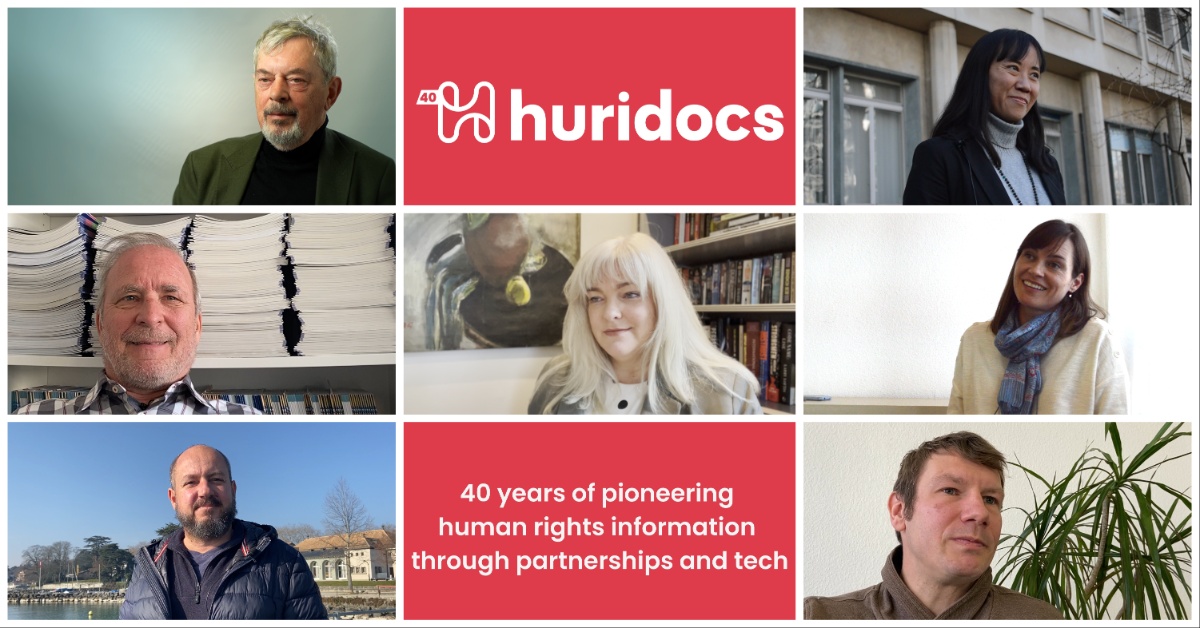
Join in exploring the vital role the NGO HURIDOCS plays in shaping the landscape of human rights today. Hear from past and present directors, board chair and senior documentalist about our ongoing impact (admittedly including my good self).
As HURIDOCS celebrates 40 years of commitment to human rights, it shared a video which is not only a retrospective, but a testament to its ongoing role and impact in the world of human rights information.
In this video, the HURIDOCS team sat down with individuals who have been instrumental in shaping HURIDOCS throughout its history. This includes our co-founder, our senior documentalist, a dedicated board member, and past and present directors, all sharing their unique insights.
“Information has always been the key to human rights work and that is still the case. Being organised, sharp, learning from our history and not being afraid to go into the future fighting for truth, justice and human rights with all of the tools that are available to us. That is the civil society we want to see, that is the civil society we want to support!”
A new political space wanting to shape the future of Latin America was born in Mexico City on 1 November 2023. In an unprecedented meeting, more than 30 organisations, leaders and young people from Latin America gave life to the Free America Forum. A space to defend an agenda of Freedom and Democracy, as an alternative to the populism of the Puebla Group and the Sao Paulo Forum.
“Those of us who believe in the ideas of freedom and democracy are more and we are also better,” said Mexican Congresswoman Mariana Gómez del Campo, president of ODCA, when she opened the Free America Forum.
This group, together with political leaders from 18 Latin American countries, parliamentarians from Ukraine, Germany, the European Parliament, political representatives from the United States, civil society activists and human rights defenders, ratified their commitment to freedom and democracy.
The result of this first meeting was the signing of the Mexican declaration “For a Free America”, which alerts the world to authoritarianism and its consequences in the region, the need for respect for democratic principles such as free elections, the separation of powers, the need for independent justice, limits to the actions of those in power and respect for human rights.
As part of this declaration, the Free America Forum warns how the conditions of poverty and inequality have been “breeding grounds” for populist alternatives and how we must focus on “the integral development of the people”, guaranteeing a free and competitive economy. In the fight against organised crime, he called for the use of “the full force of the law and the rule of law”, rejecting “radically any negotiation and complicity with those who extort, steal, kidnap, murder and sow terror on the continent”.
In the face of human rights violations, they expressed their support and solidarity with the peoples of Cuba, Venezuela and Nicaragua as “sister nations that Bolivarian socialism has subjected to atrocious dictatorships and suffering”. The declaration also condemns the “unjustified aggression” of Vladimir Putin’s Russia against Ukraine.
This new space linking defenders of democracy around the world was created to counterbalance those who venerate and validate dictators and promote authoritarian narratives.
Ahead of the International Day to End Impunity for Crimes against Journalists on 2 November, and in the year that marks the 75th anniversary of the Universal Declaration of Human Rights, High Representative Josep Borrell and Vice-President Věra Jourová issued the following statement:
“In these difficult times, marred by wars*, conflict and terrorist acts, we recall and praise the essential role played by journalists and media workers in fighting for the truth and for human rights. Journalists contribute to counter disinformation and hate speech and to keep checks and balances on governments and public institutions. They shed light on war crimes and human rights violations, sometimes at the risk of their own lives.
We firmly condemn the killings, physical attacks, arbitrary detentions, online and offline intimidation, harassment, and surveillance, that journalists at times face while exercising their profession. Media worldwide continue to be raided or closed, and journalists are increasingly targeted by legislation that curtails freedom of expression, and by abusive litigation, thus limiting pluralism, editorial independence, and infringing freedom of expression.
…
The EU remains committed to support independent journalists and media workers everywhere. We will continue to mobilise all the diplomatic tools at our disposal to raise attention to individual cases of journalists in detention or at risk. We have also established ProtectDefenders.eu to provide journalists at high risk with physical and digital protection, legal support, and relocation.
Protecting journalists means protecting our own rights. Democracy cannot work without free and independent media. This is why the EU is also taking unprecedented steps at home to protect journalists.
We call on Member States to implement the Commission Recommendation on the safety of journalists. The proposal for a Media Freedom Act aims to safeguard their independence and media pluralism. The Commission also took action to fight strategic lawsuits against public participation, which put pressure on journalists and want to silence them. These legislative proposals should be adopted swiftly to improve the environment in which journalists and media operate and to set global standards. See also: https://humanrightsdefenders.blog/2023/07/02/eu-directives-for-slapps-and-media-freedom-being-weakened-european-parliament-should-come-to-the-rescue/
The European Union stands with journalists around the world who, each and every day, exercise their freedom of expression for the benefit of us all.”
On 1 November 2023 Erin Kilbride for Human Rights Watch wrote critically about a rather weird decision by the Swiss Government namely to suspend funding to 11 respected human rights organizations in Israel and Palestine.
The Swiss government says it plans to “carry out a fresh, in-depth analysis of all financial flows” and assess the “relevance and feasibility of programmes.” Earlier this month, European governments suspended more than $150 million in development aid, as Israel cutaccess to food, water, electricity, fuel, and medicines to more than 2.2 million people in Gaza, an act of collective punishment, which is a war crime under international humanitarian law.
The affected groups are: Adalah; Al-Shabaka; Gisha; 7amleh; Hamoked; Jerusalem Legal Aid and Human Rights Centre; MIFTAH: The Palestinian Initiative for the Promotion of Global Dialogue and Democracy; Palestinian Center for Human Rights; the Palestinian NGO Network; Physicians for Human Rights, and Women’s Center for Legal Aid and Counselling.
The West Bank, home to several organizations whose funding has been suspended, has seen a significant spike in Palestinians killed or held in administrative detention without charge or trial.
International support for local human rights defenders is a clear way to support protecting rights, documenting atrocities, and securing justice.
The Swiss guidelines instruct representatives to support defenders’ security through media work, emergency protection programs, and pushing for investigations into attacks. The EU Guidelines provide, “the EU’s objective is to influence third countries to carry out their obligations to respect the rights of human rights defenders and to protect them from attacks and threats.”
Today, the work of Israeli and Palestinian human rights defenders is more critical than ever. Instead of leaving them in limbo, the Swiss government should maintain its funding of defenders while it conducts its review.
Amnesty International launched its flagship Write for Rights campaign to help people facing human rights abuses around the world. Millions of letters and emails will be sent to support these individuals and urge authorities to end injustices. ‘While sending a letter may seem like a small gesture for any single one of us, the collective action of many of us has the potential to transform lives’ said Sacha Deshmukh, Chief Executive of Amnesty International UK.
Taking place across November and December, Write for Rights will see people around the world send millions of cards, emails and social media posts of solidarity to individuals whose fundamental rights are being threatened or denied, while urging those in power to put a halt to the abuses.
This year, the global Write for Rights campaign will focus on 10 cases of individuals and communities from across the world who are facing human rights violations, including:
Rocky Myers, a Black man, has been on death row in Alabama, USA, since 1994. A nearly all-white jury convicted and sentenced him to life without the possibility of parole for the murder of his white neighbour. The trial judge overrode their decision and imposed a death sentence – a practice now outlawed in Alabama. No evidence linked Rocky to the murder, except for a VCR stolen from the victim, which he maintains he had found abandoned in the street. In 2018, Rocky and others on death row were given 30 days to choose if they wanted to die by nitrogen gas asphyxiation or by amended lethal injection protocols. Rocky chose the former, and his execution could be reset as soon as the new protocol for execution by nitrogen gas asphyxiation is finalised and ready to be implemented, which is expected by the end of this year.
Rita Karasartova, a Kyrgyzstan-based human rights defender who works for the Institute of Civic Analysis – a human rights organisation and think-tank. Rita was arrested in October 2022 for joining group of activists who objected to a border demarcation agreement with Uzbekistan. After the group called for a public assembly and formed a committee to oppose the agreement, Rita and others were charged with attempting to violently overthrow the government, which carries a maximum sentence of 15 years imprisonment. Rita is now under house arrest and a strict curfew.
Ahmed Mansoor is a human rights defender and previously won the prestigious Martin Ennals Award for Human Rights Defenders in 2015. Ahmed has documented human rights abuses in the UAE since 2006, until he was arrested in early 2011 and March 2017, he was given a 10-year prison sentence. He has been held in solitary confinement since the beginning of his detention, and continues to be denied a mattress, access to books, and to be permitted to go out in a yard. See: https://humanrightsdefenders.blog/tag/ahmed-mansoor/ and https://www.trueheroesfilms.org/thedigest/laureates/074ACCD4-A327-4A21-B056-440C4C378A1A]
Justyna Wydrzyńska is a reproductive rights defender in Poland and is one of the co-founders of the Abortion Dream Team, an activist collective campaigning against abortion stigma and offering advice on accessing safe abortion in Poland, where abortion laws are among the most restrictive in Europe. In March 2023 Justyna was convicted to 8 months’ community service for helping a pregnant woman to access abortion pills in Poland, setting a dangerous precedent in a country where abortion is almost completely banned.
Amnesty International’s Write for Rights campaign dates back to the origins of Amnesty International in 1961. In the organisation’s early days, Amnesty campaigners wrote letters of support to individuals facing human rights violations. Now, Write for Rights is Amnesty’s flagship campaign, running every year to raise awareness about individuals whose rights are being seriously threatened.
Last year’s Write for Rights saw:
Over 5.3 million actions worldwide – of which at least 234,801 letters and cards were solidarity actions.
Letters were sent from around the world, from Zimbabwe to Hong Kong.
Amnesty’s International Secretariat digitally collected almost double the number of digital actions from 2021.
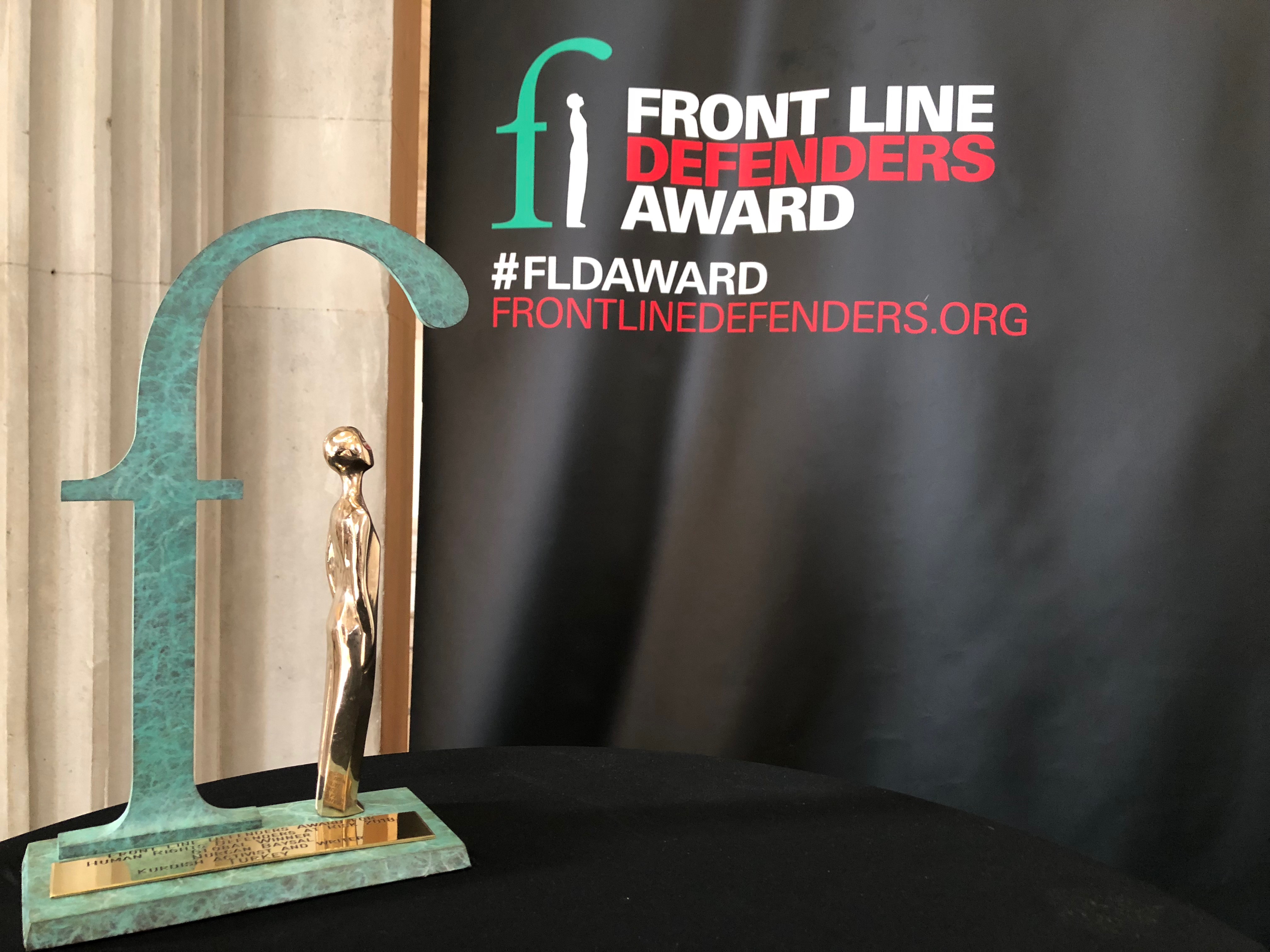
For each region of the world (Africa; Americas; Asia-Pacific; Europe & Central Asia; and Middle East & North Africa) there will be one winner selected and Front Line Defenders will recognize all five as the 2024 Front Line Defenders Award Laureates.
The nomination process is open for anyone to submit a nomination of a human rights defender, collective, organisation or community working on any human rights issue and facing significant risk due to their work or operating in an environment that itself is characterised as insecure. The purpose of the Award is to give visibility to HRDs who are not normally acknowledged or recognised at the international level. At the same time, the Award should not bring additional risk for which the HRD is not prepared. In addition to the Award, winners will receive:
a modest financial prize;
a security grant to improve their security measures;
collaboration with Front Line Defenders for media work in recognition of the Award;
advocacy by Front Line Defenders related to the Award and the work of the winners;
an event co-organized by the HRD, local partners and Front Line Defenders to give visibility to the Award in the winners’ countries (as determined and guided by the winners);
the Global Laureates will attend a ceremony in Dublin at a date to be determined;
ongoing security consultation with Front Line Defenders
If you would like to nominate a HRD for the 2024 Front Line Defenders Award for Human Rights Defenders at Risk, please follow this link to the secure online nomination form.
On 24 October 2023, human rights group Crew Against Torture reported that the Chechen Authorities had held Crew Against Torture member and Chechen human rights defender Magomed Alamov, and issued death threats. The authorities also threatened Magomed Alamov by threatening his family’s safety.
Magomed Alamov returned to the Chechen Republic after accompanying a young woman, who was a survivor of domestic, violence from Russia’s North Caucasus on 5 October 2023. Since his return, his colleagues have not been able to reach him.
Magomed Alamov is a human rights defender and lawyer of Chechen origin. Up until very recently, he has collaborated with the human rights group Crew Against Torture; an informal union of Russian lawyers who, individually, continue the work they used to do as a Russian-based human rights organisation “Committee Against Torture” (CAT). Following the listing of CAT as a foreign agent by Russian authorities on 10 June 2022, the organisation was forced to close its doors. Established in 2000, CAT was a prominent human rights organisation in Russia, investigating allegations of torture by state agents and representing victims of torture in the court system, including at the European Court of Human Rights. Human rights defenders who used to work with CAT were regularly subjected to defamation campaigns, physical attacks, detentions, and judicial persecution because of their peaceful human rights work.
On 5 October 2023, at the request of the human rights organisation ‘North Caucasus: SOS’, Magomed Alamov accompanied a survivor of domestic violence from Ingushetia to a safehouse. On 11 October 2023, the human rights defender started to receive phone calls from the General Administration for Combating Extremism (Centre E). The caller demanded that Magomed Alamov present himself for questioning in relation to his involvement in the alleged disappearance of the aforementioned survivor. In the absence of a subpoena, the human rights defender refused to present himself.
On 13 October, Chechen law enforcement officers unlawfully detained the human rights defender’s brother, at the Special Police Regiment #2, where the authorities threatened him, and demanded him to get in touch with Magomed Alamov and to convince the human rights defender to return to the Chechen Republic. Fearing for his brother’s life, Magomed Alamov travelled to the Chechen Republic; his colleagues from Crew against Torture are unsure about his current whereabouts.
On 23 October2023, the survivor of domestic violence got in touch with her relatives in the Chechen Republic, and reported that Magomed Alamov was present at their house during the call. She reported that the human rights defender addressed her and said “I am at your house, surrounded by your relatives. My life and the life of my family is in danger. They gave me a week for you to return home. If you are not home in a week – they will kill me.” On 23 October 2023 the Crew against Torture filed complaints to the Ministry of Interior and to the Office of the Prosecutor General of the Russian Federation demanding protection for the human rights defender.
Front Line Defenders condemns the harassment and death threats against the human rigths defender and lawyer Magomed Alamov. The organisation believes he is being targeted for his peaceful and legitimate human rights work. Front Line Defenders reminds the Russian authorities that the Chechen Republic is a part of the Russian Federation, and calls upon them to end systemic harassment against human rights defenders in the North Caucasus. Front Line Defenders urges the Russian authorities to confirm the whereabouts of Magomed Alamov, and ensure his safety in the Chechen Republic, as well as elsewhere in the country.
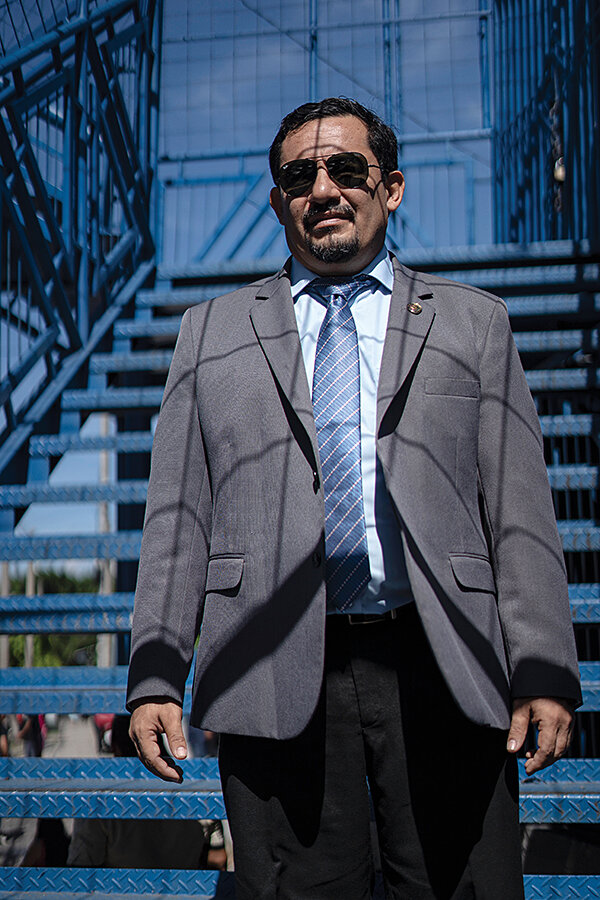
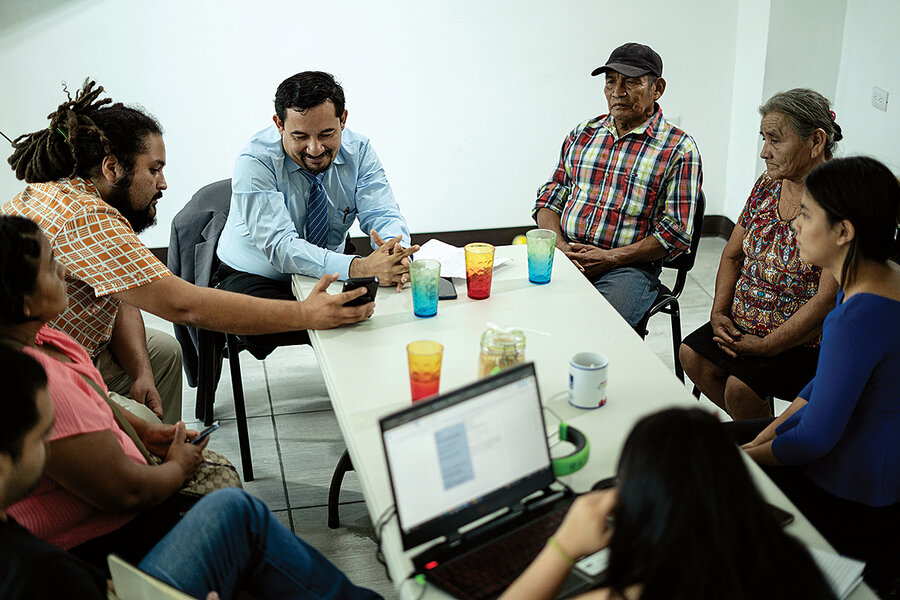
The Christian Science Monitor of 30 October 2023, tells the story of attorney Dennis Muñoz who seeks to uphold human rights in El Salvador, despite increasingly difficult and dangerous odds.
Víctor Peña/Special to The Christian Science Monitor
Mr. Muñoz found a way to channel his deep-seated desire for justice by becoming a lawyer in 2005. But he doesn’t work with just anyone – he goes for the tough cases of human rights abuses. He has defended multiple women who suffered miscarriages but were accused of murder in a nation where abortion is banned without exception. He has fought arbitrary arrests of environmentalists, activists, and average citizens. He could be called a defender of lost causes.
There’s no shortage of demand for Mr. Muñoz’s work in El Salvador, which has the highest incarceration rate in the world. And these days the risks of his work are almost as high as the demand for it.
In March 2022, a monthlong “state of exception” was enacted in response to extreme gang violence. The order suspended basic constitutional rights for those arrested under it. Securing a court warrant before searching private communications was no longer required, for example, and arrestees were barred from their right to a defense attorney and their right to see a judge within 72 hours.
But what started as an emergency measure has become ordinary practice. The state of exception has been extended every month for more than a year and a half now, with no end in sight. Violence has declined dramatically, but critics say the order’s extreme powers are seeping far beyond the gang-related arrests they were meant to address. Even those detained outside of the state-of- exception category are having their rights suspended.
That’s the group Mr. Muñoz focuses on. While he has taken a few state-of-exception cases, he primarily works on human rights violations, with the added burden now of his clients getting caught in the emergency order’s crosshairs. Despite death threats and intimidation, he’s not slowing down. Instead, fellow lawyers doing similarly risky work ask him to be on call if – or, perhaps more likely, when – they themselves are arrested.
… Despite quashing constitutional rights, the move has been overwhelmingly popular for providing a long-elusive sense of calm.
“A tired society, fed up with a lack of answers to the chronic problem of violence, is willing to accept short-term answers,” says Verónica Reyna, director of human rights for the Passionist Social Service, a nongovernmental organization focused on local violence prevention and support of human rights.
Gustavo Villatoro, minister of justice and public security, acknowledges that the state of exception is affecting more than gang members. Over 7,000 innocent people have been arrested, Mr. Villatoro said in August, noting that some degree of error is inevitable. But the consequences of those errors can be grave. Even if a case has nothing to do with gang activity, lawyers can be blocked from visiting their clients in detention, and court hearings can be suspended. Over 71,000 Salvadorans have been arrested under state-of-exception rules. With 6 million people in El Salvador, close to 2% of the adult population is currently behind bars. And many of them, even those not under the emergency order, lack access to a lawyer and may be tried en masse.
Margaret Satterthwaite, the United Nations special rapporteur on the independence of judges and lawyers, tweeted in May that in El Salvador, “public defenders reportedly have 3-4 minutes to present the cases of 400 to 500 detainees.” She warned that “fair trial rights must not be trampled in the name of public safety.”
In the last week of July, Salvadoran lawmakers eliminated a previous two-year limit on pretrial detentions and passed reforms to allow mass trials that could bring together 1,000 individuals in a single appearance before a judge.
“Maybe they won’t let us be lawyers anymore,” says Mr. Muñoz, “at least not private attorneys with independent criteria.”
“The reforms have disrupted the whole system and have turned innocence into an exception,” says Ursula Indacochea, program director at the Due Process of Law Foundation, based in Washington. “Presumption of innocence is disappearing because the roles have shifted. The state no longer has to prove I’m guilty, but now I’m guilty and have to prove I’m innocent,” Ms. Indacochea said in a Sept. 7 radio interview in El Salvador.
Of the 35,000 authorized lawyers registered in El Salvador, Mr. Muñoz stands out for almost exclusively taking cases of human rights violations.
“Things aren’t easy right now,” he says, describing the justice system as “made to convict.” The government is “criminalizing the job of lawyers,” he adds.
Yet Mr. Muñoz looked anything but cautious at a press conference in early July, where he was the only person wearing a suit at the San Salvador offices of the Christian Committee for Displaced People in El Salvador, a wartime human rights organization. He headed to the podium in the ample room, sparsely decorated with pictures of St. Óscar Romero, the archbishop of San Salvador murdered by right-wing death squads in 1980.
Mr. Muñoz discussed openly a forbidden topic. Five environmentalists were arrested in January over the alleged 1989 murder of a Salvadoran woman during the war. The case was under a court-issued gag order.
“It’s very serious that environmentalists are being unjustly accused, bending [what are considered] the rules of due process anywhere in the world,” Mr. Muñoz said, staring into the cameras.
His clients in this case are former guerrilla members, and two of the accused are part of the Association of Economic and Social Development Santa Marta, known as ADES. One of the country’s oldest environmental organizations, ADES was key in achieving the total ban on mining here in 2017. In a country where almost the entirety of war crimes remain unresolved and defendants in active cases are rarely imprisoned, the arrest of these men was an outlier, apparently due to their vocal criticism of the government. The U.N. called for the activists’ immediate release.
“Dare I say there are crimes being committed against these environmentalists,” Mr. Muñoz said before the media. “It’s nefarious that things like this happen in a country that calls itself democratic but really has a criminal injustice system in place.”
Víctor Peña/Special to The Christian Science Monitor
By late August, Mr. Muñoz had successfully convinced a judge to grant an order for his clients’ release. “It’s a crumb of justice, but we shouldn’t celebrate until there’s a dismissal of proceedings,” he said at a later press conference.
It’s hard to reconcile this image of seeming fearlessness with Mr. Muñoz’s request when the Monitor approached him for an interview: Could the piece leave out his last name? The question reflects a sense of fear that has built up over many years of doing this work.
Mr. Muñoz downplays receiving death threats, normalizing the culture of violence he’s lived under for most of his professional life. “They say they wish that I was extorted or killed because of the people I’ve defended,” he says about the social media threats. He thinks he’s been able to stay off the political radar by censoring his opinions. “I issue legal and technical opinions,” he explains. “Other colleagues have entered the political arena and expose themselves more to attacks.”
Matiullah Wesa, a girls’ education advocate, reads to students in the open area in Spin Boldak district in the southern Kandahar province of Afghanistan on May 21, 2022. Siddiqullah Khan/AP
On 26 October 2023 AP reported that the Taliban have freed an Afghan activist who campaigned for the education of girls. Matiullah Wesa was arrested seven months ago and spent 215 days in prison, according to the group, Pen Path.
The Special Rapporteur on Human Rights of the United Nations Human Rights Council, Rina Amiri,, has welcomed the release of Matiullah Wesa, the founder of the “Rah-e-Qalam” organization and an education activist, and has called for the freedom of all human rights defenders in Afghanistan. Richard Bennett, the Special Rapporteur on Human Rights of the United Nations, has requested the immediate and unconditional release of all individuals detained “arbitrarily for defending their rights and the rights of others.”
Ataullah Wesa, Matiullah’s brother, announced on his social media account that he had been released after 215 days. However, some human rights activists and well-known members of Afghan civil society remain in prison.
Amnesty International said that Wesa should never have been jailed for promoting girls’ rights to education.
“The Taliban de-facto authorities must release human rights defenders and women protesters Rasool Parsi, Neda Parwani, Zholia Parsi and Manizha Sediqi and all others who are unfairly kept behind bars for standing up for equality and denouncing repression,” the rights group tweeted.
In a letter addressed to the Sub-Committee on Accreditation (SCA) of the Global Alliance of National Human Rights Institutions (GANHRI), civil society organisations, including the FIDH and the World Organisation Against Torture (OMCT), warn that Bahrain and Egypt do not comply with the Paris Principles, failing to respect the very pillars of these principles: pluralism, independence and effectiveness.
The undersigned civil society organisations believe that the two countries’ NHRIs have failed to comply with the Paris Principles and to implement recommendations outlined by the SCA’s previous reports in 2016 and 2018, respectively.
The Paris Principles define the minimal standards that NHRIs must abide by “in order to be considered credible and to operate effectively.” The pillars of these principles are pluralism, independence and effectiveness. NHRIs must be independent from the government, represent and cooperate with civil society, and effectively promote human rights by monitoring violations and addressing them. Based on civil society reports, the Bahraini and Egyptian NHRIs fall short of these standards.
In Bahrain, all the current members of the National Institution for Human Rights (NIHR) were appointed by King Hamad through a royal decree issued on 9 May 2021, and there is no democratic or independant mechanism through which these selections are made. The current Chairman of the NIHR, Ali al-Derazi, was reportedly implicated in abuses against migrant workers. Furthermore, the Vice-Chairperson of the NIHR, Mr. Khaled Abdulaziz Alshaer had previously called on those who criticised the Bahraini government to receive the death penalty.
In August 2022, the UN Committee on Economic, Social and Cultural Rights concluded that “[the NIHR] has not yet attained the independence required to perform its functions.” Previously in 2018, the UN Human Rights Committee had expressed similar concern and “[regretted] the lack of information on the complaints [the NIHR] has received and the investigations it has carried out in response to those complaints.”
In addition, Bahrain’s NIHR fails to address and outright denies the human rights abuses committed by the authorities, including arbitrary detention, ill-treatment and medical negligence in various detention facilities. This contradicts the UN Working Group on Arbitrary Detention’s findings regarding Abduljalil al-Singace, Abdulhadi al-Khawaja and Naji Fateel, three Bahraini human rights defenders who were arbitrarily detained, tortured, medically neglected and subjected to sham trials. [see also: https://humanrightsdefenders.blog/tag/bahrain/]
As for the Egyptian National Council for Human Rights (NCHR), it also lacks independence from the government. In 2021, new members of the NCHR were appointed for four years. The Chair, Ms. Moushira Khattab, and the Vice-President, Mr. Mahmoud Karem Mahmoud are both former Egyptian officials and diplomats. In both 2014 and 2018, Mahmoud was the coordinator of al-Sisi’s presidential campaign, which clearly demonstrates the NCHR’s close relationship with the executive.
In March 2023, the UN Human Rights Committee had echoed these concerns over the “lack of safeguards to ensure [the NCHR’s] full independence and effectiveness”, as well as over “the lack of information provided on the effective implementation of its recommendations.”
The NCHR has left hundreds of complaints unanswered and blatantly denies that certain human rights abuses are being committed. In 2020, the Council stated that findings of the UN Committee against Torture, according to which torture was “systematic” in Egypt, were a “politicized categorization” seeking to “undermine the efforts of the government”. The NCHR has also remained silent on prominent human rights issues such as the practice of enforced disappearance or the dire conditions of detention. In July 2023, the Council’s president compared a new correctional facility in Wadi al-Natroun to a “5-star hotel”. We believe that the Egyptian NCHR is far from acting as a NHRI with “A” status, which it has worryingly been granted since 2006 by the SCA. [see also: https://humanrightsdefenders.blog/tag/egypt/]
In light of the above, it is clear that the NHRIs of Bahrain and Egypt have consistently failed to comply with the Paris Principles and to implement the SCA’s recommendations.
We urge you to consider the aforementioned shortcomings of Bahrain and Egypt’s NHRIs when reviewing them during your upcoming session, and to not grant them status “A”.
Signatories:
Bahrain Institute for Rights and Democracy (BIRD)
CIVICUS
Democracy for the Arab World Now (DAWN)
Egyptian Commission for Rights and Freedoms
Egyptian Front for Human Rights (EFHR)
El Nadeem against Violence and Torture
Human Rights Foundation (HRF)
HuMENA for Human Rights and Civic Engagement
International Federation for Human Rights (FIDH) – within the framework of the Observatory for the Protection of Human Rights Defenders
International Service for Human Rights (ISHR)
Law and Democracy Support Foundation (LDSF)
MENA Rights Group
Rights Realization Centre (UK)
Salam for Democracy and Human Rights (SALAM DHR)
The #FreeAlKhawaja Campaign
The Freedom Initiative (FI)
World Organisation Against Torture (OMCT) – within the framework of the Observatory for the Protection of Human Rights Defenders


 Hans Thoolen on Human Rights Defenders and their awards