Author Archive

Arsenal and Chelsea are not the only ones strugggling in Azerbaijan on 29 May

May 23, 2019

Baku’s Olympic Stadium is hosting the Europa League final between Arsenal and Chelsea Wednesday 29 May 2019 and is also the venue for four games in next year’s European Championship. I will certinaly watch the match but will keep in mind Amnesty International’s warning that we should not let Azerbaijan hide human rights abuses behind football.  Sports washing is a phenomenon that deserves more attention, see e.g.:

https://humanrightsdefenders.blog/2019/02/01/sports-and-human-rights-focus-on-sports-washing-big-names-play-for-big-money/

https://humanrightsdefenders.blog/2019/05/22/andrew-anderson-the-dangerous-game-of-sportswashing/

https://humanrightsdefenders.blog/2018/12/03/fifas-second-report-on-human-rights-misses-sustainable-approach/

https://humanrightsdefenders.blog/tag/sports-and-rights-alliance/

The decision to stage the Europa League final in Baku has drawn criticism from fans and human rights groups.
The decision to stage the Europa League final in Baku has drawn criticism from fans and human rights groups. Photograph: Robert Prezioso/Getty Images

We must ensure that Azerbaijan isn’t allowed to sportswash its appalling human rights record as a result of the football fanfare,” Amnesty International’s UK director, Kate Allen, said. “Azerbaijan is in the grip of a sinister human rights crackdown, with journalists, bloggers and human rights defenders being ruthlessly targeted. Unfair trials and smear campaigns remain commonplace.

LGBTI people have been arrested, and even people fleeing the country have been harassed and pressured to return. Fans, players and backroom staff can help prevent Azerbaijan’s likely attempt to sportswash its image by informing themselves about the human rights situation behind the glitzy facade of Wednesday’s match….All too often, governments are using high-profile sporting competitions to distract attention from repressive policies and human rights violations, to instead project an image of openness. This couldn’t be further from the truth with the current administration, and the Arsenal-Chelsea clash is just the latest reminder of this.”

https://www.theguardian.com/football/2019/may/22/amnesty-international-azerbaijan-human-rights-football

Profile of Sri Lankan Marini de Livera: a lawyer and a ‘Woman Of Courage’

May 23, 2019

REBECCA ELLIS published a profile of Marini de Livera under the title “She’s A Lawyer … A Thespian … And Now A State Department ‘Woman Of Courage‘”

Marini de Livera’s plays are not for the faint of heart. In her home country of Sri Lanka, the pro bono lawyer has found that crimes against women and children often take place behind closed doors — in homes, orphanages and schools. With her traveling theater group, de Livera seeks to shed light on the human rights abuses in her country by putting the violence on stage, front and center. “There are beautiful laws in the law books,” she says. “But when I went out to the slums, to the rural areas, to conflict-ridden areas, I found what is in the law books is not a practical reality.”

A pro bono attorney with a degree in speech and drama from Trinity College London, de Livera has spent her career using theater to ensure that the lofty lessons she learned in law school can be used to assist Sri Lankans who are unlikely to ever see an attorney. Her dedication to helping women and child victims of crime has made her one of the 10 recipients of the 2019 International Women of Courage award [see https://humanrightsdefenders.blog/2019/03/11/international-women-of-courage-awards-2019-given-out-at-the-us-state-department/ and https://humanrightsdefenders.blog/2019/03/12/one-journalist-who-did-not-get-the-women-of-courage-award-but-almost/].

De Livera has served as the chairperson of Sri Lanka’s child welfare agency, the National Child Protection Authority, and now runs Sisters at Law, an advocacy group for impoverished women and children. She spoke with NPR about her creative approach to addressing human rights in her country, and why she’s focusing on using her theater training to better the situation of children in Sri Lanka’s orphanages.

What are some of the legal issues that women and children in Sri Lanka need help with?

Women and children are denied justice if they’re uneducated, and if they live in rural areas. They don’t enjoy the same basket of human rights that privileged people have because they don’t have access to lawyers.

What needs to happen to accomplish that?

There has to be legal literacy. These women and children have to know what the laws in the country are and what their human rights are. If they are educated about their rights, they can go to court and demand them.

You’ve often used theater to promote this legal literacy in Sri Lanka. Can you give me an example of how this works?

One of my favorite plays I put on was about corporal punishment. I went to a Catholic school where a priest was hitting boys every day. I explained to the school that there are different forms of violence – cultural violence, psychological violence, physical violence. Then I asked the boys to make a play about their experiences with violence. And one of the boys reenacted what the priest had done to him. [It helped] these boys find an outlet to say, “We don’t want to kneel down when we come late to school. We don’t want to be beaten by a cane.”

How did you come to see theater as a way to educate the public on their legal rights?

I had been a lecturer in law [in Sri Lanka], and one of the things I had to teach was U.K. law principles. And the students were bored to death. So I said, these are the books, you read, then you tell me what the rule of law and separation of powers are through a performance. I realized if I could use this in the classroom, why not in the village to simplify the law?

What is your theater group working on now?

I’m working on a street theater [program] to create awareness for parents [and encourage them] not to send their children to orphanages. I’m going to show that family is the place for the child. In Sri Lanka, we have a lot of “social orphans” where they have both parents, but the children are suffering in orphanages.

Past reports have found that over 80 percent of the 20,000 children in Sri Lanka’s child-care institutions, including orphanages, have at least one parent. These parents are often unable to provide for their children or the child has a disability and requires extra care. And sometimes the children are sent to such an institution because of a criminal offense.

Orphanages should be the last resort. So I’m promoting alternative care. Some of the mothers are capable of looking after their children, but they’ve handed over their child to an overcrowded orphanage. I’m thinking of giving parenting skills training to these mothers and economically empowering them, finding them a nice home and settling the children with them.

You mentioned earlier that this prize is the first time in your life you felt appreciated for “walking in the opposite direction” from others in the law profession. Do you have hopes other attorneys will follow in your path?

I’m very unhappy to say each time I go to court people come up to me like a swarm of flies and say, “We don’t have a lawyer to appear on behalf of us.” I want to take all the country’s young attorneys and train them to be another Marini – to clone myself. Because I have to hand this on to the younger generation.

https://www.npr.org/sections/goatsandsoda/2019/03/08/701212104/shes-a-lawyer-a-thespian-and-now-a-state-department-woman-of-courage

Misconceptions about indigenous peoples and their defenders explained

May 22, 2019

In a piece of 21 May 2019, called “4 common misconceptions about indigenous peoples and local communities explained”, Lai Sanders of the Rights and Resources Initiative points to common misconceptions re indigenous peoples who have a ‘juggernaut role’ in the global fight against climate change. Why are they conspicuously absent from many national and international agendas, as well as from societal discourse at large? At the recent UN Permanent Forum on Indigenous Issues in New York, six indigenous activists and leaders from across the world spoke to the often unrecognized and under-appreciated contributions made by their communities for the betterment of society, and to address some of the most widespread and harmful misconceptions about Indigenous Peoples and local communities. The following interviews (excerpts) come with beautiful portrait pictures.

..

Indigenous Peoples and local communities customarily own over 50 percent of the world’s land, yet only have secure legal rights to 10 percent. “One of the most generalized misconceptions is that society, especially decision-makers, sees us as a people almost without rights,” says Levi Sucre, head of the Mesoamerican Alliance of Peoples and Forests (AMPB) and an indigenous native of Costa Rica

Rayanne Maximo Franca. Photo: Rights and Resources Initiative

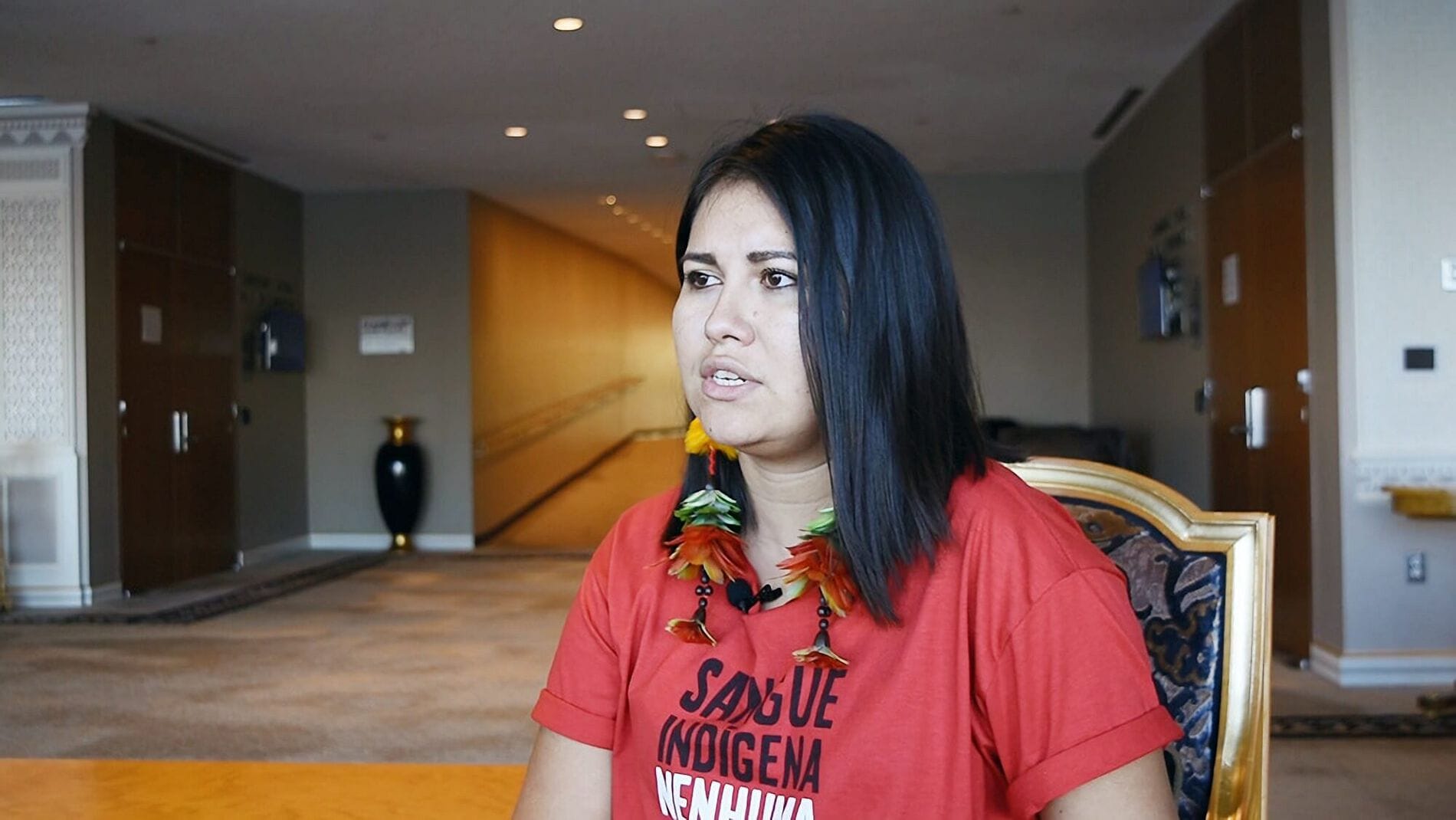
Rayanne Maximo Franca left her community at 17 to attend college in Brasilia, where she was one of a handful of indigenous students. Now 27, she is a seasoned organizer with the Indigenous Youth Network of Brazil and a representative of the Global Indigenous Youth Caucus. “Every day, being indigenous in a society that is so prejudiced, so racist, so discriminatory,” she says, “the fact that people affirm themselves as indigenous—in the society we live in today—is already an act of activism. It is already an act of self-defense.”

For Emberá activist Dayana Urzola Domicó, youth coordinator for the National Indigenous Organization of Colombia (ONIC) the erasure of indigenous identities and narratives from mainstream culture is also a major issue. “… we are not those Indigenous Peoples who look beautiful in museums. We are not of the past. All those things that are articulated in the care of Mother Earth, of you as a person, your territory, your thought, your law of origin—those things are still alive. We are still here.

Hindou Oumarou Ibrahim, coordinator of the Indigenous Women and Peoples Association of Chad describes how Mbororo pastoralist communities, who are indigenous to Chad, use their nomadic lifestyles to conserve the natural environment: “We use one place to stay for two days, and another place for three days. That allows the natural resources to get regenerated in the natural way.”

Joan Carling, co-convener of the Indigenous Peoples Major Group for Sustainable Development, grew up in the mountains of the Philippines’ Cordillera region, where she spent her childhood playing in the forests. An indigenous Kankanaey, she has fought at the forefront of environmental justice for two decades. “Indigenous Peoples have been engaging in the climate change process because we believe we have something to contribute,” she says. “We have the solutions. We have the resilience. We have the knowledge that has been accumulated through time. Our elders know how to read the rivers, the behavior of animals. They use this to predict what’s happening in the environment.”

This traditional knowledge, explains Maximo Franca, is what has kept the world’s remaining forests standing. “It maintains biodiversity, it maintains the fauna, the flora, the animals… everything that the nature has, we are maintaining. And we are countering climate change.

..The struggle to dispel a particularly harmful narrative—that Indigenous Peoples are blindly opposed to development projects, or an impediment to economic progress—is a universal one. “The biggest misconception about Indigenous Peoples is that we are anti-development,” says Carling. “That comes from the western view of development, that mining, dams, agribusiness are good for the people. But look: It has caused a lot of inequality. It is unsustainable. It has severely destroyed nature. It has severely polluted our lands and resources.

…Echoes Sucre on environmentally destructive projects: “In the short term, it looks like a development; but in the medium and long term, it will be the destruction of humanity.”

2017 and 2018 have been among the deadliest years on record for environmental defenders, particularly indigenous and community activists, who are increasingly being targeted, harassed, criminalized, and even murdered for defending their lands from exploitation. “They are not fighting for their ego, or to get economic benefits,” says Ibrahim. “They are fighting for the identity, the survival of the peoples—the protection of the planet.

For Rukka Sombolinggi, the head of AMAN, the largest indigenous organization in Indonesia and the world, learning about the struggles of indigenous communities outside her own was like “baptism by fire,” she recalls. “Twenty years ago, I realized that Indigenous Peoples were facing criminalization. Land grabbings were happening everywhere. The eviction of Indigenous Peoples—from protected areas, from national parks, from protected forests, from wildlife sanctuaries—took place in Indonesia. Today, that is still happening.”

For Carling, the issue of criminalization is deeply personal: less than a year ago, she was falsely labeled a terrorist by the Philippine government alongside hundreds of other human rights activists. Though her name was later struck from the list, the threat remains.

….

Increasingly, governments, multilateral institutions, and other important stakeholders are heeding the urgent call to action to protect those who defend the world’s forests and lands. New campaigns, projects, and funds are underway to support initiatives to strengthen Indigenous Peoples’ and local communities’ rights to their lands. And the next generation of young indigenous leaders is joining the fight: “In Colombia, there is so much conflict that you have two options,” says Urzola Domicó. “One is that they kill your family and you are left without anything, and you die with your family. And the other option is that you go out and see how to defend your people, your nation.”

Human Rights Foundation announces its first 10 Freedom Fellows

May 22, 2019

Yesterday I referred to the new look of the Human Rights Foundation [https://humanrightsdefenders.blog/2019/05/21/human-rights-foundation-uses-2019-oslo-freedom-forum-for-rebranding/], here is a substantive new proframme. On 21 May 2019 the Human Rights Foundation (HRF) announced the creation of the Freedom Fellowship, a program that awards 10 human rights defenders, social entrepreneurs and non-profit leaders from authoritarian countries around the world with the unique opportunity to increase the impact of their work. HRF is partnering with the Center for Applied Nonviolent Tactics and Strategies (CANVAS), founded by Srdja Popovic. The fellows will work with HRF staff and a team of specialists to improve leadership, movement building, fundraising, marketing, and digital security.
The first ‘class’ comprises:

  • Rania Aziz , Sudanese activist organizing professional and youth groups in the country against the dictatorship of Omar Hassan Ahmad al-Bashir. She is part of the Sudanese Professionals Association (SPA), an outlawed group of unions currently leading protests in the country.
  • Fred Bauma. Congolese human rights activist also known as “Congo’s Gandhi”. He is the leader of the pro-democracy youth group LUCHA, which advocates for nonviolent, community-level change and governmental reform in the Democratic Republic of the Congo.[ see also: https://humanrightsdefenders.blog/2015/11/30/amnesty-internationals-annual-write-for-rights-campaign-focuses-on-freedom-of-expression/]
  • Vanessa Berhe, Eritrean free-speech and democracy activist. She is the founder of One Day Seyoum, a human rights organization that campaigns for the release of jailed Eritrean journalist Seyoum Tsehaye, and raises awareness around a continued crackdown on democratic ideals in Eritrea.
  • Andrei Bystrov, lawyer, historian and democratic activist from Moscow. He is a co-founder of the December 5 Party, a pro-democracy political party that was born out of the 2011 anti-Putin protests.
  • Netiwit Chotiphatphaisal is a student activist, publisher, and author who advocates for education reform in Thailand. He founded Education for Liberation of Siam, a student group that challenges the Thai military junta’s unjust actions in the country’s education system.
  • Rodrigo Diamanti, Venezuelan human rights activist and nonviolence expert. He founded the international NGO, Un Mundo Sin Mordaza, which has coordinated creative protests against Nicolas Maduro’s dictatorship in more than 52 countries.
  • Edipcia Dubón, Nicaraguan pro-democracy and women’s rights advocate. She is the coordinator of Dialogue of Women for Democracy, a think tank that promotes open discussions about the challenges faced by women in Nicaragua.
  • Asma Khalifa, Libyan activist and researcher who has worked on human rights, women’s rights, and youth empowerment since 2011. She is the co-founder of Tamazight Women’s Movement, an organization working on gender equality and research on the indigenous women of Libya and North Africa.
  • Farida Nabourema, Togolese writer and democracy activist who began her career in activism when she was 13 years old. She co-founded the Faure Must Go movement, a hallmark of the Togolese struggle against Faure Gnassingbé’s oppressive rule.
  • Johnson Yeung, Hong Kong human rights advocate who works on freedom of assembly and expression, protection to HRDs, and capacity building to right-based CSOs. He is the chair of the board of the Hong Kong Civil Hub, which produces regular briefings on Hong Kong shrinking civic space, and builds solidarity around international rule of law and human rights communities.


In partnership with CANVAS, HRF launched the Freedom Fellowship in 2018 with a pilot opportunity for Jhanisse Vaca Daza, a civil society activist from Bolivia. During her Freedom Fellowship experience, Vaca Daza co-founded the Bolivian movement: Ríos de Pie (Standing Rivers), which has quickly gained a national following, becoming one of the leading nonviolent resistance movements in response to Evo Morales’ authoritarian regime. Vaca Daza will provide her insights from the past year as the manager for the Fellowship. “This is a truly diverse class of fellows, and they are going to learn as much from each other as from their mentors,” said Vaca Daza. “Anyone running a non-profit or civil society organization or start-up needs help and guidance with personal leadership, movement building, marketing and media strategy, fundraising, and digital security. My own experience was transformative, and I’m looking forward to bringing world-class expertise in each of these areas to 10 new Fellows.”

The Fellows will meet one another as a group for the first time at this year’s Oslo Freedom Forum, which will be held from 27-29 May in Norway. There will be special programming curated to begin their Freedom Fellowship experience starting May 25. If you would like more information about the program, please contact: jhanisse@hrf.org.

Home

Andrew Anderson: “The Dangerous Game of Sportswashing”

May 22, 2019
On 26 April 2019 Andrew Anderson of Front Line Defenders did – rightly – not mince his words in a piece drawing attention to the growing phenomenon of sports washing. In February 2019 I drew already attention to this in a post: https://humanrightsdefenders.blog/2019/02/01/sports-and-human-rights-focus-on-sports-washing-big-names-play-for-big-money/.

Anderson’s “Gloss, Not Glory: The Dangerous Game of Sportswashing” says it more eloquently:

Brutal and corrupt dictatorships trying to use sport to improve their image is nothing new, as The Guardian noted in February when it compared club ownership and the Champions League to Mussolini and the 1934 World Cup. However, the absurd news that the Dakar Rally will take place in Saudi Arabia in 2020 – compounded by reports that an offer is under consideration to bring the Spanish Super Cup to the same country in a €30 million per year, 6-year deal- brings blood drenched sportswashing to new depths.


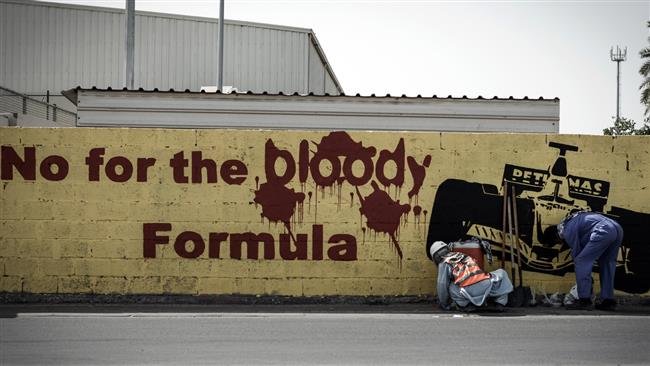
Protest graffitti against the Formula One race in Bahrain.

As the International Federation for Human Rights reported the Dakar Rally announcement comes not only in the wake of the murder of journalist Jamal Kashoggi and amidst Saudi war crimes in Yemen, but as women human rights defenders are being tortured in detention for campaigning, amongst other things, for the right of women to drive. The same Saudi rulers who order the killings and torture are seeking to buy positive coverage through sport. “The same Saudi rulers who order the killings and torture are seeking to buy positive coverage through sport.”

As someone who was at Wembley in 1992 to see Barcelona lift their first European Cup, it is particularly galling to contemplate the Cruyff-inspired masters of the beautiful game being dragged into the sportswashing of Mohammad bin Salman. The Barcelona slogan is “More Than a Club” and is explicitly linked to both values and social change. It is difficult to reconcile these noble aspirations with a PR exercise for a misogynist regime, itself the antithesis of those values.

We are, of course, already far down the slippery slope. The rulers of the UAE have also long-used sport as part of their self-promotion. The owners of Manchester City and the sponsors of Real Madrid are similarly involved in war crimes in Yemen, and routinely detain and torture those who dare to speak out for human rights. Ahmed Mansoor, winner of the Martin Ennals Prize in 2015 for his peaceful work for human rights, is currently on hunger strike in protest against prison conditions and his sentencing to 10 years in prison after an unfair trial. Front Line Defenders is gravely concerned for his health and is calling for his release.

Sunday, 28th April, Formula One will hold the Azerbaijan Grand Prix in Baku. The Azeri dictator, Ilham Aliyev, who routinely detains human rights defenders and journalists, is also President of the country’s Olympic committee. He has embraced sportswashing enthusiastically. Azerbaijan hosted the European Games in 2015 under the auspices of the European Olympic Committees. The 2019 European Games are to be in Belarus. The Formula One calendar also includes Bahrain, Abu Dhabi (UAE) and China, all countries where Front Line Defenders is campaigning for the release of unjustly detained human rights defenders.


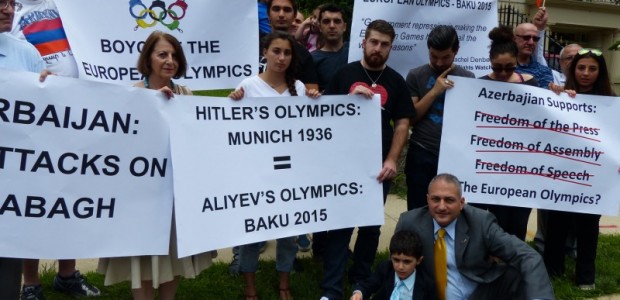
Protest against first European Games in Baku in 2015.

Many sports fans will shrug their shoulders and say that money is awash in international sport, and what can you do? The International Olympic Committee and football’s world governing body FIFA have been mired in corruption scandals and the use of international sporting events and national Olympic committees have long been seen by dictators, authoritarians and fascists as tools for advancing propaganda. But it is surely time to draw a line in the sand, and where better to do it than Saudi Arabia? The Dakar Rally should not take place there while women human rights defenders like Lujain Al-Hathloul are detained and tortured. And the Spanish Football authorities must reject the proposed Saudi deal in spite of the vast sums of money on the table.

Sportswashing is more than a game, it is a corrupt exercise of cover-up and repression. And sport must reject the tyrants.

https://www.frontlinedefenders.org/en/blog/post/gloss-not-glory-dangerous-game-sportswashing

Five Laureates of the Right Livelihood Foundation speak about woman human rights defenders

May 22, 2019

On 6 March 2019, two days before international women’s day, the Right Livelihood Award Foundation brought together 5 women Laureates from around the world to discuss ‘local realities and shared global challenges’ facing Women Human Rights Defenders. The side event, organised in parallel to the Human Rights Council’s fortieth session, was co-sponsored by CIVICUS, Human Rights House Foundation, International Network for Human Rights, and supported by the International Platform against impunity and the International Dalit Solidarity Network.

P2980249

Fabiana Leibl, Sima Samar, Mozn Hassan, Helen Mack Chang, Ruth Manorama, and Charlotte Dos Santos Pruth. Photo by: Amy Au

Here are a few takeaways from the discussion:

Fabiana Leibl, Head of Protection and Advocacy at the Right Livelihood Award Foundation, opened the meeting by describing the worsening trend for women human rights defenders who are prevented from working, not only because they are advocating for human rights, but also because they are women. As the Special Rapporteur on Human Rights Defenders noted in his recent report, this trend is often fuelled by deeply rooted ideas about ‘who women are, and who they should be’. Nahla Haidar, a member of the Committee on the Elimination of Discrimination against Women, remarked that women are frequently ‘targeted with charges of counter-terrorism’, which allows their oppressors to act with impunity.

Sima Samar, Chair of the Afghanistan Independent Human Rights Commission and a leading women human rights defender in Afghanistan, emphasised that achieving parity in educating people of all genders was a key starting point. As we approach the 70th anniversary of the Universal Declaration of Human Rights, she explained, “we need female human rights defenders in order to really change the environment on the ground, and to make the environment conducive for the women to exercise their basic human rights.” She called for an end to the misuse and misappropriation of culture, tradition, and religion as justifications for male dominance. Access to paid work, reproductive services, and justice mechanisms was also identified as crucial in the struggle for gender equality. Samar received the Right Livelihood Award in 2012 “for her longstanding and courageous dedication to human rights, especially the rights of women, in one of the most complex and dangerous regions in the world.” See also: https://humanrightsdefenders.blog/2018/08/31/major-piece-by-departing-high-commissioner-in-the-economist/ 

Mozn Hassan, founder of Nazra for Feminist studies, is one of the defendants in the well-known NGO Foreign Funding case targeting civil society organisations in Egypt. Her career’s focus on sexual and reproductive rights adds additional restrictions to her work. In July 2018, she was charged with, among other things, establishing an entity in violation of the law and receiving foreign funding with the intention of harming national security. The charges – which are clearly politically motivated – could lead to life imprisonment. Hassan could not attend the event due to a travel ban imposed by the Egyptian government since 2016. However, via video message, she conveyed the serious dangers for human rights defenders, ranging from asset freezing to arrests, arbitrary detention and forced disappearances. On top of this, women must confront gender-specific threats from state and non-state actors. As Mozn noted, “women are facing various gender-based violence in their custodies from harassment to threats of rape.” Mozn Hassan received the Right Livelihood Award together with Nazra in 2016 “for asserting the equality and rights of women in circumstances where they are subject to ongoing violence, abuse and discrimination.” See also: https://humanrightsdefenders.blog/2017/02/02/right-livelihood-has-to-go-to-egypt-to-hand-mozn-hassan-her-2016-award/

Helen Mack Chang, who has persistently sought justice and an end to impunity in Guatemala as head of the Myrna Mack Foundation, emphasised that women often suffer multiple dimensions of discrimination. Indigenous women, for instance, “suffer double discrimination (…) when defending their land or territory against the claims of international corporations.” She noted that recent years have seen a resurgence of conservatism and of global threats to the rule of law and democracy. Corruption and impunity, she stressed, go to the heart of this challenge, in Guatemala and elsewhere. Helen Mack Chang received the Right Livelihood Award in 1992 “for her personal courage and persistence in seeking justice and an end to the impunity of political murderers.

Ruth Manorama is India’s most effective organiser of, and advocate for, Dalit women, belonging to the “scheduled castes” sometimes also called “untouchables.” She is, among other things, President of the National Alliance of Women (NAWO) and National Convenor to the National Federation of Dalit Women. Ruth called for counter-narratives to combat the negative view of human rights defenders in the media. In India, for instance, activists are routinely called “enemies of the State,” “militants,” “anti-nationals,” “traitors,” and “terrorists.” She stated: “I am a patriot. I am an Indian citizen. I must enjoy my constitutional rights. (…) Protecting human rights defenders is a state obligation.” Dalit women are particularly vulnerable to systematic sexual abuse at work, forced sexual slavery such as the Devadasi system, and forced labour. Manorama received the Right Livelihood Award in 2006 “for her commitment over decades to achieving equality for Dalit women, building effective and committed women’s organisations and working for their rights at national and international levels.” See also: https://humanrightsdefenders.blog/2016/11/07/forum-asia-25th-anniversary-event-in-geneva-on-16-november-2016/

Charlotte Dos Santos Pruth is an Advocacy and Policy Advisor at Kvinna till Kvinna, a Swedish organisation working to strengthen and promote women’s organisations in several regions of the world. She presented the findings of their recent report, “Suffocating the movement – shrinking space for women’s rights”, which identifies the main effects of shrinking civic space for women. “A strong feminist movement is the single most important factor to advance women’s rights and gender equality”, she stated, adding that women often have limited access to formal decision-making processes. “This makes defending civil society space particularly crucial”, Dos Santos Pruth continued by saying. She suggested that addressing the lack of funding for women’s organisations would be an important first step.

The speakers brought together experiences from very different cultural contexts. Nevertheless, there were important parallels in their descriptions of defending human rights on the ground. The panellists all showed that the crackdown on women human rights defenders must be viewed within the context of other global trends including growing material inequality, counter-terrorism, corporate impunity, environmental degradation, and corruption. As Sima Samar pointed out, in this worrying global landscape, international solidarity must remain an important principle. In her words: “We don’t only need women in positions of power, we need feminist women; women who don’t support male domination in order to keep their own space and position”.

rewatch the event:


Lawyers for Lawyers: award to Turkish human rights defender Selçuk Kozağaçlı on 23 May

May 21, 2019

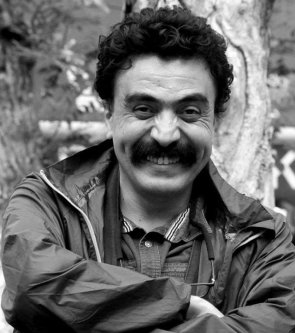
On 23 May 2019, L4L will be presenting the 2019 Lawyers for Lawyers Award to Selçuk Kozağaçlı, a human rights lawyer from Turkey. Selçuk Kozağaçlı is a lawyer, human rights defender and member of the People’s Law Office. He is well known for working on the “Soma Mine” disaster, the worst mine disaster in Turkey’s history, in which 301 miners were killed. He is also the chair of the Progressive Lawyers’ Association (ÇHD), an association which focuses on the right to life and advocates for the prevention of all types of attack on fundamental rights and human dignity. The Progressive Lawyers’ Association was closed on 22 November 2016 by Statutory Decree No. 677 issued under the State of Emergency.

Fore more on this award and other awards for human rights lawyers, see: http://www.trueheroesfilms.org/thedigest/awards/lawyers-for-lawyers.

The Award Ceremony will take place in Amsterdam. Prior to this ceremony an interesting seminar will be held in collaboration with the Amsterdam Bar Association and the Justitia Commission of the Young Lawyers Association Amsterdam. The main topic of the seminar will concern the developments surrounding the proposed European Convention on the Profession of Lawyers. Two panel discussions will be organized around this topic. Speakers include François Moyse (Vice-Chair of the CCBE European Convention Working Group), Mikolaj Pietrzak (president of the Warsaw Bar Association) and former Award winners and lawyers Sirikan ‘June’ Charoensiri (Thailand), Magamed Abubakarov (the Russian Federation) and Alec Muchadehama (Zimbabwe).

From 2:30 PM until 5:00 PM CEST L4L will livestream PART I with the seminar ‘Lawyers at risk! Do we need a European Convention?’ It will continue the broadcast with PART II from 5:00 PM until 5:30 PM CEST with the Award CeremonyTo watch online, please click on the following link: https://www.youtube.com/user/LawyersforLawyersL4L/live


Invitation Lawyers for Lawyers Award Ceremony 2019

https://www.frontlinedefenders.org/en/case/selcuk-kozagacli-detained

Four Zimbabwe human rights defenders detained at at the Mugabe Airport on their return from foreign trip

May 21, 2019
Police have arrested four human rights activists at the Robert Gabriel Mugabe International Airport on their return from a foreign trip. Police officers also took away cellphones and laptops belonging to the activists. In a statement on Tuesday, 21 May 2019 Zimbabwe Lawyers for Human Rights (ZLHR) spokesman Kumbirai Mafunda said: “They were detained upon disembarking from a South African flight at Robert Mugabe International Airport last night and held for several hours without access to their lawyers”. Lawyers were only allowed access to them 5 hours hours after they were arrested.

The four are George Makoni, 38, advocacy officer for the NGO Centre for Community Development Zimbabwe; Tatenda Mombeyarara, 37, coordinator for lobby group Citizens Manifesto; Gamuchirai Mukura, 31, executive director of Community Tolerance Reconciliation and Development (COTRAD); and Nyasha Mpahlo, 35, governance officer at Transparency International Zimbabwe.

The arrest of the human rights activists follows a report carried in State daily publications, The Herald and Chronicle that suggested that civic organisations are plotting to cause mayhem in the country. The Herald ran a story claiming that “a group of shady organisations with links to the (main opposition) MDC-Alliance has been hard at work laying the groundwork for civil unrest to be unleashed next month.” The newspaper said some activists had attended a workshop on the Maldives archipelago that was conducted by a non-profit Serbian organisation, Center for Applied Nonviolent Action and Strategies (CANVAS).

The civil society alliance Crisis in Zimbabwe Coalition condemned the latest arrests. It said in a statement: “The police, government and state media have been colluding to criminalise the work of human rights defenders, laying unfounded allegations against civil society leaders as agents of regime change who want to topple the government.

On 27 May 2019 ZW News adds that two more human rights defenders were arrested: https://zwnews.com/human-rights-arrested-at-harare-international-airport/

https://www.iol.co.za/news/africa/four-human-rights-activists-arrested-in-zimbabwe-23677924

Govt Goes After Human Rights Activists

Plea to see labour rights defenders as human rights defenders

May 21, 2019

Appropriately on  Labour Day, 1 May 2019, Ana Zbona and Sanyu Awori (at the Business & Human Rights Resource Centre). wrote in Open Global Rights “When space closes for labour rights defenders, the situation is far worse for those at the margins. Labour rights are human rights and must be protected“.

Photo: SolidarityCentre/Flickr


…..Several recent examples of human rights movements that have been led and supported by labour rights groups include: coalitions to rebuild democracy in Honduras after a coup; the mobilizing of workers in Tunisia, Egypt and Bahrain during the Arab uprisings; and the pro-democracy movement in Zimbabwe, led by the country’s labour federation…

Distinctions are often made between labour rights defenders and human rights defenders, but as former UN Special Rapporteur on Freedom of Assembly and Association Maina Kiai expressed: these distinctions are artificial. Labour rights are human rights, and any person or organisation defending them is a human rights defender.. As Sharan Burrow, the Secretary General of the ITUC, put it: “Workers and their unions are the defenders of rights and freedoms.” We must be vigilant to any distinctions that try to separate our struggles”.

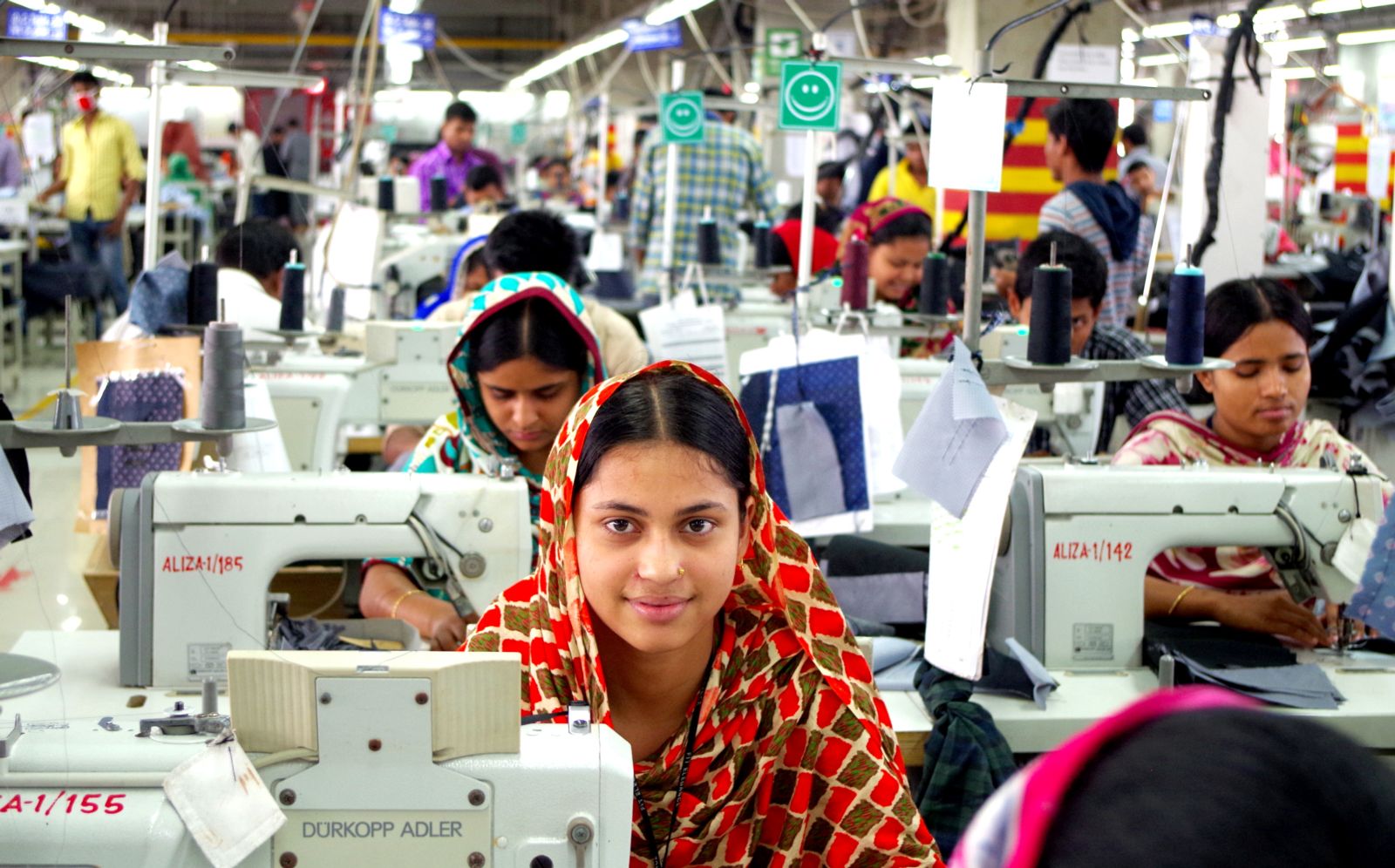
Labour rights defenders regularly experience violence and restrictions on their rights in various ways, including clamp downs on unions where governments and employers obstruct them from functioning freely and independently, laws that limit collective bargaining, and dismissals. In the past year, the International Trade Union Confederation reported an increase in violence, especially to prevent unionizing, and the safety of trade union leaders remains precarious. In Colombia, 19 trade unionists were killed in 2017; in Cambodia, trade union leaders are criminalized; and in Zimbabwe trade union leaders are regularly harassed by government authorities. With respect to laws that limit labour rights, 81% of countries deny some or all workers the right to collective bargaining and 65% of countries exclude some groups of workers from labour law, such as domestic, agricultural and contract workers, up 5% from 2017. Peaceful protests by workers are often met with heavy handed policy or army responses. In addition, the most common reprisal workers face for speaking up about violations are dismissals, a tactic used by employers to stifle civic action. As one example, over 12,000 garment factory workers in Bangladesh were fired for their protests in December 2018 and January 2019 over wages.

The Business & Human Rights Resource documents attacks against defenders working on corporate accountability, and our database shows that agriculture, food and beverage, and apparel are the most dangerous sectors for labour rights defenders. The most common forms of violence against individual union leaders and workers are arbitrary detentions and lawsuits, followed by intimidation and threats, and killings.

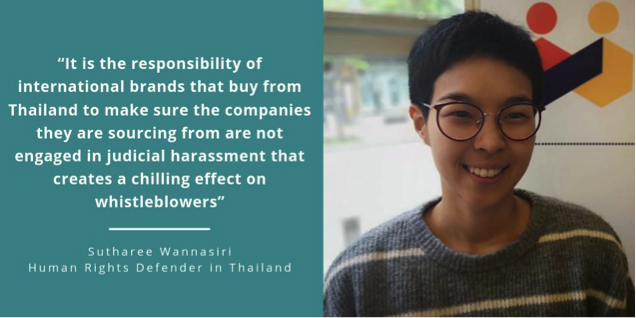
A particularly concerning trend is the use of defamation lawsuits to silence labour rights defenders. As one example, since 2016, Thammakaset Company Limited, a Thai-owned poultry company, filed more than 13 civil and criminal lawsuits against former workers who denounced labour rights violations, as well as against the activists and journalists supporting them. Governments and companies, including international brands, need to ensure such judicial attacks do not happen. As Sutharee Wanasiri, a labour rights defender from Thailand, and one of the people sued by Thammakaset, said: “It is also the responsibility of international brands that buy from Thailand to make sure the companies they are sourcing from are not engaged in judicial harassment that creates a chilling effect on whistle blowers and other defenders. They should establish mechanisms that allow workers and defenders to communicate with the brands directly and ensure that they are protected from any retaliation from suppliers during the investigation. The results should be made public and bring accountability for the abuses.

With long and fragmented supply chains, it is particularly important to ensure that we hear workers’ voices, especially those of the most marginalized at the bottom of economic hierarchies, and guarantee dignified and decent work. This includes people working in the informal economy. Workers and civil society organizations are currently focusing on redefining legal employment terms, and reconsidering union strategy in light of changing labour relations, especially in the gig economy, in which non-conventional workers are not afforded adequate legal protection—either because they do not fall within the definition of a “regular employee” under national laws, or because of gaps in legislation when it comes to regulating new forms of employment. The lack of an applicable legal protection and collectively agreed terms of employment hinders the ability to exercise work-related rights, including the right to organise and collectively bargain.

……..

Labour rights defenders should be seen as critical allies in building equitable and sustainable societies. Several businesses are also beginning to recognise that the protection of human rights defenders and the ability for them to do their work is in their interest, and that an attack on defenders is an attack on responsible business. This is encouraging, as now more than ever we need to be brokering connections and building solidarities across movements and sectors to counter threats to the shared space we all depend upon.

https://www.openglobalrights.org/rising-restrictions-on-labour-rights-threaten-the-heart-of-social-justice/

Possibility to apply for the African School on Internet Governance scholarships

May 21, 2019

Objectives of AfriSIG. AfriSIG’s primary goal is to give Africans from multiple sectors and stakeholder groups the opportunity to gain knowledge that will enable them to participate confidently and effectively in national, regional and global internet governance processes and debates. AfriSIG seeks also to give fellows the opportunity to participate actively at the AfIGF as speakers, moderators, and rapporteurs. The dates and location of this year’s AfIGF are still to be confirmed.

Curriculum

The School will run throughout six days, and will be structured to include intensive learning and knowledge sharing that covers: An overview of internet governance concepts, issues and institutions; Internet architecture, infrastructure, standards and protocols and management of internet names and numbers; Internet governance and social issues: gender, human rights and development; Cybersecurity, multistakeholder approaches and emerging issues in internet governance such as algorithms and the “internet of things”; The highlight of the school is a practicum in which participants have to tackle an actual internet-related policy challenge and come up with an agreed solution or statement.

Eligibility

The School will accept applications from a wide range of professionals including human rights defenders and NGO leaders.

Costs and Scholarships

Applicants can apply for a scholarship to attend the school. However, given the limited number of scholarships, self-funded and sponsored applicants are encouraged to apply. The full course fee, which covers accommodation, meals, course material, and tuition, is USD 2,000. This excludes travel. Scholarships will cover air travel, shared accommodation and meal costs for the duration of the School. Successful applicants have the option of staying in a single room, but they would need to cover the additional cost themselves. The deadline for applications is Saturday, 1 June 2019.

For more information, visit the AfriSIG website

To apply please complete the form here

Apply for the African School on Internet Governance scholarships