Posts Tagged ‘women’

New study shows that on-line attacks against women human rights defenders doubled

December 16, 2025
Stressed businesswoman working on laptop at home, tired freelancer

On 15 December 2025 Emma Woollacott, in Forbes, referred to a new study that shows that 7 in 10 women human rights defenders, activists and journalists have experienced online violence in the course of their work. Produced through the UN Women’s ACT to End Violence against Women program and supported by the European Commission, “Tipping point: The chilling escalation of violence against women in the public sphere” draws on a global survey of women from 119 countries.

Along with online threats and harassment, more than 4 in 10 have experienced offline harm linked to online abuse — more than twice as many as in 2020, the researchers found. This can range from verbal harassment right up to physical assault, stalking and swatting.

“These figures confirm that digital violence is not virtual — it’s real violence with real-world consequences,” said Sarah Hendricks, director of policy, programme and intergovernmental division at UN Women.

“Women who speak up for our human rights, report the news or lead social movements are being targeted with abuse designed to shame, silence and push them out of public debate. Increasingly, those attacks do not stop at the screen — they end at women’s front doors. We cannot allow online spaces to become platforms for intimidation that silence women and undermine democracy.”

And AI is only making things worse, with almost 1 in 4 women human rights defenders, activists and journalists having experienced AI-assisted online violence, such as deepfake imagery and manipulated content. This is most often the case for writers and public communicators who focus on human rights issues, such as social media content creators and influencers, for whom the figure reaches 30%.

“Gender-based online violence is not a new phenomenon, but its scale certainly is,” said report co-author Lea Hellmueller, associate professor in journalism at City St George’s and associate dean for research in the School of Communication and Creativity.

“AI tools enable the production of cheaper and faster abusive content, which is detrimental to women in public life — and beyond,” Hellmueller added.

Tech firms are partly responsible, the researchers said, with the report calling for better tools to identify, monitor, report and fend off AI-assisted online violence. The researchers also want to see more legal and regulatory mechanisms to force tech firms to prevent their technologies being deployed against women in the public sphere.

“Our next steps include publishing data from the survey about the opportunities for, and barriers to, law enforcement and legal redress for survivors of online violence,” said Julie Posetti, chair of the Centre for Journalism and Democracy at City St George’s, University of London, one of the authors of the report. “We will also focus on creative efforts to counter gender-based online violence and policy recommendations to help hold the Big Tech facilitators of this dangerous phenomenon accountable.”

https://www.forbes.com/sites/emmawoollacott/2025/12/15/online-attacks-against-women-human-rights-workers-double-in-five-years/

https://www.globalissues.org/news/2025/12/15/41907

https://theconversation.com/ai-tools-are-being-used-to-subject-women-in-public-life-to-online-violence-271703

Women, Peace and Security (WPS) at 25 sees backsliding of women’s rights globally

November 1, 2025

Patricia Egessa, Director of Global Communications, published this NGO assessment:

Looking back at the year 2000 from a gender justice perspective is sobering. The previous decade had famously been declared as ‘the end of history’ by Western male political pundits. But women knew better. As conflicts continued to rage with devastating and disproportionate impacts on women and families, gender justice activists decided history still had some way to go and demanded a central role in peacebuilding. Their efforts galvanized the adoption of the pathbreaking UN Resolution 1325, which established the Women, Peace and Security (WPS) agenda. 

Today, we face the threat of backsliding from this critical agenda at a moment when it is more needed than ever. We cannot become numb to the intentional starvation of children and families in Gaza; the kidnapping of children from Ukraine; or the deaths of untold numbers of refugees worldwide as a result of the deliberate, sudden suspension of lifesaving food and medical aid. 

As the WPS agenda marks its 25th anniversary, civil society organizations are uniting to reaffirm the importance of women’s full and meaningful participation and leadership in global processes. The NGO Working Group on Women, Peace and Security has released its annual Open Letter calling on the international community to defend the core values of the WPS agenda amid growing threats to women’s rights globally. We cite just a part of that letter as a statement of our shared concern: 

Yet, when we should be paying tribute to the hard-fought achievements of these feminist movements, we are instead confronting an alarming backlash against women’s autonomy and rights, and against those who advocate for them, at a time when the consequences of armed conflict and crises on the lives of women and girls could not be more devastating. The very term gender—a core concept in international human rights law mobilized by feminist movements for decades to challenge the systematic oppression of women and LGBTQIA+ people—is today being blatantly undermined by anti-gender movements globally, including at the United Nations (UN). Civil society and human rights defenders around the world, especially those defending gender equality, women’s rights, sexual and reproductive rights, and LGBTQIA+ rights, are being targeted for who they are and the work they do. Combined with rising militarism, erosion of respect for international law, capitalist exploitation and slashing of funding for gender equality and women’s rights organizations, these attacks have thrown our work and our movements into crisis, even as the vision of the WPS agenda is more necessary than ever. 

ICRW has proudly signed on to this collective statement precisely for the reason so clearly articulated in this letter: to remain silent as the WPS agenda and those who advocate for it are attacked not only undermines decades of progress but jeopardizes peace and security for everyone.  Twenty-five years after the adoption of the UN resolution, our work is unfinished. We join over 600 organizations worldwide in ensuring that our unified voice reaches the UN Security Council, governments, and the world’s citizens who understand and support a more peaceful world for our children. 

https://www.icrw.org/the-world-we-imagined-open-letter-on-25-years-of-women-peace-and-security/

IDRC is funding research on how to defend rights in a hostile context

March 19, 2025

On 14 March 2025, IDRC announced that it is funding research to uphold fundamental democratic freedoms and address rising threats to peoples’ rights. The CAD4.13 million investment supports six projects across five regions:

Ugandans demonstrating in Kampala hold up posters of women who have been kidnapped and murdered.

Demonstrators in Kampala, Uganda, march in 2018 to draw attention to the murders, kidnappings and, activists claim, a lack of action by the police in response. Frederic Noy/Panos Pictures

The freedom to associate, participate in decision-making and express views is fundamental to democracy. Yet, in many countries around the world, these hard-won political and civil rights are being questioned and eroded through physical attacks, online intimidation, smear campaigns, digital surveillance and the lack of response from authorities when attacks occur. Legal and policy restrictions limit individual rights such as same-sex unions and reproductive health services while, increasingly, obstacles like funding bans and censorship are reducing the ability of people and organizations to contest these measures. 

Research is needed to inform the strategies and actions of organizations, groups and movements that advocate for the respect for human rights. Research institutions, networks, and women’s rights and LGBTI+ organizations are leading IDRC-supported research to:

  • understand what drives the erosion of rights in each context 
  • analyze the strategies used to counter these trends 
  • explore how to strengthen rights defenders, for example through alliance-building and cross-movement solidarity
  • generate policy recommendations to safeguard rights 

Read about the projects

Addressing gender discrimination and violence — focus on Eastern and Southern Africa

Defending against gender backlash: Strategies of resilience in Southeast Asia

Enhancing the promotion and protection of human rights and gender equality in Sierra Leone and Liberia

Protecting LGBTIQ+ human rights movements and organizations in Honduras, Guatemala and El Salvador

Upholding rights at a time of global backlash: Strategies in the Middle East and North Africa

Fostering a solidarity network: Collective learning and action in support of gender equality

The six research projects are connected through a common research agenda aimed at producing insights across regions and globally.

https://idrc-crdi.ca/en/news/new-research-explores-how-defend-rights-hostile-context

China on dissent: over 1,500 convicted in six years, report finds

March 11, 2025

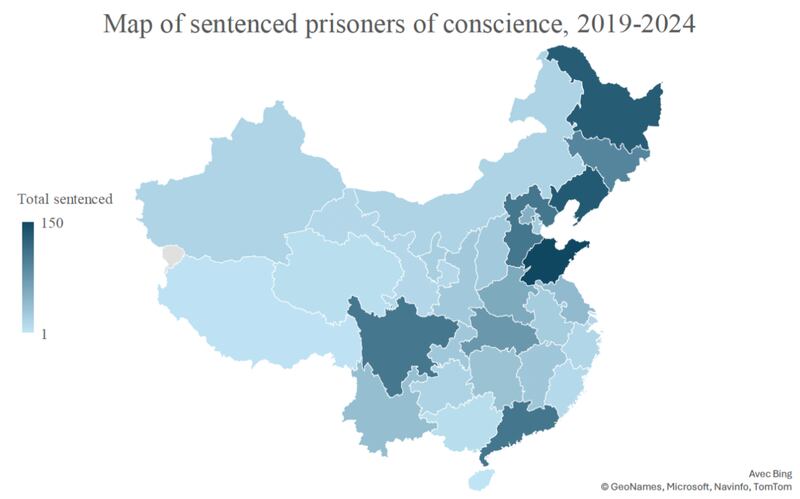
Alan Lu for RFA on 5 March 2025 refers to a a new report which shows the extent of Beijing’s arbitrary detentions, with severe sentences for prisoners of conscience.

Chinese authorities have arbitrarily detained thousands of people for peacefully defending or exercising their rights over the past six years and convicted 1,545 prisoners of conscience, a rights group said on Wednesday.

Chinese Human Rights Defenders, or CHRD, a non-government organization of domestic and overseas Chinese rights activists, said the scope and scale of wrongful detention by Chinese authorities may constitute crimes against humanity.

“They were sentenced and imprisoned on charges that stem from laws that are not in conformity with the Chinese government’s domestic and international human rights obligations,” the group said in a report.

“Their cases proceeded through the full criminal justice system, with police, prosecutors, and courts arbitrarily depriving them of their liberty in violation of their human rights.”

Prisoners of conscience have faced severe penalties, with an average sentence of six years, increasing to seven for national security charges.

Three people, identified as Tashpolat Tiyip, Sattar Sawut and Yang Hengjun, were sentenced to death, while two, Rahile Dawut and Abdurazaq Sayim, received life sentences, the group said, adding that 48 were jailed for at least a decade.

Map of sentenced prisoners of conscience in mainland China, excluding Hong Kong and Macao.
Map of sentenced prisoners of conscience in mainland China, excluding Hong Kong and Macao. (CHRD)

Among the convicted, women activists and marginalized groups, including ethnic Tibetans and Uyghurs, were disproportionately represented among those wrongfully detained, the group said.

Out of all the prisoners of conscience aged 60 or older, two-thirds were women, it added.

“Human rights experts and international experts have raised that people over the age of 60 should generally not be held in custody due to the effects on their physical and mental health,” Angeli Datt, research consultant with CHRD, told journalists in a press briefing Wednesday.

“That two-thirds of them are women was really shocking to me,” she said.

“Worse still, the impunity Chinese government officials enjoy at home emboldens them to commit abuses abroad,” the group said.

China dismissed a Swiss report last month alleging that it pressures Tibetans and Uyghurs in Switzerland to spy on their communities.

‘Endangering national security’

The CHRD said that under Chinese leader Xi Jinping, the scope and scale of the use of arbitrary detention to silence critics and punish human rights personnel had grown.

The organization documented a total of 58 individuals known to have been convicted of “endangering national security.”

“The overall average prison sentence for a national security crime is 6.72 years, though this figure excludes those sentenced to death with a two-year reprieve or life imprisonment,” it said.

In Hong Kong, more people were convicted of “subversion” and “inciting subversion” — terms that the U.N. describes as “broad and imprecise, making them prone to misapplication and misuse.”

In one 2024 case, authorities convicted 45 people for participating in a primary election, an act fully protected under both domestic and international law. Subversion charges accounted for 37% of all prisoners of conscience sentenced in Hong Kong during this period.

https://www.rfa.org/english/china/2025/03/06/chia-dissent-crack-down-humgn-rights/

https://thediplomat.com/2025/03/chinas-system-of-mass-arbitrary-detention/


8 March 2025 International Women’s Day

March 10, 2025

One in four countries report backlash on women’s rights in 2024

Women’s and girls’ rights are facing unprecedented growing threats worldwide, from higher levels of discrimination to weaker legal protections, and less funding for programmes and institutions that support and protect women.

UN Women’s latest report “Women’s Rights in Review 30 Years After Beijing”, published ahead of the UN 50th International Women’s Day on 8 March, shows that in 2024 nearly a quarter of governments worldwide reported a backlash on women’s rights. [see also: https://humanrightsdefenders.blog/tag/international-womens-day/]

Despite important progress, only 87 countries have ever been led by a woman, and a woman or girl is killed every 10 minutes by a partner or member of her own family.  Digital technology and artificial intelligence spread harmful stereotypes, while the digital gender gap limits women’s opportunities.

In the past decade, the world registered a disturbing 50 percent increase in the number of women and girls living in conflict, and women’s rights defenders confront daily harassment, personal attacks and even death. Recent global crises—like COVID-19, the climate emergency, soaring food and fuel prices—are only increasing the urgency to respond.  

“UN Women is committed to ensuring that ALL Women and Girls, everywhere, can fully enjoy their rights and freedoms,” affirmed UN Women Executive Director Sima Bahous. “Complex challenges stand in the way of gender equality and women’s empowerment, but we remain steadfast, pushing forward with ambition and resolve. Women and girls are demanding change—and they deserve nothing less.”…

Today’s report also features the new Beijing+30 Action Agenda, a courageous roadmap to complete our unfinished business by focusing on:

  1. A digital revolution for all women and girls: We must ensure equal access to technology, equip women and girls to lead in AI and digital innovation, and guarantee their online safety and privacy.
  2. Freedom from poverty: Investments in comprehensive social protection, universal health coverage, education, and robust care services are needed for women and girls to thrive and can create millions of green and decent jobs.
  3. Zero violence: Countries must adopt and implement legislation to end violence against women and girls, in all its forms, with well-resourced plans that include support for community-based organizations on the front lines of response and prevention.
  4. Full and equal decision-making power: Temporary special measures like gender quotas have proven their effectiveness in rapidly increasing women’s participation.
  5. Peace and security: Fully finance national plans on women, peace and security and gender-responsive humanitarian aid are essential. Frontline women’s organizations, so often the first responders to crisis, must receive dedicated, sustained funding to build lasting peace.
  6. Climate justice: We must prioritize women’s and girls’ rights in climate adaptation, center their leadership and knowledge, and ensure they benefit from new green jobs.

Across these six Actions, putting young women and girls at the heart of our efforts is the best way to guarantee success, both today and tomorrow. These six plus one actions have the potential to unleash progress on women’s rights and put us back on track for 2030.

The Beijing+30 commemoration and the forthcoming UN Commission on the Status of Women (CSW69) are clear opportunities to enshrine this Action Agenda into national policies, regional strategies, and global agreements.

In a pivotal year for women and girls, that is also a year of pushback and crises like no other, let us push women’s rights forward to create a world where all women and girls enjoy equal rights and equal opportunities. We can be the first generation that can live in an equal world.

Ahead of International Women’s Day, Amnesty International’s Secretary General, Agnès Callamard, said:

“The significance of International Women’s Day 2025 cannot be overstated. It is no longer a case of addressing unfinished business on the gender justice front, but one of bracing ourselves to resist active regression and a mounting assault on our rights.

“Thirty years ago, 189 governments came together at the Fourth World Conference on Women to adopt the Beijing Declaration and Platform for Action, a groundbreaking blueprint for strengthening women’s rights endorsed by thousands of activists. Despite significant progress since then, the world has failed to fully deliver on all the promises. From rape and femicide to coercion, control and assaults on our reproductive rights, violence against women and girls still threatens their safety, happiness and very existence in a multitude of ways.

“And crucially, we are now going backwards. The aggressive patriarchal crusade led by President Trump and other powerful leaders against the rights and bodily autonomy of women and gender-diverse people has already had devasting consequences not just in the United States but all over the world. By dismantling domestic efforts to tackle gender-based, racial and other forms of discrimination, erasing recognition of transgender identity, and ending international funding for abortion counselling or referrals, the US administration is shamefully erasing years of hard-fought gains.

“Let us be clear, this trend has deeper roots than President Trump’s recent election. For several years now, brazen anti-rights movements have conspired to turn back the clock to an age when patriarchal oppression was the norm. We cannot afford to be complacent in the face of this gathering storm, for women, girls and LGBTQI+ people are under attack the world over.

“Amnesty International calls on states and non-state actors who believe in universal values and a rule-based international order to resist this accelerated and well-resourced attack against women’s rights. We call on them to strengthen protections of women, girls, LGBTQI+ people and other marginalized groups against gender-based violence. We urge them to recognize and support the vital work of all women human rights defenders and all those on the frontlines of the fight for sexual and reproductive rights, and to implement concrete measures to protect and empower them.

“We appeal to all to respect sexual and reproductive rights and prevent rollbacks, including by revoking any laws that criminalize or punish people for exercising these rights, as well as fully decriminalizing, providing and funding universal access to abortion.

“Finally, this International Women’s Day, Amnesty International reiterates its call on states to recognize gender apartheid under international law as a crime against humanity. Doing so would fill a major gap in the global legal framework and help to combat institutionalized and systematic domination and oppression on the basis of gender, no matter where it occurs.

“Despite suffering setbacks and facing countless attempts to block, divide and undermine us throughout history, feminist, LGBTI+ and grassroots movements keep marching forward. We may be walking a rocky path, but we will never stop fighting for a world where women, girls and gender-diverse people are free to enjoy the full range of human rights without discrimination or fear of reprisal.”

On 7 March 2025 SaferWorld carried a post “Still standing: The resilience of women peacebuilders in a time of crisis”Still standing: The resilience of women peacebuilders in a time of crisis

As we mark International Women’s Day 2025, women’s rights organisations (WROs) and frontline activists in crisis and conflict settings are standing strong despite immense challenges. ..Yet, while their work is more critical than ever, the harsh reality is that many are being forced to operate with dwindling resources, due to global funding cuts and shifting donor priorities towards militarisation, over a genuine investment in long-term peace, security and gender justice. 

At a time when conflict, displacement and violence against women are escalating, and misogyny is a core pillar of the far-right agenda, these cuts will only deepen existing inequalities and undermine efforts to build sustainable peace and security globally. The reduction in funding for gender equality and Women, Peace and Security (WPS) initiatives threatens to reverse decades of progress and compounds the global rollback on women’s equality, safety and security. For example, cuts to the UK official development assistance (ODA) budget in 2021 led to a 30 per cent reduction in funding to programming with a focus on gender equality and to a 66% reduction in funding to WROs compared to 2017. WROs and women-led organisations – many of which are small community groups – often struggle to access direct, flexible and long-term funding, despite being the first responders in humanitarian crises and leading conflict prevention and peace efforts. When funding disappears, so do vital services, safe spaces for survivors of gender-based violence and conflict-related sexual violence, safe spaces for women peacebuilders to re-mobilise, legal aid for women and girls who have been displaced, and advocacy that ensures women’s voices are central in peace processes.  But despite these constraints, WROs and women peacebuilders are still standing. Their resilience is evident in their ability to adapt, mobilise local resources and continue working in the most difficult circumstances. But resilience alone is not enough – they need meaningful and sustained support. 

As the world commemorates International Women’s Day and gathers at the United Nations Commission on the Status of Women (CSW) to discuss gender equality and sustainable development, we reaffirm our commitment to ensuring that women and girls play a central role in peacebuilding and conflict prevention efforts around the world.  

The international community, donors, funders and philanthropists will need to act urgently to ensure that WROs are not just surviving but thriving. This means:  

  1. Increasing direct, flexible and long-term funding and shifting power to local women-led organisations, women activists and women’s groups – we have seen the value in our work of providing sustained core funding to WROs, moving beyond short-term, project-based grants to ensure continuity of their critical efforts in conflict prevention, peacebuilding and humanitarian response. To make this shift meaningful, international organisations and donors should prioritise direct and flexible funding to frontline WROs rather than channelling resources through large intermediaries. This will ensure that funding reaches those who are best placed to drive lasting change within their communities. 
  2. Ensuring women’s leadership in conflict prevention, peace and humanitarian processes – women from all backgrounds and marginalised communities must have a seat at decision-making tables, not just as implementers but as equal partners in shaping policies and solutions that affect their lives. 
  3. Standing up for gender equality and women’s rights – urgently pushing back against reversals in women’s rights and gender equality, especially in fragile and conflict-affected contexts, where regressive policies and shrinking civic space are eroding hard-won gains. Women peacebuilders, human rights defenders and frontline activists are already standing up to these challenges, demanding that women’s voices remain central. Their leadership must be protected, amplified and meaningfully supported to sustain progress and counteract the global rollback on gender equality. 
  4. Protecting and supporting women human rights defenders and peacebuilding organisations – governments and international actors must recognise and safeguard the work of women human rights defenders and peacebuilding organisations in conflict zones, ensuring they can operate without fear of reprisals. 
  5. Strengthening accountability mechanisms – governments and multilateral bodies must hold themselves accountable to their commitments to the WPS agenda and support localisation of the UN Security Council Resolution 1325 on WPS. 

Women’s rights organisations are the backbone of peace and resilience in crisis and conflict settings. This International Women’s Day, we celebrate their unwavering commitment – but celebration is not enough. The global community must act with urgency to fund, support and protect these organisations so they can continue to drive meaningful change. 

https://www.unwomen.org/en/news-stories/press-release/2025/03/one-in-four-countries-report-backlash-on-womens-rights-in-2024

Read UN Women’s full report

https://www.saferworld-global.org/resources/news-and-analysis/post/1071-still-standing-the-resilience-of-women-peacebuilders-in-a-time-of-crisis

https://www.odisharay.com/pages/single_page.php?id=47565

https://www.omct.org/en/resources/blog/mujer-defensora-derechos-humanos-regimen-de-excepcion-el-salvador

https://www.ohchr.org/en/get-involved/stories/women-activists-fighting-safe-digital-space

Woman Human Rights Defender Nonhlanhla Dlamini from Eswatini

November 30, 2024

On 29 November 2024, OHCHR published this interview in the context of the International Day for Women Human Rights Defenders.

Nonhlanhla Dlamini, Executive Director of SWAGAA, sits at the desk in her office

© Kirsty Teichert

Nonhlanhla Dlamini heads SWAGAA – the Swatini Action Group Against Abuse, a local Eswatini organisation whose primary focus is on ending gender-based violence in the country. Since 1990, SWAGAA has provided care, support, prevention, and access to justice for victims and survivors of gender-based violence, by working with community leaders, community members, and the Government, as well as providing counselling for GBV victims. For the International Day for Women Human Rights Defenders, Dlamini answers questions about GBV, her inspirations and why it was necessary for her to become one of the first women elected as a member of parliament in Eswatini.

1. What was that specific inspiring moment or experience that made you decide to focus on gender-based violence?

What actually motivated me was an incident where a relative of mine was raped at the age of six by a stranger. We didn’t find the person. SWAGAA already existed, but I didn’t know anything about them. Then in 1997, I saw an advertisement [for SWAGAA] in the newspaper. And when I learned about what they were doing, I asked myself why I didn’t know about the organization when I had this problem because I had no one to talk to. I had no one to support me. We reported the matter to the police, but nothing ever happened. We’re so frustrated. So, when I saw the position, I just knew this was my job. And my objective was, I want people to know about SWAGAA. I wanted SWAGAA to be a household name.

2. How do you stay motivated and have you ever questioned your journey?

I have several times, particularly when I get hurt, because, you know, sometimes this world can be very cruel. And I ask myself, how could people do such an evil thing? I do get depressed. And when I’m very depressed, I’m like, you know, out of all the jobs that I could be doing, why am I even doing this job? Then I get some motivation with some of the success stories. If I quit, who else is going to do it? I kind of feel I’m compelled to do it because there’s a whole lot of people that are looking up to me for help. So, I continue.

3. You were elected MP back in the early 2000s, the first woman ever for your constituency. What made you decide you had to run?

… The mistake that we make as advocates and women’s rights activists is that we’re always pushing for others to go and make the change that we want to see. So, I made a decision; I was going to stand for the next elections, which were in 2008. I realized that for years, I’ve been part of a vote for a woman campaign, pushing women to stand for elections. But I’ve never thought of myself one day running for elections. I ran the race to Parliament. I was nominated. I was widely supported. I won the primary elections. It was easy for the primary elections, but the secondary elections were not easy. And I was the only woman against seven men. It was very rough. It was very testing. But I pushed with everything that I had. And I won the elections, and I became a member of Parliament. And the first motion that I moved in Parliament, was that the Minister of Justice bring the sexual offenses and domestic violence bill within 30 days. And his response was no. I kept asking, and that is how the bill was finally seen by Parliament.

4. Let’s look to the future. If you could change one thing about the situation of gender-based violence in Eswatini, what would it be?

The most critical thing is prevention. Prevention, prevention, because once it happens, it’s difficult to pick up the pieces. …

5. Do you consider yourself a woman human rights defender? Why?

Of course I do, 100 percent. I consider myself a human rights defender because due to the nature of the work that I’m doing, I am continuously standing up for the rights of women and girls in Eswatini. And I have advocated for better legislation in the country. I have advocated for better services in the country, be it in the police, be it in the hospitals, be it in the justice system. I have done everything that I think needs to be done under the sun to make sure that I stand for the rights of the citizens of this country. And I’m saying this because I also know people believe in me. I’ve done all I possibly can to advocate for the rights of women and children in the country.

https://www.ohchr.org/en/stories/2024/11/human-rights-five-woman-human-rights-defender-nonhlanhla-dlamini

PACE’s Petra Bayr on ensuring protection of women human rights defenders

June 28, 2024

On 25 june 2024, when adopting a resolution today based on the report by Petra Bayr (Austria, SOC), PACE strongly condemned the frequent attacks perpetrated against women human rights defenders, and called for an end to impunity for perpetrators of violence.

The resolution emphasises that women human rights defenders – which include activists, NGO members, health workers, private sector actors, researchers, lawyers, students, teachers, artists, trade unionists, bloggers and journalists – act “in a peaceful and legal way to promote and protect human rights”. The Assembly deplores that they face attacks and specific threats, both on and offline, and are often victims of intersecting forms of discrimination

In this context, PACE called on member States to “repeal laws, policies and practices that affect women human rights defenders, in all their diversity, and unduly restrict their activities”. It also recommended guaranteeing their protection, by ensuring a secure and enabling environment in which to carry out their activities, and prosecuting the perpetrators of attacks and threats, including members of police forces.

Finally, PACE called on national parliaments to support women human rights defenders through practical actions and the introduction of new policies.

https://pace.coe.int/en/news/9529/ensuring-protection-of-women-human-rights-defenders

18th edition of the International Women of Courage Awards

March 5, 2024

On Monday, 4 March 2024, Secretary of State Antony J. Blinken and First Lady Jill Biden hosted the annual International Women of Courage (IWOC) Awards ceremony at the White House. See: https://www.trueheroesfilms.org/thedigest/awards/A386E593-5BB7-12E8-0528-AAF11BE46695

Now in its 18th year, the Secretary of State’s IWOC Award recognizes women from around the globe who have demonstrated exceptional courage, strength, and leadership in advocating for peace, justice, human rights, gender equity and equality, and the empowerment of women and girls, in all their diversity – often at great personal risk and sacrifice.  The 2024 awardees and many earlier laureates can be found via the Digest link above.

USAID Administrator Samantha Power had the following to say: It has always taken bravery and stubbornness to stand up for human rights. But today the threats that human rights activists and defenders face – from threats to their families to legal retribution to imprisonment and outright violence at the hands of those who would prefer to see them silenced – those threats are grave, and sadly they are growing. In 2022, more than 400 human rights defenders were murdered, the highest number ever recorded in a single year. I am in awe of the women we are honouring today for their courage. 

They refuse to back down because of a shared conviction captured by Fatima Corazon, one of the women we are recognizing today. As she puts it, courage, even in the face of danger and fear is the driving force to achieve positive change. The women we are honoring live this conviction every minute of every day. They have been unjustly imprisoned, they have been driven from their homes or trapped inside their homes, they have seen their families and their colleagues attacked, or they have received death threats and been assaulted themselves. 

But they do not relent. They go on fighting, they fight for the rights of political prisoners, they organize movements to bring services to marginalized communities, they publish articles, they host rallies, and they call out injustice wherever they can. Even in the most dangerous places against all odds, they are continuing their work demonstrating incredible, inspiring courage and putting their lives on the line to defend human rights. 

Benafsha Yaqoobi has dedicated her life to defending the rights of women and girls in Afghanistan. A former attorney and member of the Afghanistan Independent Human Rights Commission, she has helped women escape violence and visually impaired children attend school. Today, she continues to fight for the future of Afghanistan – one that respects human rights and human dignity.

Born in Isla Luis Vargas Torres, one of the most violent enclaves within Esmeraldas, Ecuador, Fátima Corozo has put her life on the line to draw hundreds of young people away from rising gang violence and help them get the education and job opportunities they need to build the futures they want for themselves.

Martha Beatriz Roque Cabello was the only woman amongst 75 people imprisoned during the black spring, Cuba’s crackdown on dissidents two decades ago, Martha was jailed for her activism. After her release, she continued to fight for the rights of political prisoners documenting fraudulent court hearings and supporting activists and their families. Unfortunately, as the Secretary relayed, the Cuban government is preventing Ms. Roque Cabello from leaving the country. So she is not here to accept the award, but let us give her a heartfelt round of applause.

As a result of Fariba Balouch’s outspoken activism for the rights of women and systematically oppressed ethnic minorities in Iran’s poorest province of Sistan and Baluchestan, Iranian authorities have threatened her life. And after she escaped to London, they detained her son and brother in a further attempt to intimidate her. Yet, Ms. Balouch believes the only way forward is resistance, and she continues to advocate for marginalized communities in Iran refusing to be silenced.

https://www.miragenews.com/2024-intl-women-of-courage-awardees-unveiled-1185728

https://www.usaid.gov/news-information/speeches/mar-04-2024-administrator-samantha-powers-remarks-international-women-courage-awards-ceremony

Anushani Alagarajah: “As a human rights defender, you’re almost expected to be superhuman”

December 8, 2023
UN Women

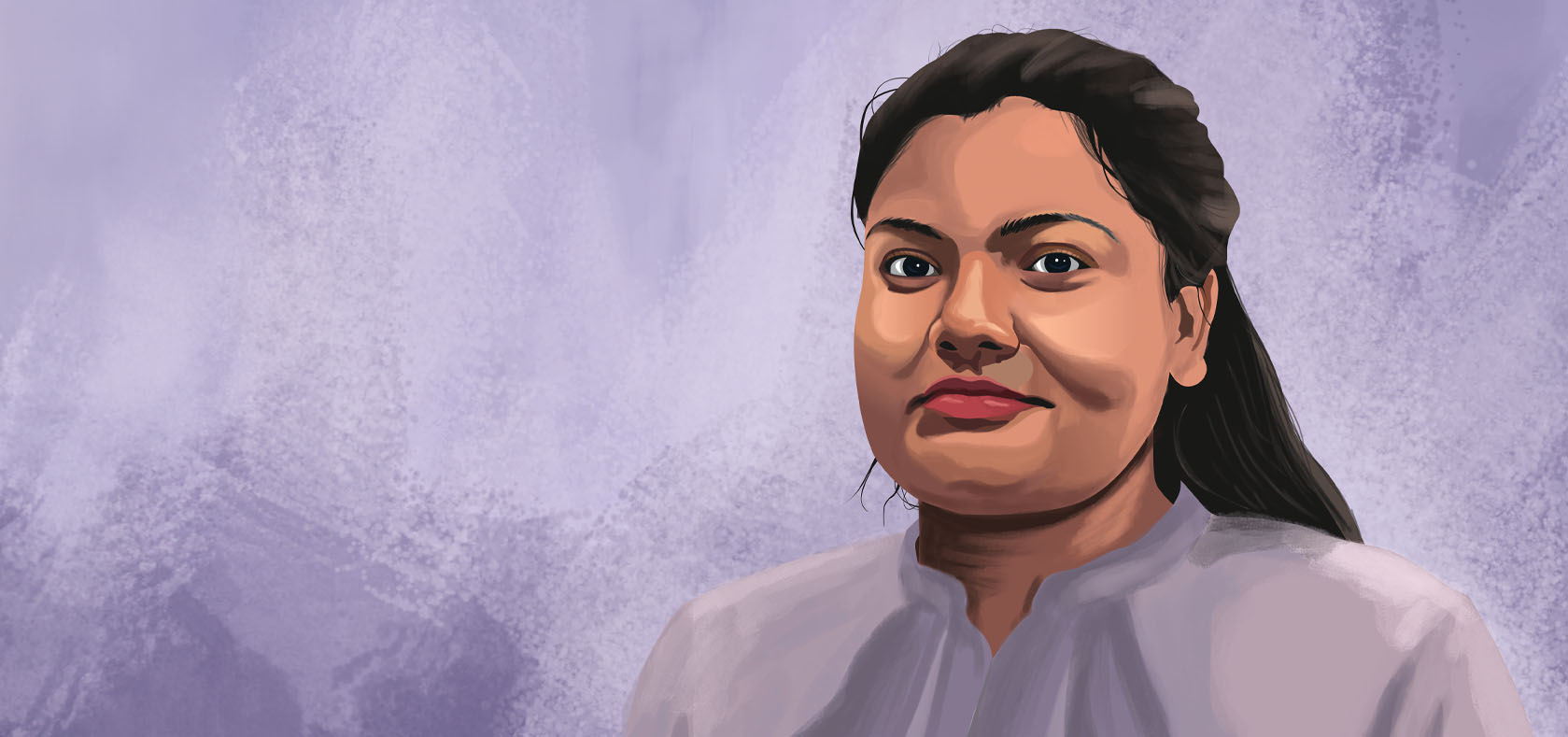
Anushani Alagarajah, human rights defender and executive director at the Adayaalam Centre for Policy Research. Illustration: UN Women Sri Lanka/Dinuk Senapatiratne

Anushani Alagarajah is a human rights defender who has worked closely with conflict-affected communities in the North and East of Sri Lanka. She is the Executive Director at the Adayaalam Centre for Policy Research, a non-profit research think-tank that works on public policy issues in Sri Lanka. On the occasion of the International Day for Women Human Rights Defenders, Ms. Alagarajah spoke about her work in post-conflict Sri Lanka.

I don’t know if I ever consciously decided to become a human rights defender. But when I was seven, there was a gang rape of a girl from our school. Her classmates held a sit-in protest. I didn’t know what rape meant, but children living with conflict grow up fast. I wanted to protest too. If I see injustice, I want to speak up.

As a child, it was horrible to live in bunkers [during the conflict], to come out and see ashes. I’ve been in survival mode my entire life. Seeing what’s happening in other countries, I worry that children will spend their entire lives trying to make sense of it, trying to be okay.

Grief is not only for people, it’s also for a place you called home, that belonged to you. For me, it was always about the childhood I didn’t have. I will probably be grieving that for the rest of my life.

I left Sri Lanka in 2009 to study in Bangladesh. I never wanted to come back. But from the time I left, I knew I had to return. I came home every summer, to conduct workshops with orphanages and conflict-affected communities.

I couldn’t run away. Afterall, I am from this community.

I was displaced thrice. I couldn’t sleep peacefully knowing I could have done something, and I didn’t do it. I thought, “I can try to make things better.” So, I returned after finishing my studies in 2014. Since then, I have been living my purpose in the community.

Whether it is the economic crisis or a lack of opportunities, a lasting political solution requires the political will for change.

It’s difficult when you come from a history of violence, conflict and trauma. During the conflict, a range of violent acts were committed against women.

Women bear the brunt of any damage, and are also expected to be the ones to rebuild, protecting the family unit, community and culture. Yet, particularly in the global South, women are not afforded resources.

Patriarchy is the norm.

Men can take a job in different places, access resources, work with men, divorce, remarry. Women cannot. They must provide out of nothing. Even though they suffered tragic, unspeakable experiences, they are still shackled by stereotypical expectations.

My own work is considered unfitting. I’m expected to be a good woman and get married. We are very far from being inclusive.

In the early days, I would try to talk to older activists about mental health, saying “I’m not doing okay”. But as a human rights defender, you’re almost expected to be superhuman. I think being sensitive helps me do my job better because I look out for others.

For the last four years, when my office researches something difficult, we check in with everyone about how they feel. Whenever one of us needs support, the community will hold them, providing a safe space to be vulnerable or angry. It took a long time for me to find this community.

You cannot heal on your own.

With my colleagues, I run practical workshops to create the next generation of activists, training people in small communities and villages to advocate for their rights. We have participants pick an issue, ideate a solution and work with relevant stakeholders. For example, we have young participants who want to reclaim an occupied land in their village. They met the parliamentarian and the Divisional Secretary’s Office and are now drafting a lease. If they have the courage and knowledge to do that at 20 years old, there is so much we can do. I’m always looking for a few people to take our struggle forward.

Sometimes, it only takes one person.

A wise woman once told me: “You will not see the changes you work for in your lifetime.” This helps put things in perspective. We can only chip at the corners so that one day, hopefully, things will be different. Giving up is not an option. We can’t stop now.”

https://asiapacific.unwomen.org/en/stories/in-the-words-of/2023/11/anushani-alagarajah

“Freedom Rising”: an initiative to bring women and survivors into NGO leadership positions

December 1, 2020
Freedom Fund Announces Initiative to Bring Women Into Leadership Positions in Anti-Slavery Orgs

On 30 November, 2020 DC Velocity reported that with $1.2 million in funding (with support from Laudes Foundation, Stardust Fund, The Ray and Dagmar Dolby Family Fund, UBS Optimus Foundation and Lisa Wolverton, President, Wolverton Foundation), the Freedom Fund has launched “Freedom Rising“, a program to identify, equip, empower and support women and survivors of modern slavery to become leaders of anti-slavery organizations in their communities and in the global movement.

Of the groups working to liberate people and end the conditions that lead to modern slavery, very few are led by women and survivors of slavery. The Freedom Fund, the largest global funder of frontline, anti-slavery organizations, believes that women and survivors should be at the center of the work to end modern slavery. Today,

We know from our experience supporting frontline organizations that the most effective and sustained way to end modern slavery is to incorporate the experiences and the leadership of women and survivors,” said Nick Grono, CEO of The Freedom Fund. “Gender bias and systemic discrimination are factors that make women and girls particularly vulnerable to modern slavery in the first place. We must center our work around the leadership of women and survivors in order to address these underlying causes. We believe we can transform the face of the movement one leader at a time, and we must start now.

Click here to watch a short film about Freedom Rising: https://www.youtube.com/watch?v=nVZdiSU1e6w

The program is designed to support leaders through a personal learning journey that provides the skills and space for participants to experience, analyze and apply their learning. Not only must women and survivors work through their experiences of trauma and bias, they must also learn new approaches to leadership in a culture where their voices are chronically undervalued or dismissed.

Each cohort of 50 leaders will receive a minimum of 12 months of mentorship, leadership and technical skills training, before graduating to join the Freedom Rising alumni network. Due to COVID-19, the program has been adapted to provide online learning until the in-person training can be safely delivered.

We invested in Freedom Rising because we believe that transformational change comes only when women are in leadership positions and in influential roles sharing power and exerting influence,” said Natasha Dolby, founder of Freedom Forward and board member of the Freedom Fund. “These women are the best positioned to understand, analyze and shape what needs to happen in their organizations and communities, and with the anti-slavery movement at-large. We’re aware that changing norms takes time, but we’re behind the Freedom Fund’s vision that we must start now, when multiple pandemics that impact women worldwide have converged.

Freedom Rising differs from many other leadership programs in its explicit focus on building a stronger, more strategic, and more representative anti-slavery movement. After completing the year-long leadership training, participants will be formally introduced to the program’s alumni network, enabling them to continue to build and strengthen connections at the local, regional and international levels. The program will be piloted in Tamil Nadu in Southern India throughout 2021. Learnings from the pilot will be used to adapt and improve the program before its rollout. The curriculum will then be tailored to the specific needs and contexts of each training location, and delivered in local languages.

Initiatives to support women’s leadership like this one are crucial, especially at this critical moment, as the world battles a global pandemic,” said Nada Al-Nashif, UN Deputy High Commissioner for Human Rights. “We know that putting women at the center, indeed ensuring women are at the helm, will help.

https://www.dcvelocity.com/articles/48151-freedom-fund-announces-initiative-to-bring-women-into-leadership-positions-in-anti-slavery-orgs