Posts Tagged ‘woman human rights defender’

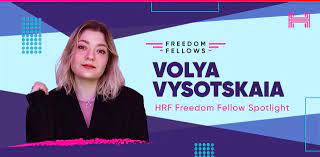
Meet Volya Vysotskaia, a Belarusian human rights defender

January 12, 2023

Meet HRF Freedom Fellow Volya Vysotskaia, a Belarusian human rights activist who exposes repression and torture by state officials. 

Vysotskaia is currently part of the 2022 Freedom Fellowship, a programme of the Human Rights Foundation, a one-year program that provides hands-on, expert mentorship across seven critical areas: leadership, movement-building, organizing, fundraising, media, mental health, and digital security.

On September 27, the Investigative Committee of the Republic of Belarus announced that five people would be tried in absentia — Vysotskaia is one of them. She has since been denied information about the trial, and her request to appear virtually was rejected. Should she return to Belarus, a country where torture and inhuman treatment is routine, officials will likely detain her.

Learn more about Vysotskaia’s case.

Q: Can you tell us about your activism protecting democracy in Belarus?

A: From August 2020 to October 2021, I was an editor of the Telegram channel, the “Black Book of Belarus.” Our work “de-anonymized” or identified law enforcement officers and other government authorities who committed human rights violations, hiding behind their high-power statuses. We published the pictures and personal data of riot police officers, prosecutors, judges, and other officials to hold them accountable for their repression of Belarusian citizens demanding democracy and freedom. 

Q: What led to the criminalization of the Black Book of Belarus’ editors and readers? 

A: In October 2020, a special service agent infiltrated our team and leaked information about members. Previously, he was part of the special operation that hijacked a Ryanair flight in May 2021 to imprison Sofia Sapega, another team member. After we uncovered the agent, my team and I were chased down in Vilnius, and dozens of people in the Telegram group were also imprisoned. 

Q: What is unique about your criminal case? 

A: The case brought against my four colleagues and me is the first trial in absentia in the country’s history. We have been accused of “exasperation of enmity” and “social disagreement,” as well as illegal actions relating to private life and personal data. The Belarusian KGB has also added us to the list of individuals engaging in “extremist activities.” Belarusian courts recognize almost all civil society organizations as extremists, but we will be the first to be tried and sentenced without the opportunity to defend ourselves. 

Belarusian authorities are undoubtedly denying us the right to a fair trial. Notably, I was denied access to information about my criminal case, and I never met the lawyer assigned to me, nor did the lawyer ever respond to my calls. 

Q: What is the scope of legal harassment against Belarusian pro-democracy activists in exile? 

A: The Lukashenko government changed the criminal procedural law back in July and invented a special proceeding for trying in absentia those who are engaged in “anti-state activities,” and living in exile. The addendum of this new procedural law provides that defendants are no longer aware of the content of their cases. It is sufficient for the legislative body to post this information on official websites, which clearly violates Article 14 of the International Covenant on Civil and Political Rights (ICCPR).

Q: What should the international community learn from your case? 

A: The violations of the right to a fair trial, among other rights, didn’t start in Belarus with our case. It just brings back the attention of the international community to the fact that the repressions in Belarus haven’t stopped. They continue every day. The power, the judicial system, and the independence of Belarus with Lukashenko are fake. The regime represses and scares the Belarusians inside the country, and while the international community doesn’t react to the severe violations of human rights, the regime spreads its attention to those living in exile. Because silence allows them to do that.

The international community has to learn that there have to be efficient mechanisms for bringing perpetrators to trial until they destroy whole nations, as well as to guarantee the defense for the victims of violations. International justice can’t be built on the international ignorance of injustice. Being concerned doesn’t stop dictators.Repression in Belarus. HRF condemns the actions of Alexander Lukashenko’s regime and stands with Volya and all Belarusians who speak truth to power, even when their lives are at risk

The Freedom Fellowship is a one-year program that gives human rights advocates, social entrepreneurs, and nonprofit leaders from challenging political environments the opportunity to increase the impact of their work. Through mentorship and hands-on training sessions, fellows develop critical skills and join a growing community of human rights activists.

https://hrf.org/category/freedom-fellows/

Sad symbolic number reached in Mexico: 100,000 disappeared.

May 17, 2022

The 100,000 officially registered disappearances in Mexico illustrate a long-standing pattern of impunity in the country, indicating the tragedy continues daily, UN human rights experts warned.

The Committee on Enforced Disappearances (CED) and the Working Group on Enforced or Involuntary Disappearances (WGEID) on 17 May 2022 expressed grave concern about the growing numbers registered by Mexico’s National Register of Disappeared Persons

There are now over 100,000 people in Mexico’s national register of the “disappeared.” The UN says organized crime is among the leading causes of missing people in the country. Human rights organizations and relatives of the missing have called on the government to step up investigations and conduct searches more effectively

In the last two years the numbers have spiked from about 73,000 people to more than 100,000 — mostly men.

Mexico has seen spiralling violence since the war on drugs began in 2006, with over 350,000 people having died since then. Last year, the country of more than 129 million people saw 94 murders a day on average.

It’s incredible that disappearances are still on the rise,” Virginia Garay, whose son went missing in 2018 in the state of Nayarit, told news agency Reuters. “The government is not doing enough to find them,” said Garay, who works in a group called Warriors Searching for Our Treasures that seeks to locate missing loved ones.

Civil society groups that help try and locate missing people stress that many families do not report disappearances because of distrust in the authorities. The actual figure of missing people is therefore believed to be much higher than the official data.

Organized crime has become a central perpetrator of disappearance in Mexico, with varying degrees of participation, acquiescence or omission by public servants,” a report by the UN Committee on Enforced Disappearances, released last month, said.

“State parties are directly responsible for enforced disappearances committed by public officials, but may also be accountable for disappearances committed by criminal organizations,” the report added.

The missing people include human rights defenders, some of whom went missing because of their own involvement in the fight against disappearances.

According to the UN committee, over 30 journalists have also disappeared in Mexico between 2003 and 2021. See also: https://humanrightsdefenders.blog/2022/01/31/more-killings-of-journalists-in-mexico-in-2022/

https://www.ohchr.org/en/statements/2022/05/mexico-dark-landmark-100000-disappearances-reflects-pattern-impunity-un-experts

https://www.dw.com/en/mexicos-number-of-disappeared-people-rises-above-100000/a-61820055

Human Rights Defender Angkhana Neelapaijit in Thailand harassed

April 14, 2022
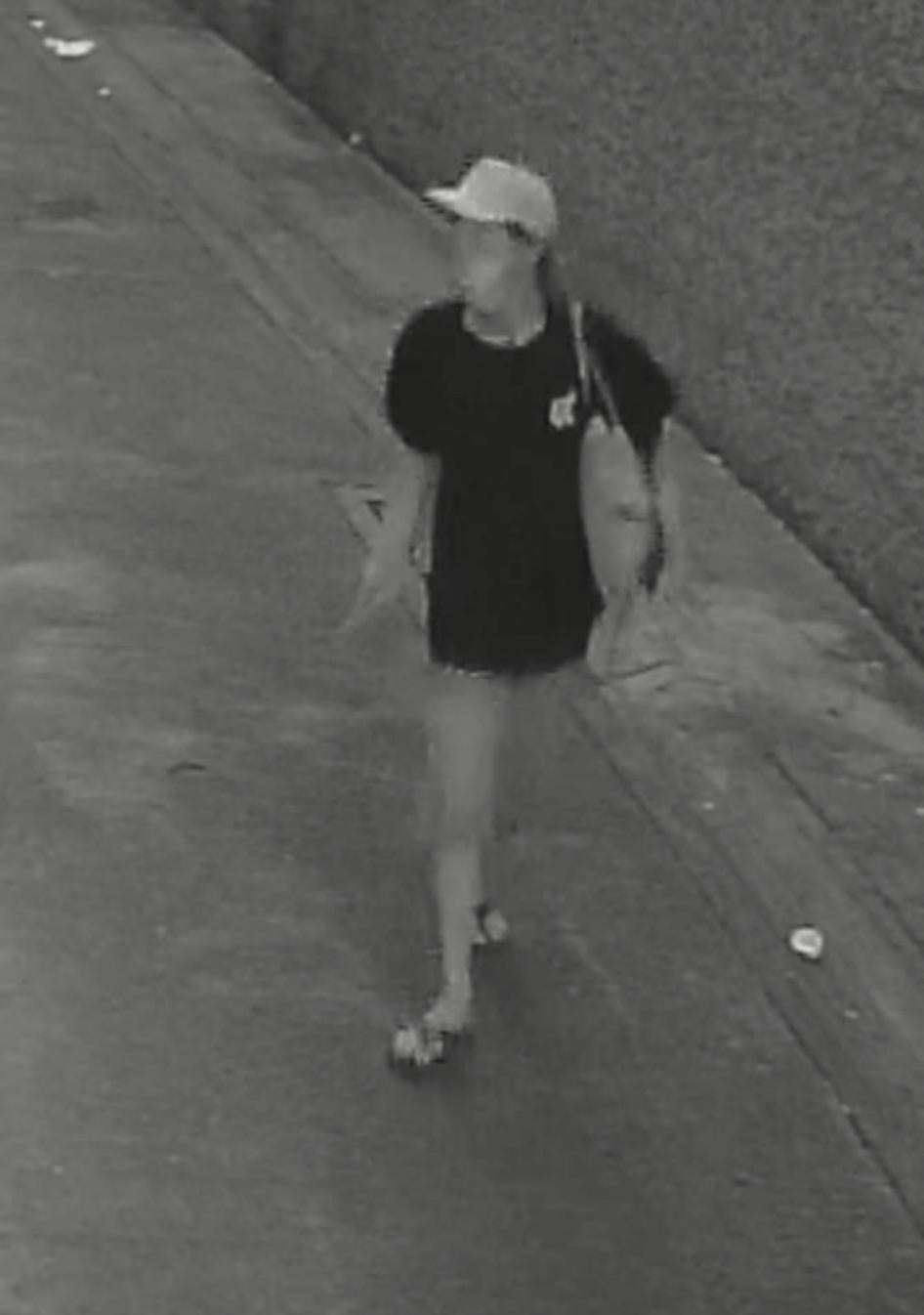
Photo captured on a security camera of the alleged assailant, a woman wearing a mask and a black t-shirt.
Photo captured on a security camera of the alleged assailant, a woman wearing a mask and a black t-shirt. © 2022 Private

The authorities in Thailand should urgently investigate an incident intended to intimidate a prominent human rights defender, Human Rights Watch said on 13 April, 2022.

On April 12, 2022, at about 6 a.m., an unidentified assailant threw a pair of 9-inch-long scissors at the house of Angkhana Neelapaijit in Bangkok, making a hole in her front door. Security camera footage showed what appeared to be a woman wearing a face mask and a dark t-shirt with the Thai numeral 9 standing in front of the house, throwing the scissors, and then running away. Angkhana, 66, is a former commissioner of the National Human Rights Commission of Thailand and a newly appointed member of the United Nations Working Group on Enforced or Involuntary Disappearances. See: https://www.trueheroesfilms.org/thedigest/laureates/0D5DED3E-F79F-4AB4-8261-F6A19486F062

Violent acts intended to intimidate a well-known figure like Angkhana not only pose a threat to her and her family, but send a spine-chilling message to the entire Thai human rights community,” said Elaine Pearson, acting Asia director at Human Rights Watch. “The Thai government should respond immediately by undertaking a serious investigation to ensure that everyone responsible for this incident is held accountable.”

Angkhana told Human Rights Watch that she and her family felt vulnerable after the Justice Ministry canceled her protection under the government’s witness protection program on April 1. The authorities claimed the service was no longer needed because Angkhana’s life would no longer be in danger after the Department of Special Investigation ended its investigation of the enforced disappearance of her husband, the prominent human rights lawyer Somchai Neelapaijit. [See also: https://humanrightsdefenders.blog/2021/03/17/where-is-somchai-a-brave-wifes-17-year-quest-for-the-truth/]

The Thai government should not ignore this disturbing incident, which appears to be a response to Angkhana’s effective human rights advocacy,” Pearson said. “Foreign governments and the United Nations should press the Thai government to urgently act to protect Angkhana and other human rights defenders in the country.”

https://www.hrw.org/news/2022/04/13/thailand-prominent-rights-defender-harassed

Pramila Patten on Enhancing the Protection of Women Human Rights Defenders and honoring Jineth Bedoya

April 14, 2022

On 12 April 2022 SRSG-SVC Pramila Patten made a statement at a side event in New York on the Protection of Women Human Rights Defenders and Journalists:

…..Today’s meeting is a critical opportunity to take stock of both the persistent and entrenched, as well as new and emerging, challenges that women activists, women human rights defenders, and women journalists face in their daily lives. The annual Report of the Secretary-General on Conflict-Related Sexual Violence, which is due to be debated tomorrow by the Security Council, notes that in 2021, women peace builders and human rights defenders were specifically targeted, including through sexual violence and harassment as a form of reprisal, in order to exclude them from public life in a number of country settings, such as Afghanistan, Libya, Myanmar, Yemen and elsewhere. Moreover, activists working to highlight the plight and rights of survivors of conflict-related sexual violence, and to support their access to justice and services, were also subjected to reprisals and intimidation, which has a chilling effect on their critical work.

The high-risk environment in which women leaders and activists are compelled to operate is directly correlated with the trend of intersecting humanitarian, security and political crises, including coups, military takeovers, and unconstitutional shifts of power seen in recent months. This has exacerbated the root causes and drivers of conflict-related sexual violence, including militarization, the proliferation of arms, impunity, the collapse of rule of law institutions, structural gender-based inequality, and harmful social norms.

Today, we will hear directly from powerful women activists who have raised their voices against injustice, at great personal risk, and continue to advocate for the eradication of conflict-related sexual violence, and the closure of accountability and protection gaps. Today’s panel of speakers will highlight the tireless efforts of women human rights defenders and journalists, as well as the risks they endure working on the frontlines of armed conflict and civic strife. In the work of my mandate, I am continually reminded that we are only as strong as our partnerships. Since I took up this mandate in 2017, I have consistently emphasized the importance of working directly with survivors as the co-creators of solutions. It is in this spirit that today, I recognize Ms. Jineth Bedoya Lima, a trailblazing survivor, activist, and agent of change, with the demonstrated ability to lead and influence others to take action to end the scourge of conflict-related sexual violence. [see: https://www.trueheroesfilms.org/thedigest/laureates/6f49a0f6-7dd6-4f95-902c-9d9f126e0bcc] I commend her courage and commitment in elevating the issue of conflict-related sexual violence onto the public agenda and historical record in Colombia and globally, and her two-decade quest for justice, truth and reparations for these heinous crimes. Her vision and determination contributed to the establishment of the National Day for the Dignity of Women Victims of Sexual Violence in the context of the internal armed conflict in Colombia, which is commemorated every year on the 25th of May. [see also: https://humanrightsdefenders.blog/2021/10/19/inter-american-court-holds-colombia-responsible-in-the-case-of-jineth-bedoya/]

I also congratulate Ms. Bedoya on the emblematic judgment delivered by the Inter-American Court of Human Rights on 18 October 2021, in connection with her case, which sets a powerful precedent for women activists, journalists, human rights defenders, and peace builders the world-over, who are subjected to, or at risk of, sexual violence. This ruling marks the first time that a court has specifically considered the use of sexual violence as a tool to silence a female journalist in the context of the Colombian armed conflict. Significantly, the judgment also entailed important reparative measures, such as the creation of a fund for the prevention, protection, and assistance of women journalists who are victims of sexual and gender-based violence.

I am pleased to announce that today I am naming Ms. Jineth Bedoya Lima a Global Champion for the Fight Against Sexual Violence in Conflict. In this capacity, she will contribute to the efforts of my mandate to enhance advocacy and awareness-raising, and to amplify the voices of survivors.

Please join me in showing our appreciation for Jineth’s remarkable journey and infinite courage. Jineth, I look forward to working with you in common cause to break not only the silence of history, which has hidden these crimes, but also the vicious cycle of violence and impunity, which must be replaced with a virtuous cycle of recognition and redress for all survivors. It is only by facing difficult truths that we can transcend them and end the seemingly endless cycle of violence.

OSRSG Sexual Violence in Conflict

https://reliefweb.int/report/world/statement-srsg-svc-pramila-patten-side-event-enhancing-protection-women-human-rights

Sudanese Fadia Khalaf, Defender of the Month of March

March 25, 2022

DefendDefenders’ regulary chooses a Defender of the Month. Here an example:

Fadia Khalaf was not meant to be an activist. By her own admission, she was born into a conservative Muslim family – the first of six siblings. In Saudi Arabia where she was born and raised, the ruling ideology in the Kingdom was wahabbism – a puritanical version of Islam in which women are strictly expected to stay in the background and not play any public role. Yet even in that conservative setting, she managed to nurture a political consciousness:

“I think reading at young age helped build my awareness on concepts like justice and rights in general. I was exposed to concepts around human freedom, and that nurtured the rebel in me,” she says. Fadia Khalaf Tweet

Now aged 25, Fadia is the Co-founder of Missing Initiative, a volunteer, youth organization dedicated to documenting all persons that are reported missing during Sudan’s ongoing political crisis. The initiative was started in the aftermath of the Khartoum massacre, when armed forces of the Sudanese Transitional Military Council attacked a protest outside the country’s military headquarters, killing at least 127 people.

From the start of protests to remove Bashir (Sudan’s long-serving President deposed in April 2019), we would always report people who we would realize never returned home after the protests. This was our way of looking out for each other. But after 3 June 2021 (the day of the Khartoum massacre), the situation was terrible. People were killed, women were raped, while many others were disappeared. All of a sudden, because of our past work, I started getting tens of phone-calls of people letting me know that their persons were missing, asking me to do something about it. I had to post all these missing cases on my social media platforms(Twitter & Instagram via @SlayKaiii) in addition to reporting to police, to try to find them. It was from that crisis that I and five other friends decided to start Missing initiative to continue searching for these people,” Fadia Khalaf Tweet

The initiative helps document persons announced missing, liaises with the police to conduct a search process, follows up on those in police detention to ensure the progress of their cases and helps some of those arrested find legal representation. To date, Missing Initiative has documented over 100 cases of missing persons, and helped locate about 60, from prisons to hospitals. Among these, at least five were found dead in city morgues.

“It’s horrifying, the conditions in which we find some of these people, if we find them at all. Some are in urgent need of medical attention from all forms of torture, others are imprisoned without charge. Others, we find, have died. But at least, it gives closure to their families,” she says. Fadia Khalaf Tweet

As a result of their work, Fadia says that Sudanese now recognise forced disappearances as a state crime, and have gradually developed a consciousness and vigilance to look out for each other against state-inspired violence.

These efforts have not been without consequences. Fadia says she and her colleagues have been threatened together with their families, and that she continues to be randomly followed and her phones tapped. She says as women human rights defenders (WHRDs) in a deeply patriarchal society, they’re even more endangered because the society does not believe they should have any rights at all, much less a voice.

“The day women rise in Sudan, patriarchy will fall because it thrives on subjugating women. And that’s why those like us are harassed because the system fears that we will awaken and empower other women to rise up and refuse to be dominated,” she says. Fadia Khalaf Tweet

Nonetheless, Fadia is optimistic, the growing women and youth agitation is unstoppable: “This spirit and desire for change, I have never seen it before. Young people are willing to die for a better country every day!  It is inspiring. All they need is to be empowered more,” she notes.

Impressive list of speakers at Oslo Freedom Forum 23-25 May 2022

March 10, 2022

Every year, human rights defenders bring their stories to the Oslo Freedom Forum stage to shed light on the struggle for freedom around the world.

The 2022 theme, CHAMPION OF CHANGE, captures the idea that celebrates both activists – who are themselves champions – and their causes, to promote positive change.

At the Oslo Konserthus, you’ll listen to talks that will expose you to a breadth of human rights issues, pro-democracy causes, and inspiring stories of nobility and triumph against monumental odds.

OFF 2022 Speakers

Areej al-Sadhan Activist & Sister of Jailed Saudi Dissident and Humanitarian Worker Abdulrahman Al-Sadhan

Bektour Iskender Kyrgyz Journalist & Free Speech Activist

Chemi Lhamo Tibetan Activist & Community Organizer

Roman Dobrokhotov Russian Investigative Journalist

Carine Kanimba Daughter of Imprisoned “Hotel Rwanda” Hero Paul Rusesabagina

Matthew Caruana Galizia Director of the Daphne Caruana Galizia Foundation

see https://www.trueheroesfilms.org/thedigest/laureates/840cf16d-c095-4033-b931-c1533f87e665

Zarifa Ghafari Exiled Afghan Activist & Politician [see: https://www.trueheroesfilms.org/thedigest/laureates/154a0717-54d4-448c-8055-cbb2bb7b7a85]

Omar Alshogre Director of Detainee Affairs at the Syrian Emergency Task Force

Agnès Callamard Secretary General of Amnesty International

see also: https://humanrightsdefenders.blog/2021/03/30/new-sg-for-amnesty-international-agnes-callamard/

Filmon Debru Eritrean Human Trafficking Survivor

Glacier Kwong Hong Kong Political & Digital Rights Activist

More details about the speakers on https://oslofreedomforum.com/oslo-freedom-forum-2022/?mc_cid=a33c5d0c01&mc_eid=f80cec329e#2022speakers

Naty Castro, human rights defender in the Philippines arbitrarily detained

March 10, 2022

On 8 March 2022 the Observatory for the Protection of Human Rights Defenders, a partnership of the World Organisation Against Torture (OMCT) and the International Federation for Human Rights (FIDH), requests an urgent intervention in the Philippines.

The Observatory has been informed by Karapatan Alliance Philippines (Karapatan) about the arbitrary detention and judicial harassment of Dr. Maria Natividad Marian “Naty” Castro, a public health practitioner and human rights defender. Ms. Castro has worked in the poorest and most marginalised areas in the Philippines as a community-based health worker. She has also worked for the defence of community rights of the indigenous Lumad and is a former National Council member of Karapatan.

In February 18, 2022, officials of the Philippine National Police (PNP) and the Philippine Army (PA) arbitrarily arrested Ms. Castro at her residence in San Juan City, Manila. The members of the PNP and PA presented an arrest warrant issued by the Regional Trial Court Branch 7 of Bayugan City, Agusan del Sur, in January 2020, on charges of “kidnapping” and “serious illegal detention” (Criminal Case No. 6527), filed by public prosecutor Genesis Efren in March 2019. Ms. Castro, together with 540 other individuals, is being accused of kidnapping and detaining an unknown individual in Barangay Kolambungan, Sibagat, Agusan del Sur Province, on December 29, 2018.

Following her arrest, Ms. Castro was taken to the San Juan City Police Station and then moved to the Quirino Memorial Medical Center in Quezon City to undergo medical examination. She was subsequently brought to the PNP’s headquarters in Camp Crame. However, neither her family members nor legal counsels were allowed to have contact with her, and their requests to bring her medicine for hypertension and diabetes were dismissed.

On the same day in the afternoon, Ms. Castro was flown to the island of Mindanao without her family or legal representatives being informed. On February 19, 2022, the authorities held Ms. Castro incommunicado. Only after multiple calls from her family and legal representatives, the PNP disclosed that Ms. Castro was being held at the Bayugan City Police Station in Agusan del Sur Province.

On the afternoon of February 20, 2022, Ms. Castro’s family and legal counsel were able to visit her and bring her medicines. On February 22, 2022, the Regional Trial Court Branch 7 of Bayugan City ordered her transfer to the Agusan del Sur Provincial Jail, where she was still being detained pending trial at the time of publication of this Urgent Appeal.

Ms. Castro’s lawyers filed a petition for bail and a motion to dismiss the charges against her. Both requests were pending before the court at the time of publication of this Urgent Appeal.

The Observatory for the Protection of Human Rights Defenders notes that since November of 2020, Ms. Castro has been a victim of red-tagging. Her name and picture have been circulated on social media platforms in Lianga, Surigao del Sur Province, falsely accusing her of being a “communist”, a “terrorist”, and a member of the New People’s Army (NPA).

Human rights defenders in the Philippines have been subjected to trumped-up charges and lengthy pre-trial arbitrary detention. Karapatan members have been subject to frequent harassment, criminalisation, and attacks, including the killing of Ms. Zara Alvarez and the arbitrary detention of Teresita Naul, Alexander Philip Abinguna, Nimfa Lanzas, and Renayn Tejero. Ms. Naul was released on October 28, 2021, after 18 months of arbitrary detention. Mr. Abinguna and Mses. Lanzas and Tejero remain detained. See also: https://humanrightsdefenders.blog/2021/05/27/william-zabel-human-rights-award-2021-to-philippines-ngo-karapatan/

https://www.fidh.org/en/issues/human-rights-defenders/philippines-arbitrary-detention-of-rights-defender-and-health

International Women’s Day 2022

March 8, 2022

International Women’s Day is today 8 March and celebratory events are being held around the world. This year’s theme is #BreakTheBias, aimed at imagining “a world free of bias, stereotypes, and discrimination.” While this special day offers hope for gender equity, it is also a reminder of the omnipresent phenomenon of violence against women, which exists regardless of the day, and needs to be addressed in a fundamental way.

See also: https://www.humanrightscareers.com/issues/why-international-womens-day-is-important/

There is too much to choose from (as usual); for last year’s see: https://humanrightsdefenders.blog/2021/03/08/celebrating-international-womens-day-in-2021/]

Still, here some concrete samples:

Upasana Rana reports Global Voices of 7 March on Nepal [https://globalvoices.org/2022/03/07/this-international-womens-day-lets-come-together-against-violence/]

On the same site Njeri Wangari tells us about how Feminist music icons from around Africa to celebrate this International Women’s Day. See her Spotify playlist with hits from artists like Fatoumata Diawara, Cesária Évora, Shishani Vranckx, Thandiswa Mazwai, and more.

Amnesty International issued a statement “International Women’s Day: Dramatic deterioration in respect for women’s rights and gender equality must be decisively reversed

  • Alarming assaults on women’s rights around the world in 2021/22. 
  • Legal protections dismantled, and women human rights defenders now at unprecedented risk.
  • Protection and promotion of women’s and girls’ rights and support for women human rights defenders crucial, including for Covid-19 recovery. 
  • Governments must act decisively to reverse regressions and uphold human rights for women and girls. 

Catastrophic attacks on human rights and gender equality over the past twelve months have lowered protection for and upped threats against women and girls across the globe.  On International Women’s Day, the organization called for bold action to reverse erosions of human rights for women and girls.   

 “Events in 2021 and in the early months of 2022 have conspired to crush the rights and dignity of millions of women and girls.  The world’s crises do not impact equally, let alone fairly. The disproportionate impacts on women’s and girls’ rights are well-documented yet still neglected, when not ignored outright.  But the facts are clear. The Covid-19 pandemic, the overwhelming rollback on women’s rights in Afghanistan, the widespread sexual violence characterizing the conflict in Ethiopia, attacks on abortion access in the US and Turkey’s withdrawal from the landmark Istanbul Convention on Gender Based Violence: each is a grave erosion of rights in its own terms but taken together? We must stand up to and stare down this global assault on women’s and girls’ dignity,” said Amnesty’s Secretary General, Agnès Callamard. [see https://www.amnesty.org/en/latest/news/2022/03/international-womens-day-dramatic-deterioration-in-respect-for-womens-rights-and-gender-equality-must-be-decisively-reversed/]

Human Rights Watch focuses on Afghanistan: On International Women’s Day, we should remember Afghanistan, and consider what the state of women’s rights there means for the struggle for gender equality worldwide. The Taliban were notorious for violating women’s rights when they ruled Afghanistan from 1996 to 2001. So, when the Taliban took control of Afghanistan again on August 15 last year, Afghan women’s rights defenders were deeply skeptical that the new rulers would be any different from the Taliban that controlled the country before, despite their pledges to respect women’s rights. They were right.

In less than seven months since taking over, the Taliban have:

  • closed most girls’ secondary schools;
  • created barriers to women and girls pursuing higher education;
  • banned women from most paid employment;
  • abolished the Ministry of Women’s Affairs;
  • restricted women’s movement including blocking them from leaving the country alone;
  • dismantled Afghanistan’s system that provided protection from gender-based violence;
  • created barriers to women and girls accessing health care;
  • beaten and abducted women’s rights protesters;
  • silenced female journalists;
  • banned women’s sports; and
  • appointed a men-only administration.

Afghanistan is not the only country where women’s rights are under attack this International Women’s Day. But the speed and extent of the obliteration of women’s rights in Afghanistan is a warning to women around the world about the fragility of progress toward equality, how quickly it can vanish, and how few will defend it. We should all be in solidarity with Afghan women; their fight is a fight for women’s rights everywhere. [See: https://www.hrw.org/news/2022/03/08/standing-afghan-women-and-girls-international-womens-day]

Caitlin Fitzsimmons in the Sydney Morning Herald of 6 March argues that “International Women’s Day highlights climate justice as a feminist issue”. Women are on the front lines of the global climate crisis, making up 80 per cent of the 21.5 million people displaced every year by climate-related events. [See: https://www.smh.com.au/environment/climate-change/international-women-s-day-highlights-climate-justice-as-a-feminist-issue-20220303-p5a1ba.html]

On International Women’s Day, UN Human Rights stands with women and girls human rights defenders of all ages, backgrounds & identities leading our collective struggle to protect our climate and environment. See.g.:

Meet Brianna Frueran, a Pacific climate change activist fighting for her native Samoan islands’ survival.

Meet Mya Pol, a content creator from the United States who advocates for disability rights and educates people about environmentalism on her social media platform.

https://news.un.org/en/story/2022/03/1113872

Profile of Woman Human Rights Defender Maria Luisa Acosta

March 8, 2022

Dr. Maria Luisa Acosta is the coordinator of the Centro de Asistencia Legal a Pueblos Indígenas (CALPI), an organisation that supports and seeks to realise the rights of Indigenous and Afrodescendant peoples and communities in Nicaragua. She shares her vision for the future and how, despite the personal toll of her work, she remains steadfast in her convictions.

States have the obligation to respect defenders, to provide them with security, to heed their calls and to consider that we are people who support the most vulnerable sectors of society, and that this is a contribution to democratic life.

https://ishr.ch/defender-stories/human-rights-defenders-story-maria-luisa-acosta-nicaragua/

Afghan human rights defender Mariam Atahi continues from far away

February 21, 2022

Mariam Atahi left Afghanistan for safe haven abroad in August 2021 with financial assistance from Journalists for Human Rights and the Daniel Pearl Foundation. However, her fight for women’s rights continues, uninterrupted.

As the Taliban began its ‘humanitarian talks’ last month in Oslo, Mariam called for the release of three fellow activists, allegedly detained for protesting against the closure of women’s universities. “It hurts me,” she said, “…to not have any information or hope to give their families asking questions about their whereabouts.”

As co-founder of the Feminine Perspectives Campaign, Mariam has been leading a fearless movement to demand accountability for the violation of women’s rights by the Taliban. In 2016, she and four colleagues interviewed women from different provinces to document “what women exactly want” and presented them during the 2016 talks with the Taliban in Qatar. They stressed that the freedom to study, work and participate in public life is important to women in urban Kabul and rural provinces alike.

This work put a target on her back. In late 2019, Mariam was working as a communications specialist at Save The Children and was informed by the National Directorate of Security in Afghanistan that she’s on the Taliban’s hit list. At the time, she was used to fielding multiple ‘mysterious calls’ a week. However, the NDS insisted she take the risk more seriously. Mariam applied for an emergency visa to India and relocated to Delhi for two months. When she returned in early 2020, the threats continued. She changed her look, her route to work and her schedule – but kept on working. In 2021, she took on a communications role with UNICEF.

Fighting for women and children’s rights is in my blood. When I see women suffering, I feel responsible. I want to build a bridge for them to reach their dreams. I have to do this work for the rest of my life.

After the Taliban takeover, Mariam decided to leave Afghanistan for a safer location where she can continue her work.

‘In Kabul, I always felt like someone is knocking at my door. I want to set myself in a better position, so I’m able to mobilize more resources to help my people. I hope to see the international community show their solidarity with Afghan women and make a solid, genuine commitment to safeguarding their rights.”