An example of how (making) film can teach young people to become human rights defenders. This comes Essex county in the USA.
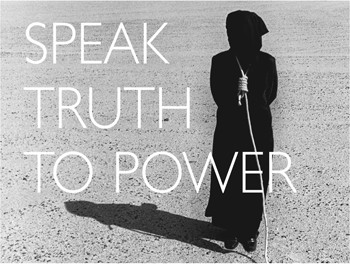
The Speak Truth To Power student video competition encourages school students to become engaged in human rights. The video contest is sponsored by New York State United Teachers and the Robert F. Kennedy Center for Justice and Human Rights and is based on Kerry Kennedy’s book Speak Truth To Power. Students who participate in the contest must choose one of the individuals identified by the RFK Center Human Rights and create a three- to five-minute short film. The contest is looking for student films that utilize creative storytelling to teach others about a human rights issue. The format is open to documentary, stop motion, narrative, digital photo essay or other innovative explorations that involve filmmaking components.
Two Bloomfield Tech students, Christopher A. Rodriguez and Julio Villegas, won the first place in the video contest with a five-minute film about genocide and focused on Holocaust survivor and human rights activist Elie Wiesel. This feat was proudly reported in the local media on 21 April:
“Essex County Executive Joseph N. DiVincenzo, Jr. and the Essex County Vocational Technical School District …… are all very proud of Chris and Julio for winning the top prize in the RFK Human Rights Center’s student film contest. ……..It was important to share their film with our Essex County audience to raise awareness of this emotional issue and to highlight the exceptional work of our students”.
The first public premiere of the film was made Tuesday, April 21st during the afternoon celebration in Newark. In addition, the will be shown at the Tribeca Film Festival in New York City on Thursday, April 23rd.
Elected and school officials shared their pride about the students’ accomplishment:
“I want to thank our students for their courage and their hard work,” Essex County Vocational Technical School Board President Father Edwin Leahy said. “Every time you speak the truth, you don’t get a crowd like this. You have to continue to do what is right even if you don’t have a lot of support”.
“Today is an amazing celebration of education,” said Bloomfield Tech Social Studies Teacher Jennifer DaSilva, who gave the students’ the assignment. “Both students have flourished in our Diaspora class. Their film is extraordinary and helps raise awareness about the tragedies taking place in the world today”.
Also sharing words of encouragement were Assemblywoman Sheila Oliver, Freeholder Patricia Sebold, Sheriff Armando Fontoura and Chief of Staff Phil Alagia.
This is already episode 69,published on 17 April 2015. This one focuses on Indonesia.
The programme begins with the latest in the decade-long fight for justice for slain human rights defender Munir Said Thalib: the naming of a street in The Hague in honour of Munir. This week, Munir’s wife travelled to The Netherlands to unveil Munir Street. AHRC TV caught up with Suciwati and learned about a recent Petition signed by Right Livelihood Award Laureates from across the world calling on Indonesian President Joko Widodo to resolve Munir’s case and prosecute those responsible for his assassination.
Next, there is a long section on the Filipino migrant worker Mary Jane Veloso who faces the firing squad in Indonesia for drug trafficking. Global campaigns are underway to stop the execution, as Veloso appears to have been duped into carrying a suitcase containing drugs into Indonesia. AHRC TV speaks with Eni Lestari of Asian Migrants Coordinating Body and Dolores Balladares of United Filipinos, who are lobbying hard to save Veloso’s life.
Finally, AHRC TV tunes in to human rights defender Chris Biantoro, who speaks about the increase in incidents of torture in Indonesia and other fatal flaws that characterise Indonesia’s criminal justice institutions.
I do no longer refer to all episodes in this remarkably long running experiment in using images as anyone can subscribe to the You Tube channel.
Whatever your opinion of George Clooney as an actor, there is no doubt that he is one of the most willing to use his celebrity for human rights causes. The latest example is his Op-Ed piece in the The New York Times, entitled, “George Clooney on Sudan’s Rape of Darfur” (together with John Prendergast and Akshaya Kumar, published on 25 February 2015) .
“Because Sudan’s government routinely blocks journalists from going into the Darfur region and severely restricts access for humanitarian workers, any window into life there is limited,” Clooney says. “The government has hammered the joint peacekeeping mission of the United Nations and African Union into silence about human rights concerns by shutting down the United Nations human rights office in the capital, Khartoum, hampering investigators of alleged human rights abuses and pressuring the peacekeeping force to withdraw.”
The 53-year-old actor then explains the evidence that has been received from citizen journalists and local human rights defenders with that videos have been smuggled out.
From the blog “News You May Have Missed” I picked up this interesting news item showing how each person can be a human rights defender when they want to:
Photo from Muslim Public Affairs Council’s Facebook page
More than 1000 Muslims formed a human shield around a synagogue in Oslo, Norway on February 21 in response to the attack on a synagogue in Denmark last weekend. Chanting “No to anti-Semitism, no to Islamophobia,” an estimated 1200-1400 Norwegian Muslims formed a “ring of peace” around the synagogue, offering symbolic protection for the city’s Jewish community. See video coverage on the NRK website here. One of the speakers in the video is 17-year-old Hajrah Asrhad, one of the event’s organizers.
Human rights defenders in the Philippines have been using information technology to advance their advocacy work. Launched in 2011, the human rights website http://www.hronlineph.com started by Egay Cabalitan and Jerbert Briola is used by human rights defenders for updates on most recent social issues in the country. The website has produced a video featuring testimonies from various advocacy groups – medical, anti-mining, human rights defenders, and international support NGOs – on the usefulness of the website.
Recently HRonlinePH launched two videos about human rights and internet rights now shared on social media outlets.
“Human rights defenders fully realize the potential of video to bring about change, And this video, a groundbreaking information tool for the HRonlinePH, is a supportive infrastructure how we can harness the power of technology and to help realize our shared interests in promoting and defending human rights, offline and online,” Human Rights Online Philippines said.
Featured in one of the videos are human rights defenders from Alyansa Tigil Mina (ATM), Asian Forum for Human Rights and Development (FORUM ASIA), Coalition Against Trafficking in Women, Asia-Pacific (CATW-AP), Medical Action Group (MAG), Partido ng Manggagawa (PM), Philippine Alliance of Human Rights Advocates (PAHRA) and Philippine Movement for Climate Justice (PMCJ).
Today, 20 January, a verdict is expected in the trial of Nabeel Rajab, an internationally recognized human rights defender in Bahrain. President of the Bahrain Center for Human Rights (BCHR), Deputy Secretary General of the International Federation for Human Rights (FIDH), and a member of Human Rights Watch’s Advisory Board, Rajab is charged with insulting public institutions via Twitter. A huge number of NGOs (see below) strongly condemn the politically motivated prosecution of Nabeel Rajab and call on the Government of Bahrain to drop all charges against the peaceful human rights defender. The video statement was prepared by True Heroes Films (THF).
On 1 October 2014, Rajab was arrested after hours of interrogation regarding one of his tweets. Rajab had just returned to Bahrain from a months-long advocacy tour, which included appearances at the 27th Session of the UN Human Rights Council in Geneva and the European Parliament in Brussels, as well as meetings with foreign ministries throughout Europe. Charged with insulting public institutions under article 216 of Bahrain’s penal code, Rajab was granted bail on 2 November 2014, but was banned from leaving the country.
[Rajab is one of many Bahrainis who have been victimized by the government’s intensified campaign to silence dissent: On 28 December, Sheikh Ali Salman, General-Secretary of Bahrain’s largest opposition party Al-Wefaq, was arrested for his political and human rights activism. Earlier in December, human rights defender Zainab al-Khawaja was sentenced to four years in prison for insulting the king and ripping up his picture, while her sister Maryam al-Khawaja, Director of Advocacy of the Gulf Center for Human Rights, was sentenced to one year in prison for allegedly assaulting a police officer during her arrest in August 2014. – https://thoolen.wordpress.com/2014/09/12/bahrain-travails-of-a-family-of-human-rights-defenders/]
To shine a light on the courageous work of women human rights defenders (WHRDs) worldwide, the NGO Protection International announces the launch of a series of interviews with women who defend human rights across the globe, from December and continuing in 2015, each month will see a new portrait of a WHRD.
This month’s conversation is with Alejandra Ancheita, a leading human rights defender from Mexico and winner of the 2014 Martin Ennals Award for Human Rights Defenders. Alejandra is the founder and executive director of The Project of Economic, Cultural, and Social Rights. To read the interview and watch the (Vimeo) video that goes with it go to Protection International’s website (see link below).
Other outstanding women lined up in the months to come include Rehana Hashmi (Pakistan), Eva Bande (Indonesia), María Martín (Spain), Porntip Honchai (Thailand).
As from 1 December the Geneva-based NGO OMCT will launch, for the 3rd year in a row, its Campaign “10 Days of Activism against torture and ill-treatment“(coinciding this year with the 30th anniversary of the UN Convention against torture). Through 10 videos, 10 human rights defenders will speak out against torture and discuss the importance of the UN Convention against Torture and its implementation in their respective countries under the slogan: “Nothing Can Justify Torture Under Any Circumstances!”. I will try and cover most of them, but you can also go to the OMCT website:
A blog that pride itself to follow with special interest what is happening in the area of film making and human rights defenders, cannot pass up this post by Queen Noor of Jordan in the Huffington Post of 21 November 2014: “Today, as the winners of the 2014 Impact Award are announced, is a good day to honour the work of documentary filmmakers everywhere. In particular, their role in documenting, highlighting and explaining human rights abuses and human rights protests even in places that western journalists cannot reach.” The growing availability of cheap small recording devices over the past years has been a major development for filmmakers and human rights defenders, allowing stories to emerge even from ‘difficult’ countries.
(No Fire Zone – one of the winners of BRITDOC Impact Award 2014)
“Four years ago, when I was part of the first Impact Award jury, we gave a special mention to the film Burma VJ. I was struck by the bravery of the Burmese video journalists who were able to capture the striking images of the SaffronRevolution.
(Luon Sovath after receiving the Martin Ennals Award for Human Rights Defenders in Geneva on 2 October 2012; left myself. AFP)
On 4 November Radio Free Asia (RFA) reports that two outspoken critics of Cambodia’s Prime Minister Hun Sen are called to court this month on vague charges of “incitement to commit a crime,” but the defendants say they have done nothing illegal. It concerns the human rights defender and monk Luon Sovath (MEA Laureate 2012) and dissident Sourn Serey Ratha (based in the USA). They received summons dated 22 October (!) signed by Phnom Penh Municipal Court deputy prosecutor Meas Chanpeseth accusing then of “incitement to commit crimes in Phnom Penh, Cambodia and abroad” in 2011, under Penal Code article 495, but the summonses, which ordered the two men to appear in court together in the capital on 25 November, do not specify what crimes they had incited or how their cases were linked.
[Under the Penal Code, incitement is vaguely defined in article 495 as directly provoking the commission of a crime or an act that creates “serious turmoil in society” through public speech, writings or drawings, or audio-visual telecommunication. Luon Sovath faces up to five years in prison if convicted, while Sourn Serey Ratha faces a total maximum punishment of 15 years.]





 Hans Thoolen on Human Rights Defenders and their awards