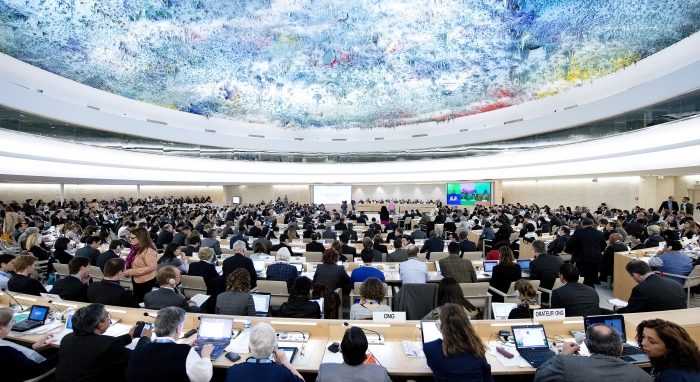
On 27 September 2019 a group of civil society organisations welcomed significant outcomes of the HRC’s 42nd session, including reaffirming its condemnation of reprisals and extending its scrutiny over Yemen, Venezuela, Cambodia, Burundi, Myanmar, and Sudan. This session witnessed heightened scrutiny of Council members by shedding light on the situation in Saudi Arabia, but it missed an opportunity to ensure scrutiny over situations in China, Kashmir and Egypt. [see also: https://humanrightsdefenders.blog/2019/09/05/human-rights-defenders-issues-at-the-42nd-session-of-the-un-human-rights-council/]
The 42nd session also advanced standards on several issues including the right to privacy, administration of justice and the death penalty, but failed to defend the mandate of the Special Rapporteur on counter-terrorism against attempts to dilute and distract its focus. The High Commissioner failed again to present the database on companies facilitating Israel’s illegal settlements.
The Council reaffirmed that reprisals can never be justified. Council members rejected attempts to weaken the text including deleting the references to the roles of the Assistant Secretary-General and the Human Rights Council Presidents. [https://humanrightsdefenders.blog/2019/09/23/andrew-gilmours-2019-report-on-reprisals-it-gets-worse-but-response-remains-mostly-rhetoric/] The resolution listed key trends such as the patterns of reprisals, increasing self-censorship, the use of national security arguments and counter-terrorism strategies by States as justification for blocking access to the UN, acknowledged the specific risks to individuals in vulnerable situations or belonging to marginalized groups, and called on the UN to implement gender-responsive policies to end reprisals. The Council called on States to combat impunity and to report back to it on how they are preventing reprisals, both online and offline.
They welcome the creation of a Fact-Finding Mission (FFM) on Venezuela as an important step towards accountability for the grave human rights violations documented by the High Commissioner.
They welcome the renewal and strengthening of the mandate of the Group of Eminent Experts on Yemen, sending a clear message to parties to the conflict – and to victims – that accountability is at the center of the mandate, and providing a crucial and much-needed deterrent to further violations and abuses. States should support the recommendations made by the GEE in their recent report, including prohibiting the authorization of transfers of, and refraining from providing, arms that could be used in the conflict to such parties; and clarifying the GEE’s role to collect and preserve evidence of abuses.
They welcome the renewal of the mandate of the Special Rapporteur on Cambodia, but regret that calls to strengthen the mandate of the OHCHR to monitor and report on the situation have been ignored. We regret that the resolution fails to accurately depict the continuing crackdowns on civil society and the severity and scale of recent attacks on the political opposition.
They welcome the renewal of the mandate of the Commission of Inquiry on Burundi. Its work is vital as the country heads towards elections in 2020. The Burundian Government should desist from denial and insults, and should cooperate with the Commission and other UN bodies and mechanisms.
They welcome that the EU and OIC have jointly presented a resolution on Myanmar requesting the High Commissioner to report on the implementation of the recommendations of the Fact-Finding Mission at HRC 45. However, the international community needs to take stronger action to ensure accountability for and cessation of grave international crimes, in particular by referring Myanmar to the ICC and imposing a global arms embargo – and by acting on the FFM’s reports, including those on economic interests of the military and on sexual and gender-based violence in Myanmar and the gendered impact of its ethnic conflicts.
On terrorism and human rights, they are deeply disappointed that Mexico and other States have partially acquiesced in attempts by Egypt to dilute or distract the work of the Special Rapporteur on counter-terrorism away from its appropriate focus on human rights violations while countering terrorism and human rights of victims of terrorism. We regret that States have asked the Special Rapporteur to spend the limited time and resources of the mandate, to comment on the overbroad concept of the “effects” of terrorism, by which Egypt and some other States seem primarily to mean macroeconomic, industrial, and investment impacts, rather than the human rights of individual victims. The length to which States seem willing to put the existing Special Rapporteur’s mandate at risk, in the name of protecting it, while failing even to incorporate stronger consensus text on human rights issues included in the most recent merged parallel resolution at the General Assembly, suggests that the merger of the previous Mexican and Egyptian thematic resolutions no longer holds any real promise of positive results for human rights.
They welcome the Council’s renewed attention to the protection of the right to privacy in the digital age: fully integrating human rights into the design, development and deployment of Artificial Intelligence, machine learning technologies, automated decision-making, and biometric systems, is essential to safeguard not only the right to privacy, but also to freedom of expression, peaceful assembly, and association, and economic social and cultural rights.
On human rights in the administration of justice, we welcome the focus in this year’s resolution on concrete measures to prevent and respond to violence, death and serious injury in situations of deprivation of liberty, which illustrates the potential of thematic resolutions to set out specific practical, legal and policy steps that can be drawn on by governments, civil society, and other stakeholders to have real positive impact at the national level.
They commend Australia for its leadership on Saudi Arabia, as well as the other States who stood up for women’s rights activists and accountability. They urge more States to live up to their commitment to defend civil society and sign the statement in the coming 2 weeks.
For five years since the last joint statement in March 2014, the Council has failed to hold Egypt accountable for continuing systematic and widespread gross human rights violations. In the latest crackdown on peaceful protests, reports indicate that more than 2000 people have been arrested in the past week. When will the Council break its silence and convene a Special Session to address the grave and deteriorating human rights situation in Egypt?
Signatories:
- International Service for Human Rights (ISHR)
- DefendDefenders (the East and Horn of Africa Human Rights Defenders Project)
- Commonwealth Human Rights Initiative (CHRI)
- CIVICUS: World Alliance for Citizen Participation
- Cairo Institute for Human Rights Studies
- Asian Legal Resource Centre
- Asian Forum for Human Rights and Development (FORUM-ASIA)
- International Commission of Jurists (ICJ)
- Amnesty International
- Association for Progressive Communications (APC)
- Human Rights Watch
- International Federation for Human Rights (FIDH)
- Physicians for Human Rights (PHR)
—————
Below the fulll list of 38 texts adopted:
Resolutions
Action on Text under Agenda Item 1 on Organizational and Procedural Matters
In a Presidential Statement (A/HRC/42/L.32) on the reports of the Advisory Committee, adopted without a vote, the Human Rights Council takes note of the reports of the Advisory Committee on its twenty-second and twenty-third sessions.
Action on Texts under Agenda Item 2 on the Report of the High Commissioner and Reports of the Office of the High Commissioner and the Secretary-General
In a resolution (A/HRC/42/L.6) on the composition of staff of the Office of the United Nations High Commissioner for Human Rights, adopted by a vote of 30 in favour, 13 against and four abstentions, the Council requests the United Nations High Commissioner for Human Rights to continue her efforts with a view to redress the current imbalance in the geographical composition of the staff of her Office and requests her to submit a report at the Council’s forty-fifth session.
In a resolution (A/HRC/42/L.16) on the human rights situation in Yemen, adopted by a vote of 22 in favour, 12 against and 11 abstentions, the Council decides to renew the mandate of the Group of Eminent International and Regional Experts for a further period of one year to, inter alia, monitor and report on the situation of human rights and carry out comprehensive investigations into all alleged violations and abuses of international human rights law and all alleged violations of international humanitarian law committed by all parties to the conflict since September 2014. The Council requests the Group of Eminent International and Regional Experts to present a comprehensive written report to the Human Rights Council at its forty-fifth session.
In a resolution ( A/HRC/42/L.21/Rev.1 ) on the situation of human rights of Rohingya Muslims and other minorities in Myanmar, adopted by a vote of 37 in favour, two against and seven abstentions, the Council requests the United Nations High Commissioner for Human Rights to follow up on the implementation of the recommendations made by the independent international fact-finding mission, including those on accountability, and to continue to track progress in the situation of human rights in Myanmar, including of Rohingya Muslims and other minorities, and to present a written report thereon to the Human Rights Council at its forty-fifth session.
In a resolution (A/HRC/42/L.38/Rev.1) on strengthening cooperation and technical assistance in the field of human rights in the Bolivarian Republic of Venezuela, adopted by a vote of 18 in favour, six against and 23 abstentions, the Council welcomes the permanent presence of the Office of the High Commissioner in Venezuela under the terms established in the memorandum of understanding signed on 20 September 2019, including unlimited access to all region and detention centres, and requests the High Commissioner to present to the Council, at its forty-third and forty-fifth sessions, as well as before the end of 2019, an oral update on the situation of human rights in Venezuela. The Council also requests the High Commissioner to submit a comprehensive written report on the situation of human rights in Venezuela at its forty-fourth session, including the outcome of the investigation on the ground into allegations of possible human rights violations to ensure the accountability of perpetrators and redress for victims.
Action on Texts under Agenda Item 3 on the Promotion and Protection of All Human Rights, including the Right to Development
In a resolution (A/HRC/42/L.1) on the human rights to safe drinking water and sanitation, adopted without a vote, the Council decides to extend the mandate of the Special Rapporteur on the human rights to safe drinking water and sanitation for a period of three years and requests the Special Rapporteur to compile good practices at the local, national, regional and international levels in order to promote the progressive realization of the human rights to safe drinking water and sanitation, and to report thereon to the Human Rights Council at its forty-fifth session.
In a resolution (A/HRC/42/L.2) on the role of prevention in the promotion and protection of human rights, adopted without a vote, the Council affirms the importance of effective preventive measures as a part of overall strategies for the promotion and protection of all human rights, and requests the Office of the High Commissioner to prepare a study, to be presented to the Human Rights Council at its forty-fifth session, on the contribution of the special procedures in assisting States and other stakeholders in the prevention of human rights violations and abuses.
In a resolution (A/HRC/42/L.5) on the World Programme for Human Rights Education: adoption of the plan of action for the fourth phase, adopted without a vote, the Council adopts the plan of action for the fourth phase (2020–2024) of the World Programme for Human Rights Education and decides to convene at its forty-eighth session a high-level panel discussion to mark the tenth anniversary of the United Nations Declaration on Human Rights Education and Training, on the theme “The tenth anniversary of the United Nations Declaration on Human Rights Education and Training: good practices, challenges and the way forward”.
In a resolution (A/HRC/42/L.7) on the promotion of a democratic and equitable international order, adopted by a vote of 25 in favour, 14 against and eight abstentions, the Council invites the Independent Expert on the promotion of a democratic and equitable international order to examine the impact of financial and economic policies pursued by international financial institutions on a democratic and equitable international order, in particular those of the World Bank and the International Monetary Fund, and to submit the report to the Human Rights Council at its forty-fifth session.
In a resolution (A/HRC/42/L.8) on the use of mercenaries as a means of violating human rights and impeding the exercise of the right of peoples to self-determination, adopted by a vote of 29 in favour, 14 against and four abstentions, the Council renews for a period of three years the mandate of the Working Group on the use of mercenaries as a means of violating human rights and impeding the exercise of the right of peoples to self-determination, and requests the Working Group to report its findings to the Human Rights Council at its forty-fifth session and to the General Assembly at its seventy-fifth session.
In a resolution (A/HRC/42/L.9) on the Special Rapporteur on contemporary forms of slavery, including its causes and consequences, adopted without a vote, the Council renews the mandate of the Special Rapporteur on contemporary forms of slavery, including its causes and consequences, for a period of three years, and requests the Special Rapporteur to submit reports on the implementation of the mandate to the Human Rights Council and the General Assembly in accordance with their annual programmes of work.
In a resolution (A/HRC/42/L.11) on human rights in the administration of justice, including juvenile justice, adopted without a vote, the Council invites States to take into consideration the issue of human rights in the administration of justice in the context of the Universal Periodic Review and requests the High Commissioner to submit to the Human Rights Council, at its forty-seventh session, an analytical report on human rights in the administration of justice, in particular on current and emerging challenges in the protection of persons deprived of their liberty, including judicial oversight.
In a resolution (A/HRC/42/L.13) on the human rights of older persons, adopted without a vote, the Council decides to extend the mandate of the Independent Expert on the enjoyment of all human rights by older persons for a period of three years, and requests the Secretary-General to ensure that the reports of the Independent Expert are brought to the attention of the Open-ended Working Group on Ageing.
In a resolution (A/HRC/42/L.14) on the right to social security, adopted without a vote, the Council decides to convene, before its forty-fifth session, an intersessional full-day panel discussion on the right to social security in the changing world of work with a view of identifying challenges and best practices. It also requests the High Commissioner for Human Rights to prepare a summary report on the panel discussion and to submit it to the Human Rights Council at its forty-sixth session.
In a resolution (A/HRC/42/L.17) on marking the twenty-fifth anniversary of the Beijing Declaration and Platform for Action, adopted without a vote, the Council decides to convene, during the high-level segment at its forty-third session, a high-level panel discussion to commemorate the twenty-fifth anniversary of the Fourth World Conference on Women, with a particular focus on the implementation of the Beijing Declaration and Platform for Action and the outcome documents of its review conferences, as well as on achievements, best practices and challenges in this regard.
In a resolution (A/HRC/42/L.18) on the right to privacy in the digital age, adopted without a vote, the Council requests the United Nations High Commissioner for Human Rights to organize, before its forty-fourth session, a one-day expert seminar to discuss how artificial intelligence, including profiling, automated decision-making and machine-learning technologies may, without proper safeguards, impact the enjoyment of the right to privacy, to prepare a thematic report on the issue, and to submit it to the Council at its forty-fifth session.
In a resolution (A/HRC/42/L.19) on the right of everyone to the enjoyment of the highest attainable standard of physical and mental health, adopted without a vote, the Council decides to extend the mandate of the Special Rapporteur on the right of everyone to the enjoyment of the highest attainable standard of physical and mental health, as established by the Human Rights Council in paragraph 1 of its resolution 6/29, for a further period of three years.
In a resolution (A/HRC/42/L.20) on human rights and transitional justice, adopted without a vote, the Council requests the Office of the United Nations High Commissioner for Human Rights to examine in a report how addressing a legacy of gross violations and abuses of human rights and serious violations of international humanitarian law through transitional justice measures can contribute to sustaining peace and the realization of Sustainable Development Goal 16, and to present the report to the Human Rights Council at its forty-sixth session.
In a resolution (A/HRC/42/L.23) on terrorism and human rights, adopted without a vote, the Council strongly condemns terrorist acts and all acts of violence committed by terrorist groups and the continued systematic and widespread abuses of human rights perpetrated by such groups, and requests States to refrain from providing support to entities or persons involved in terrorist acts, including support in establishing propaganda platforms advocating hatred that constitutes incitement to discrimination, hostility or violence, including through the Internet and other media.
In a resolution (A/HRC/42/L.24) on human rights and indigenous peoples, adopted without a vote, the Council decides to hold an intersessional round table on possible steps to be taken to enhance the participation of indigenous peoples’ representatives and institutions in meetings of the Human Rights Council on issues affecting them, with the full and effective participation of indigenous peoples’ representatives and institutions from the seven indigenous sociocultural regions represented at the thirteenth session of the Expert Mechanism on the Rights of Indigenous Peoples.
In a resolution (A/HRC/42/L.25) on human rights and indigenous peoples: mandate of the Special Rapporteur on the rights of indigenous peoples, adopted without a vote, the Council decides to renew the mandate of the Special Rapporteur on the rights of indigenous peoples for a period of three years to, inter alia, examine ways and means of overcoming existing obstacles to the full and effective protection of the rights of indigenous peoples, to pay special attention to the human rights and fundamental freedoms of indigenous children and women, and to take into account a gender perspective in the performance of the mandate.
In a resolution (A/HRC/42/L.27) on the protection of the rights of workers exposed to hazardous substances and wastes, adopted without a vote, the Council encourages States, business enterprises and other actors to implement the 15 principles presented by the Special Rapporteur on the implications for human rights of the environmentally sound management and disposal of hazardous substances and wastes through their respective legal and policy frameworks, as well as through initiatives and programmes to strengthen the coherence between human rights and occupational health and safety standards with regard to the exposure of workers to toxic substances.
In a resolution (A/HRC/42/L.34/Rev.1) on arbitrary detention, adopted without a vote, the Council decides to extend the mandate of the Working Group on Arbitrary Detention for a further period of three years, and requests the Working Group to prepare a study on arbitrary detention related to drug policies to ensure that upholding the prohibition thereon is included as part of an effective criminal justice response to drug-related crimes, and that such a response also encompasses legal guarantees and due process safeguards, and to submit to the Council at its forty-seventh session a report thereon, and to bring the report to the attention of the Commission on Narcotic Drugs as the policymaking body of the United Nations with prime responsibility for drug-control matters.
In a resolution (A/HRC/42/L.36) on the right to development, adopted by a vote of 27 in favour, 13 against and 7 abstentions as orally revised, the Council decides that, at its twenty-first session, the Working Group on the Right to Development will commence the elaboration of a draft legally binding instrument on the right to development on the basis of the draft prepared by the Chair-Rapporteur. The Council further decides to extend for a period of three years the mandate of the Special Rapporteur on the right to development, and to organize a biennial panel discussion on the right to development, starting at its forty-fifth session. It also decides to establish a subsidiary expert mechanism to provide the Council with thematic expertise on the right to development that shall consist of five independent experts who shall serve for a three-year period. The expert mechanism shall report annually to the Human Rights Council on its work and shall meet once annually for three days in Geneva and once annually for three days in New York.
In a resolution (A/HRC/42/L.37) on the question of the death penalty, adopted by a vote of 26 in favour, 14 against and 6 abstentions, the Council decides that the upcoming biennial high-level panel discussion to be held at the forty-sixth session of the Human Rights Council will address the human rights violations related to the use of the death penalty, in particular with respect to whether the use of the death penalty has a deterrent effect on crime rate, and requests the Office of the High Commissioner to prepare a summary report on the panel discussion and to submit it to the Human Rights Council at its forty-eighth session.
Action on Resolutions under Agenda Item 4 on Human Rights Situations that Require the Council’s Attention
In a resolution (A/HRC/42/L.4/Rev.1) on the situation of human rights in the Bolivarian Republic of Venezuela, adopted by a vote of 19 in favour, seven against and 21 abstentions, the Council requests the United Nations High Commissioner for Human Rights to prepare a comprehensive written report on the situation of human rights in Venezuela and to present the report to the Council at its forty-fourth session. The Council decides to establish, for a period of one year, an independent international fact-finding mission and to dispatch that mission urgently to Venezuela to investigate extrajudicial executions, enforced disappearances, arbitrary detentions and torture and other cruel, inhumane or degrading treatment since 2014, with a view to ensuring full accountability for perpetrators and justice for victims. The Council requests the mission to present a report on its findings during an interactive dialogue at its forty-fifth session.
In a resolution (A/HRC/42/L.10/Rev.1) on the situation of human rights in Burundi, adopted by a vote of 23 in favour, 11 against and 13 abstentions, the Council decides to extend the mandate of the Commission of Inquiry on Burundi in order for it to deepen its investigations, including into respect for and observance of political, civil, economic and social rights in the electoral context, until it presents a final report to the Human Rights Council during an interactive dialogue at its forty-fifth session and to the General Assembly at its seventy-fifth session. The Council requests the Commission to present an oral briefing to the Council at its forty-third and forty-fourth sessions during an interactive dialogue.
In a resolution (A/HRC/42/L.22) on the human rights situation in the Syrian Arab Republic, adopted by a vote of 27 in favour, six against and 13 abstentions, the Council deplores the fact that the conflict in the Syrian Arab Republic continues in its ninth year with its devastating impact on the civilian population, and urges all parties to the conflict to abstain immediately from any actions that may contribute to the further deterioration of the human rights, security and humanitarian situations. The Council demands that the Syrian authorities cooperate fully with the Human Rights Council and the Commission of Inquiry by granting the Commission immediate, full and unfettered access throughout the Syrian Arab Republic, and expresses deep concern about the grave humanitarian situation in the country and at the plight of the 11.7 million people in need of full, timely, immediate, unhindered and safe humanitarian assistance.
The Council welcomes the work of the International, Impartial and Independent Mechanism to Assist in the Investigation and Prosecution of Persons Responsible for the Most Serious Crimes under International Law Committed in the Syrian Arab Republic since March 2011 and its close cooperation with the Commission of Inquiry and Syrian civil society, and invites Member States to actively support the Mechanism and to provide adequate financial means for its functioning. The Council further welcomes the steps taken by Member States to prosecute the most serious crimes under international law committed in the Syrian Arab Republic in national courts under the principles of universal jurisdiction and extraterritorial jurisdiction as an important contribution to end impunity and ensure justice for victims.
Action on Resolution under Agenda Item 5 on Human Rights Bodies and Mechanisms
In a resolution (A/HRC/42/L.33/Rev.1) on cooperation with the United Nations, its representatives and mechanisms in the field of human rights, adopted by a vote of 36 in favour and 11 against, with no abstentions, as orally revised, the Council calls upon States to combat impunity by conducting prompt, impartial and independent investigations and pursuing accountability for all acts of intimidation or reprisal by State and non-State actors against any individual or group who seeks to cooperate, cooperates or has cooperated with the United Nations, its representatives and mechanisms in the field of human rights, and by condemning publicly all such acts, underlining that these can never be justified.
Action on Resolution under Agenda Item 9 on Racism, Racial Discrimination, Xenophobia and Related Intolerance
In a resolution (A/HRC/42/L.28/Rev.1) From rhetoric to reality: a global call for concrete action against racism, racial discrimination, xenophobia and related intolerance, adopted without a vote as orally revised, the Council requests the Office of the United Nations High Commissioner for Human Rights to organize, before the eleventh session of the Ad Hoc Committee on the Elaboration of Complementary Standards to the International Convention on the Elimination of All Forms of Racial Discrimination, a two-day expert seminar to consider the elements of a draft additional protocol to the Convention. It further requests the Group of Independent Eminent Experts on the Implementation of the Durban Declaration and Programme of Action to convene its seventh session for five working days during 2020 and to submit a report to the General Assembly at its seventy-fifth session.
Action on Resolutions under Agenda Item 10 on Technical Assistance and Capacity Building
In a resolution (A/HRC/42/L.3) on promoting international cooperation to support national mechanisms for implementation, reporting and follow-up, adopted without a vote, the Council requests the Office of the High Commissioner to organize five regional consultations to exchange experiences and good practices relating to the establishment and development of national mechanisms for implementation, reporting and follow-up, and their impact on effective implementation of human rights obligations and commitments.
In a resolution (A/HRC/42/L.12) on technical assistance and capacity-building for Yemen in the field of human rights, adopted without a vote, the Council requests the United Nations High Commissioner for Human Rights to continue to provide substantive capacity-building and technical assistance to the Government of Yemen and technical support to the National Commission of Inquiry to ensure that it continues to investigate allegations of violations and abuses committed by all parties to the conflict in Yemen, and requests the High Commissioner to present a written report on the implementation of technical assistance at the Council’s forty-fifth session.
In a resolution (A/HRC/42/L.15) on the enhancement of technical cooperation and capacity-building in the field of human rights, adopted without a vote, the Council decides that the theme of the annual thematic panel discussion under agenda item 10, to be held during its forty-fourth session, will be “Upholding the human rights of prisoners, including women prisoners and offenders: enhancing technical cooperation and capacity-building in the implementation of the Nelson Mandela Rules and the Bangkok Rules”.
In a resolution (A/HRC/42/L.26/Rev.1) on assistance to Somalia in the field of human rights, adopted without a vote as orally revised, the Council decides to renew the mandate of the Independent Expert on the situation of human rights in Somalia for a period of one year and requests the Independent Expert to report to the Human Rights Council at its forty-fifth session and to the General Assembly at its seventy-fifth session.
In a resolution (A/HRC/42/L.29/Rev.1) on technical assistance and capacity-building in the field of human rights in the Democratic Republic of the Congo, adopted without a vote, the Council requests the United Nations High Commissioner for Human Rights to present an oral update on the situation of human rights in the Democratic Republic of the Congo at its forty-third session and a comprehensive report at its forty-fifth session.
In a resolution (A/HRC/42/L.30) on technical assistance and capacity-building to further improve human rights in the Sudan, adopted without a vote as orally revised, the Council decides to renew the mandate of the Independent Expert on the situation of human rights in the Sudan for period of one year recognising the intention to phase out the mandate and requests the Independent Expert to present a report on the implementation of his mandate to the Human Rights Council at its forty-fifth session. The Council requests the Government of the Sudan and the Office of the High Commissioner to present their oral reports on progress towards the opening of a country office during an enhanced interactive dialogue at the Council’s forty-forth session.
In a resolution (A/HRC/42/L.31) on technical assistance and capacity-building in the field of human rights in the Central African Republic, adopted without a vote, the Council decides to renew, for one year, the mandate of the Independent Expert on the human rights situation in the Central African Republic and to organize, at its forty-third session, a high-level interactive dialogue to assess the evolution of the human rights situation on the ground, placing special emphasis on preventing the recruitment and use of children in the armed conflict and protecting their rights through their demobilization and reintegration.
In a resolution (A/HRC/42/L.35/Rev.1) on the advisory services and technical assistance for Cambodia, adopted without a vote, the Council decides to extend for two years the mandate of the Special Rapporteur on the situation of human rights in Cambodia, and requests the Special Rapporteur to report on the implementation of her mandate to the Human Rights Council at its forty-fifth and forty-eighth sessions.
http://ishr.ch/news/hrc42-civil-society-presents-key-takeaways-human-rights-council