Human Rights Watch (HRW) on Thursday 8 June 2017 called on Turkish authorities to immediately release Taner Kılıç, chair of the board of Amnesty International’s Turkey section, who has been under detention since June 6. It is heartening to see the two biggest NGOs coming to each other’ rescue from time to time. In February this year AI Israel co-signed a statement deploring the decision not to allow Omar Shakir of Human Rights Watch to take on his post [“We stand in solidarity with him and our colleagues at HRW.” – see https://humanrightsdefenders.blog/2017/02/26/israel-denies-work-permit-to-human-rights-watch-and-continues-harassment-of-hrds/]
The anti-terror unit of the Izmir police on Tuesday detained lawyer and human rights defender Kılıç together with 22 other attorneys as part of a witch-hunt targeting people linked to the Gülen movement. “Turkey should release Taner Kılıç, who is a tireless defender of human rights, known for his support for Amnesty International over many years,” said Hugh Williamson, Europe and Central Asia director at Human Rights Watch. “Detaining Kılıç on suspicion of terrorist offenses looks like a tactic aimed at discrediting his legitimate human rights work.”
Kılıç is a founding member of AI Turkey and has been chairman of its board of directors since 2014. He has also played a strong role in advocating for refugee rights as a lawyer and with domestic nongovernmental groups and others working on these issues. The European Union on Thursday expressed concern about the recent detention of Taner Kılıç.
(According to a report by the state-run Anadolu news agency on May 28, 154,694 individuals have been detained and 50,136 have been jailed due to alleged Gülen links since the failed coup attempt.
Human rights awards – one of my favorite topics [https://humanrightsdefenders.blog/?s=human+rights+awards] – come in many shapes and forms. Here two special ones: the first concerns a handicapped swimmer from Syria and other refugee related recipients (in Madrid) and the second a Turkish pianist (in Bonn).
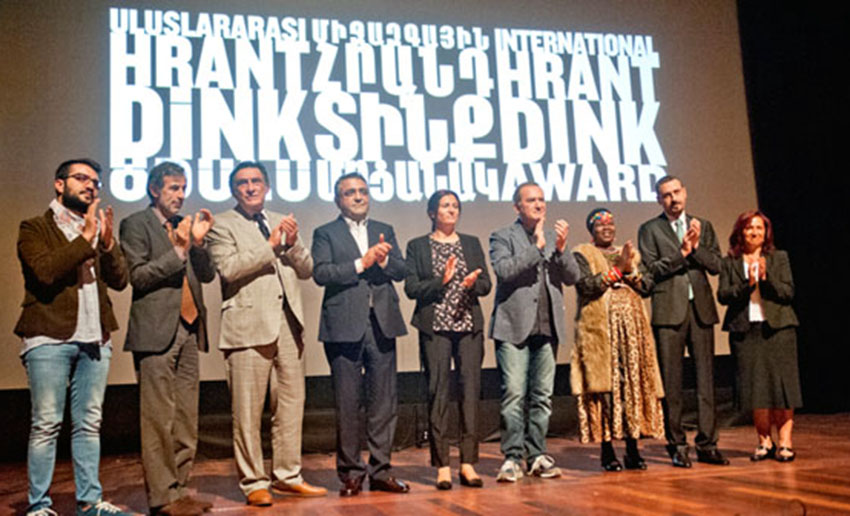
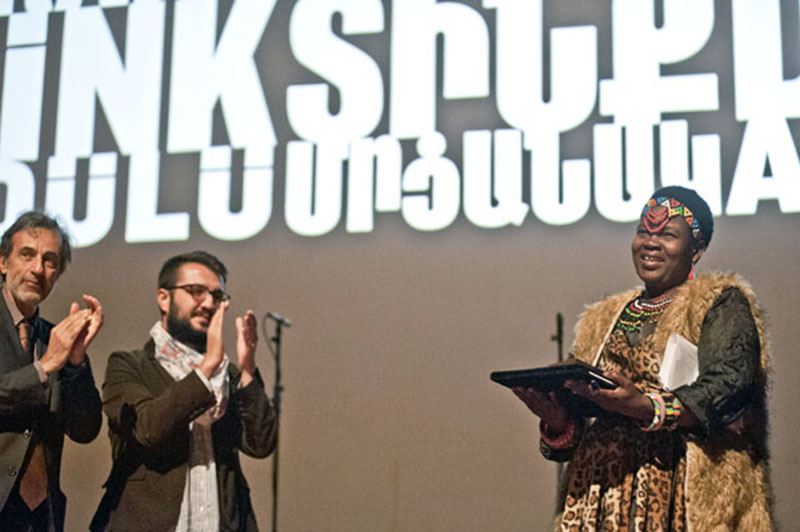
On 22 September 2016 a ceremony took place for the 8th annual ceremony of the Hrant Dink Award Granted. The laureates of the International Hrant Dink Award are the Diyarbakir Bar Association and Malawian human rights defender Theresa Kachindamoto, who works for children’s right.
Ahmet Insel, Head of the Selection Committee, made the opening speech: “It’s been almost 10 years since Hrant Dink was murdered. Nowadays, we are going through much darker times compared to 2007. The abominable coup attempt was foiled, but the state of law is completely suspended. Tens of thousands innocent people are detained without any legal procedure. Hundreds of journalists, academics, lawyers, teachers, artist and human rights defenders, meaning the usual suspects of the authoritarian regime are arrested, suspended and denied right to travel. We witnessed the arrest of Sebnem Korur Fincanci and Ahmet Altan, whose struggles were granted with Hrant Dink Award. Granted with Hrant Dink Award in 2013, Saturday Mothers (Cumartesi Anneleri) have been staging the longest civil obedience action in Turkish history; its their 600th week of protest. In times like these, the significance of the award increases. We greet the ones who struggle for creating a just and free world without violence.”
Diyarbakir Bar Association Chair Tahir Elçi was murdered on 28 November 2015 in Diyarbakir, while he was making a press statement. Deputy Chair Ahmet Özmen received the award on behalf of the association. Ahmet Özmen said inter alia: “I gratefully commemorate our dear chair Tahir Elçi, who devoted his life to the struggle for peace and freedom and sacrificed his life for this struggle….Tahir Elçi and Hrant Dink are two heroes, two human rights defenders who made history. People will remember them as intellectuals who made efforts for establishing a democratic order for the peoples of Turkey. Their only measure was rightfulness and justice. The ones who ordered their murder thought that their strong legacy will vanish and we won’t be able to follow their lead, but they are wrong.”…“Today, our most important duty and historical responsibility is to preserve and improve the legacies of Tahir Elçi and Hrant Dink. Demanding peace and speaking up for building peace is the only way.” During the ceremony, a video titled “Inspirations” was shown. People and institutions from Turkey and all around the world, who gave people hope about the future with their actions, were featured in the video. There were also people who objected to the coup and defended democracy on July 15.
Theresa Kachindamoto is the paramount chief, or Inkosi, of the Dedza District in the central region of Malawi, one of the poorest counties of Africa. For years, she has been working for preventing child marriages and defending their right to education. Becoming the chief of a tribe with 900,000 people, Kachindamoto started to struggle against child marriages, when she saw that half of the girls in the tribe are forced to marry at the ages of 12 or 13. She banned “marriage camps”, where children are abused under the name of sexual education. She managed to convince 50 tribe chiefs to abandon the traditions encouraging child marriage and to annul 850 marriages. Receiving the award from Yildiz Tar on behalf of last year’s laureate KAOS GL and Michèle Marian, Kachindamoto told the story of her struggle: “It wasn’t easy to fight against this problem. For majority of people, this practice was one of the most fundamental traditions of Malawi and encouraged by the society. We had to inform all people about the dangers and consequences of child marriage and abolish the accepted opinion which deems this practice as normal. There is no doubt that I need to push against more of the old ways of thinking to achieve my ultimate goal of removing child marriage from Malawi, and giving all girls and boys the opportunity to complete their education. I am proud of what we have achieved so far, but I am aware that there is still a long way ahead of us. I am grateful to every one who walked this way with me. I hope more people will join us and fight for the rights of Malawian girls. God bless you all.”
The Laureates of this year’s Right Livelihood Awardhave been announced today – 22 September 2016 – in Stockholm, Sweden:
SYRIA CIVIL DEFENCE (Syria)
Syria Civil Defence (The White Helmets), ‘for their outstanding bravery, compassion and humanitarian engagement in rescuing civilians from the destruction of the Syrian civil war’. It is the first time that a Right Livelihood Award goes to a Laureate from Syria.…for their outstanding bravery, compassion and humanitarian engagement in rescuing civilians from the destruction of the Syrian civil war.
The European Parliament awards the Sakharov Prizefor Freedom of Thought every year to honor individuals and organisations defending human rights and fundamental freedoms. Nominations for the Sakharov Prize are made by political groups or by at least 40 MEPs. The 4 nominees for this year’s Sakharov Prize are:
Can Dündar, the former editor-in-chief of Turkish daily Cumhuriyet, was arrested last November after his newspaper reported on Turkey’s intelligence service smuggling arms to rebels in Syria. He was later sentenced to five years and 10 months in prison for “revealing state secrets”, survived an assassination attempt and now lives in exile. He was nominated by Greens/EFA, EFDD and GUE/NGL.
Mustafa Dzhemilev, former chair of Mejlis of the Crimean Tatars People (Tatar parliament), a former Soviet dissident and a Ukrainian MP, has been standing up for human and minority rights for more than half a century. He was six months old when he and his family were deported to central Asia along with all other Crimean Tatars and was only able to come back 45 years later. Now, after Russia annexed Crimea, the human rights activist is again barred from entering the peninsula. He was nominated by EPP and ECR.
Nadia Murad Basee and Lamiya Aji Bashar are advocates for the Yazidi community and for women surviving sexual enslavement by Islamic State. They are both from Kocho, one of the villages near Sinjar, Iraq, which was taken over by Islamic State in the summer of 2014, and are among the thousands of Yazidi girls and women abducted by Islamic State militants and forced into sex slavery. Murad is also a promoter for recognition of the Yazidi genocide. They were nominated by S&D. Murad Basee was also nominated separately by ALDE.
The vote for the shortlist of three finalists will be held during a joint meeting of the foreign affairs and development committee. The Conference of Presidents, made up of the Parliament President and the political group leaders, will announce the winner(s) of the 2016 Sakharov Prize on 27 October.
Sebnem Korur Fincanci, president of the Human Rights Foundation of Turkey, and Erol Onderoglu, Turkey’s representative to Reporters Without Borders, are to remain free pending trial on charges of “propaganda for terror organization PKK,” or the Kurdistan Workers’ Party, according to the state-run Anadolu Agency. The first hearing is scheduled for November 8. A different court is handling the case against writer and journalist Ahmet Nesin and there has been no decision yet on the possibility of his release pending trial, according to Anadolu.
The three had participated in a solidarity campaign taking turns as co-editors in support of Ozgur Gundem, a pro-Kurdish publication subject to multiple investigations and lawsuits.
An academic and two journalists who play a key role in Turkey’s human rights movement have been jailed pending investigation into spurious allegations of spreading terrorist propaganda. Human Rights Watch, Reporters without Boarder, Front Line, and the Observatory for the Protection of Human Rights Defenders (a joint program of FIDH and OMCT), among others, have raised serious concern and demanded their immediate release.
An Istanbul court on 20 June, 2016, accepted a prosecutor’s request for them to be placed in pretrial detention on suspicion of having committed terrorist offenses. They are Erol Önderoglu, who is the Turkey representative of Reporters Without Borders and a journalist with the independent news website Bianet; Professor Şebnem Korur Fincancı, an academic at Istanbul University’s forensic medicine department and head of the Human Rights Foundation of Turkey; and Ahmet Nesin, a writer and journalist.
“The decision to demand the detention of Önderoğlu, Fincancı, and Nesin is a shocking new indication that the Turkish authorities have no hesitation about targeting well-known rights defenders and journalists who have played a key role in documenting the sharp deterioration in human rights in the country,” said Hugh Williamson, HRW’s Europe and Central Asia Director. “
The three were among 44 journalists, writers, and activists who participated in a solidarity campaign for media freedom in which each of them acted as a symbolic co-editor-for-a-day at the pro-Kurdish daily Özgür Gündem in Istanbul. The government sees the newspaper as hostile to it and as a result has placed it under immense pressure.
“Jailing a world-renowned journalist and human rights defender such as Erol sends a very powerful signal of intimidation to the entire profession in Turkey. It’s a new, unbelievable low for press freedom in Turkey,”Johann Bihr, head of the Eastern Europe and Central Asia desk at RSF, told CPJ. At least 14 journalists were imprisoned in Turkey on December 1, 2015, when CPJ last conducted its annual census of journalists jailed around the world. [see also: https://thoolen.wordpress.com/2016/03/20/turkey-fair-trial-human-rights-lawyers-expression-l4l/]
While the NGO reactions are expected, more remarkable is the reaction from Russia which (in the good company of the USA, the UN and the EU) has condemned the crackdown on Turkey’s press freedom: Read the rest of this entry »
The Deutsche Welle (DW) Freedom of Speech Award 2016 goes to Turkish ‘Hürriyet’ journalist Sedat Ergin. The DW prize is awarded annually to journalists who stand out in their fight for human rights and free speech. The award ceremony will on 13 June 2016 at the Global Media Forum in Bonn, Germany. Read the rest of this entry »
Attacks on higher education threaten the safety and well-being of scholars, administrators, staff and students; undermine academic work and instruction; and deny everyone the benefits of expert knowledge and scientific and creative progress. Too often such attacks go unreported. Scholars at Risk(SAR) publishes an Academic Freedom Monitorwhich tracks key attacks with the aims of protecting vulnerable individuals, promoting accountability and preventing future violations. In the period February – April 2016 SAR reports 20 incidents:





 ts and free speech. The award ceremony will on 13 June 2016 at the Global Media Forum in Bonn, Germany.
 Hans Thoolen on Human Rights Defenders and their awards