Today, 24 January 2026, marks the International Day of the Endangered Lawyer. In recognition of endangered lawyers around the world, the undersigned NGOs, express deep alarm at the growing repression of lawyers worldwide for the legitimate exercise of their professional duties. Attacks on lawyers strike at the very heart of the rule of law, deny victims meaningful access to justice, and enable wider assaults on human rights and democratic institutions.
In Russia, the regime of Vladimir Putin has moved to punish not only opponents but also those who defend them. One year ago this month, to cite just one example, lawyers Vadim Kobzev, Alexei Liptser, and Igor Sergunin, members of the defense team of the late opposition leader Alexei Navalny, were sentenced to an average of four and a half years in prison on fabricated extremism charges simply for carrying out their ordinary professional duties. Since then, Russia has intensified its harassment of lawyers, most recently arresting human rights attorney Maria Bontsler in May 2025.
In Afghanistan, the Taliban’s seizure of the Afghanistan Independent Bar Association and the transfer of licensing to the Ministry of Justice effectively stripped thousands of lawyers of their right to practise, with women lawyers almost entirely excluded from the profession.
In Iran, recent reports show a pattern of state capture of bar associations, politically motivated prosecutions, and gender specific persecution of women lawyers, which together erode fair trial guarantees for all.
In Tanzania, legal advocates have faced systemic oppression from the government, including oppression under the Advocates Act, which gives the executive branch power to manage the legal profession and control over disciplinary measures against lawyers.
In China, the regime systematically cracks down on human rights lawyers, using vague national security laws and administrative controls to dismantle the independent legal profession.
These examples are a part of a wider and well-documented trend. Lawyers are disbarred, disciplined, arbitrarily detained, prosecuted, forced into exile, subjected to surveillance and harassment, and in some cases killed, precisely because they seek to uphold the rights of their clients, including human rights defenders, opposition leaders, journalists, women, minorities, and other marginalized communities.
Despite this, lawyers continue to perform a crucial function. Even in countries without an independent and impartial judiciary, where judicial outcomes are largely predetermined, lawyers document abuses, create records of testimonies and verdicts, and preserve evidence that can one day support accountability. Their efforts also enable recourse to international and regional mechanisms once domestic remedies have been exhausted or shown to be ineffective. As the UN Special Rapporteur on the independence of judges and lawyers recognized in her 2024 report, “justice systems play an essential role in safeguarding democracy, and the work of those justice systems is carried out by people. To protect the rule of law and democracy, we must protect those people.”
Justice is never won easily. But it cannot be won at all if those who defend it are left defenseless.
On May 13, 2025, the Council of Europe (CoE) Convention on the Protection of the Profession of Lawyer opened for signature. This is the first international treaty specifically designed to safeguard lawyers from threats, harassment, and undue interference in their work. This is a historic breakthrough, but it will mean little if governments fail to give it real force. We call on all CoE member states to sign and ratify the Convention without delay and to implement it fully. We encourage states in other regions to develop complementary binding standards so that protection of the legal profession becomes a universal norm…
No lawyer should be punished for defending a client. We honour the courage of all endangered lawyers working under threat, and we reaffirm our collective commitment to protect them and to uphold the right of every person to an independent defense and a fair trial.
Respectfully,
Human Rights Foundation
The Anti-Corruption Foundation
The Arrested Lawyers Initiative
Free Russia Foundation
Freedom House
Freedom Now
George W. Bush Institute
Global Magnitsky Justice Campaign
Human Rights First
Lantos Foundation for Human Rights and Justice
Raoul Wallenberg Centre for Human Rights
Elisa Massimino, Human Rights Institute, Georgetown Law
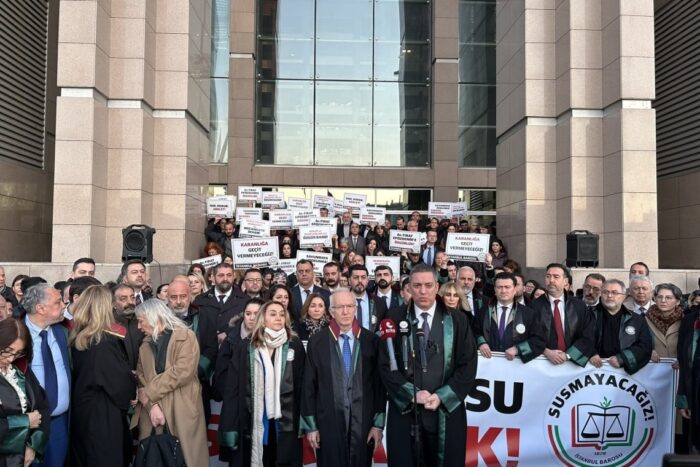
On 5 January 2026 the International Commission of Jurists and many other NGOs issued a joint statement calling on the authorities to immediately terminate the abusive criminal proceedings and drop charges ahead of the 26 Istanbul Heavy Penal Court’s expected final hearing scheduled for 5 to 9 January 2026.
The continued prosecution of the president and 10 executive board members of the Istanbul Bar Association, and the prosecutor’s request for their conviction on terrorism charges are a damning reflection of the troubled state of the rule of law and democratic norms in Turkey.
The prosecutor seeks the criminal conviction of all eleven members of the Bar’s elected leadership – President Prof. İbrahim Özden Kaboğlu, Ahmet Ergin, Bengisu Kadı Çavdar, Ekim Bilen Selimoğlu, Ezgi Şahin Yalvarici, Fırat Epözdemir, Hürrem Sönmez, Mehmedali Barış Beşli, Metin İriz, Rukiye Leyla Süren, and Yelde Koçak Urfa – on the charge of “spreading terrorist propaganda” under Article 7/2 of the Anti-Terrorism Law, solely for issuing a public statement on 21 December 2024 concerning the killing of two journalists in northern Syria and the arrest of journalists and lawyers at a related peaceful protest in Istanbul the day before.
The trial prosecutor’s final opinion confirms and deepens the concerns raised by 56 international organisations in the joint statement of January 2025, condemning the initiation of criminal and civil proceedings against the Bar’s leadership, and in the April 2025 joint statement, which deplored the removal of the elected board and the escalating attacks on lawyers across Turkey. A group of the organisations also submitted a joint amicus curiae brief in which they concluded that the proceedings violate Turkey’s obligations under international human rights law and constitute an unjustified interference with the independence of the legal profession.
A clear misuse of criminal law
In his final opinion, the prosecutor alleges that by referring to the two individuals killed in Syria as journalists and by citing international humanitarian law applicable to the protection of civilians and media workers in conflict zones, the Bar leadership “treated as a war crime” an operation carried out by security forces, thereby intentionally legitimising and disseminating the ultimate separatist aims of the Kurdistan Workers’ Party (PKK). The prosecutor further asserts that describing those killed as journalists “encouraged” membership of the PKK and “made its methods appear legitimate”, amounting to “press and media–based terrorist propaganda” under Article 7/2 of the Anti-Terrorism Law. These allegations, which claim that a lawful, rights-based statement consciously advanced the objectives of an armed organisation, are wholly unfounded and legally unsustainable.
As emphasised in both joint statements in January and April 2025 and the amicus curiae brief in September 2025, the Istanbul Bar Association has a statutory and ethical duty to speak out on violations of human rights and the rule of law. The prosecutor’s position effectively criminalises the Bar Association’s discharge of this duty protected under both domestic law and international human rights law and standards. The prosecutor’s construal of a legitimate exercise of the right to freedom of expression as a terrorism offence amounts to a misuse of criminal law and judicial harassment.
Violations of international standards and the Bar’s statutory mandate
International and regional human rights standards, including the UN Basic Principles on the Role of Lawyers, the Council of Europe Convention for the Protection of the Profession of Lawyer, and consistent jurisprudence of the European Court of Human Rights, affirm that lawyers and their associations must be able to engage in public debate on matters of justice and human rights without fear of reprisals.
Criminalising their exercise of the rights to freedom of expression and association contravenes the provisions of these instruments safeguarding the rights and role of lawyers and their professional organisations, as well as Articles 10 and 11 of the European Convention on Human Rights, Articles 19 and 22 of the International Covenant on Civil and Political Rights, and Articles 26, 27 and 33 of the Constitution of Türkiye.
The criminal proceedings strike at the heart of the independence of the legal profession and amount to a misuse of counter-terrorism laws to silence criticism, suppress human rights monitoring, and undermine self-governance of bar associations.
Signatories (in alphabetical order):
Amnesty International
Center of Elaboration and Research on Democracy (CRED)
Council of Bars and Law Societies of Europe (Le Conseil des barreaux européens, CCBE)
Defense Commission of the Barcelona Bar Association (Spain)
Deutscher Anwaltverein (German Bar Association, Germany)
Eşit Haklar İçin İzleme Derneği (Association for Monitoring Equal Rights, Türkiye)
European Association of Lawyers for Democracy and World Human Rights (ELDH)
The European Criminal Bar Association (ECBA)
Fédération des Barreaux d’Europe (European Bars Federation, FBE)
Foundation Day of the Endangered Lawyer
Hak İnsiyatifi Derneği (Rights Initiative Association, Türkiye)
Hakikat Adalet Hafıza Merkezi (Truth Justice Memory Center, Türkiye)
Haldane Society of Socialist Lawyers (UK)
Human Rights Institute of the Brussels Bar (Belgium)
Human Rights Watch
İnsan Hakları Derneği (Human Rights Association, Türkiye)
The International Association of Democratic Lawyers (IADL)
International Bar Association’s Human Rights Institute (IBAHRI)
The International Commission of Jurists (ICJ)
International Federation for Human Rights (FIDH), within the framework of the Observatory for the Protection of Human Rights Defenders
Kaos GL Derneği (Kaos GL Association, Türkiye)
The Law Society of England and Wales (LSEW, UK)
Lawyers for Lawyers (Netherlands)
Lawyers’ Rights Watch Canada (LRWC, Canada)
Lyon Bar Association (France)
National Union of Peoples Lawyers (NUPL, Philippines)
PEN Norway (Norway)
Turkey Litigation Support Project (TLSP, UK)
Türkiye İnsan Hakları Vakfı (Human Rights Foundation of Turkey, Türkiye)
Vereinigung Demokratischer Jurist:innen VDJ (Association of Democratic Jurists, Germany)
World Organisation Against Torture (OMCT), within the framework of the Observatory for the Protection of Human Rights Defenders
then on 9 January 2026 Amnesty stated “The decision to acquit the Istanbul Bar Association leadership of these unfounded charges is welcome news. This case was a clear misuse of criminal law and should never have been brought in the first place.” https://www.amnesty.org/en/latest/news/
On 5 August 2025, human rights defender Enes Hocaoğulları was detained at the Ankara Esenboğa Airport, on his return to Türkiye due to an arrest warrant issued by an Istanbul court, in connection with ongoing investigations into a speech he made at the 48th session of the Congress of Local and Regional Authorities of the Council of Europe on 27 March 2025.
Enes Hocaoğulları is a youth and LGBTI+ rights defender based in Ankara, Türkiye. Since 2022, he works as the International Advocacy and Fundraising Coordinator at ÜniKuir Association, an LGBTI+ rights organisation in Türkiye. His focus is on diplomatic engagement, monitoring youth rights, reporting and advocacy. His climate activism during his high school years eventually evolved into a fight for human rights and democracy. In February 2025, he was selected as the youth delegate from Türkiye for the Congress of Local and Regional Authorities of the Council of Europe.
On 5 August 2025, human rights defender Enes Hocaoğulları was detained at the Ankara Esenboğa Airport, on his return to Türkiye due to an arrest warrant issued by an Istanbul court, in connection with ongoing investigations into a speech he made at the 48th session of the Congress of Local and Regional Authorities of the Council of Europe on 27 March 2025.
The judgeship ruled for the pre-trial detention of Enes Hocaoğulları, justifying the decision by stating that there is strong suspicion that the human rights defender might flee. This is despite the fact that he returned to Türkiye aware of the risk of arrest upon arrival. Following the pre-trial arrest decision, he was transferred to Sincan Prison in Ankara.
In February 2025, Enes Hocaoğulları was selected as the youth delegate of Türkiye for the Congress of Local and Regional Authorities of the Council of Europe. On 24-27 March 2025, the human rights defender attended the 48th session of the Congress, where he delivered several speeches, including on 27 March 2025, when he gave a speech detailing police violence imposed on protesters in Türkiye, including attacks with tear gas, rubber bullets and water cannons, and the strip search of detained students. He called on the international community to act against the human rights violations in Türkiye.
The speech, which was recorded and posted online, went viral on social media. This led to a smear and hate campaign against the youth and LGBTI+ rights defender, accusing him of being a traitor, foreign agent and a queer who wants to “spread LGBTI+ ideology”. Additionally, investigations were initiated by Ankara and Istanbul Chief Public Prosecutors’ Office under articles 216 (inciting public to hatred and hostility) and 217/A (defamation law) of the Turkish Penal Code respectively, which were later consolidated under Ankara prosecutor’s office. An additional investigation was initiated by the Kırşehir Prosecutor’s Office under article 301 of the Turkish Penal Code (insulting the Turkish nation, the Republic of Turkey, or the institutions and organs of the state).
Front Line Defenders believes that the human rights defender was solely arrested for his peaceful human rights work and for exercising his right to free expression to explain the human rights violations that he has personally witnessed. It is particularly worrying that he was targeted for a speech that he made at the Council of Europe, which Türkiye is a member of.
On 4 April 2025 a joint statement by 13 international, regional and national civil society organisations, strongly condemned violations of the right to protest in Turkey, including police brutality, ill-treatment that may amount to torture, mass arbitrary detentions, and the systematic persecution of human rights defenders.
Mass protests erupted across Turkey on 19 March 2025, following the detention of more than 100 individuals —including the Mayor of Istanbul, Ekrem İmamoğlu. These arrests, made as part of investigations into allegations of “corruption” and “terrorism”, and their timing have raised widespread concerns that the charges are politically motivated – just days before İmamoğlu’s expected presidential candidacy.
In the immediate aftermath of the arrests, authorities imposed sweeping restrictions, including days-long blanket bans on gatherings across multiple cities, restricted access to several social media platforms curbing access and preventing the dissemination of information, and shut down major public transportation routes in İstanbul, all in a systematic effort to suppress dissent and mobilisations.
Despite these measures, thousands have continued to gather in protest across the country since 19 March. While protests have been overwhelmingly peaceful, journalists and civil society organisations have documented grave human rights violations in several locations, and particularly in Saraçhane, Istanbul, including an indiscriminate and disproportionate display of police violence and brutality that may amount to torture and other ill-treatment, including beatings with batons, demonstrators being kicked while subdued on the ground, close-range targeting with Kinetic Impact Projectiles (KIPs), as well as the indiscriminate use of chemical irritants and water cannons. Based on widely circulated footage and public testimonies, and in line with the UN Committee Against Torture’s recommendations to Turkey following its periodic review in 2024, the Human Rights Foundation of Turkey (TİHV) has also denounced the use of restraint methods that inflict unnecessary pain, such as prolonged handcuffing behind the back and stress positions. These practices, known to cause serious health consequences, have at times been publicised by police officers themselves via personal accounts, seemingly as a tactic of intimidation.
Reports have stated that protesters who have been met with excessive police force have suffered grave and long-lasting injuries such as head trauma and eye damage due to tear gas cartridges and KIPs, burns and respiratory issues due to the indiscriminate and widespread use of tear gas and water cannons, which in some cases resulted in their hospitalisation. The full extent of the injuries, as well as the physical and psychological toll on protesters’ health, will only become clear in the following months.
According to the report of Human Rights Association (İHD), as of 27 March 2025, a total of 1,879 people—including children, lawyers, journalists, students, union leaders and human rights defenders—have been taken into custody during protests and house raids on the grounds of inciting protests, engaging in violence, concealing their faces with masks, and using bats or other objects. Over 260 of them have been placed in pre-trial detention, while judicial control measures have been imposed on 468 individuals simply for exercising their right to peaceful protest. Istanbul Bar Association Child Rights Committee reported that among the arrested in İstanbul, 20 were under the age of 18.
Progressive Lawyers Association (ÇHD) also highlights incidents of torture, ill-treatment and sexual violence in detention facilities. Lawyers have denounced the treatment of seven female detainees who were subjected to beatings as well as unjustified strip searches while in custody. According to a released testimony, another female victim reported being groped by a police officer while handcuffed behind the back and forcefully pinned to the ground and that she soiled herself out of fear during the ordeal. She was reportedly placed under house arrest after her testimony. The Turkish Medical Association has recalled the importance of medical examinations upon entry in custody and detention to prevent and document torture and other ill-treatment.
Human rights defenders, including those monitoring the protests, have also become targets of State repression during the protests. Journalists and media organisations covering protests have also been persecuted, infringing on the right to freedom of expression and the right to information. As of 28 March, at least 14 journalists were detained after covering the protest.
Lawyers representing those who were arbitrarily detained in the context of protests, were also targeted. At least 14 lawyers were detained, including the lawyer of İmamoğlu, demonstrating the State authorities’ disregard for the rule of law and the right to defence, due process and justice. In the midst of the protests as part of the general intimidation strategy against lawyers, on 21 March the Istanbul Bar Association’s executive board was dismissed by the decision of İstanbul 2nd Civil Court of First Instance- a move that raises serious concerns of further attacks on the independence of the legal profession and the detainees’ right to legal representation. Following the decision, police interfered as lawyers attempted to march from the courthouse in Çağlayan to the Istanbul Bar Association building in Taksim to protest the decision.
Signatories:
ARTICLE 19
Asociación Unidad de Defensa Jurídica, Registro y Memoria para Nicaragua (AUDJUDRNIC)
CIVICUS: World Alliance for Citizen Participation
EuroMed Rights
Front Line Defenders
Gulf Centre for Human Rights (GCHR)
ILGA-Europe
United Against Torture Consortium (UATC), through its following members:
The International Rehabilitation Council for Torture Victims (IRCT)
Omega Research Foundation
Redress
And the World Organisation Against Torture (OMCT)
Unidad de Protección a Defensoras y Defensores de Derechos Humanos – Guatemala (UDEFEGUA)
Within the framework of the Observatory for the Protection of Human Rights Defenders:
Twenty-three human rights organizations have called for the immediate release of İstanbul Bar Association executive board member Fırat Epözdemir, who was arrested last week over alleged ties to the outlawed Kurdistan Workers’ Party (PKK), the Media and Law Studies Association reported February 3, 2025,
Advocacy groups condemned his detention as unlawful and part of a broader crackdown on human rights defenders and legal professionals in Turkey.
The Human Rights Defenders Solidarity Network (İHSDA) issued a statement denouncing Epözdemir’s arrest and urging authorities to drop the charges. The statement, signed by multiple rights organizations, emphasized that targeting lawyers and human rights advocates with judicial harassment is unacceptable.
Epözdemir was arrested Saturday by an İstanbul court on charges of “membership in an armed terrorist group” and “disseminating terrorist propaganda.”
Prosecutors in İstanbul accuse Epözdemir of joining a PKK-linked WhatsApp group in 2015, during the peak of clashes between Kurdish militants and Turkish security forces in the country’s predominantly Kurdish southeast.
The PKK has waged an armed insurgency against the Turkish state since 1984, a conflict that has left more than 40,000 people dead.
Epözdemir’s legal team has faced severe restrictions in accessing case files due to a confidentiality order, preventing them from reviewing the evidence against him. Authorities also imposed a 24-hour ban on lawyer visits without providing a clear justification, raising concerns of due process violations.
The joint statement criticized the prosecution’s reliance on a decade-old public event and phone conversations as grounds for Epözdemir’s arrest, calling the charges baseless and politically motivated.
His detention, rights groups argue, is an attack on the legal profession and human rights advocacy in Turkey. They linked his arrest to broader efforts to suppress dissent, noting that members of the İstanbul Bar Association have faced mounting pressure after issuing a statement regarding two journalists killed in Syria.
“Lawyers and bar associations must not be criminalized for their advocacy and defense of fundamental rights,” the statement said. “We reject all attempts to silence human rights defenders and demand the immediate and unconditional release of Fırat Epözdemir.”
Among the signatories were the MLSA, the Human Rights Association (İHD), Civil Rights Defenders, the Turkish Human Rights Foundation (TİHV) and numerous other civil society organizations.
A United Nations special rapporteur on Thursday 16 January 2025 condemned Turkey’s continued use of counterterrorism laws to imprison human rights lawyers and activists, calling it a violation of international human rights obligations.
Mary Lawlor, the UN special rapporteur on human rights defenders, expressed alarm over the long-term detention of nine Turkish human rights lawyers and activists who were sentenced to lengthy prison terms on what she described as “spurious terrorism-related charges.”
The group includes eight members of the Progressive Lawyers’ Association (ÇHD) who were arrested between 2018 and 2019 and convicted under Turkey’s Anti-Terror Law: Barkın Timtik, Aytaç Ünsal, Özgür Yılmaz, Behiç Aşçı, Engin Gökoğlu, Süleyman Gökten, Selçuk Kozağaçlı and Oya Aslan. They were sentenced to up to 13 years in prison in what has been widely criticized as an unfair trial, known as the ÇHD II trial.
Another arrestee, lawyer Turan Canpolat of the Malatya Bar Association, was imprisoned in 2016 based on the testimony of a client who later admitted he had been coerced. Canpolat was convicted of alleged links to the Gülen movement, inspired by the late Turkish cleric Fethullah Gülen, which Ankara accuses of orchestrating a coup attempt in 2016, and sentenced to 10 years in prison. The Gülen movement denies involvement in the coup.
Canpolat was detained in 2016 after responding to a police search at a client’s residence, only to find himself accused based on doctored evidence and coerced testimony. Despite the dismissal of related charges against others implicated in his case and the recanting of key testimony, he remains in prison. His conviction was based on his legal representation of companies later closed by emergency decrees after the coup, a move critics argue criminalizes standard legal work. International legal groups have denounced his imprisonment as a miscarriage of justice, calling for his release.
All nine lawyers are currently held in high-security prisons, and Canpolat has reportedly been kept in solitary confinement for nearly three years without a disciplinary order, a practice the UN expert found “extremely disturbing.”
Lawlor has raised concerns about their cases since the beginning of her mandate in 2020, but Turkey has continued to criminalize their work. “I remain dismayed that the criminalization of their human rights work has not stopped,” she said.
She urged Turkish authorities to comply with international human rights law and guarantee fair appeal hearings for the detained lawyers. “I am ready to discuss this further with Turkish authorities,” she added.
The Turkish government has repeatedly been criticized for using broad anti-terror laws to silence political dissent and imprison journalists, lawyers and activists. Since the 2016 coup attempt, Turkey has arrested thousands on terrorism-related charges, often based on tenuous evidence such as social media posts or association with banned groups.
International human rights organizations, including Amnesty International and Human Rights Watch, have condemned Turkey for what they describe as politically motivated prosecutions and the erosion of due process. The European Court of Human Rights has ruled against Turkey in multiple cases, finding that it has violated the right to a fair trial and engaged in arbitrary detention.
The Turkish government has refused to respond to allegations of systematic repression against individuals allegedly affiliated with the Gülen movement made by United Nations special rapporteurs, according to official documents published on Friday by the Office of the United Nations High Commissioner for Human Rights.
In a joint letter dated October 7, 2024, seven UN special rapporteurs asked the Turkish government about alleged measures of “systematic repression against persons ostensibly affiliated with the Gülen Movement through the misuse of counter-terrorism legislation, and the concomitant impact on civil society, human rights defenders, political dissidents, and journalists.”
The allegations center on Turkey’s treatment of people allegedly associated with the faith-based Gülen movement, inspired by the late Muslim cleric Fethullah Gülen.
In its response via a diplomatic note dated October 30, the Turkish government refrained from answering the allegations brought up by the special rapporteurs and instead listed their accusations against the Gülen movement and requested the “Special Procedures of the Human Rights Council not to allow FETÖ and its members to abuse these mechanisms, and to dismiss their allegations.”
FETÖ is a derogatory acronym used to refer to the Gülen movement as a terrorist organization.
Turkish President Recep Tayyip Erdoğan has been pursuing followers of the Gülen movement since corruption investigations revealed in 2013 implicated then-Prime Minister Erdoğan and some members of his family and his inner circle.
Dismissing the investigations as a Gülenist coup and conspiracy against his government, Erdoğan designated the movement a terrorist organization and began to target its members. He intensified the crackdown on the movement following an abortive putsch in 2016 that he accused Gülen of masterminding. The movement has strongly denied involvement in the coup attempt or any terrorist activity.
The rapporteurs outlined practices they say violate international human rights laws, including arbitrary arrests, torture, transnational renditions and surveillance abuses.
The UN Rapporteurs said these individuals face intensified crackdowns involving mass detentions, forced disappearances and unjust prosecutions under vague anti-terrorism laws. Between June 2023 and June 2024, more than 8,800 people were detained and 1,500 were charged with terrorism offenses, they said.
Among the rapporteurs’ chief concerns was the treatment of children detained as part of these operations. In May 2024, 16 children were arrested in İstanbul and allegedly subjected to psychological pressure, physical torture and denial of legal counsel. The UN rapporteurs described these actions as clear violations of international protections for children under the Convention on the Rights of the Child.
The rapporteurs also criticized Turkey’s use of public “grey lists,” wanted lists where individuals — ranging from journalists to human rights defenders — are labeled as terrorists, often without evidence or due process. These lists, which include photos and personal details, are made public alongside monetary rewards for information leading to their capture. This practice, according to the rapporteurs, endangers lives, undermines freedoms and creates a “hitman economy.”
Another key concern involved transnational renditions. The rapporteurs alleged that Turkey has systematically abducted and forcibly returned suspected Gülen affiliates from other countries under vague bilateral security agreements. Victims were reportedly detained in secret, subjected to torture and coerced into confessions used in prosecutions.
The misuse of surveillance powers also drew heavy criticism. Turkey’s intelligence agency was accused of fabricating evidence from the ByLock messaging app to convict thousands of people on tenuous charges of affiliation with the Gülen movement. The UN noted that such actions lack due process and violate privacy rights under international law.
The rapporteurs called on Turkey to address these alleged violations, halt ongoing abuses and ensure compliance with international human rights standards. They expressed particular concern about the government’s expansive interpretation of anti-terrorism laws, which they argue target legitimate political activity, dissent and human rights advocacy.
The letter was authored by seven UN special rapporteurs and a UN expert, including Mary Lawlor, special rapporteur on the situation of human rights defenders; Alice Jill Edwards, special rapporteur on torture and other cruel, inhuman or degrading treatment or punishment; and Fionnuala Ní Aoláin, special rapporteur on the promotion and protection of human rights while countering terrorism. Other contributors included Gabriella Citroni, chair-rapporteur of the Working Group on Enforced or Involuntary Disappearances and Irene Khan, special rapporteur on freedom of opinion and expression.
Mehmet Onat Sarıtaş, UN Volunteer with UNICEF in Türkiye supports the design and implementation of climate change-related programmes.
Diana Assenova, Mehmet Onat Sarıtaş and Madinabonu Salaidinova have one thing in common — They are young volunteers who believe that progress cannot be made without youth. Let’s hear from them in their own words.
“By investing in education, building the capacity of community members, and fostering global citizenship, young people play a crucial role in creating a better future that is inclusive, equitable, and sustainable for generations to come.” The words of Diana Assenova, a UN Volunteer Education Assistant with the UN Refugee Agency (UNHCR) in Kazakhstan resonate with the importance of youth and progress.
Diana focuses on the rights of youth refugees by making sure they have equal access to education. She coordinates the DAFI Scholarship Programme, through which, young refugees get education support. She encourages many more opportunities for education for refugee youth in Kazakhstan via awareness and advocacy campaigns.
The enthusiasm of youth propels her efforts — she recounts how she volunteered to organize a summer camp for teenagers from the displaced population.
The energy of working together with young people was unforgettable! This reaffirmed my dedication to making a positive impact through volunteerism.” Diana Assenova, UN Volunteer with UNHCR Kazakhstan
Another young and skilled UN Volunteer is Mehmet Onat Sarıtaş who serves with the UN Children’s Fund (UNICEF) in Türkiye as an Adolescent Development and Participation Assistant. Onat is witness to the disproportionate impact of climate change on the lives of children and adolescents in Türkiye and that is when he decided to volunteer. He values collective volunteer action to create a greener world for children.
Onat supports the design and implementation of environment-related projects. He also coordinates UNICEF’s climate-focused youth platforms, performs administrative tasks and collects data.
Youth platforms give Onat the opportunity for peer-to-peer support and technical assistance to young people. This close communication and learning has helped strengthen UNICEF’s relations with young people, he notes.
Next, we have the voice of UN Volunteer, Madinabonu Salaidinova, “I focus on increasing the engagement of young leaders from the south of Kyrgyzstan in civic activism and strengthening their potential to promote human rights.”
Madinabonu serves as a Legal and Monitoring Volunteer with the Office of the United Nations High Commissioner for Human Rights (OHCHR) Regional Office for Central Asia in Kyrgyzstan.
She monitors media channels, observes trials, and engages with the government and civil society partners, including human rights defenders. She also responds to individual complaints of alleged human rights violations submitted to OHCHR from five Central Asian countries — Kazakhstan, Kyrgyzstan, Tajikistan, Turkmenistan and Uzbekistan.
Including youth in decision-making is crucial, says Madinabonu. She feels that her voice is heard and appreciated. This gives her momentum to bring her ideas to fruition.
I appreciate that OHCHR gives me opportunities to integrate my interests and ideas into my work. I feel that I’m where I’m supposed to be right now.” Madinabonu Salaidinova, UN Volunteer with OHCHR Kyrgyzstan.
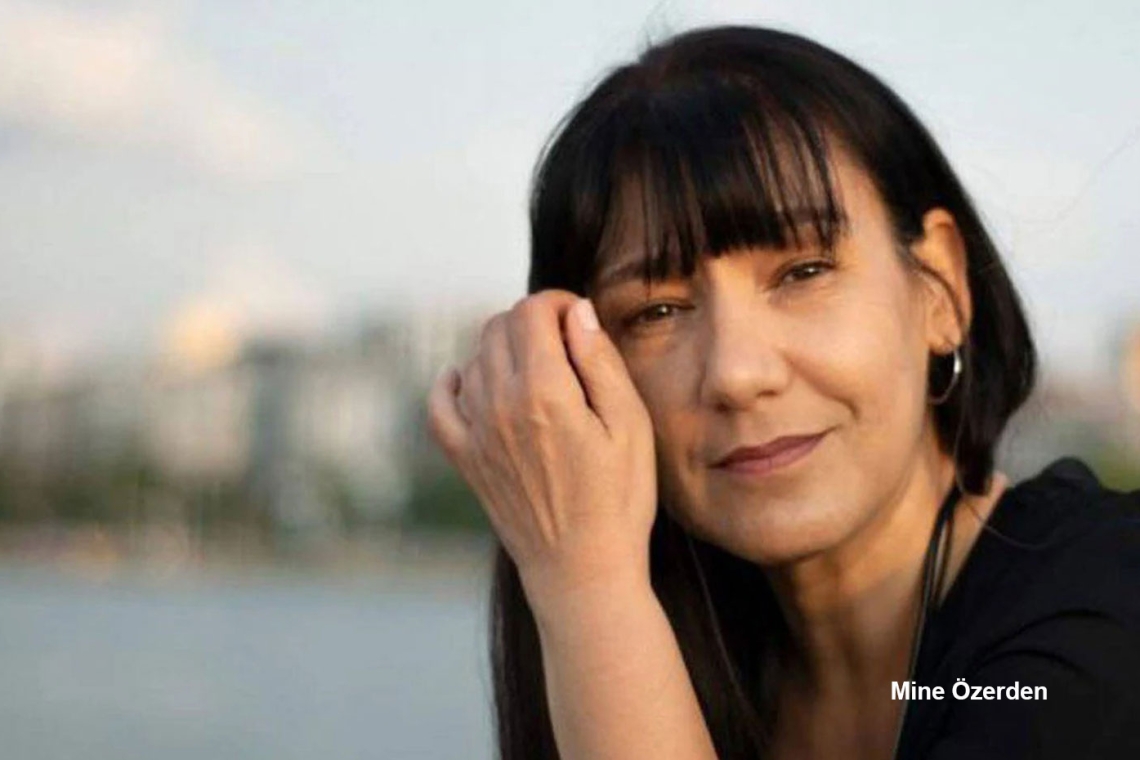
On 1 April 2024, Media and Law Studies Association (MLSA is a human rights organization committed to protecting freedom of expression, press freedom, the right to assemble and protest, and access to information in Turkey. It serves as a vital platform where journalism and legal expertise merge to safeguard these freedoms, particularly for journalists, lawyers, and human rights defenders facing increasing challenges). SEMRA PELEK wrote about Mine Özerden, a human rights defender now detained for 700 days. The detailed statement if woth reading in full:
From Mine Özerden’s standpoint, the Gezi Trial began with an unsubstantiated criminal complaint. Despite efforts, no informant was identified. Tax inspectors investigated the allegations but couldn’t confirm them. The court ruled the phone taps used as evidence were illegal. Nonetheless, Özerden was sentenced to 18 years and has been in prison for nearly two years.
“I’ve said this repeatedly, and I’ll say it again: I still can’t comprehend why I’m here, and there hasn’t been anyone who could logically explain it to me yet.”
With these words, Mine Özerden began her defense during the session of the Gezi Trial held at the Istanbul 13th Heavy Penal Court on October 8, 2021. She posed the same question during her defense at the session held on January 17, 2022. Özerden has been asking the same question at every hearing since the initial session of the Gezi Trial on June 25, 2019. However, in the years that have passed, she has received no answer to her question throughout the entire legal process.
Mine Özerden’s lawyer requested an explanation from the prosecutor through the court regarding this matter. However, the court rejected the request: “The request for a statement from the Public Prosecutor regarding which acts and crimes are being attributed to the defendant Mine Özerden by the defense attorney has been rejected…”
The court failed to provide any justification or further clarification of the rejection. However, according to the Code of Criminal Procedure, every defendant has the right to effectively present their defense, and the right to “be informed.” This means that prosecutors and courts are obligated to inform the defendant of the accusations against them to ensure a fair trial. The laws clearly state this right, however, Mine Özerden was not granted this right throughout the entire trial, and the judiciary system did not provide any logical explanation for this.
Let’s ask a question of our own here: Is there no answer to Ozerden’s question in the 657-page indictment written by the prosecution, which led to Osman Kavala’s aggravated life sentence and the 18-year sentences that Mine Özerden, Çiğdem Mater, Tayfun Kahraman, and Can Atalay have been given in the Gezi Trials? They are currently convicted of serious charges such as “attempting to overthrow the Republic of Turkey by force and violence” and “aiding this attempt,” which means the higher Court of Cassation also signed off on the decision. In the document of approval released by the Court of Cassation, is there any answer to the aforementioned question? No, there isn’t!
Scrutinizing the Gezi Trial files, one question remains: Why is Mine Özerden in prison?
And you can’t find the answer to that question. After poring over the files line by line, one can’t help but be reminded of Kafka’s novel, The Trial. So much so that you could replace the protagonist Josef K.’s name with Mine Özerden’s: “Somebody must have made a false accusation against Mine Özerden, for she was arrested one morning without having done anything wrong.”
This is exactly how the Gezi Trial, which today stands like a specter against the freedom of expression and assembly not only of the defendants but of the whole society, began for Mine Özerden.
Let’s start from the beginning: On September 26, 2013, a “criminal complaint” was sent via email to the Istanbul Communication Electronics Branch Directorate. According to the indictment, the person, who didn’t provide their name in “criminal complaint number 11167,” claimed to have “important information regarding the Gezi protests” and alleged that “before the protests began in Taksim, Mine Özerden opened bank accounts for several individuals under the direction of Osman Kavala from the Open Society Foundation.” According to the informant’s claim, the money collected in these accounts was intended to purchase “gas masks, bandages, and goggles,” which would then be “distributed to protesters.”
In the thousands of pages of the Gezi Trial file, this is the sole allegation concerning Mine Özerden.
Following up on this allegation requires due diligence in seeking the facts. Unlike Kafka’s novel, Özerden’s experiences are not allegorical but real; she has been held in Bakırköy Women’s Prison for nearly two years due to this unsubstantiated criminal complaint.
In the indictment, the prosecutor – after quoting the informant’s claim in quotation marks and bold black letters – immediately indicates in the next sentence that they “could not locate the informant”: “Upon the instruction of our Republic Prosecutor’s Office, an investigation was conducted into the IP address to obtain a detailed statement from the informant, however, no identification was made.”
In other words, the informant could not be found. So, were the bank accounts alleged by the informant opened?
No!
That, in fact, is the following sentence, where the prosecutor offers his admission that the informant could not be found. In the indictment, Istanbul Foundation’s 1st Regional Directorate’s investigation of the accounts of the Open Society Foundation, eventually preparing a report on this inquiry, but the report clearly stated that “no determination could be made regarding these allegations.”
In other words, the claim of an unidentified informant could not be substantiated.
On April 22, 2022 Mine Özerden’s lawyer submitted Tax documents, which proved that the informant’s claim was false to the file.
The court dismissed the Tax Inspectorate report and did not consider it as evidence.
Fact Two: No bank accounts opened; no purchase was made
Typically (in any rule-of-law state), when an informant cannot be found and an unsubstantiated criminal complaint is involved, the case is closed with a verdict of non-prosecution.
Moreover, according to the established jurisprudence of the Court of Cassation, evaluating a purely unsubstantiated complaint on its own is also unlawful. Thus, this jurisprudence also warranted closing the case at this stage. The law is clear: you cannot prosecute anyone with a non-existent crime and an unsubstantiated allegation.
However, instead of closing the file at this point, the prosecutor opened another investigation completely unrelated to the Gezi inquiry. Mine Özerden was incidentally wiretapped within the scope of this investigation. It wasn’t until much later, when the Gezi Trial indictment was prepared, that the fact Özerden had been coincidentally wiretapped in this investigation emerged. When her lawyer officially questioned this, it was revealed that Özerden had never been a suspect in this investigation. Furthermore, there was no wiretap order issued against her in this investigation. Her lawyer had requested wiretap orders from the court, neither the police nor the prosecution had submitted these orders to the file.
In one of these coincidental wiretaps included in the Gezi Trial indictment despite having no relevance to the Gezi investigation, Mine Özerden had a conversation with Osman Kavala on May 30, 2013. In this conversation, Mine Özerden mentioned to Osman Kavala that she had received “some offers.” Someone suggested, “Let’s buy gas masks and distribute them to the youth.” The conversation continued with discussions on how this could be done, such as “maybe opening a bank account.” It was nothing more than an exchange of ideas, with the conversation ending with the suggestion, “One of the volunteers could probably do that.”
The claim of the unidentified informant was based on this conversation. Özerden, who was coincidentally wiretapped in an investigation, where she was not a suspect, was accused on the basis of this wiretap turned into a criminal complaint. Özerden’s lawyer requested the full resolution of this wiretap. However, neither the complete resolutions of wiretaps nor the wiretap recordings were found by the prosecution and were never submitted to the file.
The conversation between Mine Özerden and Osman Kavala remained at the level of ideas because the content of the conversation was not substantiated during the investigation and trial process. No bank account was found to have been opened. Something that doesn’t exist can’t be found in the first place.
There is no evidence in the file that gas masks, bandages, or goggles were purchased. Not a single invoice exists, nor is there any evidence anywhere that these items were found.
So, suppose even one piece of evidence existed in the file – for example, if a bank account had been opened or if an invoice for goggles had been found – what would happen? Opening a bank account and buying gas masks, bandages, or goggles is not a crime under any law. Therefore, Özerden’s lawyer brought goggles, gas masks, and bandages to the trial and asked the panel, “Is acquiring these items a crime?”
Fact Three: No Press Statements or Meetings were Found to Constitute a Crime or Incitement to Commit a Crime
Despite the lack of concrete evidence, the indictment directed the accusation of “aiding an attempt to overthrow the Government of the Republic of Turkey by force and violence” against Mine Özerden. To strengthen such a serious accusation, the prosecutor highlighted Özerden’s voluntary coordination of the Taksim Platform and her continued membership in the board of directors of Anadolu Kültür, where she had worked years ago.
The Taksim Platform was established as a peaceful dialogue platform, holding weekly exchange of ideas meetings, and organizing art events. Although the activities of the platform fell within the scope of freedom of assembly and expression, it was criminalized in the indictment, yet no crime associated with the platform can be found.
Not a single press statement by the platform was included in the indictment. There was not any piece of evidence regarding which press statement or meeting of the platform, on which date, would constitute a crime according to the law. There was also no evidence that any post or statement released by the Taksim Platform could constitute a crime or incitement to violence in the indictment or the file.
The rationale behind the establishment of the Taksim Platform and all updates, statements and press releases ever released by the platform is still accessible today on the website taksimplatformu.com. So, if there had been even the slightest evidence that Taksim Platform was inciting violence, it would be easy for the prosecution to find and include in the indictment.
Moreover, the accusations against Özerden based on her membership in the board of directors of Anadolu Kültür were already refuted explicitly by the Tax Inspectorate report.
Fact four: Özerden was not in Istanbul during the Gezi protests.
It gets even stranger from here. In the indictment, Özerden is accused of organizing meetings of the Taksim Platform in Istanbul during the Gezi protests, attending the platform’s meetings, and even participating in violent actions in Gezi Park.
But the problem here is this: Mine Özerden was not in Istanbul during the Gezi protests.
The Gezi protests began on May 31, 2013. However, Özerden was working at a language school in Fethiye from June 1 to July 31, 2013. Furthermore, not a single video, photograph, or technical surveillance recorded by the police indicating Özerden’s presence in Istanbul during that period has been included in the case file.
However, official Social Security Institution (SGK) records proving Özerden’s presence in Fethiye during that period were submitted to the court. But neither the prosecutor during the investigation process nor the Istanbul 13th Heavy Penal Court during the trial took this into account. The Court of Cassation 3rd Criminal Chamber, which upheld the 18-year prison sentence, also did not. .
Even if it were the opposite, if Mine Özerden were in Istanbul during that time, it still wouldn’t prove anything. Being in Istanbul during the Gezi protests, organizing a meeting, or attending one is not a crime. On the contrary, the right to assembly and freedom of expression are protected by the Constitution.
Fact Five: Wiretapping is Illegal
So, what was written about Mine Özerden on all those pages in the indictment whenthere was no concrete evidence of a crime against her?
The indictment merely contains pages of phone conversations between Özerden and her friends! These conversations delve into personal matters, discussing, for instance, the exhaustion of life and the beauty of getting away from some stressors of life. In one conversation, for instance, Mine Özerden advises a friend to attend a conference in Istanbul where world-renowned philosophers Slavoj Žižek and Alain Badiou are speakers. The conference, titled ‘Globalization and the New Left,’ was organized by Bakırköy Municipality and MonoKL publications. However, this advice was included in the indictment as if it were a crime.
Similarly, Özerden’s response of “enjoy the beautiful weather, how lovely” to a friend saying “the weather was even better two or three days ago” is also included in the indictment as part of these casual conversations. None of the phone taps contain any reference to the organization of the Gezi protests. Instead, they clutter the file. Moreover, these wiretaps are illegal!
The Istanbul 13th High Criminal Court, which handled the case, determined that the wiretaps were illegal. In its decision dated February 18, 2020, acquitting 16 defendants in the Gezi trial, including Osman Kavala, Mücella Yapıcı, Can Atalay, Yiğit Aksakoğlu, Tayfun Kahraman, Çiğdem Mater, Mine Özerden, Yiğit Ekmekçi, and Ali Hakan Altınay, the court made the following legal assessment:
“We have 53 wiretap orders in our file. It is understood that the first wiretap order was issued for the offense of ‘forming and leading a criminal organization,’ not for the offense of ‘crimes against the government.’ Later, it was observed that Article 312 of the Turkish Penal Code (crimes against the government) was added to the requests and decisions for extending the wiretapping. However, Article 312 was not among the crimes subject to legal wiretapping as listed in Article 135/8 of the Criminal Procedure Code at that time. There is no wiretap order issued after that date. Therefore, it is accepted that the wiretap recordings are in violation of the law and are illegal evidence, considering the established precedents of the Court of Cassation and the principle that ‘the fruit of the poisonous tree is also poisonous.’ Hence, the wiretaps included in the indictment are considered as prohibited evidence.”
In other words, all phone conversations used as evidence against Mine Özerden, along with other defendants, were the fruits of the poisonous tree. In summary, the real crime was the wiretapping of phones.
But as if that weren’t enough, a new term called ‘revaluation’ was coined to justify the inclusion of wiretap recordings in the indictment. The indictment stated that “the revaluation of all evidence concerning the investigation, especially the wiretaps, was ordered.” However, there is no procedure called ‘revaluation’ in the Code of Criminal Procedure. Mine Özerden asks: “Isn’t this openly insulting to use the word ‘revaluation’?”
They Were Convicted with the “Poisonous Fruit of the Poisonous Tree”
Ultimately, the acquittal verdicts were overturned. Despite no additional evidence being presented to substantiate the allegations, the convictions handed down by the Istanbul 13th High Criminal Court on April 25, 2022, against Osman Kavala, Can Atalay, Çiğdem Mater, Mine Özerden, and Tayfun Kahraman were upheld by the Court of Cassation’s 3rd Criminal Chamber.
Osman Kavala, who was sentenced to an aggravated life sentence for the allegation of “attempting to overthrow the Government of the Republic of Turkey,” has been in prison for over six years. Can Atalay, Çiğdem Mater, Mine Özerden, and Tayfun Kahraman, who were each sentenced to 18 years in prison for “aiding this attempt,” have been deprived of their freedom for 700 days.
Responding to our questions from prison, Mine Özerden made the following comment regarding the entire legal process:
“Not only do the institutions and decision-makers of the country I am a citizen of fail to protect our rights, but they also increasingly violate our fundamental, constitutional, and legal rights more and more everyday. For nearly two years, we have been deprived of our physical freedom without reason, evidence, or truth…
I find myself involuntarily caught in a senseless quarrel of irrationality and illogic. We are continuously instrumentalized by different political segments with various affiliations. My wish is for people from all walks of life to stand up against injustice and for a collective will demanding basic human rights to emerge.”
Mine Özerden still awaits a logical explanation as to why she is being tried, why she is being punished, and why she has been held at Bakırköy Women’s Prison for years.
Instead of explaining, the judiciary merely extends to her the poisonous fruit of a poisonous tree.



 Hans Thoolen on Human Rights Defenders and their awards