Posts Tagged ‘the Guardian’

Interview with Mary Lawlor, departing UN special rapporteur

October 29, 2025

On 13 October 2025, Nina Lakhani, climate justice reporter the Guardian, published this interview with Mary Lawlor, UN special rapporteur for human rights defenders, who presented her final annual thematic report during an interactive dialogue at the 80th session of the United Nations General Assembly’s Third Committee. The Special Rapporteur’s report focused on the contributions of human rights defenders addressing climate change and working to realise a just transition from fossil fuels, and the risks they face in carrying out this work.

Mary Lawlor, the UN special rapporteur for human rights defenders since 2020, has documented hundreds of cases where states have sought to smear and silence climate defenders engaged in peaceful protest, non-violent civil disobedience and litigation.

“Attacks against climate defenders have surged over the course of the mandate, and we now see outright repression against people who are organizing for climate action. It’s some of the states that have claimed to be the strongest supporters of human rights defenders including the UK, Germany, France and the US, that are most often repressing climate activists and where the right to protest is being denigrated and delegitimized.

“These big countries spew out the rhetoric about 1.5C, but they don’t mean it. They are playing the game to suit themselves. It’s business as usual,” Lawlor said in an interview with the Guardian.

Lawlor will present the penultimate report of her six-year mandate, “Tipping points: Human rights defenders, climate change and a just transition”, to the UN general assembly on 16 October.

It documents state repression including police violence and surveillance, civil litigation deployed to deliberately wear down and silence climate defenders known as Slapp (strategic lawsuits against public participation), as well as bogus criminal charges ranging from sedition, criminal defamation, terrorism and conspiracy to trespass, to public disorder and to disobedience.

One trend documented by Lawlor is the conflation of non-violent climate action with terrorism. In 2022, the French minister of interior at the time, and current minister of justice, accused the national environmental movement Les Soulèvements de la Terre of “ecoterrorism”. The government sought to close down the group, but the country’s highest administrative court eventually overturned the effort.

Lawlor is adamant that climate activists are human rights defenders. They use non-violent protest, disruptive civil disobedience and litigation to stop fossil fuel projects and pressure elected officials to take meaningful action precisely because they are trying to protect the right to food, clean water, health, life and a healthy environment.

But it’s not just fossil fuels. Human rights are now being targeted in the rush for critical minerals and new sources of non-fossil energy. The same repressive playbook is being used by governments and private companies involved in land grabs, pollution and Indigenous rights violations in pursuit of a green transition.

Governments are repressing human rights defenders and the current trajectory is incompatible with the realization of human rights for all. It’s just a road to destruction … I think states are behaving in a criminal fashion,” Lawlor said.

No system, no power, no government, no big company seeking profit should trump the rights of billions of people in the world. And that’s what’s happening. It’s the rich, the powerful that are creating such a disaster for humanity.

https://www.theguardian.com/environment/2025/oct/13/climate-defenders-mary-lawlor-human-rights

https://ishr.ch/latest-updates/unga-80-special-rapporteur-urges-states-to-protect-environmental-defenders-working-towards-a-just-transition

https://www.business-humanrights.org/en/latest-news/new-report-un-special-rapporteur-exposes-rising-global-threats-and-systemic-retaliation-against-environmental-defenders-under-the-aarhus-convention/

https://genevasolutions.news/climate-environment/environmental-crimes-go-unpunished-experts-want-to-equip-defenders-to-fight-back

Exile is ‘a little bit less than death’ for Virginia Laparra forced to flee Guatemala

March 12, 2025

On 5 March 2025 Haroon Siddique in the Guardian wrote about Virginia Laparra, a Guatemalan anti-corruption prosecutor, who spent two years in prison after reporting her suspicion that a judge leaked sealed details of a case. She was forced into exile after being pursued by the country’s conservative elite.

In January last year, she was released under house arrest but in July was jailed for five years for another charge relating to her work. [see: https://humanrightsdefenders.blog/2024/01/04/virginia-laparra-former-impunity-prosecutor-in-guatemala-released/]

Facing the prospect of going back to prison and further charges, Laparra left her two daughters behind to seek asylum across the border in Mexico.

In an interview with the Guardian in London after receiving the Alliance for Lawyers at Risk’s Sir Henry Brooke award honouring human rights defenders, Laparra said: “Nobody goes into exile voluntarily. Exile is the only thing left when nothing else has worked, it’s the only thing you’ve got left to defend your life and your freedom.

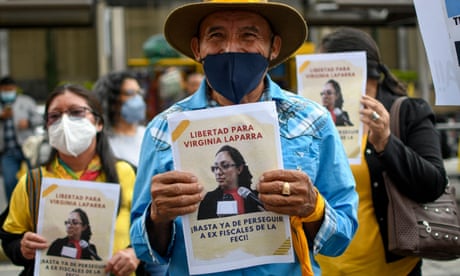
Protesters in Guatemala City demand the release of  Virginia Laparra. ‘This is a political dispute, not a legal one,’ said a member of her defence team.

Exile is just little bit different, a little bit less than death. [Your persecutors] take everything from you, take away your family, your children, your parents, your house, your way of life, your friends.’

Laparra headed a special prosecutor’s office working alongside the International Commission Against Impunity in Guatemala (Cicig), a UN anti-corruption mission that was controversially expelled in September 2019 by the then president, Jimmy Morales. Widespread reprisals followed against those who had worked with Cicig.

When Laparra was taken taken into preventive detention, she said it was as “if I were the worst drugs trafficker in Guatemala. When we drove out of the underground parking in my building there were soldiers, the police, hooded, with heavy weapons on both sides of the street. It was like in a film.”

She spent her first five months in solitary confinement in a windowless 2.5 sq meter cell in a high security jail in Guatemala City, 200 miles away from her Quetzaltenango home, and allowed out for only one hour a day.

She also endured bleeding to the womb in prison but waited months for treatment. Laparra eventually had a hysterectomy and four subsequent operations, during which she said police surrounded “the hospital, the gynaecology area, the operation room, and I had on each side of my bed a member of the police”.

She was later transferred to Matamoros prison, another notorious facility where drug traffickers and gang leaders are held, after she angered the authorities by speaking to a journalist. “My idea was that at least if I’m going to die [in jail], let’s make sure the world knows what happened,” said Laparra.

She considered pleading guilty in the hope that she might be released as both her sentences were commutable, which in Guatemala usually means no jail time is served, but her daughters told her: “Don’t do that, you’ve been here too long to give up now.”

When things reached their lowest ebb, Laparra said she decided to kill herself before remembering the promise she made to her daughters each time they visited – that she would be there the next time they came.

After her release on house arrest last year, she received an award from Guatemala’s current progressive president, Bernardo Arévalo, a surprise victor in the 2023 election. But Laparra believes the award only inflamed the pursuit of her by the public prosecutor’s office led by the attorney general, María Consuelo Porras, who had also tried to stop Arévalo from taking office.

Porras, who has pursued many other anti-corruption prosecutors and judges, also forced into exile her predecessor as attorney general and has been sanctioned by the US for corruption and the Council of the European Union for undermining democracy.

The Fund for Global Human Rights, which nominated Laparra for the Sir Henry Brooke award, and Amnesty International, which named her as a prisoner of conscience in 2022, said they were “deeply concerned about the systematic pattern of criminalisation imposed by the Guatemalan judiciary and the public prosecutor’s office against former judges, prosecutors, human rights defenders and journalists who have worked tirelessly for years to fight impunity and corruption in the country”.

Laparra says she feels proud to have received the award but adds that her persecutors reacted to the news with anger online. “I thought that it wasn’t possible to keep hate burning for so long,” she said. “Surely, two years in prison would have been enough for them, I thought, but it wasn’t.”

https://www.theguardian.com/world/2025/mar/05/virginia-laparra-lawyer-guatemala

I owe Alaa Abd el-Fattah my life, which is why I am going on a hunger strike to help free him

January 19, 2025

If anybody represents the very British values of democracy, respect for human rights, justice and due process, it is the Egyptian activist, says Peter Greste in the Guardian of 15 January 2025. The piece is so rich in detail that I give here in full:

I first encountered Alaa Abd el-Fattah 11 years ago, as a disembodied whisper of reassurance from outside the bars of my grubby prison cell in Cairo. I had just been tossed in the box by Egypt’s El Mukhabarat– the malevolent general intelligence service responsible for internal security – and I was facing an indeterminate run in solitary confinement after being arrested on bogus terrorism charges for my work as a journalist.

Alaa knew the drill. Then just 32, he’d been imprisoned by each of the four previous regimes, and he understood both the institutional meat grinder we were confronting and the psychological stresses I’d have to grapple with.

“Welcome to Ward A, Political, in Tora prison,” he told me in a hushed voice through the door. “Here, you are surrounded by people who have been fighting for justice and democracy. We are a collection of activists, trade unionists, judges, writers and now you – a journalist. This is a very prestigious place, and you are with friends.”

A significant part of the prestige came from Alaa himself. He was – and remains – Egypt’s most prominent political prisoner. That also makes him the one the government fears the most. I owe him my life, which is why I am helping step up the campaign to free him.

When the country erupted in its chapter of the Arab spring revolution in January 2011, it was driven by a loose collection of young, middle-class, secular activists – including Alaa – who understood the power of social media.

He was already well known in Egypt as a software developer, online publisher and prolific writer from a long line of campaigners. His late father was a human rights lawyer, and his mother is a mathematics professor and pro-democracy activist. His aunt is a novelist and political activist. One sister helped set up a group fighting against military trials for civilians, and another is a film editor who co-founded a newspaper. Before the 2011 revolution, Alaa learned coding and built his own award-winning blog publishing site where he wrote about national politics and social justice.

In short, activism is in his DNA.

At the time we met, Egypt was still convulsing with revolutionary turmoil. The military had installed an interim administration after ousting the elected Muslim Brotherhood government. The streets were filled with police rounding up protesters who were fighting to stop the country sliding back into autocracy, and Alaa found himself in prison on charges of rallying, inciting violence, resisting authorities and violating an anti-protest law.

After my period in solitary ended, we would use the precious hours of exercise to stride up and down a dusty walled yard discussing Egyptian history and society, political theory, and his ideas of resistance and reform. I found him to be an extraordinarily intelligent political thinker and humanitarian dedicated to turning his country into a functioning, pluralist democracy, and whose powerful writing from prison inspired millions. But more than that, I found a good friend.

In our conversations, he helped me understand the politics of my own imprisonment. I and two Al Jazeera colleagues had been charged with broadcasting terrorist ideology, conspiring with a terrorist organisation, and broadcasting false news to undermine national security. I struggled to reconcile those very serious allegations with the relatively straight reporting we had actually been doing. But as we talked, I came to see that our arrest had nothing to do with what we had done, and everything to do with what we represented – a press freely reporting on the unfolding political crisis. Inspired by his writing, I wrote two letters of my own that we smuggled out and that helped frame the campaign that ultimately got me free.

In March 2019, Alaa was released from prison but ordered to spend 12 hours each night in a police cell, “not free … even in the sense of imperfect freedom common in our country,” he wrote at the time.

Six months later, he was once again arrested, this time for spreading “false news to undermine security”, and sentenced to five years.

By rights, his prison ordeal should have ended on 29 September last year, including the time he spent in pre-trial detention. But in an act of extraordinary cynicism and callousness, the authorities decreed that they’d count his stretch from the day he was sentenced, violating their own laws and adding another two years to his time behind bars.

In protest, his 68-year-old mother, Laila Soueif, began a hunger strike on the day he was supposed to walk free. She has vowed not to eat until he is once again out of prison, and she is now 108 days into the fast. That is an extraordinarily risky undertaking for anybody, let alone someone her age, and although she is showing remarkable resilience she is in serious danger.[see https://humanrightsfirst.org/library/dr-laila-souiefs-downing-street-hunger-strike-continues-as-her-son-alaa-remains-in-egyptian-prison/]

Laila is a British national now living in London, and through her, Alaa also has British citizenship. That gives the British government consular responsibility, and powerful diplomatic leverage to get him released.

If anybody represents the very British values of democracy, respect for human rights, justice, rule of law and due process, it is Alaa Abd el-Fattah.

That is why I feel compelled to join Laila, in London and in solidarity, also on a hunger strike for the next 21 days. It may not work – at least in the short term – and Alaa might not walk free. But I don’t think that matters.

While we were in prison together, Alaa’s father passed away. At a later memorial service, here is what he told the audience: “All that’s asked of us is that we fight for what’s right. We don’t have to be winning while we fight for what’s right, we don’t have to be strong while we fight for what’s right, we don’t have to be prepared while we fight for what’s right, or to have a good plan, or be well organised. All that’s asked of us is that we don’t stop fighting for what’s right.”

This injustice has gone on far too long. Alaa Abd el-Fattah is one of the most remarkable people I know, and he deserves to be free. I am determined to do whatever I can to help.

see also: https://humanrightsdefenders.blog/2024/11/28/ngos-appeal-to-un-working-group-on-arbitrary-detention-for-egyptian-alaa-abd-el-fattah/

  • Peter Greste is a professor of journalism at Macquarie University and the executive director for the Alliance for Journalists’ Freedom. In December 2013, he was arrested on terrorism charges while working for Al Jazeera and he was eventually convicted and sentenced to seven years. Under intense international pressure, the Egyptian president ordered his release after 400 days. He is undertaking this protest in his personal capacity

https://www.theguardian.com/commentisfree/2025/jan/16/i-owe-alaa-abd-el-fattah-my-life-which-is-why-i-am-going-on-a-hunger-strike-to-help-free-him

https://www.jurist.org/news/2025/05/un-panel-finds-detention-of-british-egyptian-activist-alaa-abd-el-fattah-illegal/

Syrian human rights defender Mazen al-Hamada found dead in Sednaya prison

December 13, 2024

If the world knew about the extent of the brutality of Assad’s regime against its own people, it was in part because of Mazen, an activist who was an outspoken critic of the regime. On Sunday 8 December 2024, his body was found in the notorious “slaughterhouse”, Seydnaya prison in Damascus. It bore signs of horrific torture. A doctor who examined it told the BBC he had fractures, burn marks and contusions all over his body, allegations corroborated by Mazen’s family.

“It’s impossible to count the wounds on his body. His face was smashed and his nose was broken,” his sister Lamyaa said.

A protester when the uprising in Syria began in 2011, Mazen Al-Hamada was arrested and tortured. Released in 2013, he was given asylum in the Netherlands. He began to speak openly about what he was subjected to in prison. In the documentary Syria’s Disappeared by Afshar Films, Mazen describes how he was raped, his genitals clamped, and how his ribs were broken by a guard jumping on his chest over and over again.

While in asylum, Mazen’s nephew Jad Al-Hamada says he began suffering from severe depression and other mental health issues. …In 2020, he decided to return to Syria.

“The government told him he had a deal and that he would be safe. He was also told that his family would be arrested and killed if he didn’t return,” Lamyaa said. He was arrested as soon as he arrived in the country. And his family believes he was killed after rebels took Hama last week, shortly before the regime fell.

Ruth Michaelson in the Guardian of 10 December 2024 adds

Hamada was detained and tortured alongside tens of thousands of people after the 2011 uprising against Assad’s rule. “Mazen had endured torture so cruel, so unimaginable, that his retellings carried an almost otherworldly weight. When he spoke, it was as if he stared into the face of death itself, pleading with the angel of mortality for just a little more time,wrote Hamada’s friend, the photographer and director Sakir Khader. He “became one of the most important witnesses against Assad’s regime”, he said.

The Syrian network for human rights (SNHR) recorded 15,102 deaths caused by torture in prisons run by the regime between March 2011 and July this year. It said 100,000 more people were missing and thought to be detained, and some might be found now that prison populations have been set free.

Fadel Abdulghany, the head of SNHR, which tracks people who have been “forcibly disappeared”, broke down on live television this week as he said that all 100,000 people had probably “died under torture” in prison.

Hamada was released in 2013 and granted asylum in the Netherlands in 2014, after which he began touring western capitals, bringing audiences to tears as he showed them his scars and described what he had endured at the hands of the Syrian authorities. Then, in a decision that terrified and confused his friends and rippled through the community of dissident exiles, Hamada disappeared in early 2020 after seemingly deciding to return to Syria.

That someone who had experienced the worst of Syria’s torture chambers would choose to return led many to believe he was enticed to do by elements of Assad’s regime to prevent him from speaking out.

Rebel forces said they found 40 corpses piled in the morgue at Sednaya showing signs of torture, with an image circulating online showing Hamada among them.

The discovery of his body indicated he was probably killed shortly before prison inmates were liberated by insurgents. Khader described his friend’s suffering as “the unimaginable agony of a man who had risen from the dead to fight again, only to be condemned to a slow death in the west”.

https://www.theguardian.com/global-development/2024/dec/10/syrian-activist-who-symbolised-assad-brutality-found-dead-in-sednaya-prison

https://www.bbc.com/news/articles/c89xgke2x7lo

Surprise pardon for 1,500 prisoners in Bahrain

April 10, 2024

Patrick Wintour in the Guardian 9 April 2024 reports that Bahrain has unconditionally released more than 1,500 prisoners, including political detainees, in the biggest royal pardon since the 2011.

The amnesty followed years of campaigning inside the country and by international human rights groups but came as a complete surprise to activists. Amnesty Bahrain said: “This is a welcome step. Many of [the prisoners] should not have been imprisoned in the first place.”

The releases were ordered by King Hamad bin Isa Al Khalifa, coinciding with Eid and the silver jubilee of the king taking power. The US embassy in Bahrain welcomed the move and expressed the hope that all those being released will be reunited with their families.

Many of the detainees have been held in Jau prison, where campaigners said more than 600 political prisoners remain, including some in need of urgent medical help. Recent riots inside prisons had made the expense of keeping so many behind bars a burden on the state. [see also: https://humanrightsdefenders.blog/2023/08/20/500-bahraini-prisoners-on-hunger-strike-over-conditions/]

On social media, joyful scenes of families being reunited in their homes were screened, including some who had not been in their family home for as long as a decade.

But Sayed Ahmed Alwadaei, director of advocacy at the British-based Bahrain Institute for Rights and Democracy, said: “This came as a complete shock. There had been no prior indication, and this is the most important release programme since 2011. The release is bittersweet as there are still 600 political prisoners behind bars and on death row.”

see also: https://www.adhrb.org/2024/04/bahrains-kings-pardon-an-act-to-hide-the-human-rights-violations/#utm_source=rss&utm_medium=rss

Among those retained in prison include Hassan Mushaima, the head of the opposition group Al-Haq, and Abdulhadi al-Khawaja, a Danish-Bahraini human rights defender serving a life sentence in Bahrain for peaceful human rights work.

See also: https://www.omct.org/en/resources/statements/letter-to-the-king-of-bahrain-calling-for-the-release-of-jailed-academic-dr-abuljalil-al-singace-marking-abduljalil-al-singaces-1-000-days-on-hunger-strike and

https://www.fidh.org/en/region/north-africa-middle-east/bahrain/bahrain-dr-abduljalil-al-singace-s-1000-days-on-hunger-strike

https://www.theguardian.com/world/2024/apr/09/bahrains-king-takes-activists-by-surprise-with-pardon-for-at-least-1500-prisoners

UN Rapporteur on Iran comes with devastating assessment

March 22, 2023

Patrick Wintour, Diplomatic editor of the Guardian, reported on Monday 20 March 2023 that the he UN rapporteur on Iran, Javaid Rehman, has said the scale and gravity of Iran’s violations of human rights amount to a crime against humanity. Javaid Rehman, a special rapporteur on Iran, told the United Nations Human Rights Council on Monday the country was experiencing the most serious violations in four decades.

Rehman warned Iran was experiencing the most serious violations in four decades. He also claimed the death in police custody of Mahsa Amini, a young Kurdish woman, in September 2022 resulted from beatings by the “morality police”. Iran has said she died from a pre-existing neurological disorder, but Rahman said reliable medical sources pointed to state culpability. He said Iran had refused to conduct an impartial or transparent inquiry into her death, including the allegations that she was beaten up and tortured.

The scale and gravity of the violations committed by Iranian authorities, especially since the death of Ms Amini, points to the possible commission of international crimes, notably the crimes against humanity of murder, imprisonment, enforced disappearances, torture, rape and sexual violence, and persecution,” he said.

Drawing on evidence, including eyewitness testimony and comments from reliable medical sources, the report said it was clear she had died on 16 September “as a result of beatings by the state “morality police”.

“I would like to stress that her death was not an isolated event but the latest in a long series of extreme violence against women and girls committed by the Iranian authorities,” Rehman said. He said “the responsibility of top senior officials in instigating this violence can … not be ignored.”

The UN human rights council decided last November – despite protests from Beijing and Tehran itself – to launch a fact-finding mission into the repression of peaceful demonstrators after protests erupted around Iran. A fact-finding team has been appointed but has been denied access to Iran. See: https://humanrightsdefenders.blog/2022/11/23/un-human-rights-council-holds-special-session-on-iran-on-24-november/

“Protesters including children were beaten to death,” Rehman said, adding that “at least 527 people, including 71 children were killed, and hundreds of protesters severely injured.”He also said dozens of protesters “have lost their eyes because of direct shots to the head”, while Iranian doctors had reported that women and girls participating in the demonstrations “were targeted with shotgun fire to their faces, breasts and genitals”.

He said: “Children released have described sexual abuses, threats of rape, floggings, administration of electric shocks and how their heads were maintained underwater, how they were suspended from their arms or from scarves wrapped around their necks.”

The EU says it has now imposed sanctions on 204 individuals and 34 entities in six waves of sanctions. The UK announced it was putting sanctions on five members of the board of directors of the IRGC Co-operative Foundation. This organisation funnels money into the Iranian regime’s repression, the UK Foreign Office said.

He voiced outrage at the executions of at least four people associated with the protests “after arbitrary, summary, and sham trials marred by torture allegations”. He added: “These summary executions are the symbols of a state ready to use all means to instil fear and quash protests,” pointing out that at least 17 other protesters have so far been sentenced to death and more than 100 others face charges that carry the death penalty.

See also: //humanrightsdefenders.blog/2023/03/13/women-human-rights-defenders-from-iran-and-pakistan-explain-why-women-resisting-are-a-force-to-be-reckoned-with/

https://www.theguardian.com/world/2023/mar/20/iran-rights-violations-crime-against-humanity-un-expert

Also Human rights violations by authorities in Belarus and Venezuela may amount to crimes against humanity, the UN human rights council has heard. SEE: https://genevasolutions.news/global-news/un-finds-possible-crimes-against-humanity-in-belarus-venezuela-iran?utm_source=newsletter&utm_medium=email

Ales Bialiatski sentenced to 10 years in jail

March 9, 2023

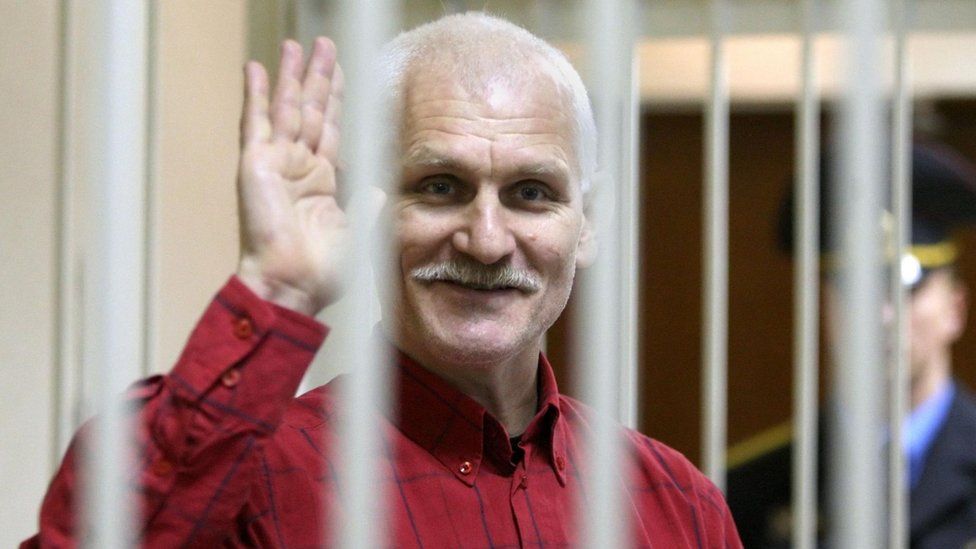
Belarus court sentences Ales Bialiatski to 10-year jail term, The sentencing of the Nobel Peace Prize winner and human rights defender has triggered protests. Media and human rights defenders across the world said that his arrest is ‘politically motivated’. See also: https://humanrightsdefenders.blog/2022/10/08/meet-ales-bialiatski-nobel-peace-prize-2022/

Ales Bialiatski pictured in November 2021
Image caption, Ales Bialiatski pictured in November 2021

Oliver Slow of BBC News reported as follows¨

…Supporters of Mr Bialiatski, 60, say the authoritarian regime of Belarusian leader Alexander Lukashenko is trying to silence him. He was arrested in 2021 following massive street protests over widely disputed elections the previous year, and accused of smuggling cash into Belarus to fund opposition activity. Demonstrators were met with police brutality and Lukashenko critics were regularly arrested and jailed during the demonstrations, which started in 2020.

Mr Bialiatski was in court alongside two fellow campaigners, Valentin Stefanovich and Vladimir Labkovich.

Mr Stefanovich was sentenced to nine years in prison, while Mr Labkovich received seven years, according to Viasna, the group Mr Bialiatski founded in 1996. All three had pleaded not guilty.

Mr Bialiatski’s wife, Natalya Pinchuk, said the trial was “obviously against human rights defenders for their human rights work”, describing it as a “cruel” verdict.

Referring to her husband’s letters from prison, where he has been held since arrest, she said: “He always writes that everything is fine. He doesn’t complain about his health – he tries not to upset me.”

Kostya Staradubets, a spokesperson for Viasna, said the sentences imposed on the three activists were “breaking our hearts”.

Speaking to the BBC World Service’s Newshour programme, he said: “We knew that our three colleagues would get long prison terms but anyway it’s still a shock, it’s breaking our hearts, not only the [prison] terms are long but the conditions also very horrific.

Belarus’s exiled opposition leader Svetlana Tikhanovskaya said the sentencing was “simply appalling”. “We must do everything to fight against this shameful injustice and free them,” she said.

Berit Reiss-Andersen, chair of the Norwegian Nobel Committee that awards the Nobel Peace Prize, said the verdict was a “tragedy” for Mr Bialiatski and described the charges as “politically motivated”.

In awarding the 2022 Nobel Peace Prize to Mr Bialiatski, Ms Reiss-Anderson said the Belarusian government had “for years tried to silence him”. “He has been harassed, he has been arrested and jailed, and he has been deprived of employment,” she said.

European Union foreign policy chief Josep Borrell condemned what he described as “sham trials”, adding they were “yet another appalling example of the Lukashenko regime trying to silence those who stand up in defence of human rights and fundamental freedoms of the people in Belarus”.

There are currently 1,458 political prisoners in Belarus, according to Viasna. Authorities claim there are none.

Mr Bialiatski is a veteran of the human rights movement in Belarus, establishing Viasna in 1996 in response to the brutal crackdown of street protests that year by Mr Lukashenko, who has been president of Belarus since the office was established in 1994. See: ¨https://humanrightsdefenders.blog/2022/10/07/nobel-peace-prize-2022-goes-to-well-recognised-human-rights-defenders/

This was followed by the sentencing of women journalists: https://www.theguardian.com/world/2023/mar/18/belarus-jails-senior-staff-at-independent-news-site-in-crackdown-on-lukashenko-critics

https://www.bbc.com/news/world-europe-64833756

https://www.livemint.com/

Dua Lipa and other artists do the right thing by not going to Qatar

November 14, 2022
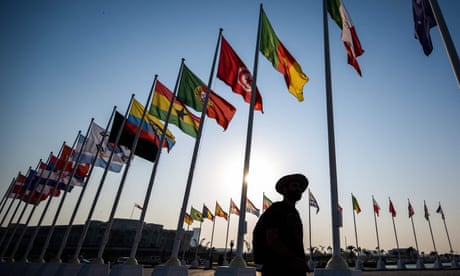
Flags of the countries participating in the World Cup on display in Doha, Qatar, this week.

According to the Guardian of 14 November 2022, singer says she will not be playing at 2022 opening ceremony. The chart-topping 27-year-old singer, born in London to parents from Kosovo, said she would only play in the country if it improves its record on human rights.

Controversy has surrounded the upcoming football tournament with Qatar’s treatment of migrant workers and criminalisation of same-sex relationships under the spotlight. See also my recent: https://humanrightsdefenders.blog/2022/11/11/geneva-the-base-from-where-qatar-pursued-its-world-cup-bid/

BTS star Jung Kook is the only official act confirmed for the opening ceremony, which will be held at Al Bayt stadium on 20 November. US rapper Diplo, DJ Calvin Harris and Jamaican singer Sean Paul will also be performing at the Fifa Fan festival, which will run over the 29 days of the tournament.

Lipa is not the first musician to make a point of avoiding playing concerts in Qatar. On Sunday, Sir Rod Stewart revealed he turned down more than US$1m to play in the country last year.

After reports linking her to the event, Lipa shared a statement on Instagram, writing: “There is currently a lot of speculation that I will be performing at the opening ceremony of the world cup in Qatar. I will not be performing and nor have I ever been involved in any negotiation to perform.

“I will be cheering England on from afar and I look forward to visiting Qatar when it has fulfilled all the human rights pledges it made when it won the right to host the World Cup.” He told the UK’s Sunday Times newspaper: “I turned it down. It’s not right to go. And the Iranians should be out too for supplying arms [to Russia].”

Also on Sunday, comedian Joe Lycett told David Beckham he would shred £10,000 if the sportsman didn’t pull out of his Qatar World Cup deal. The footballer is reportedly being paid £10m to be an ambassador for the event, and has been heavily criticised for accepting the money, given that he has previously been viewed as an ally to the LGBTQ+ community..

https://www.theguardian.com/music/2022/nov/14/dua-lipa-denies-shes-performing-at-the-qatar-world-cup

Human rights defenders in Greece, my adopted country: not doing well

July 28, 2022
OHCHR | Ms Mary Lawlor

Special Rapporteur on the situation of human rights defenders, Mary Lawlor, conducted an official visit to Greece from 13 to 22 June 2022, to assess the government’s efforts towards creating an enabling environment for those seeking to protect and promote human rights.

Human rights defenders in Greece, particularly those working on migration, operate in an environment of pervasive fear and insecurity, concluded Mary Lawlor. “I am concerned about the increasing criminalization of humanitarian assistance in Greece. Solidarity should never be punished and compassion should never be put on trial,” she said while presenting her preliminary findings at the end of a 10-day mission in the country.

With Greece facing intense international criticism over unlawful pushbacks of migrants at its borders and wider human rights concerns related to migration and asylum, the Greek government has moved to silence groups and individuals documenting these abuses. While acknowledging Greece’s migration challenges and government efforts to address them, Lawlor criticized burdensome rules for the registration of nongovernmental organizations working on migration, introduced in 2019, calling them discriminatory and in violation of Greece’s international human rights obligations. See my earlier: https://humanrightsdefenders.blog/2021/11/17/greeces-mistaken-deterrence-migrants-and-aid-workers-facing-heavy-prison-sentences/

The UN expert noted that human rights defenders not only face criminal sanctions for their activities, but are operating in an increasingly hostile environment where the general public is influenced by negative rhetoric from high-ranking officials and their unfavorable portrayal in the media, which often conflates their activities with traffickers and criminal networks.

Greece fell 38 positions within a year in Reporters Without Borders’ 2022 report on the Press Freedom Index, with the organization marking it the lowest-ranked European Union country for press freedom. “Journalists who counter the government’s narrative on the management of migration flows are often under pressure and lack access to mainstream media outlets.… Journalists reporting on corruption are sometimes facing threats and even charges,” Lawlor said. She noted that journalists have very limited or no access to facilities where migrants, refugees, and asylum seekers are being held, further contributing to a general lack of transparency regarding the government’s policies in this area.

See also: https://humanrightsdefenders.blog/2022/02/18/greek-court-fails-human-rights-defenders-on-antisemitism/

Lawlor will present a detailed report with her findings at the March 2023 session of the UN Human Rights Council. The government should listen to what the UN expert has to say and champion human rights defenders. The European Commission, which noted in July last year the narrowing space in Greece for groups working with migrants and asylum seekers, should step up its engagement on the issue and press Greece to stop harassing civil society groups and activists.

https://www.ohchr.org/en/media-advisories/2022/06/un-human-rights-expert-visit-greece-assess-situation-human-rights

https://www.ohchr.org/en/press-releases/2022/06/greece-migration-policy-having-suffocating-effect-human-rights-defenders

https://www.amnesty.org/en/location/europe-and-central-asia/greece/report-greece/

see also later:

https://www.theguardian.com/world/2022/aug/31/greece-should-face-more-checks-over-asylum-seeker-treatment-eu-official

https://www.theguardian.com/world/2022/aug/31/i-was-close-to-death-syrian-man-tells-how-greek-officials-pushed-refugees-back-out-to-sea

And on 7 November : https://www.hrw.org/news/2022/11/07/greeces-surveillance-scandal-puts-rights-risk

and then: https://www.hrw.org/news/2023/03/16/un-expert-slams-greece-over-civil-society-curbs

Disappointment with UN High Commissioner’s visit to Xinjiang boils over

June 9, 2022

Many have been the reactions to the UN High Commissioner’s visit to China, some even expressing doubt BEFORE the visit took place [see: https://www.aljazeera.com/news/2022/5/24/what-will-the-un-human-rights-commissioner-see-in-xinjiang and https://www.hrw.org/news/2022/05/20/un-rights-chiefs-credibility-stake-china-visit]. The open referred to in the Guardian of 9 June 2022 was signed by academics in wake of Michelle Bachelet’s China visit and demands release of UN report on human rights abuses.

Agnes Callamard, the secretary general of Amnesty International, said on 28 June that Bachelet should condemn human rights violations in Xinjiang, and call on China to release people arbitrarily detained and end systematic attacks on ethnic minorities in the region. “The high commissioner’s visit has been characterized by photo opportunities with senior government officials and manipulation of her statements by Chinese state media, leaving an impression that she has walked straight into a highly predictable propaganda exercise for the Chinese government,“.

Dozens of scholars have accused the UN human rights chief of having ignored or contradicted academic findings on abuses in Xinjiang with her statements on the region. In an open letter published this week, 39 academics from across Europe, the US and Australia called on Michelle Bachelet to release a long-awaited UN report on human rights abuses in China.

The letter, published online, included some academics with whom Bachelet had consulted prior to her visit to Xinjiang. The letter’s signatories expressed gratitude for this, but said they were “deeply disturbed” by her official statement, delivered at a press conference in Guangzhou at the end of her six-day tour. They said her statement “ignored and even contradicted the academic findings that our colleagues, including two signatories to this letter, provided”.

UN High Commissioner for Human Rights visits China.

It is rare that an academic field arrives at the level of consensus that specialists in the study of Xinjiang have reached,” the letter said. “While we disagree on some questions of why Beijing is enacting its atrocities in Xinjiang, we are unanimous in our understanding of what it is that the Chinese state is doing on the ground.”.

Rights organisations and several governments have labelled the campaign a genocide or crime against humanity. Beijing denies all allegations of mistreatment and says its policies are to counter terrorism and religious extremism.

At the end of her visit Bachelet said she had urged the Chinese government to review its counter-terrorism policies in Xinjiang and appealed for information about missing Uyghurs. She was quickly criticised by some rights groups for giving few details or condemnation of China while readily giving long unrelated statements about US issues in response to questions from Chinese state media.

The academics’ letter is among growing criticism of Bachelet for not speaking out more forcefully against Chinese abuses after her visit, as well as a continued failure to release the UN report, which is believed to have been completed in late 2021. On Wednesday dozens of rights groups, predominately national and local chapters of organisations associated with Uyghur and Tibetan campaigns, demanded her resignation. See: http://www.phayul.com/2022/06/09/47195/

The 230 organisations accused Bachelet of having “whitewashed the Chinese government’s human rights atrocities” and having “legitimised Beijing’s attempt to cover up its crimes by using the Chinese government’s false ‘counter-terrorism’ framing”.

“The failed visit by the high commissioner has not only worsened the human rights crisis of those living under the Chinese government’s rule, but also severely compromised the integrity of the Office of the High Commissioner for Human Rights in promoting and protecting human rights globally,” the statement said.

They also decried that she had repeatedly referred to the detention camps in Xinjiang by the Chinese government’s preferred term: “vocational education and training centres”.

All this led to speculation that Mrs Bachelet’s decision not to seek a second term was related to the critcism [see: https://www.theguardian.com/world/2022/jun/13/un-human-rights-chief-michelle-bachelet-no-second-term-china]

https://www.theguardian.com/world/2022/jun/09/fury-at-un-human-rights-chief-over-whitewash-of-uyghur-repression

https://www.ohchr.org/en/statements/2022/05/statement-un-high-commissioner-human-rights-michelle-bachelet-after-official

https://www.npr.org/2022/05/29/1101969720/un-human-rights-chief-asks-china-to-rethink-uyghur-policies?t=1654771491735