Forbes of 2 February 2015 carries an interesting piece by Thomas Fox-Brewster about Bahaa Nasr, a man who “Is Teaching Syrians To Defend Themselves Against Their Many Digital Enemies“.
After a description of recent attacks on opposition forces of the Syrian regime, the article – which does not distinguish a lot between human rights defenders and armed opposition – states that those under attack are in need of better cyber awareness. “That’s where Bahaa Nasr comes in. He runs Cyber Arabs, which provides digital security training not only for Syrians but for activists, human rights defenders and journalists across the Arab world.
“Syria, of course, has been a strong focus of our work in the past years due to the multitude of risks CSO [civil society organization) activists are facing there. While originally the main threat came from the regime and from groups like the SEA, now there is more and more concern about extremist groups like ISIS also resorting to cyber attacks,” he tells me over encrypted email.
He notes one of the most common techniques is social engineering, as the opposition has come to realise. But there are also targeted malware attacks, such as those allegedly launched by ISIS.
Then there are cruder methods at play in Syria’s information war. “Checkpoints are also a problem in many places where they often confiscate computers and mobile phones and thus gain access to data and accounts and new entry points for social engineering attacks,” Nasr adds.
He claims Cyber Arabs has helped around 500 activists, journalists, human rights defenders and citizen journalists from 17 Arab countries. At least 200 were from Syria. Training takes place in person and online, covering general digital hygiene: recognising and avoiding phishing attacks or social engineering attempts, good password practices, learning about different kinds of malware and how to improve the security of social media accounts. Cyber Arabs also teaches use of tools tailored for people’s needs, including secure email and instant messaging, and encryption. There’s an Android app to help stay up to date on the latest threats in the region too.
Nasr has been working closely with a range of influential groups, including Citizen Lab, a research collective based in Toronto, which focuses on digital attacks on activists. John Scott Railton, a member of Citizen Lab, described Cyber Arabs’ work as simply “amazing”. With such help available to Syrians, it’s hoped they won’t suffer from smart online offensives on their systems as they try to bring an end to a horrific, protracted war.”
This post is not directly related to Human Rights Defenders, but the numbers in this press statement of 24 September 2014 are so striking that I could not resist:
A spokesperson for the High Commissioner for Refugees at the UN, Melissa Fleming, revealed that “Turkey received 138,000 [Syrian] refugees in three days, which is equivalent to what was received by Europe throughout the past three years,” Anadolu news agency reported.
The Human Rights Council heard updates from the Special Rapporteurs on Belarus, the Democratic People’s Republic of Korea, and Eritrea, along with the latest update from the Commission of Inquiry into the situation in Syria. In all cases the countries in question have refused access to the mechanism created by the Council to monitor and report on the human rights situation.
On 27 May RIA Novosti picked up the press release by Human Rights Watch calling for four prominent human rights defenders allegedly in custody of an armed opposition group in Syria to be immediately released. HRW together with 45 co-signing organizations states that irregular armed opposition groups in Syria are threatening and harassing journalists and human rights defenders.“Abductions of human rights defenders by armed groups in Syria are an assault on the very freedoms the armed opposition groups claim to be fighting for”. Almost six months a group of armed men kidnapped human rights defenders Razan Zeitouneh [or Zaitouneh], Wael Hamada, Samira Khalil, and Nazem Hammadi in a city outside Damascus, then controlled by a number of armed opposition groups, but there has been no information on the status or whereabouts of Zeitouneh and her colleagues, and no group has claimed responsibility for their abduction.
In a 28-page report, Under Attack: Violence against health workers, patients and facilities, Human Rights Watch and the Coalition “Safeguarding Health in Conflict” highlight recent attacks in countries around the world. Major examples include the targeted killing of more than 70 polio vaccination workers in Pakistanand Nigeria; the arrests of health workers for providing care to protesters in Bahrainand Turkey; the bombing of hospitals and deaths of hundreds of patients and health workers in Syria; and attacks targeting health workers in South Sudan and Afghanistan. The report is released in advance of a meeting from 19-24 May 2014, of health ministers from around the world.
Yesterday I referred to the upcoming Human Rights Watch Film Festival in June. One of the films shown there will also appear on Netflix and therefore be able to reach a much larger audience. Interesting development for human rights films!!
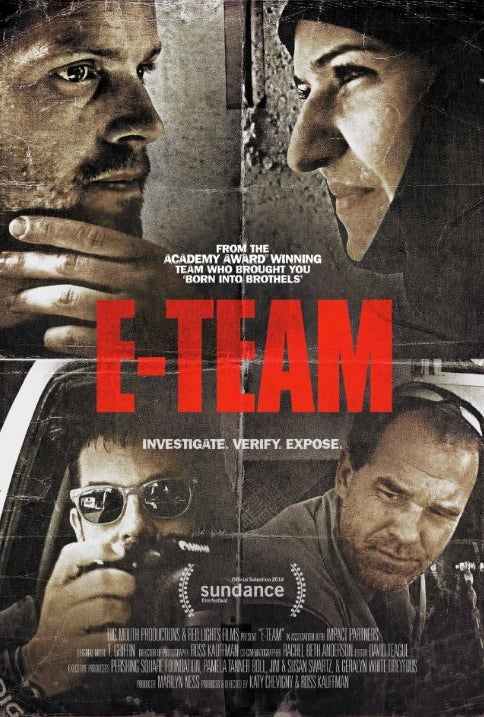
The Associated Press reported on May 8 that Netflix Inc. had purchased E-TEAM as a high-profile “Netflix original,” and would distribute the film via its vast online platform as well as through a limited theatrical release in the United States. The film focuses on four researchers in the Human Rights Watch emergencies division, or E-Team, as they interview witnesses and gather other evidence of rights abuses and war crimes in Syria, Libya, and Kosovo. It highlights the personal commitment required to stop human rights violations over the long term. The filmmakers, Ross Kauffman and Katy Chevigny, operated with full creative control and had free rein from Human Rights Watch to produce a “warts and all” portrait of human rights activists in the field. It is the first time filmmakers have documented Human Rights Watch’s work so extensively.
[The film has won numerous awards on the festival circuit, including for best cinematography at Sundance. Variety called it “a documentary that’s devastating, entertaining and inspiring in equal measure.”]
On 26 March 2014, the family of human rights defender Mr Maen Al-Ghoneimi was informed by the Damascus Military Police in Syria that he had died in detention two months earlier, on 14 January 2014. The police declared that he died of heart failure and delivered to the family the personal possessions of the human rights defender, but refused to disclose where he had been buried. Maen Al-Ghoneimi was a human rights lawyer and a member of the lawyers’ syndicate in Damascus. The human rights defender was an active participant in lawyers’ peaceful protests and sit-ins and provided legal aid to internally displaced people in Syria. Maen Al-Ghoneimi was arrested on 20 May 2013, and was then kept incommunicado until news of his death emerged. No charges had been brought against him. The family stated that he was in good health at the time of the arrest, and therefore believes that he may have been tortured or have become ill and denied medical treatment while in detention.
Front Line Defenders rightly demands a thorough, impartial and immediate investigation into the deaths of detained human rights defenders, including also Ayham Mostafa Ghazzoul https://www.frontlinedefenders.org/node/21602
While the whole of the Syrian population suffers terribly, it is important to recognize that human rights defenders, activists, media and humanitarian workers have been particularly targeted for their work since the beginning of the Syrian uprising three years ago. Many have been arrested or abducted by either government forces and pro-government militias or by non-state armed groups. The channels for obtaining reliable information are drying up and that is certainly not a coincidence.
Now several international NGOs such as Amnesty International, the Euro-Mediterranean Human Rights Network, FIDH, Frontline Defenders, Human Rights Watch and Reporters Without Borders have come together to work jointly, with other international, regional and Syrian organizations, to campaign for the release of these Silenced Voices of Syria. The campaign is starting with the documentation of 37 emblematic cases.
This campaign will use a three-pronged strategy of 1. Research and Documentation, 2. Information/Sensitisation and 3/ Mobilization.
This post is not about human rights defenders and not really about the treatment of refugees in Greece. It is simply such a story – published by Behzad Yaghmaian in the Globalist of 11 February 2014 – that I could not resist sharing it. The original title is: “Syria’s Civil War and the World’s Oldest Refugee; A reflection on our collective failures as human societies“. Once you have read this, you will agree that Greece, Germany and the UNHCR should quickly find a solution on humanitarian grounds:
(Sabria Khalaf, 107-year old refugee of the Syrian civil war (c) Behzad Yaghmaian)
expressed its concern that the whereabouts of human rights defender and lawyer Roshdy El Sheikh Rasheed remain unknown ten days after his disappearance from the city of Tadmor on 31 January 2014. Mr Roshdy El Sheikh Rasheed is the vice-president of the Arab Organization for Human Rights (AOHR) in Syria, an international organisation with UN consultative status whose objective is to promote adherence to human rights principles in Arab states. The human rights defender was taken from his home to an unknown location by plain-clothes individuals on 31 January 2014. As Tadmor is under control of government forces, it is considered very likely that state actors are involved in the disappearance. Roshdy El Sheikh Rasheed fled from Homs to Tadmur in 2013 in order to seek medical attention for an injury he sustained whilst documenting human rights violations during armed battles in Homs. [The human rights defender had been previously detained twice by authorities in Homs.]
The Syrian conflict has been marked by the targeting and abductions of other human rights defenders, to mention just: Razan Zaitouna, Wael Hamada, Nazem Hamaadi and Samira Khalil, Khalil Matouk (or Matouq).