Posts Tagged ‘Syria’

2017 was a grim year for imprisoned technologists

December 29, 2017
Prison Hands

Since its founding, EFF has highlighted and defended cases of injustice and fearmongering perpetrated against innocent technologists. We advocate for unjustly imprisoned technologists and bloggers with our Offline project. In 2017, we continue to see fear being whipped up against those who oppose oppression with modern tools—as well as those who have done nothing more than teach and share technology so that we can all use and understand it better:

Dmitry Bogatov, software developer and math lecturer at Moscow’s Finance and Law University. Bogatov ran a volunteer Tor relay, allowing people around the world to protect their identities as they used the Internet. It was one part of his numerous acts of high-tech public service, which include co-maintaining Xmonad and other Haskell software for the Debian project. For his generosity, Bogatov has now spent over a hundred days in pretrial detention, wrongfully accused of posting extremist materials that were allegedly sent via through Tor server. Law enforcement officials around the world understand that data that appears to originate from a particular Tor machine is, in fact, traffic from its anonymised users. But that didn’t stop Bogatov’s prosecutors in Russia from accusing him of sending the data himself, under a pseudonym, to foment riots—and added new charges of “inciting terrorism” when a judge suggested the earlier charge was too weak to hold Bogatov in pre-trial detention.

Ahmed Mansoor, of the United Arab Emirates. Mansoor has been a tireless voice for victims of human rights abuses in the United Arab Emirates. In 2011, amidst the Arab uprisings, he was one of five Emirati citizens to be sentenced to prison for his social media postings. That case provoked international condemnation, and the group was soon pardoned. Mansoor was subsequently targeted with sophisticated government spyware on his iPhone; he recognised and passed on the malware link to experts, which led to the discovery of three previously unknown vulnerabilities in Apple’s iOS. In April, Mansoor was seized by the UAE authorities again. On the day of his arrest, the UAE’s official news agency saying that he had been arrested on the orders of the Public Prosecution for Cybercrimes and accused of using social media to promote sectarianism and hate, among other charges. Mansoor’s family did not hear from him for two weeks, and he has been denied access to a lawyer. Just a year ago, Apple was able to roll out a security fix to their users because of Mansoor’s swift, transparent, and selfless actions. Millions of people are safer because of Ahmed’s actions, even as his family fears for his own physical and mental safety. [https://humanrightsdefenders.blog/2017/03/28/ahmed-mansoor-under-arrest-emirates-under-pressure/]

Alaa abd el-Fattah ran Linux installfests across the Middle-East and was a key online voice in the Egyptian uprising. Since then he has been jailed, in turn, by the democratically elected Islamist President Mohammed Morsi, and then when Morsi was overthrown in a coup, by incoming President Abdel Fattah El-Sisi. Alaa’s appeal against a five year prison sentence for protesting—widely seen as a means to silence him on social media—was refused in November of this yearAmnesty and the UN Working Group on Arbitrary Detention have both condemned Alaa’s continuing imprisonment.

Another long-term case is that of Saeed Malekpour, who has been in jail in Iran since 2008. Malekpour returned from Canada to visit his sick Iranian father in October of that year, at a time when the Iranian Revolutionary Guard was starting to target technologists and Internet experts. As an open source coder, Malekpour had written a free front-end image management utility for websites. The Guard found this software on a Farsi pornography site, and used it to as a pretext to seize Malekpour from the streets of Tehran, charge him with running the web site, and sentencing him to death. Malekpour’s death sentence has been anulled twice following international pressure, but a change of government in his home country of Canada risked reducing the level of support for Malekpour. A campaign to encourage the new Trudeau administration to continue to advocate for Malekpour, even as Canada seeks to normalize relations with Iran, seems to be working. One of Malekpour’s advocates, former Liberal MP Irwin Cotler, has said that the Canadian government is now working on the case. The continuing monitoring of Malekpour’s life sentence is a small consolation, but better than the alternative.

Peter Steudtner and Ali Gharavi travel the world, teaching and advising Internet users on how to improve their privacy and digital security online (Ali was an advisor for EFF’s Surveillance Self-Defence project). The two were arrested in a raid by Turkish police on a digital security workshop in July in Istanbul, along with Amnesty Turkeys’ director, Idil Eser, and eight other human rights defenders. The two technology consultants have been accused of aiding terrorists, despite the long history of both as peaceful advocates for secure online practices. After months of detention, concentrated diplomatic and public pressure led to both being released to join their families in Germany and Sweden. We’re delighted that they are free, but their unjust prosecution—and that of their Turkish colleagues—continues in the Turkish courts. 

Bassel Khartabil, the Syrian free culture advocate. Before his arrest and torture in 2012, Bassel was the driving force behind countless projects to turn technology for the public good in his country. He founded a hackerspace in Damascus, translated Creative Commons into a Middle Eastern context, and built out Wikipedia and Mozilla for his fellow Syrians. Bassel’s generosity brought him notability and respect. His prominence and visibility as a voice outside the divided political power-bases of Syria made him an early target when the Syrian civil war became violent. Bassel was killed by the Syrian government in 2015, shortly after he was removed from a civilian prison and sent into the invisibility of Syria’s hidden security complexes.


https://personalliberty.com/grim-year-imprisoned-technologists-2017-review/

International Nuremberg Human Rights Award for Syrian photographer “Caesar”

October 1, 2017

“’Caesar’ and his colleagues were driven by a desire to ensure that the documented crimes against humanity would not go unpunished. To this end they took great risks upon themselves”, explains the jury statement. “In bestowing the International Nuremberg Human Rights Award on the ‘Caesar’ group, the jury also wishes to highlight the history of Nuremberg as the cradle of modern international criminal law.

When the civil war broke out in Syria in 2011, it was “Caesar’s” job to photograph the corpses of Syrian soldiers and opposition forces and to systematically archive the images. He found the work increasingly difficult to bear. “I had never seen anything like it”, he later said in an interview with the French journalist Garance Le Caisne, whose persistence played a major part in ensuring that “Caesar’s” images found their way into the public domain.

“Caesar” decided to act rather than continue documenting in silence: over a period of roughly two years, he secretly copied his photographs onto USB sticks and smuggled them out of the country with the help of friends. His life was constantly at risk as a result.

In January 2014, “Caesar’s” photographs were published on the Internet and found to be “reliable” by an investigative commission of former chief prosecutors of international criminal courts. “Caesar” fled from Syria and by his own account is now living in Europe.

Because his life is still in danger, the photographer was not able to attend the award ceremony at Nuremberg Opera House. Garance Le Caisne accepted the award on his behalf.

Garance Le Caisne
Stadt Nürnberg/Christine Dierenbach

Source: International Nuremberg Human Rights Award for “Caesar”

Refugee Olympic Teams and Turkish pianist are given human rights awards

December 19, 2016

Human rights awards – one of my favorite topics [https://humanrightsdefenders.blog/?s=human+rights+awards] – come  in many shapes and forms. Here two special ones: the first concerns a handicapped swimmer from Syria and other refugee related recipients (in Madrid) and the second a Turkish pianist (in Bonn).

Ibrahim Al Hussein - Human Rights Award Spain
Ibrahim Al Hussein receiving the Human Rights Award from the Spanish General Council the Bar © • IPC

Read the rest of this entry »

Martin Ennals Award 2016: relive the ceremony in 13 minutes or in full

October 15, 2016

For those who missed the amazing Martin Ennals Award ceremony in Geneva on 11 October here is the 13-minute summary

For those who would like to relive the whole event please go to: new MEA_logo with text

http://www.ustream.tv/channel/ueCvkmTf59u

Summary and streaming are courtesy of THF

Right Livelihood Awards 2016 to Syrian, Egyptian, Russian and Turkish human rights defenders

September 22, 2016


Right Livelihood logoThe Laureates of this year’s Right Livelihood Award have been announced today – 22 September 2016 – in Stockholm, Sweden:

SYRIA CIVIL DEFENCE (Syria)

Syria Civil Defence (The White Helmets), ‘for their outstanding bravery, compassion and humanitarian engagement in rescuing civilians from the destruction of the Syrian civil war’. It is the first time that a Right Livelihood Award goes to a Laureate from Syria.…for their outstanding bravery, compassion and humanitarian engagement in rescuing civilians from the destruction of the Syrian civil war.

Read the rest of this entry »

This is what MEA Jury members say about Razan Zaitouneh, abducted in Syria in 2013

September 20, 2016

Jury members of the Martin Ennals Award speak about Razan Zaitouneh, one of three Finalists for the Martin Ennals Award 2016 . Razan Zaitouneh is a prominent human rights lawyer, activist, and journalist in Syria. Razan has dedicated her life to defending political prisoners and documenting crimes against humanity, whether committed by the Government or rebel forces. This video was uploaded on 25 April 2016. The MEA ceremony will take place in Geneva on 11 October. new MEA_logo with text

https://thoolen.wordpress.com/2016/07/01/an-early-save-the-date-11-october-2016-martin-ennals-award-for-human-rights-defenders-in-geneva/


UN High Commissioner for Human Rights: “States may shut my Office out – but they will not shut us up”

September 14, 2016

Readers are forgiven for not remembering that in the 1980’s it was forbidden for UN officials to name and shame countries by name (with a few exceptions) and those that did usually paid a price for that (e.g. Theo van Boven in 1982 and the curtailing of terms for some High Commissioners). Now, in the span of one week the current High Commissioner for Human Rights, Zeid Ra’ad Al Hussein, has first named and shamed some politicians as dangerous demagogues (6 September 2016 in the Hague): Mr. Wilders. Mr. Trump, Mr. Orban, Mr. Zeman, Mr. Hofer, Mr. Fico, Madame Le Pen, and Mr. Farage. He followed this up in his opening statement at the 33rd session of the UN Human Rights Council on 13 September 2016 with a forceful attack on countries that refuses to cooperate with his Office or other UN procedures: foremost Syria but also Venezuela, Turkey, Ethiopia, Israel, North Korea, India, Pakistan, Mozambique, USA, Gambia, China, Nepal, Uzbekistan, Armenia, Dominican Republic, Belarus, Eritrea, Iran, and Burundi. The non-cooperation by those in control of areas such as Abkhazia, South Ossetia, Crimea, and Nagorno-Karabakh was also singled out.

The part that underpins the ‘legitimacy’ of his interference is of special relevance: “Under international law, wrongful “intervention” – as prohibited in Article 2(7) of the UN Charter – is by nature coercive. And it should be obvious that my Office has no coercive power. No activity that we undertake can possibly be considered constitutive of a prohibited “intervention”. …We request access so we can better work to help bring your laws and practices in line with international agreements which you, the States drafted and ratified – and to assist you to comply with recommendations which you have publicly, and often fulsomely, accepted….Are human rights exclusively a national issue? Governments have the responsibility to uphold their human rights obligations and to respect the standards. But the human rights of all people, in all countries, also require – unquestionably ­– our collective attention. The Vienna Declaration, adopted unanimously 23 years ago, confirmed this..”

“Human rights violations will not disappear if a government blocks access to international observers and then invests in a public relations campaign to offset any unwanted publicity. On the contrary, efforts to duck or refuse legitimate scrutiny raise an obvious question: what, precisely, are you hiding from us? I classify as refusals of access all unreasonable delays, elaborately ritualised and unreasonably prolonged negotiations, and responses to specific requests which seem to seek to fob us off with inadequate alternatives to real, fact-based assessment. Access delayed is access denied: two weeks is surely amply sufficient to secure a decision from all relevant officials. Claims that insecure conditions make it impossible to give my staff access are also less than acceptable. My staff work with great courage in some of the world’s most severely threatened communities, and will continue to do so when called upon – or at least, we could be the judge of that.

States may shut my Office out – but they will not shut us up; neither will they blind us. If access is refused, we will assume the worst, and yet do our utmost to nonetheless report as accurately as we can on serious allegations. Our remote monitoring is likely to involve witness testimony, credible third-party reports and use of satellite imagery, among other techniques. Certainly, remote monitoring is a poor substitute for in-person observation by expert analysts. It makes it more difficult to verify and confirm the competing allegations of any party – including the Government. I regret that imprecision, and encourage all States to assist us to correct it, by permitting my teams unhindered access to events on the ground when requested.

The two texts follow below in toto; summarizing them would not do justice to the elaborate and courageous words of this High Commissioner, who seems not to be concerned about securing a second term. Moreover, the one in the Hague stands out by its eloquence!

Read the rest of this entry »

Shackled Freedoms : what space for human rights defenders in the EuroMed?

September 7, 2016


cover-en-shackled-freedomThe recent report SHACKLED FREEDOMS : WHAT SPACE FOR CIVIL SOCIETY IN THE EUROMED? depicts the obstacles and repression against civil society in the region and showcases first-hand accounts from Turkey, Egypt, Algeria, Syria, Israel and the Occupied Palestinian Territories among others. The report also features recommendations by CSOs for joint action and seeks to influence EU policies to that effect. The report also focuses on the impact of security and anti-terrorist policies and lists the growing arsenal of repressive measures – both in law and practice – that civil society organizations (CSOs) face on a daily basis: judicial harassment, surveillance, arbitrary arrests, torture and assassination.

Despite legal safeguards and the human rights “shared values” rhetoric in the EU, EuroMed Rights argues that European civil society is under increasing pressure. Austerity measures and anti-terrorism laws are increasingly used to legitimise practices that go against individual freedoms and rights of assembly, association and expression, such as in France, Spain or the UK, for instance. The report – published on 7 September 2016 – is the result of a seminar organised in April 2016 as an open dialogue between EU representatives, South Mediterranean activists and Brussels-based CSOs.

 DOWNLOAD THE REPORT


Source: Shackled Freedoms : What Space for Civil Society in the EuroMed? – EuroMed Rights – Euro-Mediterranean Human Rights Network

Drawn to peace: Hani Abbas has a dangerous pen

September 7, 2016

On 6 September 2016 True Heroes Films (THF) published a short video on Syrian-Palestinian cartoonist Hani Abbas, who is the laureate of the 2014 Cartooning for Peace Award.
See also: https://thoolen.wordpress.com/2014/05/23/cartooning-for-peace-award-in-euronews-video-clip/

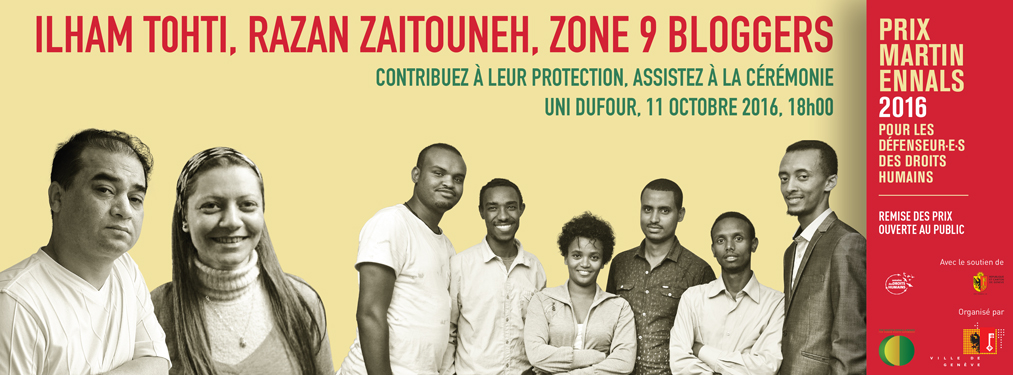
An early Save the Date: 11 October, 2016, Martin Ennals Award for Human Rights Defenders in Geneva.

July 1, 2016

poster MEA 2016


The 2016 Martin Ennals Award Ceremony, organized annually by the City of Geneva and the Martin Ennals Foundation, will this year take place on 11 October, 6.00 pm, at Uni Dufour, Geneva, as the the opening of the Human Rights Week hosted by the University of Geneva from October 11 to 14 and with the support of the Canton of Geneva.

The laureate will be selected from among three 2016 finalists:

Mr. Ilham Tohti
(China) was sentenced to life imprisonment after working for two decades to foster dialogue and understanding between Uyghurs and Han Chinese.

Mrs. Razan Zaitouneh (Syria) was kidnapped after dedicating her life to defending political prisoners and documenting crimes against humanity in Syria.

Zone 9 Bloggers (Ethiopia) have been prosecuted for documenting human rights abuses in their country.

See also: https://thoolen.wordpress.com/2016/04/27/breaking-news-final-nominees-2016-martin-ennals-award-tohti-zone-9-bloggers-razan-zaitouneh-annoucement/

The finalists and laureate are selected by the Jury of the Martin Ennals Award, made up of ten of the world’s leading human rights organizations: Amnesty International, Human Rights Watch, Human Rights First, International Federation for Human Rights (FIDH), World Organisation Against Torture (OMCT), Frontline Defenders, the International Commission of Jurists, EWDE-Germany, the International Service for Human Rights, and HURIDOCS. The detailed programme of the ceremony will follow at the beginning of September.

Martin Ennals Award for Human Rights Defenders

Martin Ennals Award for Human Rights Defenders

For the conversation in the social media, use the hashtag: #Ennals2016.

You can register already now through: http://www.martinennalsaward.org/index.php?option=com_content&view=article&id=296%3Amea-2016-save-the-date&lang=en.