Posts Tagged ‘Switzerland’

Urgent vacancy at FIDH for Delegate to the United Nations in Geneva

January 15, 2025

Posted on 6 January 2025 – Closing date 15 January 2025

The International Federation for Human Rights (FIDH) is an international non-governmental organisation (NGO) composed of nearly 200 national human rights organisations from more than 115 countries. FIDH is a nonpartisan, non-sectarian, apolitical, and not for profit organisation. Since 1922, FIDH has been defending all human rights – civil, political, economic, social, and cultural – as set out in the Universal Declaration of Human Rights.

https://www.fidh.org/en

FIDH are now recruiting : A Delegate to the United Nations (F∕M) – Indefinite-term contract based in FIDH Geneva office

The FIDH’s Delegation in Geneva

  • Represents FIDH before Geneva-based international organizations and institutions, the Office of the United Nations High Commissioner for Human Rights (OHCHR); in particular, the UN Human Rights Council (HRC) and the UN Human Rights Treaty Bodies;
  • Organizes the participation of FIDH’s member and partner organizations in the work of UN human rights bodies and mechanisms (support and assistance with regard to the submission of “parallel” or “alternative” reports, lobbying and advocacy, communication, etc.): mainly the UN Human Rights Council (including the Universal Periodic Review (UPR) mechanism), treaty monitoring bodies, and special procedures;
  • Prepares and implements the interventions of lobbying and advocacy at the Human Rights Council, and defines advocacy strategies;Feeds UN human rights protection bodies and mechanisms, in particular UN special procedures and OHCHR’s sections and branches, based on information from FIDH member and partner organizations and develops the strategic analysis of institutional developments and advocacy opportunities;

Relays and reports on activities and events to FIDH’s International Secretariat based in Paris.

Direct superviser : The representative, Head of the FIDH Delegation to the United Nations in Geneva

Applicants should send their CV and a brief cover letter (in English) by email recrutement@fidh.org quoting reference FIDH DELEGATE in the subject line.
https://reliefweb.int/job/4122938/delegate-united-nations-indefinite-term-contract-based-fidh-geneva-office

Not the moment for Switzerland to Suspend Funding for Human Rights Defenders in Israel and Palestine

November 2, 2023

On 1 November 2023 Erin Kilbride for Human Rights Watch wrote critically about a rather weird decision by the Swiss Government namely to suspend funding to 11 respected human rights organizations in Israel and Palestine.

The Swiss government says it plans to “carry out a fresh, in-depth analysis of all financial flows” and assess the “relevance and feasibility of programmes.” Earlier this month, European governments suspended more than $150 million in development aid, as Israel cut access to food, water, electricity, fuel, and medicines to more than 2.2 million people in Gaza, an act of collective punishment, which is a war crime under international humanitarian law.

The affected groups are: Adalah; Al-Shabaka; Gisha; 7amleh; Hamoked; Jerusalem Legal Aid and Human Rights Centre; MIFTAH: The Palestinian Initiative for the Promotion of Global Dialogue and Democracy; Palestinian Center for Human Rights; the Palestinian NGO Network; Physicians for Human Rights, and Women’s Center for Legal Aid and Counselling.

The West Bank, home to several organizations whose funding has been suspended, has seen a significant spike in Palestinians killed or held in administrative detention without charge or trial.

International support for local human rights defenders is a clear way to support protecting rights, documenting atrocities, and securing justice.

Switzerland made unequivocal commitments to stand with defenders in the Swiss Guidelines on the Protection of Human Rights Defenders (2014, revised 2019), the EU Guidelines on Human Rights Defenders (2008), and the OSCE Guidelines on the Protection of Human Rights Defenders (2014). This decision is hard to reconcile with those commitments.

The Swiss guidelines instruct representatives to support defenders’ security through media work, emergency protection programs, and pushing for investigations into attacks. The EU Guidelines provide, “the EU’s objective is to influence third countries to carry out their obligations to respect the rights of human rights defenders and to protect them from attacks and threats.”

Today, the work of Israeli and Palestinian human rights defenders is more critical than ever. Instead of leaving them in limbo, the Swiss government should maintain its funding of defenders while it conducts its review.

https://www.hrw.org/news/2023/11/01/switzerland-decides-suspend-funding-rights-defenders-israel-palestine

see also: https://www.nytimes.com/2023/11/02/opinion/israel-free-speech-hamas-palestine.html

Davos’ annual meeting starts on 22 May under human rights cloud

May 22, 2022
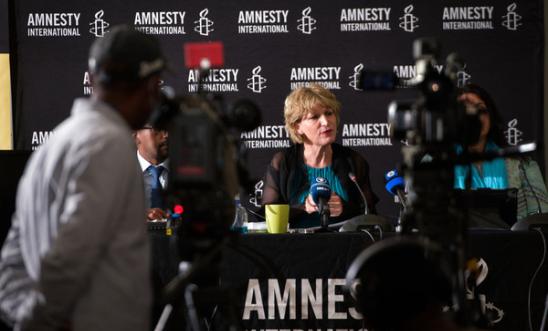
Agnès Callamard at a press conference

Agnès Callamard at a press conference © Amnesty International

Ahead of the World Economic Forum’s annual meeting in Davos that starts today, Sunday 22 May 2022, Agnès Callamard, Amnesty International’s Secretary General, said: 

This year’s Davos conference takes place amid a gathering storm of human rights crises. Russia’s mounting war crimes in Ukraine, the terrifying rollback on abortion rights in the US, the still-neglected climate emergency, the ongoing failure to secure universal vaccine access – these are just a few examples of what happens when human rights are sacrificed for power and profit.  

“Many of the political and business leaders attending Davos are directly responsible for these catastrophes, whether through their explicit pursuit of anti-human rights agendas or through their contemptible inaction and failure to implement solutions.  

“The Davos guestlist includes some of the richest and most powerful people in the world, and they have a moral obligation to put respect for human rights at the top of the agenda. They must use their vast wealth and influence to change the status quo and end the rampant inequality which has been the root cause of so much recent suffering.

The World Economic Forum’s annual meeting will take place in Davos, Switzerland, between 22 and 26 May.

https://www.amnesty.org.uk/press-releases/global-rich-and-powerful-meet-davos-amid-gathering-storm-human-rights-crises

Sudanese woman human rights defender laureate of Martine Anstett Prize 2020

April 21, 2020
Tahani Abbas Khartoum- Ahmed Younes
On Tuesday 12 March 2020 Asharq al-Awsat reported – somewhat garbled – that Tahani Abbas, a Sudanese human rights activist, was awarded “the Martin Institute Prize in Switzerland.” The newspaper surely meant: the Martine Anstett Prize for Human Rights (see: http://www.trueheroesfilms.org/thedigest/awards/martine-anstett-human-rights-prize).
Ms. Abbas told Asharq Al-Awsat that she was proud to receive the prize and because it embodies the distant world’s perception of the Sudanese people’s struggle and shows that the world is watching out for human rights. She went on to say that “personally, the award credits me with a strong role with regards to defending human rights and makes me feel that our efforts and positions in the defense of human rights are appreciated and did not go in vain.” In her acceptance speech, Abbas stressed that all Sudanese women qualify to stand in her place and receive the prize, adding that “I am only a miniature and symbolic example that personifies that struggle of all the women of Sudan. I am an extension of Sudan’s feminist struggle, which is deeply ingrained in its history since before the era of the Kandakes or Nubian Queens, passing through Mendi, daughter of the Sultan Ajabna, and reaching the icon of the Sudanese revolution, Alaa Salah.”

Despite the admiration of observers and the organizers of the prize for the role of Sudanese women in the revolution, Abbas demonstrated her anger at what she calls “women’s weak political participation of after the revolution”. However, she says “Despite being denied political participation after the success of the revolution, our struggle will not stop.”  Abbas has been an active human rights defender since 2009 and is a member of many Sudanese feminist and human rights groups. She is a member of the executive committee of the Regional Alliance of Women Human Rights Defenders of North Africa and the Middle East, a member of the executive committee of the No to the Oppression of Sudanese Women Initiative, the My Fair Home campaign which is concerned with domestic workers, the I am Sudanese, which is concerned with nationality and a member of the Sudanese Alliance to End Child Marriage.

In her assessment of the human rights situation in Sudan after the revolution, she says that it has improved a lot as per international standards. She said: ”The reports of international human rights organizations demonstrate this, and, locally, we feel that, as human rights defenders, we have achieved some victories.”

See also: https://humanrightsdefenders.blog/2015/10/16/martine-anstett-honored-with-own-human-rights-award/

https://aawsat.com/english/home/article/2176746/sudanese-female-activist-wins-martin-institute-prize-human-rights-defenders

New Amnesty report on human rights defenders helping migrants

March 4, 2020
Amnesty accuses European law enforcement agencies of using trafficking and terrorism laws
Human rights group Amnesty has warned that concerned citizens across Europe are facing prosecution for offering help and assistance to refugees and migrants.

In a new report published on 3 March 2020, Amnesty International said European law enforcement authorities and prosecutors are “misusing already flawed” laws intended to prevent people smuggling and terrorism to target members of the public who offer migrants shelter and warm clothing, or attempt to rescue them at sea. Amnesty examined several cases that took place in Croatia, France, Greece, Italy, Malta, Spain, Switzerland and the UK between 2017 and last year, during which human rights defenders who attempted to help refugees and migrants were targeted under legislation intended to tackle organised immigration crime networks. Amnesty’s report comes as world media attention has once again turned to the Mediterranean migrant crisis after Turkey opened its border with Greece to thousands of Syrian refugees.

In one such case, Frenchman Pierre Mumber was charged with “facilitating irregular entry” into France when he was caught offering tea and warm clothing to four west African asylum seekers before being acquitted on appeal. The report also notes that Swiss citizens have faced prosecution for providing migrants and refugees with shelter or helping them access services and protection. Elsewhere, the agency revealed that people in Italy who have worked to rescue migrants and refugees crossing the Mediterranean on unseaworthy vessels have been subjected to smear campaigns and criminal investigations. See also:

https://humanrightsdefenders.blog/2019/12/18/international-migrants-day-the-story-of-the-ocean-viking/

https://humanrightsdefenders.blog/2018/12/02/un-experts-consider-human-rights-defenders-in-italy-under-threat/

https://humanrightsdefenders.blog/2020/02/12/luventa10-sea-rescue-group-gets-ai-germanys-human-rights-award/

Commenting on the contents of the report, Elisa De Pieri, Regional Researcher at Amnesty International, said: “The increased focus on limiting and deterring arrivals in Europe has meant that making refugees or migrants feel safer or welcomed is seen as a threat. “The failure of European states to fulfil the basic needs of refugees and migrants means it is often left to ordinary people to provide essential services and support. “By punishing the people who step up to fill the gaps, European governments are putting people on the move at even greater risk.”

Click to access EUR0118282020ENGLISH.PDF

Amnesty accuses European police of targeting ‘human rights defenders’ who help refugees and migrants

One of the Balzan prizes 2020 will focus on human rights

September 10, 2019

The aim of the Balzan prizes is to foster culture, the sciences and the most outstanding humanitarian initiatives of peace and brotherhood among peoples, regardless of nationality, race or creed. The four subject areas for the awards change every year. As stipulated in the Articles of the Balzan Foundation, they are selected from among “literature, the moral sciences and the arts” and “the physical, mathematical and natural sciences and medicine”. Rotating the subjects ensures that new or emerging research gets recognition, while at the same time it supports important fields of study that may have beenoverlooked by other great international awards. Since 2001, the rules of procedure of the Foundation’s General Prize Committee have stipulated that Prizewinners must destine half of the Prize to finance research projects that are preferably carried out by young scholars or scientists. The International Balzan Foundation, founded in 1957, operates through two separate institutions. The International Balzan Foundation “Prize” in Milan, chaired by Enrico Decleva, selects the subjects to be awarded and the candidates through its General Prize Committee. The Balzan Foundation “Fund” in Zurich, chaired by Gisèle Girgis-Musy,administers the estate left by Eugenio Balzan, so as to place at the disposal of the International Balzan Foundation”Prize,” the financial means necessary to realize its objective. The amount of each of the four 2020 Balzan Prizes will be CHF 750 000. Every year, the four Balzan Prizes are awarded to scholars and scientists who are distinguished in their fields on an international level.

At the conclusion of the announcement of the 2019 Balzan Prizewinners, the President of the General Prize Committee, Professor Luciano Maiani, informed the public that the 2020 Balzan Prizes will be awarded in the following fields:

  • Human Rights
  • Earth System Dynamics

As a further testimonial to the interdisciplinary mission of the Balzan Prize, for the first time in its history, the two general subject areas of the awards, the sciences and the humanities, will share a common theme that is fundamental and highly pertinent to today’s concern with the future of the planet: Environmental Challenges, which will in turn be divided into these two areas:

  • Responses from the Social Sciences and the humanities
  • Materials Science for Renewable Energy

https://www.eurekalert.org/pub_releases/2019-09/gc-tfn090919.php

Aziz, MEA Laureate 2019, recognised as refugee in Switzerland from where he promises to continue the struggle

June 10, 2019

On 10 June 2019, RNZ Pacific brought the news that Abdul Aziz Muhamat, the 2019 Laureate of the Martin Ennals Award for Human Rights Defenders, has found asylum in Switzerland. From Geneva he posted a video on social media to announce that his claim for asylum had been accepted.

Abdul Aziz Muhamat…”I have everything it takes for me to fight for the freedom of each and everyone.” Image: Amnesty International


See also: Manus Island police chief calls for state action over suicidal refugees

Nicaragua moves against women human rights defenders

December 2, 2018
 
Ana Quiros

On Monday 26 November 2018 Ana Quiros, Maria Jesus Ara, Beatriz Huber and Ana Ara were called in to immigration. Quiros was then taken to the El Chipote interrogation prison and subsequently driven to the Costa Rica border. The Havana Times of 27 November carries a long piece on this. “Daniel Ortega and Rosario Murillo’s regime has just raised the level of their harassment against feminist movements, in a day of abuses that culminated on Monday with the expulsion from the country of feminist leader Ana Quiros” write Juan Carlos Bow.

Quiros is a Costa Rican and Nicaragua dual citizen who has lived in Nicaragua for more than 40 years – the entirety of her adult life. Along with Quiros, three European women living in the City of Matagalpa for decades, were also cited by immigration without any explanation to appear on Monday at their offices, where they were held for hours and then had their permanent residency revoked. The authorities refused to allow them to be accompanied by lawyers or human rights defenders.

The Ara sisters are Spanish and Huber is Swiss, all had current permanent residency status. Quiros was born in Costa Rica and is a Nicaraguan national since February 1997. All are part of the national feminist movement that has criticized the repression of the Ortega regime and its responsibility for the death of at least 325 Nicaraguans.

Last week the regime blocked activities of the feminist movement to commemorate the International Day for the Elimination of Violence against Women, which is held annually on November 25th.

Before presenting herself at Immigration, Quiros offered a press conference in which she stated that “the dictatorship must be clear that we are going to continue raising our voices, saying strongly that we want a free homeland in which to live.” “I chose to be Nicaraguan and I feel I have the right to demand that my rights be protected, to demand that in Nicaragua there be peace, justice and freedom, and to repudiate the abuses and arbitrariness that they have committed: the murders, the prison and the kidnapping of all those Nicaraguan brothers and sisters, who only want and are asking for a better Nicaragua, a Nicaragua where we all fit, where no one feels that they are above anyone else,” said Quiros.

This is the second time that a government tries to silence the critical voice of Quiros, who is a specialist in public health. In 2000, the administration of Arnoldo Alemán tried to strip Quiros of her Nicaraguan nationality, after she publicly pointed out the acts of corruption of the liberal party president.

Vilma Nunez, of the Cenidh, lamented the expulsion of Quiros noting that the Ortega government has exceeded its intolerance against everything that annoys and bothers it. “…Nuñez said that the citation of Quiros and the other three feminists “has no legal value because it did not state why they are being called in.” ….Nunez said that in order to revoke someone’s citizenship, a trial must first be held, which has not occurred in this case.

https://havanatimes.org/?p=144719

https://www.frontlinedefenders.org/en/case/deportation-ana-quiros


More about the Geneva Human Rights Platform (Geneva HRP)

June 22, 2018
Expert meeting at the Geneva Academy

The Geneva Human Rights Platform (Geneva HRP), hosted by the Geneva Academy and supported by the Federal Department of Foreign Affairs of Switzerland, provides a dynamic forum in Geneva for all stakeholders in the field of human rights – experts, practitioners, diplomats and civil society – to discuss and debate topical issues and challenges. Relying on academic research and findings, the Geneva HRP aims at enabling various actors to become better connected, break down silos and, hence, advance human rights.

The objective is to foster interactions and discussions on topical issues and challenges through regular events, conferences, expert roundtables and private meetings’ stresses Felix Kirchmeier, Director of Policy Studies at the Geneva Academy. ‘The Geneva HRP aims to increase sharing, exchange and collaboration among different actors by means of its independent, neutral and academic status’ adds Robert Roth, Director of the Geneva Academy.

Specifically, the Geneva HRP concentrates on the current challenges to human rights and the way the United Nations (UN) Human Rights Council (HRC) and other Geneva-based mechanisms address or should address them, as well as on the work of UN treaty bodies. ‘We currently focus on two human rights challenges: use of force and the specific use of less lethal weapons for law enforcement purposes, and human rights and freedoms in the digital age’ underlines Kamelia Kemileva, Executive Manager at the Geneva Academy. ‘We accompany the work of UN treaty bodies via two projects, or sub-platforms, our Academic Platform on Treaty Body Review 2020 which just released its final report, and the Treaty Body Members Platform which connects experts in UN treaty bodies with each other as well as with Geneva-based practitioners, academics and diplomats’ underlines Felix Kirchmeier. [see e.g. https://humanrightsdefenders.blog/2018/05/09/academic-want-un-treaty-bodies-to-become-fit-for-purpose/]

The Geneva HRP is up and running since the beginning of the year, but now has a dedicated online presence, on the Geneva Academy website, which provides information about activities, events and related research.

https://www.geneva-academy.ch/news/detail/134-the-geneva-human-rights-platform-a-dynamic-forum-to-discuss-and-debate-topical-human-rights-issues-and-challenges

TRIAL books success in two major cases against impunity

May 2, 2018

Two major cases of universal jurisdiction – after years of work – have finally borne fruit in the month of April 2018: One verdict in Switzerland (Sperisen) and one in the Democratic Republic of the Congo (Colonel “Marocain”) make the case that the mobilization of human rights defenders and civil society can really make a change.

TRIAL is also organising on 18 June  2018 a round-table <http://tracking.etapestry.com/t/35021127/1307643942/76621378/0/96504/?x=04c6288b> in Geneva on the fight against wartime sexual violence. This event will also be the occasion to celebrate the organization’s 15th anniversary.[see also: https://humanrightsdefenders.blog/2016/06/13/trial-at-14-has-a-facelift/]

—-

https://trialinternational.org/latest-post/affaire-sperisen-lancien-chef-de-la-police-du-guatemala-complice-dexecutions-extrajudiciaires/

https://trialinternational.org/latest-post/drc-head-of-militia-receives-20-years-sentence-for-mass-crimes/