Posts Tagged ‘students’

Bangladesh: Six student human rights defenders arbitrarily detained

August 1, 2024

On the 26th to 28th July 2024, six student human rights defender namely: Nahid Islam, Abu Bakar Majumder, Asif Mahmud, Sarjis Alam, Hasnat Abdullah, and Nusrat Tabassum reportedly have been arbitrarily detained under custody of Dhaka Metropolitan Police’s (DMP) Detective Branch (DB) and coerced to announce the withdrawal of their protest programmes through a video message sent to media from the DB office at around 8:00 PM on 28 July 2024.

Nahid Islam, Abu Bakar Majumder, Asif Mahmud, Sarjis Alam, Hasnat Abdullah, and Nusrat Tabassum are students and dedicated human rights defenders and National Coordinators of the Students Against Discrimination Movement. Nahid Islam is from the Sociology Department, Abu Bakar Majumder from the Geography Department, Asif Mahmud from the Linguistics Department, Sarjis Alam is affiliated with the Zoology Department, Hasnat Abdullah is from the English Department, and Nusrat Tabassum is from the Political Science Department of Dhaka University.

Students Against Discrimination Movement is a student led protest demanding reform of the present quota system in government jobs. A total 56 percent of first and second class government jobs in Bangladesh entailed quotas. 30 percent of the total reserved for the descendants of ‘freedom fighters’. This quota has been widely criticised especially by the students, stating that it create a discriminatory system and allegedly used to recruit students affiliated with the ruling party. Following widespread protests in 2018, the Government of Bangladesh abolished all quotas with an executive order. However, on 5 June 2024, the High Court ordered the Government to reinstate the quota with the power of any adjustment they want to make.

Since 01 July 2024, the protests have escalated in several university campuses.The protests was met with a severe crackdown from the authorities involving ruling party goons, police and paramilitary forces from Rapid Action Battelion (RAB) and Border Guard Bangladesh (BGB). It has reportedly resulted in the deaths of at least 250 people with thousands more injured. With the internet shutdown for almost a week, suspicion remains about many more killings. Since 18 July 2024, local media reported over 10000 people, including many students been arrested in a mass arrest spree.

On 28 July 2024, at around 5:00 AM, woman human rights defender Nusrat Tabassum from Dhaka University had been reportedly picked up by individuals claiming to be from Dhaka Metropolitan Police’s DB at her cousin’s home in Mirpur.

On 27 July 2024, two more student human rights defenders Sarjis Alam and Hasnat Abdullah were picked up and brought to the DB office. The Additional Commissioner of the DB claimed in a press conference that the student human rights defenders have been brought to their custody to ensure their safety, however the comissioner did not clear it whether they have been arrested. While the family members were not allowed to even enter into the DB office on 28 July 2024, they were allowed to meet the students on 29 July – only after their video message of withdrawal of their protest program been covered in media.

On 26 July 2024, at around 4:00 PM, human rights defenders Nahid Islam, Asif Mahmud and Abu Bakar Majumder were forcefully taken from Gonoshasthaya Kendra Hospital by the police in plainclothes in Dhaka and taken to custody of the Dhaka Metropolitan Police’s DB. Nahid and Asif were undergoing treatment Gonoshasthaya Kendra Hospital while Abu Bakar was accompanying them. Police also took away their phones.

Front Line Defenders condemns the arbitrary detention and coercion of student human rights defenders Nahid Islam, Abu Bakar Majumder, Asif Mahmud, Sarjis Alam, Hasnat Abdullah, and Nusrat Tabassum by the Dhaka Metropolitan Police in an attempt to repress their human rights work and target legimate students protests in Bangladesh.

Front Line Defenders urges the relevant authorities in Bangladesh to:

  1. Immediately and unconditionally release Nahid Islam, Abu Bakar Majumder, Asif Mahmud, Sarjis Alam, Hasnat Abdullah, and Nusrat Tabassum.
  2. Ensure the physical and psychological safety and well-being of Nahid Islam, Abu Bakar Majumder, Asif Mahmud, Sarjis Alam, Hasnat Abdullah, and Nusrat Tabassum while they remain in custody.
  3. To secure their immediate access to their families, legal representation, and any medical care they may require.
  4. End to all forms of harassment, intimidation, and arbitrary detention of student human rights defenders in Bangladesh. The rights to freedom of expression, assembly, and association must be respected and protected.
  5. Conduct independent and transparent investigation into the arbitrary detention and coercion of these student human rights defenders.

https://www.frontlinedefenders.org/en/case/six-student-human-rights-defenders-arbitrarily-detained-and-forced-announce-withdrawal-protest

UN Human Rights Office alarmed over repression of student protests in USA

May 2, 2024

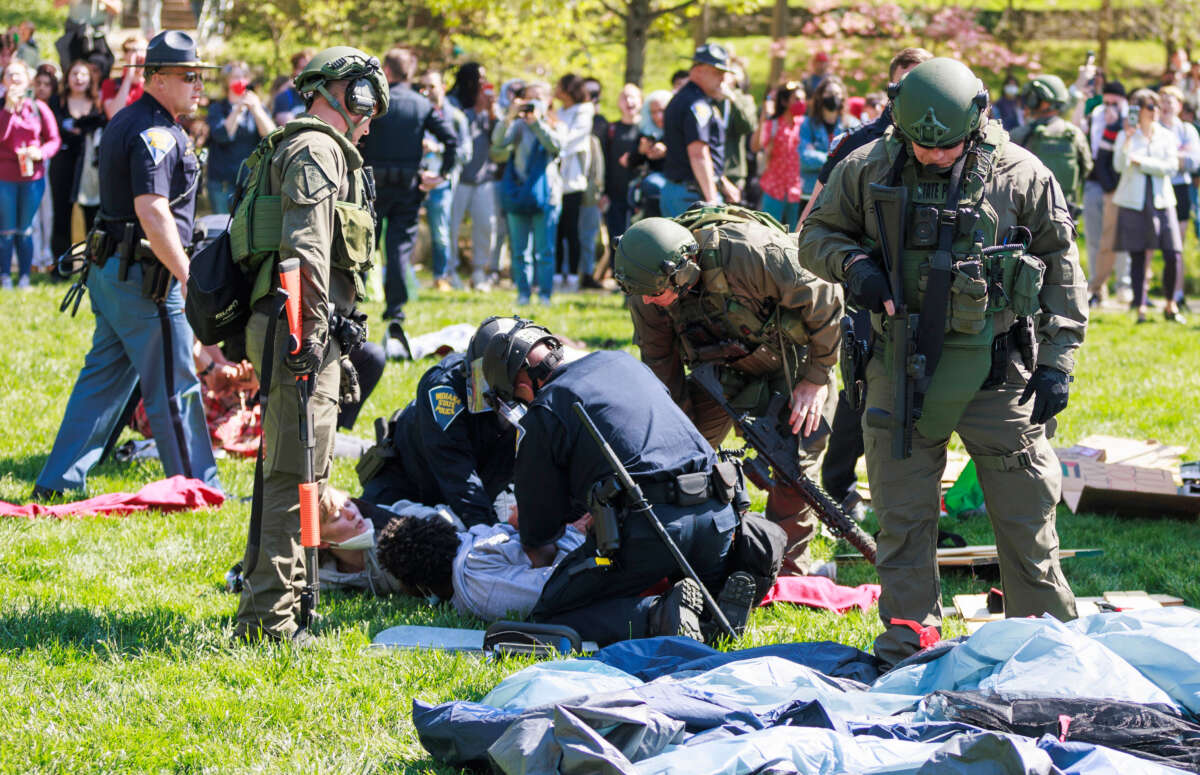
Dozens of people are arrested by the Indiana State Police riot squad during a pro-Palestinian protest on campus in Bloomington, Indiana, on April 25, 2024.

UN human rights officials are expressing alarm over the recent wave of violent repression by university administrators against the student protests for Palestinian liberation that have swept the U.S., raising concerns that protesters’ rights to free speech and assembly are being violated.

A statement on Tuesday said that UN High Commissioner for Human Rights Volker Türk, the UN’s top human rights officer, is “troubled” over a “series of heavy-handed steps taken to disperse and dismantle protests” across U.S. college campuses.

Freedom of expression and the right to peaceful assembly are fundamental to society — particularly when there is sharp disagreement on major issues, as there are in relation to the conflict in the Occupied Palestinian Territory and Israel,” said Türk. “I am concerned that some of the law enforcement actions across a series of universities appear disproportionate in their impacts.

Over the last two weeks, over 1,200 protesters have been arrested across dozens of campuses after university administrators enlisted police to crack down on encampments and other demonstrations set up by students calling for their schools to divest from Israel and supporting corporations, among other demands. At some universities, administrators even allowed law enforcement officers to aim sniper rifles at their students for their peaceful acts of protest.

UN Special Rapporteur on Human Rights Defenders Mary Lawlor said that universities’ crackdowns are an obvious violation of students’ rights.

https://www.ohchr.org/en/statements/2024/02/israelopt-enabling-human-rights-defenders-and-peaceful-protests-vital-achieving

https://www.ohchr.org/en/press-releases/2024/04/united-states-america-un-human-rights-chief-troubled-law-enforcement-actions

see also: the Economist of 30 April: Escalating protests expose three fault lines on American campuses

Türk tells students in Geneva: Human rights are the solution

November 22, 2023

On 21 November 2023 Volker Türk, UN High Commissioner for Human Rights spoke at the Université de Genève. [see also: https://humanrightsdefenders.blog/2022/09/15/new-high-commissioner-for-human-rights-volker-turk-the-man-for-an-impossible-job/] Here some extracts:

First: war. One quarter of humanity is living today in places affected by conflict. At the end of last year, the Peace Institute in Oslo, which works closely with my Office, found that the intensity, length and number of conflicts worldwide are at their highest levels since the Cold War: 55 conflicts, lasting on average between 8 and 11 years.

In Ukraine, in Sudan, in Ethiopia, in Myanmar and across the Sahel – to take just a few examples – the level of atrocities and suffering is devastating. The armed conflict in the Occupied Palestinian Territory and Israel, after just five weeks, has seen over 11,500 people killed, including more than 4500 children – and I want to emphasise that the Gaza Ministry of Health has not been lable to update those numbers since 15 November. The war has lit a firestorm of hate speech across the Middle East and the entire world. The level of Antisemitic and Islamophobic attacks, in real life and online, is deeply shocking….

Time and again, we look back and see that conflict could have been prevented. In the Occupied Palestinian Territory, for example, my Office has repeatedly issued reports that recommend practical, feasible steps towards de-escalation of tensions and overcoming human rights violations. Injustice; discrimination; oppression; extreme inequalities; a lack of accountability for human rights violations: these are among the factors that will sadly make violence more likely.

Before I took up my mandate as the UN’s High Commissioner for Human Rights, I worked for 30 years in situations of failed prevention. I was working with and for refugees –in places where conflict had erupted, with dramatic impact on civilians; or where long years of discrimination metastasized into ethnic cleansing; or where deprivation had become so overwhelming that people were massively compelled to flee. Now, I feel my utmost priority has to be prevention – and solutions. Because that is what human rights bring. They state clearly what every human being is entitled to – a life that is free from fear and from the deprivation of certain essential resources – and in advancing those rights, they bring solutions to the root causes of preventable suffering…

Harsh restriction of civic space is the Achilles heel – the fatal weakness – of governance. If there is one message that I deliver again and again to Ambassadors and Heads of State or Government, it is this: ensuring that people can speak freely – and critically – and that they can fully and meaningfully participate in decisions will build more effective policy…

These are all measures that help to prevent conflict. They are also among the steps that can de-escalate conflict, by resolving some of its root causes; and they contribute to making a peace that is real and which can endure, with development that is sustainable because it is inclusive.

They are also key guidelines for addressing challenges as crucial and complex as climate change, runaway pollution and the obliteration of biodiversity. Acting to limit the triple planetary crisis, and upholding our right to a clean, healthy and sustainable environment, are the defining struggles of our generation.

This spiralling damage is a human rights emergency. Worldwide, climate change is pushing millions of people into hunger. It is destroying hopes, opportunities, homes and lives. In the Sahel region, a recent report by my Office outlines the profound impact of climate change-related soil degradation and declining food production on income, health, resource competition, conflict, and displacement – a vicious cycle that now spins deeper with every planting season. Temperatures in the Sahel are rising much faster than the global average; even if the global temperature rise is kept to an unlikely 1.5 degrees, the impact on the people of the Sahel will be permanent and devastating.

Across the Sahel, we can see very clearly how climate change, conflict, poverty, discrimination and lack of accountability feed into each other – creating a vast knot of issues that strangle the lives and rights of people.  But this is the case everywhere, as the climate crisis continues to generate profound and increasing threats to human rights. The dignity and the very survival of communities, of nations – and ultimately, all of humanity – is at stake.

So, again, how do we prevent this? Where are the solutions?

Notably, of course, we need global solutions. The governments and people of the Sahel, and many other regions that are experiencing extreme harm, did not contribute significantly to climate change. 

In a few days, global climate negotiations will resume in Dubai. It is absolutely essential that they lead to decisive and equitable action to prevent the worst impacts of climate change, and to remedy the impacts that can no longer be prevented. We have to ensure that Governments, businesses and individuals prioritise the interests of humanity over their short-term, narrowly defined self-interest. The fact is, the COP talks have to date fallen far short of what is needed to stop climate change and remedy its worst impacts. The world is dangerously off-track to meet the promises made in the Paris Agreement. Recent discussions on loss and damage are an example of  this. The climate justice movement, and many of the countries most vulnerable to climate change, struggled for years  for an agreement to establish a new loss and damage fund, finally achieving this objective at COP27. But the recommendations that have been sent to COP28 for operationalization of that fund do not satisfy the demands of those most affected by climate change. 

A strong governance framework that is grounded in human rights. Environmental and social safeguards. An inclusive and participatory Board. And a fair funding mechanism. These should be viewed as essentials – not a point of contention, or of trade-offs in negotiation.

Point one: We must protect civic space.

On the climate and environmental issues that affect us all, key decisions continue to be made behind closed doors – and are often influenced by fossil fuel lobbies. Environmental human rights defenders working to protect communities and land from environmental harm are often vilified, attacked and even killed. Their rights to participation, freedom of expression, and access to information and to justice must be secured. We must ensure the free, meaningful and safe participation in all climate discussions of all those most affected by climate change, including women and Indigenous Peoples.

Point two: climate action must advance equality and equity.

Adaptation strategies and all other measures need to prioritize the situation of people most affected by climate change. Funding must go first to the people who need it most.

Point three: We need to ensure access to effective remedy, and accountability, for climate-related harm.

Point four: we need resources for a rapid and just transition that advances human rights, including the right to a healthy environment...

In every country, we also need to see full participation and consultation on environmental laws and measures – notably for those who are most at risk – and protection of people who raise concerns about environmental harm and the policies that produce them.  Bashing climate protests; designing laws that unfairly restrict activities that call the public’s attention to climate harms; and allowing attacks on activists to go unpunished: these are tactics that ultimately harm all States and all human beings. We need to fix this urgently. [see also: https://humanrightsdefenders.blog/2023/10/15/climate-human-rights-defenders-increasingly-seen-as-eco-terrorists/]

So: Conflict. Discrimination. Poverty. The suffocation of civic space. The triple planetary crisis. These are five immense challenges that threaten our rights and our world, and they fuel each other. We face the compounding effects of all of them – while also confronting a surge of new human rights challenges, notably in the digital realm, including artificial intelligence and surveillance.

……

Over the past 75 years, the Universal Declaration of Human Rights has guided tremendous progress in countries across the world. It has inspired vibrant, creative, powerful activism and solidarity, empowering people to claim their rights and to engage actively in their communities and societies.

How could such a simple text guide such profound transformation? Because “recognition of the inherent dignity and of the equal and inalienable rights of all members of the human family is the foundation of freedom, justice and peace.” Greater respect for human rights – all human rights, building on each other ­– constructs more sustainable development. More enduring peace. A safer future.

This is an extraordinarily powerful truth…

Economies and societies that are inclusive and participative; in which opportunities, resources and services are equitably shared; and where governance is accountable, deliver justice, opportunities and hope…

And it is precisely in our era of rising storms that the 75th anniversary of the Universal Declaration of Human Rights can help us navigate to safety. Its essential values, which connect all of humanity, were set out to ward off horror and destruction, and they have been tried and tested. They embody the power of unity of purpose and the potential for transformative action – both within societies, and globally.

It is absolutely critical, now – precisely in this time of terrible crisis – that we rekindle the spirit, impulse and vitality that led to the adoption of the Universal Declaration of Human Rights, so that we can rebuild trust in each other, and move forward, united.

https://www.ohchr.org/en/speeches/2023/11/our-utmost-priority-solutions-turk-tells-students

see also: https://www.opportunitiesforafricans.com/office-of-the-high-commissioner-for-human-rights-un-ohchr-minorities-fellowship-programme-2024/

Harvard opens applications for Fellowships 2023/24

February 6, 2023

The Human rights programme (HRP) and the International human rights clinic at Harvard law school are pleased to announce that the 2023-24 application for the Henigson Human Rights Fellowship and the Satter Human Rights Fellowship is now open.

You can apply to either or both the Henigson and Satter fellowships viathe Qualtrics application form.

Complete applications are due 27 March 2023. Prospective applicants must email Abadir Ibrahim (abibrahim@law.harvard.edu) before March 6, 2023, to discuss their plans and have their host organization vetted.

More information on the fellowships, eligibility and the application process is available on our post-graduate fellowship webpage.

Profile of Rosana Lezama Sanchez from Venezuela

October 27, 2021

The International Service for Human Rights published on 30 September 2021 “Human rights defender’s story: Rosana Lezama Sanchez from Venezuela”.

What is needed from the international community in general, and from within the UN, is a concrete, coherent and unified voice in favour of the protection of human rights defenders, the safeguard of the fundamental liberties, the civic space and human dignity,” says Rosana Lezama Sanchez, a law student in Venezuela working with three national human rights organisations.

Rosana Lezama is a law student in Venezuela working with three national human rights organisations: Centro para los Defensores y la Justicia (CDJ) / Observatorio Venezolano de Conflictividad Social (OVCS) / Centro de Derechos Humanos de la Universidad Católica Andrés Bello (CDH-UCAB). Her work includes the protection of human rights defenders, issues of transitional justice, rule of law, the right to peaceful assembly, and State repression. In this video, Rosana talks about her vision for the future and her work to achieve it.

Rosana was also a participant in ISHR’s Human Rights Defender Advocacy Programme (HRDAP) and ISHR Academy in 2021. 

https://ishr.ch/defender-stories/human-rights-defenders-story-rosana-lezama-sanchez-from-venezuela/

Thailand: joint statement by International NGOs on Pro-Democracy Protests

November 29, 2020

A group of 13 important human rights NGOs – in a joint statement – condemn the Thai police’s unnecessary and excessive use of force against peaceful protesters marching to the national parliament in Bangkok on November 17, 2020. They are concerned that authorities could employ similar measures when facing protesters who have declared they will march to the Siam Commercial Bank headquarters on November 25.

On November 17, police set out barriers and barbed wire to prevent a peaceful march organized by pro-democracy movements from reaching the parliament. Protesters planned to protest outside the parliament as members of parliament and senators debated seven different proposals for constitutional amendments, including an amendment proposed by the lawyers’ non-governmental organization iLAW (Internet Law Reform Dialogue), which was supported by the People’s Movement and its allies. Police refused to let protesters through the barriers, and when the demonstrators acted to breach those barriers, police crowd control units used water cannons laced with purple dye and an apparent teargas chemical, as well as teargas grenades and pepper spray grenades, to forcibly disperse thousands of demonstrators, including students, some of whom are children. Water cannons were first used at approximately 2:25 pm and police continued their efforts to disperse protesters, with constant use of water cannons, teargas and pepper spray into the evening.

Police also failed to prevent violence between pro-democracy protesters and royalist “yellow shirts” near the Kiak Kai intersection, near the parliament. Initially, riot police separated the two groups. However, video posted on social media later showed police officers informing the royalist protesters that they would withdraw and seconds later they vacated their position between the two groups. During the ensuing skirmishes, both sides were filmed throwing rocks and wielding clubs. Live broadcasts included sounds that appeared to be gunfire.

The Erawan Medical Centre reported that there were at least 55 protesters injured, mostly from inhaling teargas. It also reported that there were six protesters who suffered gunshot wounds. The injured included children: a kindergartener and elementary school students….

On November 18, the spokesperson for United Nations Secretary-General António Guterres “expressed concern about the [human rights] situation in Thailand … it’s disturbing to see the repeated use of less lethal weapons against peaceful protesters, including water cannons … it’s very important that the government of Thailand refrain from the use of force and ensures the full protection of all people in Thailand who are exercising a fundamental peaceful right to protest.”

We call on the Thai government to respect, protect and fulfill the right of demonstrators to peacefully protest, in line with Thailand’s international obligations under the ICCPR and customary international law. Specifically, Thailand should:

1.     Permit the People’s Movement march to proceed on November 25 and allow for non-violent protesters, including those who are children, to peacefully protest in front of the Siam Commercial Bank headquarters.

2.     Protect the rights of protesters, including those who are children, in accordance with the Human Rights Committee’s General Comment No. 37 on the Right of Peaceful Assembly.

3.     Facilitate the exercise of the right to peacefully assemble and refrain from dispersing assemblies by using weapons, including less-lethal weapons, against protesters in line with the United Nations Basic Principles on the Use of Force and Firearms by Law Enforcement Officials and UN and other guidance on less-lethal weapons.

4.     Protect protesters, including those who are children, from violence and interference by non-State actors, while also protecting the rights of counter-demonstrators.

5.     Take steps to ensure accountability for rights violations associated with the government’s crackdown on the protest movement and to ensure that those whose rights have been violated enjoy the right to an effective remedy, as guaranteed under ICCPR article 2(3).

Signed by:

Amnesty International

Article 19

ASEAN Parliamentarians for Human Rights

Asia Democracy Network

Asian Forum for Human Rights and Development (FORUM-ASIA)

Asian Network for Free Elections (ANFREL)

CIVICUS: World Alliance for Citizen Participation

Civil Rights Defenders

FIDH – International Federation for Human Rights

Fortify Rights 

Human Rights Watch

International Commission of Jurists

Manushya Foundation

———–

https://www.hrw.org/news/2020/11/25/statement-international-ngos-pro-democracy-protests-november-17-and-25-2020

Human rights defenders in Canada subject to pressure from China

July 20, 2020
CP-Web. People wearing masks stand during a rally to show support for Uighurs and their fight for human rights in Hong Kong, Sunday, Dec. 22, 2019. (AP Photo/Lee Jin-man) ORG XMIT: LJM106
People wearing masks stand during a rally to show support for Uighurs and their fight for human rights in Hong Kong, Sunday, Dec. 22, 2019. Lee Jin-man / The Associated Press

Marcus Kolga (documentary filmmaker and a senior fellow at the Macdonald-Laurier Institute’s Center for Advancing Canada’s Interests Abroad) and Yang Jianli (former political prisnoner in China – founder and president of Initiatives for China) wrote an inteteresting piece in the Vancouver Sun of 18 July 2020. Here the piece in full:

In May of this year, the Coalition for Human Rights in China published a report exposing incidents of Chinese government harassment against human rights activists in Canada that have taken place between July 2019 and March 2020. The report described efforts undertaken by the Chinese government to suppress dissidents and mobilize overseas Chinese communities to act as agents of influence.

This civil society report follows one published in March by Canada’s National Security and Intelligence Committee of Parliamentarians (NSICOP), which explicitly warned that regimes like those in China, Russia and Iran are “harassing human rights defenders in Canada and interfering with freedom of assembly and media,” with the aim being to impose a “chilling effect on human rights activism and freedom of expression.

Both reports provide clear evidence that the Chinese government is intensifying its clandestine operations to threaten, bully, intimidate and silence activists in Canada when they raise concerns about democracy and civil rights in Hong Kong, Beijing’s systemic mass abuse of Uyghur, Tibetan or Falun Gong human rights, or Chinese government influence operations in Canada.

China’s efforts to mute criticism in Canada is occurring in the shadow of that country’s arbitrary, unlawful detention of Canadians Michael Kovrig and Michael Spavor, who were taken hostage in retaliation for the lawful arrest of Huawei CEO Meng Wanzhou on a United States extradition request.

Amnesty International Canada has stated that Chinese state actors have almost certainly become emboldened by the inadequate response of Canadian officials.

The academic freedom and freedom of expression of university students in Canada speaking out on China has been stifled. Indeed, many fear that the Chinese government is monitoring their speech and activities — a fact that has been confirmed by the NSICOP report, which states that Canada’s intelligence agency “CSIS assesses that the PRC and the Russian Federation are the primary threat actors on Canadian campuses.”

The Canadian Coalition on Human Rights in China has called for a public inquiry into threats at Canadian educational institutions and has recommended setting up a monitoring office to register complaints of harassment and refer such incidents to police. Amnesty International has warned about the rampant hacking of phones, computers and websites on university and college campuses, public rallies, and cultural events in Canada, implicating China for hacking. The individuals behind these threats are often anonymous but can be characterized as state propagandists and foreign influence agents who are supported and often directed by the Chinese government.

Among the threats outlined in the Canadian Coalition on Human Rights for China report are “bullying, racist, bigoted, threats of violence including sexual violence and even death.” It has called for the expelling of Chinese diplomats — of which China has more of in Canada than any other country — and applying Magnitsky sanctions on those responsible for engaging in information warfare and threats against Canadian civil society activists.

On August 17, 2019, at a Toronto rally held in support of civil rights in Hong Kong, more than one hundred protesters blocked the pro-democracy activists, loudly chanting “One China.” They insulted the pro-democracy demonstrators and took photos of them in efforts to intimidate them. When activists sang “O Canada,” the counter protesters booed them and sang China’s national anthem, eventually requiring a police escort for the pro-democracy activists to leave safely.

Mehmet Tohti, a leading Uyghur Canadian activist, says that threatening phone calls are another method by which the Chinese government intimidates those who raise concerns about the over one million Muslim Uyghurs who have been forced into concentration and forced labour camps in Xinjiang and elsewhere. Chinese security officials are making direct phone calls to Uyghur-Canadians demanding that they remain silent with the threat of targeting family members who remain in China with harassment or worse.

Chemi Lhamo, a member of Canada Tibet Committee and Students for a Free Tibet, faced a massive harassment campaign in 2019, when she was elected president of a University of Toronto student union. Among the racist, anti-Tibetan messages she received was one that read: “China is your daddy — you better know this.”

While Canadian Foreign Minister Francois-Philippe Champagne welcomed the Coalition for Human Rights in China report and promised to follow up on its recommendations, no meaningful action was taken. Chinese government harassment against Canadian civil society activists continues to escalate, and the mass human rights abuses committed by Beijing continue unabated, with total impunity.

In order to protect its own citizens and uphold its commitment to protecting human rights, Canada must immediately apply Magnitsky human rights sanctions against Chinese officials responsible for the mass violation of human rights against Uyghurs, Tibetans, the citizens of Hong Kong and in mainland China. According to China expert Jonathan Manthorpe, roughly US$1 trillion has been “spirited out of China by Communist party leaders and their hangers-on” who seek to hide their assets “in stable overseas havens like Canada, the United States, Australia or Europe.”

Canada can help curb China’s barbaric abuse of human rights by threatening to freeze the assets of those who are responsible for them. Minister Champagne signalled last Wednesday, that the government is open to considering the option of Magnitsky sanctions and we urge him to do so in co-ordination with UK Foreign Minister Dominic Raab and U.S. Secretary of State Mike Pompeo.

Canada should immediately consider adopting legislation that requires the registration of Canadian citizens acting as agents for foreign governments — similar to Australia’s Foreign Influence Transparency law. Such legislation will introduce serious punitive consequences for anyone who acts against Canada and its citizens on behalf of malign foreign regimes.

Finally, Canada should consider expelling Chinese diplomats who use their diplomatic cover to engage in information warfare, intimidation and influence operations. Canada’s security agencies are likely aware of which “diplomats” are engaging in such activity. It should be noted that, as of March 2020, China had many more diplomats accredited to Canada than any other nation, with 163 compared to 146 for the United States or 22 for the United Kingdom.

China’s information warfare and influence operations targeting Canada will assuredly only intensify over the coming months. If Canada wishes to protect its citizens against foreign harassment, intimidation and threats, it must act immediately to show Beijing, Moscow and Tehran that their actions have consequences.

The Canadian government speaks loudly of the need to protect international human rights, but it must now back that rhetoric with action if defending the values of human rights, freedom and democracy are truly its aims.

https://vancouversun.com/opinion/marcus-kolga-and-yang-jianli-canada-must-take-measures-to-end-foreign-attacks-on-human-rights-activists-in-canada

Hull and Oxford University honour UN Special Rapporteur Professor Subedi

April 24, 2020

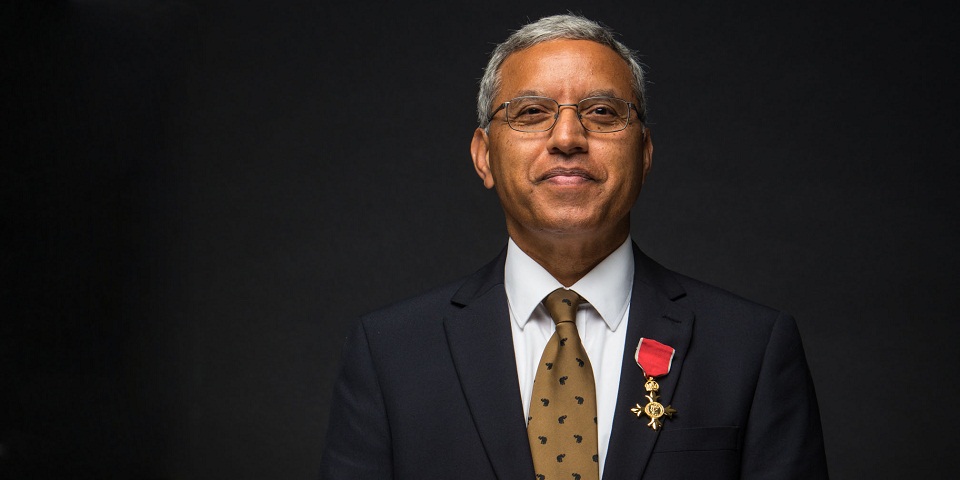
The University of Hull in the UK has awarded the degree of Doctor of Laws (LLD), honoris causa, to Professor Surya P. Subedi, QC, OBE, DCL in recognition of his accomplishments in the field of international law and human rights, the university said in a press statement. Professor Subedi had obtained an LLM with Distinction and a prize for best LLM student of the year in 1988 at Hull. Commenting on the award of such a high accolade by Hull, he said he was honored by the recognition of his accomplishments by his alma mater.

The 62-year-old professor was graduated from the Tribhuvan University, Nepal. Upon completion of his LLM, Professor Subedi won an FCO scholarship to study for a DPhil (PhD) in Law at the University of Oxford and obtained his degree with a prize in 1993. Last year, Oxford awarded him the highest degree – the Doctor of Civil Law in recognition of his contribution to international law and human rights.

This year the University of Oxford has established two awards in the name of Professor Surya Prasad SubediThe first prize named Dr Surya Subedi Award in Human Rights Law will be given to the outstanding performer in the Human Rights Law (Bachelor’s degree) and the second award named the Dr Surya Subedi Award for the D Phil in Law will be given for the doctoral thesis adjudged the best in the Faculty of Law. Prof Subedi expressed his happiness over the establishment of two awards by one of the world’s distinguished universities in his recognition. .

https://www.nepal24hours.com/oxford-university-establishes-two-awards-in-honour-of-prof-subedi/

https://myrepublica.nagariknetwork.com/news/hull-university-awards-doctor-of-laws-to-uk-based-nepali-professor-subedi/

https://en.wikipedia.org/wiki/Surya_Subedi

How to work with the UN and its Rapporteurs: new ISHR guidance for human rights defenders

December 18, 2019

On 18 November 2019 the ISHR launched its new guide to the UN Special Procedures, an essential tool for human rights defenders seeking to engage more strategically with these experts, for greater impact on the ground.

ISHR’s Practical Guide to the UN Special Procedures provides an overview of the system of independent human rights experts known as the Special Procedures, and the different ways human rights defenders can make use of it to further their human rights causes. Often their independence allows them to discuss issues deemed too politically ‘sensitive’ at the international level. It also enables them to act swiftly and react publicly against human rights violations. This handbook is intended to be a practical aid to working with the Special Procedures for non-governmental organisations (NGOs) and human rights defenders. O

Read the Practical Guide to the UN Special Procedures here

You can find more tips and examples of how to engage with Special Procedures in the ISHR Academy, ISHR’s e-learning space for human rights defenders looking to strengthen their advocacy skills with the UN for greater impact on the ground. Helping human rights defenders strengthen their advocacy skills with the UN

Navigating the UN

An overview of the international human rights system and the importance of civil society engagement

Watch the video

Test your knowledge

Learning Modules

Build your advocacy skills

Hand holding a globe in a light bulb

ISHR Academy Introduction

A quick start guide to getting the most out of the learning modules developed by ISHR

People sat around the council debating chamber

UN Human Rights Council

Understand the structure, purpose and mandate of the Human Rights Council and the opportunities for effective engagement

A team of experts

Special Procedures

Explore the purpose and mandates of the Special Procedures and how you can work with them to strengthen your advocacy. For more see: https://academy.ishr.ch/

Students who graduated in 2018/19 in the Netherlands can compete for a human rights award

October 10, 2019

Did you graduate in 2018 or 2019? And did you – at least partially – study in the Netherlands? Then you can compete for the Thoolen NJCM-Thesis Award. The best thesis will be published as a book!

The Dutch section of the International Commission of Jurists (NJCM) will select the best Master thesis in the field of human-rights. Any law student with a university or higher professional educational background is welcome to participate. The thesis must have been written in either the academic year of 2017/18 or 2018/19.

Before submitting your thesis, check whether you meet the requirements as stated in the Regulation for the Thoolen NJCM-Thesis Award <http://njcm.nl/wp-content/uploads/2019/10/Regulation-Thoolen-NJCM-Thesis-Award-2019.pdf> . For any additional questions you can contact the NJCM-secretary at: NJCM@law.leidenuniv.nl <mailto:NJCM@law.leidenuniv.nl>

Visit the Thoolen NJCM-Thesis Award webpage <https://njcm.nl/over-het-njcm/studentencompetities/>  for more information about previous award winners, the jury members and the Regulation.

The deadline for submitting your thesis is 1 December, 2019.
—-

Among the previoius winner are:

2017: Sylvie McCallum Rougerie, Police Failures to Combat Sexual Assault: Lessons from International and Regional Human Rights Law for Improving Accountability under the Canadian Charter of Rights and Freedoms
2011: Laura Henderson, Tortured reality. How media framing of waterboarding affects judicial independence
2009: Erik van de Sandt, A child’s story for global peace and justice. Best practices for a child-friendly environment during the statement- and testimony-period in respect of the Rome Statute and the International Criminal Code
2005: Janine de Vries, Sexual violence against women in Congo. Obstacles and remedies for judicial assistance