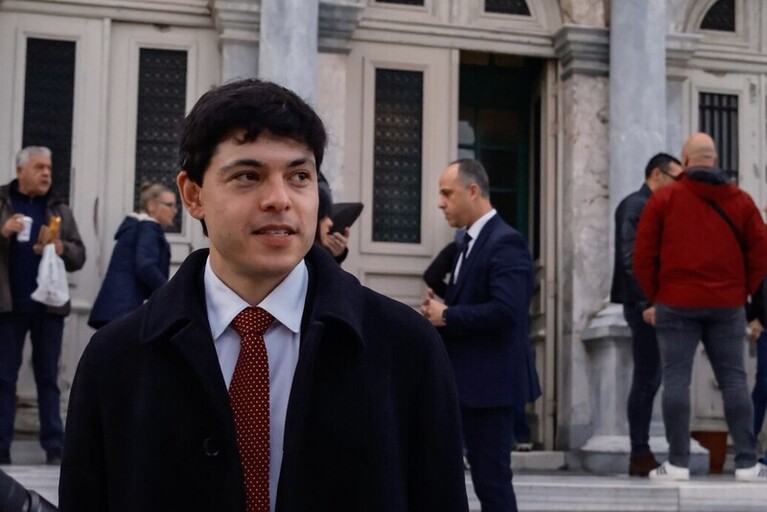
For years, Seán Binder’s life was turned upside down because he believed people’s pulses should be checked before their passports. In January, he was finally acquitted of charges relating to his humanitarian work helping migrants and refugees at sea. [https://www.bbc.com/news/articles/c98j7n2xj1xo]
Here, he shares his story and his concerns over a new piece of EU legislation that threatens vital humanitarian work in future.
My ordeal started at about 2am one morning in February 2018, when I was arrested by the Greek police. People were fleeing conflicts at home and coming to Europe seeking safety in unseaworthy boats and I was helping the Emergency Response Center International to conduct search and rescue activities.
I was detained without understanding what exactly was happening; we were provided neither a lawyer nor an interpreter. After two nights, we were released “pending further investigation.” We continued to do search and rescue. After all, we had done nothing wrong. In fact, we continued to cooperate with the very authorities that had arrested us.
Then, in August 2018, six months after our initial arrest, my colleague and I were detained again. This time, we were charged with serious crimes, including forgery, the illegal use of radio frequencies, espionage, money laundering, being members of a criminal organization, and facilitating illegal entry….Finally, on 15 January this year, I was acquitted. The prosecutor at trial stated there was no evidence of criminality, and the panel of judges unanimously agreed that my 23 co-defendants and I were motivated by, and engaged in, legal humanitarianism.
Whilst I am delighted not to be returning to prison, it has taken far too long for this absurd prosecution to collapse. In the interim, the damage has already been done. EU states’ authorities have obstructed civilian rescue efforts, and over 32,000 lives have been lost at Europe’s borders since 2014. Meanwhile, dozens of humanitarians across Europe face similar prosecutions, obstruction, intimidation and harassment. Sadly, my case was not the exception but part of a wider pattern of states criminalizing humanitarian work.
The current effort to reform EU anti-smuggling legislation, the so-called “Facilitators Package” offers an opportunity to address some of the issues that have led to our baseless prosecution. However, the proposed revisions to the legislation might inadvertently increase the risk of criminalizing rescue workers – meaning future prosecutions will still be possible and may not end in acquittals like mine. They will also impact migrants, people of migrant origin and racialized people who all too often suffer from these policies.
As Amnesty International has highlighted, the proposal’s broad and vague provisions risk perpetuating the criminalization of refugees, migrants and human rights defenders. Any reform should clarify explicitly and in a binding manner that acts of humanitarian assistance or solidarity should be exempted from prosecution or punishment. Migrants who may have been smuggled themselves, or people assisting their family members should also be protected from criminal liability.
Through this reform, the EU has an opportunity to align with the EU Charter, UN Conventions and Smuggling Protocols, and treaties on maritime search and rescue, and to explicitly protect the right to life, the right to seek asylum, and the duty to render assistance.
As it stands, the proposal tries to expand the avenues to pursue humanitarian workers by introducing the crime of “public instigation” of irregular migration. This vague new provision could be misconstrued to harm refugees and migrants, advocates and activists protesting unjust migration laws or professionals providing legal information or assistance.
Prosecutors should focus on exploitation and violence, including by authorities summarily force people across land or sea borders.
Last year, the European Court of Human Rights found “serious evidence” of systematic pushbacks in Greece. Evidence of similar practices has been mounting across European borders. Without border monitoring, this already opaque crime becomes ever more obscure. Finally, trafficking, another cross-border crime, is arguably exacerbated by EU policy. A UN report published in 2018 found that asylum seekers in Libya face “unlawful killings, torture, arbitrary detention, gang rape, slavery, forced labour and extortion,” with apparent complicity by State actors. Nevertheless, the EU has for years financed the so-called Libyan Coast Guard.
Whether in the Facilitators Package or in its wider border policies, the EU must respect the rule of law and human rights.
The way to stop people taking dangerous journeys is providing safe and legal pathways for protection, commensurate in scale with the need for protection, and channels for regular migration for those seeking a better life. By denying safe routes, the EU pushes people into the arms and boats of smugglers and traffickers.
All the while, EU laws and narratives on stopping smugglers continue being used to criminalize migrants and people doing what they can to save lives or offer assistance. Unless the reform of the Facilitators package takes serious steps to uphold the duty to rescue and defend humanitarians, people will continue to risk jail for doing what is normal, human behaviour: helping others at risk.
Watch Seán as he discusses his case, his reflections and hopes for the future.
Listen to Séan’s full story in the first season of Amnesty’s podcast ‘On the Side of Humanity’.
[see Also: https://humanrightsdefenders.blog/2024/01/16/5-podcasts-by-human-rights-defenders/]






 Hans Thoolen on Human Rights Defenders and their awards
Christof Heyns discusses new UN Comment on Right of Peaceful Assembly
July 30, 2020On 29 July, 2020 Just Security published a lengthy interview of World Justice Project Executive Director Elizabeth Andersen with Christof Heyns, Professor of Human Rights Law at the University of Pretoria and member of the United Nations Human Rights Committee. This is particularly important as a new new General Comment was issued just this week by the United Nations Human Rights Committee providing guidance on this topic at a critical moment, with protest movements on the rise across the globe, and many countries grappling with the appropriate response—something that has become even more complicated with the COVID-19 pandemic and public health restrictions on large gatherings.
The audio podcast is available at WJP. For those who pefere to read there is text version in the link below. Here a teaser:
Christof Heyns [00:13:17] I think the main idea is that peaceful assemblies are a legitimate use of the public and other spaces. If one thinks on a very sort of practical level, streets are used for vehicles, but they also are used for marathons and for markets and so forth. And they’re closed off on a Saturday or whatever the case may be for that purpose. And peaceful assemblies, like these other social gatherings, are a legitimate use of space. So a number of domestic courts–Spain and Israel and others–have said the public space “is not only for circulation but it’s also for participation”. And I like that quote; even in the translation it comes across. So that’s the underlying idea. It is, as you say, part of democracy.
It is also part of the message of the General Comment that peaceful assembly is an individual right. So one should not in the first place think about the entire assembly exercising the right — and is it violent or is it not, or does it cause damage, and as a result that everybody’s responsible — the focus is on the individual. And even if there are some individuals in a larger group who are, in an isolated way, engaged in violence, this cannot be attributed to the group as a whole. Every individual has that right. As far as possible, they should be treated as individuals.
I think also the underlying philosophy is to say that the right of peaceful assembly should be dealt with by the authorities in a “content neutral” way. As you will know, this idea is strongly present in the US jurisprudence, for example. So the idea is, even if those who are engaging in assemblies are your political opponents or you don’t like their particular message for whatever reason, they are still allowed to do so. There may be some exceptions and maybe we can talk about that. But in principle, the approach should be content neutral.
People should be allowed also to exercise the right “within sight and sound” of their target. So by doing that, they can demonstrate to others that they feel strongly enough about this to gather around this. But they can also, for themselves, see what is the support that they have. So if you organize an assembly, if you think you’re going to have a million people and it’s only yourself who shows up, that’s a message to yourself about the popularity and the support for your idea. In fact, Gandhi had this idea that what he did were “experiments with truth”. And I think to some extent that’s true for peaceful assemblies today. It’s a way of testing ideas and then seeing what is the response. Putting your toe in the water, putting up a trial balloon. And in many cases, this can diffuse a situation. So the society as a whole can take note and they can internalize the fact that there are people who feel very strongly about a certain cause and then they can do something about it. So it’s almost the idea of precaution. Even if I’m not persuaded, now, I know that these people feel like that, and I can do something about it instead of it blowing up into a massive problem.
….
Elizabeth Andersen [00:21:06] Well, it’s certainly an ambitious project you undertook and covers a lot of ground, with lots of standards and recommendations detailed. I think it’s interesting to think about how that all plays out in a concrete setting. And so you mentioned the Black Lives Matter movement and current protests, particularly here in the United States where I’m from. I’d be interested if you can share with our listeners how you see the Committee’s guidance helping us evaluate the response to that protest movement here in the United States. What’s appropriate? What’s not?
Christof Heyns [00:21:53] Well, I think a number of the themes of the General Comment are relevant in the United States and in other societies now as well. So the starting point is that this is an individual right. If there are members of a particular group of an assembly who are engaging in violence, this cannot be attributed to all members. In some cases, interventions are needed, not only permitted but actually required, if there is danger to the lives of people, for example, or to property. The state has a duty to protect, but that should be targeted as far as possible to the individuals concerned. These should be targeted interventions
I think the other overriding issue is the one of de-escalation. There are two approaches. One is to escalate the situation and to show superior force, so to speak. And, of course, if that’s done by the state, the other side also tries to show superior force, and it escalates. But the police themselves, and also the politicians, have a duty of de-escalation and to accommodate, to tolerate, some level of disruption, and to work towards preventing the situation from getting out of hand.
Perhaps more particularly, the General Comment also focuses on the use of military staff to do law enforcement – and I think much of that applies to paramilitaries as well. We don’t say this can never be done. But if it’s done, it is under exceptional circumstances, if there is no other way of doing it, and it should be on a temporary basis. And those who are involved must have the necessary training, including the human rights training, because, of course, the training of police and military staff differs very much. And then in the last place, they are bound by human rights standards. So the same standards that apply to the police also apply to military and paramilitary staff.
There’s also the issue of plainclothes police officers and the question of wearing identification. The General Comment emphasizes that law enforcement officials must wear clear identification. This is important for accountability purposes. If plainclothes police are used — and again, it’s not completely excluded, it may be the only way to have a positive intervention — before they use any force or arrest anybody, they have to identify themselves…..
https://www.justsecurity.org/71736/interview-with-christof-heyns-unhrc-general-comment-37-on-the-right-of-peaceful-assembly/
Posted in books, Human Rights Defenders, UN | 1 Comment »
Tags: Christof Heyns, Comment, Elizabeth Andersen, freedom of assembly, freedom of demonstration, Just Security, peaceful protest, podcasts, UN Human Rights Committee, USA, World Justice Project