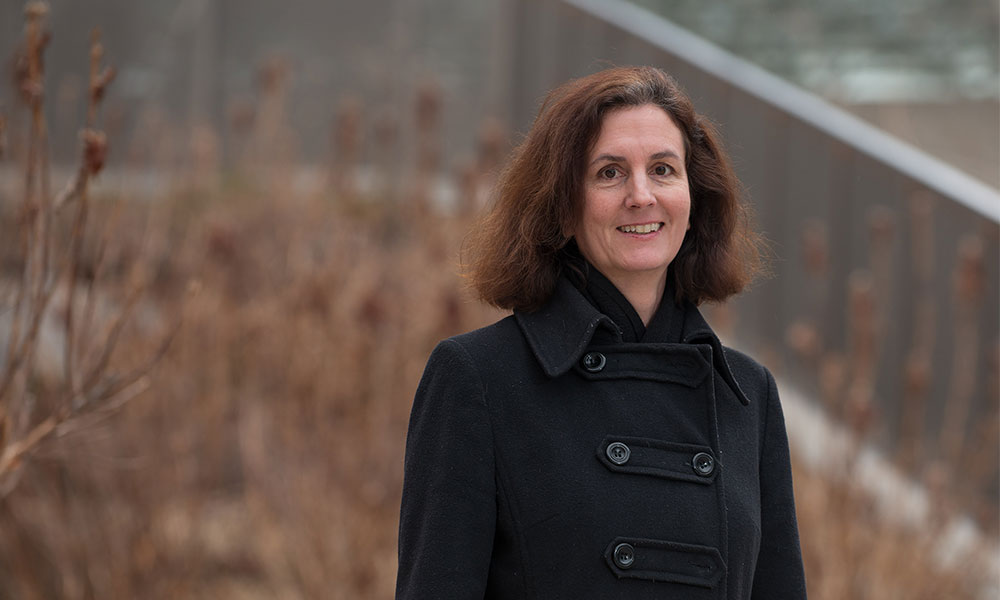
Teresa Donnelly, who leads the LSO’s Human Rights Monitoring Group, spoke at the Osgoode Hall event in Toronto commemorating International Day of the Endangered Lawyer 2020.
When supporting colleagues abroad, lawyers should consider offering behind-the-scenes support as well as making public statements, a Pakistan-based journalist told an audience at the Law Society of Ontario last week. “What has to be really kept in mind is how that support is voiced and contextualized,” said Beena Sarwar. “If it takes a simplistic view or plays into anti-Pakistan rhetoric …. it’s so easy to make Pakistan a scapegoat and target.” Sarwar, whose blog has gained international acclaim for its coverage of freedom, human rights, peace and even influential jurists, was one speaker at the Law Society of Ontario’s International Day of the Endangered Lawyer 2020, hosted at Osgoode Hall in Toronto on 24 January by the Lawyers’ Rights Watch Canada,Human Rights Watch and Amnesty International.
This year, lawyers organized a protest at the Pakistani embassy at the Hague. Past events focused on Egypt, Turkey, China and Honduras, among others.
The LSO’s Human Rights Monitoring Group has issued several statements about treatment of lawyers in Pakistan over the past few years. In the aftermath of the Kasi attack, the LSO urged the Pakistani government to “put an end to all acts of violence against lawyers and human rights defenders in Pakistan,” and “ensure that all lawyers can carry out their legitimate activities without fear of physical violence or other human rights violations.”
Other incidents that have been condemned by the LSO are the 2015 murder of Samiullah Afridi (a lawyer who defended a doctor that allegedly assisted CIA agents with their hunt for al Qaeda leader Osama bin Laden); and a suicide bomb attack on the Pakistani judiciary.
“Over the past decades, lawyers in Pakistan have been subjected to acts of mass terrorism, murder, attempted murder, assaults, (death) threats, contempt proceedings, harassment and intimidation, as well as judicial harassment and torture in detention, merely for engaging in their professional duties as lawyers,” a letter from Lawyers’ Rights Watch Canada said earlier this month. “Their families also have been targeted, and some have even been murdered. Some lawyers have also been threatened with disbarment and/or had their homes and offices raided by the police.”
At the event, bencher Teresa Donnelly read a letter the law society had received from a Pakistani lawyer. Lawyers cannot become “heroes,” Donnelly recounted from the email. Instead, she said, the writer felt the role of lawyers was to “focus on their work improving the justice system.” While support is needed for the Pakistani bar, Sarwar explained that Western organizations must be careful not to jump to issue statements that play into conspiracy theories about Western involvement. Abdul (Hamid) Bashani Khan, a lawyer at the Abdul Hamid Khan Law Office in Mississauga, also spoke on the panel, where speakers highlighted some of the common misunderstandings of the situation in Pakistan, particularly amid anti-Muslim rhetoric publicized in the post-911 era. For example, panelists said the bench and bar are portrayed as both very strong — given the influence of the lawyers’ movement of Pakistan — and also very weak, in the fight for judicial independence and public support. In 2014, a lawyer was killed after representing a high-profile professor charged with blasphemy.
To mark the Day of the Endangered Lawyer, the International Bar Association’s Human Rights Institute released a toolkit to help the legal community navigate the complex task of protecting lawyers at risk. The three-part kit includes supports for risk management, human rights mechanisms, emergency protocols, legal frameworks, international protection, security plans and response chains.
Pakistan is the focus of this year’s Day of the Endangered Lawyer (January 24) and the American Bar Association is organising a teleconference, in which panelists will provide a report of the current state of attacks on the judiciary, bar and other human rights defenders in Pakistan, as well as offering suggestions for how the ABA and other outside organizations can lend support. [see also: https://humanrightsdefenders.blog/2018/01/22/24-january-2018-day-of-the-endangered-lawyer-focus-on-egypt/]
Moderator:
Sara Sandford, Immediate Past Co-Chair, International Human Rights Committee
Speakers:
Jalila Haider, Founder of We the Humans
Farahnaz Ispahani, Senior Fellow, Religious Freedom Institute; Global Fellow, Woodrow Wilson International Center for Scholars
Hussain Haqqani, Former Ambassador to US
Raza Rumi, Director of the Park Center for Independent Media, Ithaca College; Visiting Faculty at Cornell Institute for Public Affairs; and Editor of Daily Times
On 27 Pakistani human rights defender Malala Yousafzai has been declared as “the most famous teenager in the world” by the United Nations in the ‘Decade in Review‘ report of the UN. In recognition of her efforts for children’s rights which started before she was shot in the head by Taliban militants, Malala Yousafzai became the youngest recipient of the Nobel Peace Prize in 2014. According to the UN review report “The attack made waves around the world and was widely condemned. On Human Rights Day that year, a special tribute to Malala was held at the Paris headquarters of UNESCO, pushing for action to ensure every girl’s right to go to school, and to advance girls’ education as an urgent priority,”.
“Malala’s activism and profile have only grown since the assassination attempt. She won several high-profile awards, including the 2014 Nobel Peace Prize (alongside Indian social reformer Kailash Satyarthi), and became a UN Messenger of Peace in 2017, with a special focus on girls’ education,” the report added. Recently the 22-year-old was also chosen by Teen Vogue as its cover person for its last issue of the decade.
Just to make sure the record is correct, Malala has in fact received at least the following 10 awards:
International Human Rights Day, 10 December 2019, was celebrated or observed all around the world and there is no way to report on every event. Stil to add flavour here a selection of some 14 smaller and bigger events – for more details follow the links provided (and for last year’s anthology see references at the end):
There was of course the annual statement by UN High Commissioner for Human Rights Michelle BacheletRightly, these young people are pointing out that it is their future which is at stake, and the future of all those who have not yet even been born. It is they who will have to bear the full consequences of the actions, or lack of action, by the older generations who currently run governments and businesses, the decision-makers on whom the future of individual countries, regions and the planet as whole depends…We have a duty to ensure young people’s voices are heard. The Universal Declaration of Human Rights, adopted by the UN General Assembly on 10 December 1948, was a firm commitment by States to protect the rights of everyone – and that includes making it possible for future generations to uphold human dignity, equality and rights…..Climate harms will not be halted by national borders – and reactions based on hostile nationalism, or short-term financial considerations, will not only fail: they will tear our world apart. The struggles for climate justice and human rights are not a political quarrel. This is not about left or right: it is about rights – and wrongs… We need to mobilise across the world – peacefully and powerfully – to advance a world of rights, dignity and choice for everyone. The decision-makers understood that vision very clearly in 1948. Do they understand it now? I urge world leaders to show true leadership and long-term vision and set aside narrow national political interests for the sake of everyone, including themselves and all their descendants.
Pakistan: Human Rights Defenders asked the government to make serious efforts to provide fundamental rights. Human rights, labour rights and civil society activists called upon the government to make serious efforts for the provision of fundamental human rights and freedoms, especially the freedoms of association and expression, enshrined in the Constitution of Pakistan and the Universal Declaration of Human Rights. Addressing a joint press conference at the Karachi Press Club to mark International Human Rights Day, PILER joint director Zulfiqar Shah, human rights activists Naghma Shaikh and Saeed Baloch representing the Sindh Human Rights Defenders Network said the government should ensure the restoration of the freedom of expression and the freedom to association. They demanded that the government should bring in a law to protect the rights of human rights defenders as they stood up for the voiceless people…. They also demand fully restoring the freedom of expression, as it was a constitutional right of the people to express their thought. Access to the information right must be ensured, they said.
India: Activists say NHRC urgently needs to protect human rights defenders. The National Human Rights Commission should proactively protect the rights of ‘human rights defenders’, said activists at the national convention on rights of Dalit and Adivasi rights defenders in the capital on Tuesday. Human Rights Defenders appealed to the commission to proactively intervene in cases where the works of Dalit and Adivasi organisations were being obstructed. Activists said there were a growing attack on human rights defenders in India and said the need of the hour was collective action….On Human Rights Day, the convention highlighted the importance of the work of human rights defenders. Despite the country having national human rights institutions and over 160 state human rights institutions dealing with human rights, women, children, minorities, SCs, STs, right to information, persons with disabilities, and safai-karamcharis, these institutions have often failed to protect the human rights defenders, activists said. In addition to the usual challenges, women human rights defenders face gender-specific violations, such as rape and sexual violence which are used as tools for harassment, said activists. Caste discrimination has also presented a greater danger for women rights defenders belonging to the Dalit and Adivasi communities.
Cambodia: The Khmer Times reported that very differing opinions on the status of human rights in the Kingdom became apparent as various groups marked Human Rights Day at two venues in the capital. About 400 government officials and youth group members marked the day’s 71st anniversary at the Cambodia-Korea Cooperation Centre, while about 2,000 unionists and members of the public marked the day at Freedom Park.
Keo Remy, president of the Cambodian Human Rights Committee, at the CKCC said the government has always paid attention to the rights of citizens. “Our leaders prioritise peace and stability,” Mr Remy said. “Youths can make the country chaotic because of the words democracy and human rights. That is why we focus on youths and stability.” while..
Ath Thorn, president of the Coalition of Cambodian Apparel Workers’ Democratic Union, at Freedom Park said respecting the rights of workers has decreased over the years and it is a source of concern for many. “We see that respecting workers’ rights has decreased – investors do not pay attention to workers,” Mr Thorn said. “Investors need to consider the rights of workers.” He said garment factory workers are faced with decreasing salaries, overtime work, discrimination, short-term contracts, violence and imprisonment. The Cambodian Centre for Human Rights in a statement said the government has taken action to curb issues surrounding human rights, but it has not done enough. “We call on the government to encourage the celebration of Human Rights Day in Cambodia and acknowledge the benefit human rights have on society as a whole,” it said. “We implore the government to cease all arbitrary action and targetting of human rights defenders.” The CCHR also called for the charges against two former Radio Free Asia journalists and Kem Sokha to be dropped.
Palestine: the Addameer Prisoner Support and Human Rights Association reported that Palestinians marked International Human Rights Day following a year of nonstop violence and widespread human rights violations by Israeli Occupation Forces (IOF), against the Palestinian population used, as a form of collective punishment and a method to control Palestinian society. These consistent and systematic policies by the occupation include, extrajudicial executions and issuance of discriminatory legislations, mass arrests campaigns, torture, administrative detention, and medical negligence against Palestinian political prisoners…..In 2019, the (IOF) continued its crackdown and repression of human rights defenders. Currently, Addameer faces gag orders against around 40 of the cases they represent, who are in interrogation. The gag order prohibits us from releasing any information to the public regarding their detention status, or face grave consequences.
Philippines: Groups under the Ecumenical Voice for Human Rights and Peace in the Philippines (Ecuvoice) has submitted its first wave of reports on the human rights situation in the Philippines to United Nations Commissioner on Human Rights Michelle Bachelet on Monday, Dec. 9. This is in line with Resolution 41/2 which was adopted by the UN Human Rights Council (UNHRC) in July this year. “With the intensifying transgressions on the Filipinos people’s political rights and civil liberties, we are participating in this report-making process of the UN High Commissioner for Human Rights to pursue justice and accountability,” the convenor of Ecuvoice, Edita Burgos, said.
while
the international trade union movement was using international human rights day to call attention to the alarming attacks on human and labour rights defenders in the Philippines. The government’s targeting of trade unionists has been ramped up recently with fresh waves of arrests and violence. The international trade union movement is united in calling on the government to stop the attacks. The government is targeting labour activists through a practice known as red-tagging. By falsely identifying people who speak out against the government as associated to armed militia groups, the government purposely targets them with harassment and arrests and exposes them to violence and even murder….The International Labour Organization (ILO) has resolved to send a High-Level Tripartite Mission to the Philippines to investigate the human rights situation, but despite the urgency, the government has yet to receive the Mission. The international labour movement is undertaking solidarity events across the world to demand an end to the human rights abuses and the targeting of trade unionists. The ITUC has requested to meet with the representative of the Philippines to the EU on Human Rights Day and has outlined three key demands.
Turkey. Amnesty International Turkey and MetroPOLL Strategic and Social Research Center have jointly conducted a Survey on Perception of Human Rights. The results of the survey have shown that when they hear the expression of “human rights”, 65.2 percent of the participants think of “right to life” first. While “freedom of expression” comes to the minds of 33.5 percent, the right to a fair trial ranks third with 22.1 percent. According to the survey participated by 2,651 people from 28 cities and conducted in a face-to-face manner, 82.1 percent of the society think that fundamental rights and freedoms are violated in Turkey. Of these people, 58 percent say that fundamental rights are occasionally violated and 42 percent say that they are frequently violated. 62.6 percent of the participants are of the opinion that fundamental rights and freedoms are restricted in Turkey. While 72 percent of the young participants think that fundamental rights and freedoms are restricted, this rate falls as the age of the participant gets older. For more detials see the full report.
China:Samuel Wade posted an interesting piece in China Digital Times on how the Chinese government defends if record on human rights and how others see this. Here one excerpt out of manY:
On Tuesday, International Human Rights Day, spokesperson Hua Chunying mounted a familiar defense of China’s rights record at the Ministry of Foreign Affairs’ regular press conference …and went on to note that the MoFA and State Council Information Office would host the “2019 South-South Human Rights Forum” this week “with a view to adding new dimensions and injecting impetus into exchange and cooperation in the field of human rights.” ….. At Hong Kong Free Press, the Uyghur Human Rights Project’s Omer Kanat commented on the ‘South-South Human Rights Forum’ hailed by Hua Chunying,…… Among the enablers of Xi Jinping’s repression are states with disreputable recor[ds attracted to a possible exemption from universal standards that ‘human rights with Chinese characteristics’ affords. And again, if we could freely ask the populations who reside in these states how they feel about such a concept, there would be few advocates. Therefore, on Human Rights Day, we have a responsibility to defend those who defend universal values and be clear ‘never again’ has meaning. There is injustice everywhere and we must fight it. Uyghurs are among them, for example, the imprisoned Ilham Tohti, and in exile Rebiya Kadeer, Nury Turkel, Rushan Abbas, and Gulchehra Hoja, whose families have been detained and disappeared in East Turkestan because of their advocacy. The second ‘South-South Human Rights Forum’ is opening in Shanghai for this year’s Human Rights Day. The dangerous fiction of the ‘Beijing Declaration’ that there are exceptions to the universality of rights should be firmly resisted.
Afghanistan ‘Human Rights’ should be more focused during peace talks. MENAFN (Afghanistan Times) reported that UN Special Representative for Afghanistan and head of UNAMA, Tadamichi Yamamoto, in a gathering has expressed concerns regarding the human rights achievements, saying that these gains should be saved in the ongoing negotiation with the Taliban. He called on the National Security Council to consider perseverance of human and civil rights in talks with the Taliban, adding ‘Afghanistan Independent Human Rights Commission’s role is very important in the peace process, every voice that raise should be heard and rights of the victims should be observed.‘.. Moreover, head of AIHRC, Shaharzad Akbar has called on the Taliban to legislatively recognize the values of human rights. …There are massive concerns about the violation of achievements of human rights and freedom of speech in the peace negotiation with the Taliban militants. The Taliban has back in 1990 ruled Afghanistan with the sever restriction on girls and school students. The cultural Taboos and less freedom of women are one of the other key issues that have brought sever concerns from Afghan and foreign officials.
The NGO WITNESS used the occasion to publish its ANNUAL REPORT which looks at key successes from July 2018-June 2019 (fiscal year 2019). See the video clip:
Malaysia. “What happened to Harapan’s vow to improve human rights?” asks Jasmine Choin an open letter:…’When Pakatan Harapan won a dramatic victory in the GE14 elections, they vowed to steer the country forward with human rights as one of their top priorities. However, since their win, we have seen a heavy regression in the area. The kind of regression that has gotten us worried about our present and our future as a modern, fair, and humane nation. From the Suaram 2019 report, several areas of abuse were glaring. One was the treatment of prisoners. The government has yet to abolish the Security Offences (Special Measures) Act 2012, the Prevention of Crime Act 2015 and the Dangerous Drugs (Special Preventive Measures) Act 1985……….The list of human rights abuse is getting longer and the frustration we feel with our government is reaching boiling point. Malaysia is considered a modern and democratic country, so why are we so far behind when it comes to human rights? The government should stop pandering to the religious majority and stop focusing on external matters. The rights of the rakyat are being abused.
Netherlands/Sri Lanka. The Dutch Ambassador Gonggrijp spoke at an event for Human Rights Day 2019 organized by Equal Grounds Sri Lanka saying inter alia:
…Sri Lanka has recently known a long period of conflict, during which human rights were under pressure. The reconciliation process after the end of the war has been slow. And I hear people say: what is the point of looking back, let’s move forward. To my opinion it is about recognition and human dignity. To that respect we should also recognize the progress that has been made: the Office on Missing Persons has been mandated to restore the rights of every Sri Lankan of any background, language or religion, to know what happened to their loved ones. And the work of the Sri Lanka Human Rights Commission, as an independent entity, mirrors the country’s commitment to uphold human rights and civil freedoms. The Netherlands supports this and stands ready to help Sri Lankan institutions like these with capacity building and technical expertise…..
The policy of Netherlands is aimed at 1) abolishing the criminalization of homosexuality, 2) opposing discrimination on the basis of sexual orientation and gender identity and 3) achieving wider social acceptance of gay people. In the Netherlands we have taken the first step of decriminalization a long time ago, but we are also still working on stopping discrimination and promoting acceptance. As I hope Sri Lanka will also take this first step in the near future, I also recognize that this will not solve all issues the LGBTI community is facing. It is key to inform people about the rights they have, regardless of their sexual orientation. To empower them to take responsibility, stand up or seek justice. It is also key to educate and make people from outside the community aware of the harassment and discrimination that people from the LGBTI community face. In order to also empower them to show solidarity and to take action if necessary. Every form of emancipation has been and still is a struggle. It starts with a ‘fight for your rights’. This is why this initiative of Equal Ground is so important, because – and allow me to quote again:
Mongolia / EU: Montsame reported that on the occasion of International Human Rights Day the Delegation of the European Union to Mongolia together with the Embassies of France and Italy presented European Union Human Rights Defenders’ Award (a national award!) to nine people, who are making their efforts to human rights protection…..Unfortunately, we are still observing human rights violations in many countries, especially gender and racial discrimination and discrimination in sexual orientation. Therefore, the EU Delegation to Mongolia, the Embassies of France and Italy and the Embassies of other countries are showing respect to human rights activists in Mongolia. Protection of human rights is one of main principles of the European Union, which defines its internal, and foreign policies and it is belonged to everyone. We will ever protect and encourage the people who endeavor for human rights, “ Ambassador of the European Union to Mongolia Traian Laurentiu Hristea said at the opening of the award presenting ceremony. The Ambassador also highlighted that the event will be traditionally held in the future.
MEXICO An indigenous activist who documented and denounced abuse committed by the military in Guerrero is this year’s winner of the National Human Rights Prize. Obtilia Eugenio Manuel was awarded the prize at Tuesday’s presidential press conference by National Human Rights Commission (CNDH) president Rosario Piedra Ibarra. The human rights chief said that among the military abuses that have been documented by Eugenio are the forced sterilization, sexual assault and sexual torture of indigenous women. Piedra also said the activist has received numerous threats and noted that she was abducted for four days earlier this year. ..“We don’t want one more rapist in our way,” Eugenio said, making a reference to the Chilean feminist anthem that has been performed around the world in recent weeks. Also at Tuesday’s press conference, Piedra recognized the human rights work of Margarito Díaz González and presented an award to his widow, Modesta Chávez de la Rosa. A former member of the Wirikuta security council and an advocate for environmental and indigenous rights, Díaz was murdered in Nayarit last year. Piedra recalled that the activist opposed the construction of a dam and other projects in San Luis Potosí and the development of Canadian-owned mines on sacred sites of the Huichol people.
If you are interested to compare with last year, see:
On 23 November 2019 Francesca Marino, in a personal blog post in the New Kerala wrote a short story “How human-rights activist Idris Khattak went ‘missing’ in Pakistan“. It reads like the scenario for a film but it is the horrible truth:
November 13, on the Islamabad-Peshawar motorway. It is around five o’clock in the afternoon, there’s a long queue at the toll plaza. The man and his driver are stuck in the queue like many others. An ordinary afternoon in an ordinary day, it seems. But there’s nothing ordinary in what’s going to happen. The moment the car stops at the toll plaza to pay the fare, a couple of guys in plain clothes approach the car forcing the two men to go out. The man and his driver are handcuffed, their faces covered with masks and they are thrown into another car. Nobody complains nobody says anything. The people at toll plaza let the car go without any payment. An ordinary afternoon, in an ordinary day. In a couple of minutes, the void replaces the space occupied by the two men. The void, an ordinary entity in today’s Pakistan. The man taken by the ‘unknown’ people in plain clothes is Idris Khattak, and is not an ordinary man. Because fighting for the rights of citizens, in Pakistan, is not an ordinary thing to do. Not anymore.
Idris had worked for Amnesty International and for Human Rights Watch on various human rights issues including, ironically, the issue of enforced disappearances in the country. His last post on Facebook, before he disappeared, was in fact on disappearances that, according to Amnesty International and other international organisations has become a common practice in Pakistan in the last few years.
Idris is an easy target. He has been an active member of left-wing politics and progressive circles since his student days and an important member of the Democratic Student Federation. Lately, he joined the National Party, serving as its General Secretary in Khyber Pakhtunkhwa. The usual ‘unknowns’ had called him many times in the past threatening him and ‘gently advising’ him not to cross the limits in criticising the military.
A couple of days later, another lot of people in plain clothes shows up at Idris’ house. They tell the family they are children of Idris’ friends and need to take his laptop and his hard disk. They call a number Idris is on the phone, telling his family to give laptop and hard disks to the guys. Just this and the call is cut.
Meanwhile, after three days, the driver reappeared. He is shaken and terrified. He has been kept for three days in a basement, with his warden telling him he was clear and would be released soon. During those three days, he never saw Idris and has no idea of what happened to him.
An FIR and a habeas corpus have been filed in Peshawar High Court by Latif Afridi Advocate, but unfortunately is not going to make any difference. The rule of law, in this case like in many other cases before Idris, counts nothing. Reading from the latest Amnesty Report “The groups and individuals targeted in enforced disappearances in Pakistan include people from Sindhi, Baloch, Pashtun ethnicities, the Shia community, political activists, human rights defenders, members and supporters of religious and nationalist groups, suspected members of armed groups, and proscribed religious and political organisations in Pakistan. In some cases, persons are openly taken into custody by the police or intelligence agencies, and families trying to find out where they are held are denied information by the authorities. Some victims are eventually released or their whereabouts are disclosed to their families but they continue to be held in arbitrary detention including in internment camps. Those forcibly disappeared are also at risk of torture and death during captivity.”
The bloggers, who disappeared a few years ago, have been brutally tortured and still carry physical and mental symptoms related to their detention. According to Amnesty International “The disappeared are at risk of torture and even death. If they are released, the physical and psychological scars endure. Disappearances are a tool of terror that strikes not just individuals or families, but entire societies. Enforced disappearance is a crime under international law and, if committed as part of a widespread or systematic attack, they constitute a crime against humanity”.
Defence of Human Rights, a non-governmental organisation working for the recovery of disappeared people, laments that more than 5,000 cases of enforced disappearance have remained unresolved till date in Pakistan. According to the International Commission of Jurists (ICJ), the Commission of Inquiry on Enforced Disappearance established in 2011 under international pressure hasn’t made any significant progress. The ICJ says the practice of enforced disappearances in Pakistan is no longer restricted to conflict zones alone. “It has become a tactic for suppressing dissenting voices wherever they are present.” Adding that “The practice has now become a national phenomenon” in Naya Pakistan.
Ironically, Imran Khan had committed to criminalise the practice of enforced disappearances under his government; useless to say, nothing has been done. And to add insult to irony, the Minister for Human Rights Shireen Mazari has stated that the government wants to sign the International Convention for Protection of All Persons from Enforced Disappearances. Meanwhile, the practice continues and the impunity and the arrogance of ISI and its thugs grow every day. Grows like the void, the void left where they were people once. And dreams, and hopes. The dreams and hopes to live in a civilised country, where dissent and protests are part of the democratic process and citizens have civil and human rights. An ordinary country.
The report below was published in Dawn. It shows that thinking about multimedia tools in the struggle against gender-based violence is alive and well at the ground level where it matters most:
Speakers at the Media Conference in Peshawar on Thursday 17 October 2019 called for the resolution of the issues of media persons to enable them to effectively play their role as human rights defenders. The event titled ‘media, gender and right to service’ highlighted the significance of different mediums of media and stressed the need for their use for the eradication of sexual and gender-based violence and change in the people’s attitudes towards social issues through better awareness.
It was organised by Blue Veins in collaboration with the Peshawar Press Club and Right to Public Service Commission. Provincial anti-harassment ombudsperson Rukhshanda Naz said gender-based violence was one of the most prevalent human rights abuses. She said journalists could play a fundamental role in highlighting the voice of the people, whose rights were violated. Ms Naz said media could help highlight interventions and change attitudes, practices and behaviours, which drove violence against women.
Chief Commissioner of the Right to Public Services Commission Mohammad Mushtaq Jadoon said the media was playing the role of an ‘agenda setter’, which could easily disseminate information and influence public opinion. He said the use of modern media tactics could promote human rights.
Programme coordinator of Blue Veins Qamar Naseem said media was one of the pillars of power to influence public attitudes and social structure. He said the government and non-government service providers were struggling to improve response services to gender-based violence, so they needed to become skilled at engaging journalists in their coordinated efforts as an integral part of advocacy.
Journalists Aqeel Yousafzai and Waseem Ahmad called for the adoption of multimedia engagement approach. They said an intensive multimedia campaign would help reduce and prevent gender-based violence and ensure that the survivors have safe and improved access to services.
Chairman of the Department of Journalism and Mass Communication, University of Peshawar, Dr Faizullah Jan said to improve the role of media towards better understanding of gender roles, social attitudes and root causes of gender-based violence, there was a need for ensuring adequate capacity development and sensitisation for effective media reporting on gender-based violence issues.
General secretary of Khyber Union of Journalists Mohammad Naeem said such events could suggested actions to policymakers and the media for advocating a stronger legal and regulatory environment to support voluntary, equitable and rights-based programmes. The conference also contributed into the signing of a statement by media representatives promising commitment to addressing sexual and gender-based violence in collaboration with provincial and national stakeholders.
Asma Jahangir is rightly considered one of the foremost human rights defenders of our time [see: https://humanrightsdefenders.blog/2018/02/11/asma-jahangir-one-of-the-worlds-most-outstanding-human-rights-defenders-dies-at-age-66/]. So, the two-day ‘Asma Jahangir Conference 2019 – Roadmap for Human Rights’ which concluded in Lahore, Pakistan on 20 October 2019 is fully justified. The News carries a long report on the meeting in which some 120 jurists, politicians, human rights defenders and media people acted as panellists from Pakistan, England, America, Sri Lanka, Bangladesh, Ireland, Sweden and Afghanistan. Thousands of students, attended the sessions. They all resolved to carry forward the legacy of Asma Jahangir, who fought relentlessly against dictatorial forces and always sought due process of law, equality for women and protection of minorities in the country.
(Former) Politicians dominated the panels but other speakers at the sessions paid tribute to Asma Jahangir and appreciated her commitment to human rights with a resolve to uphold the rule of law and struggle for women’s rights. Munaza Hassan spoke of women’s right to inheritance. Daughter of Asma Jahangir and journalist Munizae Jahangir, who conducted the session, said: “It is a rare moment when all political parties are seen on the same platform.” She said that politicians conveniently forget to protect fundamental rights and right to expression when in they assume power. She said: “We are convinced that without freedom of the media, the rule of law and guarantees of security to human rights defenders, neither democracy nor justice, is possible. The main challenge to development of Pakistan and the rights of its citizens is a national security state. Until the national security is subservient, no other initiative in economy, health, education and rule of law can find success.
The day began with a short film on Asma Jahangir receiving the Right Livelihood Award, produced by True Heroes Films, where she spoke of growing expectations of citizens as far as what the governments should deliver. And governments falling ever further behind, internationally this gap of creative impulses of society on one side and governments dragging their feet on the other, has been the key engine of human rights challenges. Despite threats to her life, she spoke of never leaving Pakistan as it is a place where she has received most love and affection.
As a continuation of the discussion on ‘Art inspires politics’, Munizae Jahangir conducted a panel discussion on ‘How women can build bridges for peace in South Asia’. Former foreign minister Hina Rabbani Khar, Afghan politician Fawzia Koofi, human rights lawyer from Sri Lanka Bhavani Fonseka, Swedish Ambassador Ingrid Johansson and former Afghan ambassador to Pakistan Omar Zakhilwal opined that peace in South Asia was a prerequisite to securing women’s fundamental rights and the resources should be directed towards socio-economic areas rather than the military. Human Rights Ambassador of the Kingdom of the Netherlands, H. E. Dr Bahia Tahzib-Lie, Award-winning novelist Mohammad Hanif, Christian Caryl of the Washington Post, Wusat Ullah Khan, Ms Aisha Sarwari and Iqbal Khattak participated in the discussion on the role of social media.
Dr Bahia talked about the centrality of human rights in a thriving democratic society, and also the role of her government in supporting human rights initiatives all-over the world, including Pakistan. Aisha Sarwari talked about how women are systematically excluded from law-making process and, therefore, law-making concerning social media. She said it is essential for the social and economic development of all countries for women to be able to use the media as disruptive technology and end permission culture. Wusat Ullah Khan mentioned that the social media gives space to freedom, but also makes people extremely vulnerable. He said freedom of speech is part of a bouquet – you cannot talk about freedom of speech without talking about right to life and education and freedom of religion.
Iqbal Khattak, country representative of Reporters without Borders (RSF), spoke about the need for digital safety training and how one should protect oneself by disengaging with trolls. He particularly highlighted threats, accusations of blasphemy as threats that should be taken very seriously. He strongly encouraged use of PICA laws for individuals to seek online protection. He also highlighted Pakistan’s considerable investment in controlling social media spaces and vigilance on part of civil society. The Government of Pakistan should take social media as fundamental right.
On fighting the culture of shame and silence, woman rights activist Uzma Noorani, British professor of human rights Ms Siobhan Mullally, provincial Ombudsperson Khyber-Pakhtunkhwa Rukshanda Naz, Pakistan People’s Party leader Nafisa Shah, former chairperson of the Punjab Commission on the Status of Women Fouzia Viqar said that there should be universality of rights, for all excluded communities including women and marginalised remote communities.
..
On ‘Silencing civil society’, Ms Fareeda Shahid moderated the session of Knut Ostby, United Nations Resident and Humanitarian Coordinator for Pakistan. Ms Zohra Yusuf, human rights activist and council member of HRCP, Mohammad Tehsin, convener of Pakistan Civil Society National Forum, law expert Asad Jamal said registered civil society organisations should be allowed to function, 2013 policy of banning CSOs should be challenged. Mass communication needed to change narratives.
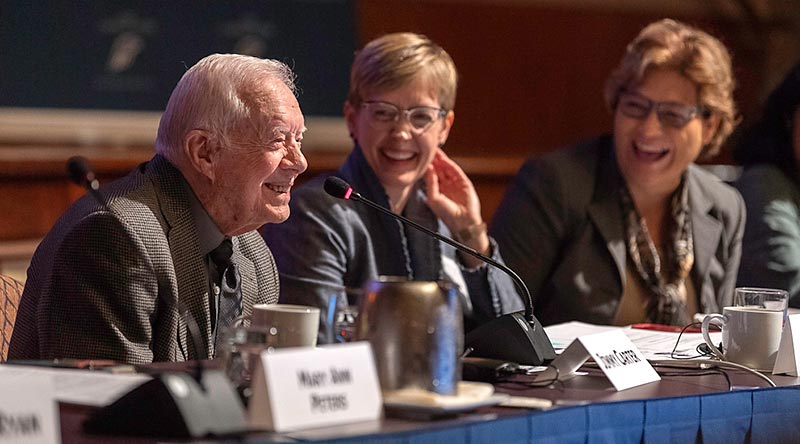
Former U.S. President Jimmy Carter speaks at the 2018 Human Rights Defenders Forum in Atlanta, GA, the theme of which was “Restoring Faith in Freedom.”
“Building Solidarity toward Equality for All” Dozens of activists, peacemakers, and community leaders from 28 countries will come together from 12-15 October for the Carter Center’s 12th Human Rights Defenders Forum. Three sessions, including a 15-minute Q&A with former U.S. President Jimmy Carter, will be livestreamed on Tuesday, 15 October. Session topics include global protection for human rights defenders, challenges for women defenders and peacemakers, and the importance of mutually supporting civil, economic, political, and social rights.
The forum this year include:
Hafida Benchehida, an Algerian senator since 2013 and a founding member of both the Algerian and Arab women parliamentarian networks. She is also a member of Mediterranean Women Mediators and a specialist in women’s roles in peace.
Mohna Ansari, a journalist-turned-attorney and a member of Nepal’s Human Rights Commission. Much of her work involves women’s rights, representation, and protection.
Ijam Alaz Augustine, minister for human rights and minorities affairs in Pakistan’s Lahore province, whose political career has been devoted to protecting the rights of religious minorities.
Fernando Carrillo Flórez, a former ambassador, minister of justice, and minister of the interior from Colombia who has published more than 14 books and 80 articles on democracy, governance, and reform of justice.
Maati Munjib, a journalist, professor, and president of Freedom Now, an organization devoted to protecting journalists and freedom of expression in Morocco. Because of his activism and writings, he faces a possible five years in prison. Amnesty International and other human rights groups have called for charges against him to be dropped.
Tuesday, October 15 webcast:
11:30 a.m. – 12:45 p.m. Remarks by President Carter Summary of the previous days’ workshops
Testimonies by human rights defenders and moderated discussion
2:15 ̶ 3:15 p.m. Discussion: “How Do We Build True Solidarity in the Struggle for Equality?”
3:50 ̶ 5 p.m. Continued: Moderated discussion Livestream Q&A with President Carter (4:35 to 4:50 p.m.)
During the webcast: Twitter @CarterCenter with hashtag #BuildingSolidarity.
The Committee to Protect Journalists’ (CPJ) 2019 Gwen Ifill Press Freedom Award recognizing extraordinary and sustained achievement in the cause of press freedom will be presented to Zaffar Abbas, editor of Pakistan’s daily newspaper Dawn. Abbas, who has decades of experience as a reporter in Pakistan, has led Dawn since 2010. Under his leadership, Dawn and its reporters frequently have come under government pressure. This is the second Ifill award which replaces the Burton Benjamin Memorial Award. For more on this and other awards for journalists: http://www.trueheroesfilms.org/thedigest/awards/gwen-ifill-press-freedom-award
“Zaffar Abbas is the embodiment of journalistic courage, which is why the board is so pleased to honor him with the Gwen Ifill Press Freedom Award,” said Kathleen Carroll, chair of the CPJ board. “Every day he fights to deliver facts to Dawn’s readers in the face of pressure, obstacles, and blockades from the institutions in Pakistan that would much prefer to go about their business without scrutiny from the press or the public.”
Nothing new but it being a Sunday here in Crete, where lots of people go to church, one is struck by the continuing religious intolerance in certain parts of the world. Here two short items relating to Pakistan, both from March 2019:
reports that on 6 March 2019 human rights defender Afzal Kohistaniwas shot dead by unidentified gunmen in Gami Ada, in Khyber Pakhtunkhwa Province. Afzal Kohistani was a human rights defender who had been campaigning against “honour killings”, or choar, in the Kohistan region of Pakistan. He had been the central figure seeking justice for the killing of five young women and three young men in 2012 and 2013.
The 2012 and 2013 “honour killings” were linked to a video, which went viral after it appeared online in 2012. It showed five young women singing and clapping, while two young men performed a traditional dance during a local wedding in Palas, a remote area in Kohistan. The mixing of genders is considered a serious violation of tribal norms in Kohistan and the young people were killed as a result of the “dishonour” they had brought on their families and community…..Prior to his death, Afzal Kohistani had received numerous death threats for seeking to bring the perpetrators of the Kohistan killings to justice. The human rights defender and his family were forced to leave their home in 2012 and had been in hiding for the past seven years. A few days prior to being killed, the human rights defender had written to the Deputy Inspector General of Police (DIG) in Hazara seeking police protection but his request never received a response. The Supreme Court’s orders for the provincial government to provide the human rights defender with protection were also not heeded. (for more detail see the link below).[ One of my first posts in 2013 concerned https://humanrightsdefenders.blog/2013/09/28/pakistan-and-rights-of-women-unbearable/]
———
A story in the Business Standard of 17 March refers to the a protest rally in Geneva by Pakistani Christians living in parts of Europe objecting to “Islamists misusing blasphemy law to harass Christians in Pakistan”. The protesters walked from Palais Wilson, to ‘Broken Chair’ in front of the UN, during the 40th session of the UN Human Rights Council.
They demanded that the Pakistan government must abolish the ‘dangerous’ law misused by the state and non-state actors to target the minorities. Frank John, Chairman of Drumchapel Asian Forum in Glasgow, said: “We are unhappy with the functioning of the government in Pakistan because the mindset of ‘maulvis’ (Islamic hardliners) towards Christians is immoral. Every day, atrocities are being committed against our children, especially girls, which is not acceptable. Our girls are being kidnapped by misusing PPC 295C and they are converted into Islam.” He added: “.. If we have an altercation with any person, they put us under PPC 295C. This is a dangerous law and needs to be abolished.”
Dr Mario Silva, Executive Chairman of International Forum for Rights and Security said: “Pakistan systematically discriminates against minorities. Christians are particularly targetted by the blasphemy law. Christian persecution is a real threat to democracy and it’s a real threat to human rights. It’s something the world community needs to take a look at. He added, “The state has a responsibility to protect its minorities rather destroying them. They have to go against the perpetrators of crimes against Christians. There are attacks on Christians, suicide bombings are taking place and the government is doing nothing to investigate the persecution of Christians in the country.” Criticising the blasphemy law, he said: “Blasphemy law should in fact never be a part of any democratic system of government because blasphemy law is meant to target minorities…..” [see also: https://humanrightsdefenders.blog/2013/12/24/pussy-riot-freed-in-russia-but-the-bigger-issue-is-blasphemy-laws-everywhere/]
Christians make up less than two per cent of the population in Pakistan. Their numbers are decreasing as many of them are migrating to other countries for their safety.

 Hans Thoolen on Human Rights Defenders and their awards