Posts Tagged ‘on-line’

Project Galileo 10th anniversary : Protecting Human Rights Defenders Online

August 21, 2025

Project Galileo celebrated its 10th anniversary with two distinguished panels hosted by the NED (National Endowment for Democracy).

These conversations highlight the future of the Internet and Internet freedom. The panels explored recent U.S. State Department efforts on Internet freedom; the role the private sector plays in helping effectuate the U.S. vision of Internet freedom with efforts like Project Galileo; the current challenges associated with authoritarian government’s influence on Internet standards, governance, and international development.

The discussions also touched on the role policy plays, both in the United States and globally, in efforts to protect the Internet; what the U.S. and other rights-respecting nations stand to lose if the open Internet is diminished; and how all stakeholders (private sector, civil society, governments) can work together to protect and advance the free and open Internet.

Moderator

  • Alissa Starzak, Head of Policy, Cloudflare

Panelists

  • Jennifer Brody, Deputy Director of Policy and Advocacy for Technology and Democracy, Freedom House
  • Emily Skahill, Cyber Operations Planner, Joint Cyber Defense Collaborative (JCDC), Cybersecurity & Infrastructure Security Agency, U.S. Department of Homeland Security (DHS)
  • Adrien Ogée, Chief Operations Officer, CyberPeace Institute

https://cloudflare.tv/event/project-galileo-presents-protecting-human-rights-defenders-online/Ya01peZn

10th anniversary Project Galileo: Protecting Human Rights Defenders Online

June 23, 2025

Project Galileo celebrated its 10th anniversary with two distinguished panels hosted by the NED (National Endowment for Democracy).

These conversations highlight the future of the Internet and Internet freedom. The panels explored recent U.S. State Department efforts on Internet freedom; the role the private sector plays in helping effectuate the U.S. vision of Internet freedom with efforts like Project Galileo; the current challenges associated with authoritarian government’s influence on Internet standards, governance, and international development. The discussions also touched on the role policy plays, both in the United States and globally, in efforts to protect the Internet; what the U.S. and other rights-respecting nations stand to lose if the open Internet is diminished; and how all stakeholders (private sector, civil society, governments) can work together to protect and advance the free and open Internet.

Moderator

  • Alissa Starzak, Head of Policy, Cloudflare

Panelists

  • Jennifer Brody, Deputy Director of Policy and Advocacy for Technology and Democracy, Freedom House
  • Emily Skahill, Cyber Operations Planner, Joint Cyber Defense Collaborative (JCDC), Cybersecurity & Infrastructure Security Agency, U.S. Department of Homeland Security (DHS)
  • Adrien Ogée, Chief Operations Officer, CyberPeace Institute

Learn more about Project Galileo:

https://cloudflare.tv/event/project-galileo-presents-protecting-human-rights-defenders-online/jvPdy5vz

Training for human rights defenders on freedom of religion or belief

February 11, 2025
Free training for human rights defenders on freedom of religion or belief

The International Bar Association’s Human Rights Institute (IBAHRI) is offering a free online training course for human rights defenders working on cases relating to freedom of religion or belief (FoRB). 

Taking place from 17–27 February, the programme is divided into 16 sessions covering all the theoretical and practical knowledge required to promote and protect the fundamental right to FoRB.

The programme will be delivered by leading experts in the field of human rights and/or FoRB, including Dr Nazila Ghanea, United Nations Special Rapporteur on FoRB; Professor Fernand de Varennes, former UN Special Rapporteur on minority issues; the Honourable Hina Jilani, IBAHRI co-chair, member of The Elders and advocate of the Supreme Court of Pakistan; and Rangita de Silva de Alwis, IBAHRI vice chair and a member of the treaty body to the UN Convention on the Elimination of All Forms of Discrimination against Women.

The IBAHRI is delivering the training in collaboration with the Rule of Law Expertise UK (ROLE UK). ROLE UK is a programme of the Advocates for International Development (A4ID), funded by the Foreign, Commonwealth & Development Office. A4ID is a global charity working to strengthen the rule of law in developing countries by supporting partnerships to provide high-quality pro bono legal and judicial expertise.

Register here

https://www.scottishlegal.com/articles/free-training-for-human-rights-defenders-on-freedom-of-religion-or-belief

NEW Website for New Tactics in Human Rights

February 6, 2025

As we kick off 2025, a year already fraught with global challenges and political uncertainty, we know that human rights defenders are on the frontlines. They face unprecedented abuses as they fight for justice. Now, more than ever, effective strategies and support are essential to drive change. That’s why we’re excited to announce the launch of our NEW New Tactics in Human Rights website! Available in English and Arabic, newtactics.org is designed to inspire and equip YOU in this critical work.

What’s New? We’ve reimagined your experience to make it easier than ever to find, share, and apply powerful human rights tactics:

🌍 Seamless Navigation: Find what you need quickly with a sleek, mobile-friendly design.

📚 Actionable Tactics: Access over 250 successful human rights tactics, with powerful filters to help you search by tactical aim, action, or region.

💬 A Space to Connect: Listen and learn from human rights defenders globally through our online conversations and perspectives from staff and guests.

https://mailchi.mp/cvt/newyearnewtactics2025?e=0cf25f99e0

ISHR’s training for human rights defenders 2025:

November 27, 2024

Are you a human rights defender keen to use the UN to push for change at home? If so, apply for the 2025 edition of ISHR’s flagship training, the Human Rights Defender Advocacy Programme (HRDAP)!

After a successful edition in 2024, [https://humanrightsdefenders.blog/2023/11/07/human-rights-defender-advocacy-programme-2024-applications-now-open/] ISHR launches the call for applications for the 2025 Human Rights Defender Advocacy Programme (HRDAP25), which will take place both remotely and in Geneva! Below are some important dates to consider before applying:

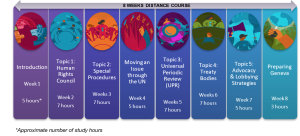
  • Mandatory distance learning course: 14 April – 8 June 2025 (part time)
  • In-person course in Geneva: 10- 20 June 2025 (full time) 
  • Deadline to apply: 10 January 2025, midnight CET (Geneva Time)
  • Programme description with all the information can be downloaded here.
  • Application form can be found here. 

Learn more about why you should apply for HRDAP by watching this video!

What is the Human Rights Defender Advocacy Programme 2025 (HRDAP25)?

The course equips human rights defenders with the knowledge and skills to integrate the UN human rights system into their existing work at the national level in a strategic manner and provides an opportunity for participants to prepare for and engage in advocacy activities at the UN with the aim to effect change back home.  

Online course topics – ISHR

Defenders will complete a 10-week hybrid learning programme, online and offline, which will include: 

  • Accessing the HRDAP Platform, where they can complete e-learning courses on each key UN human rights mechanism and on advocacy strategies, and access interactive learning materials and case studies on the ISHR Academy 
  • Taking part in live Q&A sessions with human rights experts 
  • Receiving a continuous personalised advocacy support and coaching in order to develop concrete advocacy objectives to make strategic use of the international human rights system taking into account the local context
  • Building networks around the world, and learning from peers from a range of regions working on a range of human rights issues 
  • Applying their knowledge to case-studies scenarios and enhancing their advocacy toolbox according to their specific needs (elevator pitch, SMART recommendations…)
  • Receiving support and advocacy accompaniment to conduct activities during the 59th and 60th Human Rights Council sessions and other relevant opportunities. 

Participants will have the unique opportunity to apply their knowledge and skills while being in Geneva as well as to meet and share with their peers and experts (UN staff, diplomats, supporting NGOs…). The blended format of the course allows defenders to continue their vital work on the ground, while diving into the inner workings of each key UN human rights mechanism and gaining first-hand experience from advocates and UN staff on how civil society can strategically engage in the international human rights space.  The methodology we use is interactive and learner-centred and encourage participation of everyone.

By participating in HRDAP, defenders:

  1. Gain knowledge and tools, which they can use to ensure their voice is central in international human rights decision-making 
  2. Explore and compare the benefits of engagement with the Human Rights Council, the Special Procedures, the OHCHR, the Universal Periodic Review and the Treaty Bodies, and examine how they can use them to bolster their work at the national level 
  3. Develop strategies and advocacy techniques to increase the potential of their national and regional advocacy work 

This programme is directed at experienced human rights defenders working in non-governmental organisations, with existing advocacy experience at the national level and some prior knowledge of the international human rights system. 

ISHR supports, and promotes solidarity with and between, defenders working in the following areas or contexts, which we recognise as intersectional and interdependent: 

  1. Equality, dignity and non-discrimination
  2. Environmental justice and sustainability 
  3. International accountability for the repression of human rights defenders 
  4. Transparency and rule of law 

The hybrid programme will bring together around 16 committed human rights defenders from different backgrounds, who work on a wide range of areas that are linked with our programmes to ensure a sustainable collaboration. This can include, but is not limited to, defenders working on the following thematics: women rights; Indigenous people’s rights; the human rights of LGBTIQ+ persons; anti-racism; reclaiming civil society space and increasing protection of human rights defenders.  

What do former HRDAPers say? 

16 human rights defenders from 15 countries took part in the last edition, HRDAP24. At the end of the training, 98% of the participants were either extremely satisfied or very satisfied with the programme and felt that they would be able to apply what they learnt to their own day-to-day work. Find out more about the outcomes of HRDAP24 here. 

More testimonials from HRDAP Alumni here.  

How to apply?

First, download and read carefully the HRDAP 2025 Programme Description to find out more about modalities, requirements and funding. If you meet the criteria, take some time to apply using this online form before midnight Geneva time on Friday 10 January 2025! 

As only a limited number of human rights defenders are able to participate in HRDAP each year, in addition to our range of guides and handbooks, ISHR has developed an e-learning space in English, French and Spanish to help human rights defenders strengthen their advocacy skills with the UN for greater impact on the ground: the ISHR Academy. The learning modules demystify the UN human rights system and build capacity to push for change. Discover new tools, insider tips, defender stories, and more! 

For more information, please contact us: training@ishr.ch

https://ishr.ch/latest-updates/hrdap-2025-apply-now-for-ishrs-hybrid-training-for-human-rights-defenders

WITNESS: A LIBRARY OF FREE RESOURCES FOR VIDEO ACTIVISTS, TRAINERS AND THEIR ALLIES

November 14, 2024

All Library resources are free to download, use and remix (learn more)

see also:https://www.youtube.com/humanrights

VIEW ALL FEATURED

https://library.witness.org/

Minority Rights and Advocacy Toolkit Online Course

January 24, 2024
Minority Rights Group

Challenges to freedom of religion and belief and abuses to the human rights of religious minorities are on the rise across the world, with increased violence, harassment, and threats often met with a lack of accountability. They occur against a backdrop of long-standing social, political, economic, and cultural marginalization and exclusion, particularly for those who face intersectional discrimination, such as religious minority women or persons with disabilities.

It is, therefore, vital to support organizations and activists representing these communities who work towards strengthening the rights of minorities of faith and belief and combatting the discrimination, prejudices and persecution these communities experience daily.

What is the course about?

The free, 7-week online course aims to build an understanding of regional and international minority rights mechanisms and ways to implement these rights frameworks at the national and local levels and build the capacity of human rights defenders (HRDs) to advocate for the rights of minorities.

The course will offer opportunities to exchange and collaborate with other HRDs to:

  • Monitor and report on violations against religious minorities
  • Raise awareness amongst key stakeholders of the human rights violations, persecution and discrimination these communities face
  • Campaign from local to international levels to secure commitments from key stakeholders to improve the situation of religious minorities
  • Train Graduates will also have the opportunity to follow up with access to a Training of Trainers that will give them the opportunity to develop their skills and share the knowledge they learned

Who can apply for this course?

Civil society organizations and activists representing religious minority and indigenous communities from two regions of the world where religious minorities are suffering from serious human rights violations, widespread discrimination and marginalization are welcome to apply.

Applicants from and/or based in the following countries will be prioritized: Bangladesh, Egypt, India, Indonesia, Iraq, Iran, Lebanon, Morocco, Myanmar, Nepal, Pakistan, Sri Lanka, Syria, Thailand, Tunisia.

  • Basic Concepts in Human Rights and Minority Rights
  • UN Declaration on the Rights of Persons Belonging to National or Ethnic, Religious and Linguistic Minorities
  • UN Treaties and Human Rights Mechanisms
  • Freedom of Religion or Belief (FoRB)
  • UN Mechanisms to Protect Minorities
  • Regional Human Rights Systems and Mechanisms
  • Advocacy Campaigns

To complete the course, participants must submit three written assignments: a briefer, an outline of a shadow report and an advocacy plan.

How many hours a week is the course?

The course will require approximately 3 hours per week for the duration of the course. Your participation will be facilitated by a tutor who will offer mentoring on a one-on-one basis as required. Our tutor is an expert in minority rights and community networking.

During the course we also organize a webinar, which offers a unique opportunity to learn more about the mandate of the UN Special Rapporteurs and engage in a Q&A session with them.

Human Rights Defender Advocacy Programme 2024: applications now open

November 7, 2023

Are you a human rights defender keen to use the UN to push for change at home? If so, apply for the 2024 edition of ISHR’s flagship training, the Human Rights Defender Advocacy Programme (HRDAP)!

After a successful hybrid programme launched  in 2023, ISHR is pleased to launch the call for application for the 2024 edition of the Human Rights Defender Advocacy Programme (HRDAP), which will again take place both remotely and in Geneva! Below are some important dates to take into account before applying:

  • Mandatory distance learning course: 8 April – 3 June 2024 (part time)
  • In-person course in Geneva: 5- 15 June 2024 (full time)
  • Deadline to apply: 10 January 2024, midnight CET (Geneva Time)
  • Programme description with all the information can be downloaded here.
  • Application form can be found here.

The course equips human rights defenders with the knowledge and skills to integrate the UN human rights system into their existing work at the national level in a strategic manner, and provides an opportunity for participants to prepare for and engage in advocacy activities at the UN with the aim to effect change back home.

Defenders will complete a 10-week hybrid learning programme, online and offline, which will include:

  • Access to the HRDAP Platform, where they can complete e-learning courses on each key UN human rights mechanism and on advocacy strategies, access interactive learning materials and case studies on the ISHR Academy
  • Take part in live Q&A sessions with human rights experts
  • Receive a continuous advocacy support and coaching in order to develop concrete advocacy objectives to make strategic use of the international human rights system
  • Build networks around the world, and learn from peers from a range of regions working on a range of human rights issues
  • Apply their knowledge to case-studies scenarios and enhance their advocacy toolbox according to their specific needs
  • Receive support and advocacy accompaniment to conduct activities during the 56th and 57th Human Rights Council sessions and other relevant opportunities.

Participants will have the unique opportunity to apply their knowledge and skills while being in Geneva and practice, meet and share with their peers and experts. The blended format of the course allows defenders to continue their vital work on the ground, while diving into the inner workings of each key UN human rights mechanism, and gaining first-hand experience from advocates and UN staff on how civil society can strategically engage in the international human rights space.  

By participating in HRDAP, defenders:

  1. Gain knowledge and tools, which they can use to ensure their voice is central in international human rights decision-making
  2. Explore and compare the benefits of engagement with the Human Rights Council, the Special Procedures, the OHCHR, the Universal Periodic Review and the Treaty Bodies, and examine how they can use them to bolster their work at the national level
  3. Develop strategies and lobbying techniques to increase the potential of their national and regional advocacy work

Could you be one of our 2024 participants?

This programme is directed at experienced human rights defenders working in non-governmental organisations, with existing advocacy experience at the national level and some prior knowledge of the international human rights system.

ISHR supports, and promotes solidarity with and between, defenders working in the following areas or contexts, which we recognise as intersectional and interdependent:

  1. Equality, dignity and non-discrimination
  2. Environmental justice and sustainability
  3. International accountability for the repression of human rights defenders
  4. Transparency and rule of law

The hybrid programme will bring together around 16 committed human rights defenders from different backgrounds, who work on a wide range of areas that are linked with our programmes to ensure a sustainable collaboration. This can include, but is not limited to, defenders working on the following thematics: women rights; business, environment and human rights; the human rights of LGBTIQ+ persons; anti-racism; reclaiming civil society space and increasing protection of human rights defenders. 

What do former HRDAPers say?

16 human rights defenders from 15 countries took part in the last edition, HRDAP23. At the end of the training, 98% of the participants were either extremely satisfied or very satisfied with the programme and also felt that they would be able to apply what they learnt to their own day-to-day work. Find out more about the outcomes of HRDAP23 and where they are four months later, here.

See also: https://humanrightsdefenders.blog/2023/07/26/the-story-of-camila-zuluaga-hrd-from-colombia/. More testimonials from HRDAP23 here

How to apply?

First, download and read carefully the HRDAP 2024 Programme Description to find out more about modalities, requirements and funding. If you meet the criteria, take some time to apply using this online form before midnight Geneva time on Wednesday 10 January 2024!

As only a limited number of human rights defenders are able to participate in HRDAP each year, in addition to our range of guides and handbooks, ISHR has developed an e-learning space in English, French and Spanish to help human rights defenders strengthen their advocacy skills with the UN for greater impact on the ground: the ISHR Academy. The learning modules demystify the UN human rights system and build capacity to push for change. Discover new tools, insider tips, defender stories, and more!

For more information, please contact us : training@ishr.ch 

https://ishr.ch/latest-updates/hrdap-2024-apply-now-for-ishrs-hybrid-training-for-human-rights-defenders/

Online human rights defenders need to be supported and protected – not criminalized

January 27, 2022

Laurel E. Fletcher (professor at Berkeley Law School) & Khalid Ibrahim (executive director of the Gulf Centre for Human Rights) published “When did it become illegal to defend human rights?” on January 19, 2022 in International InstitutionsTechnologyGlobalConflict & Justice Middle East.

Their key point is worth noting: The problem for human rights defenders in the Gulf region and neighbouring countries is that states have exploited the opportunity to align their cybercrime laws with European standards to double-down on laws restricting legitimate online expression BUT without any of the judicial safeguards that exist in that region.


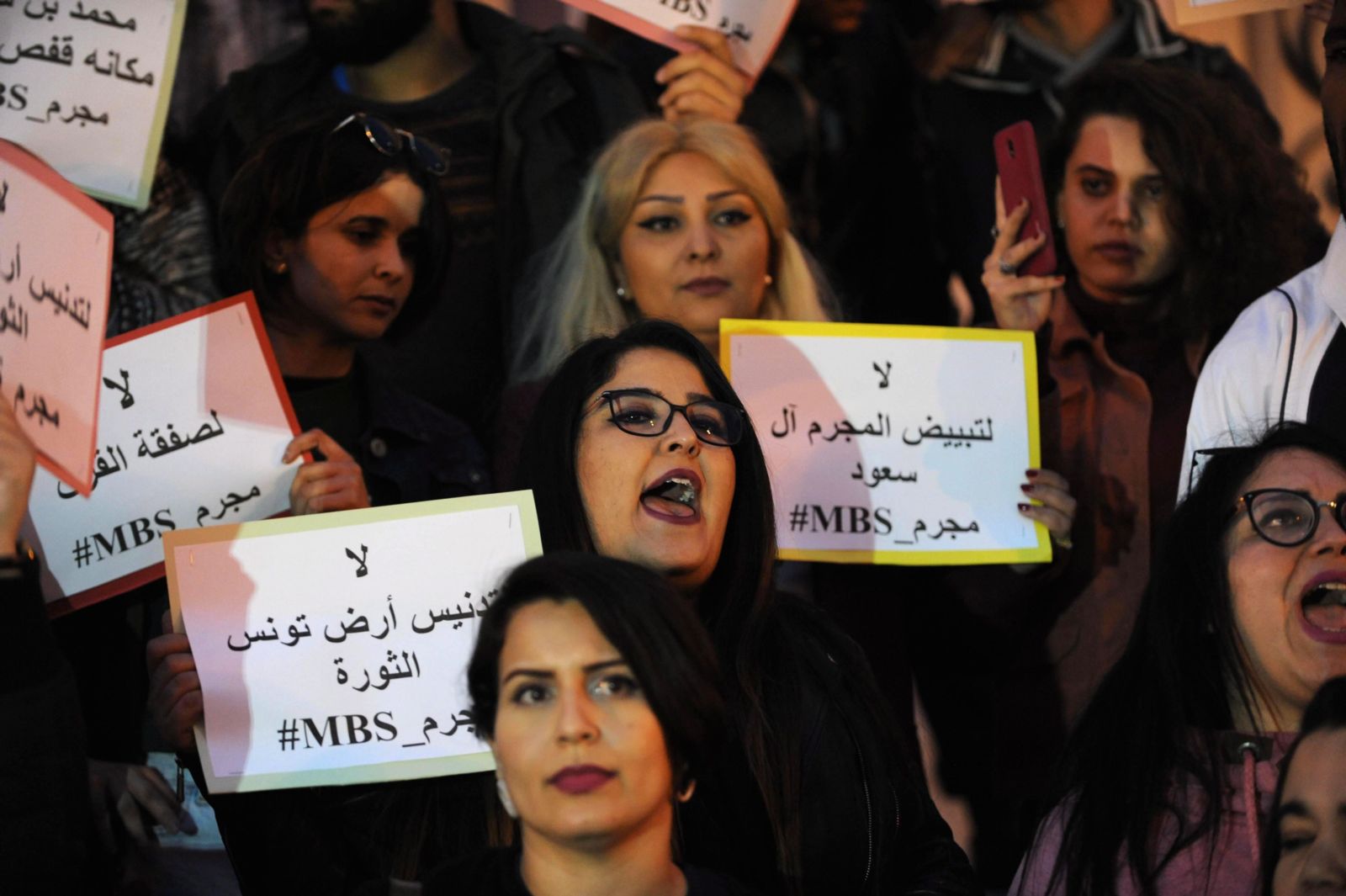
Several women take part in a protest, using a hashtag, against Saudi Crown Prince Mohamed bin Salman’s visit to the country in Tunis, Tunisia, in November 2018.  EFE / Stringer


Governments in every region of the world are criminalizing human rights activism. They do it by prosecuting protest organizers, journalists, internet activists, and leaders of civil society organizations under laws that make it a crime to insult public figures, disseminate information that damages “public order,” “national security,” and “fake news.” 

In the Gulf region and neighbouring countries, oppressive governments have further weaponized their legal arsenal by adopting anti-cybercrime laws that apply these overly broad and ill-defined offline restrictions to online communications. 

In an age when online communications are ubiquitous, and in societies where free press is crippled, laws that criminalize the promotion of human rights on social media networks and other online platforms undermine the ability to publicize and discuss human rights violations and threaten the foundation of any human rights movement.

In May of 2018, for example, the Saudi government carried out mass arrests of women advocating online for women’s right to drive. Charged under the country’s cybercrime law including article six which prohibits online communication “impinging on public order, religious values, public morals, and privacy,” these human rights activists were detained, tortured, and received multi-year sentences for the “crime” of promoting women’s rights. 

There is certainly a necessity to address the prevalence and impact of cybercrimes but without criminalizing people who speak out for human rights.

European countries and the United Nations (UN) have encouraged states to adopt a standard approach to addressing crimes committed with online technologies ranging from wire fraud to financing terrorist groups. The Council of Europe issued a 2001 regional convention on cybercrime, to which any state may accede, and the UN is promoting a cybercrime treaty

Common standards can prevent the abuse of online technologies by enabling  the sharing of online evidence and promoting accountability since the evidence of online crimes often resides on servers outside the country where the harm occurred or where the wrongdoers reside. 

The problem for human rights defenders in the Gulf region and neighbouring countries is that states have exploited the opportunity to align their cybercrime laws with European standards to double-down on laws restricting legitimate online expression. 

European countries have robust human rights oversight from the European Court of Human Rights, which ensures that limitations on freedom of expression online meet stringent international standards. There is no comparable human rights oversight for the Gulf region. Without adequate international judicial review, governments can successfully exploit international processes to strengthen their ability to stifle online expression. 

The regional model cybercrime law drafted by the United Arab Emirates and adopted by the Arab League in 2004, follows international guidance. However, it incorporates a regional twist and includes provisions that criminalize online dissemination of content that is “contrary to the public order and morals,” facilitates assistance to terrorist groups, along with disclosure of confidential government information related to national security or the economy. 

UN experts reviewed the UAE law and gave it a seal of approval, noting it complied with the European convention, ignoring the fact that  UN human rights experts have documented repeatedly that governments use such restrictions to crack down on dissent. A UN-sponsored global cybercrime study, published in 2013, similarly soft-pedaled the threat of criminalizing online dissent by noting that governments had leeway to protect local values. Such protection does not extend to speaking up for universal rights like equality and democracy.

Actually, the universal right to freedom of expression protects online content, and limitations must meet international standards of legality, legitimacy, necessity, and proportionality. In our recent report on the use of anti-cybercrime legislation throughout the Gulf region and neighbouring countries, we found that over an 18-month period (May 2018-October 2020), there were 225 credible incidents of online freedom of expression violations against activists and journalist in ten countries: Bahrain, Iran, Iraq, Jordan, Kuwait, Oman, Qatar, Saudi Arabia, Syria, and the UAE. Each country has adopted  anti-cybercrime laws except Iraq, where lawmakers’ drafts of proposed legislation have been met with stiff opposition from domestic and international human rights groups.

The international community needs to increase pressure on the Gulf region and neighboring countries to comply with their international obligations to protect freedom of expression off and online. Turning away from the clear evidence that oppressive governments are expanding the reach of criminal law to stifle online human rights activism undermines legitimate international efforts to address cybercrime. 

How can we trust the UN to safeguard the voices advocating online for human rights and democracy in a region that so desperately needs both, if it fails to insist human rights safeguards be written into the regional and national cybercrime laws it champions? 

In the age of the internet, online human rights activism needs to be supported—and protected—as a vital part of the cybercommunications ecosystem. In the Gulf region, defenders of human rights pay an untenable price for their work, risking arrest, torture, and even death. It is time to reverse the trend while there are still defenders left. 

One of the women human rights defenders in Saudi Arabia said before she was imprisoned, “If the repressive authorities here put behind bars every peaceful voice calling for respect for public freedoms and the achievement of social justice in the Gulf region and neighboring countries, only terrorists will remain out.” History has proven the truth of her words, as most of the individuals who led terrorist groups with a global reach have come from this region and have caused, and still cause, chronic problems for the whole world.

The important lesson that we must learn here is that repressive governments foster a destructive dynamic of expansion and intensification of human rights violations. Repressive governments cooperate with and look to one another for strategies and tactics. Further troubling is that what we see in the Gulf region is enabled by the essentially unconditional support provided by some Western governments, especially the US and UK. This toxic template of Western support to governments that oppress their own people constitutes a threat to world peace and prosperity and must be addressed.


https://www.openglobalrights.org/when-did-it-become-illegal-to-defend-human-rights/index.cfm


Report Freedom on the Net, 2021

October 12, 2021

Freedom on the Net 2021 finds that while some democratic governments have made good-faith attempts to regulate the technology industry, state intervention in the digital sphere worldwide has contributed to the 11th consecutive year of global decline in internet freedom.

Governments around the world are increasingly asserting their authority over technology platforms, forcing businesses to comply with censorship and surveillance and contributing to an 11th consecutive year of global decline in internet freedom, according to Freedom on the Net 2021, the annual country-by-country assessment of internet freedom released today by Freedom House.

Global norms shifted dramatically toward greater state intervention in the digital sphere over the past year. Of the 70 states covered by Freedom on the Net 2021, 48 pursued legal or administrative action against technology companies. Some measures reflected legitimate attempts to mitigate online harms, rein in misuse of data, or end manipulative market practices. Many governments, however, proposed new policies that obliged businesses to remove content and share personal data with authorities, at great cost to free expression, privacy, and public accountability.

This change in the balance of power between companies and states has come amid a historic crackdown on freedom of expression online. In 56 countries, officials arrested or convicted people for their online speech. Governments suspended internet access in at least 20 countries, and 21 states blocked access to social media platforms, most often during times of political turmoil such as protests and elections. Authorities in at least 45 countries are suspected of obtaining sophisticated spyware or data-extraction technology from private vendors.

“The rights of internet users around the world, especially the rights to free expression and privacy, are being massively violated as a result of recent state actions,” said Michael J. Abramowitz, president of Freedom House. “Instead of using regulation to curb the immense power of tech companies, many governments are wielding it for their own repressive purposes.”

The decision by several platforms to deactivate the accounts of outgoing US president Donald Trump—in the wake of the January 6 assault on the Capitol—intensified concerns about the arbitrary power of a few firms to shape political debate, as well as their responsibility to stem offline violence. The move sparked a plethora of new regulatory and legislative proposals, including bad-faith attempts to prevent companies from moderating the accounts of politicians and state-run media. Tech companies faced high-profile showdowns with illiberal and authoritarian leaders in India, Nigeria, Russia, and Turkey that will have global implications for the future of free expression online.

“In these high-stakes battles between governments and tech companies, human rights risk becoming the main casualties,” said Adrian Shahbaz, director for technology and democracy at Freedom House. “Given the examples to date, you can hardly blame people for being skeptical that government regulation will lead to greater protection of their rights online. Regulations should ensure that power does not accumulate in the hands of a few dominant actors, whether in government or the private sector.”

Internet freedom plummeted by 14 points in Myanmar—the largest annual decline ever recorded on Freedom on the Net’s 100-point scale—after the military refused to accept the results of the November 2020 general elections and launched a deadly coup in February 2021. Electoral disputes also led to major internet freedom declines in Belarus, where authoritarian incumbent Alyaksandr Lukashenka claimed victory in a fraudulent presidential election in August 2020, and Uganda, where authorities shut off the internet and blocked social media platforms during marred general elections in January 2021. In addition, officials in both Myanmar and Belarus sought to silence independent online media by shutting down news outlets and harassing, assaulting, and torturing online journalists.

“Governments everywhere are invoking a vague need to retake control of the internet—whether from foreign powers, multinational corporations, or even civil society,” said Shahbaz. “In the absence of a shared vision for a free and open internet, many states are imposing restrictions on the free flow of information across borders, denying people access to life-changing tools based solely on their location. This fragmentation is diminishing the emancipatory power of the internet.”

“The daunting complexity of internet regulation makes it all the more important for democracies to take the lead and set a high bar by introducing regulatory approaches that protect human rights online and preserve a free and open internet,” said Allie Funk, senior research analyst for technology and democracy at Freedom House. “The laissez-faire approach to the tech industry spurred some forms of innovation, but it has also created opportunities for authoritarian manipulation, data exploitation, and widespread malfeasance. Democratic governments should pursue well-crafted regulations that tackle these problems while protecting people’s rights to express themselves, share information across borders, and hold the powerful to account.”

KEY FINDINGS:

  • Global internet freedom declined for the 11th consecutive year. The greatest deteriorations were documented in Myanmar, Belarus, and Uganda, where state forces cracked down amid electoral and constitutional crises.
  • Governments clashed with technology companies on users’ rights. Authorities in at least 48 countries pursued new rules for tech companies on content, data, and competition over the past year. With a few positive exceptions, the push to regulate the tech industry, which stems in some cases from genuine problems like online harassment and manipulative market practices, is being exploited to subdue free expression and gain greater access to private data.
  • Free expression online is under unprecedented strain. More governments arrested users for nonviolent political, social, or religious speech than ever before. Officials suspended internet access in at least 20 countries, and 21 states blocked access to social media platforms. Authorities in at least 45 countries are suspected of obtaining sophisticated spyware or data-extraction technology from private vendors.
  • China ranks as the worst environment for internet freedom for the seventh year in a row. Chinese authorities imposed draconian prison terms for online dissent, independent reporting, and mundane daily communications. The COVID-19 pandemic remains one of the most heavily censored topics. Officials also cracked down on the country’s tech giants, citing their abuses related to competition and data protection, though the campaign further concentrated power in the hands of the authoritarian state.
  • The United States’ score declined for the fifth consecutive year. False, misleading, and manipulated information continued to proliferate online, even affecting public acceptance of the 2020 presidential election results. The new administration took promising steps to enforce stronger protections for internet users.
  • State intervention must protect human rights online and preserve an open internet. The emancipatory power of the internet depends on its egalitarian nature. To counter digital authoritarianism, democracies should ensure that regulations enable users to express themselves freely, share information across borders, and hold the powerful to account.

Freedom on the Net 2021 assesses internet freedom in 70 countries, accounting for 88 percent of internet users worldwide. The report focused on developments that occurred between June 2020 and May 2021. Detailed country reports, data on 21 internet freedom indicators, and policy recommendations can be found at freedomonthenet.org.

In the high-stakes battle between states and technology companies, the rights of internet users have become the main casualties. Illustration by Mitch Blunt

Freedom on the Net 2021: The Global Drive to Control Big Tech

In the high-stakes battle between states and technology companies, the rights of internet users have become the main casualties, according to Freedom on the Net 2021, the annual country-by-country assessment of internet freedom released by Freedom House. Read the Report

https://freedomhouse.org/article/new-report-global-battle-over-internet-regulation-has-major-implications-human-rights