The DVB made on 10 May 2021 the following emergency statement :
Three senior DVB’s journalists and two activists, who escaped to Thailand after the military crackdown in Burma, were arrested by the police on Sunday, May 9th in Chiang Mai, Thailand. They were arrested during a random search by the police and charged for illegal entry into Thailand. DVB strongly urges the Thai authorities to not deport them back to Burma, as their life will be in serious danger if they were to return. They have been covering the demonstrations in Burma until March 8 – the day the military authority revoked DVB’s TV license and banned DVB from doing any kind of media work. We also appeal to the United Nations High Commissioner for Refugees in Bangkok to intervene to help guard their safety. We request the international community to help call the Thai authorities to waive their deportation. Thank you in name of all DVB journalists, Aye Chan Naing, Executive director and chief editor DVB
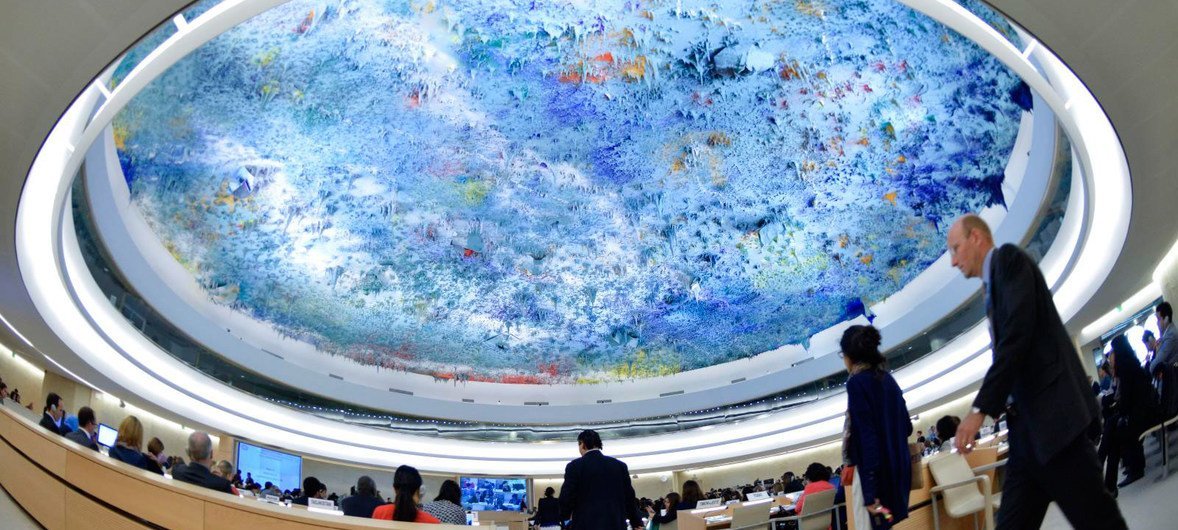
UN Photo/Jean-Marc FerréA general view of the Geneva-based UN Human Rights Council in session. 24 March 2021
The UN’s top rights forum passed resolutions condemning abuses of fundamental freedoms in Belarus and Myanmar on Wednesday, in response to ongoing concerns over the human rights situation in both countries.
The ISHR and another 15 organisations (see below) produced as usual their reflections on the key outcomes of the 46th session of the UN Human Rights Council, as well as the missed opportunities to address key issues and situations including pushbacks and other human rights violations faced by migrants and refugees, and the human rights situations in Algeria, Cameroon, China, India, Kashmir and the Philippines.
They welcome some important procedural advances such as the possibility for NGOs to make video statements, which should be maintained and expanded after the pandemic for all discussions, including in general debates. …They are concerned by the renewal for another year of the ‘efficiency’ measures piloted in 2020, despite their negative impact on civil society participation in a year also impacted by the COVID-19 pandemic. We urge States to reinstate general debates in the June sessions, to preserve their open-ended nature, and maintain the option of video intervention also in general debates.
Environmental justice:
They welcome the joint statement calling for the recognition of the right of all to a safe, clean, healthy and sustainable environment that was delivered by the Maldives, on behalf of Costa Rica, Morocco, Slovenia and Switzerland and supported by 55 States. We call on all States to seize this historic opportunity to support the core-group as they continue to work towards UN recognition so that everyone in the world, wherever they live, and without discrimination, has the right to live in a safe, clean and sustainable environment.
We welcome the joint statement that was delivered by Bangladesh, on behalf of 55 States, calling the Council to create a new Special Rapporteur on human rights and climate change. We believe this new mandate would be essential to supporting a stronger human rights-based approach to climate change, engaging in country visits, normative work and capacity-building, and further addressing the human rights impacts of climate responses, in order to support the most vulnerable. This mandate should be established without further delay.
Racial Justice: Over 150 States jointly welcomed that the implementation of HRC Resolution43/1 will center victims and their families. They urge the Council to respond to the High Commissioner’s call to address root causes of racism including the “legacies of enslavement, the transatlantic trade in enslaved Africans, and its context of colonialism”. The Council must answer to the demands of victims’ families and civil society’s, and establish – at its next session – an independent inquiry to investigate systemic racism in law enforcement in the United States and a thematic commission of inquiry to investigate systemic racism in law enforcement globally, especially where it is related to legacies of colonialism and transatlantic slavery.
Right to health: The resolution on ensuring equitable, affordable, timely, and universal access by all countries to vaccines in response to the COVID-19 pandemic is a welcome move in highlighting the need for States not to have export and other restrictions on access to safe diagnostics, therapeutics, medicines, and vaccines, and essential health technologies, and their components, as well as equipment and encouraged States to use all flexibilities within TRIPs. However, a revised version of the resolution tabled was further weakened by the deletion of one paragraph on stockpiling of vaccines and the reference to ‘unequal allocation and distribution among countries”. The specific deletion highlights the collusion between rich States and big pharmaceuticals, their investment in furthering monopolistic intellectual property regimes resulting in grave human rights violations. The reluctance of States, predominantly WEOG States who continue to defend intellectual property regimes and States’ refusal to hold business enterprises accountable to human rights standards is very concerning during this Global crisis.
Attempts to undermine HRC mandate: They regret that once again this Council has adopted a resolution, purportedly advancing ‘mutual beneficial cooperation’ which seeks to undermine and reinterpret both the principle of universality and its mandate. Technical assistance, dialogue and cooperation must be pursued with the goal of promoting and protecting human rights, not as an end in itself or as a means of facilitating inter-State relations. We reiterate our call on all States, and especially Council members, to consider country situations in an independent manner, based on objective human rights criteria supported by credible UN and civil society information. This is an essential part of the Council’s work; reliance on cooperation alone hobbles the Council’s ability to act to support the defenders and communities that look to it for justice.
Country-specific resolutions: They welcome the new mandate for the High Commissioner focused on the human rights situation in Belarus in the context of the 2020 Presidential election. It is now essential for States to support the High Commissioner’s office, ensuring the resources and expertise are made available so that the mandate can be operationalised as quickly as possible. Immediately afterwards, on 24 March, 2021 the Human Rights House Foundation published a call by 64 Belarusian and international human rights organisations, welcoming the resolution passed by the UN Human Rights Council mandating the High Commissioner to create a new robust monitoring and reporting mandate focused on accountability for human rights violations in Belarus that have taken place since 1 May 2020. In so doing, the Council demonstrated its determination to hold Belarusian authorities to account. This mandate needs immediate action. We urge the international community to support this critical next step. The mandate should provide a complementary and expert international mechanism to regional accountability processes already under way. Furthermore, it should assist in the identification of those responsible for the most serious violations for future prosecution. [https://humanrightshouse.org/statements/civil-society-organisations-call-for-the-immediate-operationalisation-of-hrcs-new-mandate-on-belarus/]
They welcome the renewal of the mandate of the Special Rapporteur on Iran, and urge Council to consider further action to hold Iranian authorities accountable, in view of the systematic impunity and lack of transparency surrounding violations of human rights in the country.
They welcome the call for additional resources for the Special Rapporteur on Myanmar, increased reporting by OHCHR as well as the work of the IIMM. Lack of international monitoring on, the imposition of martial law in Myanmar to prosecute civilians, including protesters, before military courts, the dangerous escalation of violence by the Tatmadaw and the widespread human rights violations amounting to crimes against humanity demand more efforts to ensure accountability.
They welcome the renewal and strengthening of the OHCHR’s monitoring and reporting mandate on Nicaragua, in a context of steady human rights deterioration marked by the Government’s refusal to cooperate constructively with the Office, over two years after its expulsion from the country. The adopted resolution lays out steps that Nicaragua should take to resume good faith cooperation and improve the situation ahead of this year’s national elections. It is also vital that this Council and its members continue to closely follow the situation in Nicaragua, and live up to the resolution’s commitments, by considering all available measures should the situation deteriorate by next year.
They welcome the increased monitoring and reporting on the situation of human rights in Sri Lanka. However, in light of the High Commissioner’s report on the rapidly deteriorating human rights situation and Sri Lanka’s incapacity and unwillingness to pursue accountability for crimes under international law, the Council should have urged States to seek other avenues to advance accountability, including through extraterritorial or universal jurisdiction.
While they welcome the extension of the mandate of the Commission on Human Rights in South Sudan (CHRSS), they regret the adoption of a competing resolution under the inadequate agenda item 10. This resolution sends a wrong signal as myriads of local-level conflicts and ongoing SGBV and other violations of fundamental rights continue to threaten the country’s stability. We urge South Sudan to continue cooperating with the CHRSS and to demonstrate concrete progress on key benchmarks and indicators.
They welcome the report by the Commission of Inquiry on Syria on arbitrary imprisonment and detention and reiterate the recommendation to establish an independent mechanism “to locate the missing or their remains”, and call on States to ensure the meaningful participation of victims and adopt a victim-centered approach, including by taking into consideration the Truth and Justice Charter of Syrian associations of survivors and families of disappeared when addressing arbitrary detention and enforced disappearance.
Country-specific State statements: They welcome States’ leadership and statements on human rights situations that merit the HRC’s attention.
They welcome the joint statement on the situation in Ethiopia’s Tigray region and urge all actors, including the Ethiopian Federal Government, to protect civilians and ensure unhindered humanitarian access. Those responsible for crimes under international law, including Ethiopian soldiers, members of armed militias and non-State groups, and Eritrean soldiers involved in Tigray, must be held criminally accountable. The HRC should mandate an independent investigation and reporting by the High Commissioner.
For the first time in seven years, States at the HRC have united to condemn the widespread human rights violations by Egypt and its misuse of counter-terrorism measures to imprison human rights defenders, LGBTI persons, journalists, politicians and lawyers and peaceful critics. They welcome the cross-regional joint statement by 32 States and we reiterate our call supported by over 100 NGOs from across the world on the HRC to establish a monitoring and reporting mechanism on the situation.
They welcome the joint statement by 45 States focused on the human rights situation in Russia, including the imprisonment of Alexi Navalny and the large number of arbitrary arrests of protestors across Russia. The statement rightly expresses concern for shrinking civil society space in Russia through recent legislative amendments and Russia using its “tools of State” to attack independent media and civil society.
The next session will receive a report on pushbacks from the Special Rapporteur on human rights of migrants. The Council must respond to the severity and scale of pushbacks and other human rights violations faced by migrants and refugees in transit and at borders and the ongoing suppression of solidarity, including by answering the High Commissioner’s call for independent monitoring. The Council’s silence feeds impunity, it must build on the momentum of the joint statement of over 90 States reaffirming their commitment to protection of the human rights of all migrants regardless of status.
While the OHCHR expressed deep concern about the deteriorating human rights situation and the ongoing crackdown on civil society in Algeria, and called for the immediate and unconditional release of arbitrarily detained individuals, the Council has remained largely silent. As authorities are increasingly arbitrarily and violently arresting protesters – at least 1,500 since the resumption of the Hirak pro-democracy movement on 13 February, they call on the Council to address the criminalisation of public freedoms, to protect peaceful protesters, activists and the media.
Cameroon is one of the human rights crises the Council has failed to address for too long. They condemn the acts of intimidation and reprisal exercised by the Cameroonian government in response to NGOs raising concerns, including DefendDefenders. This is unacceptable behavior by a Council member. The Council should consider collective action to address the gross human rights violations and abuses occurring in the country.
They echo the calls of many governments for the Council to step up its meaningful action to ensure that concerns raised by civil society, the UN Special Procedures and the OHCHR about the human rights situation in China be properly addressed, including through an independent international investigation. We also regret that a number of States have taken an unprincipled approach of voicing support to actions, such as those by the Chinese government, including in Xinjiang and Hong Kong, through their national and other joint statements.
They call for the Council’s attention on the rapid deterioration of human rights in India. Violent crackdowns on recent farmers’ protests, internet shutdowns in protest areas, sedition and criminal charges against journalists reporting on these protests, and criminalisation of human rights defenders signal an ongoing dangerous trend in restrictions of fundamental freedoms in India. We call on India to ensure fundamental freedoms and allow journalists, HRDs and civil society to continue their legitimate work without intimidation and fear of reprisals. [see also: https://humanrightsdefenders.blog/2020/10/29/also-un-calls-on-india-to-protect-human-rights-defenders/]
We once again regret the lack of Council’s attention on the human rights crisis in Kashmir. Fundamental freedoms in the Indian-administered Kashmir remains severely curtailed since the revocation of the constitutional autonomy in August 2019. Raids in October and November 2020 on residences and offices of human rights defenders and civil society organisations by India’s anti-terrorism authorities in a clear attempt at intimidation have further exacerbated the ongoing crisis. We call on the OHCHR to continue to monitor and regularly report to the Council on the situation in both Indian and Pakistani administered Kashmir, and on Indian and Pakistani authorities to give the OHCHR and independent observers unfettered access to the region. [See also; https://humanrightsdefenders.blog/2020/02/09/forgotten-kashmir-something-has-to-be-done/]
Nearly six months since its adoption, the Council Resolution 45/33 on technical assistance to the Philippines has proven utterly insufficient to address the widespread human rights violations and persistent impunity. Killings in the war on drugs continue, and attacks on human rights defenders and activists have escalated. The killing of nine unarmed activists on 7 March 2021 clearly demonstrates that no amount of technical assistance will end the killings as long as the President and senior officials continue to incite violence and killings as official State policy. It is imperative that the Council sets up an international accountability mechanism to end the cycle of violence and impunity in the Philippines. [see also: https://humanrightsdefenders.blog/2021/03/09/philippines-killings-continue-and-de-lima-stays-in-jail/]
Watch the statement:
*The statement was also endorsed by: Franciscans International; Egyptian Initiative for Personal Rights (EIPR); International Commission of Jurists (ICJ); International Movement Against All Forms of Discrimination and Racism (IMADR); Asian Forum for Human Rights and Development (FORUM-ASIA); African Centre For Democracy And Human Rights Studies; International Federation for Human Rights Leagues (FIDH); MENA Rights Group; International Lesbian and Gay Association; Impact Iran; Ensemble contre la Peine de Mort (ECPM); Siamak Pourzand Foundation; Cairo Institute for Human Rights Studies (CIHRS); ARTICLE 19; CIVICUS: World Alliance for Citizen Participation.
NOTE: The 47th regular session of the Human Rights Council is scheduled from 21 June 2021 to 9 July 2021.
On 1 March 2021 Asian Forum for Human Rights and Development (FORUM-ASIA) and its members from Myanmar, namely Progressive Voice and Equality Myanmar, published a joint statement calling on the ASEAN Foreign Ministers Meeting (AFMM) of 2 March to take genuine and meaningful actions to call out the horrific acts of the Myanmar military and to explore a possibility to generate a regional response to address the situation,’ .
‘The ASEAN response to the crisis must align with UN Human Rights Council’s stance on rejecting the coup, de-escalating the military junta’s brutality, ensuring the safety of those who oppose the military as well as ensuring the fulfilment of their rights, and imposing targeted economic sanctions against military leaders, military-linked entities and cronies,’ said Shamini Darshni Kaliemuthu, FORUM-ASIA’s Executive Director.
Since the Myanmar military illegitimately seized power, the Assistance Association for Political Prisoners has documented at least 1,132 people to have been arbitrarily arrested, charged or sentenced. On 28 February alone, the military’s deliberate acts of extreme violence against peaceful protesters had killed 18 people and wounded at least 30…
On 19 February 2021, 69 civil society organisations across Southeast Asia issued ASEAN an open letter to demand a response to the situation in Myanmar. They called for ASEAN to urge the military junta to immediately and unconditionally release all those detained, refrain from using violence against protesters, and ensure the safety and security of people in Myanmar, including pro-democracy activist, human rights defenders, journalists and youth protesters.
‘ASEAN’s response must comply with the Myanmar’s peoples’ aspiration and the stance made by civil society in the region,’ said Aung Myo Min, Equality Myanmar’s Executive Director.
While the groups acknowledged efforts made by ASEAN on addressing the situation in Myanmar, through a statement from the ASEAN Chairman, individual Member States as well as the statements from four individual representatives from Indonesia, Malaysia, Singapore, and Thailand to the ASEAN Intergovernmental Commission on Human Rights (AICHR), uncertainty remains if the regional body’s actions will reflect the will of the people of Myanmar. It also remains to be seen if the responses from the UN Security Council and international mechanisms addressing the urgent situation in Myanmar are taken into account. Given the severity of the situation, the fact that five ASEAN Member States, namely Brunei Darussalam, Cambodia, Laos, Philippines, Vietnam, are either unwilling to ‘interfere’ or demonstrate persistent silence under the pretext of respecting Myanmar’s ‘internal affairs’, is alarming…
The groups reiterate that the decreasing trust in ASEAN are attributed to its failure to meet this crucial moment, take action, and its persistent silence and weak position on addressing the prolonged crises in Myanmar, including the Rohingya crisis perpetrated by the same military regime that has unlawfully seized power.
‘Finding a solution that aligns with the will of the people of Myanmar and international mechanisms to meaningfully address the situation and recognise Myanmar people’s brave and unwavering sacrifices to restore democracy, rule of law and protection of their human rights and dignity are essential to regain the public’s trust in ASEAN,’ said Nang Zun Moe, Progressive Voice’s Executive Director.
For a PDF version of this statement, please click here.
Many institutions have responded negatively to the arrest of State Counsellor Aung San Suu Kyi and others in the context of a military coup Myanmar. A military-owned television station announced that a one-year state of emergency was being imposed under the authority of the Commander in Chief, Senior General Min Aung Hlaing.
Amnesty International’s Deputy Regional Director for Campaigns, Ming Yu Hah, said: “The arrest of Aung San Suu Kyi, senior officials and other political figures is extremely alarming. Unless those detained can be charged with a recognizable criminal offence under international law, they must be immediately released.
“This is an ominous moment for people in Myanmar, and threatens a severe worsening of military repression and impunity. The concurrent arrests of prominent political activists and human rights defenders sends a chilling message that the military authorities will not tolerate any dissent amid today’s unfolding events.
“Previous military coups and crackdowns in Myanmar have seen large scale violence and extrajudicial killings by security forces. We urge the armed forces to exercise restraint, abide by international human rights and humanitarian law and for law enforcement duties to be fully resumed by the police force at the earliest opportunity.
Khine Rola in the Irrawaddy of 22 December 2020 relates what happens when you demonstrate peacefully during international human rights day in Myanmar.
Rakhine State police have opened a case against three activists under Article 19 of the Peaceful Assembly and Procession Law over a human rights demonstration in the state capital, Sittwe, earlier this month.
The three – Ko Min Bar Chay (also known as Ko Than Hla), Ko Naing Naing Tun and Ma Khaing Mrat Thu from the Rakhine Youth New Generation Network — led other protesters to mark Human Rights Day on Dec. 10. The three were detained as they protested on Strand Road in Sittwe and released on bail later that evening.
However, Sittwe Township police chief, Major Zaw Naing, said the three organized the event without seeking approval from the authorities when he filed the charges on Monday. The three insisted that the event was too important to cancel because the authorities failed to grant approval. At the event, the activists held placards calling for human rights, women’s rights and to end terrorism.
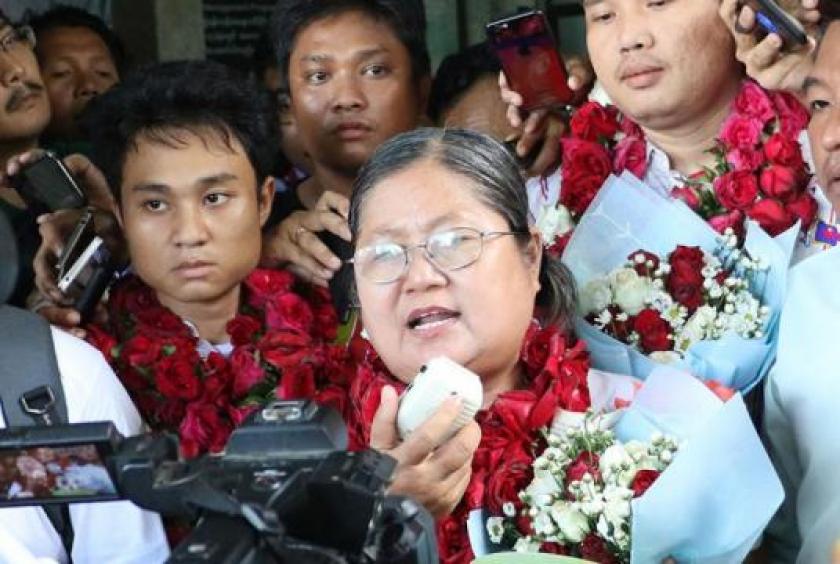
The three suspects leave court on December 21. / Khine Rola / The Irrawaddy
Ma Khaing Mrat Thu said: “It was Human Rights Day and Myanmar has ratified the International Human Rights Declaration. What we organized was not a protest but a campaign. We are very sad that the government filed a lawsuit against us instead of appreciating the citizens who respect human rights.”
Ko Zaw Zaw Min, a lawyer at the Arakan Human Rights Defenders and Promoters Association, said: “They just expressed their opinions on Human Rights Day. They should have freedom of expression. They marked the event to protect human rights. Treating such activities as a sensitive issue and taking legal action will only disrupt justice.” The next court hearing is scheduled for December 30.
Naw Ohn Hla appears in court in Kyauktada Township in October last year on charges of organizing Kayin Martyr’s Day. (Photo-Nay Myo Win) Published 11 December 2020
Naw Ohn Hla, chairperson of Democracy and Peace Women Network in Myanmar, has been presented with the Civil Rights Defender of the Year Award 2020 by Civil Rights Defenders based in Sweden. The award announcement was made on Human Rights Day on December 10.
Naw Ohn Hla is a Karen democracy activist, politician, human rights defender, environmental rights and land rights activist for decades. She has been active in campaigning against the Letpadaung mining project in northern Burma. Naw Ohn Hla is also serving as general secretary of the United Nationalities Democracy Party.
Naw Ohn Hla has received the award for her exceptional perseverance in the fight against oppression and for her continued courage to stand up to those in power, Civil Rights Defenders said in its statement.
“We are standing by the victims of human rights violations. It is now encouraging to see that not only us but also the international community is standing by this. It also encourages us to do more,” said Naw Ohn Hla.
She said she would accept the award at the headquarters of Civil Rights Defenders in Sweden together with the 2021 award winner because this year sees the Covid-19 outbreak.
Migrant Workers Rights Network is a grassroots member-based association that works to protect the rights of migrant workers who live and work in Thailand, the majority being from Myanmar. The organization was founded in 2009 by nine Myanmar migrant leaders after seeing extensive exploitation and abuse of migrant workers in Thai factories, the seafood industry, agriculture, and construction. They decided that empowerment of migrants is the best way for migrant workers to protect themselves.
Intentionally shutting down or restricting access to the internet violates multiple rights and can be deadly during a health crisis such as the COVID-19 pandemic, Human Rights Watch said on 31 March 2020. Governments that are currently imposing an internet shutdown, such as Bangladesh, Ethiopia (it just announced restoring service), India, and Myanmar, should lift them immediately to save lives. During a health crisis, access to timely and accurate information is crucial. People use the internet for updates on health measures, movement restrictions, and relevant news to protect themselves and others.
“Internet shutdowns block people from getting essential information and services,” said Deborah Brown, senior digital rights researcher and advocate. “During this global health crisis, shutdowns directly harm people’s health and lives, and undermine efforts to bring the pandemic under control.” For people around the world staying at home, either willingly or because of government restrictions, the internet is critical to communicate with doctors, family, and friends. For many children and others seeking an education, it is needed to continue learning as schools shutter around the world.
[Internet shutdowns have become increasingly common in recent years, usually during tense periods, such as elections, anti-government protests, or armed conflicts. Thirty-three countries enforced 213 internet shutdowns in 2019, according to Access Now. Government justifications ranged from a need to combat fake news to public safety and national security.[
Khin Myat Myat Wai of the Myanmar Times reported on 16 January 2020: “Reconstituted Myanmar Human Rights Commission more of the same“.
Human rights defenders blasted the newly reconstituted Human Rights Commission as comprised of a bunch of retirees who have little experience in protecting and promoting human rights. President U Win Myint has appointed U Hla Myint, Myanmar representative at the ASEAN Intergovernmental Commission on Human Rights, as the chair of the 11-member reconstituted body. Daw Nanda Hmun, retired permanent secretary of Ministry of Religious Affairs and Culture was appointed as his deputy chair.
Critics expressed doubt on the capacity of the commission to perform its functions independently, especially in investigating cases, which involved police or military personnel as well as other government officials. Daw Nyo Nyo Thin, a former legislator who now heads an anti-corruption watch group in Yangon, said that one good thing about the newly formed commission is it has four female members. But she observed that since most of them are retired civil servants with little experience in human rights-related works, they might not be the right persons for the commission. ..“One of the main functions of the commission is to challenge the government if they received complaints of abuses.” The former legislator bewailed the lack of an active human rights advocate appointed in the body, commenting that the new commission seemed to be comprised of people close to President U Win Myint.
Ko Aung Zaw Oo, a member of the Myanmar Human Rights Defenders and Promoters Association, noted the lack of consultation and transparency on the appointment of the new commissioners. “I don’t want to criticize people but the selection process,” he said. “I want to ask if being a retired person is a requirement to be a member of Human Rights Commission.” For U Aung Myo Min, director of local resource centre Equality Myanmar, the lack of human rights expert in the commission is disturbing. The new commission does not have human rights subject experts or experienced people from ethnic regions where human rights violations mainly occurred and so, there are doubts in its capacity to discharge its function well, he said.
“The previous commission does not have transparency and was criticized not only locally but also by the international community. The new Commission follows the same steps and I want to question that,” U Aung Myo Min said.
In December last year, 20 local civil society organizations called on the government to respect and ensure the independence of the commission and most of them felt frustrated their call went unheeded as evidenced by the appointment of the members of new commission. The Myanmar National Human Rights Commission was established in September 2011, under the administration of former president U Thein Sein.
Malaysian cartoonist Zunar helps launch a report by the International Commission of Jurists at the Foreign Correspondents’ Club of Thailand. (Photo by Osama Motiwala/ICJ))
The ICJ has a slightly different take from other non-governmental organisations that seek to protect freedom of speech. For the ICJ, the law is both the problem and the solution: Southeast Asian governments use existing laws and draft new ones to stifle dissent, violating international statutes upholding freedom of expression that they themselves have signed onto. The report calls for governments in Southeast Asia to “repeal, amend or otherwise rectify existing legal and regulatory frameworks to bring them in line with their international obligations” — and argues that “legislation framed in human rights terms is also the best and most effective way to protect against the very real threats posed by the spread of hate speech, disinformation online, cyber-attacks and other cybercrimes.”
From left: ICJ director of Asia and the Pacific Frederick Rawski, Myanmar surgeon Ma Thida, human rights defender Sutharee Wannasiri, Singaporean activist Jolovan Wham and Malaysian cartoonist Zunar (Photo by Dave Kendall)
“It’s not a pretty picture,” Frederick Rawski, ICJ director of Asia and the Pacific told the forum. “Laws are used to harass and threaten human rights defenders, lawyers, journalists and others…New legal frameworks are being seen as an opportunity to consolidate and protect political power.” Corporations, too, have joined the party. “Businesses are using strategic lawsuits to avoid criticism, claiming they are protecting their businesses interests,” Sutharee Wannasiri told the audience. [https://humanrightsdefenders.blog/2019/05/04/international-civil-society-week-3-human-rights-defenders-engaging-business/]. The human rights activist is out on bail.
Governments have often cited vague concepts of “national security” and “public order” to justify using disproportionate means to shut down opposing views, sometimes even when privately expressed. “I was sentenced to 23 years in prison in 1993,” said Dr Ma Thida, a Myanmar surgeon, writer, and human rights activist. “The first charge was ‘endangering national serenity’.” She said the use of speech-suppressing colonial-era laws such as the National Secrets Act has actually increased since Aung San Suu Kyi joined the Myanmar government.
Governments across Southeast Asia vary in the subtlety — or otherwise — they employ in using the law to stifle dissent. “The police were very nice to me,” recalled Jolovan Wham, a Singaporean civil and labour rights activist [https://humanrightsdefenders.blog/2019/02/24/human-rights-defender-jolovan-wham-in-singapore-sentenced-ngos-dismayed/]. “They asked me, ‘Is the room too cold? Would you like some biscuits?’ Singapore introduced its Protection from Online Falsehoods and Manipulation Act this year. “Singapore has a very good PR machine… they use democratic processes for authoritarian ends,” said Mr Wham. “They made a show of democratic consultation to justify this repressive law.”
The ICJ report was welcomed by Sutawan Chanprasert, the founder of DigitalReach, a new organisation campaigning to protect digital rights in Southeast Asia. “The report shows that while technology gives more opportunities for people to express themselves on social media, the state is moving to control the online space too,” she told the Bangkok Post. “Under repressive ‘fake news’ laws, any content can be interpreted as ‘fake’, ‘false’ and ‘misleading’. And tech has provided a new kind of threat to freedom of expression– digital surveillance of political dissidents.”




 Hans Thoolen on Human Rights Defenders and their awards