Posts Tagged ‘journalists’

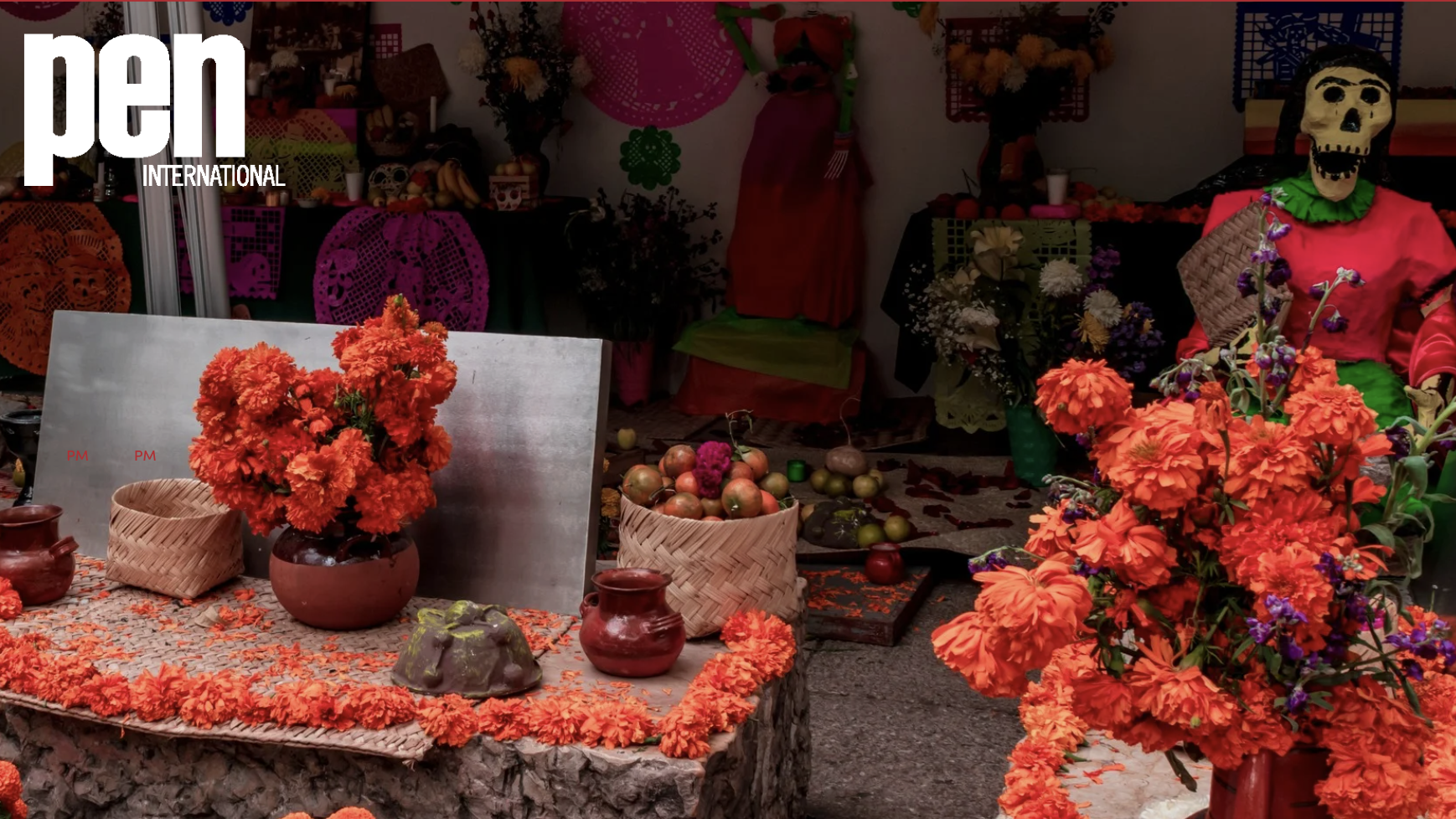
Day of the Dead 2025: PEN International, Amnesty International, ARTICLE 19, and PEN Centres honour journalists killed in Mexico 

November 3, 2025

Every journalist who dares to speak the truth faces danger, yet their courage lights the path for all of us. Remembering those killed is not enough; we must demand justice, protection, and a world where truth can be spoken without fear”. Burhan Sonmez, PEN International President  

31 October 2025: On the Day of the Dead, we the undersigned, honour the journalists  in Mexico who have been killed for their work. This act of remembrance is also an urgent appeal: violence against the press has reached alarming levels in the region. In Mexico, practicing journalism carries deadly risks. The Mexican State must acknowledge this reality and take immediate action. 


PEN International and Article 19’s Mexico and Central America office have documented the killing of at least ten journalists over the past twelve months in Mexico. Seven of these cases are believed to be directly linked to their work, while the motives behind the remaining three killings are still under investigation. The past year,  UNESCO, PEN, CPJ, RSF also recorded the murder of journalists in Brazil (1), Colombia (3), Ecuador (2), Honduras (1), Guatemala (1), Haiti (2), and Peru (2), positioning Mexico once again as the country with the highest number of journalists murdered in the continent. The murders of journalists are closely linked to their reporting on matters of high public interest, including corruption, organised crime, drug trafficking, human rights violations, environmental concerns, and abuses of power. 

The brutality of the attacks, combined with entrenched impunity, has created a perpetual cycle of violence that undermines not only the right to freedom of expression but also the public’s right to be informed. 

Despite its international obligations, the Mexican State continues to fail to ensure the protection of journalists and a safe environment for journalism, and to deliver effective justice for victims and their families. 

This reflects a reality that cannot be ignored: Mexico faces not only a crisis of violence, but also a crisis of structural impunity that enables attacks to continue without consequence. Such impunity creates a chilling effect of self-censorship, restraint, and fear among journalists. 

Emblematic cases 

We remember the journalists Kristian Uriel Martínez Zavala and Calletano de Jesús Guerrero,  killed in Mexico in 2025. …

see also: https://humanrightsdefenders.blog/2020/08/24/killing-of-journalists-in-mexico-juan-carlos-morrugares-the-latest-victim/

Mexico’s ongoing crisis is no accident. It is the result of entrenched impunity and a state either unable or unwilling to protect those who bring truth to light. 

We urge the Mexican State to: 

  1. Take concrete steps to guarantee that journalists in Mexico can exercise their right to freedom of expression without fear of reprisals. 
  2. Review and strengthen the Protection Mechanism for Human Rights Defenders and Journalists, ensuring that effective measures are deployed swiftly. 
  3. Undertake thorough, impartial, and independent investigations into the killings of and attacks on journalists, and deliver effective justice for victims and their families. 

Signed:

PEN International 

Amnesty International 

ARTICLE 19 

https://www.pen-international.org/news/day-of-the-dead-2025-pen-international-amnesty-international-article-19-and-pen-centres-honour-journalists-killed-in-mexico

Journalists from Belarus and Georgia winners of European Sakharov Prize 2025

October 23, 2025

Two journalists, one imprisoned in Belarus and the other in Georgia, have won the European Union’s top human rights honor, the Sakharov Prize, European Parliament President Roberta Metsola announced on Wednesday 22 October 2025.

Andrzej Poczobut is a correspondent for the influential Polish newspaper Gazeta Wyborcza. He was convicted of “harming Belarus’ national security” and sentenced to eight years, which he is serving in the Novopolotsk penal colony.

Mzia Amaghlobeli, a prominent journalist who founded two of Georgia’s independent media outlets, was in August convicted of slapping a police chief during an anti-government protest. She was sentenced to two years in prison in a case that was condemned by rights groups as an attempt to curb media freedom.

Both are journalists currently in prison on trumped up charges simply for doing their work and for speaking out against injustice. Their courage has made them symbols of the struggle for freedom and democracy,” Metsola said at the parliament in Strasbourg, France.

For more on the annual EU award, named after Soviet dissident Nobel Peace Prize laureate Andrei Sakharov, see: https://www.trueheroesfilms.org/thedigest/awards/BDE3E41A-8706-42F1-A6C5-ECBBC4CDB449

The winner is chosen by senior EU lawmakers from among candidates nominated by the European Parliament’s various political groups. [see: https://humanrightsdefenders.blog/2025/10/02/2025-nominees-for-the-european-sakharov-prize/]

https://abcnews.go.com/International/wireStory/journalists-imprisoned-belarus-georgia-win-eus-top-human-126748980

https://spring96.org/en/news/118943

https://www.rferl.org/a/sakharov-prize-2025-andrzej-poczobut-mzia-amaglobeli-/33566711.html

https://euneighbourseast.eu/news/latest-news/2025-sakharov-prize-parliament-honours-andrzej-poczobut-and-mzia-amaglobeli/

RSF World Press Freedom Index 2025: economic fragility now major threat

September 22, 2025

Although physical attacks against journalists are the most visible violations of press freedom, economic pressure is also a major, more insidious problem. The economic indicator on the RSF World Press Freedom Index now stands at an unprecedented, critical low as its decline continued in 2025. As a result, the global state of press freedom is now classified as a “difficult situation” for the first time in the history of the Index. See the Index

At a time when press freedom is experiencing a worrying decline in many parts of the world, a major — yet often underestimated — factor is seriously weakening the media: economic pressure. Much of this is due to ownership concentration, pressure from advertisers and financial backers, and public aid that is restricted, absent or allocated in an opaque manner. The data measured by the RSF Index’s economic indicator clearly shows that today’s news media are caught between preserving their editorial independence and ensuring their economic survival.

“Guaranteeing freedom, independence and plurality in today’s media landscape requires stable and transparent financial conditions. Without economic independence, there can be no free press. When news media are financially strained, they are drawn into a race to attract audiences at the expense of quality reporting, and can fall prey to the oligarchs and public authorities who seek to exploit them. When journalists are impoverished, they no longer have the means to resist the enemies of the press — those who champion disinformation and propaganda. The media economy must urgently be restored to a state that is conducive to journalism and ensures the production of reliable information, which is inherently costly. Solutions exist and must be deployed on a large scale. The media’s financial independence is a necessary condition for ensuring free, trustworthy information that serves the public interest.” Anne Bocandé, RSF Editorial Director

Of the five main indicators that determine the World Press Freedom Index, the indicator measuring the financial conditions of journalism and economic pressure on the industry dragged down the world’s overall score in 2025. 

The economic indicator in the 2025 RSF World Press Freedom Index is at its lowest point in history, and the global situation is now considered “difficult.”

OSCE review shows Malta is still struggling to adequately protect human rights defenders

September 18, 2025

Malta is still struggling to adequately protect human rights defenders, including journalists, according to a new OSCE review published on 2 September 2025.

While some progress has been noted, the report warns that legal pressure, rhetoric used and a lack of meaningful reforms continue to erode fundamental freedoms. The assessment by the OSCE’s Office for Democratic Institutions and Human Rights (ODIHR) follows a fact-finding mission to Malta in March 2023.

ODIHR noted “concerning instances of disparaging rhetoric and smearing remarks used by political actors, including politicians and other persons of authority” in relation to activists in various areas and journalists  Those working on corruption, migration, environmental issues, and sexual and reproductive rights were identified as frequent targets. Interviewees described harassment, threats and intimidation, often extending to their families.

Women activists reported sexist abuse, including being spat on or confronted physically.

Interviewees told ODIHR that their work was often portrayed as partisan political activity. The assessment also noted attempts to damage reputations, harm employment prospects and label defenders as enemies, traitors or political opponents.

The report connects this hostile environment to the 2021 public inquiry into journalist Daphne Caruana Galizia’s assassination, which found that state inaction and vilification of journalists fostered a “climate of impunity.” Two years later, ODIHR says many recommendations remain unfulfilled, particularly on media freedom and journalist safety.

The OSCE heard accounts of online trolling, social media threats, spoofing campaigns, threatening phone calls, and verbal abuse of family members.

ODIHR also found that Maltese journalists continue to receive threatening letters from local and international law firms, sometimes prompting article removals due to fear of high legal costs.

Although defamation was decriminalised in 2018, gaps in the law remain, and proposed anti-SLAPP reforms have been criticised as inadequate.

Freedom of expression and access to information also face obstacles. Journalists spoke of costly and lengthy efforts to secure public records, while whistle-blower protections are seen as weak due to fears of reprisals.

The report calls for a public review of Malta’s Freedom of Information Act, the release of a government-commissioned evaluation, and new legislative proposals to improve transparency and accountability.

Civil society activists also described intimidation around protests, including court rulings against authorities for repeatedly removing banners and memorials related to Caruana Galizia.

ODIHR acknowledged political support for LGBTI rights, with NGOs in this sector receiving strong public backing and engagement from officials. Freedom of assembly was generally upheld, and some NGOs received benefits through tax incentives and secondments. Nonetheless, ODIHR concludes that Malta must urgently rebuild trust and ensure a safer environment for rights defenders.

Key recommendations include public recognition of their work, stronger police protection protocols, robust anti-SLAPP legislation, improved transparency measures, and genuine consultation on media reforms. “Baseless lawsuits, threats and smear campaigns not only endanger individuals but weaken democracy itself,” the report warns.

ODIHR said it is ready to support Malta in implementing reforms but emphasised that political commitment is vital.

https://www.independent.com.mt/articles/2025-09-02/local-news/New-report-highlights-ongoing-risks-for-rights-advocates-in-Malta-6736272807

https://www.maltatoday.com.mt/news/national/136819/report_flags_unimplemented_recommendations_from_daphne_caruana_galizia_inquiry

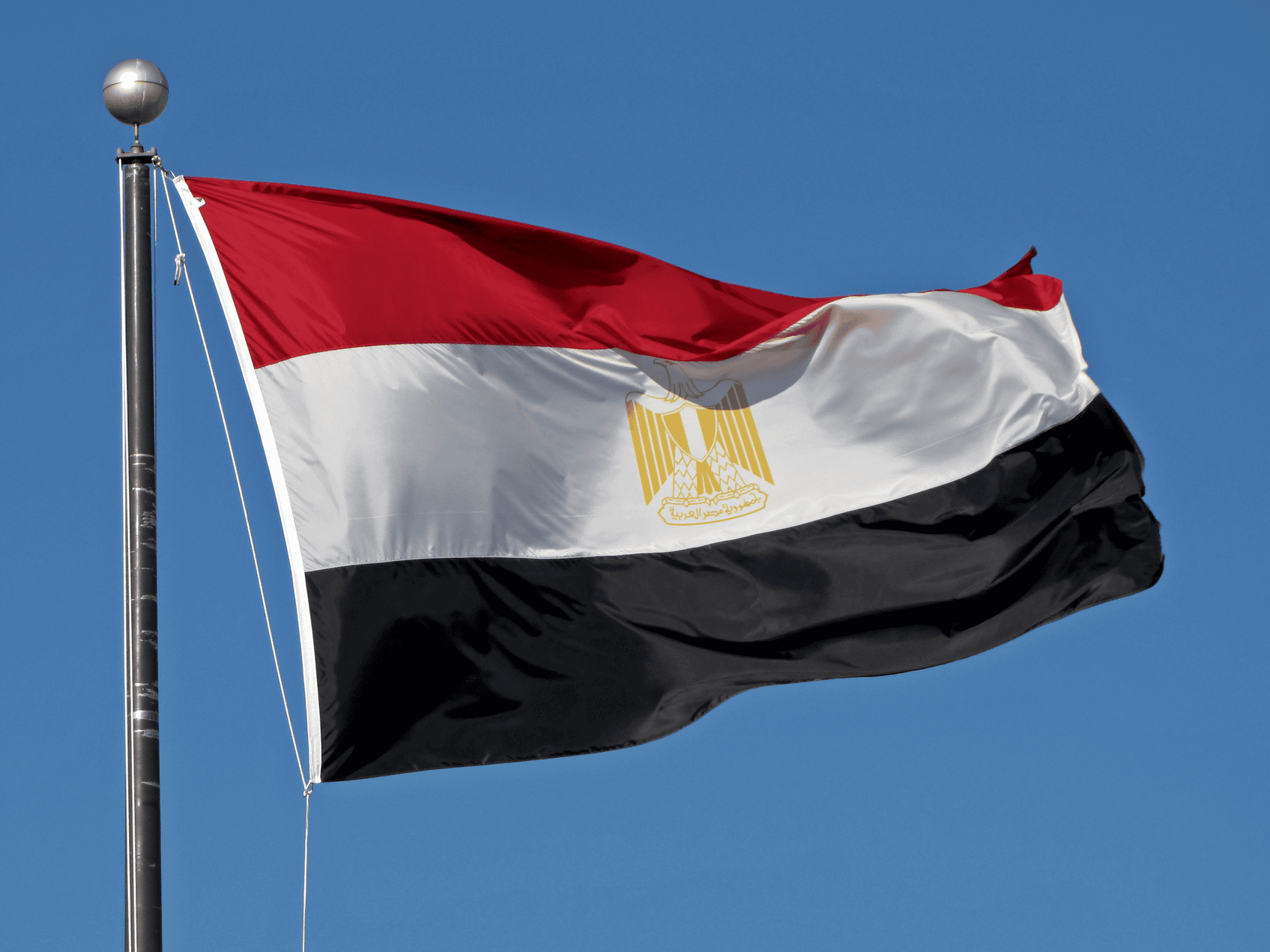
Transnational repression against exiled Egyptian journalist Basma Mostafa must end

June 27, 2025

Egypt: End transnational repression against exiled journalist Basma Mostafa - Protection

Photo credit: Ben Schumin, CC BY-SA 2.0

ARTICLE 19, and the undersigned human rights organistions, call on the Egyptian government to immediately end its campaign of transnational repression targeting exiled Egyptian journalists. We specifically urge the government to respond to the UN report detailing the harassment and surveillance of Egyptian investigative journalist Basma Mostafa, currently residing in Germany. We further urge German authorities to ensure her safety and uphold their international obligations to protect freedom of expression.

Despite seeking safety in exile, Mostafa continues to face threats, surveillance, harassment, and online gender-based violence across multiple countries—including Germany, Switzerland, Kenya, and Lebanon—simply for doing her work. These acts are detailed in a joint communication from UN Special Rapporteurs (AL EGY 6/2024), which documents a disturbing pattern of cross-border intimidation carried out by or with the acquiescence of Egyptian authorities.

Germany’s former Human Rights Commissioner, Luise Amtsberg, has publicly condemned Egypt’s transnational repression and urged the Egyptian government to address findings outlined in the UN report. The Egyptian authorities have yet to issue an official response. The silence is telling.

Mostafa is a prominent investigative journalist known for reporting on human rights abuses in Egypt, including tortureand extrajudicial killings. She was arrested in 2016 while covering protests, and again twice in 2020 while reporting on a police raid in southern Egypt. After facing charges of spreading false news and joining a terrorist organization, she was released on bail and forced into exile. [https://humanrightsdefenders.blog/2024/11/30/human-rights-defenders-story-basma-mostafa-from-egypt/]

Her case is not isolated; Egypt is among the world’s top perpetrators of transnational repression, using tactics such as arresting journalists’ family members, blocking access to exile-based media, targeting journalists with spyware, and denying consular services and identity documents for those living abroad and their family members, including children. In another notable case, a Berlin court convicted a man for charges related to spying for the Egyptian regime, including on Egyptian exiles while working in the press office of former Chancellor Angela Merkel, where he had access to data on exiled Egyptian journalists accredited with the Federal Press Office.

We call on the Egyptian authorities to immediately respond to UN communication AL EGY 6/2024 and end all forms of transnational repression against Egyptian journalists and critics in exile. Egypt must stop targeting journalists abroad and ensure independent, transparent investigations to hold perpetrators accountable.

We also urge the German authorities to protect exiled journalists and critics from intimidation tactics by foreign governments and those working on their behalf, in line with their International Covenant on Civil and Political Rights (ICCPR) obligations and the 2023 Declaration of Principles to Combat Transnational Repression. Germany must provide full protection to Basma Mostafa, ensure accountability for her assault, investigate all attacks, harassment, and surveillance on its soil, and use its influence to demand that Egypt end its campaign of transnational repression.

Signed by:

  1. Access Now
  2. ARTICLE 19
  3. Cairo Institute for Human Rights Studies (CIHRS)
  4. Cartoonists Rights
  5. Committee for Justice (CFJ)
  6. Committee to Protect Journalists (CPJ)
  7. Egyptian Commission for Rights and Freedoms (ECRF)
  8. Egyptian Front for Human Rights (EFHR)
  9. Egyptian Human Rights Forum (EHRF)
  10. EuroMed Rights
  11. EuroMed Rights Network
  12. Gulf Centre for Human Rights (GCHR)
  13. HuMENA for Human Rights and Civic Engagement
  14. Human Rights Watch
  15. International Federation for Human Rights (FIDH), within the framework of the Observatory for the Protection of Human Rights Defenders
  16. International Service for Human Rights (ISHR)
  17. Intersection Association for Rights and Freedoms
  18. Law and Democracy Support Foundation (LDSF)
  19. MENA Rights Group
  20. Middle East Democracy Center (MEDC)
  21. PEN America
  22. PEN Berlin
  23. Robert F. Kennedy Human Rights
  24. Samir Kassir Foundation (SKF)
  25. The Regional Coalition for Women Human Rights Defenders in South West Asia and North Africa (WHRDMENA)
  26. World Organisation Against Torture (OMCT), within the framework of the Observatory for the Protection of Human Rights Defenders

https://euobserver.com/eu-and-the-world/ar65312e54

Journalists for Human Rights (JHR) use World Refugee Day to reflect on journalists forced into exile

June 24, 2025
Journalists for Human Rights blog post

On June 20 we marked World Refugee Day by honouring the courage, resilience and humanity of those forced to flee their homes in search of safety.

Many of those fleeing conflict and persecution are journalists themselves. Forced into exile, they risk losing not only their homes but their platforms and their purpose. JHR equips these journalists with training and story grants, so they can keep working even in the most challenging circumstances.

In Canada, Soraya Amiri arrived from Afghanistan in 2022. She began her career here through the JHR-Meta Afghan Journalists in Residence Fellowship at The Walrus. Today, she continues as a Contributing Writer. In this essay, she reflects on what it means to reclaim her voice as a journalist in exile. Read her latest stories here. Mostafa Al-A’sar, another fellow originally from Egypt who resettled in Canada in 2024, joined the Contributing Writers Program in May and is already at work on his first article for The Walrus. Through their stories, Canadians gain a deeper understanding of the lives and events unfolding beyond our borders.

In Europe we fund and train exiled Russian and Belarusian journalists now based in the Baltics and Poland. With our support they continue reporting on shrinking civic space and government repression. Brestskaya Gazeta has documented the lives of former political prisoners, making visible the human toll of repression. Two young Belarusian bloggers used their platforms to counter state propaganda and foster dialogue on democratic values. And SOTA Vision reads letters to political prisoners on livestreams, helping ensure that those imprisoned in Russia are not forgotten.

In Turkey, where millions of Syrians settled after fleeing the now-toppled Assad regime, JHR-trained journalists have helped ensure that language barriers don’t stop refugees from accessing education, that legal aid is available to refugee women and that travel permits helped legally restricted refugees move freely to safer regions after the 2023 Turkey-Syria earthquake.

At a moment of global upheaval, when self-interest drowns out solidarity, when aid budgets are slashed and the number of displaced people worldwide has never been higher, it is more urgent than ever to stand with refugees.

At JHR, we remain committed to supporting journalists in exile and to equipping local reporters with the tools they need to cover refugee rights objectively and accurately.

IKON journalists’ case in El Salvador: finally justice after more than 40 years!!

June 7, 2025

In a previous post I explained my personal involvement in this case [https://humanrightsdefenders.blog/2018/09/25/murder-of-dutch-ikon-journalists-in-1982-in-el-salvador-revisted/] and had several follow ups [https://humanrightsdefenders.blog/tag/ikon/].

Now finally there is some closure as reported by ANP on 4 June 2025:

In El Salvador, three suspects have been found guilty of murdering four Dutch journalists that were working for IKON in 1982. All three were handed a prison sentence of 15 years, several Salvadorian media outlets reported, including the newspaper Diario El Salvador. 

After a hearing that took longer than 11 hours, the jury ruled that all the suspects were involved in the death of the journalists. The suspects are the former Minister of Defense, Guillermo Garcia (91), former director of a special police service, Francisco Antonio Moran (93), and former colonel Mario Reyes Mena (85). 

Koos Koster, Jan Kuiper, Hans ter Laag, and Joop Willemsen, four journalists who worked for the now defunct broadcaster IKON, were reporting on the civil war in the country in 1982. They walked into an ambush at Chalatenango and were killed. A now-repealed amnesty law prevented the prosecution of the perpetrators for years.

Sonja ter Laag (70), the sister of Hans ter Laag, responded to the verdict. “I am very happy that the people who murdered my brother have been convicted. And that they will go to their graves as murderers. We can finally close this after 43 years.” 

She added that the victim’s relatives have been living in a state of hope and desperation for the convictions for 43 years. “That costs a lot of energy, you don’t want to know. And now it is over. The people who gave the order to murder my brother, an innocent 25-year-old boy, will be punished.” Ter Laag did not mind that the elderly men would not have long to live anymore. “In any case, they will not go to their grave decorated.”

The judges imposed a lower sentence than the maximum set by the law. Instead of a prison sentence of 30 years, they imposed 15 years because of the defendants’ age and poor health.

García and Morán are being treated in a private hospital. El Salvador has requested the extradition of Reyes Mena. He currently lives in the U.S.

https://nltimes.nl/2025/06/04/three-former-soldiers-convicted-dutch-journalists-murder-el-salvador-1982

seehttps://jsis.washington.edu/humanrights/2025/07/18/uwchr-provides-historical-documentation-of-1982-killings-of-dutch-journalists-in-el-salvador/

NGOs address Pakistan on Afghan journalists and Baloch human rights defenders

May 30, 2025

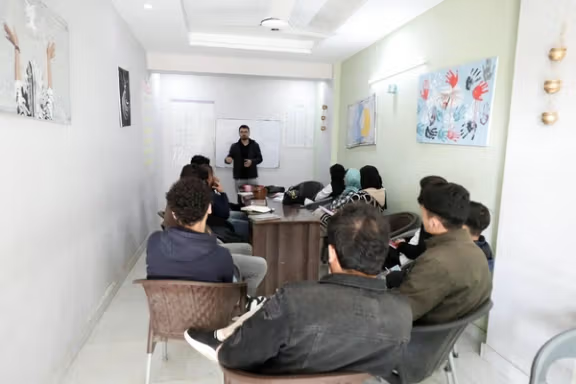
On 29 May the Committee to Protect Journalists and fourteen other organisations have urged Pakistan to immediately halt deportation of Afghan journalists and other vulnerable Afghan migrants. The fifteen advocacy groups expressed deep concern over Pakistan’s ongoing deportation plan, first announced on 3 October 2023, which targets undocumented Afghan nationals. The joint statement highlights the heightened risks faced by Afghan journalists, writers, artists, human rights defenders, and others who fled Taliban persecution and are now at risk of being forcibly returned.

Among the signatories are prominent international organisations such as PEN Germany, CPJ, Unlimited Free Press, Front Line Defenders, International Cities of Refuge Network (ICORN), Nai – Supporting Open Media in Afghanistan, and Reporters Without Borders (RSF).

The organisations also called on the international community to provide safe resettlement opportunities for these individuals, recognising the dangers they face if returned to Taliban-controlled Afghanistan. Pakistan’s deportation policy has faced sharp criticism from local and international bodies, including the Pakistan Human Rights Commission, the United Nations High Commissioner for Refugees (UNHCR), and the International Organisation for Migration (IOM). These entities have urged Pakistan to uphold its international obligations and provide protection to those fleeing conflict and persecution.

Despite repeated calls for restraint, the Pakistani government has accelerated forced returns in recent months. In April alone, more than 300,000 Afghans were deported, drawing further condemnation from human rights organisations.

——

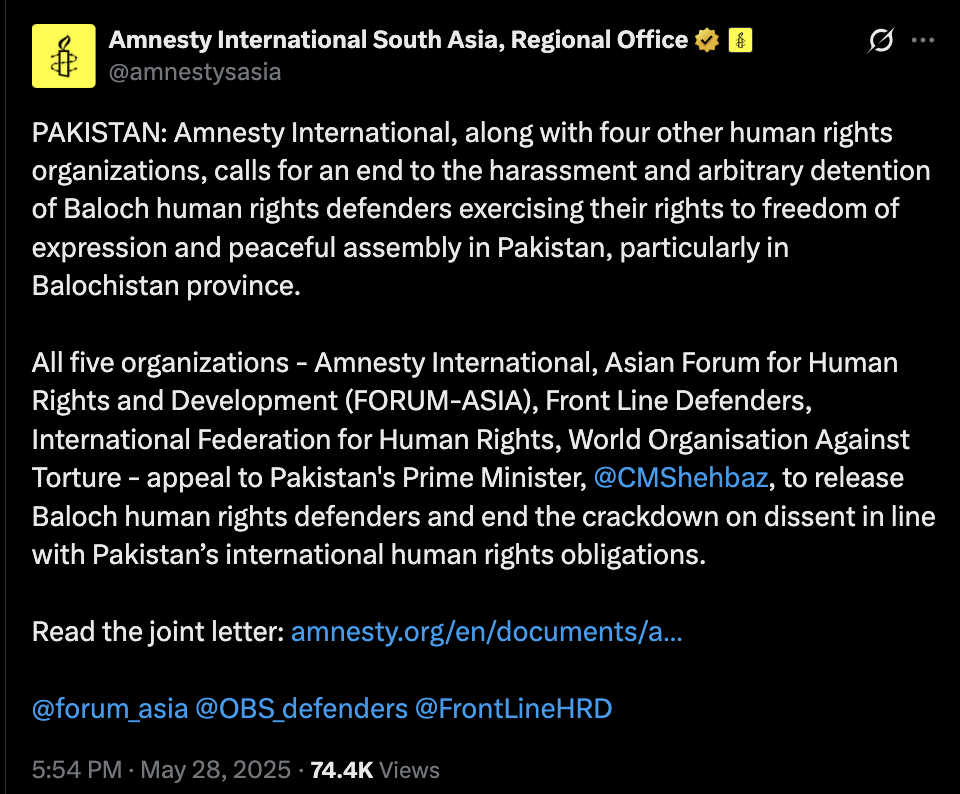
On 28 May Amnesty International along with four other human rights organizations wrote to the Pakistani prime minister, calling for an end to the “harassment and arbitrary detention” of Baloch human rights defenders (HRDs) exercising their rights to freedom of expression and peaceful assembly, particularly in Balochistan province. 

The letter comes in the wake of Dr. Mahrang Baloch, one of the leading campaigners for the Baloch minority and the leader of the Baloch Yakjehti Committee (BYC), and a number of other activists, being arrested in March on charges of terrorism, sedition and murder. ..

The five organizations — Amnesty International, Asian Forum for Human Rights and Development (FORUM-ASIA), Front Line Defenders, International Federation for Human Rights, World Organization Against Torture — appeal to Pakistan’s Prime Minister to release Baloch human rights defenders and end the crackdown on dissent in line with Pakistan’s international human rights obligations;

A dozen UN experts called on Pakistan in March to immediately release Baloch rights defenders, including Dr. Baloch, and to end the repression of their peaceful protests. UN special rapporteur for human rights defenders Mary Lawlor said she was “disturbed by reports of further mistreatment in prison.”

Balochistan is the site of a long-running separatist movement, with insurgent groups accusing the state of unfairly exploiting Balochistan’s rich gas and mineral resources. The federal and provincial governments deny this, saying they are spending billions of rupees on the uplift of the province’s people. 

see also: https://humanrightsdefenders.blog/2024/10/22/prominent-baluch-human-rights-defender-stopped-from-attending-time-event-in-us-and-then-assaulted/

https://www.afintl.com/en/202505291879

https://www.arabnews.com/node/2602563/amp

NGOs demand end to crackdown on peaceful Human Rights Defenders in Turkey

April 10, 2025

On 4 April 2025 a joint statement by 13 international, regional and national civil society organisations, strongly condemned violations of the right to protest in Turkey, including police brutality, ill-treatment that may amount to torture, mass arbitrary detentions, and the systematic persecution of human rights defenders. 

Mass protests erupted across Turkey on 19 March 2025, following the detention of more than 100 individuals —including the Mayor of Istanbul, Ekrem İmamoğlu. These arrests, made as part of investigations into allegations of “corruption” and “terrorism”, and their timing have raised widespread concerns that the charges are politically motivated – just days before İmamoğlu’s    expected presidential candidacy. 

In the immediate aftermath of the arrests, authorities imposed sweeping restrictions, including days-long blanket bans on gatherings across multiple cities, restricted access to several social media platforms curbing access and preventing the dissemination of information, and shut down major public transportation routes in İstanbul, all in a systematic effort to suppress dissent and mobilisations. 

Despite these measures, thousands have continued to gather in protest across the country since 19 March. While protests have been overwhelmingly peaceful, journalists and civil society organisations have documented grave human rights violations in several locations, and particularly in Saraçhane, Istanbul, including an indiscriminate and disproportionate display of police violence and brutality that may amount to torture and other ill-treatment, including beatings with batons, demonstrators being kicked while subdued on the ground, close-range targeting with Kinetic Impact Projectiles (KIPs), as well as the indiscriminate use of chemical irritants and water cannons. Based on widely circulated footage and public testimonies, and in line with the UN Committee Against Torture’s recommendations to Turkey following its periodic review in 2024, the Human Rights Foundation of Turkey (TİHV) has also denounced the use of restraint methods that inflict unnecessary pain, such as prolonged handcuffing behind the back and stress positions. These practices, known to cause serious health consequences, have at times been publicised by police officers themselves via personal accounts, seemingly as a tactic of intimidation.

Reports have stated that protesters who have been met with excessive police force have suffered grave and long-lasting injuries such as head trauma and eye damage due to tear gas cartridges and KIPs, burns and respiratory issues due to the indiscriminate and widespread use of tear gas and water cannons, which in some cases resulted in their hospitalisation. The full extent of the injuries, as well as the physical and psychological toll on protesters’ health, will only become clear in the following months. 

According to the report of Human Rights Association (İHD), as of 27 March 2025, a total of 1,879 people—including children, lawyers, journalists, students, union leaders and human rights defenders—have been taken into custody during protests and house raids on the grounds of inciting protests, engaging in violence, concealing their faces with masks, and using bats or other objects. Over 260 of them have been placed in pre-trial detention, while judicial control measures have been imposed on 468 individuals simply for exercising their right to peaceful protest. Istanbul Bar Association Child Rights Committee reported that among the arrested in İstanbul, 20 were under the age of 18

Progressive Lawyers Association (ÇHD) also highlights incidents of torture, ill-treatment and sexual violence in detention facilities.  Lawyers have denounced the treatment of seven female detainees who were subjected to beatings as well as unjustified strip searches while in custody. According to a released testimony, another female victim reported being groped by a police officer while handcuffed behind the back and forcefully pinned to the ground and that she soiled herself out of fear during the ordeal. She was reportedly placed under house arrest after her testimony. The Turkish Medical Association has recalled the importance of medical examinations upon entry in custody and detention to prevent and document torture and other ill-treatment.

Human rights defenders, including those monitoring the protests, have also become targets of State repression during the protests. Journalists and media organisations covering protests have also been persecuted, infringing on the right to freedom of expression and the right to information. As of 28 March, at least 14  journalists were detained after covering the protest. 

Lawyers representing those who were arbitrarily detained in the context of protests, were also targeted. At least 14 lawyers were detained, including the lawyer of İmamoğlu, demonstrating the State authorities’ disregard for the rule of law and the right to defence, due process and justice. In the midst of the protests as part of the general intimidation strategy against lawyers, on 21 March the Istanbul Bar Association’s executive board was dismissed by the decision of İstanbul 2nd Civil Court of First Instance- a move that raises serious concerns of further attacks on the independence of the legal profession and the detainees’ right to legal representation. Following the decision, police interfered as lawyers attempted to march from the courthouse in Çağlayan to the Istanbul Bar Association building in Taksim to protest the decision.

Signatories:

  • ARTICLE 19
  • Asociación Unidad de Defensa Jurídica, Registro y Memoria para Nicaragua (AUDJUDRNIC)
  • CIVICUS: World Alliance for Citizen Participation
  • EuroMed Rights
  • Front Line Defenders
  • Gulf Centre for Human Rights (GCHR)
  • ILGA-Europe
  • United Against Torture Consortium (UATC), through its following members:
    • The International Rehabilitation Council for Torture Victims (IRCT)
    • Omega Research Foundation
    • Redress
    • And the World Organisation Against Torture (OMCT)
  • Unidad de Protección a Defensoras y Defensores de Derechos Humanos – Guatemala (UDEFEGUA)
  • Within the framework of the Observatory for the Protection of Human Rights Defenders:
    • International Federation for Human Rights (FIDH)
    • World Organisation Against Torture (OMCT)

see also: https://humanrightsdefenders.blog/tag/turkey/

https://www.frontlinedefenders.org/en/statement-report/end-brutal-crackdown-peaceful-protest-and-human-rights-defenders

Launch of the Free Expression Legal Network to support free expression and free media

February 25, 2025

The Free Expression Legal Network, a new initiative dedicated to strengthening legal protections for free expression and media freedom, was launched at Webber Wentzel’s Sandton office on 18 February 2025, with more than 50 People in attendance. Developed by the SA National Editors’ Forum (Sanef), the Press Council, the Campaign for Free Expression (CFE), and other organisations and legal experts, the network aims to ensure that individuals and organisations facing legal threats can access the support they need.

Among those that this new initiative aims to support are journalists, smaller media outlets, community-based organisations and businesses that lack access to corporate or external legal representation. It aims to ensure co-ordination with several other international efforts of this kind to provide a stronger framework for defending free expression,

The network will focus on several key areas to strengthen legal protections for free expression and media freedom. Media freedom is critical – ensuring that individuals and media organisations can report and impart information freely and hold power to account without fear of legal repercussions. Additionally, the network will support media viability by providing legal guidance to help media outlets navigate financial and operational challenges, ensuring their long-term sustainability. Another critical area is policy advocacy, where the network will assist with legal challenges related to media regulation and press freedom policies, helping to create a more supportive legal environment for journalism. Lastly, the initiative will prioritise small and community media, offering essential legal resources to newsrooms and organisations that often lack adequate legal support, ensuring they have the protection needed to operate effectively.

But this initiative comes at a time of new and sinister threats to freedom of expression more generally. Unchecked and unprecedented powers to platform and platform certain voices and sources of information present pronounces threats to freedom of expression globally. It is intended that this network, enabling resources and expertise, is able to respond innovatively, nimbly and effectively in meeting these dangers.

The keynote address was delivered by Navi Pillay, former UN High Commissioner for Human Rights, Judge of the International Criminal Court, and President of the International Criminal Tribunal for Rwanda. Drawing from her extensive experience in international human rights law, she provided invaluable insight into the legal challenges surrounding free expression and the role of judicial systems in upholding these rights. Emphasising the power of collective action, she stated, “If you clap with a single hand, nobody yells for you. But if a lot of people form a network clap, they will be heard. So, I can only see success for an initiative like this, I encourage them to go for it here. 

Anton Harber, Campaign for Free Expression Director, emphasised the importance of the new body in defending free speech, stating, “This new body will be a vital tool in preventing attacks on free speech and free media, bringing together a range of resources to respond quickly and strongly. It will help ensure that anyone whose free speech is threatened will be properly defended. It will also be proactive – pushing for change to laws that don’t defend free speech or the right to information. In the face of growing threats to free speech, we are building a strong defence“.

Echoing this urgency, Nicole Fritz, Executive Director of Campaign for Free Expression, highlighted the global nature of these challenges, adding, “I think that the threats to free expression are especially intense at this time, not only in our country but in the world generally. It is especially important that those who have their rights to expression violated and threatened are offered expert support and legal assistance in order to counter those threats”.

Dario Milo, a partner at Webber Wentzel and a leading expert in media law, emphasised the importance of this initiative, stating: “The Free Expression Legal Network is a significant step forward in ensuring that journalists, media organisations and other human rights defenders, particularly those with limited resources, have access to the legal guidance they need. At a time when media freedom is under increasing pressure, this initiative will play a crucial role in safeguarding free expression and upholding the public’s right to know.”

For more information on the Free Expression Legal Network and how to get involved, please contact Anton Harber, Director, CFE, anton@harber.co.za