Posts Tagged ‘Israeli–Palestinian conflict’

Calls for protection of Gaza human rights defenders and access for investigators

October 8, 2025
At Human Rights Council: Euro-Med Monitor calls for protection of Gaza human rights defenders and access for investigators

In a statement delivered before the United Nations Human Rights Council on 2 October 2025 , Euro-Med Human Rights Monitor called to protect human rights defenders in Gaza and to grant international investigators unrestricted access to examine violations committed amid Israel’s ongoing war on the Gaza Strip.

The statement was delivered remotely from Gaza by Maha Hussaini, Head of Media at Euro-Med Monitor, during the Council’s 60th session under Item 8. Hussaini stressed that the continued silence of states and civil society representatives severely undermines international law and enables further violations.

Addressing the Council, Hussaini said: “I speak to you from my last refuge after I was forcibly expelled from my home in Gaza City under relentless Israeli bombardment, though I do not know if by the time you hear these words I will still be alive or buried beneath the rubble.”

She continued: “Gaza is under unprecedented Israeli attacks, and I have been forcibly displaced along with my colleagues at Euro-Med Human Rights Monitor several times now. I’m meant to present this statement as a human rights defender, to document and to advocate. But today I can no longer count the Israeli crimes I witness, because they surround me in every breath and every hour.”

Hussaini further noted: “It is a shame that I had to tear up my business card identifying me as a human rights worker at some point during this genocide to avoid being killed or detained by the Israeli military.”

She concluded: “We demand, not plead, we demand protection for those documenting genocide in Gaza, we demand unhindered access for international investigators, and we demand that perpetrators face justice. Every silence from you, representatives of states and civil society, is another strike of the hammer driving the coffin of international law.”

On 4 October 2025, in its response to a call for input by UN Special Rapporteur on human rights defenders, Mary Lawlor, Al-Haq drew urgent attention to the escalating and systematic efforts to silence Palestinian voices and dismantle the infrastructure of Palestinian civil society. The submission highlights how Israel’s settler-colonial apartheid regime has intensified its campaign to suppress resistance, criminalise advocacy and quash any pursuit of accountability as it pursues Palestinian erasure.

https://euromedmonitor.org/en/article/6871/At-Human-Rights-Council:-Euro-Med-Monitor-calls-for-protection-of-Gaza-human-rights-defenders-and-access-for-investigators

https://www.alhaq.org/advocacy/26700.html

https://www.omct.org/en/resources/statements/israel-palestine-the-observatory-condemns-the-arbitrary-detention-and-ill-treatment-of-activists-aboard-the-global-sumud-flotilla-in-israeli-prisons

Palestinian Human Rights Defender Awdah Hathaleen killed by Israeli Settler

August 4, 2025

“Despite it all, I hold onto a small hope—that the future might bring justice, that our voices will eventually be heard, and that one day I can celebrate my birthday again, in peace, with the people I love, free from fear and loss.”  – Awdah Hathaleen, April 2025 Photo by: Emily Glick

An Israeli settler shot dead a Palestinian teacher who helped film Oscar-winning documentary No Other Land, according to the Palestinian education ministry and an Israeli-American activist who was at the scene of the shooting.

No Other Land co-director Yuval Abraham said on X that a settler shot Odeh (also Awdah) Hathaleen in the lungs in Umm Al-Khair village in the occupied West Bank. Residents allege the shooter was Yinon Levy, who is sanctioned by the UK.

Attorney Avichai Hajbi said he was representing a resident “who felt his life was in danger, was forced to fire his weapon into the air” after residents were “attacked by an Arab mob, along with foreign activists, with stones and violence”. Mattan Berner-Kadish, an Israeli-American activist at the scene, told the BBC that at about 17:20 local time (15:20 BST) on Monday, a bulldozer from a nearby Israeli settlement was driven through private Palestinian land, crushing a sewage pipe, multiple olive trees and two fences.

Berner-Kadish and other activists, including Hathaleen’s cousin Ahmad, ran to block the bulldozer. The activist said the driver hit Ahmad in the neck and shoulder with a drill that extended from the bulldozer, with his footage capturing Ahmad falling to the ground. Berner-Kadish did not believe Levy was driving.

While attending to Ahmad’s injuries, Berner-Kadish heard a pop. Running back to the village to get water, he saw Hathaleen lying bleeding from a gunshot wound and Levy, the only settler he saw, holding a gun.

In a video believed to be filmed by a relative of Hathaleen and posted on social media, a man identified as Levy is seen holding a pistol with a bulldozer behind him, as men yell at him. Levy pushes at one man, who pushes back. Levy then raises his pistol and shoots ahead of him, then again into the air.

The clip cuts off when the person filming turns around to run away as women are heard screaming. The footage does not show what or who the shots hit, if anything, and whether anyone else was shooting. There are no other settlers visible. Israeli police said it was investigating the incident in the area of Carmel, an Israeli settlement near Umm Al-Khair.

“As a result of the incident, a Palestinian man was pronounced deceased. His exact involvement is under investigation,” police told the BBC. Police said on Tuesday morning they had detained an Israeli citizen for questioning. Israeli media later reported Levy was released on house arrest.

The Israel Defense Forces (IDF) also detained five Palestinians on suspicion of involvement in the incident, along with two foreign tourists who were present. Berner-Kadish said on Tuesday evening they were still detained. The activist, who began visiting the village in 2021, said Hathaleen was “one of my best friends in the world” and the two were days away from constructing a football field in the village. He added that Hathaleen was a “warm and loving” father of three young children.

The Palestinian education ministry said Hathaleen was a teacher at a local secondary school. US congresswoman Lateefah Simon, a Democrat from California, said she was “heartbroken” over the killing of Hathaleen. He and his cousin, “both holding valid visas”, were detained and deported from San Francisco airport last month while travelling for a multicultural faith dialogue, she said.

Abraham said Hathaleen had helped film No Other Land, the 2025 Oscar winner for best documentary feature that follows the legal fight between the Israeli government and Palestinians over Masafer Yatta, a West Bank community of about 20 villages.

..Levy, a leader of an outpost farm, was sanctioned by the UK in 2024, along with others, because he “used physical aggression, threatened families at gunpoint, and destroyed property as part of a targeted and calculated effort to displace Palestinian communities”.

He was also sanctioned by the US under the Biden administration, along with others, last year, but President Donald Trump lifted those sanctions.

Gilad Kariv, a member of Israel’s Knesset from the Democrats party, said on X in response to the video that “in the territories, armed Jewish militias operate unchecked”.

Settler violence, which has also been on the rise for years, has surged since the outbreak of the war in Gaza. The UN documented at least 27 attacks by settlers against Palestinians that resulted in property damage, casualties or both, between 15 and 21 July, in the West Bank.

see also: https://www.frontlinedefenders.org/en/statement-report/optisrael-statement-solidarity-palestinian-human-rights-defenders-risk-occupied

https://www.bbc.com/news/articles/c776x78517po

https://www.amnesty.org/en/latest/news/2025/

https://en.wikipedia.org/wiki/Killing_of_Awdah_Hathaleen

https://mailchi.mp/2a4342b25255/hrdf-10982507?e=51113b9c0e Read here the words of chairperson of the board, Sahar Vardi.

Nobel Peace Prize: choice between Trump and Albanese?

July 24, 2025

No-one will have missed the recent media hype surrounding the opposite candidacies of US President Trump and UN rapporteur Francesca Albanese for this year’s Nobel Peace Prize. This blog with its focus on human rights defenders and their awards would be amiss in not taking note, even if the Nobel Prize is foremost a peace prize not necessarly a human rights award. [see also my piece of 2012 https://global.comminit.com/content/nobel-prize-peace-not-necessarily-human-rights]

So, it is not excluded that the ‘making peace at any cost’ considerations will prevail, but my bet is that the Peace Prize Committee will be careful in ignoring the massive support from the world’s human rights community who have massively come out against the Trump administration’s sanctions against Albanese. Human rights should trump ‘peace’ on this occasion.

Nominations for a Nobel Peace Prize for Francesca Albanese are gathering steam. See the links below:

https://www.frontlinedefenders.org/en/statement-report/united-states-america-sanctions-united-nations-special-rapporteur-assault-human

https://www.scmp.com/news/us/diplomacy/article/3318822/trump-says-he-deserves-nobel-peace-prize-not-everyone-agrees

https://english.pnn.ps/news/47558

https://www.business-humanrights.org/en/latest-news/un-experts-condemn-us-sanctions-on-special-rapporteur-francesca-albanese-amid-report-on-corporate-complicity-in-israels-occupation-genocide/

https://www.thearabweekly.com/eu-gingerly-criticises-washingtons-unprecedented-sanctions-un-rapporteur

https://www.ynetnews.com/article/bku2skjbgl

https://www.hrw.org/news/2025/07/10/us-imposes-sanctions-on-un-special-rapporteur

https://eu.fayobserver.com/story/opinion/2025/08/22/trump-wants-nobel-peace-prize-but-cut-food-abuses-immigrants-has-not-resolved-gaza-or-ukraine/85765058007/

https://www.ynetnews.com/article/sk429uepgg

https://economictimes.indiatimes.com/news/international/global-trends/donalds-dream-dumped-trump-overlooked-for-2025-nobel-peace-prize-but-why/articleshow/124450001.cms?from=mdr#google_vignette

DAWN added to blacklist by Israel

July 18, 2025

On 1 July 2025 DAWN issued a response to reports of a new Israeli directive to ban employees of DAWN, along with other respected human rights and legal advocacy organizations including Al-Haq Europe, Law for Palestine, and Lawyers for Palestinian Human Rights (LPHR), from entering Israel, aiming to punish and suppress accountability efforts for war crimes, apartheid, and genocide, DAWN issues the following:

Israel is now banning human rights organizations from even entering the country to expose and seek accountability for the atrocities and crimes it is committing,” said Sarah Leah Whitson, DAWN’s executive director. “Israel’s ban against organizations seeking accountability for IDF abuses is only the latest indication of its growing isolation in the international community.”  

“Israel’s decision to blacklist DAWN is a desperate attempt to block scrutiny of its crimes against the Palestinian people,” said Raed Jarrar, advocacy director at DAWN. “We will not be intimidated by authoritarian tactics and will continue our work to expose Israel’s violations of international law until there is full accountability and justice.”

“It’s hard to imagine greater validation of DAWN’s work to hold accountable Israeli officials and soldiers than being banned from entering the country specifically because of that work,” said Michael Schaeffer Omer-Man, director for Israel-Palestine at DAWN. “This is nevertheless a worrying harbinger of even greater Israeli repression of human rights defenders, be they Palestinian, Israeli, or American.”

Some rabbis want to be human rights defenders!

April 3, 2025
ICN Logo

Image: RHR

Image: RHR

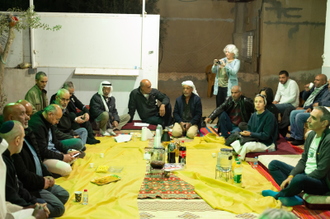
On 29 March 2025 Rabbis for Human Rights wrote: “This week, we took part in a moving Iftar meal-the traditional dinner that breaks the daily fast during the month of Ramadan-together with residents and activists from the Negev. The event was held in collaboration with the Regional Council for the Unrecognized Villages.

We sat together around one table, broke bread, listened to stories, and felt both the pain-and the hope. It was a moment of deep human connection between communities fighting for justice, equality, and a safer future.

But alongside the warmth and solidarity, we cannot ignore the harsh reality: In just the first half of 2025, more than 2,000 structures in unrecognized villages in the Negev have been demolished-a dramatic increase from previous years. The destruction of Umm al-Hiran last November still echoes-a whole community erased to make way for a new Jewish settlement.

True solidarity is not just a slogan-it is presence, listening, and action. We will continue to stand with these communities, amplify their voices, and work toward a future in which every person can live with dignity and security.

As Jews and as Rabbis, our commitment to justice is unconditional-it is at the heart of our identity.

As Ramadan draws to a close next week, we wish all our Muslim friends and partners a joyous Eid al-Fitr (Eid Mubarak).

May this holiday bring you and your families happiness, abundance, and blessings. We hope these festive days offer moments of comfort, renewal, and peace to all!”

This is not our Judaism.

Every day Rabbis from our organization are taking to the streets to protest against the government and for the protection of democracy. Rabbis for Human Rights’ staff and board members are on the streets every day, raising their voices to end the horrific bloodshed in Gaza, to bring the hostages home, and to call for an immediate ceasefire.

As rabbis and human rights defenders, we believe in the sanctity of every human life. This war must end now!

Read more about Rabbis for Human Rights: www.rhr.org.il/eng

Tags: Rabbis For Human Rights, RHR, Iftar, Holy Land, Israel, Palestine

https://www.indcatholicnews.com/news/52042

Venezuela’s opposition wins top EU human rights award

October 27, 2024
Opposition Leader Maria Corina Machado Speaks After Presidential Election
Democratic leader María Corina Machado and exiled presidential candidate Edmundo González won the top human rights award for representing all Venezuelans who are “fighting for the restoration of freedom and democracy.” | Marcelo Perez del Carpio/Getty Images

The European Parliament on Thursday 24 October 2024 awarded the Sakharov Prize to Venezuela’s opposition leaders. Democratic leader María Corina Machado and exiled presidential candidate Edmundo González won the top human rights award for representing all Venezuelans who are “fighting for the restoration of freedom and democracy.”

The Venezuelan opposition leaders were nominated by the center-right European People’s Party (EPP) and the hard-right European Conservatives and Reformists (ECR). The far-right Patriots group rallied behind them after their original candidate, tech billionaire Elon Musk, failed to make the shortlist for the prestigious prize.

After Venezuela’s elections in late July, in which incumbent socialist President Nicolás Maduro declared victory for another term, the European Union’s foreign service said it would not recognize the results because the government had failed to release supporting voting records from polling stations. 

The authoritarian Maduro’s disputed declaration of victory sparked massive opposition protests and a violent government crackdown that left more than two dozen people dead and nearly 200 injured.

Later, presidential candidate González — who fled to Madrid during the crackdown — was recognized by the European Parliament as the country’s legitimate leader.

For more on the Sakharov Prize for Freedom of Thought and its laureates see: https://trueheroesfilms.org/thedigest/awards/BDE3E41A-8706-42F1-A6C5-ECBBC4CDB449

Two other finalists made the shortlist. One was Gubad Ibadoghlu, a jailed Azerbaijani dissident and critic of the fossil fuel industry nominated by the Greens. The other finalist was a joint nomination of Israeli and Palestinian peace organizations Women Wage Peace and Women of the Sun. The groups, who announced a partnership in 2022, were nominated by the Socialists and the Renew group.

https://www.politico.eu/article/eu-human-rights-award-venezuela-opposition-maria-corina-machado-edmundo-gonzalez-nicolas-maduro/

https://www.europarl.europa.eu/news/en/press-room/20241017IPR24738/maria-corina-machado-and-edmundo-gonzalez-urrutia-awarded-2024-sakharov-prize

see: https://www.lapatilla.com/2024/10/26/at-least-900-people-arrested-after-venezuelas-post-election-protests-are-being-held-in-tocoron-prison/

Germany’s fear of being seen as antisemitic goes over the top

December 21, 2023

On 20 December 2023 Jakob Guhl posted in Index on Censorship a piece stating that German authorities are increasingly silencing pro-Palestine activism in an effort to stamp out anything they fear could be seen as antisemitic. He makes some excellent points (which apply also outside Germany):

..The seemingly isolated incidents highlighted in this article are piling up and the curtailing of civic space is starting to be noticed internationally: Civicus, which ranks countries by freedom of expression rights, recently downgraded Germany in a review from “open” to “restricted” due to repression of pro-Palestinian voices, as well as of climate activists…

There are long-standing disagreements around where to draw the line between legitimate criticism of Israel and attacks on Israel that single it out because it is a Jewish state, are expressed in antisemitic ways or are motivated by antisemitic views. For example, the International Holocaust Remembrance Alliance (IHRA) definition of antisemitism acknowledges that “criticism of Israel similar to that levelled against any other country cannot be regarded as antisemitic” but identifies seven examples of when attacks on Israel may be antisemitic (taking into account the overall context). For example, it could be antisemitic to reference classic antisemitic tropes such as the blood libel conspiracy myth to describe Israel, deny the Jewish people’s right to self-determination or blame Jews collectively for the actions of Israel, according to IHRA.

While Germany has adopted IHRA, much looser standards seem to be applied by authorities and commentators committed to tackling Israel-related antisemitism. Calls for a binational state, advocacy for the Palestinian refugees’ right of return, support for Boycott, Divestment and Sanctions (BDS) or accusations that Israel is committing Apartheid are regularly identified as antisemitic. There is a strong sense that given its historical responsibility, it is not Germany’s place to judge, or let anyone else judge, Israel even as its offensive in Gaza has resulted in one of the highest rates of death in armed conflict since the beginning of the 21st century, and disproportionately affects civilians. [see also: https://humanrightsdefenders.blog/2021/01/18/israel-and-apartheid-israeli-human-rights-group-stirs-debate/]..

The debates since 7 October have created an atmosphere in which pro-Palestinian voices are more and more stigmatised. Pro-Palestinian protests have repeatedly been banned by local authorities. Their dystopian rationale for these bans revolves around the idea that, based on assessments of previous marches, crimes are likely to be committed by protesters. The practice is not new: in the past, German police have even banned protests commemorating the Nakba (Arabic for “catastrophe”), the collective mass expulsion and displacement of around 700,000 Palestinians from their homes during the 1947-49 wars following the adoption of the Partition Plan for Palestine by the United Nations. In reaction to pro-Palestine protests since 7 October, the antisemitism commissioner of North Rhine Westphalia and former federal justice minister even suggested the police should pay closer attention to the nationality of pro-Palestine protest organisers as protests organised by non-Germans could be banned more easily.

Furthermore, pro-Palestinian political symbols are being falsely associated with Hamas or other pro-terrorist organisations. In early November, the Federal Interior Ministry banned the chant “From the River to the Sea, Palestine will be free” as a symbol of both Hamas and Samidoun, a support network for the Marxist-Leninist Popular Front for Liberation of Palestine which has been designated as a terrorist organisation by the European Union.

While one plausible interpretation of the “From the River to the Sea” slogan is that it is a call for the destruction of Israel, it is equally plausible to understand it as a call for a binational state with full equality of all citizens. Without context, the slogan cannot automatically be identified as antisemitic, though it is of course entirely legitimate to criticise this ambivalence. As has been extensively documented, the slogan does not originate with nor is exclusively used by Hamas.

Apart from being based on misinformation, banning “From the River to the Sea” has also created the ludicrous situation that the German police force is asked to make assessments on whether holding a “From the River we do see nothing like equality” placard is an expression of support for terrorism. A former advisor to Angela Merkel even called for the German citizenship of a previously stateless Palestinian woman to be revoked who posted a similar slogan (“From the River to the Sea #FreePalestine”) on her Instagram.

In some cases, these dynamics venture into the absurd. On 14 October, the activist Iris Hefets was temporarily detained in Berlin for holding a placard that read: “As a Jew & an Israeli Stop the Genocide in Gaza.”

These illiberal and ill-conceived measures are not limited to protests. In response to the 7 October attacks, authorities in Berlin allowed schools to ban students from wearing keffiyeh scarves to not “endanger school peace”.

Curtailing civic spaces

While these trends have been accelerated since 7 October, they predate it. In 2019, the German Bundestag passed a resolution that condemned the BDS movement as antisemitic. It referenced the aforementioned IHRA definition of antisemitism (which does not comment on boycotts), compared the BDS campaign to the Nazi boycotts of Jewish business and called on authorities to no longer fund groups or individuals that support BDS.

BDS calls for the boycott of Israeli goods, divestment from companies involved in the occupation of Arab territories and sanctions to force the Israeli government to comply with international law and respect the rights of Palestinians, including the right of return for Palestinian refugees. Inspired by the boycott campaign against Apartheid South Africa, BDS has attracted many supporters, but critics have claimed that BDS singles out Israel and delegitimises its existence. Accusations of antisemitism within the movement should of course be taken seriously: BDS supporters have previously been accused of employing antisemitic rhetoric about malign Jewish influence and intimidating Jewish students on campus. However, many of BDS’ core demands are clearly not antisemitic. Since the BDS lacks a central leadership that would issue official stances, it is difficult to make blanket statements about the movement in its entirety.

The 2019 resolution is now being cited to shut down cultural events. A planned exhibition in Essen on Afrofuturism was cancelled over social media posts that, according to the museum, “do not acknowledge the terroristic attack of the Hamas and consider the Israeli military operation in Gaza a genocide” and expressed support for BDS. The Frankfurt book fair “indefinitely postponed” a literary prize for the Palestinian author Adania Shibli, after one member of the jury resigned due to supposed anti-Israel and antisemitic themes in her book. Shibli has since been accused by the left-wing Taz newspaper of being an “engaged BDS supporter” for having signed one BDS letter in 2007 and a 2019 letter that criticised the city of Dortmund for revoking another literary price for an author that supports BDS. A presentation by the award-winning Forensic Architecture research group at Goldsmiths (University of London), which has analysed human rights abuses in SyriaVenezuela and Palestine as well as Neo-Nazi murders in Germany, was likewise cancelled by the University of Aachen which cited the group’s founder Eyal Weizman’s support for BDS.

The curtailing of civic space increasingly affects voices that have stood up for human rights at great personal risk. The Syrian opposition activist Wafa Ali Mustafa was detained by Berlin police near a pro-Palestine protest, reportedly for wearing a keffiyeh scarf. Similarly, the Heinrich-Böll-Stiftung, which is associated with the centre-left Green Party, pulled out of the Hannah Arendt prize ceremony, which was due to be awarded to the renowned Russian dissident, philosopher and human rights advocate Masha Gessen. Despite acknowledging differences between the two, Gessen had compared Gaza to the Jewish ghettoes in Nazi-occupied Europe in an article about the politics of memory in Germany, the Soviet Union, Russia, Poland, Ukraine, Hungary and Israel.

Conversation stoppers

Alarm bells should ring as one of Europe’s major liberal democracies has taken an authoritarian turn in the aftermath of 7 October. Germany’s noble commitment to its historical responsibility in the face of rising antisemitism is morphing into a suppression of voices advocating for Palestinian political self-determination and human rights.

In this distorted reality, civic spaces are eroded, cultural symbols banned, political symbols falsely conflated with support for terrorism and events are shut down. So far, there has been little pushback or critical debate about these worrying developments. To the contrary: politicians, foundations, cultural institutions and media outlets seem to be closing ranks under the shadow of the 2019 BDS resolution and a skewed interpretation of the IHRA definition.

Following the appalling violence committed by Hamas on 7 October, and the scale of civilian suffering in Gaza due to the subsequent Israeli military offensive, polarisation and tension between communities have been on the rise. In this context, it is crucial to be able to have passionate, empathetic, controversial and nuanced discussions about the conflict, its history, the present impasse, potential ways forward and its impact on Jewish, Muslim and Arab communities abroad. With the voices of activists, authors and even internationally renowned human rights advocates being increasingly isolated, these vital exchanges are prevented from taking place.

https://www.indexoncensorship.org/2023/12/from-the-danube-to-the-baltic-sea-germany-takes-an-authoritarian-turn/

Human rights defenders in Palestine and Israel

December 18, 2023

While the war rages in Gaza, the media focus is understandably on the conduct of the war and the many victims. Still, it is good to focus on the role of HRDs and that is what Front Line Defenders has done on 15 December 2023.

Front Line Defenders has been receiving reports from human rights defenders in Gaza, the West Bank and Israel on an ongoing basis in recent months, updating on the dire circumstances they have been facing since 7 October 2023.

This has included serious risks to life and safety amid Israel’s relentless bombardment and siege of Gaza, as well as increased violence and harassment targeting Palestinian HRDs in the West Bank and Israel. Meanwhile, some governments have decided to suspend or review funding to Palestinian and Israeli civil society organisations, further contributing to the hardships faced by HRDs at this critical time. [see also: https://humanrightsdefenders.blog/2023/11/02/not-the-moment-for-switzerland-to-suspend-funding-for-human-rights-defenders-in-israel-and-palestine/]

Here you can find Front Line Defenders’ public responses to the challenges faced by HRDs:

https://www.frontlinedefenders.org/en/human-rights-defenders-occupied-palestinian-territory-and-israel-0

on 20 December it added a Statement:

https://www.frontlinedefenders.org/en/statement-report/israelopt-deep-concern-enforced-disappearance-detention-and-ill-treatment-human

Palestinian and Israeli peace defenders share hope for peace

December 5, 2023

On 4 December 2023 he Middle East Monitor published this rare event: Palestinian and Israeli peace activists share hope for peace and better future

Speaking at an interfaith peace vigil organised by Together for Humanity at Downing Street in London, UK, Palestinian peace activist Hamza Awad and Israeli peace activist Magen Inon emphasised the crucial importance of promoting peace and mourning the lives lost. In an interview with BBC News, they shared the success of the event in bringing people together during challenging times, and said they hope for a better future where their children could grow up not hating or fearing anyone.

Results of the 54th session of the UN Human Rights Council

October 15, 2023

On 13 October 2023 the ISHR and other NGOs shared their reflections on the key outcomes of the 54th session of the UN Human Rights Council [see: https://humanrightsdefenders.blog/2023/09/11/human-rights-defenders-at-the-54th-session-of-the-un-human-rights-council/:

…We firmly condemn all crimes and other grave violations under international law committed by both Israel and Palestinian armed groups. Targeted and indiscriminate attacks against civilians can never be justified. We call on the ICC Office of the Prosecutor to accelerate its investigation into serious crimes committed by all parties in Palestine and Israel. We call on Israel to ratify the Rome Statute, and for the ICC to hold both State and non-State perpetrators of international crimes accountable. We call on the Commission of Inquiry to address the situation within the context of its root causes: settler colonialism, apartheid, and denial of the fundamental rights to self-determination and return of the Palestinian people, all amounting to grave violations of international law. We call on governments to immediately stop providing political and military support to Israel, while Ministers manifest a genocidal intent against Palestinians. On 9 October 2023, Yoav Gallant, Israel’s Minister of Defense, stated: “We are imposing a complete siege on [Gaza]. No electricity, no food, no water, no fuel – everything is closed. We are fighting human animals, and we act accordingly”. We deplore the dehumanization of all people, including not mentioning  Palestinian civilians’ killings in statements in this Council. As we gear up to celebrate the 75th anniversary of the UDHR, we remind this Council that for 75 years, generations of people in Gaza and historic Palestine have not been born free and equal in dignity and rights. Until this is addressed, the cycles of violence will not end. As Israel continues to bomb the Rafah crossing, the international community has a duty to guarantee immediate humanitarian access to besieged Gaza. We call on States to establish an international protective presence in the OPT, as called for by UN Special Procedures.  For 75 years, the international community has enabled impunity and failed to fulfill the right to self-determination of Palestinian people, including through their legitimate right to resist colonialism.

The Council has shown that it does have an important role to play in addressing violations amidst multiple human rights crises. We welcome the establishment of the mechanism on Sudan and the extension of the Special Rapporteur on Russia, inter alia, in this regard. But these stand in stark contrast to its failure to renew the critical mandate on Ethiopia, particularly in light of the expert finding of the acute risk of ongoing and further atrocity crimes, as well as other Council blind spots where mounting human rights violations remain ignored. We stress the need for the Council to take a principled approach and to address situations on their merits. 

We remain deeply concerned about reprisals against civil society actors who engage or seek to engage with UN bodies and mechanisms. We call on all States and the Council to do more to address the situation, including raise concerns about specific cases of reprisals and demand that governments provide an update on any investigation or action taken toward accountability. We welcome the adoption of the resolution on cooperation with the UN, including the reference to adequately resourced dedicated civil society focal points, however we are disappointed that several proposals by States and civil society to strengthen the text were not taken on board. The Secretary General’s most recent report on reprisals notes increased physical and digital surveillance of those cooperating with the UN and application of laws aimed at punishing or deterring cooperation. While the resolution takes notes of these trends we regret that the resolution does not fully address how these should be addressed. We welcome the strong focus on prevention and emphasis given to accountability. Nonetheless, the preventative role the Council could play in regard to reprisals, as signs of deterioration in civic space conditions, is overlooked. In addition, States’ monitoring and reporting responsibilities in relation to allegations of acts of intimidation or reprisal could be addressed more fully. Also, we welcome the call to the SG for adequate resources to be allocated to OHCHR to prevent and address allegations.

We welcome the resolution on preventable maternal mortality and morbidity, which reiterates that PMMM is a human rights issue that requires a human rights-based approach response, centering inter alia the principles of accountability, meaningful participation of primarily affected people, non-discrimination and equality and transparency. The resolution aims at garnering political will to curb maternal mortality and morbidity rates that have been stagnating and failing to meet SDGs targets. The resolution rightly highlights the full realization of the right to sexual and reproductive health and the provision of comprehensive sexual and reproductive health information and services, including comprehensive sexuality education and safe abortion (with the caveat of not when against national law), as pre-conditions to lower PMMM. We welcome the call to update the technical guidance on a HRBA to PMMM. We however deplore the amendments put forward seeking to weaken the text and apply a protectionist lens to women’s rights to bodily autonomy, taking away their agency and their status of full rights holders under IHRL.

We express our support for a new resolution on the right to privacy in the digital age, which contains strong new standards under the theme of data protection. The resolution also contains stronger language on remote biometric surveillance systems, such as facial recognition, stressing that they raise serious concerns with regard to their proportionality. While we applaud that the resolution acknowledges that some applications of new and emerging technologies may not be compatible with international human rights law, we call for future iterations to take a step further in establishing “red lines” and to call for bans of such technologies. We also urge the core group to address other emerging issues for the right to privacy in the future, such as social media monitoring.

We welcome the adoption of the resolution on the question of the death penalty aimed at ensuring that criminal justice systems are consistent with international human rights obligations in relation to capital punishment, with a focus on the relation between Art 6 and Art 14 of the ICCPR, particularly on the right to seek pardon or commutation of the sentence, and the right to have one’s conviction reviewed by a higher tribunal according to law. In accordance with the safeguards guaranteeing the protection of the rights of those facing the death penalty, as set out in the annex to Economic and Social Council Resolution 1984/50. We welcome that any attempt by a number of States to undermine the aim of the resolution through a number of amendments, have been rejected.           

We welcome the adoption of the resolution from rhetoric to reality: a global call for concrete action against racism, racial discrimination, xenophobia and related intolerance’ and the mandate renewal of the Working Group of Experts of People of African Descent (WGEPAD). We welcome that the rhetoric to reality resolution, interalia, strongly condemns the discriminatory treatment, unlawful deportations, excessive use of force and deaths of African migrants and migrants of African descent, including refugees and asylum-seekers, at the hands of law enforcement officials engaged in migration and border governance. It calls on States to ensure accountability and reparations for human rights violations at borders and to adopt a racial justice approach, including by adopting policies to address structural racism in the management of international migration. However, we regret that it did not reiterate that the transatlantic trade in enslaved Africans and colonialism were grave violations of international law that require States to make reparations proportionate to the harms committed and to ensure that structures in the society that are perpetuating the injustices of the past are transformed, including law enforcement and the administration of justice. We urge all States to fully implement the Durban Declaration and Programme of Action (DDPA). We also call on States to fully cooperate with the WGEPAD and EMLER including by accepting country visits, and implementing their recommendations as well as those from the Permanent Forum and the High Commissioner’s Agenda towards Transformative Change for Racial Justice and Equality.

We welcome the adoption of the resolution on the human rights situation in the Russian Federation, and the re-mandating of the Special Rapporteur. The human rights situation in Russia has drastically deteriorated in the past year, and the Special Rapporteur needs more time to report on the general situation in the country and the Council to equally be able to scrutinize the situation.

We welcome the adoption of the resolution on a Working Group on the rights of Peasants and Other People Working in Rural Areas. The resolution recognizes the contributions of peasants and other people working in rural areas in ensuring the right to adequate food and nutrition, a clean, healthy and sustainable environment, as well as to conserving and improving biodiversity. It calls upon all States and all stakeholders to cooperate fully with the Working Group on the Rights of Peasants and Other People Working in Rural Areas. The establishment of an interdisciplinary WG with balanced geographical representation will promote the effective and comprehensive implementation of the UNDROP and provide opportunities to share and promote good practices and lessons learned on the implementation of the UNDROP.

We welcome the adoption of the resolution on Afghanistan, which extends and strengthens the mandate of the Special Rapporteur. However, we are dismayed that the HRC once again failed to establish an independent investigative mechanism, despite compelling evidence for its need. This risks the entrenchment of impunity for crimes against humanity. This body must center rights holders and survivors, and heed the call of Afghan civil society, who have consistently asked for such a mechanism. We urge States to recognise the situation of women and girls in the country as amounting to gender apartheid, and to support the codification of this crime in the draft Articles on Crimes against Humanity.

We regret that the item 10 resolution on Yemen, again fails to respond to the urgent need for accountability for past and on-going violations and abuses in Yemen.

We welcome the adoption of the resolution on the enhancement of technical cooperation and capacity-building in the field of human rights and its focus on the Universal Periodic Review. The resolution contains a number of key references to the positive role civil society plays in technical assistance, and the possible role multi-stakeholder partnerships between States, UN agencies and civil society can play in supporting the implementation of international human rights obligations by UN Member States. The establishment of an online repository of technical cooperation and capacity-building activities could help civil society identify advocacy opportunities in regards to country-specific situations, in collaboration with UN agencies, as well as opportunities to share best practices and capitalize on lessons learned in regard to technical assistance.

We welcome the renewal of the mandate of the Special Rapporteur on the situation of human rights in Cambodia. In a context defined by systematic targeting and silencing of human rights defenders, critics and political opponents, the Special Rapporteur’s independent and objective assessment of the situation is more important than ever. However, we regret that the resolution once again failed to adequately reflect the reality of the situation and attempted to justify continuing restrictions on civil and political space on the basis of the country’s political and historical particularities as well as national legislation that contradict its international obligations.

We welcome the resolution on the rights of older persons and its important focus on the right of older persons to live free from violence, abuse, and neglect. Now, more needs to be done to ensure that older persons’ rights are protected in reality, including by establishing an international treaty on the rights of older persons.

We welcome the allocation of additional resources to the OHCHR in the area of economic, social and cultural rights, with the adoption of the resolution on ESCR and inequalities.

One year after the release of the OHCHR report finding possible crimes against humanity committed by China against Uyghurs and Muslim minorities, we deplore the sustained failure of this Council to engage in dialogue on the matter, let alone prevent the continuation of abuses. We regret the absence of a joint statement on China at the Council in 2023. The CESCR, the CEDAW, the CERD, the OHCHR, the ILO, as well as Special Procedures through three joint statements, nearly 30 press releases and over 100 letters to the government since 2018, have provided overwhelming evidence pointing to systematic and widespread human rights violations across the country. So long as the Council is not able to take principled action on the basis of objective criteria, other powerful perpetrators will feel empowered to continue committing atrocity crimes, relying on the Council’s silence. We reiterate our pressing call for all Council Members to support the adoption of a resolution establishing a UN mandate to monitor and report on the human rights situation in China.

Finally, we note the outcomes of the Human Rights Council elections. We welcome that Russia’s candidacy was defeated but regret the election of other members responsible for atrocity crimes, widespread civil society repression, and patterns of reprisals.

Signatories: International Service for Human Rights (ISHR), International Federation for Human Rights (FIDH), GIN SSOGIE NPC, Cairo Institute for Human Rights Studies, FIAN International, Asian Forum for Human Rights and Development (FORUM-ASIA).

See also: https://www.jurist.org/news/2023/10/un-human-rights-council-adopts-5-new-resolutions-including-renewal-of-un-mandate-in-burundi/ 

https://ishr.ch/latest-updates/hrc54-civil-society-presents-key-takeaways-from-human-rights-council/

https://rightlivelihood.org/news/54th-un-human-rights-council-we-shed-light-on-activist-repression-indigenous-peoples-plight-in-nicaragua-environmental-degradation/