Posts Tagged ‘Israel’
March 2, 2017
The banquet hall at the National Museum in Copenhagen played host to the presentation of the PL Foundation Freedom Award on 12 December 2016, an annual prize given in honour of a Danish resistance fighter that recognises the exercise of human rights in an extraordinary manner. The winner was Breaking the Silence, an Israeli organisation that collects and shares testimonies (some anonymous) from soldiers who have served in the West Bank and Gaza – over a thousand at the last count. “Breaking the Silence shows great personal courage to talk about their own experience in the West Bank” commented the PL Foundation, named after the Danish resistance fighter Poul Lauritzen. Previous winners include Turkish publisher Ragıp Zarakolu and Turkish playwright Ali Tuygan. One of Breaking the Silence’s co founders, Yehuda Shaul, 33, along with spokesperson Achiya Schatz, appeared in person to receive the award, which included a prize of 100,000 kroner, from Poul Søgaard, a leading judge at the Supreme Court.
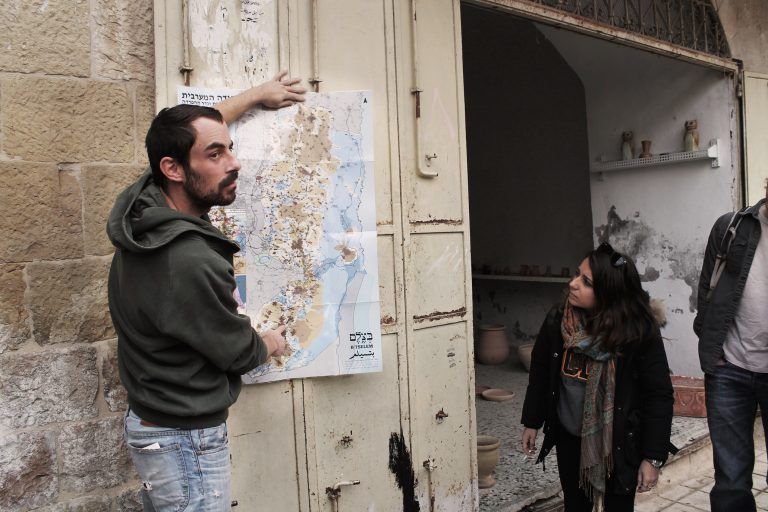
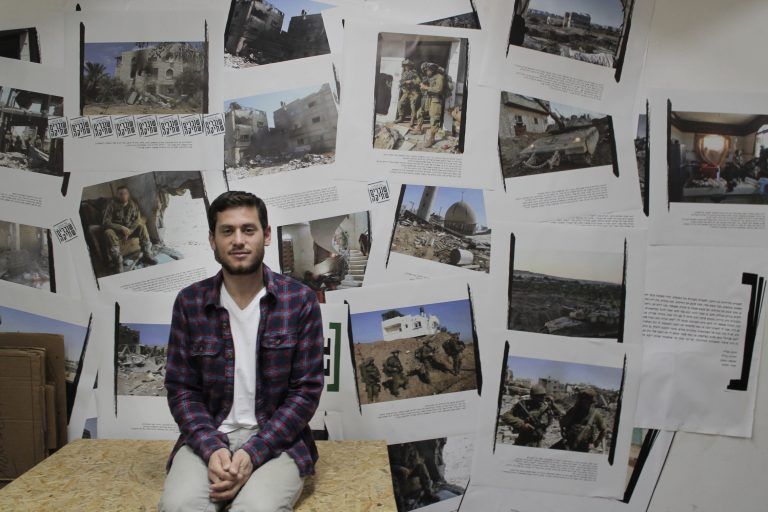
Founded in 2004, Breaking the Silence initially published the testimonies of the soldiers in an art gallery in Tel Aviv. Today, it publishes them in booklets and articles and shares them in lectures and guided tours of cities like Hebron in the West Bank.

Achiya Schatz in front of the testimonies at the Breaking the Silence office in Tel Aviv. (all photos: Cornelia Mikaelsson)
Banned by the Israeli authorities from speaking to soldiers or schoolchildren, Breaking the Silence has been accused of spreading mistruths and of betraying the Israeli military. Threats are an occupational hazard. “To remain silent is no longer an option,” explains Achiya Schatz, 31, who did his national service in the Israeli army from 2005-08. Schatz recalls that many of his missions to search Palestinian residences were pointless – commanding officers would throw away the gathered intelligence without reading it. “After completing my service I got time to think. One question led to another and all of a sudden I asked myself: how can you ever occupy morally?”
Over half of Breaking the Silence’s funding comes from abroad (7 million kroner in 2014 alone) and one of its biggest supporters is Danish – Dan Church Aid, the humanitarian NGO. And this has led to extra suspicion in Israel. Earlier this year, the Israeli government passed a transparency bill forcing NGOs that receive more than half of their funding from foreign sources to declare them openly. Those who voted for the bill claimed that it served a democratic purpose. Critics, however, argued that it only was an attempt to target NGOs critical of Israel’s governmental policies. Israeli PM Benjamin Netanyahu wrote a statement on his Facebook page, claiming that the bill aims to “prevent an absurd situation, in which foreign states meddle in Israel’s internal affairs by funding NGOs, without the Israeli public being aware of it”. [see also: https://humanrightsdefenders.blog/2016/01/05/michael-sfardjan-israels-human-rights-activists-arent-traitors/]

Ido Even-Paz, one of the guides on the Breaking the Silence tour of Hebron
Source: Former Israeli soldiers pick up Danish freedom award in Copenhagen – The Post
Posted in awards, human rights, Human Rights Defenders | Leave a Comment »
Tags: Achiya Schatz, Benjamin Netanyahu, Breaking the Silence, Denmark, funding restrictions, human rights award, Israel, Israeli-occupied territories, PL (Paul Lauritzen) Foundation Peace Prize, PL Foundation Freedom Award, testimony, Yehuda Shaul
February 26, 2017
![Image of Israeli security forces [Issam Rimawi - Anadolu Agency]](https://i2.wp.com/www.middleeastmonitor.com/wp-content/uploads/2016/11/20161122_2_20267166_16259293.jpg?resize=1200%2C800&quality=75&strip=all&ssl=1)
Image of Israeli security forces [Issam Rimawi – Anadolu Agency]
The Israeli occupation authorities have denied a work permit for the director of
Human Rights Watch (HRW) in Israel and Palestinian territories, they said on Friday 24 February 2017. Israel accused the organisation of
“engaging in politics in the service of Palestinian propaganda, while falsely raising the banner of ‘human rights’.” In response, HRW said that this comes as the Israelis seek to limit the space for local and international human rights groups to operate in Israel and the Occupied Palestinian Territories. “
This decision and the spurious rationale should worry anyone concerned about Israel’s commitment to basic democratic values,” commented Deputy Executive Director of Programmes at HRW,
Lain Levine.
“It is disappointing that the Israeli government seems unable or unwilling to distinguish between justified criticisms of its actions and hostile political propaganda.” The next day sixteen NGOs working in Israel issued a statement deploring the decision not to allow
Omar Shakir of Human Rights Watch (HRW). “
We stand in solidarity with him and our colleagues at HRW.” “
Neither closing Israel’s borders to human rights organizations and activists nor other measures by the Israeli government against organizations that criticize the occupation will deter us from continuing to report human rights violations in the territories controlled by Israel. Attempts to silence the messenger will not suppress our message,” concluded the NGOs that include:
Adalah – The Legal Center for Arab Minority Rights in Israel, Akevot, Amnesty International Israel, Bimkom, Breaking the Silence, B’Tselem, Coalition of Women for Peace, Emek Shaveh, Gisha, Hamoked: Center for the Defense of the Individual, Haqel-Jews and Arabs in Defense of Human Rights, Human Rights Defenders Fund, Machsom Watch, Physicians for Human Rights Israel, The Public Committee Against Torture in Israel and Yesh Din.
Human Rights Watch is an independent, international, nongovernmental organisation and monitors rights violations in more than 90 countries across the world.” It also has staff who work legally in its registered offices in some 24 countries around the world, including Lebanon, Jordan and Tunisia. “While the Israeli government is hardly the only one to disagree with our well-researched findings,” concluded Levine, “its efforts to stifle the messenger signal that it has no appetite for serious scrutiny of its human rights record.”
Sources:
Israel denies work permit for Human Rights Watch director – Middle East Monitor
http://english.wafa.ps/page.aspx?id=dJyp7Ba54219464904adJyp7B
Posted in Front Line, HRW, human rights, Human Rights Defenders | 3 Comments »
Tags: Abdallah Abu Rahma, Front Line, HRW, Human Rights Watch, Israel, Lain Levine, Lema Nazeeh, Mohammed Khatib, NGOs, Omar Shakir, Palestinian, work permit
December 21, 2016
The Office of the United Nations High Commissioner for Human Rights released a statement on Friday 16 December 2016 condemning the “daily violations” of human rights and international law faced by human rights defenders in the occupied Palestinian territory. A “worrying number of complaints” have been filed by human rights activists to the UN in recent months, which have highlighted in particular the Israeli government practice of arbitrarily detaining Palestinian activists “as a direct result of their important work in their communities.” The statement, which drew from the investigations of two UN special rapporteurs highlighted the cases of Issa Amro, founder of the Hebron-based group Youth Against Settlements, and Hebron-area lawyer Farid al-Atrash, who were both arrested for participating in a peaceful protest in February. [The march commemorated the 22 years since extremist American-born Israeli settler Baruch Goldstein opened fire on Muslim Palestinian worshipers killing 29 and injuring more than 120 in Hebron’s Ibrahimi mosque in 1994.]
Meanwhile, Israeli authorities handed Amro 18 charges, ranging from “insulting a soldier” to “assault,” and “participation in a rally without a permit,” with some of the charges dating back to 2010. … “This relatively unusual practice of bringing up stale charges, which were not pursued many years ago, strongly suggests that Mr. Amro is being unfairly targeted due to his legitimate and peaceful human rights work,” the UN experts noted in Saturday’s statement. The UN experts said Amro’s current trial was part of a “concerted pattern of harassment and intimidation by the Israeli authorities aimed at inhibiting his work as a human rights defender.” Amro faces up to three years in prison. His attorney, Gabby Lasky, has submitted a motion to have 14 of the 18 charged dismissed on the grounds that those charges are several years old and in some cases the charges were already investigated and closed without indictment. Issa Amro’s arrest has garnered international attention—many see it as one of the most serious examples of Israel’s intent to clamp down on all forms of resistance—violent or non-violent. The hearings promise to be a landmark legal battle over what Israel will permit in terms of peaceful protest and the consequences that face those who engage in it. In 2010 he was named Human Rights Defender of the Year for Palestine by the Office of the United Nations High Commissioner for Human Rights (OHCHR), in 2011 he was a guest of the US State Department as part of their International Visitor Leadership Program. In a 2015 op-ed he wrote for The Guardian, Amro explained how he became involved in activism:“I read books by Martin Luther King, Mahatma Gandhi and Nelson Mandela. I became convinced that their non-violent method was the best strategy for community resistance.” Magdalena Mugrabi, Amnesty International’s Deputy Regional Director for the Middle East and North Africa says “Issa Amro has faced a sustained campaign of harassment and assault at the hands of the Israeli military and settlers because of his activism. His case is emblematic of the climate of increasing hostility towards activists who protest the settlements, which are illegal under international law.” She added, “The deluge of charges against Issa Amro does not stand up to any scrutiny. In their determination to silence him and stifle his human rights work, the Israeli authorities have apparently even reopened a closed case file. If he is convicted we will consider Issa Amro a prisoner of conscience.”

Palestinian journalist, human rights defender and Addameer media coordinator Hasan Safadi
The Special Rapporteurs also recalled the case of Hasan Safadi, media coordinator for Addameer human rights organization, whose three-month administrative detention order was renewed for an additional six months on 8 December. On 13 December Front Line issues an update on the extension of his administrative detention with an additional six months [Hasan Safadi was due to be released on 10 December 2016 from the Negev Desert (Ktziot) prison – where he is currently being held. Hasan Safadi has been in detention since 1 May 2016. – https://www.frontlinedefenders.org/en/profile/hasan-safadi]. On 27 October 2016 Hasan Safadi was sentenced to three months and one day imprisonment for visiting Lebanon, a country that is considered an enemy State under Israeli law. He had been placed in administrative detention on 1 May 2016 upon returning from an Arab youth conference in Tunisia.
The UN statement 0f 16 December went on to mention the case of Salah Khawaja, a member of the Stop the Wall Campaign, who was arrested in October and remains in detention without charges.
Sources:
Amnesty slams Israel’s detention of Palestinian human rights defender – Middle East Monitor
https://electronicintifada.net/blogs/ali-abunimah/israel-threatens-expel-reporter-who-asked-apartheid-question
http://www.huffingtonpost.com/david-palumboliu/israel-puts-celebrated-_b_13590812.html
http://ohchr.org/EN/NewsEvents/Pages/DisplayNews.aspx?NewsID=21041&LangID=E
http://www.ohchr.org/EN/NewsEvents/Pages/DisplayNews.aspx?NewsID=16906&LangID=E
Posted in AI, Front Line, human rights, Human Rights Defenders, OHCHR, UN | 2 Comments »
Tags: Addameer, Farid al-Atrash, Hasan Safadi, Human Rights Defenders, illegal detention, Israel, Israeli-occupied territories, Issa Amro, Michael Sfard, Michael Sfardjan, Palestinian, Salah Khawaja
September 7, 2016
The recent report SHACKLED FREEDOMS : WHAT SPACE FOR CIVIL SOCIETY IN THE EUROMED? depicts the obstacles and repression against civil society in the region and showcases first-hand accounts from Turkey, Egypt, Algeria, Syria, Israel and the Occupied Palestinian Territories among others. The report also features recommendations by CSOs for joint action and seeks to influence EU policies to that effect. The report also focuses on the impact of security and anti-terrorist policies and lists the growing arsenal of repressive measures – both in law and practice – that civil society organizations (CSOs) face on a daily basis: judicial harassment, surveillance, arbitrary arrests, torture and assassination.
Despite legal safeguards and the human rights “shared values” rhetoric in the EU, EuroMed Rights argues that European civil society is under increasing pressure. Austerity measures and anti-terrorism laws are increasingly used to legitimise practices that go against individual freedoms and rights of assembly, association and expression, such as in France, Spain or the UK, for instance. The report – published on 7 September 2016 – is the result of a seminar organised in April 2016 as an open dialogue between EU representatives, South Mediterranean activists and Brussels-based CSOs.
DOWNLOAD THE REPORT
Source: Shackled Freedoms : What Space for Civil Society in the EuroMed? – EuroMed Rights – Euro-Mediterranean Human Rights Network
Posted in books, EMHRN, EU, Human Rights Defenders | Leave a Comment »
Tags: Algeria, anti-terrorist laws, Civil society, Egypt, enabling environment, EU, Euro-Mediterranean Human Rights Network, euroMed Rights, Europe, freedom of association, harassment, Human Rights Defenders, Israel, Israeli-occupied territories, Mediterranean, Morocco, report, Syria, Tunisia, western Sahara
May 14, 2016
reports on 13 May 2016 how Israel refused to give a travel document and could possibly revoke the permanent resident status of Omar Barghouti.
On 10 May 2016, human rights defender Mr Omar Barghouti received confirmation of the official refusal by Israeli authorities to renew his travel document. Moreover he was informed that the refusal to renew the travel document is a first step in the eventual revocation of his permanent resident status. Omar Barghouti is a Palestinian human rights defender and co-founder in 2005 of Boycott, Divestment and Sanctions [https://www.frontlinedefenders.org/en/profile/omar-barghouti]. Omar Barghouti has been living in Acre, Israel with his family since 1994, when he was granted permanent residency. His Israeli travel document allows him to travel back and forth to Palestine to carry out his advocacy work related to the promotion of Palestinian rights. The permit must be renewed every two years, and was renewed regularly without any difficulty.
On 10 May 2016, Omar Barghouti received official confirmation that renewal of his travel document and re-entry permit had been refused by Israeli authorities. In April 2016, he was informed by Israel’s Interior Ministry, who has responsibility for immigration, that his resident status was under review by the Attorney General. Officials have stated that the revocation of his resident permit is related to his work and international travel advocating “for the boycott of Israel”. Without travel document, Omar Barghouti will be unable to freely travel to and from Palestine; should the resident permit also be withdrawn, he will be unable to reside in Israel, where he has been living with his family for 22 years.
Prior to this incident, Omar Barghouti was prevented by Israeli authorities from traveling abroad on several occasions including to two conferences held by BDS in California, on nonviolent and strategic action against human rights violations.
Posted in Front Line, Human Rights Defenders | Leave a Comment »
Tags: BDS, boycott, Divestment and Sanctions, freedom of movement, Front Line (NGO), Human rights defender, Israel, Omar Barghouti, Palestinian, travel ban, USA
February 13, 2016
Israel has used excessive force against Palestinians, Makarim Wibisono, the outgoing UN Special Rapporteur on Human Rights in Gaza and the West Bank said, calling for an investigation. He demanded that all Palestinian prisoners, including children, be charged or released. “The upsurge in violence is a grim reminder of the unsustainable human rights situation in the Occupied Palestinian Territory and the volatile environment it engenders”. Makarim Wibisono has announced he is resigning in protest at the Israeli government’s response to his concerns (his term would have expired on 31 March). The special investigator quoted statistics by the Israeli human rights group B’Tselem, which say that about 5,680 Palestinians, including children, were detained by Israel as of the end of October 2015. Detaining these people “often under secret evidence, and for up to six-month terms that can be renewed indefinitely, is not consistent with international human rights standards,” Wibisono said, adding that the Israeli government “should promptly charge or release all administrative detainees.” Israeli Foreign Ministry spokesman Emmanuel Nahshon branded Wibisono’s report as biased. “The report reflects the one-sidedness of the mandate and its flagrant anti-Israel bias. It is this one-sidedness which has made the rapporteur’s mission impossible to fulfill, hence his resignation,” he said.
Front Line reports that on 3 February 2016, human rights defender Mr Awni Abu Shamsiyya, son of human rights defender Mr Emad Abu Shamsiyya, was arrested alongside youth activist Mr Nizar Silhab Al-tamimi. The arrest took place after a raid on the Shamsiyya family home in Tel-Rumeida, Hebron. Awni Abu Shamsiyya and Nizar Silhab Al-tamimi were accused of throwing a Molotov cocktail at Israeli soldiers and of posting inflammatory statements on Facebook. [Awni Abu Shamsiyya is a 16 year old, known for his participation in the Palestinian non-violent popular resistance movement in Hebron. He is also an active member of the Human Rights Defenders Group, a non-partisan group that aims to document and expose violations of international law and injustice against families in areas of conflict under Israeli occupation. His father, Emad Abu Shamsiyya, is a long-standing activist in Palestine and volunteer at B’Tselem, the Israeli Information Center for Human Rights in the Occupied Territories, where he is involved in documenting the occupation of Tel-Rumeida. He is also a deputy coordinator of the Human Rights Defenders Group.In May 2015, Emad Abu Shamsiyya’s family home was subjected to an attempted arson attack by settlers in the middle of the night. In March 2015, a group of soldiers invaded his family home, searched the house and confiscated the family’s computer hard disk and a memory card containing footage filmed by B’Tselem volunteers.
http://www.btselem.org/hebron/20150402_night_search_and_confiscation]
On 4 February 2016, Awni Abu Shamsiyya and Nizar Silhab Al-tamimi were interrogated by Israeli police and intelligence services before being brought before the military court of Ofer, where the accusations against the young activists of throwing a Molotov cocktail at Israeli soldiers and posting inflammatory statements on social media were presented, and a fine of appr €460 was requested by the military prosecutor. The court ordered Awni Abu Shamsiyya’s release after holding that the accusations against him had not been proven, however, the trial of Nizar Silhab Al-tamimi was postponed to 7 February 2016 after it was claimed by the military prosecutor that his confession had been obtained.
As an illustration of the context in which the violence and arrests occur see the report of Tuesday, 9 February 2016, by the International Solidarity Movement, al-Khalil team (Hebron), which published graphic pictures of Israeli forces patrolling the Palestinian market in occupied al-Khalil (Hebron), harassing and intimidating residents.

Israeli forces on their patrol through the Palestinian market
Any male adult or youth was stopped on their way to work and forced by the Israeli soldiers to lift up their shirts and trouser-pants, as well as throw their IDs on the ground. After throwing their IDs on the ground Israeli soldiers ordered the men to move back, so they could pick up the IDs from a ‘safe distance’. Most Palestinians were dismissed after this humiliating procedure, whereas some of them were detained for minutes or violently body-searched.
Also interesting to note here the protest by Palestinian human rights defenders who are condemning the killing by Hamas of one of the resistance organization’s own members in Gaza. On Sunday, the Qassam Brigades, the military wing of Hamas, announced it had executed Mahmoud Rushdi Ishteiwi. Qassam said that the slaying of Ishteiwi implemented a death sentence issued by “the military and Sharia judiciaries of Qassam Brigades for behavioral and moral excesses that he confessed.”
“Killing Ishteiwi in such a way constitutes an assault on the rule of law and might institutionalize a serious case of extrajudicial execution,” said the Palestinian Centre for Human Rights (PCHR). “Prosecuting collaborators with the Israeli forces is necessary, and the Palestinian armed groups play an important role in such prosecution,” PCHR stated. “However, only official authorities should open investigations and hold the perpetrators to account.” Following news of Mahmoud Ishteiwi’s execution, Buthaina Ishteiwi told the Wattan news outlet that she believed her brother had been killed due to a dispute with his superiors.
[Under the laws of the Palestinian Authority, death sentences issued by courts can only be carried out after ratification by the PA president. The West Bank-based PA leader Mahmoud Abbas has not ratified any death sentences in a decade. Hamas has however continued the use of the death penalty in Gaza. According to PCHR, a total of 172 death sentences have been issued since the PA was established in 1994, of which 30 were in the West Bank and 142 in Gaza. Eighty-four death sentences were issued since Hamas took over in Gaza in 2007. But however serious the threat from informants, Palestinian human rights defenders have been adamant that even wartime collaboration must be dealt with according to the rule of law. Both PCHR and Al Mezan have moreover long advocated the total abolition of the death penalty in all cases. In a short film entitled “Against the Death Penalty” and released in December, PCHR highlights its campaign to end the practice once and for all.]
https://www.rt.com/news/332245-israel-excessive-force-palestine/
Source: Palestinian human rights defenders condemn execution by Hamas | The Electronic Intifada
http://palsolidarity.org/2016/02/intimidating-military-patrol-of-palestinian-market/
Posted in films, Front Line, human rights, Human Rights Defenders, UN | Leave a Comment »
Tags: Against the Death Penalty, al-Khalil, arbitrary execution, Awni Abu Shamsiyya, B’Tselem, death penalty, Emad Abu Shamsiyya, film, Front Line (NGO), harassment, Hebron, Israel, Israeli-occupied territories, Mahmoud Rushdi Ishteiwi, Makarim Wibisono, military, Palestinian Centre for Human Rights, Special Rapporteur, violence
February 8, 2016
In a post last year I referred already to the fears that the NGO Committee of the UN was becoming very NGO-unfriendly [ https://thoolen.wordpress.com/2015/06/07/uns-ngo-committee-seems-not-very-fond-of-ngos/]. Now the ISHR has reported on another case where this UN committee has shown its lack of fair play by refusing let a NGO apply without even wanting to hear the NGO in question. On 1 February 2016 the International Service for Human Rights informed us that the NGO Committee had voted to close the application of the Khmers Kampuchea Krom Foundation (KKF) denying the NGO the opportunity to apply for consultative status. This came on the back of the Committee’s decision on Thursday to deny the NGO the opportunity to even speak in support of its own application. Only 3 Committee members voted against closure of the application – Greece, Israel and the US- with Uruguay abstaining. All other Committee members voted in favour. Vietnam – the State that has consistently objected to the application by the KKF – congratulated the Committee on its decision and its ability – as it described it – to distinguish between ‘genuine’ NGOs and others.
‘The NGO Committee is known for denying NGOs access to the UN through the practice of multiple deferrals of applications. However, the Committee has hit a new low in denying an NGO the opportunity even to apply for access,’ said ISHR’s Eleanor Openshaw. ‘Furthermore, it allowed accusations to be made against the NGO during its own session, without allowing the NGO to respond. The NGO Committee has allowed an NGO to be stigmatised and then silenced. ECOSOC must reverse the decision of its Committee on this case at its next session in April.’
The request by Cuba, Nicaragua and Venezuela to close KKF’s new application was challenged by the US who called the move premature, as the NGO’s application had only been considered once by the Committee. It was agreed the NGO Committee would vote on the application on Friday morning. The members of the Committee then voted on the Chair’s proposal to allow the NGO to speak at the regular Q&A held at the end of each day the NGO Committee sits. Greece, Israel, US and Uruguay voted in favour of allowing the organisation the right to speak. Russia abstained. All other members of the Committee – Azerbaijan, Burundi, China, Cuba, Guinea, India, Iran, Mauritania, Nicaragua, Pakistan, South Africa, Sudan, Turkey, Venezuela – all voted against, except Guinea who was absent.
The US noted that it was essential that the KKF be allowed to speak as this had to date been a one-sided discussion based on Vietnam’s original protest against the NGO. The US noted that ‘a serious allegation of misconduct’ was made against the NGO and the Committee was denying the NGO a chance to respond. They characterised the vote as one between freedom of speech and silencing debate. Committee member Greece rightly noted that ‘one thing is to object to an NGO and another is to silence them’.
‘Not only has the reputation of the organisation been seriously questioned, but a dangerous precedent set where an UN Committee silences an NGO seeking to engage with the UN. This is plainly incompatible with the rights to freedom of expression and association,’ Ms Openshaw said. ISHR’s view in this regard is strongly supported by the UN’s own expert on freedom of association and assembly, Maina Kiai, who in a report in 2014 said that multilateral institutions have a legal obligation to ensure that people ‘can exercise their rights to freedom of peaceful assembly and of association in multilateral arena’. In that same report, the Special Rapporteur was particularly critical of the conduct of States on the UN’s Committee on NGOs, resulting in the systematic exclusion of NGOs working on human rights issues. ‘States sitting on the Committee should champion the right to freedom of association and the right to freedom of peaceful assembly,’ said Mr Kiai in his report.
see also: https://thoolen.wordpress.com/2015/05/04/jean-daniel-vigny-hopes-to-improve-ngo-participation-at-the-un/
Source: UN Committee on NGOs: Don’t deny NGO the right to speak | ISHR
Posted in human rights, Human Rights Defenders, ISHR, UN | 1 Comment »
Tags: accredited NGOs, ECOSOC, freedom of expression, Greece, ISHR, Israel, Khmers Kampuchea Krom Foundation (KKF), Maina Kiai, New York, NGO Committee, UN, USA, Vietnam
January 13, 2016
Further to my post about the pressure under which human rights defenders in Israel have to work [https://thoolen.wordpress.com/2016/01/05/michael-sfardjan-israels-human…] this post by Chelsey Berlin (B’Tselem USA) “The blaze at B’Tselem’s Jerusalem office was an accident, but many of us assumed it was arson” is telling:
In “Why Did We Assume B’Tselem Fire Was Arson?” she explains the context: …..”For months, the message that human rights defenders are the problem in Israel has been repeatedly delivered with sledgehammer strength: In Tirtzu’s video labeling four human rights activists, including B’Tselem Executive Director Hagai El-Ad, “moles”; the government’s ongoing legislative crusade against organizations receiving foreign government funding, and last Thursday’s sensationalized report on an Israeli TV news program that aired false accusations against a B’Tselem field researcher. All this is done to hide the dire situation they expose, the real evil, which is the occupation, the human rights violations it produces in the occupied Palestinian territories and the fascism increasingly required of Israel to maintain it.“….
(When news broke on 10 January 2015 of a fire at B’Tselem’s Jerusalem office most feared the worst: arson. Since then, the smoke has cleared — literally — and a preliminary investigation has been concluded. The Jerusalem fire brigade has announced that the cause of the fire was likely an electrical fault.)
Source: Why Did We Assume B’Tselem Fire Was Arson? – Opinion – Forward.com
Posted in human rights | 1 Comment »
Tags: arson, B’Tselem, B’Tselem USA, blog, Chelsey Berlin, Human Rights Defenders, Israel, Jerusalem, Tirtzu’s video
January 8, 2016
On 7 January 2016 it was announced that Israeli journalist Gideon Levy and Palestinian pastor Mitri Raheb have won the 2015 Olof Palme human rights prize. Levy, a journalist at the left-leaning Israeli daily Haaretz, and Raheb, a preacher and pastor in the Lutheran church in Bethlehem, were honoured for their “courageous and indefatigable fight against occupation and violence, and for a future Middle East characterised by peaceful coexistence and equality for all,” the Olof Palme Memorial Fund said in a statement. Read the rest of this entry »
Posted in awards, human rights, Human Rights Defenders | Leave a Comment »
Tags: cleric, conflict and peace, digest of human rights awards, Gideon Levy, Haaretz, human rights award, Israel, Jordan, Journalist, Lutheran, Mitri Raheb, Olof Palme Prize, Palestine, Sweden, THF
January 5, 2016
Posted in films, human rights, Human Rights Defenders | 3 Comments »
Tags: Ayelet Shaked, Breaking the Silence, Foreign agent, foreign funding, Human Rights Defenders, human rights lawyer, Israel, Michael Sfardjan, New York Times, Palestinian people, restrictive laws, smear campaign, stigmatization, video, Yesh Din