On 3 June 2024, ISHR published Human rights defender’s story: Elham Kohistani, from Afghanistan
Elham Kohistani is a human rights defender from Afghanistan. Having witnessed successive governments trample human rights in her country since her childhood, she has dedicated her life to fighting for the basic rights of women and girls.
In an interview with ISHR, Elham spoke about her hopes for the future of Afghanistan, urging the international community to continue supporting human rights defenders in the long term to achieve peace and prosperity.
Stand in solidarity with Elham and other women human rights defenders (WHRDs) from Afghanistan: join us in our campaign to push for UN experts and States to explicitly and publicly recognise the situation in Afghanistan as a form of gender apartheid and the need for an accountability mechanism to address gross human rights violations against women.
Sara Nabil is a human rights defender and artist from Afghanistan, forced into exile. She spoke to ISHR about her dream of one day seeing a ‘free democratic Afghanistan, where each human being [regardless of which] gender they are, man or woman, neutral or other genders, [would be] treated equally.’
‘Since the Taliban came to power, Afghanistan [has become] the only country where we see that women don’t have any kind of rights.’
Human rights defenders and civil society are the voices of our communities. These voices must be at the heart of decision and policy making at all levels. Yet, some States and non-states actors feel those voices are too loud. Cao Shunli, Chinese human rights defender, victim of reprisals who died in detention 10 years ago. Around the world, inspiring voices echo Cao’s ambition, on different issues and in different contexts, but with the same aspiration: promoting and protecting human rights. In so doing, many have engaged with the United Nations to share evidence of abuses with experts and States. Regrettably, some are facing the same form of reprisals as Cao, and are now arbitrarily detained.
These include Trang in Viet Nam, Irfan and Khurram in India and Abdulhadi in Bahrain.
It’s time to take a stand. Join us in our campaign to #EndReprisals and call for the release of Trang, Abdulhadi, Khurram and Irfan. Let’s ensure that no one else faces Cao’s fate. Their voices deserve to be heard, and their freedom and lives must be protected.
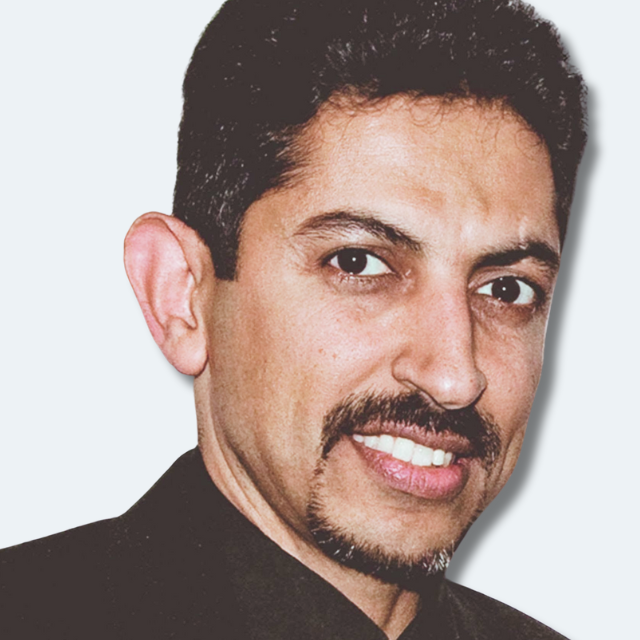
Abdulhadi Al-Khawaja
Abdulhadi Al-Khawaja is a Bahraini-Danish advocate known for his unwavering commitment to freedom and democracy. An outspoken human rights defender he serves as a source of inspiration for activists in Bahrain and globally. Abdulhadi has protested Bahrain’s unlawful detention and torture of several civilians since he was a student. He received political asylum in Denmark with his family where he continued his advocacy work, documenting human rights violations in Bahrain.
Abdulhadi Al-Khawaja was included for five times in the Secretary-General report on reprisals, noting “allegations of arbitrary arrest, torture and lengthy sentence following his engagement with United Nations human rights mechanisms.” In 2012, the Working Group on Arbitrary Detention found the detention of Abdulhadi arbitrary.
Pham Doan Trang is an author, blogger, journalist and pro-democracy activist from Viet Nam. She is a well-known advocate for human rights and has written on a wide range of human rights topics, including LGBTQI+ rights, women’s rights, environmental issues and on the suppression of activists.
She is considered among the most influential and respected human rights defenders in Viet Nam today. She has always been a major source of inspiration and mentorship for Vietnamese civil society and the next generation of human rights defenders.
Trang was prosecuted for her articles and reports on the human rights situation in Viet Nam, including an analysis of a 2016 report on the Formosa Ha Tinh Steel Plant environmental disaster that was shared with the United Nations. See also: https://humanrightsdefenders.blog/tag/pham-doan-trang/
Trang was the subject of several communications by special procedures mandate holders and an Opinion by the Working Group on Arbitrary Detention in 2021, which found her deprivation of liberty arbitrary. On 2 November 2022, experts addressed Trang’s detention, including restriction of her right to family visits and her deteriorating health status.
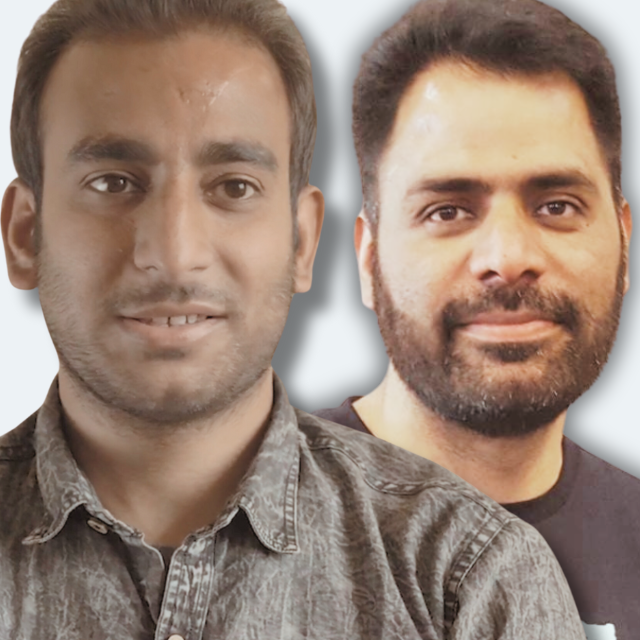
Irfan Mehraj and Khurram Parvez
Khurram Parvez and Irfan Mehraj are two Kashmiri human rights defenders. They have conducted ground-breaking and extensive human rights documentation in the Indian-administered Jammu and Kashmir, including through their work within the Jammu Kashmir Coalition of Civil Society (JKCCS) – Khurram as founder and programme coordinator, and Irfan as a researcher.
On 22 November 2021, Khurram was arrested again by the Indian Government, this time by India’s National Investigation Agency (NIA) under the Unlawful Activities (Prevention) Act (UAPA) and other laws, reportedly on allegations of “terrorism funding, being a member of a terrorist organisation, criminal conspiracy, and waging war against the state.” He remains in arbitrary detention to this day.
Meanwhile, on 20 March 2023, Irfan was summoned for questioning and arbitrarily detained by the NIA in Srinagar also under provisions of the UAPA and other laws. The NIA targeted Irfan for being ‘a close associate of Khurram Parvez.’ Both Khurram and Irfan are presently in pre-trial detention in the maximum-security Rohini prison in New Delhi, India. If convicted, Khurram and Irfan could face life imprisonment or even the death penalty.
Khurram’s situation has been included in the Secretary-General’s report on reprisals since 2017 and Irfan’s case was included in the 2023 report.
In June 2023, United Nations experts expressed serious concerns regarding the charges against and arrest of Irfan and Khurram, stating that their continued detention is ‘designed to delegitimise their human rights work and obstruct monitoring of the human rights situation in Indian-administered Jammu and Kashmir.’ The United Nation Working Group on Arbitrary Detention (WGAD) published an opinion in the same year, finding Khurram’s detention arbitrary.
What do we want? It’s simple. We want Irfan, Khurram, Trang and Abduhadi to be freed so they can continue their work without fear of further reprisals, and we want accountability for Cao.
How do we achieve this?
We mobilise diplomatic missions, encouraging them to speak out and raise individual cases of reprisals against defenders at the UN and in other spaces and hold their peers to account. We convince the UN Secretary General and his team to acknowledge and document ALL cases of reprisal and intimidation by including them in his annual report on reprisals and intimidation against defenders engaging or seeking to engage with the UN and its human rights mechanisms. We push the UN system to establish clearer protocols on how to consistently and effectively prevent, respond and follow up on cases of reprisals. We encourage governments, activists, and concerned individuals to stand in solidarity with human rights defenders and organisations who are subjected to reprisals and intimidations.
What can you do?
To achieve our goals, we are drawing attention to some of the most emblematic cases of reprisals that illustrate how human rights defenders are prevented from or punished for engaging with the UN. Here are impactful actions you can take:
In order to assist stakeholders with research, analysis and action on cases of reprisals and intimidation, ISHR launched an online database compiling cases or situations of intimidation and reprisals documented by the United Nations (UN) Secretary-General between 2010 and 2020.
878 Cases of intimidation and reprisals against human rights defenders engaging with the UN reported by the UN Secretary General between 2010 and 2020.
81 Countries were cases of reprisals were documented by the UN Secretary-General between 2010 and 2020.
13 Reports published by the UN Secretary General on intimidation and reprisals.
‘My passion is the defence of the right to land and territory,’ says Lourdes Gómez, a land rights defender and professor working on issues affecting Indigenous women defenders and the impacts of palm oil production.
The ISHR had the chance to meet Lourdes Gómez during her Geneva visit to attend the Human Rights Council’s 55th session. Lourdes, a land right defender and professor working on issues of Indigenous women defenders and the impacts of oil palm production, delivered a powerful statement during the session. She was also one of the speakers at a side event about the human rights situation in Guatemala.
Lourdes recently participated into the ‘artivism’ project by journalist and photographer Teresa Ordás, ‘Paisojos de mujeres defensoras de derechos humanos de Guatemala‘ (‘Landscapes of women human rights defenders from Guatemala’). The project is a collection of beautiful photographs of the real reflections of the subjects’ eyes, where Teresa Ordás highlights ‘the world in people’s eyes.’ [Website: https://www.paisojos.com]
Here is how Lourdes introduces herself in the frame of ‘Paisojos’:
‘I am a Q’eqchi’ Mayan woman of African descent. I inherited my path of defending human rights from my mother Lucia Willis Paau, who since my childhood had joined the movement to defend the rights of Mayan women in the north of Guatemala. My passion is the defense of the right to land and territory. I have dedicated myself to denouncing the violence that the State of Guatemala exerts at the community level on Indigenous, rural and peasant women while they fight for access, use, control and protection of their land. These communities face racism, discrimination and machismo. I have dedicated myself to the defense of land rights, contributing through historical registry and communal research, to the restitution of land rights’.
NGOs and activists paid tribute to the late Chinese human rights defender Cao Shunli by holding a moment of silence and applauding her name during their speaking time at the Human Rights Council.
Delivering a joint statement before the Council plenary on behalf of ISHR and 16 organisations accredited to the UN as well as 20 NGOs without consultative status, a human rights defender from the Chinese mainland concluded her intervention with a short silence and a call to States and NGOs to mirror the courage of human rights defenders and always stand in solidarity with them.
After the intervention, in a sign of respect to Cao Shunli, the room was filled with applause from NGOs and a handful of governments in honour of Cao and in solidarity with victims of reprisals for cooperation with the UN.
‘It is unacceptable to normalise reprisals,’ the human rights defender from the Chinese mainland said. ‘Cao’s courage inspires defenders globally, so let her legacy and name resonate in this room until there is accountability for all victims of reprisals,’ she emphasised.
In an attempt to silence the activist, the Chinese delegation raised a point of order protesting against the statement. This mirrored their 2014 response to ISHR and other NGO’s attempt to hold a moment of silence at the Council after Cao’s death, during which Chinese diplomats disrupted the session for over an hour. This time, Cuba, Venezuela, the Democratic People’s Republic of Korea and Russia supported China in their attempt to silence activists’ right to speak at the United Nations.
In response to China’s attacks, Belgium on behalf of the 27 states of the European Union, supported by the United States of America, Canada and the United Kingdom, took the floor to defend NGOs’ right to speak freely.
‘We cannot allow Cao’s story and her work to be forgotten,’ said Raphaël Viana David, China Programme Manager for ISHR. ‘Ten years on, no one has been held to account for this emblematic case of tragic State reprisals. UN experts called for an inquiry in 2014, 2019 and once again last week. Governments cannot let Beijing off the hook: they must push for accountability for Cao’s fate and for that of all activists who have been persecuted for cooperating with the UN in standing up for human rights.’
ISHR and its civil society partners urge the international community to hold the individuals and institutions responsible for Cao’s death to account and to end all acts of reprisals and repressive measures seeking to restrict civil society space and prevent activists from engaging with the UN.
On 22 February 2024, Human Rights Watch came with a study on governments reaching outside their borders to silence or deter dissent by committing human rights abuses against their own nationals or former nationals. Governments have targeted human rights defenders, journalists, civil society activists, and political opponents, among others, deemed to be a security threat. Many are asylum seekers or recognized refugees in their place of exile. These governmental actions beyond borders leave individuals unable to find genuine safety for themselves and their families. This is transnational repression.
Transnational repression looks different depending on the context. Recent cases include a Rwandan refugee who was killed in Uganda following threats from the Rwandan government; a Cambodian refugee in Thailand only to be extradited to Cambodia and summarily detained; and a Belarusian activist who was abducted while aboard a commercial airline flight. Transnational repression may mean that a person’s family members who remain at home become targets of collective punishment, such as the Tajik activist whose family in Tajikistan, including his 10-year-old daughter, was detained, interrogated, and threatened.
Transnational repression is not new, but it is a phenomenon that has often been downplayed or ignored and warrants a call to action from a global, rights-centered perspective. Human Rights Watch’s general reporting includes over 100 cases of transnational repression. This report includes more than 75 of these cases from the past 15 years, committed by over two dozen governments across four regions. While the term “transnational repression” has at times become shorthand for naming authoritarian governments as perpetrators of rights violations, democratic administrations have assisted in cases of transnational repression.
Methods of transnational repression include killings, unlawful removals (expulsions, extraditions, and deportations), abductions and enforced disappearances, targeting of relatives, abuse of consular services, and so-called digital transnational repression, which includes the use of technology to surveil or harass people. These tactics often facilitate further human rights violations, such as torture and ill-treatment.
This report also highlights cases of governments misusing the International Criminal Police Organization (Interpol)—an intergovernmental organization with 195 member countries—to target critics abroad.
Victims of transnational repression have included government critics, actual or perceived dissidents, human rights defenders, civil society activists, journalists, and opposition party members and others. Governments have targeted individuals because of their identity, such as ethnicity, religion, or gender. Back home, families and friends of targeted people may also become victims, as governments detain, harass, or harm them as retribution or collective punishment. Transnational repression can have far-reaching consequences, including a chilling effect on the rights to freedom of expression, association, and assembly among those who have been targeted or fear they could be next.
This report is not an exhaustive examination of cases of transnational repression. Instead, it outlines cases that Human Rights Watch has documented in the course of researching global human rights issues that point to key methods and trends of transnational repression.
Human Rights Watch hopes that by drawing attention to cases of transnational repression, international organizations and concerned governments will pursue actions to provide greater safety and security for those at risk. Governments responsible for transnational repression should be on notice that their efforts to silence critics, threaten human rights defenders, and target people based on their identity are no less problematic abroad than they are at home. This report provides governments seeking to tackle transnational repression with concrete recommendations, while raising caution against laws and policies that could restrict other human rights.
Human Rights Watch calls on governments committing transnational repression to respect international human rights standards both within and beyond their territory. Governments combatting transnational repression should recognize such abuses as a threat to human rights generally and act to protect those at risk within their jurisdiction or control.
“Effectively realising human rights for everyone, everywhere is the pathway to free, fair and just communities and a more peaceful and sustainable world“, write ISHR Director Phil Lynch and Board Chair Vrinda Grover on 8 March 2024. Here some excerpts from a piece worth reading:
We face a global climate emergency. We witness atrocity crimes being perpetrated with apparent impunity, from Afghanistan to Sudan, Palestine to Ukraine, and Nicaragua to Xinjiang. We confront rising populism and propaganda, with artificial intelligence misused to fuel disinformation and discrimination, and democracy facing a ‘make-or-break year’ in 2024, with over 70 national elections. Each of these crises and conflicts are complex, yet they are also interconnected in four fundamental ways.
First, repression and rights violations are among the root causes of all these crises and conflicts…
Second, respect for human rights, and accountability for violations, is essential to address and resolve these crises and conflicts. ..
Third, very few States, if any, have been prepared to treat human rights as paramount and apply human rights standards in a principled, consistent way to each crisis and conflict. ..The selective and inconsistent application of international human rights law undermines the integrity of the framework, as well as the credibility, legitimacy and influence of States and other actors who engage in such double standards.
Fourth and finally, the work of human rights defenders at the national level, as well as their engagement and advocacy at the international level, is essential to address and resolve each of these conflicts and crises. Defenders prevent rights violations, document abuses, promote accountability, and propose solutions that are grounded in community priorities and needs. Indigenous rights defenders carry the knowledge that is necessary to live sustainably and to respect and protect the environment. Digital rights activists are pushing for rights-based regulation of artificial intelligence to ensure that humanity benefits from its innovations and efficiencies. Whistleblowers are exposing government wrongdoing and corporate misfeasance, working to safeguard democracy, while corporate accountability activists are campaigning for an international treaty on business and human rights. Women human rights defenders from Afghanistan are leading the campaign to hold the Taliban accountable for the crime of gender apartheid, while also ensuring that humanitarian aid reaches the most vulnerable populations. In Sudan, women defenders are leading peace movements and protests at the local level, as well as international advocacy, which was instrumental in the establishment of a UN investigative mechanism, further adding to the pressure on the Sudanese Armed Forces and the Rapid Support Forces to end the war. Despite the challenges, complexities and uncertainties we collectively face, we remain convinced that, with international human rights laws and standards providing a compass, human rights defenders can chart a course to a more peaceful, just and inclusive world….
Despite the challenging times, exacerbated by declining funding for international human rights advocacy and organisations by some States and foundations, ISHR continues to pursue a positive and forward-looking agenda.
We’re pleased that in 2023 the Democratic Republic of Congo enacted a specific national law on the protection of defenders, the culmination of years of work by ISHR and national partners. With this development, the DRC joins the ranks of countries like Côte d’Ivoire, Niger, Burkina Faso, Mali, and Mongolia amongst the countries where we have worked alongside national partners to strengthen legal frameworks for defenders and establish specific defender protection laws and will continue to work to ensure effective implementation.
In the area of women’s rights, we are working with defenders from Afghanistan and Iran, together with international legal experts, to push for the explicit recognition and codification of the atrocity crime of gender apartheid. This would fill an international protection gap for women and girls, as well as impose responsibilities on third States and non-State actors to take concrete steps to prevent and end gender apartheid.
With 2023 marking the 25th anniversary of the Declaration on Human Rights Defenders, we are coordinating a broad coalition to develop an authoritative baseline document of international and regional jurisprudence in relation to the protection of defenders, which will be launched in 2024.
And throughout 2024 we’ll continue allying with Black-led organisations to promote racial justice, with feminist and LGBTIQ+ organisations to resist anti-rights narratives and movements, with corporate accountability activists to strengthen laws on business and human rights, and with Global South defenders to ensure that key multilateral fora are relevant, accessible and responsive to them.
Reflecting on our collective wins over 2023, we identified one golden thread: human rights defenders working in dynamic coalitions, movements and networks to strategically leverage international law and mechanisms to contribute to positive change. With 2023 marking both the 75th anniversary of the Universal Declaration of Human Rights and the 25th anniversary of the Declaration on Human Rights Defenders, and 2024 marking ISHR’s own 40th anniversary, it is apt to recall that the work of defenders and the integrity of the international framework are essential to the realisation of human rights on the ground.
The promise of the Universal Declaration will only be fulfilled when we work in coalition to ensure that defenders are protected and that standards are consistently respected and applied.
Tala Odeh, a young human rights defender from Jordan, serves as a regional coordinator for the NAMA Network, immersing herself in the MENA region’s socio-political complexities. Her efforts to advocate for individual rights and address systemic issues highlight the critical need for resilience and adaptability.
According to the Business and Human Rights Resource Center (BHRRC), since January 2015, there have been nearly 5,000 attacks on human rights defenders working on business and human rights issues. Defenders and UN experts have long worked to hold businesses accountable for meeting their responsibilities to defend civic freedoms and protect human rights defenders. Part of this work has included articulating what these responsibilities are and practical steps to meet them.
Inspired by and building from the United Nations Guiding Principles on Business and Human Rights, the BHRRC and ISHR 2018 report, ‘Shared Space Under Pressure: Business Support for Civic Freedoms and Human Rights Defenders, Guidance for Companies,’ lays out the normative framework that clarifies the corporate responsibility to act and to do no harm against HRDs. The UN Working Group on Business and Human Rights reaffirmed this in their 2021 Guidance on ensuring respect for human rights defenders. This guidance develops the implications of the Guiding Principles for engaging with and safeguarding the rights of human rights defenders– providing both States and businesses with a set of recommendations to follow.
Over the last few years, there has been an increasing articulation of the responsibility of businesses to respect and promote civic freedoms and the rights of Human Rights Defenders. Some recent examples of these efforts include the 2023 Unilever human rights policy and implementation guide and the BHRRC Human Rights Defender Policy Tracker.
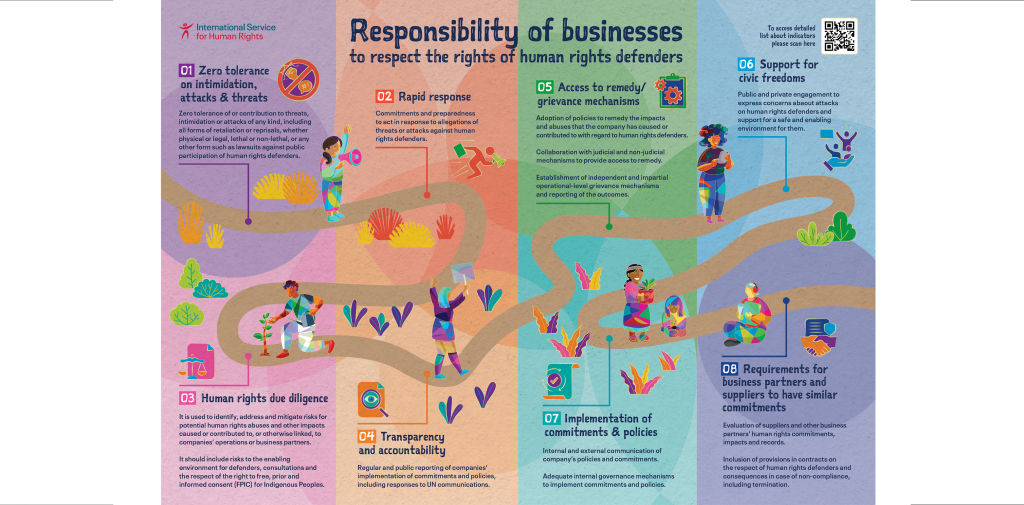
In this same spirit, ISHR is launching a set of Indicators on Business and Human Rights that cover the following areas:
Zero tolerance on intimidation, attacks and threats against HRDs
Human rights due diligence
Transparency and accountability
Access to remedy/grievance mechanisms
Support for civic freedoms
Requirements for business partners and suppliers to have similar commitments
The indicators come in list and poster form. ISHR has also produced a ‘snapshot’ of the UN Working Group’s Guidance on ensuring respect for human rights defenders, in the form of an explainer, available in multiple languages.
We created a wonderful “Responsibility of businesses” roadmap poster for you. It shows the important steps to take on the journey to a responsible business, respecting the rights of human rights defenders amongst all people. You can download it in poster size print quality in the download section and print it yourself to go on your office wall, to remind everyone about the little steps and big responsibility to take everyday.
On 7 March 2024, the ISHR report that the Inter-American Court of Human Rights examined the Escazú Agreement’s role in safeguarding environmental defenders, a landmark move for climate justice and human rights
The Advisory Opinion, which has already garnered a record number of interventions – over 250, a record in the history of the court – will mark a rare instance in which the Court will analyse a treaty that is not part of the Inter-American System, but of the Economic Commission for Latin America and the Caribbean: the ‘Regional Agreement on Access to Information, Public Participation and Justice in Environmental Matters in Latin America and the Caribbean’, also known as the ‘Escazú Agreement‘. For more on this, see: https://humanrightsdefenders.blog/tag/escazu-agreement/
In order to support the protection of environmental defenders, ISHR filed an intervention on environmental defenders, in collaboration with CIEL, FARN, and other international, regional and national organisations and human rights experts.
The obligation to effectively protect EHRDs
The Inter-American Court of Human Rights has already recognised that States are obliged to protecthuman rights defenders, arising from the general obligations to protect the rights to life and integrity of the person, among others. However, the Court has yet to expressly establish whether protecting environmental defenders is an obligation that also derives from environmental commitments made by States, as these stakeholders are an indispensable partner in the fight against climate change.
This is an opportunity for the Court to recognise that, in order to guarantee the right to a clean, healthy and sustainable environment, States must protect environmental defenders, as violating their rights also violates the rights they are defending.
The Court is also called to elaborate upon the specific protection needs of Indigenous, women and youth defenders. These groups face particular forms of attacks which must be addressed with cultural and gender perspectives, taking into account not only the particularities of the attacks they suffer, but also of their needs and desires.
In the case of Indigenous groups, the existing jurisprudence of the Court on recognising collective rights, along with the language used in article 9 of the Escazú Agreement – which establishes that ‘persons, groups and organisations’ can defend human rights – provides an opportunity to firmly establish the existence of a collective right to defend human rights, as well as the State’s obligation to set up and adapt their protection measures and mechanisms to ensure that collective protection is available when needed.
Environmental defenders and ‘access rights’
While the express mention of environmental defenders in the Escazú Agreement is extremely important, it is not its main focus. The treaty contains several obligations for States to guarantee access to information, to decision-making spaces and to justice in environmental matters.
These ‘access rights’ are applicable to all persons, but the Inter-American Court must reaffirm and elaborate upon its own jurisprudence related to their applicability for environmental defenders, which states that: ‘defenders cannot properly defend environmental rights if they cannot exercise their own rights of access to information, freedom of expression, assembly and peaceful association, guarantees of non-discrimination and participation in decision-making‘.
This is also an opportunity for the Court to clearly assert that private actors are also under the obligation to respect these rights, which includes conducting meaningful consultations and ensuring the free, prior and informed consent of communities affected by their projects.
The extent of the Advisory Opinion
Latin America is the region with the most and the oldest laws and protection mechanisms regarding human rights defenders, so it was only logical that it would be the first region to adopt the first treaty that expressly protects them.
The Inter-American Court has also been a pioneer in this regard. It was the first regional human rights court to deal with human rights defenders’ cases and order structural reforms to better protect them.
These successes must be celebrated, but there is still work to be done. The coming years will see an increase in three areas, all linked with one another: climate crisis, the amount of environmental defenders, and the risks faced by defenders.
The Court must seize this opportunity and set an example for countries in the region and beyond on how to properly defend the rights of those that defend our rights.



 Hans Thoolen on Human Rights Defenders and their awards