Posts Tagged ‘ISHR Academy’

Apply for ISHR’s 2026 training for defenders

January 7, 2026

Are you a human rights defender working on democratic backsliding and/or racial justice, keen to use the UN to push for change at home? If so, apply for the 2026 edition of ISHR’s flagship training, the Human Rights Defender Advocacy Programme (HRDAP)!

After a successful edition in 2025, ISHR is pleased to launch the new call for applications for the 2026 Human Rights Defender Advocacy Programme (HRDAP26), which will take place both remotely and in Geneva and will be focused on thematic and context area! Below are some important dates to consider before applying:

  • Mandatory distance learning course: 13 April – 8 June 2026 (part time)
  • In-person course in Geneva: 10- 20 June 2026 (full time)
  • Deadline to apply: 15 January 2026, midnight CET (Geneva Time)
  • Programme description with all related information can be downloaded here.
  • Application form can be found here.

What’s new for HRDAP 2026?

For the last 10 years, this flagship training has equipped human rights defenders with the knowledge and skills to integrate the UN human rights system into their existing work at the national level in a strategic manner. 

Following an external review of the programme in 2024, as well as to maximise impact and enhance follow-up, for 2026 the HRDAP selection criteria are evolving: they are based on 2 themes focused on context area and thematic advocacy, according to ISHR’ strategic priorities and opportunities at the UN: democratic backsliding and racial justice. The HRDAP themes will change annually (see the criteria below and the programme description for more details).[see: https://humanrightsdefenders.blog/2024/11/27/ishrs-training-for-human-rights-defenders-2025/]

12 participants will be selected for the 2026 edition of HRDAP.

What are HRDAP objectives?

By participating in the programme, defenders will:

  1. gain knowledge and tools, which they can use to ensure their voice is central in international human rights decision-making
  2. explore and compare the benefits of engagement with the Human Rights Council, the Special Procedures, the OHCHR, the Universal Periodic Review and the Treaty Bodies, and examine how they can use them to bolster their work at the national level
  3. develop networks, strategies and advocacy techniques to increase the potential of their national and regional advocacy work.

How is HRDAP organised?
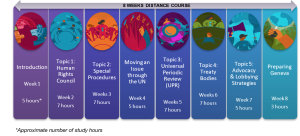
HRDAP topics

Defenders will complete a 10-week hybrid learning programme through a participatory approach, which will include:

  • accessing the HRDAP Platform, where they can complete e-learning courses on each key UN human rights mechanism and on advocacy strategies, and access interactive learning materials and case studies on the ISHR Academy
  • taking part in live Q&A sessions with human rights experts
  • receiving continuous advocacy support and personalised coaching in order to develop concrete advocacy objectives to make strategic use of the international human rights system
  • building networks around the world, and learning from peers from a range of regions working on a range of human rights issues
  • applying their knowledge to case-studies scenarios and enhancing their advocacy toolbox according to their specific needs
  • receiving support and advocacy accompaniment to conduct activities during the 62nd and 63rd Human Rights Council sessions and other relevant opportunities.

Participants will have the unique opportunity to apply their knowledge and skills while being in Geneva as well as to meet and share with their peers and experts. The blended format of the course allows defenders to continue their vital work on the ground, while diving into the inner workings of each key UN human rights mechanism and gaining first-hand experience from advocates and UN staff on how civil society can strategically engage in the international human rights space.  

What are the criteria and themes for selection?

This programme is directed at experienced human rights defenders working in non-governmental organisations, with existing advocacy experience at the national level and some prior knowledge of the international human rights system. In 2026, we will select human rights defenders working on democratic backsliding and racial justice.

Defenders working in contexts of democratic backsliding 

This theme is for human rights defenders working in democratic countries where authoritarian practices are gaining ground

We particularly welcome applications from defenders who are: 

  • pushing back against repressive laws, attacks on free expression, or restrictions on the freedom of peaceful assembly and association 
  • documenting abuses linked to police and military violence, arbitrary arrests, surveillance, or harassment 
  • fighting for justice, transparency, and the rule of law, and refusing to let democratic institutions be dismantled without accountability. 

Defenders working on racial justice 

This thematic is for defenders working to dismantle systemic racism and build societies rooted in equality and dignity. We will select applications from defenders focusing on anti-racism, exclusion and police violence, including anti-Black racism as experienced through legacies of colonialism and the Transatlantic Trade in Enslaved Africans, Indigenous (including Afro-Indigenous) communities working on historical injustice and reparations, as well as defenders of migrants and asylum seekers. We also welcome applications from mothers working for accountability for their children, victims of police violence. 

Please read the programme description for more information on the criteria.

https://ishr.ch/latest-updates/hrdap-2026-apply-for-ishrs-training-for-defenders-working-on-democratic-backsliding-and-racial-justice

https://ishr.ch/latest-updates/hrdap-2026-apply-for-ishrs-training-for-defenders-working-on-democratic-backsliding-and-racial-justice

New wave of repression against human rights lawyers unleashed in China

July 12, 2023

In a joint statement published today, over 60 human rights organisations {such as the ISHR}, bar associations, scholars and Chinese human rights activists in exile urge global attention to the Chinese government’s new wave of repression against human rights lawyers unfolding over the past three months.

Human rights lawyers are a cornerstone of China’s human rights movement. From Uyghurs, Tibetans and Hong Kongers, to religious minorities, LGBTQI and feminist advocates, journalists, and political dissidents: human rights lawyers defend the full spectrum of civil society. They accompany and empower the most vulnerable against land evictions, discrimination, health scandals, or extra-legal detention. They embody the promise of rule of law and hold the government accountable to its commitments under China’s constitution, laws, and the international human rights treaties it has ratified. They ensure that no one is left behind.

As a result of this work, for many years and particularly since the round-up of over 300 human rights lawyers and legal assistants in the days following July 9, 2015 – an episode known as the 709 crackdown -, this profession has been ‘effectively criminalised in China,’ according to UN experts.

This year alone, Chinese authorities have passed harsh sentences on national security grounds of ‘subversion of State power’ against three lawyers who had attended a private gathering: Xu Zhiyong (14 years), Ding Jiaxi (12 years) and Chang Weiping (3.5 years). [see: https://humanrightsdefenders.blog/2023/04/11/xu-zhiyong-and-ding-jiaxi-two-human-rights-defenders-in-china-sentenced/]Xu’s partner, feminist activist Li Qiaochu was also recently put on trial behind closed doors, being denied both a lawyer and access to healthcare.[see also: https://www.netherlandsandyou.nl/latest-news/news/2022/12/09/index]

Previously, lawyer Yu Wensheng – recipient of the 2021 Martin Ennals Award for Human Rights Defenders – and his wife Xu Yan had also been arrested on their way to the Delegation of the European Union in Beijing, over a year after Yu’s release. See: https://www.trueheroesfilms.org/thedigest/laureates/69fc7057-b583-40c3-b6fa-b8603531248e

China’s abuse of national security to target lawyers has been growingly mimicked in Hong Kong, where Chow Hang-tung and Albert Ho are awaiting trial under the territory’s overbroad National Security Law.

Beyond arrests, authorities are also increasingly using travel bans and enforced disappearances – including through a criminal procedure known as ‘Residential Surveillance at a Designated Location’ (RSDL) – to intimidate and silence human rights lawyers. Lawyer Li Heping and his family were intercepted at Chengdu airport in June this year, while lawyer Tang Jitian was detained for 398 days for attempting to attend a Human Rights Day celebration in December 2021. For RSDL, see: https://humanrightsdefenders.blog/tag/residential-surveillance-at-a-designated-location-rsdl/

Released lawyers increasingly face disbarment, while their relatives, including underage children, are subjected to unrelenting harassment from the authorities. In recent months, Beijing-based lawyer Wang Quanzhang and his family have been forced to move 13 times, reporting constant threats and repeated cuts to their gas and electricity supply.

Human rights lawyers are one of the last avenues left to Chinese citizens seeking justice for the trampling of their most basic rights. Without sustained global pressure, the government will ramp up its campaign to imprison, disbar or silence these critical advocates for a more equal, just and rights-respecting China.

Raphael Viana David, ISHR’s China Programme Manager

Detained human rights lawyers are constantly subject to physical and psychological torture and ill-treatment in pre-trial detention and prison. They are routinely denied contact with their relatives and access to medical care, despite critical health issues. The government impedes family-appointed lawyers from accessing court documents and representing victims, instead imposing government-appointed lawyers whose identities are not disclosed or refuse to communicate with relatives. Detained lawyers are often convicted during sham closed-door trials, without notification to families nor disclosure of court verdicts for prolonged periods.

My husband Ding Jiaxi and his colleagues always fought for what’s right, despite knowing they risked being disappeared, tortured, disbarred. Their bravery is only equalled by their moral commitment to defending the rights of the most vulnerable, enshrined in China’s constitution and international treaties. Their sacrifice cannot be in vain: governments should stand with China’s human rights lawyers.

Sophie Luo Shengchun, human rights activist and wife of Ding Jiaxi

The UN Working Group on Arbitrary Detention has determined that China has a ‘systemic problem with arbitrary detention which amounts to a serious violation of international law.’

Against this new wave of repression, which has been known as the ‘709 crackdown 2.0’, the 63 signatories call on the international community to urge the Chinese government to:

  • Put an end to its crackdown on human rights lawyers and defenders;
  • Immediately and unconditionally release all those arbitrarily detained;
  • Amend laws and regulations, including national security legislation, its Criminal Law and Criminal Procedure Law, to bring them into full compliance with international human rights standards; and meaningfully cooperate with the United Nations human rights bodies to that end.

Full statement here in English and Chinese

https://ishr.ch/latest-updates/china-unleashing-new-wave-of-repression-against-human-rights-lawyers-global-response-needed/

https://thediplomat.com/2023/07/8-years-after-709-persecution-of-chinese-human-rights-lawyers-continues/

How to work with the UN and its Rapporteurs: new ISHR guidance for human rights defenders

December 18, 2019

On 18 November 2019 the ISHR launched its new guide to the UN Special Procedures, an essential tool for human rights defenders seeking to engage more strategically with these experts, for greater impact on the ground.

ISHR’s Practical Guide to the UN Special Procedures provides an overview of the system of independent human rights experts known as the Special Procedures, and the different ways human rights defenders can make use of it to further their human rights causes. Often their independence allows them to discuss issues deemed too politically ‘sensitive’ at the international level. It also enables them to act swiftly and react publicly against human rights violations. This handbook is intended to be a practical aid to working with the Special Procedures for non-governmental organisations (NGOs) and human rights defenders. O

Read the Practical Guide to the UN Special Procedures here

You can find more tips and examples of how to engage with Special Procedures in the ISHR Academy, ISHR’s e-learning space for human rights defenders looking to strengthen their advocacy skills with the UN for greater impact on the ground. Helping human rights defenders strengthen their advocacy skills with the UN

Navigating the UN

An overview of the international human rights system and the importance of civil society engagement

Watch the video

Test your knowledge

Learning Modules

Build your advocacy skills

Hand holding a globe in a light bulb

ISHR Academy Introduction

A quick start guide to getting the most out of the learning modules developed by ISHR

People sat around the council debating chamber

UN Human Rights Council

Understand the structure, purpose and mandate of the Human Rights Council and the opportunities for effective engagement

A team of experts

Special Procedures

Explore the purpose and mandates of the Special Procedures and how you can work with them to strengthen your advocacy. For more see: https://academy.ishr.ch/