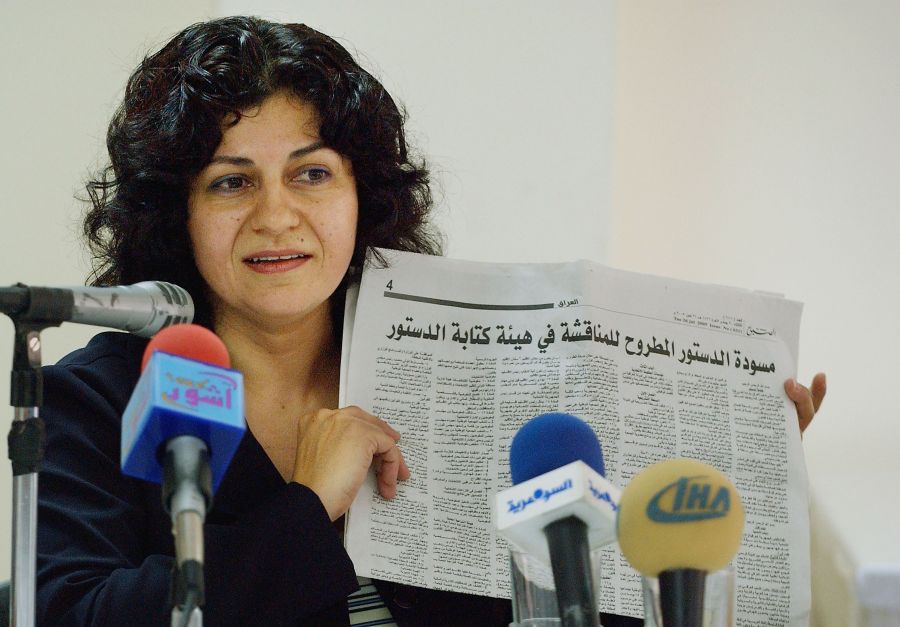
On 2 March 2026, woman human rights defender and feminist Yanar Mohammed was killed in an armed attack in front of her residence in northern Baghdad.
Yanar Mohammed was a prominent Iraqi woman human rights defender and feminist, and the co-founder and director of the Organisation of Women’s Freedom in Iraq (OWFI). Since 2003, she had worked to protect women facing gender-based violence, including domestic abuse, trafficking, and so-called ‘honour killings.’ Under her leadership, OWFI established a network of safe houses across several Iraqi cities, providing protection and support to hundreds of women. Yanar Mohammed led these efforts despite all the ongoing impediments and risks. She was a strong advocate for secularism and women’s equality. Throughout her activism, Yanar Mohammed faced death threats and, at times, was forced to restrict her movement. {see also: https://humanrightsdefenders.blog/2019/01/07/women-human-rights-defenders-in-iraq-have-to-live-dangerously/]
According to an offical statement from OWFI, on 2 March 2026 at 9:00, two unidentified gunmen on motorcycles opened fire on Yanar Mohammed as she stood outside her home. She was quickly transported to the hospital, however, despite the effort of medical personnel, she succumbed to her injuries.
Reportedly, Yanar Mohammed had returned to Baghdad from Canada just a few days prior to her assassination, raising concerns about the potential surveillance and monitoring of her movements.
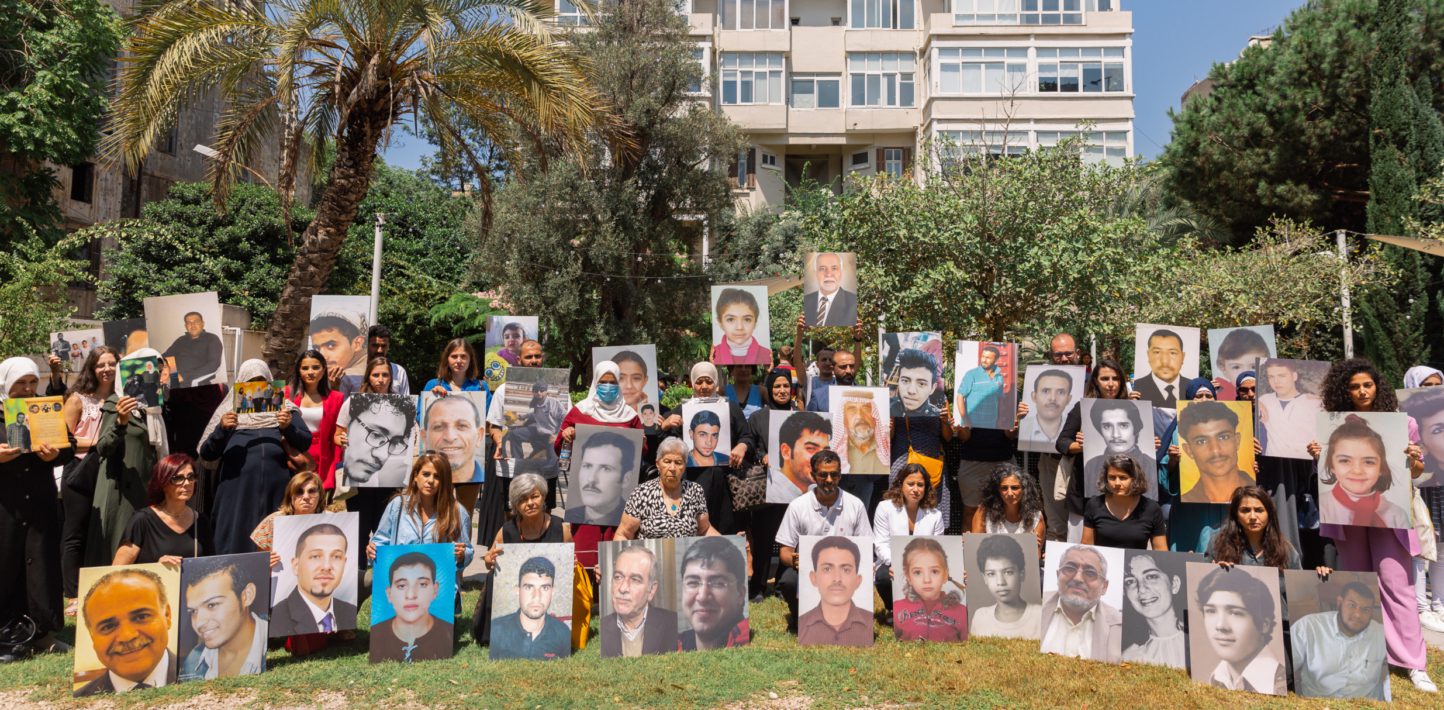
On 30 August 2023, Amnesty International reported on that Representatives of the families of people forcibly disappeared in Iraq, Lebanon, Syria and Yemen gathered in Beirut to demand that their governments uphold their rights to truth, justice and reparation, during an event organized by AI to mark the International Day of the Victims of Enforced Disappearances.
Across the Middle East, both state authorities and non-state actors, such as armed opposition groups, abduct and disappear people as a way to crush dissent, cement their power, and spread terror within societies, largely with impunity.
While most governments in the region have not yet investigated disappearances nor provided accurate numbers of those missing or disappeared, civil society organizations and UN bodies have published estimated numbers of people abducted and disappeared in each country. These numbers in Iraq, Lebanon, Syria and Yemen, when multiplied by a conservative estimate of the total years these individuals have been missing, suggest that families have spent more than a million years waiting for answers – an agonizing length of time.
“In the face of their governments’ apathy and complicity for the crime of enforced disappearances, the families of the disappeared across the Middle East have led the charge, year after year, in demanding their right to know what happened to their loved ones and to get justice and reparation – often at great personal risk,” said Aya Majzoub, Amnesty International’s Deputy Director for the Middle East and North Africa.
“Today we honour their perseverance and add our voice to theirs in calling for authorities to take real action to investigate these crimes, hold those suspected of criminal responsibility accountable and ensure these crimes are not committed again.”
Iraq
In Iraq, the UN estimates that between 250,000 to 1,000,000 individuals have been disappeared since 1968 – making it one of the countries with the highest number of disappearances in the world. Disappearances are still being carried out today at hands of militias affiliated with the government. Consecutive Iraqi governments have repeatedly failed to take meaningful steps to investigate disappearances or hold those suspected of criminal responsibility to account. Widad Shammari from Iraqi organization Al Haq Foundation for Human Rights, whose son has been missing since 2006, said: “I was a single protester until I met many others who shared my struggle, and we formed a strong coalition who fights for the truth for all the disappeared in the Arab region, not just Iraq.”
Lebanon
In Lebanon, the official estimate of those abducted or missing as a result of the 1975-1990 civil war is 17,415. Every year, on 13 April – the anniversary of the start of the Lebanese Civil War – the families of the missing and disappeared gather to mark the beginning of the conflict, repeating the mantra, “Let it be remembered, not repeated.”
The Lebanese authorities granted amnesty to the perpetrators of crimes that occurred during the civil war, but after years of campaigning, in 2018, the families of the disappeared successfully pressured the government to acknowledge the disappearances that took place. The government also passed a law that established the National Commission for the Missing and Forcibly Disappeared with a mandate to investigate individual cases, locate and exhume mass graves and enable a tracing process.
However, Wadad Halawani, whose husband was kidnapped in 1982 and who leads the Committee of the Kidnapped and Missing in Lebanon said: “Today, we raise our voice and shout out loud. The National Commission for the Missing and Forcibly Disappeared is 3 years old already. Only two years remain in its mandate. The Commission established a clear strategy for its work, but it cannot carry on without the needed financial and logistical support. The government must provide it with all the needed resources immediately.”
Syria
Since 2011, the Syrian authorities have forcibly disappeared tens of thousands of its actual or perceived opponents, including political activists, protestors, human rights defenders, journalists, lawyers, doctors, and humanitarian aid workers, as part of a widespread and systematic attack against the civilian population that amounts to crimes against humanity. Thousands have also gone missing after being detained by armed opposition groups and the so-called Islamic State. Given the Syrian government’s role in orchestrating the campaign of enforced disappearances, there has been total impunity for these crimes in Syria. The families have therefore resorted to international justice mechanisms.
In a momentous victory for the families, on 29 June 2023, the UN General Assembly voted to establish an international institution dedicated to shedding light on the fate and whereabouts of those missing and disappeared since the start of the armed conflict in Syria.
Fadwa Mahmoud from Families for Freedom, whose husband and son were disappeared in Syria in 2012 said: “We had big dreams in 2011. But we paid a very heavy price. My husband and son have been disappeared since September 2012… We faced our fears and raised our voice until it reached the United Nations …this [institution] is the product of our labour as the families of the detained…and this is its strength. We are demanding that we have an instrumental role in the institution.”
My husband and son have been disappeared since September 2012… We faced our fears and raised our voice until it reached the United Nations …this [institution] is the product of our labour as the families of the detained…and this is its strength.Fadwa Mahmoud from Families for Freedom, whose husband and son were disappeared in Syria in 2012
Yemen
In Yemen, human rights organizations have documented 1,547 cases of disappeared and missing people since 2015. All parties to the conflict, including the Huthi de facto authorities and the internationally recognized government forces, are still committing these crimes with impunity at a time when the world’s attention has turned away. Since the Human Rights Council voted in 2021 to end the mandate of the Group of Eminent Experts, following heavy lobbying from Saudi Arabia, efforts to hold all those suspected of criminal responsibility accountable in fair trials and realize victims’ rights to reparations have stalled.
The Abductees’ Mothers Association in Yemen said: “We were harassed and threatened and beaten-up during demonstrations, but we will not give up and we are determined at ensuring some progress every step of the way. We are not mothers of our own disappeared family members only; we consider ourselves mothers of every single disappeared person in the region and we will continue our fight for the truth for all of them.
It has now been made public that Fatima Al-Bahadly, a human rights defender from the city of Basra, has received the 2020 Frontline Defenders Award.
The award was granted to Al-Bahadly for her role in founding Al-Firdaws Society, an organisation that focuses on protecting women affected by war and strengthening their role in peace building.
Hussein al-Qaidi, director of the Office of Rescuing Kidnapped Yezidis for the Kurdistan Regional Government (KRG), has been named the recipient of the Sergio Vieira De Mello Prize, which is awarded yearly in Poland (!) to individuals and organizations which promote human rights and dialogue.
Qaidi is a Yezidi, born in the Duhok province of Iraqi Kurdistan. In 2014, after ISIS overran the Yezidis’ homeland, he organized campaigns to find missing people, free them, and help then return to a normal life.
The KRG supported Qaida’s efforts and already in August 2014, he was named to lead a new unit: the Office of Rescuing Kidnapped Yezidis. It is based in Duhok, and Qaida remains its head.
Last November, Qaida received the prestigious Mother Teresa Memorial Award for rescuing thousands of Yezidi women from the clutches of the ISIS terrorists.
Raoof hopes that the award will put Yezidis in the spotlight again in Poland, since previous awards were widely reported in the Polish media.
“I believe that it will once again make Polish people aware of the difficult fate of Yezidis and also show that there are still many people and organizations helping Yezidi people with great courage and commitment, ”he continued.
The European Parliamenthas announced its long-list of nominees for the annual Sakharov Prize. The nominees for this year’s prize, announced at last week’s plenary session of the Parliament, are:
Two nominations for the democratic opposition in Belarus, represented on the one hand by the Coordination Council, an initiative of political and civil society figures, and on the other by Sviatlana Tsikhanouska, an activist and politician whose defeat in this year’s presidential election led to accusations of fraud against the winner, Alexander Lukashenko. Tsikhanouska is also a member of the Coordination Council.
Monsignor Najeeb Moussa Michaeel, Archbishop of Mosul in Iraq who ensured the evacuation of Christians, Syriacs and Chaldeans to Iraqi Kurdistan when Islamic State arrived in the city in 2014, and who safeguarded more than 800 historic manuscripts dating from the 13th to the 19th century.
Guapinol activists and Berta Caceres in Honduras. The Guapinol activists have been imprisoned after taking part in a peaceful protest against a polluting mining company in Tocoa, Honduras. Berta Caceras was assassinated in 2016, and was a land-rights activist and protestor against illegal logging and land-grabbing from indigenous peoples in Honduras.
Finally, Polish LGBTI activists Jakub Gawron, Paulina Pajak, Paweł Preneta and Kamil Maczuga who founded the website Atlas of Hate, monitoring the implementation by local municipalities to the anti-LGBTI legislation introduced by the national government. This year five of the municipalities sued Gawron, Pajak and Preneta, demanding financial compensation for loss of reputation.
At the end of the month, the foreign affairs and development committees and the human rights subcommittee of the Parliament will announce their shortlist of three finalists. On 22 October the Conference of Presidents – consisting of the President of the European Parliament and the leaders of the political groups – will announce the winner.
The Prize itself will be awarded at a ceremony in the European Parliament in Strasbourg on 16 December.
This new film directed by Greg Barker [see also: https://humanrightsdefenders.blog/2014/01/23/we-are-the-giant-film-about-the-arab-spring-here-is-the-trailer/] and based on his own award-winning documentary, confusingly also called Sergio, is a biographical drama about Sérgio Vieira de Mello, a diplomat from Brazil who worked for the United Nations High Commissioner for Refugees (UNHCR) for most of his life and was briefly High Commissioner for Human Rights. He was celebrated as a pre-eminent humanitarian before tragically dying in the Canal Hotel bombing in Iraq alongside many of his staff in 2003. The fiction film Sergio made its premiere at the Sundance Film Festival on 28 January 2020 before heading to Netflix.
Kayleigh Donaldson in Screenrant of 2 january 2020 wrotes perhaps a bit too breathlessly that the film Sergio is “one of the most anticipated Netflix original movies in 2020“.
Now the first two reviews are out and they indicate that it is foremost a romantic story that is well acted but diverts a lot from reality.
Jessica Kiang in Variety of 29 January 2020 is the more critical and – in my view – serious voice:
… handsome, heroic, charismatic de Mello (played with persuasive charm by Wagner Moura) certainly does seem like a man whose present was shaped by …the better, brighter, freer global future he believed the U.N. could be instrumental in achieving and that he personally could help midwife into being. Such noble intentions and such impact on world affairs does render understandable Barker’s rather starry-eyed approach, but [puts] unnecessary length and sentimental emphasis on the man’s romantic life…
..First, we spin forward to the 2003 bombing of the U.N. headquarters in Baghdad, which was ordered by terrorist leader Abu Musab al-Zarqawi and which claimed at least 22 lives and wounded over 100 people, and here provides a loose framing device. De Mello and close associate Gil Loescher (Brian F. O’Byrne), both critically wounded, were trapped under tons of rubble in the blast, and … screenwriter Craig Borten imagines a borderline delirious de Mello reliving moments of significance from his storied life. Chief among these reminiscences is the tale of his romance with Carolina Larriera.. .an Argentinian U.N. economic adviser whom the married father-of-two met while brokering a peace deal between the rebels and the Indonesian government in East Timor.
In Adrian Teijido’s calm, throughful photography (it’s a refreshing choice to not go the shaky handheld docudrama route), de Armas and Moura make an attractive couple, and de Armas is able to imbue Carolina — whose role seems just a little wispy on the page — with an intelligence and will that makes her more than just de Mello’s romantic foil. But Barker’s emphasis on this love story at the expense of a deeper exploration of the exceptional talents that earned de Mello his reputation for feats of diplmatic wizardry in highly fraught situations where others had tried and failed, also has a curiously flattening effect.
Although the relationship with Larriera was doubtless crucially important to de Mello, it was not the thing that made him extraordinary in the eyes of the world. And so the hesitant courtship, the smouldering looks, and the romancing, including a tasteful but unnecessarily lengthy sex scene over which Fernando Velázquez’ otherwise rather generic political-thriller score crescendos like it’s high drama, all feel like a distraction from the more thorny and politically provocative side of de Mello’s story. That’s especially irksome given that the scenes of geopolitical debate, diplomatic argument and even ego clash between de Mello and the world-wearily witty Loescher … are actually where the film crackles to life.
…But this sentimental approach glosses over much of the potential drama that is set up only to dissipate: de Mello’s prickly relationship with U.S. Envoy Paul Bremer (Bradley Whitford); his association, criticized by Loescher, with war criminals and terrorists if he believed it could achieve his ends; and his fateful decision to send the U.S. Army guards away from the U.N. office in Baghdad in 2003. Sergio Vieira de Mello was, by all accounts, not a man who let fear of making the wrong decision stop him from acting decisively, and it’s a shame that the soft-edged romantic prevarications of “Sergio” prevent the film from embodying that same dynamism.
Courtesy of Sundance
John DeForein Hollywood Reporter of 30 January 2020 sees a more than successful transition from documentary to a feature film:
… Rather, it’s one of those rare films .. in which a genuine concern for geopolitics coexists perfectly well with romance and old-fashioned moviegoing pleasures. This portrait of influential U.N. diplomat Sergio Vieira de Mello benefits immensely from two magnetic leads, Wagner Moura and Ana de Armas, whose onscreen chemistry is undeniable; but its deft sense of structure is of equal importance, making it an engrossing picture even for those who know next to nothing about its subject or settings.
..Sergio and refugee expert Gil Loescher were trapped alive in the rubble; as a framing device, Sergio sets flashbacks to various points in his career during the hours when two American soldiers (Garret Dillahunt and Will Dalton) worked to extract the pinned men. These episodes help cement the diplomat’s reputation as an idealistic fix-it man for some of the world’s trickiest conflicts. …Sergio is out for a jog during his East Timor assignment when he passes another jogging foreigner, Carolina Larriera (de Armas). The attraction is immediate, but the film savors its development: …While the film plays up Sergio’s attractiveness to the younger woman (shirtless, the 50 year-old man probably bore little resemblance to Moura), it’s not blind to emotional flaws: He’s ignorant of key facts about his two sons’ lives, and he admits he’s most attentive to relationships and projects whose timeframe is finite.
Also on hand in East Timor is Loescher (Brian F. O’Byrne), who will be trapped by his side in Baghdad. The real Loescher, who had two legs amputated in his rescue from the site, was an independent expert who was only in Sergio’s Baghdad office (along with Arthur Helton – see: https://en.wikipedia.org/wiki/Arthur_Helton) to interview him for a column on openDemocracy.net. In Sergio, Loescher is a composite, depicted as Vieira de Mello’s right-hand man for multiple U.N. missions — the conscience who argues against his boldest moves. As a storytelling device, this works quite well; but using Loescher’s real name is an unexpected choice for a documentarian, and confuses the truth for no reason. [my view: INDEED – see also: https://humanrightsdefenders.blog/2017/06/07/gil-loescher-life-long-defender-of-rights-of-refugees-honored/ and https://www.imdb.com/title/tt0479980/]
Those who know the history intimately may take issue with other condensations that play perfectly well to a layperson: Sergio’s interactions with U.S. diplomat Paul Bremer (Bradley Whitford) are dramatically satisfying, and seem to capture the general nature of U.S./U.N. friction at the time; a question regarding the U.S. Army’s protection of Sergio’s office is probably also finessed for maximum thematic effect. The picture is most vulnerable to Hollywoodisms in scenes set after the bombing, as Carolina looks frantically for Sergio; the latter dreams of a sunny beach in his native Rio de Janeiro; and those soldiers heroically try to extract him despite having none of the necessary rescue equipment. But, coming late in the film as they do, these indulgences feel appropriate to the film’s lionization of its subject and investment in the couple’s relationship. Sergio believes in heroes and big ideals, and hopes we’re capable of the same belief…
Monica Castillo in NBC of 31 January 2020 adds an interview with the star Wagner Moura who “was so intrigued by Vieira de Mello’s story that he signed on as a producer for the movie. In the interview with NBC News, Moura said that this is the first of many stories he’d like to share to address the lack of Latinos on the screen. In the interview he also says “this guy is kind of a personal hero for me, and I’ve been working with the U.N. for a while; I’m a goodwill ambassador for the ILO [International Labour Organization] and the fight against slave labor..[Sergio] was a man who dedicated his life to human rights. When he was killed, he was the high commissioner for human rights; when he started in the U.N., he was the high commissioner for refugees“. Well he was NOT, he worked for the UNHCR.
Stock Daily Dish on 16 December 2019 reports that Melania Trump made a rare public appearance to present 13 women with the 2017 Secretary of State’s International Women of Courage Award. The prize honors those who fight for women’s empowerment, often at great personal risk. “Together, we must declare that the era of allowing the brutality against women and children is over while affirming that the time for empowering women around the world is now,” Mrs. Trump said. She called on leaders to “continue to work towards gender empowerment and respect for people from all backgrounds and ethnicities,” and on the international community to fight all forms of injustice. For more on this award – and 7 more that have ‘courage’ in the title – see: http://www.trueheroesfilms.org/thedigest/awards/international-women-of-courage-award.
Each US embassy can nominate one woman for the award. The 13 women honored this year are:
Malebogo Molefhe (Botswana), who used to play for the Botswana national basketball team, has served as an advocate for survivors of gender-based violence after she was attacked and shot eight times by her ex-boyfriend in 2009 and confined to a wheelchair,
Rebecca Kabugho (Democratic Republic of the Congo), has led peaceful anti-government protests calling for credible elections in the DRC, and spent six months in prison for her role as an activist
Major Aichatou Ousmane Issaka (Niger), currently the deputy director of social work at the Military Hospital of Niamey, was one of the first women to join the Nigerien army in 1996, and was one of the first to attend a military academy. She has served throughout Niger, including in the Diffa Region, a stronghold of the Boko Haram terrorist group.
Veronica Simogun (Papua New Guinea), the founder and director of the Family for Change Association, who works to help shelter and relocate women affected by violence,
Saadet Ozkan (Turkey) was a primary school teacher, who uncovered a “decades-long pattern of sexual abuse” and forced a criminal investigation of the principal; she still supports the victims and their case as a private consultant.
Jannat Al Ghezi (Iraq), helps Iraqi women escape violence, rape and domestic abuse, as well as Islamic State terrorism and occupation, and offers them shelter, training, protection and legal services through the Organization of Women‘s Freedom in Iraq
Sister Carolin Tahhan Fachakh (Syria), known as Sister Carol, runs a nursery school in war-torn Damascus for more than 200 Muslim and Christian children, as well as a tailoring workshop for internally displaced women.
Fadia Najib Thabet (Yemen) is a child protection officer who has dissuaded young boys from joining Al-Qaeda, exposed its Yemeni branch Ansar al-Sharia as a recruiter of child soldiers and reported on human rights violations for the UN Security Council.
Sharmin Akter (Bangladesh), a student who refused an arranged marriage at age 15, which resulted in the prosecution of her mother and her much-older prospective husband,
Sandya Eknelygoda (Sri Lanka), who fought for justice after the disappearance of her journalist husband in 2010 and who has served as a voice for the families of others who have disappeared during the country‘s civil war.
Natalia Ponce de Leon (Colombia), who has become a human rights activist for the victims of acid attacks after a stalker threw a liter of sulfuric acid on her in 2014,
Arlette Contreras Bautista (Peru), a domestic violence survivor and activist, who helped launch the Not One Woman Less movement, which aims to increase the social and political awareness of women‘s rights and gender-based violence in Peru.
The newspaper noticed that Mrs Trump did not mention her husband or his presidential administration during her 10-minute remarks.
Dr. Widad Akreyi at the award ceremony for the 2018 International Woman Harmony Award, Cortona, Italy, Nov. 23, 2018.
On 12 June 2019 Marta Bellingreri (an Italian writer, Arabist and cultural mediator. is the author of two books about Lampedusa and minor migrants in Tunisia, France and Italy) wrote a profile of Dr. Widad Akreyi, who lived through the 1980s Anfal genocide and the 2014 Yazidi genocide, and has become one of the major defenders of human rights in Iraq and beyond.
Khemta H Jose in the Quint reviews the movie ‘Hell & Hope’. This documentary is filmed in Germany in 2018, where 1,100 Yazidi survivors of ISIS brutalities found refuge. There, they have managed to rebuild shattered lives even as mothers and sisters are missing – presumed enslaved or killed – fathers and brothers dead. Before it was too late for Salwa in Iraq’s Sinjar, before the militants came, she says it was Yazidi men who prevented them from running. “The men refused to run despite their wives asking them to. ‘We men don’t run away, we stay and fight’. But the women didn’t know how to drive, so they couldn’t run either. I doubt if in all of Sinjar, even four women know how to drive – if they knew how to drive, they would have escaped and survived. The men could’ve stayed and fought if that was what they wanted. They should have fought and not let us face what we faced.” said Salwa, Yazidi Survivor Knowing how to drive seems like a small thing, in the grand scale of what was happening in Iraq and Syria. And yet it is that small independence they were denied that might have made all the difference.
Despite the gripping horror of each story, there is not much different in the perspectives offered than what we’ve heard over the years now in countless pieces of reporting – the kidnappings, the slavery, the killings. What’s new is the fine detail that comes out when you have multiple women tell broadly the same story; the banality of evil.
Two of the three women who spoke expressed disgust, contempt and were especially distressed by the encouragement given to Daesh terrorists by their wives. It was felt as a deeper betrayal, even though Salwa explains why they did it: “What we saw was that the women encouraged their husbands. This is why I always say that women should see the world and get an education. They controlled women’s minds. What was Daesh telling their wives? They would say that women don’t go to heaven, that a woman is incomplete. Only men go to heaven, so in this life, women must please their husbands, and when they go to heaven, they can ask for their wives to join them. After a Daesh militant kills Yazidis, because they are infidels, he will go to heaven and if he is satisfied with his wife, he will ask for her to come.”
..how did they make it out of that hell? The German government reached out. “The girls did not apply for asylum. The government of the German state of Baden Württemberg came up with a special quota program to give girls, children and other victims a direct residence permit for 3 years.” Amish Srivastava, Director, Hell & Hope…
Watching the documentary is an exhausting experience, but the viewer is forewarned. One of the first lines that appear on the screen is “Girls risked their lives to escape Islamic State captivity. Few succeeded.”
To strengthen the resilience of Iraqi women journalists and women human rights defenders against online and offline gender-based attacks, Internews conducts workshops and other activities that focus on digital and physical security:
Iraq is one of the world’s most dangerous countries for journalists according to Reporters without Borders, ranking 160 out of 180 countries in the World Press Freedom Index. Women journalists and activists in Iraq have a particularly difficult time due to online threats and attacks that adversely affect their ability to express themselves freely and advocate effectively. Women have witnessed an escalation in online abuse over the past few years, not just in numbers, but also in methods and sophistication. The risk of harassment and gender-based attacks online is not limited to the digital space as research has shown that online abuse and stalking often escalate into real world physical violence if left unaddressed.
In an interview with The New Arab, Hala ‘Asif, a 24-year-old journalist working as a correspondent for the channel NRT in Baghdad, noted that, “Foreign journalists often investigate political affairs in Iraq, which sometimes is impossible for us to cover as it would be too dangerous and would prevent us from working safely in our country. I would like to go to other provinces in Iraq and carry out investigations about relevant issues, but as a young woman it would cost too much to take care of my safety.”
To address the issue of women’s safety in Iraq, Internews, with funding from the US State Department’s Bureau of Democracy, Human Rights and Labor (DRL), is using a multi-pronged approach – building local networks, coordinating advocacy, and conducting targeted journalism trainings on gender-sensitive issues. Internews’ program, Women Voices (Aswat Al-Maraa), aims to challenge societal attitudes that stigmatize survivors of sexual and gender-based violence (SGBV) by supporting journalists and women human rights defenders to shed light on sensitive issues through coordinated reporting and advocacy. The program works with female Iraqi journalists and media outlets to create a nationwide coalition of women journalists and human rights defenders to strengthen their resilience against gender-based attacks and build the capacity of journalists to report on sensitive human rights and SGBV.
Within the Women’s Voices project, Internews has conducted so far two training-of-trainers (TOT) workshops that focus on the digital and physical security of the project participants. Through a peer-to-peer program, TOT trainees have trained eighty women from Erbil, Najaf, and Halabja how to protect themselves from threats online and in their everyday lives.
….Another participant, from the Erbil workshop, said, “Females often have to face extreme scrutiny of their presence online, and are threatened with death in some instances for photos posted online without family consent or that are considered inappropriate; these kinds of workshops are incredibly important for every female in this country.”
To support the voices and participation of women in some of the world’s most challenging places, Internews’ MENA team ensures the implementation of digital as well as a physical security trainings in all of its projects across the region.


 Hans Thoolen on Human Rights Defenders and their awards