Posts Tagged ‘indigenous groups’

Interview with Mary Lawlor, departing UN special rapporteur

October 29, 2025

On 13 October 2025, Nina Lakhani, climate justice reporter the Guardian, published this interview with Mary Lawlor, UN special rapporteur for human rights defenders, who presented her final annual thematic report during an interactive dialogue at the 80th session of the United Nations General Assembly’s Third Committee. The Special Rapporteur’s report focused on the contributions of human rights defenders addressing climate change and working to realise a just transition from fossil fuels, and the risks they face in carrying out this work.

Mary Lawlor, the UN special rapporteur for human rights defenders since 2020, has documented hundreds of cases where states have sought to smear and silence climate defenders engaged in peaceful protest, non-violent civil disobedience and litigation.

“Attacks against climate defenders have surged over the course of the mandate, and we now see outright repression against people who are organizing for climate action. It’s some of the states that have claimed to be the strongest supporters of human rights defenders including the UK, Germany, France and the US, that are most often repressing climate activists and where the right to protest is being denigrated and delegitimized.

“These big countries spew out the rhetoric about 1.5C, but they don’t mean it. They are playing the game to suit themselves. It’s business as usual,” Lawlor said in an interview with the Guardian.

Lawlor will present the penultimate report of her six-year mandate, “Tipping points: Human rights defenders, climate change and a just transition”, to the UN general assembly on 16 October.

It documents state repression including police violence and surveillance, civil litigation deployed to deliberately wear down and silence climate defenders known as Slapp (strategic lawsuits against public participation), as well as bogus criminal charges ranging from sedition, criminal defamation, terrorism and conspiracy to trespass, to public disorder and to disobedience.

One trend documented by Lawlor is the conflation of non-violent climate action with terrorism. In 2022, the French minister of interior at the time, and current minister of justice, accused the national environmental movement Les Soulèvements de la Terre of “ecoterrorism”. The government sought to close down the group, but the country’s highest administrative court eventually overturned the effort.

Lawlor is adamant that climate activists are human rights defenders. They use non-violent protest, disruptive civil disobedience and litigation to stop fossil fuel projects and pressure elected officials to take meaningful action precisely because they are trying to protect the right to food, clean water, health, life and a healthy environment.

But it’s not just fossil fuels. Human rights are now being targeted in the rush for critical minerals and new sources of non-fossil energy. The same repressive playbook is being used by governments and private companies involved in land grabs, pollution and Indigenous rights violations in pursuit of a green transition.

Governments are repressing human rights defenders and the current trajectory is incompatible with the realization of human rights for all. It’s just a road to destruction … I think states are behaving in a criminal fashion,” Lawlor said.

No system, no power, no government, no big company seeking profit should trump the rights of billions of people in the world. And that’s what’s happening. It’s the rich, the powerful that are creating such a disaster for humanity.

https://www.theguardian.com/environment/2025/oct/13/climate-defenders-mary-lawlor-human-rights

https://ishr.ch/latest-updates/unga-80-special-rapporteur-urges-states-to-protect-environmental-defenders-working-towards-a-just-transition

https://www.business-humanrights.org/en/latest-news/new-report-un-special-rapporteur-exposes-rising-global-threats-and-systemic-retaliation-against-environmental-defenders-under-the-aarhus-convention/

https://genevasolutions.news/climate-environment/environmental-crimes-go-unpunished-experts-want-to-equip-defenders-to-fight-back

International Organizations Denounce Escalating State Violence in Ecuador

October 22, 2025

On 16 October 2025 Amazon Watch reported that more than 130 civil society and human rights organizations from across Latin America and around the world have issued an urgent appeal for an immediate end to repression, militarization, and human rights violations by the Ecuadorian government. The statement follows weeks of violent crackdowns against Indigenous-led protests that began on September 21, when social movements mobilized to defend democracy, rights, and the environment amid controversial government reforms.

According to Ecuadorian human rights groups, the government’s response has been brutal and disproportionate: at least three people have been killed, including Indigenous leader Efraín Fuerez; over 282 people injured; 172 detained; and 15 temporarily disappeared. Reports also confirm attacks on journalists, raids without warrants, internet blackouts, and summary deportations, while military operations continue across several provinces.

The joint declaration denounces the criminalization of Indigenous and human rights defenders, who face fabricated charges of terrorism, sabotage, and illicit enrichment, along with the freezing of organizational bank accounts. The signatories condemn President Daniel Noboa’s use of racist and stigmatizing rhetoric to justify state violence and to discredit legitimate social protest.

“Defending life, land, human rights, and freedom of expression cannot be criminalized. Peace cannot be imposed by force; it is built on truth, justice, and dialogue,” the statement affirms.

The organizations also point to international alarm: on October 8, seven United Nations Special Rapporteurs expressed concern about the repression and institutional rollbacks that weaken environmental protections and Indigenous rights. Two days later, members of the European Parliament called for a public EU statement, a monitoring mission, and a review of the E.U.–Ecuador Trade Agreement under its human rights clauses.

In response to the escalating crisis, Amazon Watch has launched an international action urging President Noboa to cease all violence immediately, end the criminalization of Indigenous movements, and ensure full respect for human rights and the rule of law.

Download the statement in PDF format to view a complete list of signatories.

Only 9% of companies assessed by Forrest 500 committed to not tolerate attacks on defenders

September 15, 2025

On 8 September 2025, a report “Defending forests shouldn’t cost lives: Forest 500 assesses corporate zero tolerance policies,” links world’s top banks to social & environmental harms from mining

… Global Canopy’s annual Forest 500 assessment looks at six human rights criteria closely associated with preventing deforestation. Three indicators are interconnected with deforestation as violations of these rights frequently happen around the point of forest loss. They are: Free, Prior and Informed Consent (FPIC); zero tolerance for threats and violence against forest, land and human rights defenders; and customary rights to land, resources and territory.

Among them, zero tolerance is least likely to be addressed by companies: only 9% of the 500 companies assessed have a public commitment in place for at least one forest risk commodity. By comparison, 37% of companies have committed to FPIC, and 24% have commitments to respect the customary rights of IPLCs to land, resources and territory.

… Only 47 Forest 500 companies have commitments for zero tolerance. Companies in the palm oil (18%) and cocoa (14%) supply chains are more likely to have commitments. Commitments are scarce in the beef (10%), soy (11%) and timber (6%) sectors, although these industries are linked to abuses in Latin America. According to BHRRC, 40% of attacks against human rights defenders over the last decade took place in Latin America, with Brazil recording the highest number of killings worldwide.

… Only six of the Forest 500 companies publish evidence of due diligence and progress reporting on eradicating violence and threats f

The report focuses on financing for companies mining critical minerals used in the global energy transition, including lithium, nickel, graphite and cobalt. Nearly 70% of these transition mineral mines overlap with Indigenous lands and roughly an equal amount is in regions of high biodiversity.

“Our findings shed light on the central role that financial institutions play in enabling this new wave of destruction as companies rush to expand mining operations as rapidly as possible,” Steph Dowlen, forests and finance campaigner for the Rainforest Action Network, told Mongabay by email. “While this extraction for raw minerals falls under a ‘green’, ‘clean’ or ‘renewable’ banner, it’s still extraction and the mining sector remains high-risk, dominated by companies with egregious track records on rights, the environment and corporate accountability.”

The report assessed environmental, social and governance policy scores of 30 major financial institutions and found an average score of only 22%. Vanguard and CITIC scored the lowest, each with just 3%. The assessment found that many financial institutions lacked policies to prevent financing issues, including pollution, Indigenous rights abuses or deforestation.

Of all institutions assessed, 80% lacked policies on human rights defenders and none had safeguards for Indigenous peoples living in voluntary isolation. Many institutions (60%) lacked grievance mechanisms, which allow communities that have been negatively impacted by mining activities to seek justice. Also, 60% of institutions had no policies on tax transparency, which is key to preventing companies from shifting profits abroad and ensuring that mining revenues remain in the resource-rich countries.

“Due to the significant overlap with transition minerals and Indigenous Territories, and high-biodiversity areas, there is an immediate need for governments, financial institutions and mining companies to stop and listen,” Dowlen said. “Indigenous Peoples and local communities have been raising the alarm for a long time but continue to face disproportionate harm as well as violence and intimidation for defending their rights and their lands.”

BlackRock and JPMorgan Chase declined to comment on the report. None of the other institutions mentioned in this piece responded to Mongabay’s emails.

https://www.business-humanrights.org/en/latest-news/forest-500-report-finds-only-9-of-companies-assessed-have-a-public-commitment-to-not-tolerate-attacks-on-defenders/

Environmental defenders and the Escazú Agreement

April 28, 2025

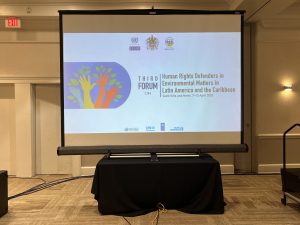
From 7-10 April, the Latin American and Caribbean Forum on Environmental Human Rights Defenders brought together environmental defenders, Indigenous Peoples, civil society, and government representatives in Basseterre, Saint Kitts and Nevis.

The Escazú Agreement is a landmark regional human rights treaty that guarantees access to environmental information, public participation and justice in Latin America and the Caribbean. Article 9 describes States’ obligation to protect human rights defenders in environmental matters and guarantee their rights, including those related to access to information, participation, and justice, as set forth in the agreement.  

As of today, 17 countries are parties to the agreement, while other key countries in the region still haven’t signed or ratified it. In February 2025, Special Procedures mandate holders sent a communication to these countries urging them to sign and ratify the agreement.  

The 2024 Action Plan adopted by the parties to the Escazú Agreement aims to implement practical protections for human rights defenders in environmental matters. It outlines capacity building and assessment, calling for urgent national action to address immediate threats and ensure the continuity of defenders’ work.

Since April 2024, individuals who believe that a State is not complying with its obligations as a party to the Escazú Agreement can send information (‘communications’) to the treaty’s Implementation and Compliance Support Committee. At a 2024 Conference of the Parties (COP) to the Agreement, States agreed to incorporate a gender perspective within the Escazú Agreement, recognising the unique risks faced by women human rights defenders in environmental matters.

This decision further requires States to consider gender-based violence and ensure women’s participation, enhancing security and effectiveness for all defenders. 

At the Forum on Environmental Human Rights Defenders, the #EscazuEnlaCorteIDH initiative was presented during the Third Forum. This initiative seeks to ensure that Escazú standards are included in the Inter-American Court’s forthcoming advisory opinion on the climate emergency.

A central piece of this effort was the amicus brief co-submitted by ISHR. 

see also: https://humanrightsdefenders.blog/tag/escazu-agreement/

https://ishr.ch/latest-updates/better-protection-and-participation-of-environmental-human-rights-defenders-through-effective-implementation-of-the-escazu-agreement

Human rights defenders in Brazil disappointed by Lula and Mary Lawlor agrees with them

April 24, 2024

On 19 April 2024 – Indigenous Peoples Day in Brazil – tribal leaders and activists used the occasion to criticize government of Brazilian President Luiz Inácio Lula da Silva for falling short on promises to safeguard native land rights.

This is revolting for us Indigenous peoples to have had so much faith in the government’s commitments to our rights and the demarcation of our territories,” Alessandra Korap Munduruku, a member of the Munduruku people and a 2023 winner of the prestigious Goldman Environmental Prize, told Amazon Watch in a statement published Friday.

We hear all of these discussions about environmental and climate protection, but without support for Indigenous peoples on the front lines, suffering serious attacks and threats. Lula cannot speak about fighting climate change without fulfilling his duty to demarcate our lands,” she added.

On the same day United Nations Special Rapporteur on the situation of human rights defenders, Mary Lawlor said that Brazil needs to prioritise the demarcation and titling of land – the root cause of most attacks against human rights defenders in the country.

Human rights defenders are under extreme threat in Brazil. The Federal Government knows this but has so far failed to put the structures in place to provide them with better protection and tackle the root causes of the risks they face,” said Mary Lawlor, in a statement following an official visit to the country.

Brazil’s Federal Government recognises human rights defenders and their work, and understands the risks they face, the expert noted. However, when human rights defenders challenge structures of power that impose and reinforce injustice, they are violently attacked and face an extremely high level of risks, she said. “Again and again during my visit I heard from defenders who had survived assassination attempts, who had been shot at, had their houses surrounded, had death threats delivered to their door. I heard from defenders whose work had been criminalised,” Lawlor said.

“The defenders most at risk in Brazil are indigenous and quilombola people and members of other traditional communities. In many cases, perpetrators of the attacks are known. Yet, there is rampant impunity for these crimes,” the expert said.

The UN expert said business and markets play a key role as drivers of conflicts, putting human rights defenders at risk. “The demarcation and titling of indigenous, quilombola and other traditional peoples’ land, as well as the revision of the legality of all existing concessions given to companies must be prioritised,” she said.

Lawlor said that in urban areas, human rights defenders were also being attacked, defamed and heavily criminalised, specifically black women human rights defenders, journalists, popular communicators and lawyers, and social and cultural workers.

“The conflation of human rights defenders with criminals by local authorities – in particular defenders who are part of social movements and supporting the most vulnerable in society – is a clear problem and must end,” the expert said.

A protection programme to address situations of risk for human rights defenders has been in place in Brazil for some time. However, Lawlor said it was currently unfit for purpose and needs radical reform and expansion. Lawlor applauded the Federal Government for re-opening the door to human rights defenders and civil society in the design of policy that affects them and encouraged authorities to not abandon these efforts.

The Federal Government needs to match the courage of human rights defenders in the country – and it must do so now,” Lawlor said.

On 22 April 2024 Maria Laura Canineu HRW’s Deputy Director, Environment and Human Rights, said she wanted to use this quilombolaas an opportunity to celebrate the work of the courageous people who put themselves at risk fighting for a world in which people and the planet can thrive. “I personally would like to honor Osvalinda Marcelino Alves Pereira. Sadly, she passed away from a long-standing illness just over a week ago.”

https://reliefweb.int/report/brazil/united-nations-special-rapporteur-situation-human-rights-defenders-mary-lawlor-brasilia-19-april-2024-enpt

Download Report (PDF | 213.1 KB | Statement – English version)

https://www.commondreams.org/news/lula-indigenous-rights

https://www.hrw.org/news/2024/04/22/earth-day-homage-beloved-forest-defender

Human rights defender’s profile: Lourdes Gómez from Guatemala

April 3, 2024

‘My passion is the defence of the right to land and territory,’ says Lourdes Gómez, a land rights defender and professor working on issues affecting Indigenous women defenders and the impacts of palm oil production.

The ISHR had the chance to meet Lourdes Gómez during her Geneva visit to attend the Human Rights Council’s 55th session. Lourdes, a land right defender and professor working on issues of Indigenous women defenders and the impacts of oil palm production, delivered a powerful statement during the session. She was also one of the speakers at a side event about the human rights situation in Guatemala.

Lourdes recently participated into the ‘artivism’ project by journalist and photographer Teresa Ordás, ‘Paisojos de mujeres defensoras de derechos humanos de Guatemala‘ (‘Landscapes of women human rights defenders from Guatemala’). The project is a collection of beautiful photographs of the real reflections of the subjects’ eyes, where Teresa Ordás highlights ‘the world in people’s eyes.’ [Website: https://www.paisojos.com]

Here is how Lourdes introduces herself in the frame of ‘Paisojos’:

‘I am a Q’eqchi’ Mayan woman of African descent. I inherited my path of defending human rights from my mother Lucia Willis Paau, who since my childhood had joined the movement to defend the rights of Mayan women in the north of Guatemala. My passion is the defense of the right to land and territory. I have dedicated myself to denouncing the violence that the State of Guatemala exerts at the community level on Indigenous, rural and peasant women while they fight for access, use, control and protection of their land. These communities face racism, discrimination and machismo. I have dedicated myself to the defense of land rights, contributing through historical registry and communal research, to the restitution of land rights’.

https://ishr.ch/defender-stories/human-rights-defenders-story-lourdes-gomez-willis-from-guatemala

Torture victim Damian Gallardo from Mexico speaks out

January 19, 2024

More than 10 years ago, in May 2013, Damian Gallardo from Oaxaca, Mexico, was arbitrarily detained, disappeared, and tortured. He was eventually released but lodged a complaint with the UN Committee against Torture, who reviewed Gallardo’s case and adopted an unprecedented decision stating that, in fact, Gallardo had been tortured.

In a decision published on 14 December 2021 the UN anti-torture body found that Damián Gallardo Martínez, a teacher and campaigner for education and indigenous people’s rights, was a victim of torture in Mexico, in violation of Convention against Torture and Other Cruel, Inhuman or Degrading Treatment or Punishment.

The Committee also requested that Mexico provide Gallardo Martínez with full compensation, make a public apology to the complainants, and widely disseminate the Committee’s decision through a daily newspaper with a large circulation in the state of Oaxaca.

On 18 January 2024, UN Human Rights published the above video clip.

https://www.ohchr.org/en/2022/01/mexico-detention-and-torture-human-rights-defender-highlights-criminalization-legitimate

https://www.frontlinedefenders.org/en/case/case-history-damian-gallardo-martinez

Environmental defenders call for better protection by the African Commission

November 11, 2023

The Environmental Rights Agreement Coalition called on the African Commission on Human and Peoples’ Rights to develop an environmental rights agreement to increase public participation and protect environmental rights defenders. The Environmental Rights Agreement (ERA) Coalition organised, on 21 October 2023, a side event on the margins of the 77th Ordinary Session of the African Commission on Human and Peoples’ Rights (African Commission).

Participants shared information on the movement for an environmental rights legal framework for Africa, lessons learned and generated wider support for the ERA movement. Joseph Burke, Head of Universal Rights Group Africa noted some progress in the protection of the environment globally such as the African Leaders Nairobi Declaration on Climate Change and Call to Action, Paris Agreement and the Regional Agreement on Access to Information, Public Participation and Justice in Environmental Matters in Latin America and the Caribbean (ESCAZU Agreement). However, environmental rights defenders continue to face significant barriers to the conduct of their activities. According to Global Witness, one environmental defender was killed every two days in 2022 while the rest were subjected to violence, harassment and criminalisation. In its statement before the African Commission, ISHR reiterated this worrisome trend on the African continent.

Rights of Indigenous communities not recognised

Two panellists reviewed national trends in Kenya and Tanzania on the protection of environmental rights and public participation. In Kenya, Emily Kinama, Research and Litigation Associate at Katiba Institute stated that there do not exist laws which cater for environmental rights in Kenya. Civil society organisations have used public interest litigation to challenge laws that criminalise environmental and land rights defenders but the impact of these actions has, at times, been marginal because of strategic lawsuits against public participation. ‘Indigenous peoples’ rights are not recognised despite the African Court on Human and Peoples’ Rights’ judgment in the Ogiek case reiterating the obligations of Kenya to promote and protect their rights. This judgement has not been implemented by Kenya, six years after it was handed down’, said Kinama. She concluded by stating that ‘Kenya should continue to recognise their rights and pass laws and processes following the historical injustice stage and ensure the participation of Indigenous population in the protection of the environment given that Indigenous peoples have been protecting it since time immemorial’. 

The relevance of inclusive participation

In her presentation, Miriam Tikoine, from the Maasai Women Development Organization, highlighted the necessity to involve the Maasai, and other pastoral communities in environmental and climate change debates, and to raise their awareness on environmental matters for them to understand the importance of protecting the environment.

Farmers should be trained on how to face climate change issues and adapt their farming practices; youth, traditional leaders and women should understand carbon credit-related concerns so that they can take action. If everyone is not involved, climate change and environmental concerns will remain a matter of just a few.

Litigating environmental rights

The African Commision’s Special Rapporteur on Human Rights Defenders and Focal Point on Reprisals, Commissioner Remy Lumbu, called on States to strengthen human and environmental rights education, transparency and accountability in extractive industries to prevent leonine contracts which only benefit powerful businesses and sacrifice the interests and rights of present and future generations. Environmental rights defenders raise their voices against such contracts and stand against State and business’ practices which endanger the planet. Commissioner Lumbu said that this role played by environmental defenders has been recognised by the African Commission which has established this mechanism to remind States of their obligations, send urgent appeal letters or publish press releases when environmental defenders are in danger. These efforts must be honed by increased litigation activism, before national and African human rights bodies, on the part of NGOs. 

We have not had enough communications on environmental rights concerns. NGOs must start challenging behaviours of States before the African Commission or the Court. If 40 NGOs decide to work on one case each, we will have 40 environmental rights-related cases before the African Commission in one year.

The need for an environmental rights instrument

The Coalition called the Special Rapporteur, and the African Commission as a whole, to champion a process geared towards the development and the adoption of an environmental rights instrument.

The impact of businesses has crossed on people leading them into poverty. As civil society organisations, we have realised we need to protect our resources and planet and those who put their lives at risk. Environmental rights defenders are at the forefront but have been victims of several human rights violations including arbitrary killings. With the massive onslaught of business in Africa, our resources and individuals protecting them must be protected by a tailor-made legal instrument as other regions have done.

https://ishr.ch/latest-updates/achpr77-environmental-defenders-call-for-better-protection-by-the-african-commission/

CIVICUS protests over ‘judicial harassment’, ‘terrorist’ label on human rights defenders in the Philippines

August 10, 2023
“Activism is not terrorism” . . . five Filipino indigenous peoples’ leaders and advocates have been branded as “terrorist” individuals and their property and funds have been frozen. Image: CIVICUS

On 28 July, 2023 CIVICUS, a global alliance of civil society organisations, has protested to Philippine President Ferdinand “Bongbong” Marcos Jr in an open letter over the “judicial harassment” of human rights defenders and the designation of five indigenous rights activists as “terrorists“.

CIVICUS, representing some 15,000 members in 75 countries, says the harassment is putting the defenders “at great risk”.

It has also condemned the “draconian” Republic Act No. 11479 — the Anti-Terrorism Act — for its “weaponisation’ against political dissent and human rights work and advocacy in the Philippines.

The CIVICUS open letter said there were “dire implications on the rights to due process and against warrantless arrests, among others”.

The letter called on the Philippine authorities to:

  • Immediately end the judicial harassment against 10 human rights defenders by withdrawing the petition in the Quezon City Regional Trial Court Branch 84;
  • Repeal Resolution No. 35 (2022) designating the six human rights defenders as terrorist individuals and unfreeze their property and funds immediately and unconditionally;
  • Drop all charges under the ATA against activists in the Southern Tagalog region; and
  • Halt all forms of intimidation and attacks on human rights defenders, ensure an enabling environment for human rights defenders and enact a law for their protection.

The full letter can be found at: https://asiapacificreport.nz/2023/07/28/civicus-protests-to-marcos-over-judicial-harassment-terrorist-label-on-human-rights-activists/

Front Line Defenders just published its global analysis 2022: new record of over 400 killings in one year

April 4, 2023

Front Line Defenders launched its Global Analysis 2022 on the situation of human rights defenders (HRDs) at risk around the world, an in-depth annual publication detailing the variety of risks, threats and attacks faced by HRDs around the world. Front Line Defenders’ Global Analysis 2022 gives a panorama of the threats faced by HRDs in all regions of the world. Despite an assault on human rights and the rule of law in many countries, human rights defenders (HRDs) showed remarkable courage and persistence in advocating for more democratic, just and inclusive societies in 2022. [see also https://humanrightsdefenders.blog/2022/01/17/at-least-78-human-rights-defenders-killed-in-colombia-in-2021/]

The report also names 401 HRDs killed in 26 countries in 2022 compared to 358 HRDs killed in 35 countries in 2021 – based on statistics by the HRD Memorial, a collective initiative of human rights organisations working to collect and verify data on the killings of HRDs each year.

“In a grim milestone, for the first time we saw more than 400 targeted killings of human rights defenders in 2022. While Latin America remained the deadliest region in the world for human rights defenders, we also saw a more dangerous landscape for defenders in the context of Russia’s full-scale invasion of Ukraine,” said Olive Moore, Interim Director of Front Line Defenders. ”These human rights defenders were deliberately targeted and killed because of their human rights work. Because they choose to speak out and challenge injustice, they paid for it with their lives.”

Five countries – Colombia, Ukraine, Mexico, Brazil and Honduras – accounted for over 80% of killings, according to HRD Memorial data. Colombia alone accounted for 46% of the total, with at least 186 killings documented and verified by HRD Memorial partner Somos Defensores to date. Defenders working on land, indigenous peoples’ and environmental rights were the most frequently targeted sector, accounting for almost half (48%) of the total killings.

In the context of Russia’s full-scale invasion of Ukraine, defenders engaged on humanitarian response and human rights journalists were also specifically targeted, with at least 50 documented killings by Russian military forces.

Wide array of threats

Global Analysis 2022 data is based on more than 1,500 threats and violations reported to Front Line Defenders, and is disaggregated by region, type of threat, sector of human rights work and gender.

The main threats HRDs reported to Front Line Defenders in 2022 included: arrest or detention (19.5%); legal action (14.2%); physical attack (12.8%); death threats (10.9%); and surveillance (9.6%). In Asia and the Americas, death threats were the most frequent violation against defenders; in Africa it was arrest and detention; while in ECA and MENA it was legal action against HRDs.

Women HRDs (WHRDs) were frequently targeted with death threats, which accounted for the third most common violation against them. Physical violence was the most prevalent violation reported by trans and gender variant/gender nonconforming HRDs.

The five most targeted sectors of human rights defence were: environmental, land and indigenous peoples’ rights (11%); freedom of expression (10%); protest movement/ freedom of assembly (9%); women’s rights (7%); and impunity and access to justice (6%).

________________________________________________________________________________________________________________________________

About the data on killings: Front Line Defenders manages the collection of partner-verified data-sets under the HRD Memorial umbrella. The partners in the HRD Memorial are: ACI-Participa (Honduras); Amnesty International; Comité Cerezo (Mexico); FIDH; Front Line Defenders; Global Witness; Human Rights Defenders’ Alert – India; Karapatan (the Philippines); OMCT; El Programa Somos Defensores (Colombia); Red TDT (Mexico); and UDEFEGUA (Guatemala).

About the data on other violations against HRDs: This is derived from 1,583 reported threats and violations, based on Front Line Defenders’ urgent actions and approved grants between 1 January and 31 December 2022. For more details, see the Methodology section of the report.

for last year’s report, see: https://www.frontlinedefenders.org/en/resource-publication/global-analysis-2021-0

Download the Global Analysis 2022

https://www.theguardian.com/world/2023/apr/04/colombia-human-rights-defenders-killings-2022