‘My passion is the defence of the right to land and territory,’ says Lourdes Gómez, a land rights defender and professor working on issues affecting Indigenous women defenders and the impacts of palm oil production.
The ISHR had the chance to meet Lourdes Gómez during her Geneva visit to attend the Human Rights Council’s 55th session. Lourdes, a land right defender and professor working on issues of Indigenous women defenders and the impacts of oil palm production, delivered a powerful statement during the session. She was also one of the speakers at a side event about the human rights situation in Guatemala.
Lourdes recently participated into the ‘artivism’ project by journalist and photographer Teresa Ordás, ‘Paisojos de mujeres defensoras de derechos humanos de Guatemala‘ (‘Landscapes of women human rights defenders from Guatemala’). The project is a collection of beautiful photographs of the real reflections of the subjects’ eyes, where Teresa Ordás highlights ‘the world in people’s eyes.’ [Website: https://www.paisojos.com]
Here is how Lourdes introduces herself in the frame of ‘Paisojos’:
‘I am a Q’eqchi’ Mayan woman of African descent. I inherited my path of defending human rights from my mother Lucia Willis Paau, who since my childhood had joined the movement to defend the rights of Mayan women in the north of Guatemala. My passion is the defense of the right to land and territory. I have dedicated myself to denouncing the violence that the State of Guatemala exerts at the community level on Indigenous, rural and peasant women while they fight for access, use, control and protection of their land. These communities face racism, discrimination and machismo. I have dedicated myself to the defense of land rights, contributing through historical registry and communal research, to the restitution of land rights’.
More than 10 years ago, in May 2013, Damian Gallardo from Oaxaca, Mexico, was arbitrarily detained, disappeared, and tortured. He was eventually released but lodged a complaint with the UN Committee against Torture, who reviewed Gallardo’s case and adopted an unprecedented decision stating that, in fact, Gallardo had been tortured.
In a decision published on 14 December 2021 the UN anti-torture body found that Damián Gallardo Martínez, a teacher and campaigner for education and indigenous people’s rights, was a victim of torture in Mexico, in violation of Convention against Torture and Other Cruel, Inhuman or Degrading Treatment or Punishment.
The Committee also requested that Mexico provide Gallardo Martínez with full compensation, make a public apology to the complainants, and widely disseminate the Committee’s decision through a daily newspaper with a large circulation in the state of Oaxaca.
On 18 January 2024, UN Human Rights published the above video clip.
The Environmental Rights Agreement Coalition called on the African Commission on Human and Peoples’ Rights to develop an environmental rights agreement to increase public participation and protect environmental rights defenders. The Environmental Rights Agreement (ERA) Coalition organised, on 21 October 2023, a side event on the margins of the 77th Ordinary Session of the African Commission on Human and Peoples’ Rights (African Commission).
Participants shared information on the movement for an environmental rights legal framework for Africa, lessons learned and generated wider support for the ERA movement. Joseph Burke, Head of Universal Rights Group Africa noted some progress in the protection of the environment globally such as the African Leaders Nairobi Declaration on Climate Change and Call to Action, Paris Agreement and the Regional Agreement on Access to Information, Public Participation and Justice in Environmental Matters in Latin America and the Caribbean (ESCAZU Agreement). However, environmental rights defenders continue to face significant barriers to the conduct of their activities. According to Global Witness, one environmental defender was killed every two days in 2022 while the rest were subjected to violence, harassment and criminalisation. In its statement before the African Commission, ISHR reiterated this worrisome trend on the African continent.
Rights of Indigenous communities not recognised
Two panellists reviewed national trends in Kenya and Tanzania on the protection of environmental rights and public participation. In Kenya, Emily Kinama, Research and Litigation Associate at Katiba Institute stated that there do not exist laws which cater for environmental rights in Kenya. Civil society organisations have used public interest litigation to challenge laws that criminalise environmental and land rights defenders but the impact of these actions has, at times, been marginal because of strategic lawsuits against public participation. ‘Indigenous peoples’ rights are not recognised despite the African Court on Human and Peoples’ Rights’ judgment in the Ogiek case reiterating the obligations of Kenya to promote and protect their rights. This judgement has not been implemented by Kenya, six years after it was handed down’, said Kinama. She concluded by stating that ‘Kenya should continue to recognise their rights and pass laws and processes following the historical injustice stage and ensure the participation of Indigenous population in the protection of the environment given that Indigenous peoples have been protecting it since time immemorial’.
The relevance of inclusive participation
In her presentation, Miriam Tikoine, from the Maasai Women Development Organization, highlighted the necessity to involve the Maasai, and other pastoral communities in environmental and climate change debates, and to raise their awareness on environmental matters for them to understand the importance of protecting the environment.
Farmers should be trained on how to face climate change issues and adapt their farming practices; youth, traditional leaders and women should understand carbon credit-related concerns so that they can take action. If everyone is not involved, climate change and environmental concerns will remain a matter of just a few.
Litigating environmental rights
The African Commision’s Special Rapporteur on Human Rights Defenders and Focal Point on Reprisals, Commissioner Remy Lumbu, called on States to strengthen human and environmental rights education, transparency and accountability in extractive industries to prevent leonine contracts which only benefit powerful businesses and sacrifice the interests and rights of present and future generations. Environmental rights defenders raise their voices against such contracts and stand against State and business’ practices which endanger the planet. Commissioner Lumbu said that this role played by environmental defenders has been recognised by the African Commission which has established this mechanism to remind States of their obligations, send urgent appeal letters or publish press releases when environmental defenders are in danger. These efforts must be honed by increased litigation activism, before national and African human rights bodies, on the part of NGOs.
We have not had enough communications on environmental rights concerns. NGOs must start challenging behaviours of States before the African Commission or the Court. If 40 NGOs decide to work on one case each, we will have 40 environmental rights-related cases before the African Commission in one year.
The need for an environmental rights instrument
The Coalition called the Special Rapporteur, and the African Commission as a whole, to champion a process geared towards the development and the adoption of an environmental rights instrument.
The impact of businesses has crossed on people leading them into poverty. As civil society organisations, we have realised we need to protect our resources and planet and those who put their lives at risk. Environmental rights defenders are at the forefront but have been victims of several human rights violations including arbitrary killings. With the massive onslaught of business in Africa, our resources and individuals protecting them must be protected by a tailor-made legal instrument as other regions have done.
“Activism is not terrorism” . . . five Filipino indigenous peoples’ leaders and advocates have been branded as “terrorist” individuals and their property and funds have been frozen. Image: CIVICUS
On 28 July, 2023 CIVICUS, a global alliance of civil society organisations, has protested to Philippine President Ferdinand “Bongbong” Marcos Jr in an open letter over the “judicial harassment” of human rights defenders and the designation of five indigenous rights activists as “terrorists“.
CIVICUS, representing some 15,000 members in 75 countries, says the harassment is putting the defenders “at great risk”.
It has also condemned the “draconian” Republic Act No. 11479 — the Anti-Terrorism Act — for its “weaponisation’ against political dissent and human rights work and advocacy in the Philippines.
The CIVICUS open letter said there were “dire implications on the rights to due process and against warrantless arrests, among others”.
The letter called on the Philippine authorities to:
Immediately end the judicial harassment against 10 human rights defenders by withdrawing the petition in the Quezon City Regional Trial Court Branch 84;
Repeal Resolution No. 35 (2022) designating the six human rights defenders as terrorist individuals and unfreeze their property and funds immediately and unconditionally;
Drop all charges under the ATA against activists in the Southern Tagalog region; and
Halt all forms of intimidation and attacks on human rights defenders, ensure an enabling environment for human rights defenders and enact a law for their protection.
Front Line Defenders launched its Global Analysis 2022 on the situation of human rights defenders (HRDs) at risk around the world, an in-depth annual publication detailing the variety of risks, threats and attacks faced by HRDs around the world. Front Line Defenders’ Global Analysis 2022 gives a panorama of the threats faced by HRDs in all regions of the world. Despite an assault on human rights and the rule of law in many countries, human rights defenders (HRDs) showed remarkable courage and persistence in advocating for more democratic, just and inclusive societies in 2022. [see also https://humanrightsdefenders.blog/2022/01/17/at-least-78-human-rights-defenders-killed-in-colombia-in-2021/]
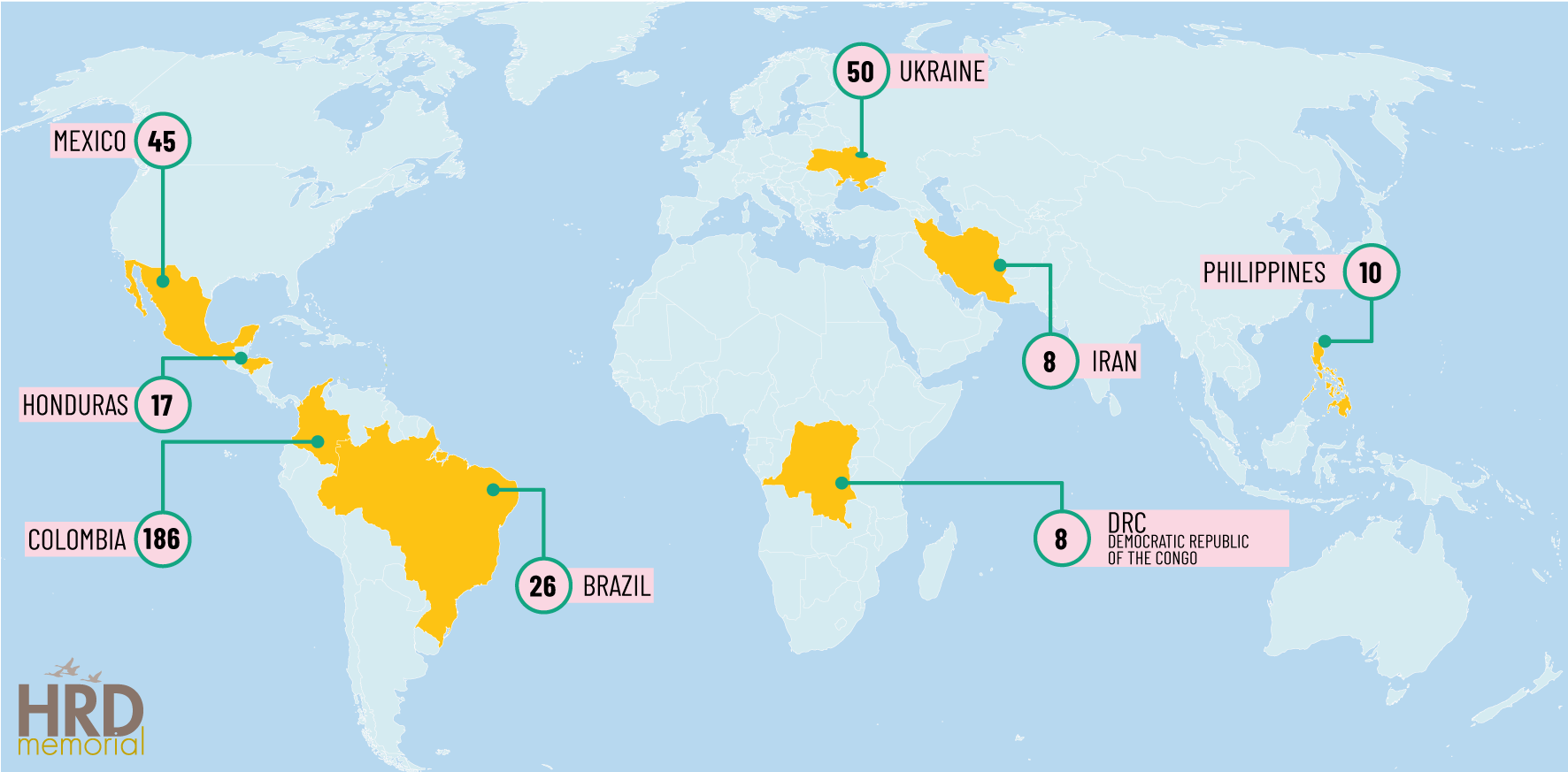
The report also names 401 HRDs killed in 26 countries in 2022 compared to 358 HRDs killed in 35 countries in 2021 – based on statistics by the HRD Memorial, a collective initiative of human rights organisations working to collect and verify data on the killings of HRDs each year.
“In a grim milestone, for the first time we saw more than 400 targeted killings of human rights defenders in 2022. While Latin America remained the deadliest region in the world for human rights defenders, we also saw a more dangerous landscape for defenders in the context of Russia’s full-scale invasion of Ukraine,” said Olive Moore, Interim Director of Front Line Defenders. ”These human rights defenders were deliberately targeted and killed because of their human rights work. Because they choose to speak out and challenge injustice, they paid for it with their lives.”
Five countries – Colombia, Ukraine, Mexico, Brazil and Honduras – accounted for over 80% of killings, according to HRD Memorial data. Colombia alone accounted for 46% of the total, with at least 186 killings documented and verified by HRD Memorial partner Somos Defensores to date. Defenders working on land, indigenous peoples’ and environmental rights were the most frequently targeted sector, accounting for almost half (48%) of the total killings.
In the context of Russia’s full-scale invasion of Ukraine, defenders engaged on humanitarian response and human rights journalists were also specifically targeted, with at least 50 documented killings by Russian military forces.
Wide array of threats
Global Analysis 2022 data is based on more than 1,500 threats and violations reported to Front Line Defenders, and is disaggregated by region, type of threat, sector of human rights work and gender.
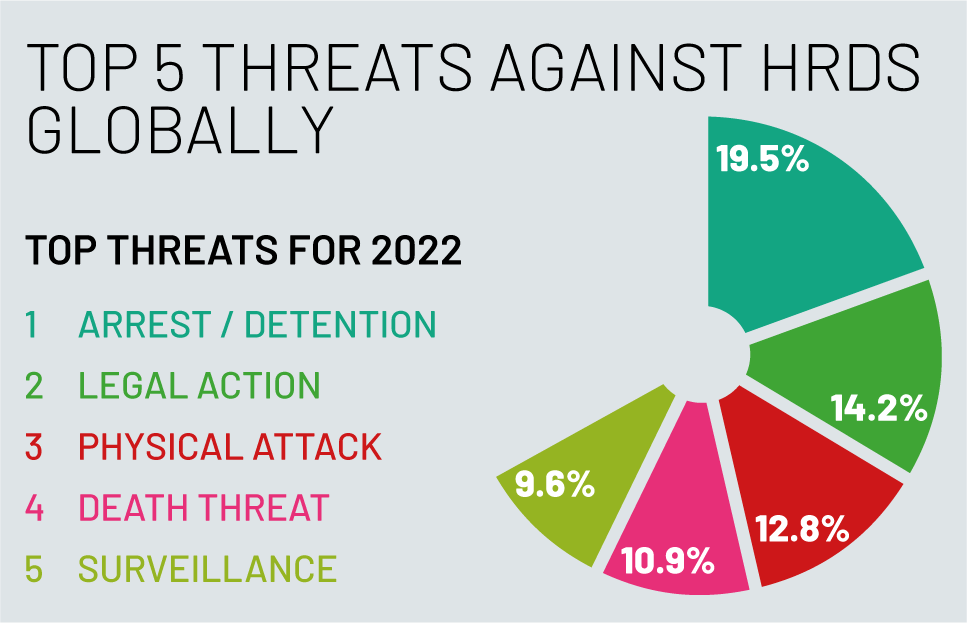
The main threats HRDs reported to Front Line Defenders in 2022 included: arrest or detention (19.5%); legal action (14.2%); physical attack (12.8%); death threats (10.9%); and surveillance (9.6%). In Asia and the Americas, death threats were the most frequent violation against defenders; in Africa it was arrest and detention; while in ECA and MENA it was legal action against HRDs.
Women HRDs (WHRDs) were frequently targeted with death threats, which accounted for the third most common violation against them. Physical violence was the most prevalent violation reported by trans and gender variant/gender nonconforming HRDs.
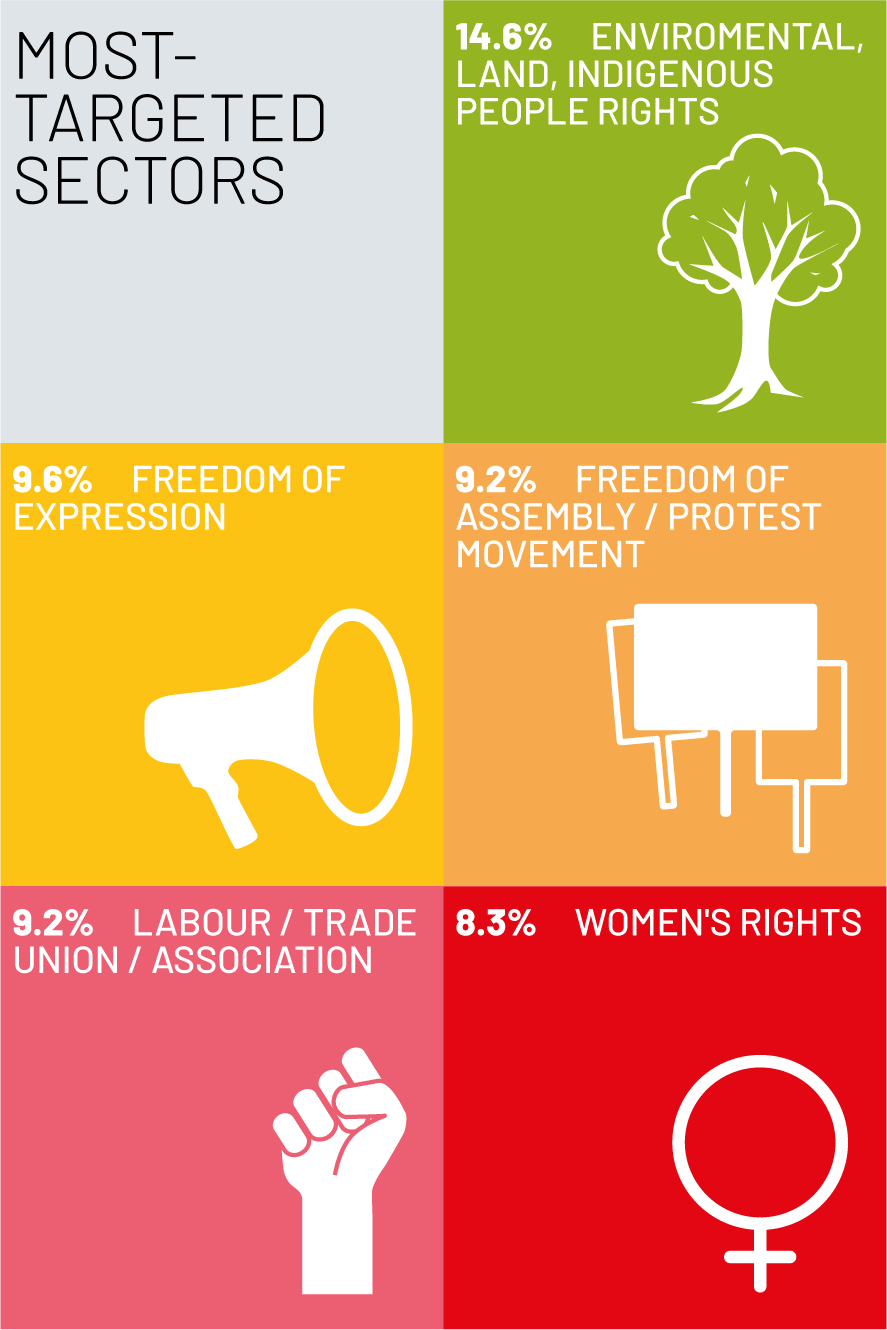
The five most targeted sectors of human rights defence were: environmental, land and indigenous peoples’ rights (11%); freedom of expression (10%); protest movement/ freedom of assembly (9%); women’s rights (7%); and impunity and access to justice (6%).
About the data on killings: Front Line Defenders manages the collection of partner-verified data-sets under the HRD Memorial umbrella. The partners in the HRD Memorial are: ACI-Participa (Honduras); Amnesty International; Comité Cerezo (Mexico); FIDH; Front Line Defenders; Global Witness; Human Rights Defenders’ Alert – India; Karapatan (the Philippines); OMCT; El Programa Somos Defensores (Colombia); Red TDT (Mexico); and UDEFEGUA (Guatemala).
About the data on other violations against HRDs: This is derived from 1,583 reported threats and violations, based on Front Line Defenders’ urgent actions and approved grants between 1 January and 31 December 2022. For more details, see the Methodology section of the report.
Anuja Pathak was in Guatemala for a year, escorting threatened rights activists for International Peace Brigades. (Credit: Geneva Solutions/ML)
Michelle Langrand in Geneva Solutions of 1 July 2022 did a lengthy portrait of Anuja Pathak, the 27-year-old who had just returned from spending one year in Guatemala as an international observer for Peace Brigades International (PBI). The NGO provides protection to threatened human rights defenders in different Latin American countries and other regions by stationing volunteers whose presence is meant to discourage attacks. See also: https://humanrightsdefenders.blog/2021/01/04/we-start-2021-with-a-long-read-about-non-violence-and-pbi/
Along with other young volunteers, Pathak was sent to Guatemala to accompany indigenous and peasant rights groups persecuted for resisting mining, hydroelectric and farming projects in their lands. The Central American region, and particularly Guatemala carry a history of violent repression against land rights defenders. In 2020, the country ranked seventh worldwide in killings of environmental activists, according to the NGO Global Witness.
Pathak and her colleagues were based in Guatemala City, the national capital, and would oversee several organisations. Most of them were a six or eight hours ride away in the rural regions of Verapaces. The volunteers would make weekly visits and were on call 24/7 in case they were contacted by one of the NGOs.
“I’m a light sleeper,” Pathak says, in between laughs. Taking a more serious tone, she tells of the emergencies that they’re expected to handle citing the example of the Association of Neighbours of Chicoyogüito, Alta Verapaz (AVECHAV) – an organisation that she grew fond of.
Massacred and kicked out of their lands by the army in the 1980s, the group is still fighting to recover their territory. One night, the volunteers got a call, Pathak remembers.
“Members of AVECHAV had tried to take over one piece of land, and they had been arrested and taken into custody for trespassing, including children,” she explains.
“It’s a complex situation because we don’t support the fact that they trespassed, but we have to make sure that their rights are respected.”
The volunteers then call the police to obtain information and activate their network of organisations and embassies in order to raise the alarm, all in the hopes that international attention will deter authorities from abusing those in custody.
In the remote rural areas where these rights groups are based, impunity is rampant and criminalisation of human rights defenders has been institutionalised. One of the other organisations PBI supports, the Peasant Committee of Altiplano (PCA), has over 300 members with arrest warrants on them and seven in prison, according to their own figures. The Q’eqchi’ indigenous group has been in a land dispute with the government and business landowners for over 100 years.
Imelda Teyul, leader of PCA, gave a chilling account last month in Geneva about the harassment and abuse she and other members went through when they visited their imprisoned colleagues.
Pathak’s job was to accompany some of the defendants during their trials. “A lot of times you go to court, and you just wait for hours. I think I went to more court hearings that were postponed than those that went through. It’s part of the process of criminalisation in order to cause frustration,” she says, sharing the feeling.
In recent years, Guatemala has passed increasingly restrictive laws against civil society. The latest, the law of NGOs, gives the government the power to shut down any organisation that uses external funds to “alter public order”.
“It’s obviously a law that seeks to restrain the work of organisations,” Pathak stresses. It has also made it harder for organisations like PBI. Set up in the 1980s and inspired by Gandhi’s non-violence movement, PBI follows a non-partisan approach and abstains from making public statements.
“We would take measures in order to mitigate these risks, for example, by being very careful to always present clearly the work of PBI to avoid confusions.”
Questioning international aid
Brought up in Birmingham by Swiss and Indian parents, Pathak was drawn to the world of international aid. Before going to Guatemala, she worked in Tunisia, Lebanon and Palestine with refugee and minority rights organisations. She had also volunteered in refugee camps in Calais and Greece.
“In the jungle refugee camp, there was a massive feeling of community, and people supported each other, whereas other camps organised by the UN or other international organisations have a different feeling,” she says.
Through her different experiences, Pathak found herself interested in grassroot organisations, the topic of her bachelor’s degree thesis from the University of Leeds, and questioning the role of big international organisations in conflict-affected zones.
“The field of international development is crazy in the sense that we have countries supporting other countries, while also causing issues in those countries. It is ultimately based on racism and unequal wealth distribution. I was curious to understand how international organisations could change those power dynamics, rather than exacerbate them,” she reflects.
In Guatemala, Pathak got to experience a more horizontal approach, where the international organisation is only there to support local actors. “What will I take from this experience is the importance of a collaborative approach with different organisations and embassies and how that’s the only way to make changes,” she says.
• Most of the victims are targeted because they clash with the interests of illegal armed groups, including drug trafficking gangs, according to Colombia’s human rights ombudsman.
• The victims include 28 land rights and community rights activists, nine indigenous activists and four farming activists, Colombian newspaper El Tiempo reports.
A total of 52 Colombian human rights activists and community leaders have been killed in the first three months of this year, authorities say.
It is a significant increase from 2021, which saw 145 murders all year.
Most of the victims are targeted because they clash with the interests of illegal armed groups, including drug trafficking gangs, according to Colombia’s human rights ombudsman.
The country is one of the world’s most dangerous for activists, monitors say.
The victims include 28 land rights and community rights activists, nine indigenous activists and four farming activists, Colombian newspaper El Tiempo reports. Of the victims, 48 were men and four were women.
One of the most shocking cases was that of Breiner David Cucuñame, a 14-year-old indigenous activist who was shot dead in January while on patrol with an unarmed group that seeks to protect indigenous lands.
Colombia is officially at peace after signing a deal with the largest rebel group, the Revolutionary Armed Forces of Colombia (Farc), in 2016. But other armed gangs continue to operate in the country, the world’s largest cocaine producer.
Violence started increasing towards the end of last year due to disputes over territory and resources involving dissident Farc rebels and members of another Marxist guerrilla group – the National Liberation Army (ELN) – as well as right-wing paramilitary groups and criminal gangs such as the Gulf Clan.
“The homicides against social leaders and human rights defenders seriously affect the foundations of democracy,” said Carlos Camargo, the human rights ombudsman.
On 21 April 2022 Christen Dobson, Ana Zbona and Andrea Pelliconi of the Business & Human Rights Resource Centre wrote a piece entitled: “Safe, legitimate engagement between firms, human rights defenders key to a just transition“
..Human rights defenders are vital leaders of a just transition to green economies. They are on the front lines of the climate crisis – and they hold essential information on the risks and harms associated with business actions, which can be used by companies and investors to conduct effective environmental and human rights due diligence to create long-term value.
Yet, these defenders are under sustained attack. In 2021, there were at least 615 attacks against people raising concerns about business-related harms, with nearly 70 per cent of attacks against climate, land and environmental rights defenders. Since January 2015, we have documented more than 3,870 attacks globally, including killings, death threats, arbitrary detention and strategic lawsuits against public participation.
One of the main drivers of this violence is the failure of companies and investors to engage in safe and legitimate consultation with rights-holders and defenders. This failure stands to derail the fast transition to a zero-carbon economy that we urgently need.
That’s the case even in the sector most crucial to the transition: our 2021 Renewable Energy Benchmark, we found that of the 15 of the largest global renewable energy companies evaluated, all scored zero on their commitment to respect the rights of human rights and environmental defenders.
The urgently needed global transition to green economies will only be successful if it is sustainable and just. This means respecting the rights of the people at the forefront of protecting our earth and raising the alarm about harmful business practices.
We have seen this failure to secure consent from affected communities prior to starting development projects lead to horrific outcomes. On 30 December 2021, police officers in the Philippines raided an Indigenous village, killing nine leaders. Local groups said that those killed were targeted and red-tagged because of their opposition to the Jalaur Mega Dam construction. Indigenous groups had challenged the project for years saying it would destroy their ancestral domain.
Meanwhile, in Mexico, an Indigenous Zapotec community has been raising concerns about wind farm construction not respecting their rights to self-determination and free, prior, and informed consent. Leaders have faced stigmatisation and harassment. In October 2018, a federal court in Mexico delivered a historic ruling in favour of the community, ordering the Mexican authorities to carry out a consultation at a wind farm operated by a state-owned company based in Europe. In October 2020, the community filed a civil lawsuit in Paris against the company.
Engaging with rights-holders and defenders early on is one of the most effective ways of identifying actual and potential human rights and environmental impacts, while also reducing business risks. It is also their responsibility under the United Nations Guiding Principles on Business and Human Rights.
For human rights due diligence processes to be effective, companies and investors can start by making clear they will not tolerate any attacks to defenders related to their operations, value chains or investments, communicating this publicly and to their suppliers and business partners. Companies should also conduct due diligence across their entire value chains, as the biggest risks and harms to people and planet occur in the lower tiers…
Throughout the entire due diligence process, companies should engage in ongoing consultation with rights-holders and defenders, including prior to and at every stage of business activity, and integrate their input into decision-making.
Effective due diligence also involves conducting human rights and environmental impact assessments. The assessments should map potentially affected rights-holders and land and resource conflicts and by informed by rights-holders and defenders’ expertise
This is not just nice to do. Conducting safe and legitimate human rights and environmental due diligence benefits everyone and will ensure companies are more effectively achieving their climate commitments. As the UN Working Group on Business and Human Rights says, defenders need to be seen as key partners who can help businesses identify their human rights impacts, rather than being seen as obstacles to be disposed of.
The urgently needed global transition to green economies will only be successful if it is sustainable and just. This means respecting the rights of the people at the forefront of protecting our earth and raising the alarm about harmful business practices.
On 30 March 2022 CIVICUS reported on a very interesting case: On 11th March 2022, the National Assembly of Ecuador approved a bill granting amnesty to 268 people who faced prosecution for their defence of land, indigenous and environmental rights, and for their involvement in 2019 protests. The bill was approved by the plenary of the National Assembly with 99 favourable votes out of the 125 parliamentarians in attendance.
Among those benefitted by the amnesty, 153 are land defenders, 43 are environmental activists, 12 are Indigenous leaders criminalised for administering Indigenous justice and 60 others were more generally facing charges related to their involvement in the October 2019 demonstrations. Several defenders, such as Gabriela Fraga, Nancy Simba, Ángel Punina, Javier Ramírez and Jovita Curipoma, were cleared of charges related to resistance against extractive industries. Civil society groups also highlighted the case of Víctor Guaillas, a water defender who had been detained on charges of ‘sabotage’ in 2019, for whom amnesty came too late. Guaillas was one of the 62 people murdered in November 2021 amid a riot in a Guayaquil prison.
Ecuador’s Human Rights Alliance (DDHH) called the move a “historical precedent against the criminalisation and prosecution of rights defenders.” In a statement, the coalition said that this amnesty “means vindicating the right to truth and justice for those who exercise the right to defend human rights” in a context of recurrent criminalisation of these actors.
In a separate but related development, in December 2021 President Guillermo Lasso had made stigmatising statements about social movements and Leonidas Iza, the president of the Indigenous confederation Confederación de Nacionalidades Indígenas (CONAIE). Iza and former CONAIE president Jaime Vargas were among those facing prosecution related to October 2019 protests, and were both granted amnesty in March 2022.
On 21st December 2021, during a weekly broadcast programme in which he discusses government initiatives, Lasso called Iza “an anarchist” and “a violent man,” and claimed that the Indigenous leader “hates democracy.” The President accused the CONAIE leader of incentivising violence during the October 2019 protests. Lasso also said his government would use all the power of the state to jail “those who want to anarchise this country, disrupt public services, and deepen an economic crisis that has already been affected by the pandemic.”
On 22nd December 2021, the DDHH issued a statement expressing solidarity with the Indigenous movement and Leonidas Iza. The coalition said that Guillermo Lasso’s “violent and contemptuous discourse stigmatises the work carried out by social and political leaders, social and Indigenous movements, and makes unfounded and reckless attacks against Leonidas Iza.”
Lasso repeated his statements in a programme aired on 4th January 2022, calling Iza “an enemy of Ecuadorean democracy.”
On 27th January 2022, Ecuador’s Constitutional Court confirmed the violation “of the rights to prior consultation, to nature, water, a healthy environment, culture and territory, as well as comprehensive reparation measures”, regarding the A’i Cofán Indigenous people of the Sinangoe community in relation to mining concessions that affected their ancestral territory without their free, prior and informed consent. In their ruling, the country’s highest court reaffirmed the state’s obligations in consultation processes on plans and projects that affect Indigenous peoples’ rights and interests.
Indigenous communities and organisations have led the international campaign “Who Should Decide?”. Just days before this court ruling, they delivered more than 365,000 signatures to the Constitutional Court asking the Court to protect the right of Indigenous peoples to decide on the future of their ancestral territories.
International group Amazon Frontlines said that the Constitutional Court ruling recognises “for the first time, the right of Indigenous communities to have the final decision over oil, mining and other extractive projects that affect their lands.” The organisation also evaluated that Ecuador “now has one of the most powerful legal precedents in the world on the internationally recognised right of Indigenous peoples to Free, Prior and Informed Consent.”
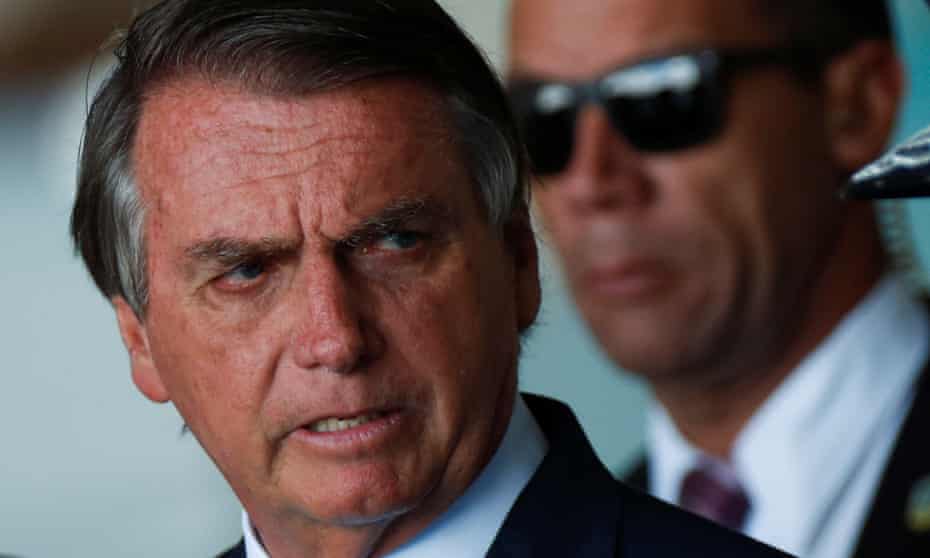
Indigenous leaders said Jair Bolsonaro had spent three years promoting legislation that would open their territories to commercial development. Photograph: Adriano Machado/Reuters
Tom Phillips on 17 March 2022 reported how the Brazilian Government honours a president who activists accuse of undermining Indigenous protections.
Brazilian activists are outraged after Jair Bolsonaro – who has been accused of spearheading a cataclysmic attack on Indigenous rights – was honoured by his own government for his supposedly “altruistic” efforts to protect Indigenous lives.
Bolsonaro was granted the Medal of Indigenous Merit on Wednesday in recognition of what the justice ministry called his attempts to defend Indigenous communities in the South American country.
The same honour was bestowed upon key Bolsonaro allies, including his health, defence and agriculture ministers and the hardline institutional security chief, Augusto Heleno, who has accused Indigenous activists of committing crimes against the state by criticising the government’s policies overseas.
Indigenous leaders reacted to the award with disbelief and exasperation, noting how Brazil’s far-right president had spent three years undermining its Indigenous and environmental protection agencies, Funai and Ibama, and promoting legislation that would open Indigenous territories to commercial development.
The Articulation of Indigenous Peoples of Brazil criticised the government’s “contemptuous gesture”. “They want to destroy us at all costs and, as if that wasn’t enough, they now want to pay tribute to themselves in our name?” the group said, claiming Bolsonaro deserved only “the medal of Indigenous genocide”.
“Now he wants to use the Ukraine war [as justification] for allowing mining, oil and gas exploration, hydroelectric dams and soy plantations on Indigenous lands,” Korap added, in reference to recent moves to fast-track draft legislation allowing such activities.
Alessandro Molon, the lower house leader of Brazil’s opposition, urged Congress to strip Bolsonaro of the medal. “It’s a mockery that the same government that is trying to legalise mining on Indigenous lands – endangering the existence of these utterly persecuted and mistreated people – has the nerve to award itself medals of ‘merit’ for all of the harm it has caused over the past three years,” Molon told the magazine Veja.
“If Congress doesn’t overrule this absurdity it will be associating itself with this unprecedented assault on Indigenous people,” Molon said.