Civil society actors across the world frequently operate in challenging or hostile environments in their efforts to defend human rights. The World Organisation Against Torture (OMCT) supports members of the SOS-Torture network, along with local actors, working to end torture and impunity and to support the rehabilitation of victims. We provide support by:
Engaging in joint activities and campaigns.
Sharing expertise and capacity-building opportunities.
Providing financial support to local actors, individuals, organisations, and initiatives, primarily outside the European Union.
This assistance enables them to carry out their crucial work in defending human rights and ending torture.
Our activities in support of the human rights movement are made possible by the generous contributions of our donors.
On January 12, 2024, Thomas Antkowiak in Just Security reflects on dangers of HRDs in Mexico and Latin america generally, motivated by the fate of his friends Ricardo and Antonio Díaz Valencia.
…Strategic use of the legal mechanisms—bolstered by the research and financial resources, political leverage, reputations, and media connections of Northern institutions—can be very effective to obtain remedies for victims of rights violations, and even to bring about legal reform and structural change. But the methods are toothless, and even misguided, without partners like Ricardo, the expert local attorneys. Truly, without such counterparts, this kind of human rights project lacks legitimacy. Without sustained connections to the affected communities, it would become just another decree handed down from the ivory tower.
In our isolated and polarized world, virtual meetings may have increased productivity in international lawyering, but they can further insulate us—cutting off deeper engagements to our clients abroad and the communities we hope to work with. In contrast, frontline defenders are fully connected and, of course, face all the risks. Authoritarian governments, criminal organizations, and complicit transnational corporations are all closing in. Can we still sense their peril?
If these human rights advocates are in more jeopardy than ever, so are the human rights themselves. Frontline defenders are the torchbearers of the international human rights movement. As such, they deserve the honors, the funding, and the protection. For the work to continue, we urgently need to do our part: the Global North’s human rights organizations, governments, universities, foundations, and businesses must coordinate to shield and support them.
Certainly, someinstitutions are already doing good work. Where to redouble our efforts? First, let’s ask the defenders themselves what they most need, recalling that their role is primary and their safety paramount. In the case of Mexico, there is almost total impunity for these types of cases. If the cartels, corrupt officials, and their accomplices cannot be held accountable, the killings will continue unabated (and thousands will keep fleeing from the violence to the southern U.S. border). When the defenders’ work becomes too hazardous, asylum must be streamlined—and the opportunity forever preserved. U.S. legislation and political pressure on Mexico play key roles here. So does divestment from colluding transnational corporations.
Every day, I wish that we could have somehow prevented the disappearance of my cherished friend and long-time collaborator. Through various channels, Global Rights Advocacy, other colleagues, and my clinic continue to push the Mexican government to find Ricardo and Antonio, and to prosecute the case. The world cannot afford the loss of another Ricardo, Berta Cáceres, Thulani Maseko. Without such guiding lights, we won’t be marking another 75 years of the international human rights movement.
The international community must pursue pathways for justice at the international level to address systemic impunity for Iranian officials responsible for hundreds of unlawful killings of protesters and widespread torture, Amnesty International said on 13 September 2023, as Iran marks the one-year anniversary of the “Woman Life Freedom” uprising.
Over the past year, Iranian authorities have committed a litany of crimes under international law to eradicate any challenge to their iron grip on power. These include hundreds of unlawful killings; the arbitrary execution of seven protesters; tens of thousands of arbitrary arrests; widespread torture, including rape of detainees; widespread harassment of victims’ families who call for truth and justice; and reprisals against women and girls who defy discriminatory compulsory veiling laws.
“The anniversary of the ‘Woman Life Freedom’ protests offers a stark reminder for countries around the world of the need to initiate criminal investigations into the heinous crimes committed by the Iranian authorities under universal jurisdiction. Government statements calling on the Iranian authorities to halt the unlawful use of firearms against protesters, stop torturing detainees, and release all individuals detained for peacefully exercising their human rights remain as crucial as ever. These actions show victims they are not alone in their darkest hour.”
The anniversary of the ‘Woman Life Freedom’ protests offers a stark reminder for countries around the world of the need to initiate criminal investigations into the heinous crimes committed by the Iranian authorities under universal jurisdiction. Diana Eltahawy, Amnesty International’s Deputy Regional Director for the Middle East and North Africa
The Iranian authorities have waged an all-out assault on the human rights of women and girls over the past year. Despite months of protests against Iran’s compulsory veiling laws, triggered by the arbitrary arrest and death in custody of Mahsa/Zhina Amini, the authorities have reinstated “morality” policing and introduced a raft of other measures that deprive women and girls who defy compulsory veiling of their rights.
These include the confiscation of cars and denial of access to employment, education, healthcare, banking services and public transport. Simultaneously, they have prosecuted and sentenced women to imprisonment, fines and degrading punishments, such as washing corpses.
This assault on women’s rights is taking place amid a spate of hateful official statements referring to unveiling as a “virus”, “social illness” or “disorder” as well as equating the choice to appear without a headscarf to “sexual depravity.”
The authorities are also working on new legislation that will introduce even more severe penalties for defying compulsory veiling.
Mass arbitrary detentions and summons
During the uprising and in the months that followed, the authorities arbitrarily arrested tens of thousands of men, women and children, including protesters, human rights defenders and minority rights activists. Those arrested include at least 90 journalists and other media workers and 60 lawyers, including those representing families of individuals unlawfully killed. Scores of other lawyers were summoned for interrogations. [see e.g. https://humanrightsdefenders.blog/2023/05/11/now-it-is-the-turn-of-the-iranian-journalists-who-reported-on-mahsa-amini/]
Ahead of the anniversary, the authorities have intensified their campaign of arbitrary arrests targeting, among others, family members of those unlawfully killed, and forcing thousands of university students to sign undertakings not to participate in anniversary protests.
Execution of protesters
Over the past year, the authorities have increasingly used the death penalty as a tool of political repression to instil fear among the public, arbitrarily executing seven men in relation to the uprising following grossly unfair sham trials. Some were executed for alleged crimes such as damage to public property and others in relation to the deaths of security forces during the protests. All were executed after Iran’s Supreme Court rubber stamped their unjust convictions and sentences despite a lack of evidence and without carrying out investigations into their allegations of torture. Dozens remain at risk of execution or being sentenced to death in connection with the protests.
A crisis of impunity
The authorities have refused to conduct any thorough, independent and impartial investigations into the human rights violations committed during and in the aftermath of the “Woman Life Freedom” uprising and have failed to take any steps to hold those suspected of criminal responsibility to account.
Instead, authorities have applauded the security forces for suppressing the unrest and shielded officials from accountability, including two officials who admitted raping women protesters in Tehran. They have also dismissed complaints from victims and/or their families, threatening them with death or other harm if they pursued their complaints.
Amnesty International welcomed the establishment of a Fact-Finding Mission on Iran by the UN Human Rights Council in November 2022, yet much more is needed to combat the crisis of impunity for serious crimes in Iran – and to deter further cycles of bloodshed.
Amnesty International urges all states to consider exercising universal and other extraterritorial jurisdiction in relation to crimes under international law and other serious human rights violations committed by Iranian authorities, irrespective of the absence or presence of the accused in their territory. This includes initiating adequately resourced criminal investigations aimed at disclosing the truth about the crimes, identifying those suspected of responsibility, including commanders and other superiors and issuing, when there is sufficient admissible evidence, international arrest warrants. States should also contribute to achieving reparations for the victims.
The arrested suspects, Defense Minister General Guillermo García and Colonel Francisco Antonio Morán, will be arraigned on Monday before a judge in Chalatenango. El Salvador has also requested the U.S. to extradite Colonel Mario Reyes Mena, another suspect in the case who is believed to be the main person responsible for the murders.
The case concerns the murder of four Dutch journalists who worked for the now-defunct public broadcaster IKON: Koos Koster, Jan Kuiper, Joop Willemsen and Hans ter Laag. They traveled to El Salvador in 1982 to report on families living in the guerrilla zone during the country’s 12-year civil war. They were ambushed and shot on March 17, 1982 by the Salvadoran army.
A 1993 UN Commission of Inquiry marked Colonel Reyes Mena as “responsible for planning the ambush and assassination,” according to Zembla. That same year, an amnesty law was passed in El Salvador, which meant that Reyes Mena could not be prosecuted in that country. The criminal investigation into the murders of the four Dutch journalists was launched in 2013 and El Salvador’s amnesty law was lifted in 2016. The result was that perpetrators of crimes during the Salvadoran Civil War can now be prosecuted.
Reyes Mena, now in his 80s, was discovered to be living in the U.S. in 2018. “The case has already been investigated, I have never been charged. You are part of a communist plan to retaliate,” Reyes Mena told Zembla journalists who confronted him about the murders.
According to Zembla, a Dutch justice is being dispatched to the Central American country to speak with the arrested suspects.
On August 15, 2022, the Attorney General’s Office formally notified the Justice Ministry’s Department of Special Investigation (DSI) of its decision to indict four park officials accused of abducting and murdering Porlajee “Billy” Rakchongcharoen in April 2014. The charges include illegal confinement, premeditated murder, and concealing the victim’s body.
“Thai officials have long hindered justice for Billy through cover-ups and exploitation of legal loopholes,” said Elaine Pearson, acting Asia director at Human Rights Watch. “The authorities can right this wrong by ensuring that the attorney general’s decision to indict four officials moves promptly to an effective and fair prosecution.”
Billy was last seen on April 17, 2014, in the custody of Chaiwat Limlikitaksorn, then-head of Kaeng Krachan National Park in Phetchaburi province, and his staff. The park officials said they released him after questioning him briefly and had no information regarding his whereabouts. On September 3, 2019, DSI officials announced that his remains had been found in Kaeng Krachan National Park. Chaiwit was among the four indicted.
Pinnapa Prueksapan, Billy’s wife, told Human Rights Watch that she hoped there would be answers to basic questions, such as who had abducted and killed her husband, and who had obstructed justice.
Thailand is obligated under international human rights treaties to which it is a party to investigate and appropriately prosecute enforced disappearance, torture, custodial deaths, and other alleged human rights violations. In addition, in September 2019, Prime Minister Gen. Prayut Chan-ocha ordered the Department of Special Investigation to ensure that the case was watertight so the culprits could be brought to justice, regardless of their rank or position.
However, the investigation has suffered from a cover-up, Human Rights Watch said. Despite a long list of allegations against Chaiwat for serious abuses and misconduct during his tenure as head of Kaeng Krachan National Park, he has never been held to account.
In addition, Thai law does yet not recognize enforced disappearances as a crime. Human Rights Watch has repeatedly urged Prime Minister Prayut and his government to ratify the International Convention for the Protection of All Persons from Enforced Disappearance, which Thailand signed in 2012, and make enforced disappearance a criminal offense.
Chaiwat and his staff arrested Billy on April 17, 2014, for alleged illegal possession of a wild bee honeycomb and six bottles of honey.
At the time of his enforced disappearance, he was traveling to meet with ethnic Karen villagers and activists in preparation for an upcoming court hearing in the villagers’ lawsuit against Chaiwat and the National Park, Wildlife, and Plant Conservation Department of the Ministry of Natural Resources and Environment.
The villagers alleged in the lawsuit that, in July 2011, park authorities had burned and destroyed the houses and property of more than 20 Karen families in the Bangkloy Bon village. Billy was also preparing to submit a petition about this case to Thailand’s monarch. When he was arrested, he was carrying case files and related documents with him. Those files have never been recovered.
In September 2014, Police Region 7 officers filed malfeasance charges under article 157 of the penal code against Chaiwat and three other park officials for unlawfully detaining him. The other suspects named in the case are Boontaen Bussarakham, Thanaseth or Pitoon Chaemthes, and Krissanapong Jitthes. The DSI found traces of human blood in a vehicle belonging to the park office, but was not able to verify if the blood belonged to Billy because the vehicle was cleaned before forensic experts could examine it.
On September 3, 2019, the DSI announced that his remains had been found in Kaeng Krachan National Park, where he was last seen in custody of the park officials. The investigation team found an oil barrel, its lid, two steel rods, a burned wooden piece, and two bones at the bottom of the reservoir on April 26, 2019.
The Central Institute of Forensic Science subsequently confirmed the genetic trace of one of the bones found inside the barrel matched Billy’s mother. The investigation team then concluded it was part of his remains. The condition of this piece of human skull, which was burned, cracked, and shrunk due to exposure to heat of 200 to 300 degrees Celsius, suggests the killers burned his body to conceal the crime.
“The indictment of Chaiwat and other park officials is an important step for justice for Billy and all those whom Thai government officials have forcibly disappeared and killed,” Pearson said. “Thai authorities should recognize that they can’t escape being held accountable for the most heinous crimes.”
Commissioner of police Christian Ngoy Kenga Kenga was found guilty of murder, desertion and misappropriation of weapons and ammunition. Mr Chebeya’s body was found bound and gagged in his car in Kinshasa.
There is a moratorium on capital punishments in DR Congo. However, the death penalty has not been abolished and military courts continue to hand down such sentences.
Another policeman, Jacques Migabo, was also sentenced to 12 years during the trial. He admitted to having strangled Mr Chebeya and his driver, Fidèle Bazana.
Police commissioner Paul Mwilambwe, who had been a key witness in the trial, was acquitted, UN-sponsored Radio Okapi says.
Mr Mwilambwe, who had been a fugitive since the murder and was only repatriated last year, named ex-President Joseph Kabila and the former head of police General John Numbi, as having ordered the killing. Neither Mr Kabila nor Gen Numbi have commented publicly, but a military court has charged the general with the murder of Mr Chebeya and his driver. He has fled the country and his current whereabouts are not known.
Kenga, Migabo and Mr Mwilambwe were initially sentenced to death in 2011, with Kenga arrested in 2020 in the southern city of Lubumbashi before the case was re-opened last September. Floribert Chebeya led the Congolese charity Voice of the Voiceless, and as a prominent critic of the government received regular death threats during his career of more than 20 years. See also: https://www.trueheroesfilms.org/thedigest/laureates/BA601D45-292F-61CB-530A-17FE52D5F974
He went to the police headquarters to meet the then head of the national police force, Gen Numbi, on the day he was killed. His driver Mr Bazana also went missing that day with authorities later pronouncing him dead.
HURIDOCS has been working with urgency to meet the needs of our Ukrainian partners to enable effective, comprehensive and safe documentation of human rights violations. The HURIDOCS Team on 19 April 2022 tells how:
A maternity ward and children’s hospital are hit by an airstrike. Schools and apartment blocks are shelled. A psychiatric facility is attacked. Residential areas are targeted by cluster bombs. Critical infrastructure is struck by missiles. Mass civilian graves are discovered.
These horrendous attacks on civilians in Ukraine, some of them on healthcare facilities, are labelled by the United Nations as ‘acts of unconscionable cruelty’. Russia’s invasion of Ukraine, which started on 24 February 2022, is unfolding as a series of atrocities committed against civilians.
Indiscriminate attacks using missiles, heavy artillery shells, rockets and airstrikes on civilians and non-combatants are in contravention of international humanitarian law and may amount to war crimes. Apart from attacks on civilians, Russia is reported to be shelling agreed-upon humanitarian corridors from conflict zones and therefore halting mass evacuations.
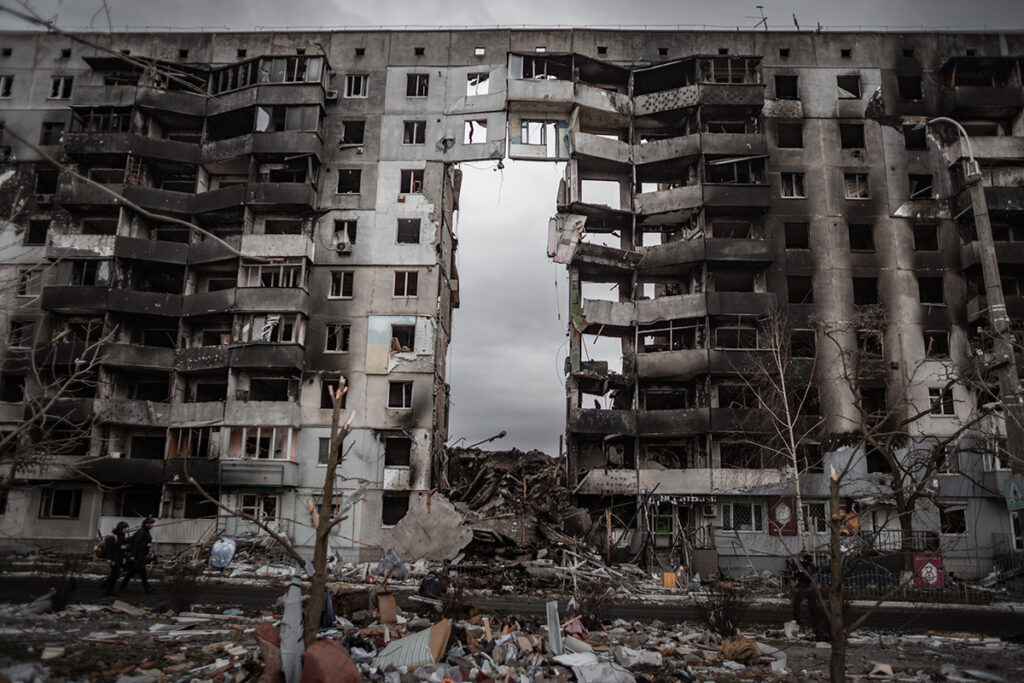
Borodyanka, a Ukrainian commuter town near Kyiv, was among the first places to be hit by Russian airstrikes.
Kyiv Declaration calls for support to groups actively documenting violations
Leaders of more than 100 Ukrainian civil society organisations have published the Kyiv Declaration, which defines the invasion as “a war against the fundamental principles of democracy”. The #KyivDeclaration asks for solidarity and immediate action, and outlines six urgent appeals to the international community. The organisations are collectively calling for the creation of safe zones in Ukraine, military aid, sanctions against Russia, humanitarian aid, freezing assets and revoking visas of prominent Russian families, and providing equipment to track war crimes. This includes technology and support to groups who are actively documenting the events in Ukraine, as well as human rights groups and lawyers who will be supporting accountability efforts in the long run.
An appeal from 100 Ukrainian civil society leaders
HURIDOCS has been working with urgency to meet the needs of our Ukrainian partners to enable effective, comprehensive and safe documentation of human rights violations.
“When Russia started its full-scale invasion in February this year, we revived the work of EuromaidanSOS. We are faced with a large number of war crimes that need to be documented. Among these are indiscriminate attacks on civilians and civilian objects, deliberate killings, torture, cruel and inhumane treatment, enforced disappearances and other crimes listed in the Rome Statute. Such acts are not justified by any circumstances of the war. Russia is simply using war crimes as a way of waging war.
Our volunteers from EuromaidanSOS are based in different parts of the country, and some of them work directly in hot spots, where they face constant connectivity issues. This is why usable technical solutions are indispensable. As this work is undertaken in the context of war, it is important to have qualified technology support. We are very grateful to the organisations, such as HURIDOCS, providing it in this difficult time for us.”– Oleksandra Matviychuk, Head of the Center for Civil Liberties and Board Member of HURIDOCS
Documenting violations is vital for accountability
Four days into the Russian invasion, the International Criminal Court (ICC) Prosecutor opened an investigation into war crimes being committed in Ukraine. In conjunction with the investigation, the ICC launched a contact portal and anyone with relevant information is urged to come forward and share the details with the ICC. The United Nations Human Rights Council expressed that it is gravely concerned about the escalating human rights and humanitarian crisis and passed a resolution to establish a Commission of Inquiry. The Commission will first and foremost collect evidence of violations and those responsible, and subsequently submit reports to the Human Rights Council and General Assembly. The Federal Prosecutor’s Office in Germany has launched an investigation by collecting evidence of suspected crimes on civilians and critical infrastructure. Germany’s probe is based on the principle of universal jurisdiction, which allows countries to prosecute crimes against international law outside of its borders.
The United Nations High Commissioner for Human Rights released a statement where she expressed horror by the images of civilian bodies on the streets and in improvised graves in the town of Bucha. She stated that reports of egregious crimes raise serious questions about possible war crimes and grave breaches of international and humanitarian law. She urged that “it is vital that all efforts are made to ensure there are independent and effective investigations into what happened in Bucha to ensure truth, justice and accountability, as well as reparations and remedy for victims and their families”.
In addition to these and other measures already underway to investigate possible war crimes and breaches of international and humanitarian law, some of the most authoritative civil society organisations in Ukraine have established a global initiative to seek justice and hold perpetrators accountable. The ‘Breaking the Vicious Circle of Russia’s Impunity for Its War Crimes’ initiative was jointly established by the Ukrainian Helsinki Human Rights Union, the Kharkiv Human Rights Protection Group and the Center for Civil Liberties, and is also known as the ‘Tribunal for Putin’.
The Tribunal for Putin aims to document events which can be classified as genocide, crimes against humanity and war crimes under the Rome Statute of the International Criminal Court. The Tribunal for Putin will also collect evidence and facts on the crimes committed and will work with existing international mechanisms of the United Nations, Council of Europe, OSCE, EU and the International Criminal Court. The initiative has called for support from various actors such as international organisations, networks, government agencies, public associations, volunteer initiatives and groups who all share the common goal of restoring peace in Ukraine and ensuring that justice will prevail.
Civil society plays a crucial role in seeking justice
In this context, it is clear that the systematic documentation of human rights violations, irrespective of who is committing the transgression, is critical to achieving justice and accountability. Documentation should not only be undertaken to assist future justice and accountability mechanisms but also to support the process of reckoning and healing.
Civil society plays a key role in efforts to document and monitor violations, and to build and strengthen cases for accountability. Civil society actors are usually the first to respond to crises, have the deepest community reach and can mobilise the people who are living through these experiences. Documenting human rights violations as they happen is imperative in the process of restoring justice. To effectively and safely assist the community there is a need for strong digital tools to gather, process, preserve, manage, protect and analyse the rapidly growing bodies of potential evidence, including large amounts of storage-intensive video. In addition, deterrence against the worst violations can also be established through credible documentation strategies.
HURIDOCS is a longtime supporter of civil society organisations and human rights defenders who use human rights documentation strategies and tools as a means to strengthen accountability and advocate for justice. We are already supporting a number of groups working on documenting human rights violations in Ukraine and HURIDOCS invites other initiatives who need support with their documentation efforts to contact us. We value diverse approaches to documenting violations, as it may strengthen accountability measures and aid in articulating narratives during the process of memorialisation.
Support for documenting violations in Ukraine
With the increased need for support to document violations in Ukraine to strengthen accountability, the Alfred Landecker Foundation has partnered with HURIDOCS to increase our capacity to support civil society-led initiatives where our expertise can be helpful. HURIDOCS is grateful to the Foundation for the support, as it comes at a time when documenting threats to peace, justice and democracy is critical. The support from the Alfred Landecker Foundation will be used to assist groups who are already participating in documentation efforts, and to aid other initiatives related to documenting violations in Ukraine.
HURIDOCS is currently supporting our partners in the following ways:
Training and consultation on information collection, protection and management techniques and associated tools, such as Uwazi;
Setting up digital information repositories to securely store sensitive data;
Refinement and integration of existing technology solutions to document, protect and analyse evidence of human rights violations; and
Hardening and scaling infrastructure to preserve and protect large amounts of information.
There is a significant and growing need to support organisations with their efforts to gather, process, preserve, manage, protect and analyse information on abuses. Reliable documentation of violations is essential for the restoration of justice in the pursuit of upholding democracy and human rights.
On 23 March 2022 the above-mentioned NGOs issued a Joint Press Release: “Hold the Myanmar military accountable for grave crimes”
“UN must explore all possible ways to prosecute Myanmar military leaders and hold them accountable for genocide and atrocity crimes” said Human Rights Defenders from Myanmar in an online event as they engaged with the UN Human Rights Council following a series of reporting on Myanmar during the Council’s 49th Regular Session.
Having so far failed to impose its rule over the territory and population, the military continues to intensify its cruel and brutal attacks against the people of Myanmar with indiscriminate airstrikes, shelling, massacres, burning down of villages, torture, and sexual and gender-based violence. In addition, the military continues to block humanitarian aid to over 880,000 displaced people across the country while attacking medical facilities and medical and humanitarian workers.
Despite the brutal violence, the Myanmar people have continued to resist the military, steadfastly demonstrating their courageous will and defense of their democracy.
Over 400,000 civil servants who have joined the Civil Disobedience Movement refuse to work under the military, while others carryout general strikes and street protests. Boycott of military products and refusal to pay electricity bills continues and self-defense forces and formation of new autonomous local administrations alongside the existing parallel administrations in ethnic areas mar the military’s desperate attempts to assert administrative and territorial control.
Responding to calls made by civil society organizations for the UN to explore avenues to prosecute Myanmar military leaders and hold them accountable for grave crimes in Myanmar, His Excellency Aung Myo Min, National Unity Government’s Minister for Human Rights expressed his support during the online event, stating, ‘The UN Secretary-General should explore the feasibility of the establishment by the General Assembly or the Human Rights Council of an ad hoc tribunal to support accountability for alleged violations of international law in Myanmar.’
Following Minister Aung Myo Min’s remarks, Marzuki Darusman of Special Advisory Council for Myanmar and Former Chairperson of the Indpendent International UN Fact-Finding Mission on Myanmar stated during the event, ‘To complement the Independent Investigative Mechanism for Myanmar, that has been in operation for the last few years, it is only logical that an entity needs to be set up that is precisely a jurisdiction that would allow the IIMM – that was established by the Human Rights Council – to undertake its next step, and that is, on the basis of preparing the ground for criminal prosecution, for the Council to decide on a jurisdiction where those prosecutions can take place.’
Human Rights Defenders also called on the UN to seek pathways for accountability. ‘International community must rally to end cycle of impunity enjoyed by the military, and call on the Human Rights Council to explore all options to establish a jurisdiction to prosecute Myanmar military for committing war crimes, crimes against humanity and genocide, and stand with the people of Myanmar in their defense of democracy,’ said Khin Ohmar of Progressive Voice.
‘We welcome US designating the brutal violence committed against the Rohingya as genocide, but this must translate into action to hold the perpetrators accountable. Failure to act on the grave crimes being committed against the people of Myanmar, past and present, will only serve to embolden the military junta,’ said Razia Sultana of RW Welfare Society.
‘The military junta continues to conduct fierce airstrikes against civilians in Karen State, as well as in Karenni, Chin, and Sagaing with total impunity. CSOs and other human rights organizations have already provided, and continue to provide, the necessary evidence of atrocity crimes committed by the Myanmar military to UN bodies. It is time for active steps to be taken by the Human Rights Council to ensure that justice mechanisms move forward without delay.’ said Naw Htoo Htoo of Karen Human Rights Group.
‘Myanmar military is burning villages to the ground, conducting mass scorched earth campaigns in towns such as Thantlang, Chin State and using rape as a weapon of war. Without concrete action to stop this military’s campaign of terror, including an arms embargo and targeted sanctions, whole villages will continue to be reduced to ashes,’ said Salai Za Uk of Chin Human Rights Organization.
‘The price of inaction is surely clear to the Members of the Human Rights Council, which has documented military’s crimes for over 15 years. Through its various mandates and mechanisms such as the Fact-Finding Mission and Independent Investigative Mechanism for Myanmar, the Council has amassed vast amounts of evidence of Myanmar military’s atrocities including the genocide against Rohingya. It is time for the Council to build on this work and explore all possible avenues to hold the military leaders accountable through criminal prosecutions,” said FORUM-ASIA.
The online Side Event during the 49th Regular Session of the Human Rights Council “Justice and Accountability for Myanmar: Expectations and Possibilities”, which took place on 22 March 2022 can be viewed here: https://www.facebook.com/progressivevoice/videos/2137679243064231
***
For a PDF version of this press release, click here
The conviction of a former Syrian intelligence officer for crimes against humanity by a German court is a ground-breaking step toward justice for serious crimes in Syria, Human Rights Watch said today. The judgment is a meaningful moment for civilians who survived torture and sexual abuse in Syria’s prisons.
On January 13, 2022, a German court delivered its judgment in the trial of Anwar R., a former member of Syria’s General Intelligence Directorate, one of the country’s four main intelligence agencies commonly referred to collectively as the mukhabarat. Anwar R. is the most senior former Syrian government official to be convicted for serious crimes in Syria.
German prosecutors accused Anwar R. of overseeing the torture of detainees in his capacity as head of the investigations section at the General Intelligence Directorate’s al-Khatib detention facility in Damascus, also known as “Branch 251.”
The judges found Anwar R. guilty of committing crimes against humanity and sentenced him to life in prison. Following the verdict in the case, Anwar R. has one week to appeal.
“More than 10 years after the violations were committed in Syria, the German court’s verdict is a long-awaited beacon of hope that justice can and will in the end prevail,” said Balkees Jarrah, associate international justice director at Human Rights Watch. “Other countries should follow Germany’s lead, and actively bolster efforts to prosecute serious crimes in Syria.”
Syrian survivors, lawyers, and activists have been central to making this trial a reality, not only pressing for justice but laying the groundwork that makes justice possible, Human Rights Watch said.
More than 80 witnesses testified, including former detainees, former Syrian government employees, German police investigators, and experts in Syrian affairs. The testimony included well-documented accounts of torture and sexual abuse in Branch 251, descriptions of mass graves, and details of Syria’s government policy to violently crack down on peaceful protesters in 2011. Several of the witnesses were able to identify Anwar R. in the courtroom.
One of the major challenges of this trial was witness protection. Several witnesses living in Germany and other European countries cancelled their appearance in court out of fear for their lives and safety, or that of their families. Several witnesses, some who were also victims, testified that they feared a risk to themselves and their families given their role in the trial. German authorities should ensure that witnesses and victims are sufficiently informed about their rights to protective measures, including to appear anonymously before the court.
Tens-of-thousands of people have been detained or disappeared in Syria since 2011, the vast majority by government forces using an extensive network of detention facilities throughout the country. The Syrian government continues to detain and forcibly disappear thousands of people.
Many of those detained have died from torture and horrific detention conditions. Comprehensive justice for these and other unchecked atrocities in Syria has been elusive. Syria is not a member of the International Criminal Court. And in 2014, Russia and China blocked efforts at the United Nations Security Council to give the court a mandate over serious crimes in Syria.
The trial of Anwar R. and Eyad A. is possible because Germany’s laws recognize universal jurisdiction over certain of the most serious crimes under international law. That allows for the investigation and prosecution of these crimes no matter where they were committed and regardless of the nationality of the suspects or victims. Universal jurisdiction remains one of the few viable pathways to justice for crimes committed in Syria.
Germany has several elements in place to allow for the successful investigation and prosecution of grave crimes in Syria. It has above all a comprehensive legal framework, well-functioning specialized war crimes units, and previous experience with prosecuting such crimes. Countries with universal jurisdiction laws should establish specialized war crimes units within law enforcement and prosecution services, and ensure that such units are adequately resourced and staffed.
“Germany’s trial against Anwar R. is a message to the Syrian authorities that no one is beyond the reach of justice,” Jarrah said. “The Koblenz case has shown that with other avenues blocked, national courts can play a critical role in combating impunity.”
As feared in November (see blog post below) Russia’s Supreme Court on Tuesday 28 December 2021 ordered the closure of Memorial International, one of the country’s most respected human rights organizations, wiping out three decades of work to expose the abuses and atrocities of the Stalinist era. Memorial is the winner of at least 7 international human rights awards: https://www.trueheroesfilms.org/thedigest/laureates/BD12D9CE-37AA-7A35-9A32-F37A0EA8C407
The court ruled that Memorial International had fallen afoul of Russia’s “foreign agent” law. But the group said the real reason for the shutdown was that authorities did not approve of its work.
The ruling is the latest blow to Russia’s hollowed-out civil society organizations, which have gradually fallen victim to Putin’s authoritarian regime.
Videos posted on social media showed Memorial supporters shouting, “Shame, shame!” in the court’s hallways and at the entrance to the building shortly after the ruling. Seven people were detained outside the courthouse following the proceedings, according to independent monitoring group OVD-Info. The organization said three of them are believed to be instigators whose sole aim was to cause havoc, not support Memorial.
Memorial International’s lawyer, Tatiana Glushkova, confirmed the ruling to CNN and said the group would appeal the decision. “The real reason for Memorial’s closure is that the prosecutor’s office doesn’t like Memorial’s work rehabilitating the victims of Soviet terror,” Glushkova told CNN.
The Prosecutor General’s Office of Russia requested Memorial International be liquidated in November. The group was accused of repeatedly breaking the law for failing to mark all its publications with a compulsory “foreign agent” warning. The Justice Ministry had designated the group a foreign agent in 2016, using a law targeting organizations receiving international funding.
Memorial’s representatives argued there were no legal grounds for the group’s closure, and critics say the Russian government targeted Memorial for political reasons.
Oleg Orlov, a member of Memorial International’s board, said the court’s decision was “purely ideological” and “a demonstrative, blatant, illegal decision.”
“Allegedly, we do not assess the Soviet Union and Soviet history the right way. But this is our assessment, we have the right to do it,” Orlov told CNN.
Memorial was founded in the late 1980s to document political repressions carried out under the Soviet Union, building a database of victims of the Great Terror and gulag camps. The Memorial Human Rights Centre, a sister organisation that campaigns for the rights of political prisoners and other causes, is also facing liquidation for “justifying terrorism and extremism”. One of the group’s co-founders was Nobel Peace Prize winner Andrei Sakharov, who went on to be the first honorary chairman of the Memorial Society.



 Hans Thoolen on Human Rights Defenders and their awards