Posts Tagged ‘impunity’

Myanmar: no impunity for the military leaders

March 23, 2022

On 23 March 2022 the above-mentioned NGOs issued a Joint Press Release: “Hold the Myanmar military accountable for grave crimes”

“UN must explore all possible ways to prosecute Myanmar military leaders and hold them accountable for genocide and atrocity crimes” said Human Rights Defenders from Myanmar in an online event as they engaged with the UN Human Rights Council following a series of reporting on Myanmar during the Council’s 49th Regular Session.

Nearly 14 months after the military launched its nationwide campaign of violence and terror in an attempt to illegally seize power, the military has killed over 2,000 people, including women and children and detained over 12,000. See also: https://humanrightsdefenders.blog/2022/02/02/myanmar-one-year-after-the-coup-only-getting-worse/

Having so far failed to impose its rule over the territory and population, the military continues to intensify its cruel and brutal attacks against the people of Myanmar with indiscriminate airstrikes, shelling, massacres, burning down of villages, torture, and sexual and gender-based violence. In addition, the military continues to block humanitarian aid to over 880,000 displaced people across the country while attacking medical facilities and medical and humanitarian workers.

Despite the brutal violence, the Myanmar people have continued to resist the military, steadfastly demonstrating their courageous will and defense of their democracy.

Over 400,000 civil servants who have joined the Civil Disobedience Movement refuse to work under the military, while others carryout general strikes and street protests. Boycott of military products and refusal to pay electricity bills continues and self-defense forces and formation of new autonomous local administrations alongside the existing parallel administrations in ethnic areas mar the military’s desperate attempts to assert administrative and territorial control.

Responding to calls made by civil society organizations for the UN to explore avenues to prosecute Myanmar military leaders and hold them accountable for grave crimes in Myanmar, His Excellency Aung Myo Min, National Unity Government’s Minister for Human Rights expressed his support during the online event, stating, ‘The UN Secretary-General should explore the feasibility of the establishment by the General Assembly or the Human Rights Council of an ad hoc tribunal to support accountability for alleged violations of international law in Myanmar.’

Following Minister Aung Myo Min’s remarks, Marzuki Darusman of Special Advisory Council for Myanmar and Former Chairperson of the Indpendent International UN Fact-Finding Mission on Myanmar stated during the event, ‘To complement the Independent Investigative Mechanism for Myanmar, that has been in operation for the last few years, it is only logical that an entity needs to be set up that is precisely a jurisdiction that would allow the IIMM – that was established by the Human Rights Council – to undertake its next step, and that is, on the basis of preparing the ground for criminal prosecution, for the Council to decide on a jurisdiction where those prosecutions can take place.’

Human Rights Defenders also called on the UN to seek pathways for accountability.
‘International community must rally to end cycle of impunity enjoyed by the military, and call on the Human Rights Council to explore all options to establish a jurisdiction to prosecute Myanmar military for committing war crimes, crimes against humanity and genocide, and stand with the people of Myanmar in their defense of democracy,’ said Khin Ohmar of Progressive Voice.

‘We welcome US designating the brutal violence committed against the Rohingya as genocide, but this must translate into action to hold the perpetrators accountable. Failure to act on the grave crimes being committed against the people of Myanmar, past and present, will only serve to embolden the military junta,’ said Razia Sultana of RW Welfare Society.

‘The military junta continues to conduct fierce airstrikes against civilians in Karen State, as well as in Karenni, Chin, and Sagaing with total impunity. CSOs and other human rights organizations have already provided, and continue to provide, the necessary evidence of atrocity crimes committed by the Myanmar military to UN bodies. It is time for active steps to be taken by the Human Rights Council to ensure that justice mechanisms move forward without delay.’ said Naw Htoo Htoo of Karen Human Rights Group.

‘Myanmar military is burning villages to the ground, conducting mass scorched earth campaigns in towns such as Thantlang, Chin State and using rape as a weapon of war. Without concrete action to stop this military’s campaign of terror, including an arms embargo and targeted sanctions, whole villages will continue to be reduced to ashes,’ said Salai Za Uk of Chin Human Rights Organization.

‘The price of inaction is surely clear to the Members of the Human Rights Council, which has documented military’s crimes for over 15 years. Through its various mandates and mechanisms such as the Fact-Finding Mission and Independent Investigative Mechanism for Myanmar, the Council has amassed vast amounts of evidence of Myanmar military’s atrocities including the genocide against Rohingya. It is time for the Council to build on this work and explore all possible avenues to hold the military leaders accountable through criminal prosecutions,” said FORUM-ASIA.

The online Side Event during the 49th Regular Session of the Human Rights Council “Justice and Accountability for Myanmar: Expectations and Possibilities”, which took place on 22 March 2022 can be viewed here: https://www.facebook.com/progressivevoice/videos/2137679243064231

***

For a PDF version of this press release, click here
Ground breaking conviction of Syrian torturer in Germany

January 17, 2022
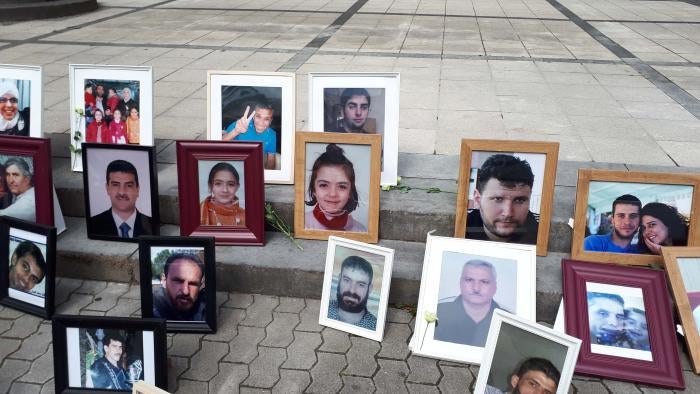
Group of framed portraits
Photos of Syrians who have been detained or disappeared set up by Families for Freedom, as part of a protest in front of the court in Koblenz, July 2, 2020. © 2020 Alexander Suttor

The conviction of a former Syrian intelligence officer for crimes against humanity by a German court is a ground-breaking step toward justice for serious crimes in Syria, Human Rights Watch said today. The judgment is a meaningful moment for civilians who survived torture and sexual abuse in Syria’s prisons.  

On January 13, 2022, a German court delivered its judgment in the trial of Anwar R., a former member of Syria’s General Intelligence Directorate, one of the country’s four main intelligence agencies commonly referred to collectively as the mukhabarat. Anwar R. is the most senior former Syrian government official to be convicted for serious crimes in Syria.  

German prosecutors accused Anwar R. of overseeing the torture of detainees in his capacity as head of the investigations section at the General Intelligence Directorate’s al-Khatib detention facility in Damascus, also known as “Branch 251.” 

The judges found Anwar R. guilty of committing crimes against humanity and sentenced him to life in prison. Following the verdict in the case, Anwar R. has one week to appeal.  

“More than 10 years after the violations were committed in Syria, the German court’s verdict is a long-awaited beacon of hope that justice can and will in the end prevail,” said Balkees Jarrah, associate international justice director at Human Rights Watch. “Other countries should follow Germany’s lead, and actively bolster efforts to prosecute serious crimes in Syria.”  

Human Rights Watch issued a question and answer document and a feature article on the trial and how it is situated in the larger context of the Syrian conflict on January 6, 2022. The trial against Anwar R. and Eyad A., who was found guilty of aiding and abetting crimes against humanity in February, began in April 2020 and was the first anywhere in the world for state-sponsored torture in Syria. Eyad A.’s appeal against his conviction remains pending. 

Syrian survivors, lawyers, and activists have been central to making this trial a reality, not only pressing for justice but laying the groundwork that makes justice possible, Human Rights Watch said.  

More than 80 witnesses testified, including former detainees, former Syrian government employees, German police investigators, and experts in Syrian affairs. The testimony included well-documented accounts of torture and sexual abuse in Branch 251, descriptions of mass graves, and details of Syria’s government policy to violently crack down on peaceful protesters in 2011. Several of the witnesses were able to identify Anwar R. in the courtroom.  

One of the major challenges of this trial was witness protection. Several witnesses living in Germany and other European countries cancelled their appearance in court out of fear for their lives and safety, or that of their families. Several witnesses, some who were also victims, testified that they feared a risk to themselves and their families given their role in the trial. German authorities should ensure that witnesses and victims are sufficiently informed about their rights to protective measures, including to appear anonymously before the court. 

Tens-of-thousands of people have been detained or disappeared in Syria since 2011, the vast majority by government forces using an extensive network of detention facilities throughout the country. The Syrian government continues to detain and forcibly disappear thousands of people. 

Many of those detained have died from torture and horrific detention conditions. Comprehensive justice for these and other unchecked atrocities in Syria has been elusive. Syria is not a member of the International Criminal Court. And in 2014, Russia and China blocked efforts at the United Nations Security Council to give the court a mandate over serious crimes in Syria. 

The trial of Anwar R. and Eyad A. is possible because Germany’s laws recognize universal jurisdiction over certain of the most serious crimes under international law. That allows for the investigation and prosecution of these crimes no matter where they were committed and regardless of the nationality of the suspects or victims. Universal jurisdiction remains one of the few viable pathways to justice for crimes committed in Syria.  

Germany has several elements in place to allow for the successful investigation and prosecution of grave crimes in Syria. It has above all a comprehensive legal framework, well-functioning specialized war crimes units, and previous experience with prosecuting such crimes. Countries with universal jurisdiction laws should establish specialized war crimes units within law enforcement and prosecution services, and ensure that such units are adequately resourced and staffed. 

“Germany’s trial against Anwar R. is a message to the Syrian authorities that no one is beyond the reach of justice,” Jarrah said. “The Koblenz case has shown that with other avenues blocked, national courts can play a critical role in combating impunity.” 

The first such reaction came immediately, see: https://www.ncr-iran.org/en/news/human-rights/after-german-conviction-of-syrian-official-focus-may-turn-to-swedish-trial-of-iranian/

https://www.hrw.org/news/2022/01/13/germany-conviction-state-torture-syria

https://www.fidh.org/en/region/north-africa-middle-east/syria/syria-landmark-ruling-offers-hope-to-regime-s-victims

https://www.ecchr.eu/en/case/first-criminal-trial-worldwide-on-torture-in-syria-before-a-german-court/

Russia’s Supreme Court orders closure emblematic Memorial

December 29, 2021

As feared in November (see blog post below) Russia’s Supreme Court on Tuesday 28 December 2021 ordered the closure of Memorial International, one of the country’s most respected human rights organizations, wiping out three decades of work to expose the abuses and atrocities of the Stalinist era. Memorial is the winner of at least 7 international human rights awards: https://www.trueheroesfilms.org/thedigest/laureates/BD12D9CE-37AA-7A35-9A32-F37A0EA8C407

The court ruled that Memorial International had fallen afoul of Russia’s “foreign agent” law. But the group said the real reason for the shutdown was that authorities did not approve of its work.

The ruling is the latest blow to Russia’s hollowed-out civil society organizations, which have gradually fallen victim to Putin’s authoritarian regime.

Videos posted on social media showed Memorial supporters shouting, “Shame, shame!” in the court’s hallways and at the entrance to the building shortly after the ruling. Seven people were detained outside the courthouse following the proceedings, according to independent monitoring group OVD-Info. The organization said three of them are believed to be instigators whose sole aim was to cause havoc, not support Memorial.

Memorial International’s lawyer, Tatiana Glushkova, confirmed the ruling to CNN and said the group would appeal the decision. “The real reason for Memorial’s closure is that the prosecutor’s office doesn’t like Memorial’s work rehabilitating the victims of Soviet terror,” Glushkova told CNN.

The Prosecutor General’s Office of Russia requested Memorial International be liquidated in November. The group was accused of repeatedly breaking the law for failing to mark all its publications with a compulsory “foreign agent” warning. The Justice Ministry had designated the group a foreign agent in 2016, using a law targeting organizations receiving international funding.

Memorial’s representatives argued there were no legal grounds for the group’s closure, and critics say the Russian government targeted Memorial for political reasons.

Oleg Orlov, a member of Memorial International’s board, said the court’s decision was “purely ideological” and “a demonstrative, blatant, illegal decision.”

“Allegedly, we do not assess the Soviet Union and Soviet history the right way. But this is our assessment, we have the right to do it,” Orlov told CNN.

Memorial was founded in the late 1980s to document political repressions carried out under the Soviet Union, building a database of victims of the Great Terror and gulag camps. The Memorial Human Rights Centre, a sister organisation that campaigns for the rights of political prisoners and other causes, is also facing liquidation for “justifying terrorism and extremism”. One of the group’s co-founders was Nobel Peace Prize winner Andrei Sakharov, who went on to be the first honorary chairman of the Memorial Society.

https://www.theguardian.com/world/2021/dec/28/russian-court-memorial-human-rights-group-closure

https://www.swissinfo.ch/eng/-erasing-history—russia-closes-top-rights-group–capping-year-of-crackdowns/47222634

On 22 March 2022: https://www.rferl.org/a/memorial-appeal-denied/31765088.html

FIDH launches “SEE YOU IN COURT” campaign

September 29, 2021

The disastrous impact that multinationals have on the environment can no longer be denied. The human right to live in a healthy environment concerns us all, therefore, FIDH and its member organisations are launching coordinated legal actions across the world. The companies implicated and States which allow it to happen must be held accountable.

The first legal actions

It is time to recognize the right to a healthy environment as a fundamental human right and to hold companies accountable for their actions.

  • Environmental impact = human impact Because human rights and the environment are interdependent, it is crucial that States recognise the right to a healthy environment as a fundamental human right. Hundreds of organisations are fighting for a UN resolution to achieve international recognition of this.
  • Restoring a healthy environment to affected communities In the face of environmental disasters and human rights violations, the balance is still too often tipped in favour of the companies involved. Ensuring access to justice for those most affected and passing laws which hold multinationals accountable are also means to protect the planet.

https://seeyouincourt.fidh.org/?lang=en#

UK outdoes Pinochet with proposed amnesty

September 13, 2021

On 10 September 2021 Brian Dooley blogged for Human Rights First: “British Government Proposes Amnesty for Killings That’s Worse Than Pinochet’s”:

In a startling move, in July 2021, the British government announced a proposal to end all Troubles-era prosecutions, granting amnesty to its soldiers for any crimes they committed during this time. While the proposal has yet to be introduced as a bill, its mere introduction has already received a strong reaction.

Last week, I visited Belfast and Derry where I met with human rights NGOs and families of those killed during the Troubles. Human Rights First has been active on these issues for decades, with a focus on past abuses and on supporting the human rights lawyers helping families bring prosecutions against those who committed them.

This recently introduced proposal is a significant setback to the families whose loved ones were killed by British forces during those years. Many of which have spent decades looking for the truth about what happened to those who were killed. During my time with them, some of the family members said that this proposal, which would eliminate any potential for accountability, has left them exasperated and angry.

Some of the killings from this period, like those on Bloody Sunday in Derry or Ballymurphy in Belfast, are well known and have received international attention. Others, such as the Springhill-Westrock shootings and many others, have had less attention. Overall, during the Troubles (1969-1998), 3,350 people were killed, including 1,840 civilians, and 47,500 were injured.

In many cases of killings, there was no real investigation done at the time. Local human rights NGO, the Pat Finucane Centre, has recently published declassified documents showing how some soldiers evaded prosecutions. The new proposal would remove any possibility of the families having any possibility for legal recourse or bringing the killers to justice.

The wide scope of the UK government’s proposed amnesty is breathtaking.

Human Rights First has for many years worked with Belfast-based human rights NGO the Committee for the Administration of Justice (CAJ). This week, with a team of experts from Queen University, Belfast, the CAJ produced an analysis of the proposed amnesty laws, measuring the British government’s proposals “against binding international and domestic human rights law, the Good Friday Agreement and other international experiences of amnesties to deal with past human rights violations.”

This study found that the proposal would create an amnesty more sweeping than that of General Augusto Pinochet, the former Chilean dictator who introduced a policy to shield human rights violators from prosecution, which is often regarded as the worst. However, unlike the UK proposal, which excludes no crimes and has no temporal limits, Pinochet’s amnesty excluded certain crimes, such as sexual violence, and applied only to the first five years of the 17-year dictatorship. Additionally, Pinochet’s amnesty excluded criminal cases already before the courts and applied only to criminal prosecutions. The UK proposal on the other hand would close cases already in the system and apply to both civil and criminal cases.

Professor Louise Mallinder, one of the experts on the report and a world-renowned scholar of transitional justice who has examined roughly 300 amnesties relating to various conflicts around the world from 1990 until 2016, says the UK’s proposed amnesty “would offer the broadest form of impunity of all the amnesties surveyed.”

Yes, the British government’s standard for addressing past human rights violations by its soldiers, including murders, appears to be lower than that of General Pinochet’s.

The plan is so bad that all major political parties in Ireland, north and south, have united in rejecting it. Members of the U.S. Congress are reportedly signing a letter objecting to it.

The British government got many things wrong over the course of The Troubles. This proposed amnesty for its former soldiers is another huge mistake and should be rejected immediately.

Instead, a real process of justice should be followed, along the lines of that outlined in the 2014 Stormont House Agreement. Dealing with The Troubles’ past is difficult but not impossible. The families of those killed – and of victims of human rights violations in other post-conflict situations that a new UK precedent might influence – deserve much better than what the British government has proposed.

https://www.humanrightsfirst.org/blog/british-government-proposes-amnesty-killings-s-worse-pinochet-s

European Court of Human Rights calls probe into murder of Natalia Estemirova ineffective

September 1, 2021

Tanya Lokshina of Human Rights Watch wrote on 31 August 2021 “Justice for Murder of Chechen Rights Defender Remains Elusive”

Today, the European Court of Human Rights ruled on the case of Natalia Estemirova, Chechen human rights defender murdered in July 2009. It found that Russia had violated their obligations to protect her right to life by “fail[ing] to investigate effectively [her] abduction and killing.” [see: https://www.trueheroesfilms.org/thedigest/laureates/BA7B3FCE-AFE7-4B72-9156-EA257B3BC205]

Natalia – Natasha to me and many others – was a colleague and very close friend. I last saw her 36 hours before the murder, while staying at her place in Grozny, as I always did when in Chechnya. We’d spent a week interviewing people whose homes police had torched because of their alleged involvement with militants, and whose relatives had been rounded up, disappeared, or killed by security officials.

We said goodbye just past midnight on July 14. When I woke up later that morning, Natasha had already left for an early meeting, so I went to the airport without getting to see her again. The next day, armed men pushed her into a car as she was running to catch a bus to the city center. They drove her into neighboring Ingushetia and shot her near the forest.

In 2011, having lost hope for an effective investigation by Russian authorities, Natasha’s family filed a complaint with the European Court, alleging a violation of her right to life because Russian authorities failed to protect human rights defenders in Chechnya, Chechnya’s leadership repeatedly threatened Natasha, and her abduction was apparently carried out by security officials.

Ten years later, the court ruled today that Russia had failed to investigate but also held that there wasn’t sufficient evidence to conclude that state agents had murdered Natasha.

[see also: https://humanrightsdefenders.blog/2019/07/15/ngos-remember-10th-anniversary-of-natalia-estemirovas-murder/]

The ECHR noted that Russian authorities promptly opened a probe into Estemirova’s killing and identified a suspect, but emphasized that Moscow’s failure to provide full materials of the case made the court “unable to conclude that the investigation had been carried out thoroughly.” It noted some contradictions in the expert evidence led it to doubt that the investigation had been effective.

The victim’s sister, Svetlana Estemirova, alleged in her appeal that state agents were behind the killing but the Strasbourg-based court ruled that the evidence didn’t support the claim.

The court required Russia to pay 20,000 euros ($23,600) to Estemirova’s sister and urged Russian authorities to track down and punish the perpetrators of her murder.

“I had very high hopes and it would be an understatement to say that I’m disappointed,” Natasha’s daughter Lana, who was 15 when she lost her mother, told me today.

The lack of sufficient evidence the court cited is a direct result of Russia’s brazen determination to protect the perpetrators of this outrageous murder. Natasha was killed for fearlessly exposing abuses by Chechen authorities. An effective investigation would leave no doubt about official involvement in her murder.

https://spectrumlocalnews.com/nc/charlotte/ap-top-news/2021/08/31/europe-court-russian-probe-into-activist-murder-ineffective

https://www.eng.kavkaz-uzel.eu/articles/56609/

https://www.hrw.org/news/2021/08/31/justice-murder-chechen-rights-defender-remains-elusive

Reed Brody about the death of Hissene Habre

September 1, 2021

A bit of a special post: On 28 August 2021, Reed Brody, [see also https://humanrightsdefenders.blog/2017/02/21/the-dictator-hunter-works-from-home/] wrote on Facebook a post about the death of the former dictator of Chad Hissene Habre. Reed’s deep involvement in his case makes his observations worth a read:

“A lot of people have asked me how I felt about the death in Senegal of the former dictator of Chad Hissene Habre, on whose prosecution I spent 17 years. https://www.nytimes.com/…/africa/hissene-habre-dead.html For me, especially in later years, the effort was much more about using the case to promote transformation and giving the victims a means to claim their dignity than about the person of Hissène Habré.At Habré’s trial, Kaltouma Deffalah, one of the survivors of sexual slavery, testified defiantly that she felt “strong, very courageous because I am before the man who was strong before in Chad, who …doesn’t even speak now, I am really happy to be here today, facing him, to express my pain, I am truly proud.” It was a sentiment expressed, in one way or another, by many of the survivors who testified.Since Habré was sentenced to life in prison in 2016, his victims have been campaigning to get reparations, as awarded by courts in Chad and Senegal. In fact, on the morning of his death, I was having a phone conference with the victims’ Chadian lawyer Jacqueline Moudeina [ see: https://www.trueheroesfilms.org/thedigest/laureates/179E3C5C-9175-1B42-99C9-1004DDBC850E]and other lawyers on how to kick-start the stalled procedures, particularly at the African Union ( background here – https://www.hrw.org/…/hissene-habres-victims-continue…) That said, it is a strange feeling that he’s dead. I used to imagine that Habré and I were sitting across a chessboard in a strategic battle, trying to anticipate the other’s moves. Back in 2004, I asked the French journalist Christian Millet, who maintained friendly contact with Habré, what he thought the former dictator’s strategy was against us. And Millet responded: “Il vous attend dans sa grotte.” He is waiting for you in his cave, a reference to his days as a rebel fighter in the rocky desert of northern Chad. Habré was playing this chess game with the black pieces, waiting for us to over-extend. That is how as president of Chad, with French and American help, he defeated Libya’s Moemmar Qaddafi whose troops had occupied part of his country.In Senegal, we were in Habré’s cave, where he had used the millions he looted from the Chadian treasury to build himself a network of protection that included politicians, religious figures and journalists . But in the end, the tenacity and perseverance of his victims, the evidence of his massive crimes ( thousands of killings, systematic torture, sexual slavery ) , and the courage of some Senegalese leaders such as then-justice minister Aminata Toure, overcame Habré’s home-field advantage, and he was powerless to prevent his conviction in an exemplary and transparent trial.In his one written declaration to the investigating judges, Habré said that I was “an enemy… who has never hidden his aggressive and outrageous hostility, a specialist in forgery and lies.” How do I feel now? I’m grateful that Habré lived long enough to face justice and the accusatory gaze of his victims.”

Rida Faraj Fraitis, Libyan government staffer, abducted – UN Libya mission ‘deeply concerned’

August 19, 2021

Rida Faraj Fraitis, is Chief of Staff for the First Deputy Prime Minister of the Government of National Unity (GNU), the UN-backed administration that since March, has been leading a new unified Libyan push towards ending years of civil conflict and division. Up until this year, the oil-rich nation was split between the former Government of National Accord based in Tripoli, and a rival administration based in the east. In recent weeks, progress towards new democratic elections in December has stalled, despite wide-ranging and on-going negotiations continuing.

Mr. Fraitis was taken along with a colleague, on 2 August, following a visit to GNU premises in Tripoli: “The fate and whereabouts of both Mr. Fraitis and his colleague remain unknown and UNSMIL fears for their safety and security”, the mission said in a statement.  

“The Mission expresses further concern about individuals who have taken on roles in support of Libya’s democratic transition and State institutions being targeted in this manner which has serious implications for the peace and reconciliation process and for the full unification of national institutions”, the statement continued.

UNSMIL said that it has documented several cases of illegal arrests and detention, enforced disappearances, as well as torture. The mission has also recorded cases of extrajudicial killings of citizens, officials, journalists, civil society members and human rights defenders, in the past year. See also: https://humanrightsdefenders.blog/2020/11/12/libyan-human-rights-defender-hanan-al-barassi-gunned-down-in-benghazi/

The Mission is now calling on Libyan authorities to fully investigate all alleged violations of international human rights law, and international humanitarian law.

“Libya must end the entrenched culture of impunity in the country”, stressed Mr. Kubis. 

Three UN workers killed following Benghazi car bomb attack, as Security Council meets in emergency session, honours their ‘ultimate sacrifice’

https://news.un.org/en/story/2021/08/1097512

Yury Dmitriev wins 2021 Sakharov Freedom Award

May 21, 2021

Thomas Nilsen in the Barents Observer of 21 May reports that The Norwegian Helsinki Committee has given its 2021 award, the Sakharov Freedom prize, to Russian dissident Yury Dmitriev. for more on this award and its laureates, see: https://www.trueheroesfilms.org/thedigest/awards/DC70DA62-BCB5-497A-A145-79D1F865FC11

Dmitriev is well known for his research and campaigns to create a memorial to the victims of Soviet terror in the Republic of Karelia, a northwestern province near Russia’s border to Finland. see also: https://www.trueheroesfilms.org/thedigest/laureates/303c010f-033a-45b1-9d25-ed42d99b1da9

“Yuri Dmitriev has returned the human value back to the Russian state. He confronts the past and gives a new vision for the future, which today’s regime does not have,” says Secretary General of the Norwegian Helsinki Committee, Geir Hønneland, to the Barents Observer.

Explaining the reason behind the award, Hønneland says it is not only about Dmitriev as a historian. “His work has already inspired thousands of young and old people, who want to find their dearest in the darkest graves. It is about hope and common identity.”

Millions were killed during Soviet terror, but the victims of these atrocities and their living relatives have never been given real justice. This was what Yury Dmitriev was working on. In the forests of Karelia, tens of thousands of people were shot and killed without trial or conviction and buried in mass graves.

Dmitriev is currently serving a 13 years prison sentence and is considered a political prisoner by the Norwegian Helsinki Committee and other leading human rights organizations. See also: https://humanrightsdefenders.blog/2020/10/01/dunja-mijatovic-calls-on-russia-to-end-judicial-harassment-of-human-rights-defenders/

https://thebarentsobserver.com/en/democracy-and-media/2021/05/jailed-russian-historian-receives-sakharov-freedom-award

Joint NGO-call for UN to protect civilians caught in armed conflict

May 12, 2021

On 12 May 2021 the International Rescue Committee (IRC) and 25 other civil society organizations have issued a joint statement ahead of the May 25th UN Security Council Open Debate on the Protection of Civilians in Armed Conflict. The joint statement calls for the UN Secretary General, UN Security Council, Member States, and armed actors to take urgent and ambitious action to shift mindsets and invest in robust policies, strategies, and practices, to protect civilians caught in armed conflict.

Civil Society Statement on the Protection of Civilians in Armed Conflict (2021)

Over the past year, anniversaries of the conflicts in Syria, Libya, Yemen, and new outbreaks of violence elsewhere, have served as grim reminders of the international community’s lack of meaningful progress to uphold their commitments to protect civilians in armed conflict. The COVID-19 pandemic has interacted with new, ongoing, and protracted conflicts, exacerbating existing inequalities and protection concerns, and contributing to dramatically escalating humanitarian needs including displacement, famine and food insecurity, and desperate medical shortfalls. Civilians living in conflict-zones continue to experience the devastating impacts of conflict-related environmental damage and an increased vulnerability to climate and environmental risks with wide-ranging effects on health and human suffering.

Meanwhile, States continue to use the pandemic and other pretexts to shrink civic space. Dialogue essential to the development of policies, strategies, and plans for protection of civilians too often fails to be adequately representative and inclusive of civil society, despite their voices being essential. This is especially true for vulnerable or marginalized communities and for human rights defenders.

Parties to conflict continue to be blind to the gendered, age-specific, and intersectional vulnerabilities of civilians. In particular, conflicts continue to undermine the rights of women, children, persons with disabilities and minorities, especially when it comes to participating in decisions that impact their lives and communities. Conflict often leads to the widespread use of gender-based violence, undermining of women’s freedom of movement and access to education, health and livelihoods. The deliberate targeting and collateral impact of conflicts on women and girls continues to result in specific gendered harms that must be redressed, requiring the humanitarian system to ensure that there is gender equity in the decision-making structures at all levels. Attacks on educational institutions and their military use result in death, destruction, and loss of education, creating long-term negative consequences for whole communities.

Moreover, the absence of genuine political will to realize accountability for war crimes and other serious violations has deepened a culture of impunity.  As a result, parties to conflict continue to directly violate international humanitarian law (IHL) or enable violations by others and fail to take meaningful practical steps to minimize and respond to civilian harm in conflict.  Parties, including some States who profess to support the protection of civilians agenda are also fueling protection crises around the world, including through the supply of weapons and other forms of military and security assistance. Rather than enhancing the protection of civilians, millions have been forced to flee bombing and fighting and face hunger, starvation and disease as their access to life-saving humanitarian assistance is denied or otherwise impeded.

At the same time, protecting civilians has too often been understood through the prism of compliance with international humanitarian law. This is an incomplete view: compliance with the law is the bare minimum, but current patterns of harm and long-term effects of hostilities highlight the need for policies and practices to effectively prevent, minimize, and respond to civilian harm. The full protection of civilians must become a strategic imperative across scenarios from direct involvement in hostilities to support provided to parties to conflict, and through the full spectrum of UN and other international and regional peace operations. This should entail prioritizing the health and wellbeing of people, supporting political and social structures that ensure justice and dignity, and protecting the environment, and be understood as a wider goal of conflict prevention and response.

Ambitious action to shift mindsets and invest in robust policies, strategies and practices is urgently required to adequately protect civilians caught in armed conflict:

Member States, the UN System, and the international community must recommit to a United Nations of ‘We the Peoples’, and engage conflict-affected communities and local, national, and international civil society in a direct, robust, inclusive, and sustained dialogue on the protection of civilians and measures to minimize civilian harm. Effective protection of civilians can only be conceived and implemented through safe and inclusive dialogue with conflict-affected communities and civil society at all levels. Additionally, the UN, States, and other stakeholders should support nonviolent and community-based protection mechanisms where possible such as political mediation, early warning/early response activities, and unarmed civilian

The UN Security Council, Member States, and the UN System must fulfill their commitment to the full protection of civilians, including by promoting and implementing the relevant and applicable legal and policy frameworks. Member States should partner with civil society to develop national policy frameworks that include mechanisms to systematically record casualties, track, analyze, prevent, mitigate, and respond to civilian harm from the actions of their own and those of security partners, including the indirect and reverberating effects of hostilities on critical civilian objects, critical infrastructure and essential services, including health and education, and that ensure principled and sustained dialogue with humanitarian organizations in conflict contexts.

The UN Security Council, Member States and all parties to conflict must operate in a manner that preserves and protects space for principled humanitarian action, including by ensuring compliance with international humanitarian and human rights law, as a critical aspect of strengthening the protection of civilians. As conflicts are increasingly defined as protection crises, disproportionately affecting women, girls, and boys, and are compounded by the gendered and age-specific impacts of COVID-19, States must take actions to reinforce the rights of women, children, persons with disabilities and other marginalized groups, and the localization of principled humanitarian response. States and all other parties to conflict must facilitate unhindered access to affected populations, respecting humanitarian principles of humanity, impartiality, neutrality, and independence. Sanctions and counterterrorism measures must include effective humanitarian exceptions and not limit principled humanitarian action. All actors must redouble efforts to protect humanitarian, education and health workers, and cease attacks on them, particularly in light of COVID-19’s effects and vaccine rollout.

The UN Secretary-General, the Security Council, and Member States must redouble efforts to ensure accountability for violations, including by publicly condemning actors who violate international humanitarian law, international human rights law and other applicable legal frameworks. The UN Security Council and Member States must strengthen the implementation of accountability mechanisms. The Secretary-General should reinforce transparent mechanisms, including at the field level, to track, analyze, and publicly report on violations caused by parties to armed conflicts, and make practical recommendations to enhance the protection of civilians and prevent further violations. Critical mechanisms established to help strengthen accountability, such as the list of perpetrators of grave violations of children’s rights included in the Secretary-General’s Annual Report on Children and Armed Conflict, must be credible and accurate, free from politicization.

Member States should engage constructively in the process to develop a political declaration that would strengthen the protection of civilians from the use of explosive weapons with wide area effects. Such a declaration should commit States to avoid the use of explosive weapons with wide area effects in populated areas. It should include inclusive humanitarian provisions to assist victims and affected communities including from damage and destruction to infrastructure – including schools and hospitals – and the resulting reverberating effects. This should recognize the particular vulnerability of and specific impacts of explosive weapons on children, the gendered impacts, and particular impacts on persons with disabilities.

The UN Secretary-General must work together with the UN Security Council to ensure protection is at the heart of UN peace operations.  Configurations and operations of UN peace operations must prioritize and be driven by analysis of threats against civilians, including threats of sexual and gender-based violence and threats of grave violations against children. The Secretary-General and Member States should ensure a coherent and adequately resourced approach to the protection of civilians, including that distinct capacities for protection, human rights, gender equality and the empowerment of women and girls, and child protection are defined and provided across the spectrum of peace operations and in UN Country Teams, and sustained throughout transitions. Peacekeeping operations should continue to strengthen implementation of the UN Department of Peace Operations PoC Policy, mitigate potential harm from their presence or operations, and incorporate local perspectives into protection strategies.

As civil society, we believe in the comprehensive protection of civilians: the protection of civilians from conflict, the protection of civilians during conflict, and the protection of civilians in the devastating and often long aftermath of conflict. Over the past year, the pandemic has further forced the world to confront the protection implications of a global health crisis. Especially in the context of conflict, States and the international community must meaningfully advance the protection of civilians, starting with a recommitment to the critical dictum of “do no harm.”

Read the full statement below and click here for the PDF.