Posts Tagged ‘human rights’

Oxford Human Rights Hub inviting applications for two paid internships

July 24, 2024

The Oxford Human Rights Hub (OxHRH) brings together academics, practitioners, and policy-makers from across the globe to advance the understanding and protection of human rights and equality. Through the vigorous exchange of ideas and resources, we strive to facilitate a better understanding of human rights principles, to develop new approaches to policy, and to influence the development of human rights law and practice.

The Oxford Human Rights Hub (OxHRH) is currently inviting applications for two paid internships jointly organised with ASSEDEL (Strasbourg).

ASSEDEL (L’Association européenne pour la défense des droits et des libertés) is a non-profit organisation, established to disseminate, promote and defend human rights and fundamental freedoms in the spirit of the European Convention on Human Rights, both within the Council of Europe system and at the local, national and international levels. The organization guides and supports victims of human rights violations.

ASSEDEL works with local and international partners, submits reports to worldwide organizations, informs the public and publishes opinion articles about human rights violations and humanitarian issues such as immigration, women’s rights, discrimination, new technologies, environment, children’s rights, education, freedom of speech, rule of law and democracy.

Tasks include:

  • Analysis of the judgments of the European Court of Human Rights (ECtHR) and publication of articles on these judgments
  • Creating partnerships with the civil society organisations working with the ECtHR
  • Following the implementations of the judgments of the Court
  • Preparing applications to the Court, in particular on Rule 39 cases
  • Creating working relations with relevant structures of the Council of Europe
  • Participating in relevant meetings at the Council of Europe and the ECtHR

Duration and starting dates

Duration: min. 3 months (a longer period can be negotiated)

Start dates: September 2024 or February 2025 (please indicate preference in your application letter)

Requirements

Essential

  • A strong understanding of human rights law, in particular: knowledge about the human rights bodies in Strasbourg
  • Strong editorial skills
  • Good communication skills
  • Strong research skills

Desirable

  • Working knowledge of French
  • Ability to use digital tools

Eligibility

These internships are open to current graduate students in (or recent graduates of) the Law Faculty in the University of Oxford.

Stipend

Each intern will receive a stipend of EUR 700 per month (which should be sufficient to cover living costs in Strasbourg).

How to Apply

Applicants are invited to send:

  1. A cover letter (2 pages max) outlining how they qualify for the role, their availability and experience;
  2. A CV (2 pages max) including their publications;
  3. The names of 2 referees (including your supervisor), to oxfordhumanrightshub@law.ox.ac.uk by noon 9 August 2024.

Enquiries about the project are welcome at: oxfordhumanrightshub@law.ox.ac.uk .

Athletes ‘human rights defenders’ need protection says Volker Turk

July 1, 2024
Athletes who are ‘human rights defenders’ need protection, says UN

(REUTERS)

On 1 July 2024 Arab News reported that Volker Turk, the UN High Commissioner for Human Rights stated rhat “when athletes use their voice to promote equality in sport, they are human rights defenders”.
They often speak out at great risk to themselves and to their careers, in a context that has not always been open to criticism from the inside. Because — as in other areas — power dynamics are still very much at play in the sporting world, and more is needed to dismantle them.”
Turk, who did not name any athletes, said those who use their voice to address issues in their sport or in society should be protected and given “avenues to speak out and seek redress, safely and without fear of reprisals.”
Turk was speaking at the UN Human Rights Council in Geneva on a panel alongside Thomas Bach, the president of the International Olympic Committee (IOC), on human rights and the Olympics ahead of the Paris Summer Games.

https://www.arabnews.com/node/2541151/world

Human rights defenders working in war zones such as Ukraine and Israel

July 1, 2024

On 20 June 2024 Swissinfo spoke with human rights defenders from Ukraine and Israel about how they operate in tough contexts. The main tasks of human rights defenders include investigating, collecting information about, and reporting rights violations. They raise public awareness to ensure that human rights are respected. But how do they work in a war zone or in an environment where a large part of public opinion is against them? SWI swissinfo met activists from Ukraine and Israel in Geneva’s Palais des Nations, where they had come to meet delegations and attend side-events during a session of the Human Rights CouncilExternal link .

We are documenting testimonies from victims of the war in Ukraine,” says Lyubov Smachylo, an analyst with the Ukrainian organisation Media Initiative for Human Rights (MIHR).

MIHR’s main office is in Kyiv. It has direct access to victims and witnesses of rights violations, such as Ukrainians living in the north of the country – formerly under Russian occupation and now back under Ukrainian rule – or former prisoners in Russian jails. Smachylo, who lives between Kyiv and Paris, analyses documented testimonies of human rights violations committed by Russia. These include Russian armed forces acting with generalised impunity, the arbitrary detention of civilians – often accompanied by torture and ill-treatment – and in some cases enforced disappearances.
Lyubov Smachylo from the Ukrainian Media Initiative for Human Rights. Courtesy of Lyubov Smachlyo

MIHR is one of the few NGOs able to gather information on the ground. Virtually no international organisation can go into the occupied Ukrainian regions, not even the Office of the UN High Commissioner for Human Rights (OHCHR). The International Committee of the Red Cross (ICRC), for example, has only limited access to Ukrainian prisoners of war. This absence of accountability and the underreporting of abuses mean there is an increased risk of mistreatment and of perpetrators going unpunished.

Among other things, the MIHR deals with prisoners of war and civilians who have been arrested in the Russian-occupied regions of Ukraine or who are being detained in unknown places. Beatings and torture are rife, and some have died because of the poor detention conditions, says Smachylo.

“We know of 55 places of detention in the occupied regions of Ukraine and 40 in Russia, where a total of at least 1,550 Ukrainian civilians are being held,” says Smachylo. Contacted by SWI, the ICRC did not comment on whether it has access to the occupied regions. More More Human Rights Council: Fundamental or fundamentally flawed?

This content was published on Jun 30, 2021 The Human Rights Council, convening in Geneva, is mired in US-China rivalry, while the Council also faces criticism from developing countries. Read more: Human Rights Council: Fundamental or fundamentally flawed Increasingly hostile environment

Tal Steiner is meanwhile a human rights lawyer and director of the Public Committee Against Torture in Israel (PCATI). The NGO holds Israel accountable on its use of torture, which is not illegal in the country, although there is an absolute prohibition on torture enshrined in international human rights instruments such as the Universal Declaration of Human Rights. Steiner says her NGO’s work has become particularly difficult since the Hamas attacks of October 7 and the Israeli-Palestinian war. Israel has restricted access to political prisoners, while rights defenders find themselves in an increasingly hostile environment where they are regularly branded as“defending terrorists”.

The political prisoners to which Steiner has access include Palestinians living in Israel and in the West Bank as well as Jewish Israeli citizens.

“Working on the issue of torture – or on any issue in Israel that affects human rights in terms of security – has never been easy,” she says.
Tal Steiner, right, pictured with Miriam Azem, advocacy associate at the Legal Center for Arab Minority Rights in Israel (ADALAH). Keystone/AFP/Coffrini

Compassion for Palestinian prisoners and the view that human rights apply to everyone have been greatly diminished since the war, Steiner explains.“This means that the circle that supports our work has become smaller.”

According to her, many Israelis have opted for security above human rights. Many also harbour feelings of vengeance towards Palestinians.“We saw this, for example, at the Israeli Prison Service (IPS),” Steiner says. There, extreme overcrowding since October 7 has led to a severe deterioration in conditions, including limited access to basic needs like water, electricity, food, and medical care. Human rights groups have also noted cases of severe beating of detainees and prisoners, sexual harassment and intimidation.

Miriam Azem also took part in the SWI interview with Steiner. The international advocacy expert works for Palestinian organisation Adalah, which defends Palestinians living in Israel and the occupied territories in Israeli courts. “Since October 7, the attitude towards our lawyers has changed a lot,” she says. This has become apparent in disciplinary committees, which handle disputes in universities.“Since the beginning of the war, over 120 disciplinary proceedings have been initiated against Palestinian students – citizens of Israel – for statements made on their private social media accounts” she says.

She cites the example of Palestinian students with Israeli citizenship who have been accused of inciting terrorism on the basis of unfounded arguments. Adalah attorneys, who have represented 95 Palestinian students facing this charge,“were questioned regarding their loyalty to Israel”, Azem says.

According to Azem, there has been an increase in arrests and interrogations due to posts on social media. “The vast majority of these posts do not meet any criminal threshold. Nevertheless, the accusations against activists were grounded in Israel’s Counter-Terror Law, which carries severe imprisonment penalties,” she says. More More Is Geneva still the capital of peace?

In February, PCATI and Adalah, together with two other Israeli organisations, sent an urgent appeal to the UN Special Rapporteur on Torture, Alice Jill Edwards. They called on Edwards to intervene immediately to stop torture and the systematic mistreatment of Palestinian prisoners in Israeli detention facilities. Apart from private lawyers, these are the only four organisations that can currently visit Israeli prisons – Israel has denied the ICRC access.

“We are therefore the only ones who can report what we have seen there,” says Steiner. Around 10,000 Palestinian prisoners are currently in Israeli custody, many of them detained without trial. However, no one is allowed to visit the Israeli military camps for prisoners from the Gaza Strip. PCATI fears a“new Guantanamo” is being established there, in reference to the US facility in Cuba where prisoners were held indefinitely without trial in the aftermath of the terrorist attacks on September 11, 2001.

In their appeal to the UN rapporteur, the four organisations also expressed concern about the dehumanising rhetoric being used by some members of the Israeli government. The Minister of National Security, Itamar Ben-Gvir, in charge of the IPS, has repeatedly spoken out in favour of subjecting Palestinians to degrading and inhumane treatment.

In the meantime, UN rapporteur Edwards has called on Israel to investigate the numerous allegations of torture against detained Palestinians. Since the attacks of October 7, it is estimated that thousands of Palestinians including children have been detained, she has written. Edwards says she received allegations of individuals being beaten, kept blindfolded in cells, handcuffed for excessive periods, deprived of sleep, and threatened with physical and sexual violence. Burnouts and death threats

Burnout and death threats are also part of the job. Smachylo says the war which stretches through the whole of Ukraine is an added strain on a very stressful job. Activists and staff members of her organisation spend hours writing reports detailing torture and mistreatment of Ukrainian citizens by the Russian authorities. She particularly highlights the risk of burnout for those who regularly carry out missions in the field.

The Geneva-based World Organization against Torture (OMCT), which cooperates with the NGO, provides financial support for their psychological and therapeutic retreats.

Steiner, for her part, draws particular attention to the huge amount of work involved.“In view of the grief over the tragedies of October 7 and the war in the Gaza Strip, cooperation between Israelis and Palestinians is proving to be a challenge right now,” she says. For her, it is fundamental that every detainee has the right to defense.

Smear campaigns have also targeted her work. For example, the Israeli TV station Channel14, the equivalent of the rightwing US station Fox News, made a derogatory programme about PCATI and other organisations campaigning for Palestinian rights. The title:“Disgrace: the Israeli activists who take care of the treatment of Hamas terrorists”. The program led to harassment and threatening phone calls. Some of the emails Steiner received were about rape and death threats, others targeted her family.

“We are aware that we are operating in an environment that is very hostile to our work,” says Azem.“As an NGO registered in Israel, we are extremely cautious.” Steiner adds that the persecution of NGOs in Israel and Palestine has a long history. Six Palestinian human rights organisations have been classified as terrorist by Israel. And several bills currently envisage a higher taxation rate for Israeli NGOs in order to block their work.

https://menafn.com/1108388272/Silence-Threats-Burnout-Challenges-For-Human-Rights-Defenders-In-Times-Of-War

PACE’s Petra Bayr on ensuring protection of women human rights defenders

June 28, 2024

On 25 june 2024, when adopting a resolution today based on the report by Petra Bayr (Austria, SOC), PACE strongly condemned the frequent attacks perpetrated against women human rights defenders, and called for an end to impunity for perpetrators of violence.

The resolution emphasises that women human rights defenders – which include activists, NGO members, health workers, private sector actors, researchers, lawyers, students, teachers, artists, trade unionists, bloggers and journalists – act “in a peaceful and legal way to promote and protect human rights”. The Assembly deplores that they face attacks and specific threats, both on and offline, and are often victims of intersecting forms of discrimination

In this context, PACE called on member States to “repeal laws, policies and practices that affect women human rights defenders, in all their diversity, and unduly restrict their activities”. It also recommended guaranteeing their protection, by ensuring a secure and enabling environment in which to carry out their activities, and prosecuting the perpetrators of attacks and threats, including members of police forces.

Finally, PACE called on national parliaments to support women human rights defenders through practical actions and the introduction of new policies.

https://pace.coe.int/en/news/9529/ensuring-protection-of-women-human-rights-defenders

Geneva Roadmap 40/11 series on 4 July: How are environmental defenders protected in the regions?

June 27, 2024

This event, organized on the occasion of the 56th session of the Human Rights Council and of the 28th Working Group of the Parties to the Aarhus Convention, as part of the Geneva Roadmap 40/11 series, provides a platform for experience sharing around with different protection mechanisms.

About this Session

Today, some specific instruments, such as the Aarhus Convention, regional processes and mechanisms are playing a growing and rapidly transforming role for environmental defenders in terms of new standards, collaborative efforts and plans. Yet, how effective are these instruments, processes and mechanisms in supporting and protecting environmental defenders in different parts of the world? What are the lessons in terms of the relevance and effectiveness of regional human rights and environmental protection mechanisms? How can ongoing experiences by civil society organizations and defenders help shape new and strengthened regional approaches? There is wide recognition of the different situations across regions as well as relevant lessons from ongoing initiatives.

On the occasion of both the 56th Session of the UN Human Rights Council and of the 28th Working Group of the Parties to the Aarhus Convention, on access to information, public participation and access to justice in environmental matters, this event will aim to gather views from various stakeholders on the question: “How are environmental defenders protected in the regions?”

Geneva Roadmap 40/11 Series

Five years ago, on 21 March 2019, the Human Rights Council adopted Resolution 40/11 – Recognizing the contribution of environmental human rights defenders to the enjoyment of human rights, environmental protection and sustainable development – without a vote.

Following the adoption of the resolution, platforms, coalitions and networks of defenders met in February 2020 to launch the Geneva Roadmap 40/11 to foster the implementation of this Resolution.

Building on previous Geneva Roadmap 40/11 efforts in relation to global human rights mechanisms, this year’s events organized by the University of Geneva, Earthjustice, the International Service for Human Rights, with the support of the Geneva Environment Network, will focus on the protection mechanisms provided at the regional level for environmental defenders.

To attend on-line, register with: https://ungeneva.webex.com/webappng/sites/ungeneva/meeting/register/3e557712421b4e8ead22641b4d3bab74?ticket=4832534b000000078514d3e000931fd016c9cc18835becb6ccd518f1a5e9a6bf63a5563f32a1a932&timestamp=1719521373667&RGID=r18b54211d7fc07219656ed6fdab82df1

https://www.genevaenvironmentnetwork.org/events/how-are-environmental-defenders-protected-in-the-regions-geneva-roadmap-40-11/#scroll-nav__3

Dejusticia: Fellowship Program for Human Rights Defenders from the Global South

June 26, 2024

On 25 June 2024, Isabel de Brigard and Christy Crouse described this fellowship programme taking place in Bogota:

Dejusticia’s work as part of the human rights movement has always been carried out alongside individuals and partner organizations with whom we have collaborated to advance various agendas. The value of these encounters drives us to constantly seek ways to better articulate our work with leaders, activists, and professionals from different areas of the human rights movement in Colombia and different countries of the Global South. As part of this effort, the Fellowship Program for activists and human rights defenders from the Global South was born. With this program, we seek to generate South-South collaboration ties that are sustained over time and contribute both to building a more coordinated and organized civil society, as well as supporting the individual efforts of those who work for global justice on a daily basis.

What does the program entail? Dejusticia provides fellowships for cohorts of 5 to 8 human rights defenders who come to Bogota, Colombia, to live and work here for periods of 3 to 6 months. They are integrated into one of Dejusticia’s teams to work with its researchers on collaborative projects. The program offers fellows a collaborative and creative space to reflect on various relevant issues, strengthen their work in the struggle for social and environmental justice, and get inspired by new strategies, approaches and possibilities of transformative actions. 

For those who in their places of origin often face risks derived from the work they do, Dejusticia offers a quiet and safe space for research, advocacy, and fellowship with those who share their struggles. The program is a useful opportunity for exchange, in which those who come to Dejusticia can explore our tools and action-research strategies to enrich the work they do in their home countries, while Dejusticia learns from their experience and that of their organizations.  

A new kind of profile for fellows 

The program we designed at Dejusticia takes a slightly different approach. We look for human rights defenders and activists with three key characteristics: (1) people who are at risk due to threats, armed conflict, an authoritarian government, or obstruction of their work; (2) people who may be at risk of burnout from their job; and (3) people linked to a human rights organization in the global south that is interested in working with Dejusticia. 

This approach has allowed us to receive people from Brazil, India, Mexico, Nigeria, Turkey, Venezuela, among other countries. Our fellows are professionals and activists in political science, law, sociology, communications, and more, many with extensive experience, as well as people who are just beginning their careers. Welcoming each of the people who have participated in the program has been an opportunity to add hospitality to the strategies with which we seek to strengthen the human rights movement in the Global South. And in the same vein, programs like this one are a fundamental part of our efforts to strengthen the voice and presence of actors from the Global South in debates, academic production, and the setting of human rights agendas.

Cohort 2023

In the second semester of 2023 we had a cohort of fellows whose time with Dejusticia was enormously enriching. 

Jorge Lule, for example, is a political scientist and public administrator from Mexico, specializing in public security issues and conflict analysis. He has worked on issues of militarization, drug policy, serious human rights violations and international crimes. During his fellowship at Dejusticia, he collaboratively wrote an article, with a researcher of the Transitional Justice line, regarding the serious crisis of disappearances and the search for missing persons faced by both countries. This text was published in Dejusticia’s Global Blog and in the Mexican news portal Animal Político. 

Another fellow, Danielly Rodriguez, comes from Venezuela and is an activist and social documentarian. She has a long history of telling the stories of  Venezuelans, their struggle against authoritarianism and in favor of human rights. She has been working in the field of human rights for more than 11 years, especially through documentary photography. According to her, the fellowship at Dejusticia helped her understand other contexts of human rights situations, both in the countries of the other fellows and in Colombia. It also confirmed her belief that although we are separated by borders, there are situations that affect us in very similar ways.

Miracle Joseph comes from Nigeria and joined the tax justice team. With a background in geography, he specializes in economic, social and behavioral geography, focusing on the connections between government policies and social patterns. His main project at Dejusticia was an investigation that aimed to understand how corruption affects the advancement of human rights and sustainable development in Nigeria, focusing on health, education and climate change.

Finally, Fabian Hernandez is a young activist from the Colombian Caribbean region with campesino roots, linked to the peasant resistance movement in the department of Cesar. He is active in social movements, especially in the struggle for the recovery of land, water and ecosystems. Fabián strengthened his research skills and exchanged tools with Dejusticia’s Land and Peasant Rights team, which he joined during his stay. During this time he wrote a text on autonomy and peasant resistance in the Sumapaz region and organized a discussion with peasant leaders from different parts of Colombia to discuss the challenges and stakes in agroalimentary farming territories.

Having these four talented and committed people be part of our team in 2023 was a great privilege and an opportunity to learn and build valuable partnerships. By the middle of 2024 we will have a new cohort, which will continue to enable us to strengthen the knowledge, experiences, and collaborative networks essential to the work of those of us who fight for global justice.

https://www.dejusticia.org/en/fellowships-program/

https://www.dejusticia.org/en/human-rights-in-the-global-south/

Breaking news: UN Declaration protecting human rights defenders updated with the Declaration +25

June 20, 2024

19 June 2024: in a ground-breaking initiative, civil society organisations worldwide have united to produce an authoritative articulation of the international legal framework for the protection of human rights defenders.

Following a year-long project involving consultations with human rights defenders, a coalition of 18 international (full list below) and regional human rights organisations released the Declaration +25, a landmark document systematising relevant developments in regional and international human rights law and standards of the last 25 years.

The principles contained in the two documents together represent a baseline for the protection and promotion of human rights defenders while addressing their enduring and evolving needs.

https://ishr.ch/25-years-un-declaration-on-human-rights-defenders/

To download: https://ishr.ch/defenders-toolbox/resources/declaration-25

‘The 1998 Declaration was a turning point in human rights history,’ the coalition of 18 international and regional human rights groups said today, ‘it recognised the importance and legitimacy of human rights defenders, and the need to protect the right to defend human rights.’

However, the Declaration has never been fully implemented or enforced, and human rights defenders have had to adapt their work to rising issues such as the climate crisis, racism, discrimination, the backlash against sexual and reproductive rights, but also to new threats – including digital surveillance, and different forms of stigmatisation, and criminalisation.

‘With grassroots and frontline activists’ lived experiences and concerns at its heart, the Declaration + 25 will help tackle the current challenges faced by human rights defenders. It will also be a major step towards fulfilling the promise of the 1998 Declaration: enshrining in law the protection of human rights defenders around the world.’

The project commenced in 2023 with the coalition conducting online and in person consultations with defenders to identify the key issues they face in the defence of human rights that were not fully addressed by the 1998 Declaration, and analyse developments in international and regional contexts and jurisprudence.

Over 700 human rights defenders from all regions of the world took part in these consultations, which, along with inputs from legal and human rights experts and civil society organisations, fed into the Declaration + 25. The document was adopted unanimously at a two-day experts’ meeting in Bangkok, Thailand in April 2024. The result is a call to action to governments, multilateral organisations, businesses, and civil society to protect human rights defenders and their activities.

‘People everywhere have the right to defend human rights and unite to achieve justice for all, and States have an obligation under international law to protect those exercising that right, and ensure they can work freely and safely,’ the 18 rights groups emphasised.

‘The Declaration +25 is a powerful new tool and reminder of the existing standards and principles that States, corporations and society at large must implement to protect and enable human rights defenders across the world for the years to come.’

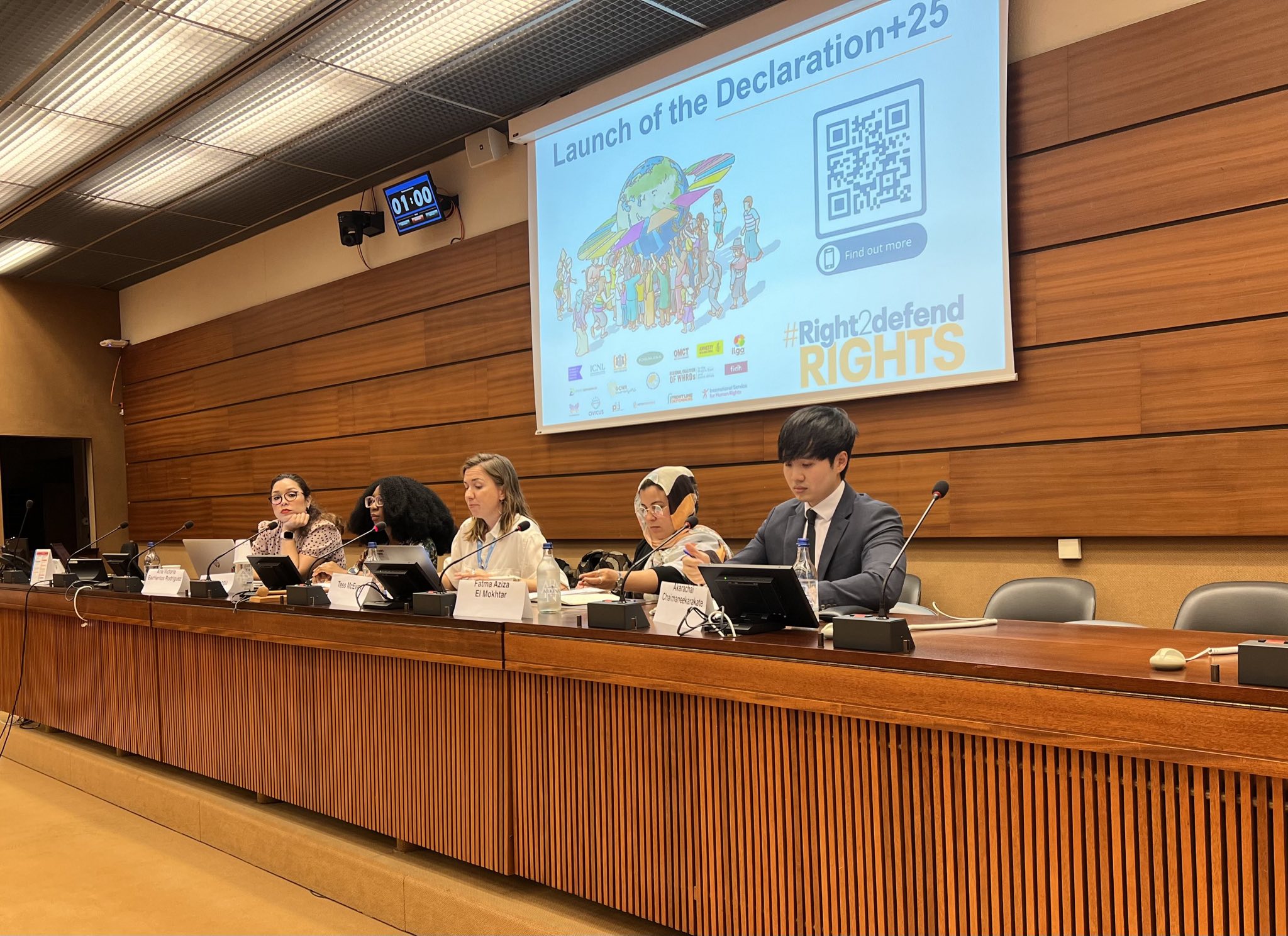
The Declaration+25 was formally launched on Wednesday 19 June at a side event in Geneva, on the margins of  the 56th session of the United Nations Human Rights Council. [https://humanrightsdefenders.blog/2024/06/08/launch-of-the-hrd-declaration25/]


List of participating organisations: 

  • Amnesty International 
  • Asia Pacific Forum on Women, Law and Development (APWLD) 
  • CIVICUS 
  • Defend Defenders 
  • FIDH 
  • FORUM-ASIA 
  • Front Line Defenders 
  • Gulf Centre for Human Rights 
  • ICNL 
  • ILGA World 
  • IM Defensoras 
  • International Service for Human Rights (ISHR) 
  • OMCT 
  • Peace Brigades International 
  • Protect Defenders 
  • Protection International 
  • The Regional Coalition for WHRDs in South-West Asia and North Africa (known as WHRDMENA) 
  • Robert F. Kennedy Human Rights

https://ishr.ch/latest-updates/civil-society-unveils-new-supplement-of-un-declaration-protecting-human-rights-defenders

ISHR’s 40th anniversary – help celebrate

June 18, 2024

ISHR are celebrating longstanding and collective efforts in supporting human rights defenders. Join and find out more! ISHR’s journey began in 1984, inspired by the courageous actions of human rights defenders who dared to challenge injustices and advocate for a fairer world.

We’ve created a list of 40 things you can do to shed light on our mission and the vital work of human rights defenders and advocates who tirelessly strive to make our world a better and more equal place for all.

Twice a week, we will suggest an action that you can do to support ISHR’s work until we reach 40 actions, representing our 40 years of engagement. These actions are designed to be simple yet impactful, allowing everyone to actively participate in the celebration and contribute to the advancement of human rights. Whether you are a long-time supporter or new to our mission, each action will provide a tangible way to support and promote human rights defenders and advocates around the world.

The actions will be published on this page as well as on our social media feeds. From sharing a resource that inspires you, to watching a defender story and sharing what you love about ISHR, every action counts and helps amplify the voices of those who are fighting for justice, equality and freedom.

You can follow the mobilisation here:

Please share these links with your network. The success of our mobilisation relies on the collective effort of our community, so we encourage you to spread the word and invite others to join us. By participating, you are not only celebrating our anniversary but also reinforcing the importance of human rights and the tireless work of those who defend them. We are looking forward to your participation and can’t wait to see the creative ways in which you will engage!

Actions published so far:

https://ishr.ch/latest-updates/40-actions-to-celebrate-ishrs-40th-anniversary/

JOINT NGO LETTER asks to suspend EU-CHINA HUMAN RIGHTS DIALOGUE 2024

June 17, 2024

On 12 June 2024, a group of important NGOs addressed the following letter to Josep Borrell, EU High Representative for Foreign Affairs:

We, the undersigned civil society organisations, are writing to reiterate our request for the European Union to suspend its human rights dialogue with China, and to consider other, more impactful measures at the EU’s disposal to address the Chinese government’s assault on human rights at home and abroad.

While appreciative of the open and frank discussion and engagement with the EEAS in preparation of each round of human rights dialogue with China, we regret that the EU continues this exercise despite its amply proven ineffectiveness over 38 rounds. While the EU raises concerns during these dialogues, it knows that the Chinese government will not acknowledge abuses, will not undertake any effort to secure accountability, and will not be persuaded to undertake any policy or legislative action to comply with China’s international human rights obligations. The EU’s reluctance to establish any measurable benchmark of progress, or even to establish clearly defined objectives beyond having a dialogue, exacerbates the ineffectiveness of this exercise.

This year’s human rights dialogue would also entail EU officials sitting down with authorities in Beijing to “engage… through dialogue and cooperation” on human rights, days after the 35th anniversary of the Tiananmen massacre.

Since Xi Jinping came to power in 2013, the Chinese government has intensified its crackdown on dissent, harassing and imprisoning human rights defenders and activists including the Swedish bookseller Gui Minhai, the Uyghur economist and Sakharov Prize laureate Ilham Tohti [7 human rights awards, see: https://www.trueheroesfilms.org/thedigest/laureates/37AE7DC4-16DB-51E9-4CF8-AB0828AEF491], the Hong-Kong barrister and human rights activist Chow Hang-tung and human rights lawyers Yu Wensheng and his wife Xu Yan, who were arrested a little over a year ago on their way to meet with the EU delegation [see: https://www.trueheroesfilms.org/thedigest/laureates/69fc7057-b583-40c3-b6fa-b8603531248e and https://humanrightsdefenders.blog/2023/07/12/new-wave-of-repression-against-human-rights-lawyers-unleashed-in-china/]. The Chinese government has committed egregious violations against Uyghur and other Turkic communities in Xinjiang/The Uyghur Region, which a report of the UN High Commissioner for Human Rights in August 2022 stated “may constitute international crimes, in particular crimes against humanity.” Beijing has also intensified its repression in Tibet, while in Hong Kong the creation of a new national security architecture at Beijing’s behest has severely restricted the rights and freedoms long enjoyed by Hong Kong’s people.

Beijing’s foreign policy has also been increasingly detrimental to human rights, both in the region and beyond. The Chinese government continues to support highly abusive governments, to challenge international efforts to secure accountability for grave abuses, and to intensify efforts to undermine the international human rights system and rewrite its norms. The Chinese government has also engaged in increasingly brazen transnational repression – abuses committed outside its borders – including in EU countries.

The EU has already suspended human rights dialogues with highly repressive countries such as Russia, Syria, Belarus, and Myanmar, among others, in light of the nature, scale and pervasiveness of their authorities’ human rights abuses and violations of international law. The Chinese government has committed serious crimes amounting to crimes against humanity. It has long been evident that the human rights dialogue is not an appropriate nor an effective tool to address them. There is no reason to expect the 39th round will prove more beneficial to the rights of people in China than the previous 38. The EU and its member states should pursue different, more effective actions to press the Chinese government to end its crimes against humanity and other serious violations – and to hold accountable those responsible for failing to do so.

We have long been suggesting alternative action, latest in this February 2023 letter. We stand ready to discuss these and other options with you any time.

Signatories:
Amnesty International
Front Line Defenders
Human Rights Watch
International Service for Human Rights
World Uyghur Congress

https://www.frontlinedefenders.org/en/statement-report/joint-public-civil-society-letter-eu-china-human-rights-dialogue-2024

and see https://www.ucanews.com/news/jailing-of-chinese-metoo-journalist-upsets-rights-groups/105431

https://www.aol.com/news/eu-urges-china-stop-human-145953152.html

https://www.reuters.com/world/china/eu-urges-china-stop-human-rights-crackdown-2024-06-17/

Columbia University’s Human Rights Advocates Program

June 17, 2024

Founded in 1989, the Human Rights Advocates Program (HRAP) is a model of human rights capacity building. HRAP capitalizes on its affiliation with Columbia University and its location in New York City to provide grassroots leaders the tools, knowledge, access, and networks to strengthen their organizations and promote human rights.

HRAP’s comprehensive program of advocacy, networking, skills-building, and academic coursework provides advocates the opportunity to hone practical skills, develop a deeper understanding of human rights, and foster mutually beneficial relationships with organizations and individuals in their fields.

hrap_lespinasse.jpg

Before I came to HRAP, I knew that people were suffering in Bosnia and that people were dying in Sudan. But when I came to HRAP, I met Advocates from Bosnia, Sudan, and other countries – people who are living and making a difference in their countries.

See also: https://www.york.ac.uk/cahr/human-rights-defenders/past/natalia-zviagina/

https://www.york.ac.uk/cahr/human-rights-defenders/past/tewodros/

https://www.humanrightscolumbia.org/hrap