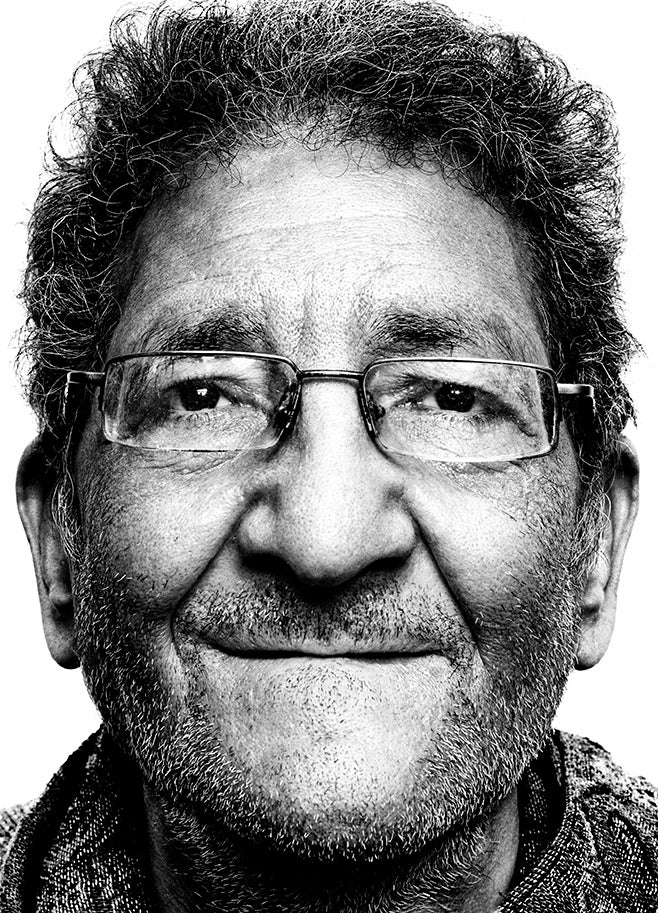
On 21 August I reported on the travails of an Egyptian family of human rights defenders [https://thoolen.wordpress.com/2014/08/21/an-exceptional-egyptian-family-of-human-rights-defenders/], a week later Mona Seif’s father has died. Ahmed Seif Al Islamwas a veteran Egyptian lawyer, activist and former political prisoner. Arrested and tortured by State Security Investigations officers in 1983 for his political activity, he served five years in prison. Founder of the Hisham Mubarak Law Centre, which since 2008 has been providing legal assistance to protesters. The Hisham Mubarak Law Centre (HMLC ) monitored state violence during the 2011 protests, and became a gathering place for human rights activists during the revolution. Ahmed Seif was arrested by Military Intelligence with his staff at the height of the protests.
Seif, a human rights lawyer, was on the legal defense team in numerous high-profile trials of human rights, labor, and more broadly political activists in the Hosni Mubarak years, but he was above all an activist himself. The was more often than not the coordinating center for planning peaceful demonstrations and then, invariably, for deploying lawyers to various detention centers in response to the usual mass arrests that followed such events.In a conversation I had with Seif several years ago, in February 2007, he told me how he became engaged in human rights activism and lawyering:
1. Sepideh — Reaching for the Stars (Denmark/Iran/Germany/Norway/Sweden) The story of a teenage girl named Sepideh, living in a rural village outside of Tehran, who dreams of becoming a famous astronomer. The documentary tackles gender roles in Iran while showcasing one young woman’s ambition and strength in the face of her family’s discouragement, university pitfalls and societal expectations. Directed by Berit Madsen. [youtube https://www.youtube.com/watch?v=wTzbIc6oiqs?wmode=opaque]
2. Dangerous Acts Starring the Unstable Elements of Belarus (US/UK/Belarus) Made up of smuggled footage and uncensored interviews, this documentary gives audiences a glimpse into Belarus’ dissident movement as it takes the shape of stage performances and public activism. Directed by Madeleine Sackler. [youtube https://www.youtube.com/watch?v=LGALySJ3O24?wmode=opaque]
3. Lady Valor: The Kristin Beck Story (US) A veteran shares her story moving from one identity, a former U.S. Navy Seal named Chris Beck, to another, a transgender woman named Kristen Beck. Directed by Sandrine Orabona. [youtube https://www.youtube.com/watch?v=r21OdLSTfQY?wmode=opaque]
4. A Quiet Inquisition (US)Here you’ll meet OBGYN Dr. Carla Cerrato, who must navigate the perilous territory of Nicaragua’s anti-abortion policies, which prohibit abortion, even in cases of rape, incest, or when a woman’s life is at stake. Directed by Alessandra Zeka and Holen Sabrina Kahn.
5. Scheherazade’s Diary (Lebanon) This “tragicomic documentary” follows women inmates in Lebanon as they stage a theater/drama therapy project titled “Scheherazade in Baabda,” revealing personal stories of domestic violence, failed relationships and traumas associated with motherhood. Directed by Zeina Daccache. [youtube https://www.youtube.com/watch?v=5VnZGmd6EMg?wmode=opaque]
6. Siddharth (Canada/India) One father’s desperate journey to locate his son, a 12-year-old boy who was sent to work in another province to support his family, but did not return and is feared to have been kidnapped or trafficked. Directed by Richie Mehta.
7. The Supreme Price (US) The film covers the evolution of the Pro-Democracy Movement in Nigeria and efforts to increase the participation of women in leadership roles. Directed by Joanna Lipper.
8. Private Violence (US) Questioning the accepted discourse on domestic violence, the documentary introduces audiences to two women survivors who advocate for justice while exploring “the fact that the most dangerous place for a woman is her home.” Directed by Cynthia Hill.
9. The Beekeeper (Switzerland) This is the touching story of Ibrahim Gezer, a Kurdish beekeeper from southeast Turkey who, robbed of his family, possessions and 500 bee colonies, moves to Switzerland to make a new life. Directed by Mano Khalil.
10. Abounaddara Collective Shorts from Syria (Syria) The Abounaddara Collective is a group of filmmakers who came together in 2010 to help provide an alternative image of Syrian society, one not seen in mainstream media. This portion of the festival will showcase 90 minutes of their short films.
On 27 May RIA Novosti picked up the press release by Human Rights Watch calling for four prominent human rights defenders allegedly in custody of an armed opposition group in Syria to be immediately released. HRW together with 45 co-signing organizations states that irregular armed opposition groups in Syria are threatening and harassing journalists and human rights defenders.“Abductions of human rights defenders by armed groups in Syria are an assault on the very freedoms the armed opposition groups claim to be fighting for”. Almost six months a group of armed men kidnapped human rights defenders Razan Zeitouneh [or Zaitouneh], Wael Hamada, Samira Khalil, and Nazem Hammadi in a city outside Damascus, then controlled by a number of armed opposition groups, but there has been no information on the status or whereabouts of Zeitouneh and her colleagues, and no group has claimed responsibility for their abduction.
In an excellent piece written for CNN, Tanya Lokshina of Human Rights Watch, on 15 May gives an overview of the different measures that threaten human rights defenders in Russia. While attention is on Ukraine, a vicious crackdown on civil society in Russia itself also escalated with every week brings a new pernicious law or legislative proposal:
The authorities have blocked or essentially took editorial control over a number of independent news portals and are pushing new laws to stifle freedom of expression.
A week ago, President Vladimir Putin signed a law requiring Russian bloggers with significant followings to register with the authorities and comply with media regulations.
The same law requires blogging services and social networks to store user activity for six months.
Another legislative proposal would introduce administrative and criminal offenses for editors who publish “false anti-Russian” information or offer media support to “anti-Russian extremist and separatist forces.”
Another new draft law introduces a ban on publishing negative information about the Russian government and military.
Also, amendments presently under review by the State Duma, the lower house of parliament, would enable the authorities to throw people behind bars for up to five years for repeated participation in unauthorized public protests.
Yesterday I referred to the upcoming Human Rights Watch Film Festival in June. One of the films shown there will also appear on Netflix and therefore be able to reach a much larger audience. Interesting development for human rights films!!
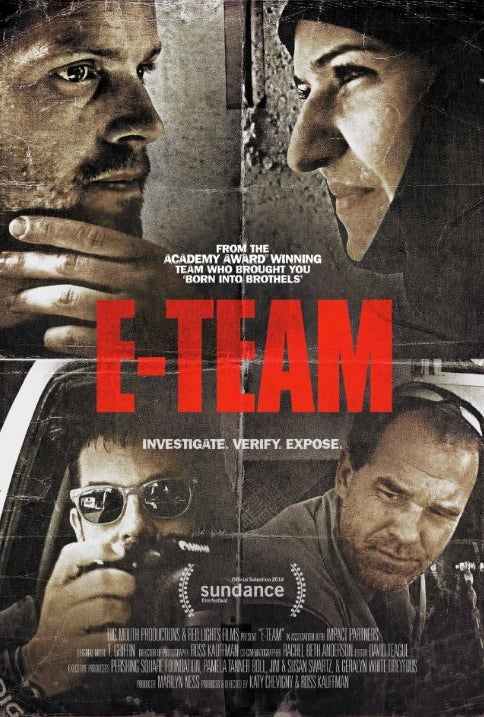
The Associated Press reported on May 8 that Netflix Inc. had purchased E-TEAM as a high-profile “Netflix original,” and would distribute the film via its vast online platform as well as through a limited theatrical release in the United States. The film focuses on four researchers in the Human Rights Watch emergencies division, or E-Team, as they interview witnesses and gather other evidence of rights abuses and war crimes in Syria, Libya, and Kosovo. It highlights the personal commitment required to stop human rights violations over the long term. The filmmakers, Ross Kauffman and Katy Chevigny, operated with full creative control and had free rein from Human Rights Watch to produce a “warts and all” portrait of human rights activists in the field. It is the first time filmmakers have documented Human Rights Watch’s work so extensively.
[The film has won numerous awards on the festival circuit, including for best cinematography at Sundance. Variety called it “a documentary that’s devastating, entertaining and inspiring in equal measure.”]
Former US intelligence contractor and whistleblower Edward Snowden’s latest allegations point to a very real risk that human rights defenders have been the targets of mass surveillance by the US and British spy agencies. Snowden, who is living in exile in Moscow, made the remarks this afternoon, 8 April 2014, via a videoconference link to the Parliamentary Assembly of the Council of Europe (PACE) in Strasbourg, France. When asked if the US National Security Agency (NSA) or its British counterpart Government Communications Headquarters (GCHQ) were actively spying on human rights organizations such as Amnesty International, Human Rights Watch and others, he said: “Without question, yes, absolutely …The NSA has in fact specifically targeted the communications of either leaders or staff members in a number of purely civil or human rights organizations of the kind described”.
On the Human Rights Watch website, 29 March 2014, Aryeh Neier, remembers fondly Zbigniew Zbyszek Romaszewski, a physicist, who in 1979 volunteered to lead an underground Helsinki Committee in Poland under the just concluded Helsinki Accords. Romaszewski died in Warsaw on 13 February 2014 at the age of 74.
“When martial law was imposed in December 1981, some 30,000 people were arrested and imprisoned. Romaszewski and his wife Zosia were among them. Some time after the imposition of martial law, we learned that the Polish Helsinki Committee had found a way to continue to operate secretly. They managed to smuggle highly detailed reports to Helsinki Watch. Their first report, produced under the difficult conditions of search, seizure and secrecy, was 182 pages long. Helsinki Watch published it in English translation under the title “Prologue to Gdansk.” They were a leading source of information on human rights practices in Poland in that period. In March 1984 – after we had no person-to-person contact with anyone in Poland for more than two years – I traveled to Warsaw. Before I left, I learned that Amnesty International had designated Zbigniew Romaszewski a prisoner of conscience. Arriving in Poland, I hoped to see Zosia Romaszewska, who had recently been released from prison. Her husband was still in prison. I could not say for sure that I would see her because it was not possible to make advance appointments. All I could do was to turn up at people’s apartments and hope that I would find them there. During my visit to Warsaw I met many persons who had been imprisoned, and also family members of those still imprisoned, who had been entirely cut off from such contacts. This included Zosia who I was able to spend several hours with. I was able to publish a number of articles in the US on the vitality of the Solidarity movement. During a visit to Warsaw in 1985, my colleague Ken Roth spent time with both Zbigniew, who by then had been released from prison, and Zosia. They graciously spent many hours with him. In this difficult period, when the country was still recovering after the imposition of martial law, Zbigniew and Zosia were the key source of information on the struggling dissident movement which remained very much alive despite the Soviet-backed General Wojciech Jaruzelski’s efforts to crush it. Later on, I got to know Zbigniew Romaszewski and, a couple of times, brought him to conferences in other parts of the world to speak about how a human rights movement could cope with a repressive regime. He became a Senator in Poland and Chairman of the Polish Senate Human Rights and Rule of Law Committee. The organization he founded, now the Helsinki Foundation for Human Rights in Poland, is going very strong. The last time I visited Warsaw – about a year-and-a-half ago – its legal staff included 23 lawyers. It is in the forefront of human rights advocacy in Europe.”
While the whole of the Syrian population suffers terribly, it is important to recognize that human rights defenders, activists, media and humanitarian workers have been particularly targeted for their work since the beginning of the Syrian uprising three years ago. Many have been arrested or abducted by either government forces and pro-government militias or by non-state armed groups. The channels for obtaining reliable information are drying up and that is certainly not a coincidence.
Now several international NGOs such as Amnesty International, the Euro-Mediterranean Human Rights Network, FIDH, Frontline Defenders, Human Rights Watch and Reporters Without Borders have come together to work jointly, with other international, regional and Syrian organizations, to campaign for the release of these Silenced Voices of Syria. The campaign is starting with the documentation of 37 emblematic cases.
This campaign will use a three-pronged strategy of 1. Research and Documentation, 2. Information/Sensitisation and 3/ Mobilization.
There was considerable attention in the media for the new United Nation report that has found that crimes against humanity are occurring in North Korea and calls for an international tribunal to investigate and hold perpetrators to account, but you may have missed the 14-minute video produced by Human Rights Watch on 17 February 2014. The report, by a UN Commission of Inquiry appointed by the UN Human Rights Council in March 2013, recommends that the UN Security Council refer the situation in North Korea to the International Criminal Court (ICC) and that the UN High Commissioner for Human Rights carry out investigations. The three person commission, which was chaired by Australian jurist Michael Kirby, will formally present its findings to the Human Rights Council on or around March 17, 2014. The council will then consider a resolution to act on the commission’s recommendations.
As this blog is very fond of human rights films, I am copying the programme almost in full. Morever, one the five themes in London this year is: Human Rights Defenders!
The 18th edition of the Human Rights Watch Film Festival in London will be presented from 18 to 28 March, 2014, with a programme of 20 award-winning documentary and feature films. The festival will take place at the Curzon Mayfair, Curzon Soho, Ritzy Brixton and for the first time at the Barbican cinemas.
This year’s programme includes ten UK premieres and three exclusive previews organised around five themes:
Armed Conflict and the Arab Spring;
Human Rights Defenders, Icons and Villains;
Lesbian, Gay, Bisexual and Transgender (LGBT) Rights;
Migrants’ Rights; and
Women’s Rights and Children’s Rights.
“This year’s programme demonstrates the risks filmmakers take to capture the stories behind the headlines, and our centrepiece film, the E-Team, reveals the tenacity and heroic efforts of human rights activists to bring war crimes to the world’s attention,” said John Biaggi, film festival director at Human Rights Watch. Read the rest of this entry »
 © 2011 Platon for Human Rights Watch