On May 28, 1961 -64 years ago today – a British lawyer named Peter Benenson penned a letter for the Observer newspaper in the UK launching the “Appeal for Amnesty 1961,” a campaign calling for the release of people imprisoned around the world because of the peaceful expression of their beliefs. This movement galvanized into what is now Amnesty International, an organization founded on the idea that ordinary people around the world could protect human rights by coming together to take action on behalf of others.
Sixty-four years later, Amnesty is a worldwide movement for human rights with a collective power of 10 million people, each one committed to fighting for justice, equality and freedom everywhere.
Today, Amnesty is needed more than ever to confront a backlash against human rights and increasing authoritarian practices, including right here in the United States.
As a global movement, we have—and continue to—show up in solidarity for communities and across issues and geographies. Caring, compassionate people have powered our movement for decades as we’ve shined a light on injustice and defended human rights. We will raise the political cost of authoritarian practices through direct advocacy, constituent pressure on Congress and other leaders to use their power in the defense of human rights, and other impactful campaigning efforts……
As we mark our anniversary, we are recommitting to our efforts to champion and protect human rights, here in the United States, and around the world.
12 tips from Amnesty International leaders around the world:
Fight hard against early attacks against individuals and institutions, and ask, “If we lose now, who will they come for next.”
Watch for new government agencies and data collection designed for repression. Leaders who embrace authoritarian tactics create “lists” to target effective activists, often using social media. Surveillance is a red flag.
Elections are dangerous flashpoints for accelerators of repression. Crackdowns and laws passed to restrict civic space often spike pre-elections.
Resist the legal system being weaponized. Governments will use trumped up charges, long pretrial detentions and lengthy trials to sideline activists, denying bail and delaying appeals.
Read new “unrelated” laws carefully with an eye on civic space and freedom of expression. Not every attack on rights will be direct and obvious.
Be ready for fake “facts” and smear campaigns to paint human rights defenders as corrupt or criminal. How are you going to get the truth out quickly and widely?
Catch repressive legislative drafts early and fight back hard and publicly. And don’t stop until bills are dead and won’t come back.
Stay inspired about a pro-rights future, but create strategies and stay ready for worsening anti-rights scenarios.
Public narrative matters. Anti-rights actors will reframe human rights as threats, to shrink civic space. Don’t let them. Resist and frame a public narrative that speech, protest and assembly are essential to defend all the other rights.
Protect yourself, your wellbeing and your safety. Threats come in many forms and will be experienced differently by each activist. Do what is right for you.
Be a good partner. Solidarity wins. Build coalitions, share resources, lean on allies and let them lean on you.
Keep an eye on other contexts. Repressive leaders learn from each other. Human rights activists need to do the same.
From Hungary to China to Venezuela, and anywhere else leaders think they can act with impunity—we have fought back at every turn.
On 5 December 2023, Natalie Samarasinghe – global director for advocacy at the Open Society Foundations. – wrote about strengthening human rights based on David Griffiths’ paper, Barometer in Context: Strengthening the Human Rights System.
….But this is not the whole story. The Open Society Barometer, a poll of over 36,000 people in a representative group of countries, found that most people believe in the value of human rights. Over 70 percent said that human rights “reflect the values I believe in” and are “a force for good” in the world.
Actors such as human rights lawyers, NGOs, and international organizations continue to provide hope, support, and redress to those seeking justice and protection. And they are joined by a growing cohort of others, from rural communities to indigenous peoples, political and social movements. They may not use the language of rights but their work is grounded in them. They cannot afford to have theoretical debates about the relevance of the UDHR. They need support and solutions.
To mark the UDHR’s anniversary, Open Society commissioned a paper on what those solutions might look like, written by David Griffiths, an advocate and policy expert with more than two decades of diverse experience across the human rights movement. His paper, Barometer in Context: Strengthening the Human Rights System, sets out a series of proposals for how to make this moment count, including prioritizing economic inequality and climate change, exposing the failure of authoritarians to deliver, defending civic space, rethinking migration, widening accountability, and strengthening the human rights system.
Drawing on 18 months of research and material from at least 65 interviews with people from all parts of the world, as well as the Open Society Barometer, these proposals provide inspiration for those of us approaching this anniversary with a heavy heart. It is vital that we avoid paralysis and gloom, which only plays into the hands of abusers and authoritarians.
We must become more creative in how we support those defending rights, whether they are in the courtroom or community center, or on the streets marching for debt relief and climate justice. We must invest in the leaders and tools of tomorrow, instead of playing catch-up with authoritarians, while doubling down on our backing for traditional actors and approaches that continue to deliver results.
And now more than ever, we must nurture a global movement—of the sort that was not possible in 1948—to reaffirm the simple truth that lies at the heart of the Declaration: that all human beings are equal, that every life has value.
Resistance inspires. Defiance in the face of a violent, oppressive culture can inspire another person’s defiance. Even when an uprising is only beginning, when the path forward is unclear, it is essential to resist. All together. The goal: to defeat a system fundamentally, historically, and intentionally based on mass exploitation in the interest of profit for a privileged few.
The environmental movement can learn from those who come from a tradition of resistance and have organized their struggle in movements like Black Lives Matter and Idle No More, founded by First Nations. The protests enveloping our country today are seeded by centuries of injustice and violence, by underlying power imbalances and inequalities that have never been truly addressed. The founders of these social movements knew then and now that they cannot combat violent oppressors through pure persuasion. So they resist.……….
Environmentalists and justice activists cannot stay isolated in their movements. To be effective at combating climate change and countless other social and environmental injustices, we must acknowledge the links between the abuse of nature and people, and devise strategies to protect the planet, to resist its demise – even when doing so is frightening. Especially then. Ultimately, resisting mass exploitation on all fronts is the only thing that will make us safer.
For many — especially people of color — the impacts of climate change and the degradation of environmental harm are not a future concern. It is life or death, and it’s happening now. If we want to reverse the losses, we need to begin to speak honestly to each other about the long history of abuse that has led to the unrest, rage, and grief that we feel today. We need to confront how power works in society, including in regions where exploitation of indigenous people and the ecosystems they call home go unnoticed by mainstream media….
In addition to poverty, lack of clean air, safe drinking water, health care, and more—all of which lead to “preexisting conditions”—many communities of color are confronted with the threat of coronavirus and are more vulnerable to the pandemic. Reports estimate that people of color are twice as likely to die from COVID-19…….
The author provides several examples from her own field work and experience……
How can we endeavor to protect the planet when its frontline defenders are being killed or intimidated by state-sanctioned violence? How can we expect to solve the climate crisis if our strategies do not include protecting life above corporate, government, and elite interests? Again, environmental advocates can learn from movements born from violent exploitation who are organizing to resist that violence.
Viable movements need supportive cultures to sustain them. They require healthy norms of behavior, processes to handle conflict, and ways to defeat destructive internal divisions and competition that stymie even the best-intentioned efforts toward progress. Horizontal hostility—a concept defined by Florynce Rae Kennedy, an African American lawyer, feminist, civil rights advocate, lecturer, and activist—occurs when activists fight against each other over differences rather than vertically against the oppressor. This behavior leaves relationships, activist networks, and movements in shreds.
A livable planet for all requires solidarity, using our shared principles and humanity to rise together to protect nature and banish injustice.
Cayte Bosler is a student in Columbia’s Sustainability Management masters program.
Human Rights Houses are coalitions of civil society organisations working together to advance human rights at home and abroad.
The Human Rights House Foundation (HRHF) works with civil society organisations to establish and support Human Rights Houses as bases for human rights activities. While member organisations are often co-located under one roof, the structure and make-up of House reflects the local needs and local context. This allows Houses to provide relevant benefits to a local human rights community as a whole and enhance the national capacity to uphold and protect human rights and independent civil society.
HRHF connects Human Rights Houses, building an international network for change and freedoms, and today, the network extends across 11 countries with 17 Houses.
Membership in Human Rights House provides solidarity, as well as opportunities for collaboration and networking. Working together, member organisations have greater opportunity to influence the human rights agenda. House members are also able to more effectively pool resources and benefit from reduced administration costs. Finally, in a time of closing space for civil society and attacks against human rights defenders, House membership offers a level of security and protection from increased threats and harassment.
HRHF’s Human Rights House concept is built around the enduring values of solidarity and partnership. It remains as important today as when the first House opened its doors in Oslo in 1989.
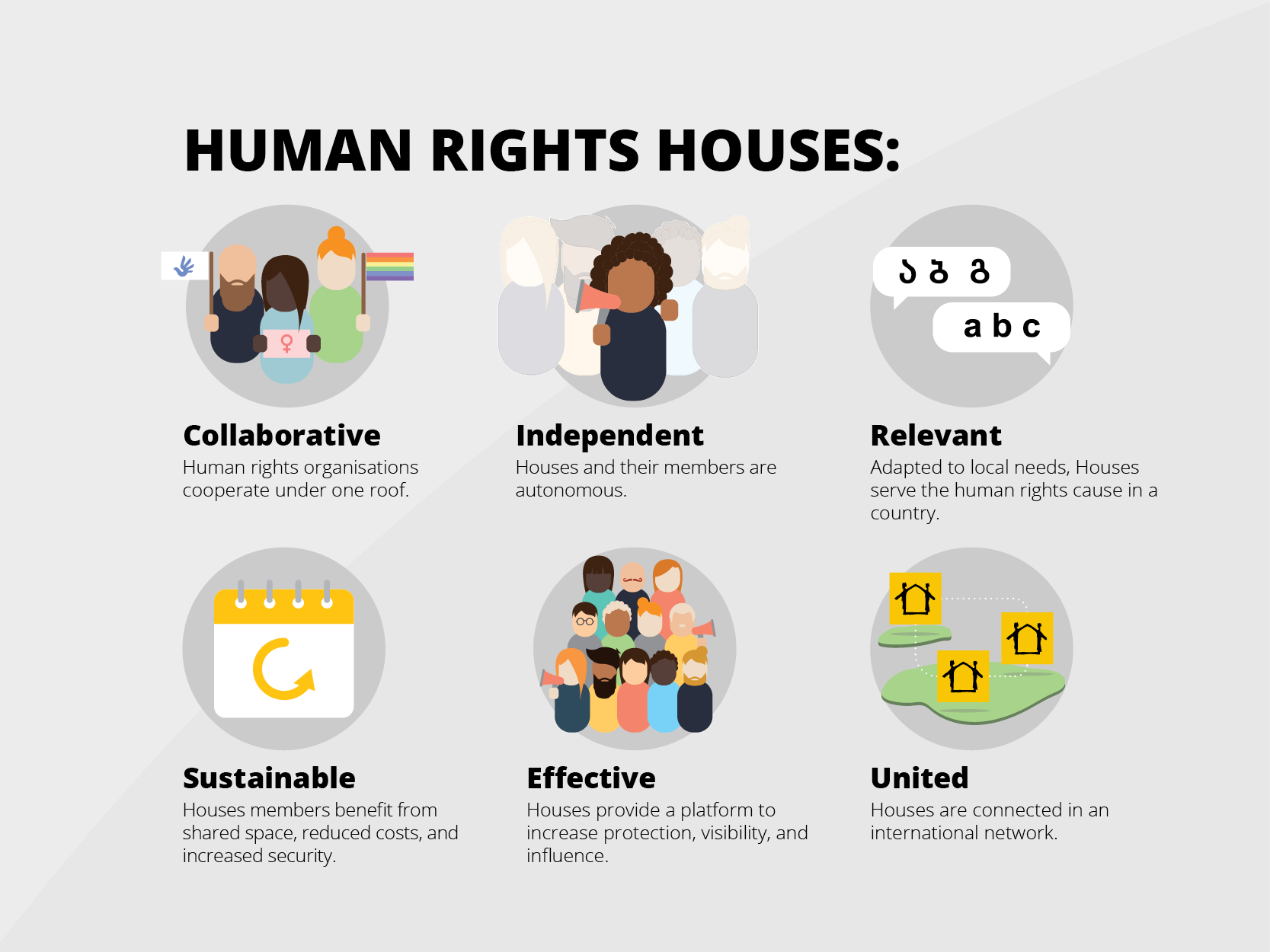
While each Human Rights House is unique, all houses are collaborative, independent, relevant, sustainable, effective, and united.
Human Rights Houses: collaborative, independent, relevant, sustainable, united
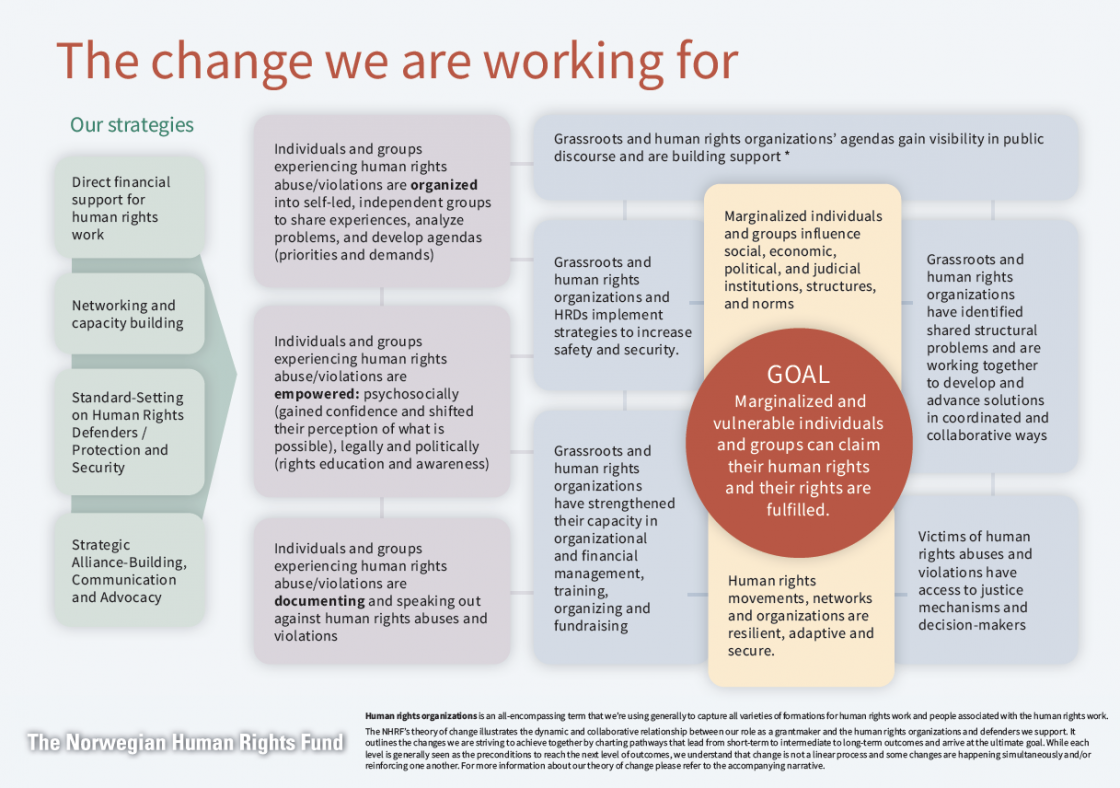
The development of the theory of changewas a participatory process involving the NHRF Secretariat, its Board, NHRF local consultants, and a selection of grantee partners. It is a living document that represents our theory of how change is created and driven forward. It articulates expected outcomes and their preconditions that, together, form pathways of change that lead to the overall goal. We understand these processes to be non-linear, interconnected, interdependent, mutually reinforcing, and occurring simultaneously or separately. The theory of change will guide our work as a partner and grantmaker by informing the support we provide to human rights work to achieve the defined outcomes and overall goal. It is one of the key elements used in our monitoring, evaluation, and learning processes. We will regularly review and refine the theory of change as we assess if our interventions are bringing about change and if the pathways of change are accurate and realistic.
On 13 May 2020, Adri Kemps passed away at the age of 65. He was – from 1993 – 2001 – Director of Amnesty International Netherlands. Even after an infarct in 2015 he continued to be active in human rights work e.g. as an active volunteer at the Netherlands Helsinki Committee. Adri was known for his cheerful character, optimistic outlook, but above all his passion, especially about human rights. He could be stubborn and persistent as well, but always engaging and a true gentleman. That combination brought him many successes, as the obituary written by his friend and long-time colleague Harry Hummel underlines.
Remembering the life of Adri Kemps (1955 – 2020)
…. Adri was part of a brilliant team, at the national office of Amnesty International. Human rights until that time were a concept only known to a group of foreign policy experts and to a minute fraction of the legal community. Amnesty in the Netherlands was hugely successful in popularizing the concept as a notion that stood above political struggle. Adri and his friends developed campaigns to mobilise public support to raise human rights issues in countries around the world. A new action method for Amnesty, that was viewed by many in the organization’s London headquarters as a suspect deviation. This group of volunteers was dominant in the Netherlands’ representation in Amnesty’s international decision-making bodies. By 1980, they formed the majority of the executive board of Amnesty Netherlands. A group of people aged 25 or younger leading an organization with a budget of millions and several dozen staff members, unthinkable in today’s professionalized civil society sector in the Netherlands.
At that time, Adri was part of the board for a couple of years. He was also engaged in setting up a number of other organizations working on international solidarity (as this was called). He soon left for Nicaragua, joining his partner Marijke (who he had met at Amnesty), and gradually carving out a role for himself in development work in that new location.
In the beginning of the 1990s, a much more mature man, he joined Amnesty Netherlands again as Executive Director. An exceedingly difficult job, he had to lead an organization that was professionalizing rapidly but still maintained some characteristics of the volunteer spirit. The period was a challenging time for human rights, and yet it was a high period for their national as well as international recognition. Adri skilfully utilized this for the benefit of the organization.
After yet another, shorter period living in Nicaragua, he returned to the Netherlands to head the Netherlands Fundraising Regulator (CBF). An entity that runs a certification scheme for fund-raising NGOs, independent from both government and civil society, yet a civil society body itself, and subject to diverse pressures and not easy to lead.
He started running into health problems, including a stroke now six years ago. During his recovery, he joined the Netherlands Helsinki Committee’s office, and stayed on to work on an increasingly broad range of assignments. His expertise and strategic and tactical insight helped the organization tremendously in its fund-raising efforts. He took on substantive activities as well – things important for the promotion and defence of a healthy society but that did not necessarily fall in the defined areas of work of the organization – a training on strategy development for fund-raising organizations in Ukraine, involvement in a study on political advertising on the internet.
He continued to be active in local social democracy in Haarlem, where he lived, and increasingly also in initiatives to recreate a sound environment and in addressing the climate crisis. The extreme political repression that has developed over the past years in Nicaragua, the country where he had lived for such a long time, affected him a lot. He spent time advising on initiatives to help local people and increase pressure on the government.
The maxim that to be a human rights activist, you must by definition be an optimist, definitely applied to Adri. His co-workers at the NHC remember him as a friendly, interested and cheerful colleague, bringing a lot of positivity and creativity to the workplace.
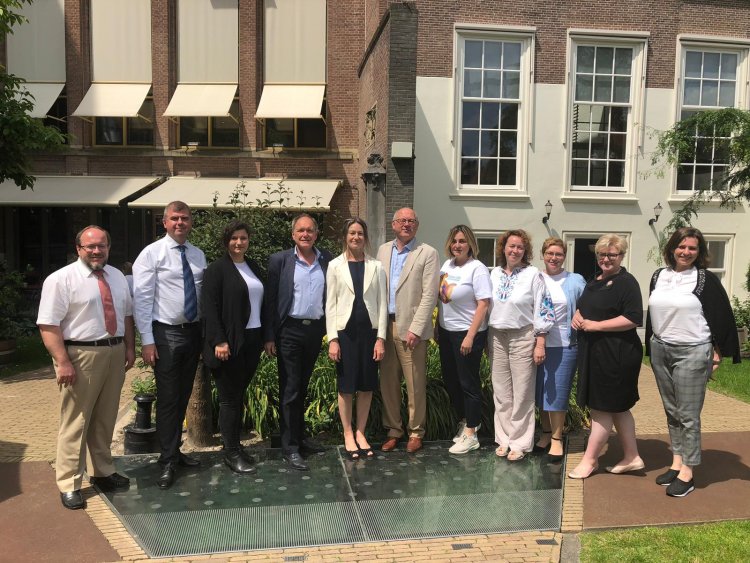
Adri (in the middle) at a meeting with Ukrainian civil society and government representatives, discuss effective government-civil society partnerships
James A. Goldston, Executive Director of the Open Society Justice Initiative and previously in the Office of the Prosecutor at the International Criminal Court, wrote on 20 August 2019 an opinion piece in ‘Balkan Insight’ entitled: “Illiberal Populism: A Wake-Up Call for Human Rights”. His conclusion is that human rights defenders need to up their game but be under no illusion that they alone can defend liberal values. “The battle against illiberal populism will ultimately be won in the arenas of politics and power — in voting booths, legislative offices, the media and the streets.“
The writer focuses on 3 critcisms often thrown at the human rights movement:
Foremost a lack of concern with economic inequality (Indeed, over the past four decades, the international human rights movement has grown hand in hand with obscene disparities of wealth).
Secondly over reliance on legalisation. (Norms and standards go only so far if they are not implemented in real life – a preoccupation with legal claims has blinded the movement to the underlying moral values that move many to action.)
Finally, critics argue, it overlooked people. (.. rights defenders have spent so much time refining arguments for courts and legislatures that they have failed to .. cooperate meaningfully, with the victims, survivors, family members and others on whose behalf they purport to advocate)
The criticisms – although overblown especially by populist leaders – contain truth, and they lead to clear prescriptions, says Goldston: We must pay more attention to economic suffering. We must relearn how to speak less like lawyers and more like people. And we must work more collaboratively with like-minded groups that don’t identify themselves as rights defenders, but whose contributions — whether through science, technology, economics, or the arts — can foster rights awareness.
.. But rolling back reactionary politics worldwide requires not just rights activism but also deeper engagement in political debate and elections. That’s a task not just for the rights movement, but for everyone.The author notes that although annual philanthropic funding for “human rights and social justice” has increased worldwide in recent years, it remains under $3 billion. {and human rights defenders a tiney partof that, see: https://humanrightsdefenders.blog/2019/07/18/important-report-to-help-you-understand-human-rights-grantmaking/]
This video is part of an editorial partnership with the Fund for Global Human Rights.
In this video, Miriam Miranda, executive director of OFRANEH – the Honduran Black Fraternal Organisation – talks about the importance of funding social movements, not just structured NGOs (which inherently seek to sustain themselves). She also discusses the need for more funders to support work happening at the community level. She shares her thoughts on how flexible funding allows activists to respond to the changing needs of their communities and the difficult context in which they work. She stresses the critical importance of donors trusting their partners on the ground and building trust-based relationships.
Denia Castillo, coordinator of Red De Abogadas Defensoras de Derechos Humanos (Network of Human Rights Defenders), shares why grassroots activism is often the most effective to way to spur on social change. This is because activists on the ground best understand their communities and the challenges they face, and they don’t have the costs of much larger organisations – allowing for resources to be distributed closer to the ground. She also talks about the need for international funders to provide flexible funding, which allows grassroots groups to adapt their plans and support their communities in the emergencies they often face on Honduras.
Indyra Mendoza, executive director of CATTRACHAS – a feminist lesbian network – provides insight into the importance of funding and working with non-registered entities. In countries where governments are cracking down on the work of activists and NGOs, restrictive legislation is making it harder to register as an NGO or operate freely as a registered NGO. For this reason, many activists and groups doing critical work for their communities choose not to register as NGOs, which creates difficulties for them in receiving foreign funding and support.
Bertita Caceres is the general secretary of COPINH – Civic Council of Popular and Indigenous Organisations of Honduras. She is also the daughter of COPINH’s founder Berta Caceras, who was murdered in 2016 because of her campaigning work to stop a hydro-electric dam from destroying indigenous lands and livelihoods. Bertita shares her thoughts on the importance of international allies helping build the capacity and strength of organisations like COPINH, specifically around security and protection. She also shares how important it is for groups like hers to have international partners and funders use their positions of power to speak out on behalf of grassroots groups and apply pressure internationally in a way that supports their strategies and advocacy on the ground.
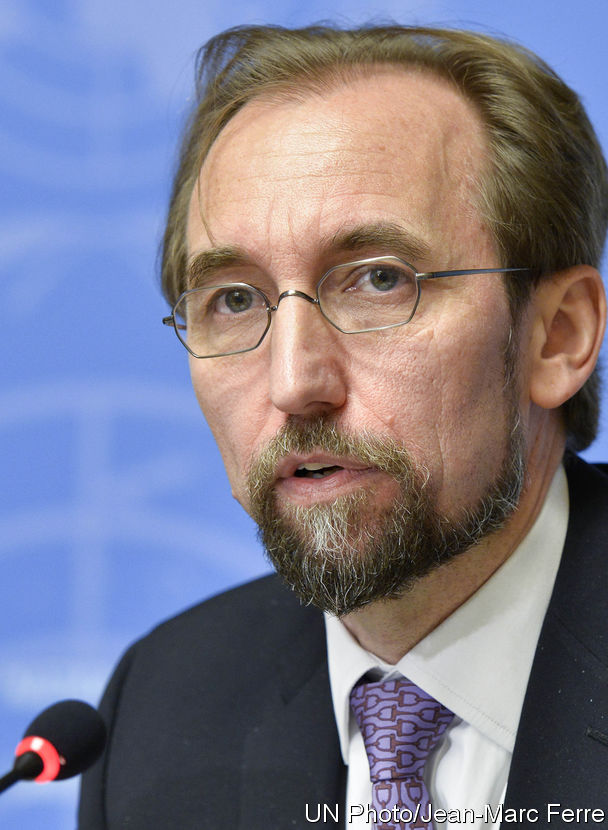
Zeid Ra’ad Al Hussein, the UN High Commissioner for Human Rights, who steps down on 1 September wrote a long and hard-hitting piece under the title “Grassroots leaders provide the best hope to a troubled world” in the Economist of 30 August 2018. Just some excerpts here, please read the whole thing:
…………….Now look at today’s politicians. First, those who occupy so much of the news media’s attention: the Trumps, the Orbans, the Salvinis. Keen to be viewed as the virile leaders of their respective countries; eager to inflate their image by harming migrants and refugees, the most vulnerable in society. If there is courage in that, I fail to see it. Authoritarian leaders, or elected leaders inclined toward it, are bullies, deceivers, selfish cowards.
If they are growing in number it is because (with exceptions) many other politicians are mediocre. They, too, are focused on their own image, the vanities associated with protocol and re-election. Too busy with themselves, or too afraid to stand up to the demagogues and for others, they seem to shelter in the safety of silence and shuffled papers. Only when they leave public office do some speak up, discovering their courage rather belatedly. Many come and go; no one really notices.
In consequence, too many summits and conferences held between states are tortured affairs that lack profundity but are full of jargon and tiresome clichés that are, in a word, meaningless. What is absent is a sincere will to work together, though all will claim—again, under the lights and on camera—that they are wholly committed to doing so. The systems for states to act collectively at higher levels in pursuit of solutions are decomposing. There are signs of it everywhere we care to look.
….
I believe it is only a matter of time, for example, before we see a Takfiri confrontation with Buddhist extremism in Asia. Where this is likely to occur, geographically, and who is likely to be involved, can already be surmised. The how and the when are, as always, indeterminate. It will depend on the outcome of regional presidential elections and how the situations in Cox’s Bazaar and Myanmar play out. The current signs are not encouraging. What is clear is that our systems for fixing this are broken.
When Myanmar inflicts enormous suffering on the Rohingya—burns them in their homes, cuts the throats of their children, rapes and terrorises, sends 700,000 people fleeing to Bangladesh in only three weeks—and the government pays no penalty for this—what are we saying to the perpetrators? Or to the victims? And to other potential perpetrators across the globe? Xi Jinping openly backs the government of Myanmar and, unusually for the US, given the extent of the horrors, President Trump did not even mention Rakhine when he addressed the UN General Assembly in September 2017. Strong evidence indicates the Burmese military and others may have committed acts of genocide. How much more cruel can humanity be, and how much chaos and pain are we fomenting?
….
And when multiple stress fractures already exist—the result of decades of mediocre leadership—all that’s required is a tripwire. To heal those fractures, whether in the Middle East or elsewhere, we must think differently, think more about human rights, and do this with some urgency.
A fracture within society is often shorthand for human suffering or the existence of burning grievances. Before conflicts begin, suffering stems from three types of human rights violations. One is the denial of fundamental freedoms, such as of opinion, expression and peaceful assembly, creating a situation where life and fear of the state become inseparable. A second is the deprivation of basic services, such as legal and social protections or rights to education and healthcare, which often only confirms the hold of political elites over others. And third, feeding the first two, discrimination, structural and deep, propped up by racism, chauvinism and bigotry.
When multiple stress fractures already exist—the result of decades of mediocre leadership—all that’s required is a tripwire
…If we do not change course quickly, we will inevitably encounter an incident where that first domino is tipped—triggering a sequence of unstoppable events that will mark the end of our time on this tiny planet. Can we swerve in time?
My hope lies in a set of people not widely known internationally, but familiar to those in the human rights community. Unlike the self-promoters—the elected xenophobes and charlatans—these people do have courage. They have no state power to hide behind: instead, they step forward. They are the leaders of communities and social movements, big and small, who are willing to forfeit everything—including their lives—in defence of human rights. Their valour is unalloyed; it is selfless. There is no discretion or weakness here. They represent the best of us, and I have had the privilege of knowing some of them personally, while others are well known to my office.
Suffering reflects a massive dereliction of the duty to serve, by those who exercise sovereignty on behalf of their people
This is what true leaders look like. Bertha Zuniga Caceres from Honduras, the young daughter of the murdered environmental activist, Bertha Caceres, who has bravely continued her mother’s struggle. Dr Sima Samar in Afghanistan, who leads the country’s independent human rights commission and is utterly fearless, even when threats to her personal safety abound. The same could be said of Senator Leila de Lima in the Philippines, who has now been arbitrarily imprisoned without trial for 18 months. Pierre Claver Mbonimpa from Burundi, a gentle yet principled soul, undeterred even after his son was murdered and he himself survived repeated attacks.
I have also been deeply impressed by the dignity and courage of Denis Mukwege from the Democratic Republic of Congo, an extraordinary human being by any measure. Likewise, I have been humbled by the determination of Angkhana Neelapaijit from Thailand, whose husband, a lawyer, disappeared in 2004 leaving her to become a most courageous activist, fighting against enforced disappearances.
There are others too, from Bahrain for example: the Khawaja family, Nabeel Rajab, Maytham Al Salman and Ebtisam Al Sayegh, who have all have shown extraordinary courage in the face of considerable adversity. Hatoon Ajwad Al Fassi and Samar Badawi in Saudi Arabia: courageous leading voices for the rights of Saudi women, both currently in detention. Amal Fathy in Egypt and Radhya Al Mutawakel in Yemen are also two brave individuals who have put their own safety at risk as they have spoken out against injustice and on behalf of victims of human-rights violations.
Likewise, Ludmila Popovici, an activist against torture in Moldova. In Poland, Barbara Nowacka has been active in organising protests against measures to pull back women’s rights. Sonia Viveros Padilla in Ecuador is fighting for the rights of people of African descent. Close by, in El Salvador, Karla Avelar, the courageous transgender activist, deserves high praise—as does the Peruvian Maxima Acuna, a well-known environmental human rights defender.
I could continue. There are grassroots leaders of movements against discrimination and inequalities in every region. These names are just a sample of the real store of moral courage and leadership that exists among us today.
While some speak from an individual vantage point, fighting specific battles on behalf of their local communities, others lead broader social movements. World-wide, they are not coordinated. But what if they were? What would happen if all the movements supported each other, openly and actively?
There are grassroots leaders of movements against discrimination and inequalities in every region…the real store of moral courage and leadership among us.
……What if this coordinated, focused, human-rights movement had the backing of business leaders? There are business leaders who are also real leaders, and who have thought seriously about human rights; people like Barbara Novick of Blackrock, Paul Polman of Unilever, Microsoft’s Brad Smith and Deepmind’s Mustafa Suleyman. This has never been done before; but if we did do it, it might just deliver a sort of shock therapy to those dangerous or useless politicians who now threaten humanity. Maybe, just maybe, it would be enough to stop the rot, so that when a fool tips that first domino or strikes the tripwire they hurt no one but themselves, and we can hope that the injury is only a slight one.
I leave you with that thought. This is my parting note: one of courage and defiance, and a longing for the leadership of the just.
The last year or so there has been a lot soul-searching within the broader human rights movement, questioning its relevance or even survival at a time of resurgent ‘anti-human rights’ attitudes in the superpowers (regression in China, USA, and Russia, with the EU vacillating between careful diplomacy and trade interest). A number of smaller countries have also taken enthusiastically to human rights bashing (just to mention Turkey, Philippines, Hungary, Venezuela and Burundi). In all these cases the leadership seems to imply that human rights are niceties that no longer have the support of the majority of their population, which could well be true due to the extent that their control over the media and relentless whipping up of populist feelings make this self-fulling.This blog has tried to monitor – at least illustrate – this phenomenon on many occasions [too many to list]. Now comes along an interesting piece written by professor Samuel Moyn of Yale university under the provocative title “How the Human Rights Movement Failed” (published on 23 April 2018 in the New York Times). The piece is a must read (in full) and I give the text below in green. Even if I disagree with some important parts, it remains a coherent and thought-provoking article (once you get over feeling offended by the idea that you are a plutocrat).
The key notion is expressed in the following quotes:
“.those who care about human rights need to take seriously the forces that lead so many people to vote in majoritarian strongmen in the first place.”
and
“The truth is that the growth of international human rights politics has accompanied the very economic phenomena that have led to the rise of radical populism and nationalism today. In short, human rights activism made itself at home in a plutocratic world.”
Where I most disagree with the author is that there is lot more going on in the human rights movement than the defense of civil and political rights or playing along with elites. Either he does not know it or ignores it on purpose. The thousands of human rights defenders working in their own countries are fully aware of the realities on the ground and are often prioritizing social, economic, cultural and community rights [just a cursory sample of blog posts on environmental activists will show this: https://humanrightsdefenders.blog/tag/environmental-activists/]. International and regional NGOs mostly help and protect them! Also, the author seems to underestimate the potential attraction of the human rights cause in civil society (especially victims and young people), whose mobilization is still patchy. If the human rights movement can overcome its fragmentation and use media better this potential could turn tides. Say I!.
Here the piece in full/ judge for yourselves:
The human rights movement, like the world it monitors, is in crisis: After decades of gains, nearly every country seems to be backsliding. Viktor Orban in Hungary, Rodrigo Duterte in the Philippines and other populist leaders routinely express contempt for human rights and their defenders. But from the biggest watchdogs to monitors at the United Nations, the human rights movement, like the rest of the global elite, seems to be drawing the wrong lessons from its difficulties.
Advocates have doubled down on old strategies without reckoning that their attempts to name and shame can do more to stoke anger than to change behavior. Above all, they have ignored how the grievances of newly mobilized majorities have to be addressed if there is to be an opening for better treatment of vulnerable minorities.
“The central lesson of the past year is that despite considerable headwinds, a vigorous defense of human rights can succeed,” Kenneth Roth, the longtime head of Human Rights Watch, contended recently, adding that many still “can be convinced to reject the scapegoating of unpopular minorities and leaders’ efforts to undermine basic democratic checks and balances.”
That seems unlikely. Of course, activism can awaken people to the problems with supporting abusive governments. But if lectures about moral obligations made an enormous difference, the world would already look much better. Instead, those who care about human rights need to take seriously the forces that lead so many people to vote in majoritarian strongmen in the first place.
The truth is that the growth of international human rights politics has accompanied the very economic phenomena that have led to the rise of radical populism and nationalism today. In short, human rights activism made itself at home in a plutocratic world.
It didn’t have to be this way. The Universal Declaration of Human Rights, which was promulgated in 1948 amid the consolidation of welfare states in Europe and North America and which formed the basis of the human rights agenda, was supposed to enshrine social protections. But in the 1970s, when activists in the United States and Western Europe began to take up the cause of “human rights” for the victims of brutal regimes, they forgot about that social citizenship. The signature group of that era, Amnesty International, focused narrowly on imprisonment and torture; similarly, Human Rights Watch rejected advocating economic and social rights.
This approach began to change after the Cold War, especially when it came to nongovernmental advocacy in post-colonial countries. But even then, human rights advocacy did not reassert the goal of economic fairness. Even as more activists have come to understand that political and civil freedom will struggle to survive in an unfair economic system, the focus has often been on subsistence.
In the 1990s, after the Cold War ended, both human rights and pro-market policies reached the apogee of their prestige. In Eastern Europe, human rights activists concentrated on ousting old elites and supporting basic liberal principles even as state assets were sold off to oligarchs and inequality exploded. In Latin America, the movement focused on putting former despots behind bars. But a neoliberal program that had arisen under the Chilean dictator Augusto Pinochet swept the continent along with democracy, while the human rights movement did not learn enough of a new interest in distributional fairness to keep inequality from spiking.
Now the world is reaping what the period of swelling inequality that began in the 1970s through the 1990s sowed.
There have been recent signs of reorientation. The Ford Foundation, which in the 1970s provided much of the funding that made global human rights activism possible, announced in 2015 that it would start focusing on economic fairness. George Soros, a generous funder of human rights causes, has recently observed that inequality matters, too.
Some have insisted that the movement can simply take on, without much alteration of its traditional idealism and tactics, the challenge of inequality that it ignored for so long. This is doubtful.
At the most, activists distance themselves from free-market fundamentalism only by making clear how much inequality undermines human rights themselves. Minimum entitlements, like decent housing and health care, require someone to pay. Without insisting on more than donations from the rich, the traditional companionship of human rights movements with neoliberal policies will give rise to the allegation that the two are in cahoots. No one wants the human rights movement to be remembered as a casualty of a justifiable revolt against the rich.
If the movement itself should not squander the chance to reconsider how it is going to survive, the same is even truer of its audience — policymakers, politicians and the rest of the elite. They must keep human rights in perspective: Human rights depend on majority support if they are to be taken seriously. A failure to back a broader politics of fairness is doubly risky. It leaves rights groups standing for principles they cannot see through. And it leaves majorities open to persuasion by troubling forces.
It has been tempting for four decades to believe that human rights are the primary bulwark against barbarism. But an even more ambitious agenda is to provide the necessary alternative to the rising evils of our time.
—–
Samuel Moyn is the author of “Not Enough: Human Rights in an Unequal World.”


 Hans Thoolen on Human Rights Defenders and their awards