Posts Tagged ‘Human Rights House Foundation’

Some governments are ‘weaponising’ Trump language to attack NGOs

April 3, 2025

On 2 April 2025 AFP reported that language used by President Donald Trump and his government to slash US-funded foreign aid is being adopted by other governments to attack NGOs and independent media.

Civil society groups in parts of Eastern Europe and beyond — long targeted by discredit-and-defund campaigns because of the light they shone on corruption and lack of transparency — are now also dealing with Trumpian rhetoric, human rights groups said.

Trump administration statements “are being weaponised in real-time by autocrats and dictators across Eastern and Southeastern Europe to justify and deepen their crackdown on independent media, NGOs, and human rights defenders,” Dave Elseroad, of the Human Rights House Foundation, told AFP.

From Hungary to Serbia, to Georgia and Bosnia, non-governmental organisations and independent media outlets working to bolster democratic norms are hearing officials borrow White House phrases to justify officials’ stances against them.

© Kayla Bartkowski / GETTY IMAGES NORTH AMERICA/AFP/File

It includes Trump’s claim that the US Agency for International Development (USAID) was “run by radical lunatics”, and his billionaire advisor Elon Musk’s calling the agency a “criminal organisation” that needed to be put “through the woodchipper”.

Such terms are “seriously encouraging language used in Budapest or in Belgrade or in Bratislava or Banja Luka,” said Miklos Ligeti, head of legal affairs at Transparency International’s Hungary chapter.

In some countries, the verbal ammunition comes on top of a sudden funding gap wrought by the dismantling of USAID, which is hitting the NGO sector hard. USAID had been providing funding to a vast array of independent organisations in countries like Hungary where such groups have been “financially suffocated domestically,” Ligeti told AFP.

Hungarian Prime Minister Viktor Orban has hailed the crackdown on USAID by his ally Trump as a “cleansing wind”. Orban has vowed to “eliminate the entire shadow army” he says is made up of his political enemies, judges, the media and NGOs.

The UN rights office in Geneva slammed “escalating attempts worldwide to weaken and harm domestic and international human rights systems, including defunding and delegitimising civil society”. It said that “it is all the more worrying to see these trends also emerging in established democracies”.

In some countries there is a direct line between utterances in Washington and action to undermine civil society. In Georgia, for example, the ruling Georgian Dream party last month called for the country to adopt its own version of the US Foreign Agents Registration Act (FARA) — which observers warn could be turned against NGOs receiving foreign funding.

And in Serbia, which has been rocked by months of protests over government corruption, authorities referred to statements made by Trump and other top US officials to justify raiding a number of NGOs. The Serbian government saw the Trump administration’s labelling of USAID as a “criminal organisation” as “a fantastic opportunity to basically punish civil society”, said Rasa Nedeljkov, programme director at the Center for Research, Transparency and Accountability (CRTA).

CRTA’s offices were raided in February by heavily armed police. The operation took 28 hours because prosecutors had CRTA staff manually copy documents related to USAID-funded projects to hand to them, rather than accepting digital versions.

Serbian authorities have explicitly referred to statements by Trump and other US officials to justify raids on a number of NGOs.

Pavol Szalai, head of the EU-Balkans desk at Reporters Without Borders (RSF), said leaders in a string of countries were using “the suspension of USAID by Trump to attack media which had received USAID funds”. He said such groups were being doubly punished: they “lost their funding from one day to the next” while also increasingly being “targeted by intimidation”…

He warned that, “as these media retreat.. they will be replaced by propaganda”.
https://www.france24.com/en/live-news/20250402-other-governments-weaponising-trump-language-to-attack-ngos-rights-groups

What can we do about the result of the Belarussian “election”? On line discussion

August 13, 2020
The Human Rights House Foundation, in partnership with Barys Zvozskau Belarusian Human Rights House, will host on THURSDAY, AUGUST 13, 2020 AT 14 PM an on -line  panel discussion with individuals closely following events on the ground. It will investigate what the European Union, United Nations, and individual states must do immediately to prevent further violence and seek a political solution to this growing crisis and how the international community should continue to occupy this space once this crisis moves off of the front pages.
On August 9, Belarusian President Alyasandr Lukashenka claimed a landslide re-election victory. This claim was widely anticipated, condemned by the political opposition, and met with large-scale peaceful protests across the country. Belarusian authorities responded with what international organisations label disproportionate violence against protesters. Since Monday, local human rights organisations report thousands detained, many of them arbitrarily, and facing further violence and abuse while in detention. More than 60 journalists – both domestic and foreign – have been arrested with the whereabouts of several unknown. In many ways, these early days of the post-election environment point towards a more violent crackdown than the country faced following the last presidential elections in 2010.
What can and should the international community do to pressure Belarusian authorities to cease their violent attacks on protesters and human rights defenders?
Speakers:
Anaïs Marin
UN Special Rapporteur on the human rights situation in Belarus

Oleg Kozlovsky

Amnesty International
Franak Viačorka
Vice President of the Digital Communication Network
Hanna Liubakova
Journalist, Outriders

Valiantsin Stefanovic

Viasna. Human rights in Belarus

and

Tanya Lokshina
Associate director, Europe and Central Asia, Human Rights Watch
Moderation by Dave Elseroad, Human Rights House Foundation.
Also today, 13 August 2020, 5 UN human rights experts strongly criticised Belarus for police violence against peaceful protesters and journalists and large scale detention following a controversial presidential election, and called on the international community to put pressure on Belarus to stop attacking its own citizens: https://yubanet.com/world/belarus-must-stop-attacking-peaceful-protesters-un-human-rights-experts-say/

The Human Rights House concept

May 30, 2020

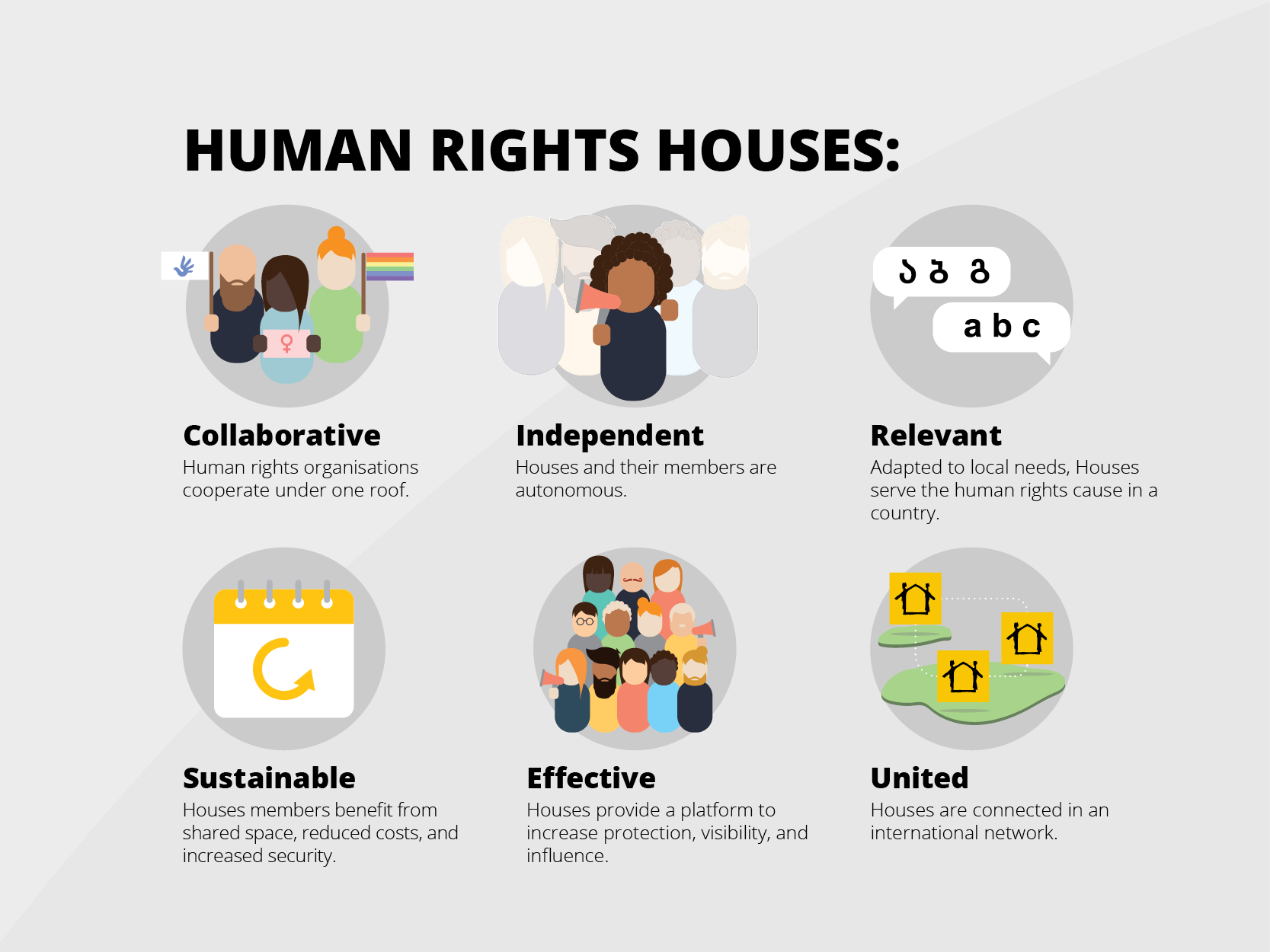
Human Rights Houses are coalitions of civil society organisations working together to advance human rights at home and abroad.

The Human Rights House Foundation (HRHF) works with civil society organisations to establish and support Human Rights Houses as bases for human rights activities. While member organisations are often co-located under one roof, the structure and make-up of House reflects the local needs and local context. This allows Houses to provide relevant benefits to a local human rights community as a whole and enhance the national capacity to uphold and protect human rights and independent civil society.

HRHF connects Human Rights Houses, building an international network for change and freedoms, and today, the network extends across 11 countries with 17 Houses.

Membership in Human Rights House provides solidarity, as well as opportunities for collaboration and networking. Working together, member organisations have greater opportunity to influence the human rights agenda. House members are also able to more effectively pool resources and benefit from reduced administration costs. Finally, in a time of closing space for civil society and attacks against human rights defenders, House membership offers a level of security and protection from increased threats and harassment.

HRHF’s Human Rights House concept is built around the enduring values of solidarity and partnership. It remains as important today as when the first House opened its doors in Oslo in 1989.

While each Human Rights House is unique, all houses are collaborative, independent, relevant, sustainable, effective, and united.

Human Rights Houses: collaborative, independent, relevant, sustainable, united

To find out more:

General enquiries, Human Rights House Foundation info@humanrightshouse.org

Human Rights House Foundation developed major new tool kit “Rights of Defenders”

December 18, 2018

“Rights of Defenders” aims to promote understanding of international standards that protect and empower human rights defenders. The project is inspired by the 20th anniversary year of the landmark 1998 Declaration on Human Rights Defenders.

For implementation of international standards to be effective, it is essential that human rights defenders know and understand their rights. The Rights of Defenders project promotes and builds understanding of international standards and provides clear, accessible, and targeted insight into the standards and the context that surrounds them. As part of the project, HRHF has developed tools and resources for defenders to disseminate standards nationally, engage with authorities and hold them accountable to the commitments they make internationally, and initiate national conversations on the importance of defenders and their work.

The Rights of Defenders resources – developed by Human Rights Houses and HRHF – promote and build an understanding of international standards and provide clear, accessible, and targeted insight into the standards and the context that surrounds them. The aim is to provide resources to help defenders to disseminate standards nationally, engage with authorities and hold them accountable to the commitments they make internationally, and initiate national conversations on the importance of defenders and their work.

These resources are currently available in English, Russian, and Georgian. Human Rights Houses and HRHF are in the process of translating the booklet and other related materials into other languages. These will be published on this page when available. We currently expect translations into Armenian, Croatian, Tatar, and Ukrainian.

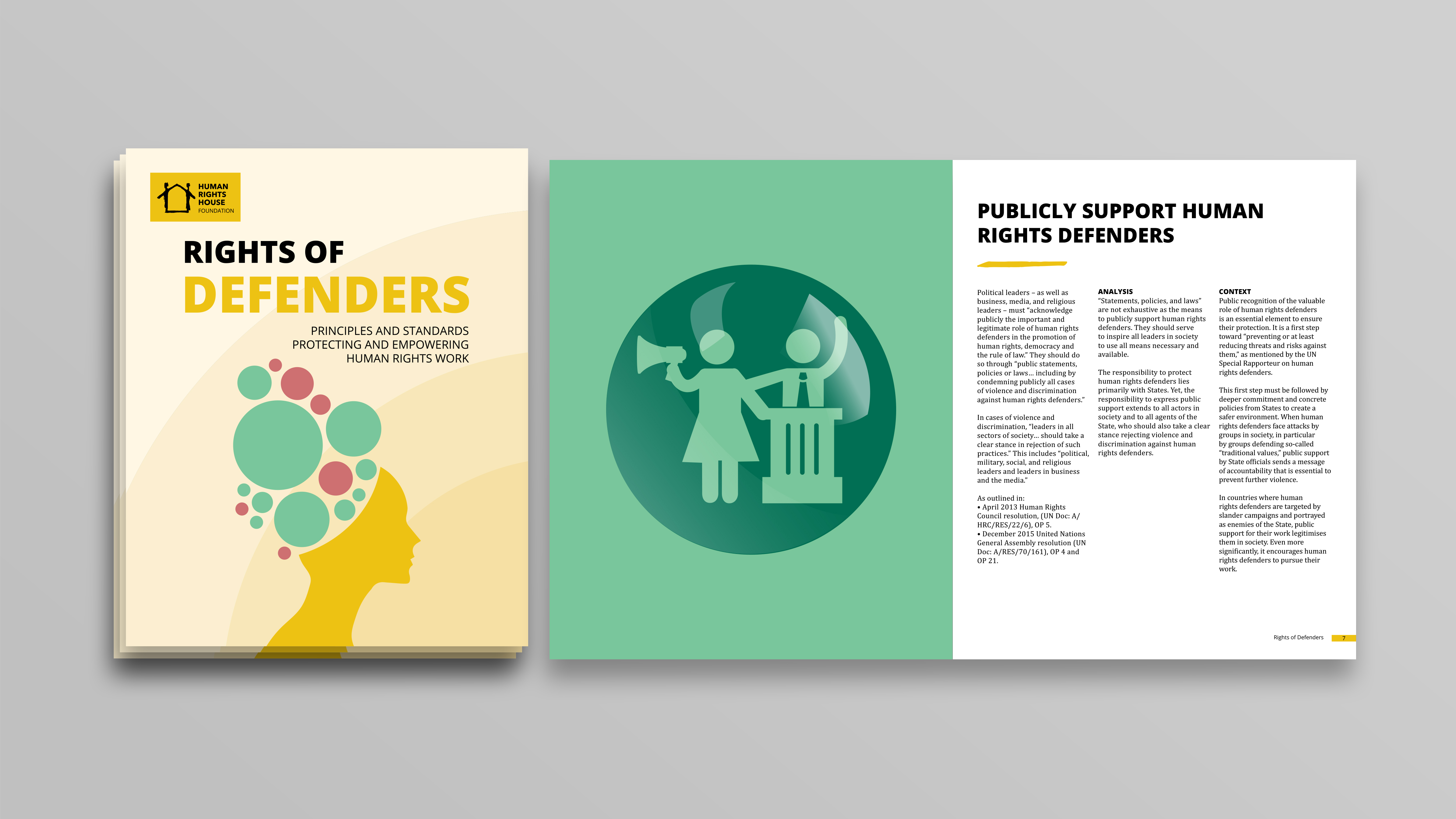
The Rights of Defenders booklet is divided into 16 standards, inspired by the strong content of landmark resolutions on human rights defenders and their work, adopted at the United Nations and Council of Europe. It condenses the main points of each standard as outlined in the resolutions. The standards confer both positive and negative obligations – whether it is action or refraining from an action. They are illustrated in red or green respectively to illustrate these obligations. The booklet also provides analysis to inform the interpretation and implementation of these standards. This is inspired by the commentary of experts such as UN Special Rapporteurs and by the experience of HRHF and Human Rights Houses in Western and Eastern Europe, Balkans, and the Caucasus. Further, to give context, the booklet outlines the trends affecting each standard and provides recommendations for their implementation.

Download the Rights of Defenders booklet.

References and sources In most cases, defenders may only need the main points of each standard together with analysis and context, as provided in the booklet. Yet there may be other occasions that require more detailed information. Our companion document provides sources and in-depth referencing to the full language of the resolutions.

Download the Rights of Defenders companion document of references and sources.

Poster

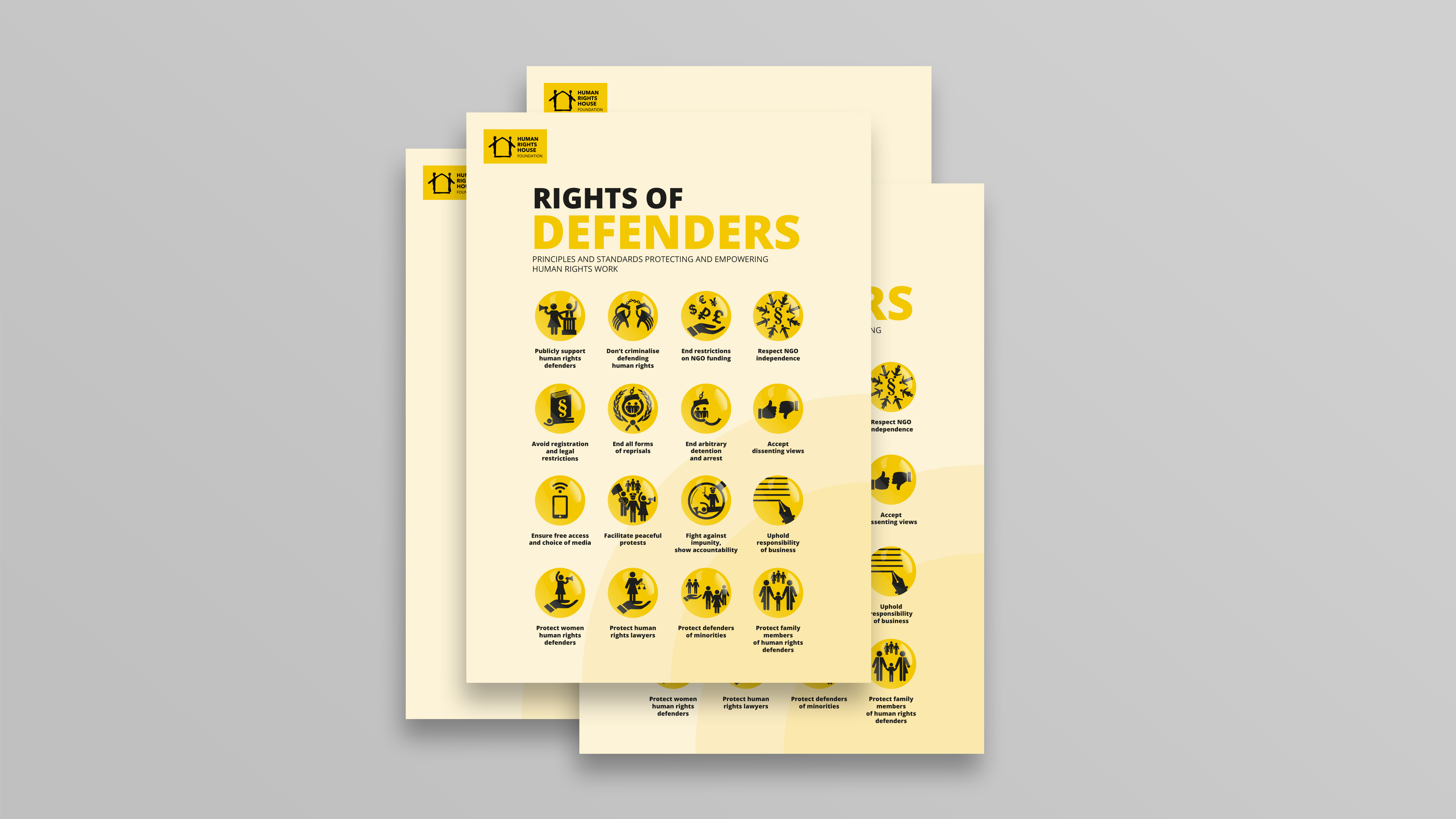
The Rights of Defenders poster promotes the 16 international standards outlined in the booklet. It aims to help promote and raise awareness of these standards.

Download the Rights of Defenders poster

Postcards

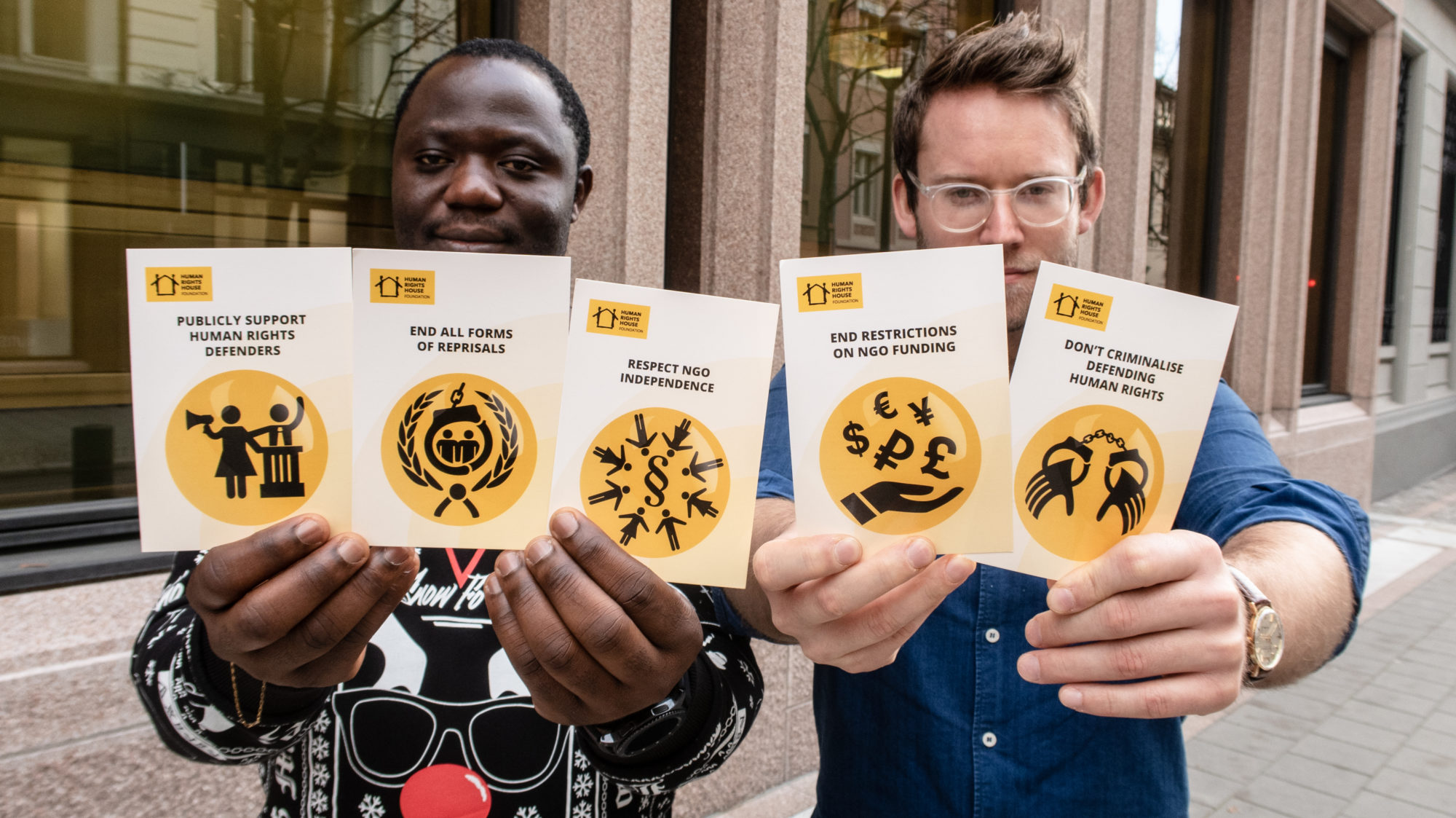
The Rights of Defenders postcards are a tool to promote and raise awareness of the standards that are most relevant to a particularly country or situation. They are designed to be printed A6, but also work at other sizes. Postcards with five of the most prominent standards are available to download below, though on request we can provide postcards for any of the 16 standards featured in the booklet.

Download postcards for:

Contact

Doriane Anfrie
PROJECT COORDINATOR
Languages: English, French, Spanish
For some of my earlier posts on the HRHF: https://humanrightsdefenders.blog/tag/hrhf/

Human Rights House Foundation shows portraits of HRDs on Twitter

December 4, 2018

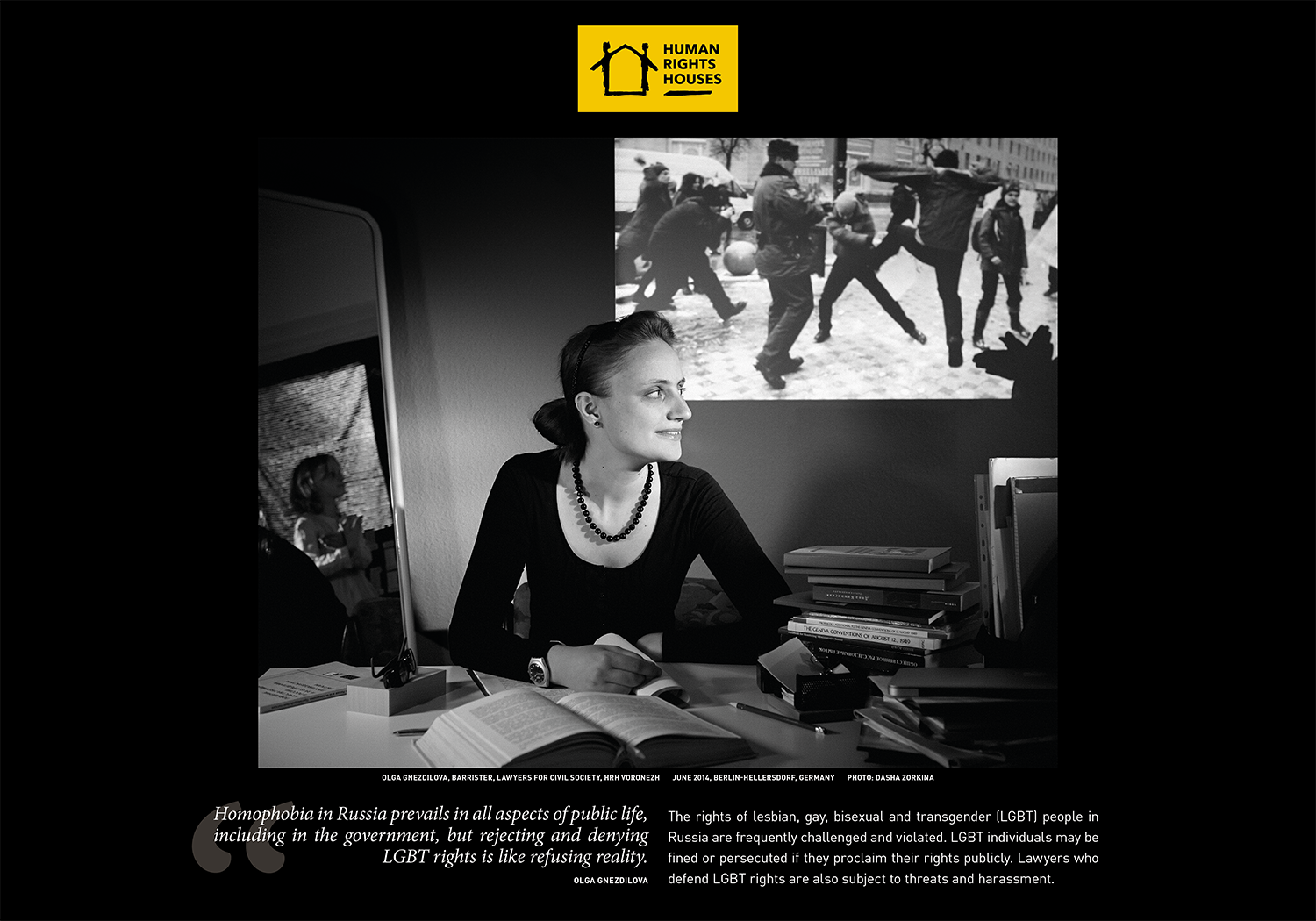
A series of beautiful portraits of LGBTI and women human rights defenders in Russia, such as the one below, on HRHF’s twitter account”


In spite of or because of the US’ absence, the 39th Human Rights Council considered a relative success

September 29, 2018

Civil society organisations welcomed significant outcomes of the Human Rights Council’s 39th session, including the creation of independent investigative mechanism on Myanmar, the renewal of the mandate of the Group of Eminent Experts on Yemen and the Commission of Inquiry on Burundi, and a dedicated space on the Council’s agenda in 2019 to discuss the human rights situation in Venezuela. [see alsohttps://humanrightsdefenders.blog/2018/09/08/many-hrd-issues-at-the-39th-session-of-the-un-human-rights-council/]

In a joint statement, several NGOs (ISHR The African Centre for Democracy and Human Rights Studies (ACDHRS), Amnesty International, Article 19, Center for Reproductive Rights. CIVICUS, DefendDefenders, FIDH, Forum Asia, Human Rights House Foundation (HRHF), Human Rights Watch, International Commission of Jurists) welcomed the Council’s adoption of landmark resolutions on several country situations:

On Myanmar, the creation of the independent investigative mechanism is an important step towards accountability for the horrific crimes committed in Myanmar, as elaborated in the Fact Finding Mission’s report to this session. The overwhelming support for the resolution, notwithstanding China’s shameful blocking of consensus, was a clear message to victims and survivors that the international community stands with them in their fight for justice. 

On Yemen, the Council demonstrated that principled action is possible, and has sent a strong message to victims of human rights violations in Yemen that accountability is a priority for the international community, by voting in favor of renewing the mandate of the Group of Eminent Experts to continue international investigations into violations committed by all parties to the conflict. 

Furthermore, the leadership by a group of States, including Latin American countries, on the landmark resolution on Venezuela, was as an important step for the Council applying objective criteria to address country situations that warrant its attention. The resolution, adopted with support from all regions, sends a strong message of support to the Venezuelan people. By opening up a space for dialogue at the Council, the resolution brings scrutiny to the tragic human rights and humanitarian crisis unfolding in the country.  

The renewal of the mandate of the Commission of Inquiry (CoI) on Burundi will enable it to continue its critical investigation and work towards accountability. However, the Council failed to respond more strongly to Burundi’s record of non-cooperation and attacks against the UN human rights system. [see alsohttps://humanrightsdefenders.blog/2016/10/26/enough-is-enough-ngos-call-for-burundi-suspension-from-un-human-rights-council/]

The Council also adopted a resolution on Syria, which among other things condemns all violations and abuses of international human rights law and all violations of international humanitarian law committed by all parties to the conflict.

However, on other country situations including China, Sudan, Cambodia and the Philippines, the Council failed to take appropriate action. 

On Sudan, the Council adopted a weak resolution that envisions an end to the Independent Expert’s mandate once an OHCHR office is set up; a “deal” Sudan has already indicated it does not feel bound by, and which is an abdication of the Council’s responsibility to human rights victims in Sudan while grave violations are ongoing. At a minimum, States should ensure the planned country office monitors and publicly reports on the human rights situation across Sudan, and that the High Commissioner is mandated to report to the Council on the Office’s findings.  

The Council failed to take action on the Philippines, in spite of the need to establish independent international and national investigations into extrajudicial killings in the government’s ‘war on drugs’, and to monitor and respond to the government’s moves toward authoritarianism. 

In addition, the Council continued with its weak response to the deepening human rights and the rule of law crisis in Cambodia, failing to change its approach even when faced with clear findings by the Special Rapporteur demonstrating that the exclusive focus on technical assistance and capacity building in the country, is failing.

Many States, NGOs and the High Commissioner, raised concerns about China’s human rights record, specifically noting serious violations of the rights of Uyghurs and other predominantly Muslim minorities in Xinjiang province. It is regrettable that States did not make a concrete and collective call for action by China to cease the internment of estimates ranging up to 1 million individuals from these communities. 

On thematic resolutions, the Council adopted by consensus a resolution on equal participation in political and public affairs, as well as a resolution on the safety of journalists. The latter sets out a clear roadmap of practical actions to end impunity for attacks.  

The Council also adopted by consensus a resolution on preventable maternal mortality and morbidity and human rights in humanitarian settings. Women and girls affected by conflict have been denied accountability for too long. The implementation of this resolution will ensure that their rights, including their sexual and reproductive health and rights, are respected, protected and fulfilled. 

Finally, the Council’s first interactive dialogue on acts of reprisals and intimidation was an important step to ensure accountability for this shameful practice. More States need to have the courage and conviction to stand up for human rights defenders and call out countries that attack and intimidate them. [https://humanrightsdefenders.blog/tag/reprisals/]

Read the full statement here.

Florian Irminger moves from HRHF to Penal Reform International

September 19, 2018

In September 2018, Florian Irminger joined PRI as its Executive Director. He was previously the Head of Advocacy at Human Rights House Foundation (HRHF) in Geneva. Before joining HRHF, Florian co-founded ‘Stop Suicide’, a non-governmental organisation dedicated to the prevention of suicide among young people in Switzerland. Florian has been Chair of the Board of the House of NGOs in Geneva for four years. From 2009 to 2012, he was a member of the editorial team responsible for revising Geneva’s constitution, adopted in 2012, and was also a member of the young leaders’ programme of the World Economic Forum.

In his inaugural blog in PRI Newsletter, Florian reflects upon the organisation’s practical approach to penal reform, which has enabled PRI to play a key role in implementing international standards and provide effective and tailored solutions to criminal justice problems worldwide.

For my earlier posts on Florian: https://humanrightsdefenders.blog/tag/florian-irminger/

——-

https://www.penalreform.org/blog/pris-approach-as-needed-as-ever/

Side event on human rights situation in Ukraine on Monday 20 June Geneva

June 18, 2016

HRHFlogo

Despite the hopes raised by the Euromaidan movement and improvements in many facets of life and governance in Ukraine, the last two years have brought the occupation of Crimea, armed conflict in parts of eastern Ukraine, and ongoing abuses, corruption, and political unrest. Two years after Euromaidan and the illegal occupation of Crimea, what efforts have been undertaken to prevent unlawful killings and ensure accountability, justice and redress in such cases?

The Human Rights House Foundation organisms a side event: “The human rights situation in Ukraine two years after Euromaidan: a view from civil society”, on Monday 20 June 2016, from 17:00 to 18:00 in Room XXIV, Palais des Nations, Geneva

Speakers:

  • CHRIST HEYNS, United Nations Special Rapporteur on extrajudicial, summary or arbitrary executions
  • TETIANA PECHONCHYK, Human Rights media monitoring, Ukraine;
  • OLGA SKRYPNYK, Crimean Human Rights Group, Ukraine;
  • MARKIYAN HALABALA, Euromaidan victim’s legal representative, Ukraine;
  • Moderator: Anna Innocenti,  Human Rights House Foundation.

for more info: ALEXANDER.SJODIN@HUMANRIGHTSHOUSE.ORG

Reprisals reach even an international NGO attending the Human Rights Council in Geneva

June 13, 2016

This blog has always had a keen eye out for reprisals against human rights defenders as I believe strongly that this issue is one of the most crucial facing the human rights movement. See e.g. https://thoolen.wordpress.com/2014/03/13/zero-tolerance-for-states-that-take-reprisals-against-hrds-lets-up-the-ante/. Now it turns out that Florian Irminger, Head of Advocacy at the Human Rights House Foundation (HRHF), received a death threat during the 31st session of the UN Human Rights Council (in March). Evidence strongly suggests that a diplomat working for the Russian Federation in Geneva and attending the Human Rights Council made this threat [see confirmation in link at the end of this piece]. Read the rest of this entry »

Fritt Ord and ZEIT awards to Eastern European media: Elena Milashina, Seymour Hazi and Nashi Groshi

May 13, 2016

Fritt Ord and ZEIT-Stiftung have given their 2016 awards to: Read the rest of this entry »