Register here for this on-line event. When we think of police violence, the images that are conjured up are of Black men being targeted and tortured at the hands of law enforcement. Demanding justice and accountability for victims of systemic racism, Wednesday 22 June 16:00 – 18:00 CET
While these images are important, they tell only a part of the story. What are the harms that we are not seeing? How are those harms felt more broadly by communities that are impacted directly and those who witness its affects as the humdrum of terror running automatically in the background? And, how are human rights defenders using the United Nations as a tool to expose these violations and seek justice for victims?
This event, organised by the UN Anti-Racism Coalition, will address these questions and expand the definition of what it means to be directly impacted by police and State-sanctioned violence. The aim is to highlight and recognise the broader and deeper impacts of systemic racism.
SPEAKERS:
Ana Paula Oliveira, Bruna da Silva, Vanessa Francisco Sales, human rights defenders from Brazil
María Mercedes Manjarrez, human rights defender from Colombia
Esther Mamadou, human rights defender from Spain
Ejim Dike, human rights defender from Nigeria
Adrienne Hood, human rights defender from the United States
MODERATOR: Iki Yos, Caribbean, afrodiasporic-transborder artist, performer, and anti-racist activist You are welcome to join this discussion, which will be held in English with simultaneous interpretation in Spanish, French and Portuguese. Click here to register to the event and here for more information.
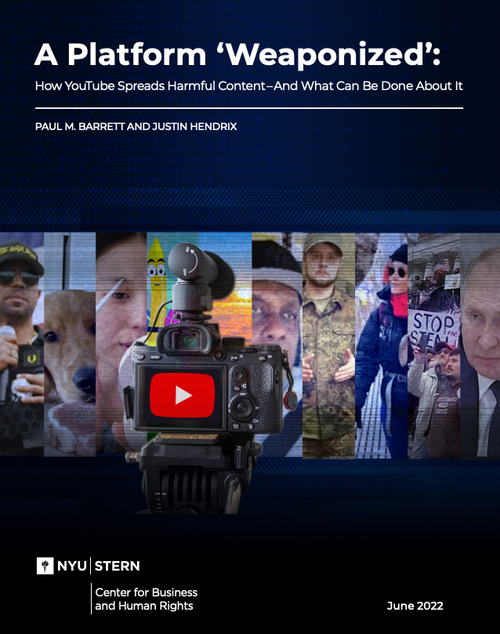
In June 2022, Paul M. Barrett and Justin Hendrix of NYU’s STERN Centre for Business and Human Rights came with a very timely report: “A Platform ‘Weaponized’:How YouTube Spreads Harmful Content—And What Can Be Done About It“. We know less about YouTube than the other major social media platforms. YouTube, with more than 2 billion users, is the most popular social media site not just in the United States, but in India and Russia as well. But because of the relative difficulty of analyzing long-form videos, as compared to text or still images, YouTube has received less scrutiny from researchers and policymakers. This in-depth report addresses the knowledge gap.
Like other major platforms, You Tube has a dual nature: It provides two billion users access to news, entertainment, and do-it-yourself videos, but it also serves as a venue for political disinformation, public health myths, and incitement of violence.
——————————————————————-
YouTube’s role in Russia illustrates this duality. Since Russia launched its invasion of Ukraine in February 2022, YouTube has offered ordinary Russians factual information about the war, even as the Kremlin has blocked or restricted other Western-based social media platforms and pressured foreign journalists in the country to silence themselves. But for years before the brutal incursion, YouTube served as a megaphone for Vladimir Putin’s disinformation about Ukraine and its relations with the West. Despite its heft and influence, less is known about YouTube than other major social media sites.
Does YouTube send unwitting users down a ‘rabbit hole’ of extremism?
In response to reports that the platform’s own recommendations were “radicalizing” impressionable individuals, YouTube and its parent, Google, altered its recommendation algorithm, apparently reducing the volume of recommendations of misinformation and conspiratorial content. But platform recommendations aren’t the only way people find potentially harmful material. Some, like the white 18-year-old accused of shooting and killing 10 Black people in a Buffalo, N.Y., grocery store, seek out videos depicting violence and bigotry. These self-motivated extremists can find affirmation and encouragement to turn their resentments into dangerous action.
A social media venue with global reach
Roughly 80% of YouTube traffic comes from outside the United States, and because of language and cultural barriers, the platform’s content moderation efforts are less successful abroad than at home. The report explores how YouTube is exploited by Hindu nationalists persecuting Muslims in India, right-wing anti-vaccine advocates in Brazil, and supporters of the military junta in Myanmar.
In Part 2, we examine YouTube’s role as the internet’s vast video library, one which has contributed to the spread of misinformation and other harmful content. In 2019, for example, YouTube reacted to com- plaints that its recommendations were pushing impressionable users toward extremist right-wing views. The company made a series of changes to its algorithms, resulting in a decline in recommendations of conspiratorial and false content. But recommendations are not the only way that people find videos on YouTube. A troubling amount of extremist content remains available for users who search for it. Moreover, YouTube’s extensive program for sharing advertising revenue with popular creators means that purveyors of misinformation can make a living while amplifying the grievances and resentments that foment partisan hatred, particularly on the political right.
In Part 3, we turn our attention to YouTube’s role in countries outside of the U.S., where more than 80% of the platform’s traffic originates and where a profusion of languages, ethnic tensions, and cultural variations make the company’s challenges more complicated than in its home market. Organized misogynists in South Korea, far-right ideologues in Brazil, anti-Muslim Hindu nationalists, and supporters of Myanmar’s oppressive military regime have all exploited YouTube’s extraordinary reach to spread pernicious messages and rally like minded users. [see also: https://humanrightsdefenders.blog/2020/11/02/bbc-podcast-on-the-framing-of-video-monk-luon-sovath/]
Recommendations to the U.S. government Allocate political capital to reduce the malign side effects of social media: President Biden’s off-the- cuff expressions of impatience with the industry aren’t sufficient. He ought to make a carefully considered statement and lend his authority to legislative efforts to extend federal oversight authority. Former President Obama’s recent speech at Stanford about disinformation provided a helpful foundation. Enhance the FTC’s authority to oversee social media: Some of the issues raised in this report could be addressed by a proposal we made in a February 2022 white paper—namely, that Congress should authorize the Federal Trade Commission to use its consumer protection authority to require social media companies to disclose more data about their business models and operations, as well as provide procedurally adequate content moderation.
To YouTube: Disclose more information about how the platform works: A place to start is explaining the criteria algorithms use to rank, recommend, and remove content—as well as how the criteria are weighted relative to one another. Facilitate greater access to data that researchers need to study YouTube: The platform should ease its resistance to providing social scientists with information for empirical studies, including random samples of videos. Expand and improve human review of potential harmful content: YouTube’s parent company, Google, says that it has more than 20,000 people around the world working on content moderation, but it declines to specify how many do hands-on review of YouTube videos. Whatever that number is, it needs to grow, and outsourced moderators should be brought in-house. Invest more in relationships with civil society and news organizations: In light of their contribution to the collapse of the advertising-based business model of many U.S. news-gathering organizations, the platforms should step up current efforts to ensure the viability of the journalism business, especially at the local level.
The NYU Center for Business and Human Rights began publishing reports on the effects of social media on democracy in the wake of Russia’s exploitation of Facebook, Twitter, and YouTube during the 2016 U.S. presidential campaign. We initially advocated for heightened industry self-regulation, in part to forestall government intervention that could lead to First Amendment complications. As the inadequacy of industry reforms has become clear, we have supplemented our calls for self-regulation with a proposal for enhancement of the Federal Trade Commission’s consumer protection authority to oversee the industry.
In Part 4, we offer a concise version of the FTC proposal, as well as a series of recommendations to YouTube itself. The report does not address the problem of YouTube hosting potentially harmful videos aimed at children and teenagers. This persistent phenomenon deserves continued scrutiny but is beyond the scope of our analysis.
38 NGOs, including HRW and AI, ask Algeria to end the repression of human rights and the “immediate” release of detainees. They have launched a campaign calling on Algeria to end the repression of Human Rights and demand the immediate release of people detained in the country for exercising their freedom of expression. “The campaign calls on all relevant individuals, organizations and parties to contribute to collectively demanding an end to the criminalization of the exercise of fundamental freedoms in Algeria using the label At least 300 people have been arrested since the beginning of 2022, and until April 17, in the country for exercising their right to free expression, peaceful assembly or association, according to human rights defender Zaki Hannache. “The arrests and sentences of peaceful activists, independent trade unionists, journalists and human rights defenders have not decreased, even after the protest movement was closed,” they said in a statement. The organizations have given the example of the hunger strike of the Algerian activist, Hadi Lassouli, to protest against his arbitrary imprisonment, as well as the case of Hakim Debazi, who died in custody on April 24 after being placed in preventive detention on April 22. February for social media posts. “Those suspected of criminal responsibility for serious human rights violations must be brought to justice in trials with due guarantees, and the authorities must provide victims with access to justice and effective reparations,” they have requested. This awareness campaign will be carried out until the anniversary of the death of Kamel Eddine Fejar, a human rights defender who died in custody on May 28, 2019 after a 50-day hunger strike. The United Nations High Commissioner for Human Rights, Michelle Bachelet, was “concerned” last March at the increase in fundamental restrictions in the country, including an increase in arrests and detentions of human rights defenders, as well as members of civil society and political opponents. “I call on the government to change course and take all necessary measures to guarantee the rights of its people to freedom of expression, association and peaceful assembly,” she said in a statement from the UN High Commissioner for Human Rights.
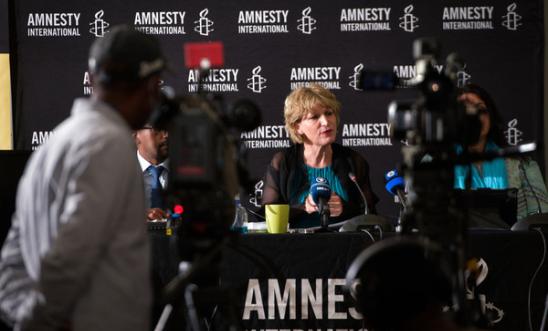
Ahead of the World Economic Forum’s annual meeting in Davos that starts today, Sunday 22 May 2022, Agnès Callamard, Amnesty International’s Secretary General, said:
“This year’s Davos conference takes place amid a gathering storm of human rights crises. Russia’s mounting war crimes in Ukraine, the terrifying rollback on abortion rights in the US, the still-neglected climate emergency, the ongoing failure to secure universal vaccine access – these are just a few examples of what happens when human rights are sacrificed for power and profit.
“Many of the political and business leaders attending Davos are directly responsible for these catastrophes, whether through their explicit pursuit of anti-human rights agendas or through their contemptible inaction and failure to implement solutions.
“The Davos guestlist includes some of the richest and most powerful people in the world, and they have a moral obligation to put respect for human rights at the top of the agenda. They must use their vast wealth and influence to change the status quo and end the rampant inequality which has been the root cause of so much recent suffering.”
The World Economic Forum’s annual meeting will take place in Davos, Switzerland, between 22 and 26 May.
Every year, champions of human rights bring their stories to the Oslo Freedom Forum to shed light on the struggle for freedom around the world.
The theme for the 2022 Oslo Freedom Forum, CHAMPION OF CHANGE, celebrates both activists, who are themselves champions, and their causes. This theme represents a strong, scalable call to action, inviting you to act and advocate on behalf of activists and in support of human rights. At the Oslo Freedom Forum, we realize that everyone has the potential to effect change — either as a champion on an individual level, or as part of a larger movement.
The 2022 mainstage program includes keynote speakers, who will be shedding light on the struggle for freedom around the world, including:
The three women who are leading the democratic movement in Belarus: Maria Kolesnikova, Sviatlana Tsikhanouskaya, and Veronica Tsepkalo, first stood on stage together in 2020 in Belarus, when Aleksandr Lukashenko brazenly stole the country’s elections. They will reunite with us, to provide an update on the Belarusian people’s remarkable multi-year protest, and explain how we can help.
Carine Kanimba, daughter of imprisoned “Hotel Rwanda” hero — who saved more than a thousand people during the Rwandan genocide — will share her extremely risky quest to liberate her father, who was was kidnapped by the state in 2020, and is now serving a life sentence in prison for criticizing the Kagame regime. Despite being wiretapped and targeted by Pegasus spyware, Carine continues to speak out to bring justice to her father.
At the young age of 26, Zarifa Ghafari became the unlikely mayor of Maidan Shar, a town in Afghanistan filled with Taliban support. Hatred toward her as a woman leader led to the assassination of her father in 2020. Last summer, with her life at risk after the fall of Kabul, she made a daring escape in the footwell of a car, evading Taliban fighters. Today she lives in exile, where she continues to advocate for human rights in Afghanistan, committed to the cause of freedom in her country.
Jewher Ilham’s father, Uyghur scholar Ilham Tohti, has been held under a life sentence since 2014, imprisoned in a concentration camp in China’s Xinjiang region. Jewher has been speaking truth to power, shedding light on China’s forced labor police by testifying before US Congress, publishing op-eds, receiving numerous international awards on behalf of her father, and writing two books on the subject.
In 2012, Syrian activist and Georgetown student Omar Alshogre was detained along with his cousin for demonstrating against the Syrian regime. He spent more than three years in Assad’s infamous jail system, where he endured and survived unspeakable torture. At the age of 20, his mother helped smuggle him out to freedom. His story is a bedrock piece of evidence in the international case to hold the Assad regime accountable for crimes against humanity.
One of the 100 most influential women defining the last century according to TIME Magazine, Nobel Peace Prize laureate Tawakkol Karman, also known as the “mother of the revolution,” “the iron woman,” “Lady of the Arab Spring,” as well as one of the Most Rebellious Women in History, is a notoriously true powerhouse. She is a human rights activist, journalist, politician, and founder of her own international foundation.
Event on 1 June 2022, 12:00-14:00: “Don’t forget about us: Strategies for resisting long-term detention of Human Rights Defenders”. Location: Cassese Room, Villa Moynier, 120B Rue de Lausanne, Geneva (and online)
In 2021, the UN Special Rapporteur on Human Rights Defenders published a report on cases of long-term detention of activists, which were estimated to number hundreds or thousands worldwide. This report confirms the terrible treatment and conditions many defenders bear in prison. However, while an objective of long-term detention may be to discourage defenders, many cases result in perennial campaigns and increased publicity for the defenders themselves.
How can governments, civil society and international mechanisms work together to keep the pressure on long-term detention cases? What strategies have proven successful in improving respect for defenders’ rights and physical integrity while imprisoned?
Andrés Zaragoza in Open Global Rights of 16 May 2022 hits the nail by arguing that “If we want to constructively engage companies, business associations or investors on human rights issues, we must recognize who our interlocutor is.“
..Building trust and a common narrative to engage in a constructive conversation is extremely difficult. Some would argue that a trusting relationship between civil society and private companies is not only impossible but also not desirable; that good faith is nowhere to be found in business sectors where human rights abuses can and do take place.
Despite an understandably dogged legacy of mistrust between civil society and corporations, there is a momentum for human rights organizations to engage productively with businesses, responsible investors, and other private actors that hold increasing market power, leverage, and are subject to new human rights legislation. As we write, global corporations are becoming increasingly relevant actors in international conflicts. In other words, businesses could become powerful allies in advancing human rights’ agendas with governments or in regards to public opinion.
It’s no mystery that businesses and civil society speak different languages and engage from radically distinct perspectives when referring to human rights issues.
It is true that corporate activism is on the rise, with some companies supporting important causes and campaigns such as LGBTQ+ rights, anti-racism, equality, and non-discrimination. However, companies are not founded for promoting and protecting human rights, even if we may wish it otherwise. Instead, corporations see human rights issues through the lens of their productive and business models. This does not mean that workers or companies do not care about human rights. They do care, especially in certain sectors and business cultures.
As civil society, we need to identify and understand how to best engage our strategic targets and audiences. If we want to constructively engage companies, business associations or investors on human rights issues, we must recognize who our interlocutor is. Businesses’ core activity is the starting point to analyse any human rights issue: their business, people, customers, and supply chain.
Businesses tend to focus on risk identification and mitigation. There is growing recognition that human rights defenders can play a vital role in sounding the alarm on problems within an organization’s operations or supply chain. Generally, ‘UN speak’ does not work with businesses. Civil society should avoid jargon when engaging with business circles. Business representatives seek examples and clarity on which human rights issues are of concern and how they are relevant to their operations. See also: https://humanrightsdefenders.blog/2019/01/21/davos-businesses-need-strong-human-rights-defenders/
Civil society should not automatically feel good about the fact that a company has a person with “human rights” written in their title. Unfortunately, this often means that a position was created for compliance or reputational management purposes, to deal discreetly with human rights issues, or engage (read: manage) civil society relations. By contrast, companies that take human rights seriously embed the topic across functions and departments, working towards including human rights within the company’s ethos.
To achieve change, civil society should make every effort to better understand the complexity of a particular company, its economic sector, activity, internal governance, corporate values, and culture. Each company has its own systems and structure, progressing through their human rights journey differently.
On a micro level, the individual background, connections, and motivations of the human rights personnel within the company have great bearing on how issues are pushed through a company. At the systemic level, NGOs must understand the functioning of international business, economics, investment and trade.
Lessons learnt and scars taken
..Civil society should understand and use the market. As companies need to comply with human rights and sustainability regulations, NGOs and defenders can become key in risk assessment or due diligence processes, influencing directly the behavior of companies. We need to know the “enemy” and know ourselves. As civil society, we should build our technical capacity to understand and leverage international business, economics, investment and trade. We will not change business dynamics if we do not understand them.
The 100,000 officially registered disappearances in Mexico illustrate a long-standing pattern of impunity in the country, indicating the tragedy continues daily, UN human rights experts warned.
There are now over 100,000 people in Mexico’s national register of the “disappeared.” The UN says organized crime is among the leading causes of missing people in the country. Human rights organizations and relatives of the missing have called on the government to step up investigations and conduct searches more effectively
In the last two years the numbers have spiked from about 73,000 people to more than 100,000 — mostly men.
Mexico has seen spiralling violence since the war on drugs began in 2006, with over 350,000 people having died since then. Last year, the country of more than 129 million people saw 94 murders a day on average.
“It’s incredible that disappearances are still on the rise,” Virginia Garay, whose son went missing in 2018 in the state of Nayarit, told news agency Reuters. “The government is not doing enough to find them,” said Garay, who works in a group called Warriors Searching for Our Treasures that seeks to locate missing loved ones.
Civil society groups that help try and locate missing people stress that many families do not report disappearances because of distrust in the authorities. The actual figure of missing people is therefore believed to be much higher than the official data.
“Organized crime has become a central perpetrator of disappearance in Mexico, with varying degrees of participation, acquiescence or omission by public servants,” a report by the UN Committee on Enforced Disappearances, released last month, said.
“State parties are directly responsible for enforced disappearances committed by public officials, but may also be accountable for disappearances committed by criminal organizations,” the report added.
The missing people include human rights defenders, some of whom went missing because of their own involvement in the fight against disappearances.
The United States Agency for International Development (USAID), Bureau for Development, Democracy, and Innovation, Democracy, Human Rights, and Governance (DDI/DRG) Center is inviting applications for the Justice, Rights, and Security (JRS) Annual Program Statement (APS). Deadline: 11 May 2023
The purpose of the JRS APS is to empower USAID and its Missions to seek solutions to JRS-related challenges, to engage new and underutilized partners, to solve problems not adequately addressed by other USAID investments, and to offer USAID Missions and USAID/Washington Offices a mechanism through which such work can be innovatively accomplished with dedicated support and expertise from USAID Washington DRG Center’s JRS team.
Objectives
Promote Justice, including the following objectives:
To ensure the independent, efficient, and open administration of justice.
To enhance the quality and accessibility of justice.
To guarantee impartial application of the law and due process.
To improve justice seeker experiences and outcomes.
To strengthen effective checks and balances and accountable institutions as foundations of democratic governance.
Protect Rights, including the following objectives:
To improve enabling environments for the protection and advancement of human rights.
To facilitate, develop, and implement effective remedies to address human rights violations and abuses to ensure non-recurrence.
To promote equal and equitable enjoyment of human rights by all.
To empower people to know, use, and shape the law in their daily lives to protect and advance human rights.
To facilitate the work of all types of human rights defenders and activists.
Promote Security, including the following objectives:
To constrain the arbitrary exercise of power and tempering the use of force by civilian law enforcement.
To strengthen the accountability, professionalism, capacity, and integrity of police and other civilian law enforcement actors.
To safeguard all members of society from crime and violence, including gender-based violence, so they may live safely and recognize their full potential.
Both U.S. and Non-U.S. Non-Profit Organizations NGOs) are eligible to apply for this APS
NOGs (such as Human Rights Watch and the Human Rights Foundation) have condemned the arrest of Cardinal Joseph Zen, as well as the lawyer Joseph Zen, the singer Denise Ho and the scholar Hui Po-Keung, for having maintained contacts with foreign forces in Hong Kong.
HRW Senior China researcher Maya Wang, said that “the arrest of a 90-year-old cardinal is the latest example of the city’s human rights freefall in recent years.”
The four, along with former lawmaker Cyd Ho, who is already in jail, were part of the 612 Humanitarian Aid Fund, which provided medical, legal and psychological help to protesters arrested during the 2019 pro-democracy protests in Hong Kong. Kong.
Denise Ho, Margaret Ng, and others affiliated with Stand News, an independent pro-democracy online publication, were previously arrested by national security police in December 2021 under allegations of publishing “seditious” and “inflammatory” materials. Denise Ho formerly served on the board of Stand News, but stepped down in November 2021. Meanwhile, the 612 Humanitarian Support Fund ceased operations in October 2021 after national security police and Chinese state-backed media requested information on its beneficiaries and donors.
Maya Wang has specified that Hong Kong has “long been a regional leader in openness and respect for the rule of law, but now competes for the first places in Asia for repression and political prisoners.”
“The people of Hong Kong have been unequivocal in their demand for human rights, and governments around the world should be unequivocal in their response to that call,” concluded the HRW researcher.


 Hans Thoolen on Human Rights Defenders and their awards