Posts Tagged ‘Human Rights Defenders’

Mutabar Tadjibayeva wins landmark case in UN Human Rights Committee against Uzbekistan

October 8, 2015

Mutabar Tadjibayeva is remarkable, even among human rights defenders. Her story is well-known in human rights circles: arrested, detained and tortured in Uzbekistan’s prisons, she was released on medical grounds and allowed to leave the country in 2008. That year she came to Geneva to receive in person the Martin Ennals Award for Human Rights Defenders [see: http://www.martinennalsaward.org/index.php?option=com_content&view=article&id=73&Itemid=116&lang=en and https://thoolen.wordpress.com/tag/mutabar-tadjibayeva/].OLYMPUS DIGITAL CAMERA

But she does not just live quietly in exile in Paris. She continues fight for her rights, lodged a complaint to the UN Human Rights Committee in 2012 and this body found on 6 October 2015 that there had been “multiple violations” of her rights, according to a press release issued by three human rights NGOs on 8 October (the Fiery Hearts Club, Redress and FIDH).   Read the rest of this entry »

Iduvina Hernandez: Human Rights Defender from Guatemala

October 8, 2015

The newsletter of the ISHR of 7 October 2015 carries an interview with Iduvina Hernandez, co-founder of Association for the Study and Promotion of Security in Democracy in Guatemala.

Iduvina Hernandez founded the Association for the Study and Promotion of Security in Democracy (SEDEM), together with US citizen Rachel Garst in 2000. As journalists, Iduvina and Rachel had studied the behaviour of armed forces and intelligence services which were linked to numerous human rights abuses. The organisation initially questioned the meaning of ‘oversight’ and ‘accountability’ of security services for the public as Guatemala was having raging debate about security forces and intelligence sources. In order to expand this discussion, the organisation started building citizen networks in the provinces providing them with training so as to enable them to conduct independent oversight of State security forces actions in their region.

Guatemala’s public security is handled by the military and dominated by a national security doctrine. Extra-judicial killings and enforced disappearances have been documented in a country still haunted by genocide. Civil society organisations have suggested that the militarisation of public security makes human rights abuses more probable, a fact that Iduvina’s organisation aims to change.

‘In a true democracy the military has nothing to do with citizen security.’

Iduvina believes human rights work is in her DNA since she grew up in a family where solidarity was a critical value. She remembers seeing people hidden in her home when she was a child, her father explaining that these people’s lives were in danger. At that point, Iduvina already felt like part of the framework working to protect them.

‘We can always do something for anyone, in any place, in any way.’

From an early age Iduvina was part of the student movement, working for student rights and then became  a student leader for the University Students Association from 1976 to 1981. She lost many friends along the was due to disappearances or killings. She was even forced into exile but returned to the country as soon as she got the opportunity.

Challenges and threats to human rights defenders

One of Iduvina’s major challenges is linked to personal issues. As director of her own organisation she works on a volunteer basis and is therefore forced to have several jobs in order to sustain herself.

As for security conditions in Guatemala they expose human rights defenders to serious risks throughout their work. This usually includes being targeted by various Government actors and former members of the military often linked to the Government.

Iduvina highlights that though the social movement recently overthrew the former president, disappointingly there has not been any significant change in the political sphere.

‘The new person in charge is a fascist and very old. His policies, as well as his security policies, will be the same. We are afraid because we have a Government that does not respect human rights and certainly does not defend human rights.’

Iduvina states that the dangers that human rights defenders face in Guatemala stem from: Government action; Government policies; Government tolerance towards perpetrators; perpetrators’ actions; corruption; the composition of the judicial sector; and impunity.

The legislative framework for NGOs and human rights defenders

A restrictive law against NGOs was introduced in 2003 which imposed new conditions and limitations on NGOs – especially those working for the promotion of human rights. While registering a NGO used to be a simple process (only requiring registration at the  city hall office) the 2004 amendment to the Constitution now requires NGOs to register at the Minister of Interio. This has become a real obstacle for human rights defence as NGOs now need approval to work legally and even to change their board membership. This particularly targets ngos working for the promotion of human rights. Iduvina’s organisation once had to wait  6 months to be registered, whilst another organisation not involved with human rights was registered in 10 days.

‘An organisation working against genocide was required to maintain the same board and president as they were not granted approval to change the legal representation. If you are not registered you cannot deal with the banks, you cannot receive donations, you are on standby.’

No specific law in Guatemala protects the work of human rights defender though there are a number of institutionstasked with their protection. Iduvina believes that oversight over the process of registering NGOs must be removed and thinks it necessary to have a law  to protect the work of human rights defenders. Yet she believes it would be easier and more achievable to introduce a chapter on human rights defenders into the Special Ombudsman Law. With the composition of the current political system – dominated by right-wing ideas – this is still something she knows will be difficult to strive for. Attempting to implement such changes now would likely restrict human rights defenders further.

National and International Advocacy Goals

At the national level Iduvina is currently working on a draft national policy for the protection of human rights defenders. This includes the creation of  focus groups and the use of  workshops and interviews to identify the real needs of  grassroots defenders.

At the international level, Iduvina says it is essential that the international community bears in mind that Guatemala is not a consolidated democracy and that human rights defenders continue to be at high risk.

‘It is more important today than it has ever been. The movement to overthrow the Government suggested that things were going to change in Guatemala. We need to make clear to the international community that although the demonstrations were a huge success, the root problems have not changed, not yet. We still need the international community’s eye on the country, especially as the new President is in many ways worse than the last – coming from the armed forces and involved in the genocide. He is an enemy of democracy.’

Iduvina would like the Special Rapporteurs on the situation on human rights defenders and on the promotion of truth, justice, reparation and guarantees of non-recurrence, to visit Guatemala. She would also welcome visits from other special procedures and treaty bodies, in particular those working to protect the rights to freedom of assembly and freedom of opinion and expression

The Future for Human Rights Defenders in Guatemala

The future for human rights defenders in Guatemala is two sided, says Iduvina. On one hand the social movement has helped to extend their work and in some spaces of society they will now achieve more respect and understanding for their work. On the other hand if the political system does not change, human rights defenders will be confronted with new threats and new levels of risks.
Source: Iduvina Hernandez: Human Rights Defender from Guatemala | ISHR

The link to the full MEA 2015 ceremony of 6 October

October 7, 2015
Martin Ennals Award for Human Rights Defenders

Martin Ennals Award for Human Rights Defenders

For those who missed this impressive ceremony of the 2015 Martin Ennals Award for Human Rights Defenders last night, here is the link to the full 1h40 event, including the surprise appearance by Laureate Ahmed Mansoor via the internet. The films and streaming were provided by True Heroes Films.

Rafto award 2015 goes to human rights defender and priest Padre Melo in Honduras

October 7, 2015

The 2015 Rafto Prize has been awarded to the Honduran priest, radio activist and human rights defender Ismael Moreno Coto, better known as Padre Melo. The Prize is awarded in recognition of his use of the media in defense of freedom of expression and fundamental rights in Honduras, a country plagued by extreme violence.

Activities around this important Norwegian prize are:

  • the 2015  Rafto Conference on Saturday 31 October 10 am at Radisson Blu Hotel Norge (the banquet hall) in Bergen [free of charge, but registration here before 28 October].
  • the 2015 Rafto Prize Award Ceremony on Sunday 1 November 6 pm at Den Nationale Scene, Bergen in honour of Laureate Padre Melo, with artistic contributions from Norwegian artists.

For more on this award: http://www.brandsaviors.com/thedigest/award/rafto-prize

For any inquiries, please contact Project Coordinator Liv Unni Stuhaug: livunni.stuhaug@rafto.no

Read more about this year’s Rafto Prize Laureate here.


Ahmed Mansoor, leading human rights defender in the Emirates, is 2015 Laureate MEA

October 6, 2015

BREAKING NEWS: Ahmed Mansoor was just announced during the ceremony in Geneva as the 2015 MEA Laureate [6 October 2015].  Since 2006, Ahmed Mansoor (United Arab Emirates) has focussed on initiatives concerning freedom of expression, civil and political rights. He successfully campaigned in 2006-2007 to support two people jailed for critical social comments, who were released and the charges dropped. Shortly after, the Prime Minister of UAE issued an order not to jail journalists in relation to their work. Mr Mansoor is one of the few voices within the United Arab Emirates who provides a credible independent assessment of human rights developments. He regularly raises concerns on arbitrary detention, torture, international standards for fair trials, non-independence of the judiciary, and domestic laws that violate international law.

He has faced repeated intimidation and harassment, including imprisonment in 2011 after being convicted of “insulting officials” and sentenced to three years’ in prison, although he was released after eight months. Since being jailed in 2011, he has been denied a passport and banned from travelling. The Martin Ennals Jury has in vain urged the government of the UAE to lift this travel ban and allow him to travel. Martin Ennals Foundation Chair Micheline Calmy-Rey stated “ Ahmed Mansoor continues to pay the price for speaking out on human rights issues in his country, we urge his government to lift the travel ban.” [https://thoolen.wordpress.com/2015/09/15/fly-emirates-if-the-emirs-let-you/]

Ahmed Mansoor’s message (recorded on video before the ceremony): 

The Martin Ennals Award for Human Rights Defenders (MEA) is a unique collaboration among ten of the world’s leading human rights organizations to give protection to human rights defenders worldwide. The Jury is composed of the following NGOs:

Martin Ennals Award for Human Rights Defenders

Martin Ennals Award for Human Rights Defenders

–  Amnesty International,

–    FIDH,

–    Human Rights First,

–    HURIDOCS,

–    International Service for Human Rights,

–    EWDE Germany,

–    Front Line Defenders,

–  Human Rights Watch,

–  International Commission of Jurists,

–    World Organisation Against Torture.

The two other finalists received Martin Ennals Prizes:

Robert Sann Aung (Myanmar)

Since 1974, Robert Sann Aung has courageously fought against human rights abuses. He has been repeatedly imprisoned in harsh conditions, physically attacked as well as regularly threatened. He was disbarred from 1993 – 2012. Currently, he represents students detained for peaceful protests.

Asmaou Diallo (Guinea)

Her human rights work started following the events of 28 September 2009 when the Guinean military attacked peaceful demonstrators. She founded l’Association des Parents et Amis des Victimes du 28 septembre 2009 (APIVA), which assists those affected, and supports them to testify in court proceedings.

Electronic version of the press kit with Video: http://bit.ly/1DYqlFn

For further information, please contact: khambatta@martinennalsaward.org


The three human rights defenders in the MEA ceremony tonight

October 6, 2015

This one minute trailer by THF is a good introduction to tonight’s MEA ceremony. Starts shortly after 18h00 Geneva time and can be followed on www.martinennalsaward.org.

88-year old Russian human rights defender received 2015 Vaclav Havel Prize

October 2, 2015


The Parliamentary Assembly of the Council of Europe has awarded its annual Vaclav Havel Human Rights Prize to veteran Russian activist Ludmilla Alexeeva, 88, at a special ceremony in Strasbourg on the opening day of its fall plenary session on 28 September 2015.

Ludmilla Alexeeva has inspired many generations of activists in Russia, but also abroad, to commit themselves to the struggle for justice” – PACE President Anne Brasseur, chair of the selection panel, said presenting the award on 28 September. In her youth, Alexeeva gave up an academic career to join the Soviet dissident movement, going on to become a founding member of the Moscow Helsinki Group in 1976. A year later, she was forced to emigrate to the United States. Alexeeva returned to Russia in 1989 and became the International Helsinki Foundation president and later joined the Russian presidential human rights commission. At a demonstration in Moscow’s Triumfalnaya Square in 2010 against restrictions on the freedom of assembly, the by then 82-year-old head of the Moscow Helsinki group, received a severe blow to the head.

Alexeeva told the Assembly that for her receiving the prize was a “recognition of all Russian human rights defenders who work in very hard circumstances”. She also condemned the so-called foreign-agent law adopted in 2012, which she said aimed at “destroying” civil society groups. [Critics say the Russian government is using the foreign-agent law to hound non-governmental organizations that are critical of the Kremlin. As of June, there were 67 organizations deemed as such by Russia’s Ministry of Justice, including Transparency International and the Sakharov Center.]

Source: Russian Rights Activist Awarded Vaclav Havel Prize – Transitions Online

for info on this award: http://www.brandsaviors.com/thedigest/award/václav-havel-prize-human-rights

Martin Ennals Award: ceremony 2015 and nominations for 2016

October 1, 2015
Martin Ennals Award for Human Rights Defenders

Martin Ennals Award for Human Rights Defenders

  • For those wanting to submit candidates for the 2016 MEA, please note that the nominations deadline is one month earlier than in the past, i.e. 9 November 2015. Nominations can be submitted electronically at  www.martinennalsaward.org

The Jury of the Award is composed of the following NGOs:

OMCT

ISHR

International Commission of Jurists

HURIDOCS

Human Rights Watch

Human Rights First

Front Line Defenders

FIDH

EWDE Germany

Amnesty International


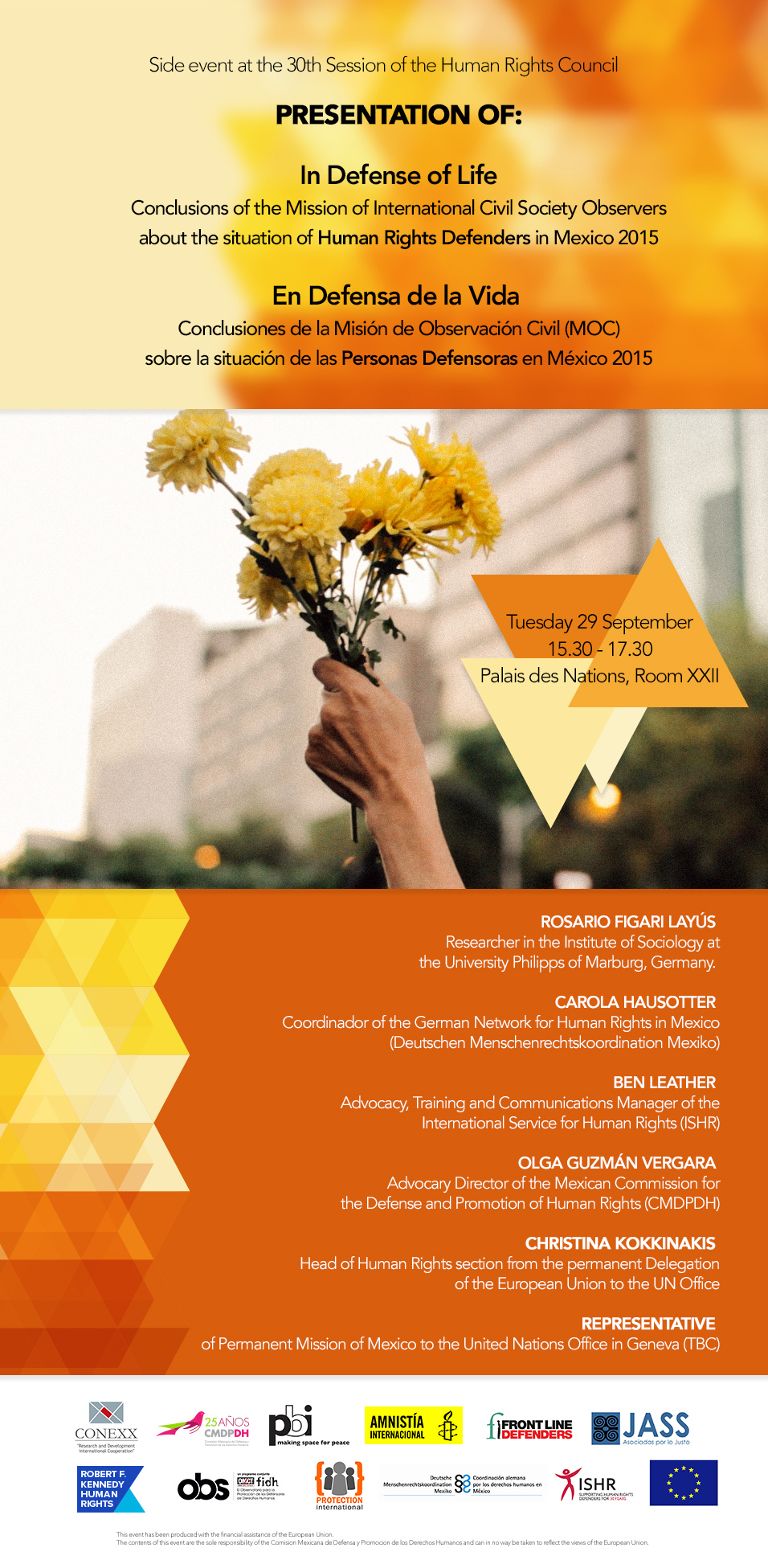
“In Defense of Life”: observer mission report to Mexico at side event Geneva

September 25, 2015

On Tuesday 29 September (15h30 – 17h30, Palais des Nations, Room XXII, Geneva), the CMDPDH,  Asociación Civil and ISHR organise a side event about the situation for human rights defenders in Mexico. [A Mission of International Observers visited Mexico in November 2015 and will present its conclusions – under the title “In Defense of Life” – to the Mexican Government within the framework of the 30th session of the Human Rights Council.]

Panelists in the event are::

  • Rosario Figari Layús – Researcher in the Institute for Interdisciplinary Research on Conflict and Violence (IKG) at the University of Bielefeld, Germany.
  • Carola Hausotter – Coordinador of the German Network for Human Rights in Mexico (Deutschen Menschenrechtskoordination Mexiko)
  • Ben Leather – Advocacy, Training and Communications Manager of the International Service for Human Rights (ISHR)
  • Olga Guzmán Vergara – Advocary Director of the Mexican Commission for the Defense and Promotion of Human Rights (CMDPDH)
  • Ambassador Jorge Lomónaco Tonda – Permanent Representative of Mexico to the UN in Geneva (TBC)
  • Christina Kokkinakis – Head of Human Rights section from the Permanent Delegation of the European Union to the UN in Geneva

Download the flyer: HUMAN RIGHTS IN MEXICO

see previous posts: https://thoolen.wordpress.com/tag/mexico/


Human Rights Defenders are too often forced to play ‘whack-a-mole’

September 22, 2015

On 18 June 2015, Rachel Ball, Director of Advocacy at the Human Rights Law Centre in Australia, reflects on a cross-regional consultation of human rights defenders facilitated by ISHR:

There’s a game that you sometimes find at amusement arcades called whack-a-mole. Toy moles rise out of their holes at random and the player uses a large mallet to whack the moles on the head and force them back into their holes. A successful player needs vigilance, composure and a quick eye. 

For human rights defenders, the protection of civil society space is a lot like a game of whack-a-mole. Threats arise without warning and valuable time, resources and energy are spent opposing them. 

Almost one year ago, the Human Rights Council passed a resolution urging States to ‘create and maintain, in law and in practice, a safe and enabling environment in which civil society can operate free from hindrance and insecurity’. In too many cases the Human Rights Council’s resolution has not translated into domestic action and last week in Geneva ISHR convened a group of expert whackers from around the world to share their experiences of threats to civil society space and strategies to counter those threats.

Participants discussed anti-protest laws, restrictions on the establishment and funding of civil society organisations, constraints on the work of journalists, and national security and counter-terrorism laws that unduly restrict freedom of association and assembly. Each of these restrictive practices constitutes a current threat to civil society space in my country, Australia, and it was both troubling to see the regularity with which these laws and policies arise around the world, and encouraging to be exposed to the skill and dedication of human rights defenders working to defeat them.

We discussed and debated strategies for protecting civil society space, including building and maintaining strong coalitions, engaging with UN human rights mechanisms and other international actors, working with Governments and legislatures, strategic litigation, monitoring and reporting and working with the media and social media. We shared stories of success as well as failure.  

What was abundantly clear during the ISHR convening was that human rights defenders should not be spending their time whacking moles. Beyond our work protecting civil society space, we are engaged in issues like persecution on the basis of sexual orientation and gender identity, militarisation, sustainable development, climate change and refugee rights, to name a few.

The contribution of civil society actors to human rights challenges like these is vital. As the UN High Commissioner for Human Rights, Zeid Ra’ad Al Hussein, told the Human Rights Council at the opening of its 30th session last week, ‘When ordinary people can share ideas to overcome common problems, the result is better, more healthy, more secure and more sustainable States. It is not treachery to identify gaps, and spotlight ugly truths that hold a country back from being more just and more inclusive. When States limit public freedoms and the independent voices of civic activity, they deny themselves the benefits of public engagement, and undermine national security, national prosperity and our collective progress. Civil society – enabled by the freedoms of expression, association and peaceful assembly – is a valuable partner, not a threat.’ 

In addition to enabling civil society through the proper protection of freedom of expression, assembly and association, States should make public commitments to support civil society and protect civil society space. Those commitments should be backed up by legal and institutional protection against intimidation and reprisals, support for the establishment and operation of non-government organisations and mechanisms to ensure transparency and accountability.

Human rights defenders will return home from ISHR’s consultation, training and advocacy program with their mallets at the ready, but really it would better if we didn’t have to use them at all.

You can follow Rachel on Twitter at @RachelHRLC.

Source: Civil society space and whacking moles | ISHR

see also: https://thoolen.wordpress.com/tag/civil-society-organisations/